Red Velvet with Icing

“So Jupiter’s white stripes are huge updrafts of ammonia snow and its dark stripes are weird chemicals we only see when downdrafted ammonia snow evaporates. Fine, but how does that account for my buddy the Great Red Spot? Have another lemon scone.”

“Thanks, Al, don’t mind if I do. Well, those ideas only sort-of account for Spot. The bad news is that they may not have to for much longer.”

“Huh? Why not?”

“Because it seems to be going away.”

“Hey, Sy, don’t mess with me. You know it’s been there for 400 years, why should it go away now?”

“I don’t know anything of the kind. Sure, the early telescope users saw a spot 350 years ago but there’s reason to think that it wasn’t in the same location as your buddy. Then there was a century-long gap when no-one recorded seeing anything special on Jupiter. Without good evidence either way, I think it’s entirely possible we’ve had two different spots. Anyway, the new one has been shrinking for the past 150 years.”

“The big hole must be filling in, then.”

“What hole?”
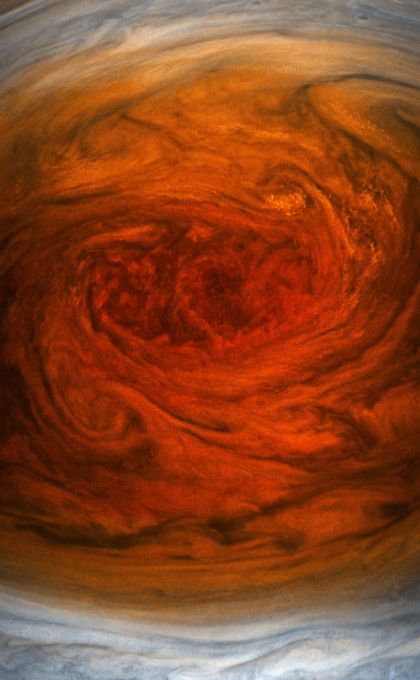
Juno GRS image, NASA/JPL-Caltech/SwRI/MSSS/Gerald Eichstädt

“The Spot. If the dark-colored stripes are what we see when the bright ammonia ice evaporates, then the Spot’s gotta be a hole.”

“A reasonable conclusion from what we’ve said so far, but the Juno orbiter has given us more information. The Spot actually reaches 500 miles further up than the surrounding cloud tops.”

“But higher-up means colder, right? How come we don’t see the white snow?”

“That higher-is-colder rule does apply within Jupiter’s weather layer, mostly, but the Spot’s different. There seems to be a LOT of heat pouring straight up out of it, enough to warm the overlying atmosphere by several hundred degrees compared to the planetary average. That suppresses the ammonia ice, lifts whatever makes the red color and may even promote chemical reactions to make more.”

“But Sy, even I know heat spreads out. You’ve just described something that acts like a searchlight. How could it work like that?”

“Here’s one hypothesis. You’ve got your sound system here rigged up so the back of the shop is quiet, right? How’d you do that?”

“Oh, I bought a couple of directional speakers. They’re deeper than the regular kind and they’ve got this parabolic shape. I aimed them up here to the front where the traffic is. Work pretty good, don’t they?”

“Yes, indeed, and I’m grateful for that. See, they focus sound energy just like you can focus light. Now, to us the Spot just looks like an oval. But it’s probably the big end of a deep cone, spinning like mad and turning turbulent wind energy into white noise that’s focused out like one of your speakers. Wouldn’t that do the trick?”
“Like a huge trombone. Yeah, I suppose, but what keeps the cone cone-shaped?”

“The same thing that keeps it spinning — it’s trapped between two currents that are zipping along in opposite directions. The Spot’s northern boundary is the fastest westbound windstream on the planet. Its southern boundary is an eastbound windstream. The Spot’s trapped between two bands screaming past each other at the speed of sound.”

“Wow. Sounds violent.”

“Incredibly violent, much more than Earth hurricanes. At a hurricane’s eye-wall the wind speeds generally peak below 200 miles per hour. The Great Red Spot’s outermost winds that we can see are 50 miles per hour faster but those triangular regions just east and west must be far worse. When I think about adding in the updrafts and downdrafts I just shudder.”

“Does that have anything to do with the shrinking you told me about?”

“Almost certainly — we simply don’t have enough data to tell. But the new news is that your buddy’s uncorked a fresh shrinkage mode. Since the mid-1800s it’s been contracting along the east-west line, getting more circular. Now it seems to be flaking, too. Big, continent-size regions break away and mix into the dark belt above it. Meanwhile, the white equatorial zone is getting darker, sort of a yellow-green-orange mix.”

GRS image courtesy of Sharin Ahmad

“Yucky-colored. Does that mean the Spot’s draining into it?”

“Who knows? We certainly don’t. Only time will tell.”

~~ Rich Olcott

Icing on The Brownie

“So what you’re saying, Sy, is that Jupiter’s white stripes are ammonia snow clouds that go way up above a lower layer of brown clouds like the white icing stripes I put on my brownies.”

“That’s what I’m saying, Al.”

“But why stripes? We got white clouds here on Earth and sometimes they’re in layers but they don’t make stripes.”

“Well, actually they do, but you need the long-term picture to see it. Ever notice that Earth’s forests and deserts make stripes?”

“How ’bout that? I guess they do, sorta. How’s that work?”

“It took us five hundred years to figure out the details. Quick summary. Sunlight does its best year-round heating job at the Equator, where the oceans humidify the air. Warm air rises. Rising warm air cools, releases its moisture as rain, and you get a rainforest belt. The cooled, dried air spreads out until it sinks at about the 30th parallels north and south. Dry air sucks moisture out of the land as it returns to the Equator and you get desert belts. Repeat the cycle. More loops like that center around both 60th parallels. The pattern’s not completely uniform because of things like mountain ranges that block some of the flows. Basically, though, as the years accumulate you get stripes.”

“Jupiter does that, too, huh?”

“On steroids. In one way it’s simpler — no underlying continents mess things up. On the other hand, Jupiter’s got more than a hundred times Earth’s surface area so there’s room for more loops. Also, Jupiter’s interior is still shedding a lot of heat, almost as much as the planet gets from the Sun. Here’s a diagram on Old Reliable.”

“So you’re saying that the upward loops push Jupiter’s atmosphere to where it’s colder and those white ammonia snow clouds form. Then the downward loops move the clouds to where it’s warmer and the ammonia evaporates to show us the brown stuff. Makes sense. But what’re those side-to-side arrows about? We got anything like those on Earth?”

“Sort of, a little bit. Remember the Coriolis force?”

“Uhh, that’s what makes hurricanes go round and round, right? Something to do with the Equator running faster than places further north or south?”

“That’s the start of it. The Earth as a whole rotates 360° eastward in 24 hours, but how many miles per hour that is depends on where you are. The Equator’s about 25000 miles long so Quito, Ecuador on the Equator does a bit more than 1000 miles per hour. Forty-five degrees away, the 45th parallels are only 70% as long as that, so Salem, Oregon and Queenstown, New Zealand circle 70% slower in miles per hour. Suppose a balloon from Salem travels south as seen from space. As seen from the Equator, the balloon appears in the northeast rather than straight north. Winds work the way that balloon would. All around the world, winds between 10° and 30° north and south come from an east-ish direction most of the time.”

“What about the winds right at the Equator? You’d think the northerly part and the southerly part would cancel each other out.”

“That’s exactly what happens, Al. We’ve got a more-or-less equatorial belt of thunderstorms from humid air cooling off as it goes straight up, but not much of a prevailing wind in any direction — that’s why the old sea captains called the region ‘the doldrums’.”

“An equator belt like Jupiter’s, eh?”

“Not quite. Jupiter has a lovely white equatorial zone all right, but that one doesn’t stand still. It roars eastward, 300 miles per hour faster than the equator’s own 28000 miles per hour. All Jupiter’s white zones move east at a pretty good clip. Its dark belts sprint westward at their own hundred-mile pace. Then there’s the jet streams that run between neighboring bands, and lots of big and little vortices carried along for the ride. The planet’s way too segmented and violent for Coriolis forces to build up enough to play a part. The scientists have a couple of heavily-simplified models, but nowhere near enough data or computer time to fill them in.”

“Earth’s atmosphere is messy enough, thanks. My brain’s hurting.”

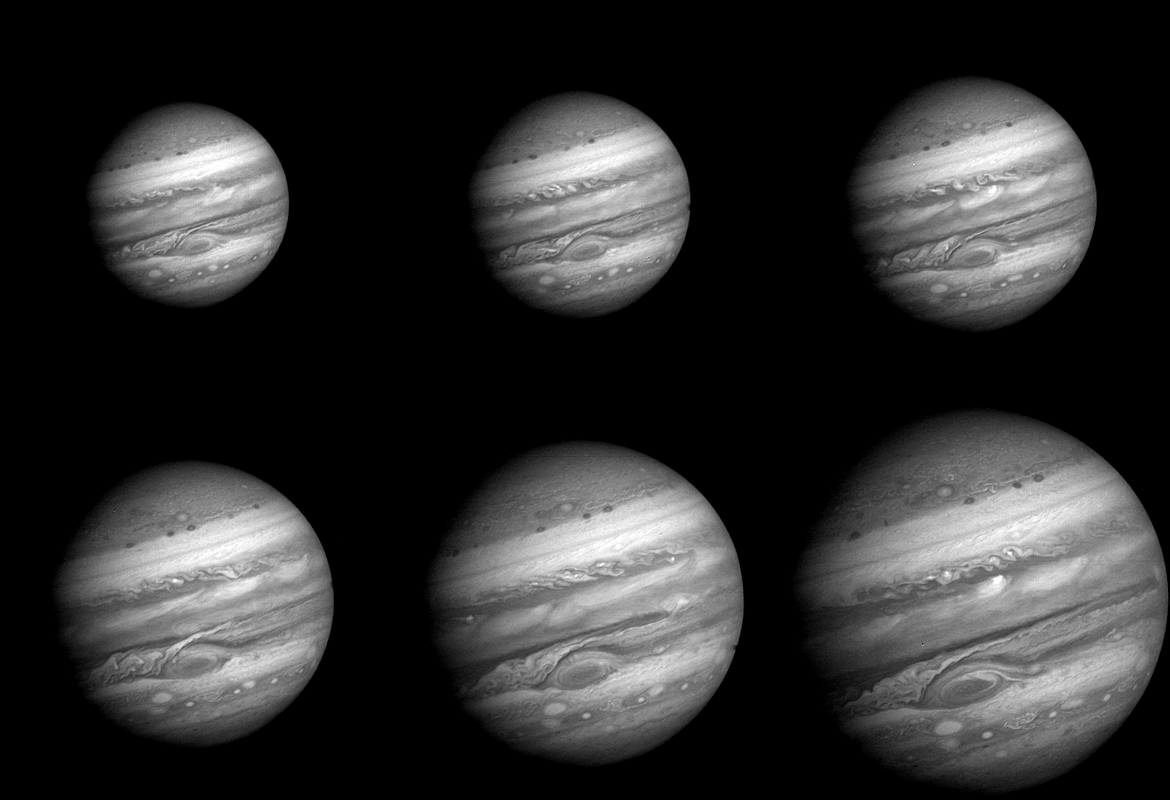
Voyager I video of Jupiter, processed by JPL,
from Wikimedia Commons

~~ Rich Olcott

Lemon, Vanilla, Cinnamon

Al claims that lemon’s a Summertime flavor, which is why his coffee shop’s Scone Flavor of the Month in July is lemon even though it doesn’t go well with his coffee. “Give me one of those lemon scones, Al, and an iced tea. It’s a little warm out there this morning.”

“Sure thing, Sy. Say, what’s the latest science-y thing up in the sky?”

“Oh, there’s a bunch, Al. The Japanese Hayabusa-2 spacecraft collected another sample from asteroid Ryugu. NASA’s gravity-sniffer GRAIL lunar orbiter found evidence for a huge hunk of metallic material five times larger than the Big Island of Hawai’i buried deep under the Moon’s South Pole-Aitken Basin. The Insight Mars lander’s seismometer heard its first Marsquake —“

“Quit yanking my chain, Sy. Anything about Jupiter?”

“Gotcha, Al. I know Jupiter’s your favorite planet. As it happens I do have some Jupiter news for you.”

“The Juno orbiter’s still working, I hope.”

“Sure, sure, far as I know. It’s about to make its 13th close flyby of Jupiter, and NASA administrators have green-lighted the mission to continue until July 2021. Lots of data for the researchers to work on for years. Here’s a clue — what’re the top three things that everyone knows about Jupiter?”

“It’s the biggest planet, of course, and it’s got those stripes and the Great Red Spot. Has the planet gotten smaller somehow?”

“No, but the stripes and the Red Spot are acting weird. Had you heard about that?”

“No, just that the Spot’s huge and red and been there for 400 years.”

“Mmm, we’re not sure about the 400 years. But yes, it’s huge.”

“Four times wider than Earth, right?”

“Hasn’t been that big for a long time. Back in the 1870s telescope technology gave the astronomers that ‘four Earths wide‘ estimate. But the Spot’s shrunk in the last 150 years.”

“A whole lot?”

“Last measurement I saw, it’s just barely over one Earth wide. Seems to have gotten a bit taller, though, and maybe deeper.”

“Taller and deeper? Huh, that’s a new one. I always thought of the Spot as just this big oval ring on Jupiter’s surface.”

“Everyone has that bogus idea of Jupiter as a big smooth sphere with stripes and ovals and swirls painted on it. Don’t forget, we’re looking down at cloud tops, like those satellite pictures we get looking down at a storm system on Earth. From space, one of our hurricanes looks like a spirally disk centered on a dark spot. That dark spot isn’t in the clouds, it’s actually the top of the ocean, miles below the clouds. If you were a Martian working with photos from a telescope on Phobos, you’d be hard-put to figure that out. You need 3-D perspective to get planets right.”

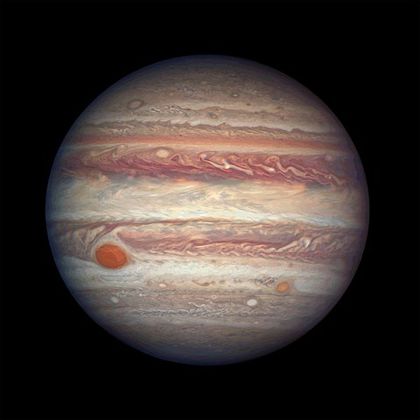
Jupiter image courtesy ESA/Hubble

“Those stripes and stuff aren’t Jupiter’s surface?”

“As far as we can tell, Jupiter doesn’t have a surface. The hydrogen-helium atmosphere just gets denser and denser until it acts like a liquid. There’s a lot of pressure down there. Juno recently gave us evidence for a core that’s a fuzzy mix of stony material and maybe-metallic maybe-solid hydrogen but if that mush is real it’s only 3% of the planet’s mass. Whatever, it’s thousands of miles below what we see. Jupiter’s anything but smooth.”

“Lumps and bumps like this bubbly scone, huh?”

“More organized than that, more like corduroy or a coiled garden hose. The white stripes are hundreds of miles higher-up than the brown stripes so north-to-south it’s like a series of extreme mountain ranges and valleys. The Great Red Spot reaches up maybe 500 miles further.”

“Does that have to do with what they’re made of?”

“It has everything to do with that, we think. You know Earth’s atmosphere has layers, right?”

“Yeah, the stratosphere’s on top, then you got the weather layer where the clouds are.”

“Close enough. Jupiter has all that and more. Thanks to the Galileo probe we know that Jupiter’s ‘weather layer’ has a topmost blue-white cloud layer of ammonia ice particles, a middle red-to-brown layer containing compounds of ammonia and sulfur, and a bottommost white-ish layer of water clouds. The colors we see depend on which layer is exposed where.”

“But why’re they stripey?”

~~ Rich Olcott

The Big Chill

Jeremy gets as far as my office door, then turns back. “Wait, Mr Moire, that was only half my question. OK, I get that when you squeeze on a gas, the outermost molecules pick up kinetic energy from the wall moving in and that heats up the gas because temperature measures average kinetic energy. But what about expansion cooling? Those mist sprayers they set up at the park, they don’t have a moving outer wall but the air around them sure is nice and cool on a hot day.”

“Another classic Jeremy question, so many things packed together — Gas Law, molecular energetics, phase change. One at a time. Gas Law’s not much help, is it?”

“Mmm, guess not. Temperature measures average kinetic energy and the Gas Law equation P·V = n·R·T gives the total kinetic energy for the n amount of gas. Cooling the gas decreases T which should reduce P·V. You can lower the pressure but if the volume expands to compensate you don’t get anywhere. You’ve got to suck energy out of there somehow.”

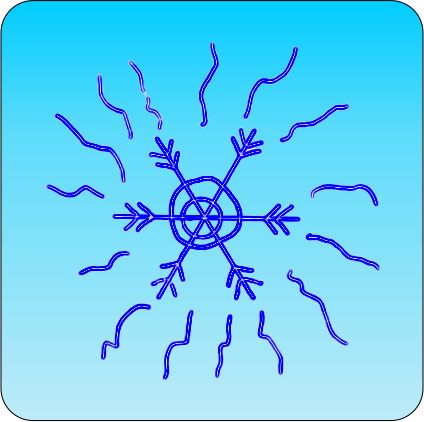
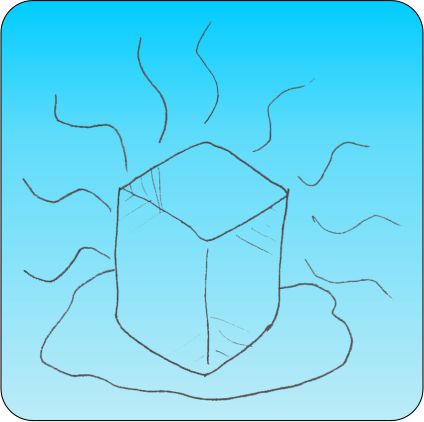
Illustrations adapted from drawings by Trianna

“The Laws of Thermodynamics say you can’t ‘suck’ heat energy out of anything unless you’ve got a good place to put the heat. The rule is, heat energy travels voluntarily only from warm to cold.”

“But, but, refrigerators and air conditioners do their job! Are they cheating?”

“No, they’re the products of phase change and ingenuity. We need to get down to the molecular level for that. Think back to our helium-filled Mylar balloon, but this time we lower the outside pressure and the plastic moves outward at speed w. Helium atoms hit the membrane at speed v but they’re traveling at only (v-w) when they bounce back into the bulk gas. Each collision reduces the atom’s kinetic energy from ½m·v² down to ½m·(v-w)². Temperature goes down, right?”

“That’s just the backwards of compression heating. The compression energy came from outside, so I suppose the expansion energy goes to the outside?”

“Well done. So there has to be something outside that can accept that heat energy. By the rules of Thermodynamics, that something has to be colder than the balloon.”

“Seriously? Then how do they get those microdegree above absolute zero temperatures in the labs? Do they already have an absolute-zero thingy they can dump the heat to?”

“Nope, they get tricky. Suppose a gas in a researcher’s container has a certain temperature. You can work that back to average molecular speed. Would you expect all the molecules to travel at exactly that speed?”

“No, some of them will go faster and some will go slower.”

“Sure. Now suppose the researcher uses laser technology to remove all the fast-moving molecules but leave the slower ones behind. What happens to the average?”

“Goes down, of course. Oh, I see what they did there. Instead of the membrane transmitting the heat away, ejected molecules carry it away.”

“Yup, and that’s the key to many cooling techniques. Those cooling sprays, for instance, but a question first — which has more kinetic energy, a water droplet or the droplet’s molecules when they’re floating around separately as water vapor?”

“Lessee… the droplet has more mass, wait, the molecules total up to the same mass so that’s not the difference, so it’s droplet velocity squared versus lots of little velocity-squareds … I’ll bet on the droplet.”

“Sorry, trick question. I left out something important — the heat of vaporization. Water molecules hold pretty tight to each other, more tightly in fact than most other molecular substances. You have to give each molecule a kick to get it away from its buddies. That kick comes from other molecules’ kinetic energy, right? Oh, and one more thing — the smaller the droplet, the easier for a molecule to escape.”

“Ah, I see where this is going. The mist sprayer’s teeny droplets evaporate easy. The droplets are at air temperature, so when a molecule breaks free some neighbor’s kinetic energy becomes what you’d expect from air temperature, minus break-free energy. That lowers the average for the nearby air molecules. They slow their neighbors. Everything cools down. So that’s how sprays and refrigerators and such work?”

“That’s the basic principle.”

“Cool.”

~ Rich Olcott

Thanks to Mitch Slevc for the question that led to this post.

The Hot Squeeze

A young man’s knock, eager yet a bit hesitant.

“C’mon in, Jeremy, the door’s open.”

“Hi, Mr Moire. How’s your Summer so far? I got an ‘A’ on that black hole paper, thanks to your help. Do you have time to answer a question now that Spring term’s over?”

“Hi, Jeremy. Pretty good, congratulations, and a little. What’s your question?”

“I don’t understand about the gas laws. You squeeze a gas, you raise its temperature, but temperature’s the average kinetic energy of the molecules which is mass times velocity squared but mass doesn’t change so how does the velocity know how big the volume is? And if you let a gas expand it cools and how does that happen?”

“A classic Jeremy question. Let’s take it a step at a time, big-picture view first. The Gas Law says pressure times volume is proportional to the amount of gas times the temperature, or P·V = n·R·T where n measures the amount of gas and R takes care of proportionality and unit conversions. Suppose a kid gets on an airplane with a balloon. The plane starts at sea level pressure but at cruising altitude they maintain cabins at 3/4 of that. Everything stays at room temperature, so the balloon expands by a third –“

Kid drawing of an airplane with a red balloon
Adapted from a drawing by Xander

“Wait … oh, pressure down by 3/4, volume up by 4/3 because temperature and n and R don’t change. OK, I’m with you. Now what?”

“Now the plane lands at some warm beach resort. We’re back at sea level but the temp has gone from 68°F back home to a basky 95°F. How big is the balloon? I’ll make it easy for you — 68°F is 20°C is 293K and 95°F is 35°C is 308K.”

“Volume goes up by 308/293. That’s a change of 15 in about 300, 5% bigger than back home.”

“Nice estimating. One more stop on the way to the molecular level. Were you in the crowd at Change-me Charlie’s dark matter debate?”

“Yeah, but I didn’t get close to the table.”

“Always a good tactic. So you heard the part about pressure being a measure of energy per unit of enclosed volume. What does that make each side of the Gas Law equation?”

“Umm, P·V is energy per volume, times volume, so it’s the energy inside the balloon. Oh! That’s equal to n·R·T but R‘s a constant and n measures the number of molecules so T = P·V/n·R makes T proportional to average kinetic energy. But I still don’t see why the molecules speed up when you squeeze on them. That just packs the same molecules into a smaller volume.”

“You’re muddling cause and effect. Let’s try to tease them apart. What forces determine the size of the balloon?”

“I guess the balance between the outside pressure pushing in, versus the inside molecules pushing out by banging against the skin. Increasing their temperature means they have more energy so they must bang harder.”

“And that increases the outward pressure and the balloon expands until things get back into balance. Fine, but think about individual molecules, and let’s pretend that we’ve got a perfect gas and a perfect balloon membrane — no leaks and no sticky collisions. A helium-filled Mylar balloon is pretty close to that. When things are in balance, molecules headed outward approach the membrane with some velocity v and bounce back inward with the same velocity v though in a different direction. Their kinetic energy before hitting the membrane is ½m·v²; after the collision the energy’s also ½m·v² so the temperature is stable.”

“But that’s at equilibrium.”

“Right, so let’s increase the outside pressure to squeeze the balloon. The membrane closes in at some speed w. Out-bound molecules approach the membrane with velocity v just as before but the membrane’s speed boosts the bounce. The ‘before’ kinetic energy is still ½m·v² but the ‘after’ value is bigger: ½m·(v+w)². The total and average kinetic energy go up with each collision. The temperature boost comes from the energy we put into the squeezing.”

“So the heating actually happens out at the edges.”

“Yup, the molecules in the middle don’t know about it until hotter molecules collide with them.”

“The last to learn, eh?.”

“Always the case.”

~~ Rich Olcott

Thanks to Mitch Slevc for the question that led to this post.