A Far And Dusty Traveler

Cathleen takes the mic. “Quick coffee and scone break, folks, then Jim will continue our ‘IR, Spitzer And The Universe‘ symposium.” <pause> “OK, we’re back in business. Jim?”

“Thanks, Cathleen. Well, we’ve discussed finding astronomical molecules with infra-red. Now for a couple of other IR applications. First up — looking at things that are really far away. Everyone here knows that the Universe is expanding, right?”

<general murmur of assent, although the probably-an-Art-major looks startled>

“Great. Because of the expansion, light from a far-away object gets stretched out to longer wavelengths on its way to us. Say a sodium atom shot a brilliant yellow-gold 590-nanometer photon at us, but at the time the atom was 12.5 million lightyears away. By the time that wave reaches us it’s been broadened to 3540 nanometers, comfortably into the infra-red. Distant things are redder, sometimes too red to see with an optical telescope. The Spitzer Space Telescope‘s infra-red optics let us see those reddened photons. And then there’s dust.”

<voice from the crowd> “Dust?”

Cosmic dust, pretty much all the normal matter that’s not clumped into stars and planets. Some of it is leftovers from early times in the Universe, but much of it is stellar wind. Stars continuously spew particles in their normal day-to-day operation. There’s a lot more of that when one explodes as a nova or supernova. Dust particles come in all sizes but most are smaller than the ones in tobacco smoke.”

<same voice> “If they’re so small, why do we care about them?”

“Two reasons. First, there’s a lot of them. Maybe only a thousand particles per cubic kilometer of space, but there’s a huge number of cubic kilometers in space and they add up. More important is what the dust particles are made of and where we found them. Close inspection of the dust is like doing astronomical archaeology, giving us clues about how stars and galaxies evolved.”

<Vinnie, skeptical as always> “So what’s infra-red got to do with dust?”

“Depends on what kind of astronomy you’re interested in. Dust reflects and emits IR light. Frequency patterns in the light can tell us what that dust made of. On the other hand there’s the way that dust doesn’t interact with infra-red.”

<several voices> “Wait, what?”

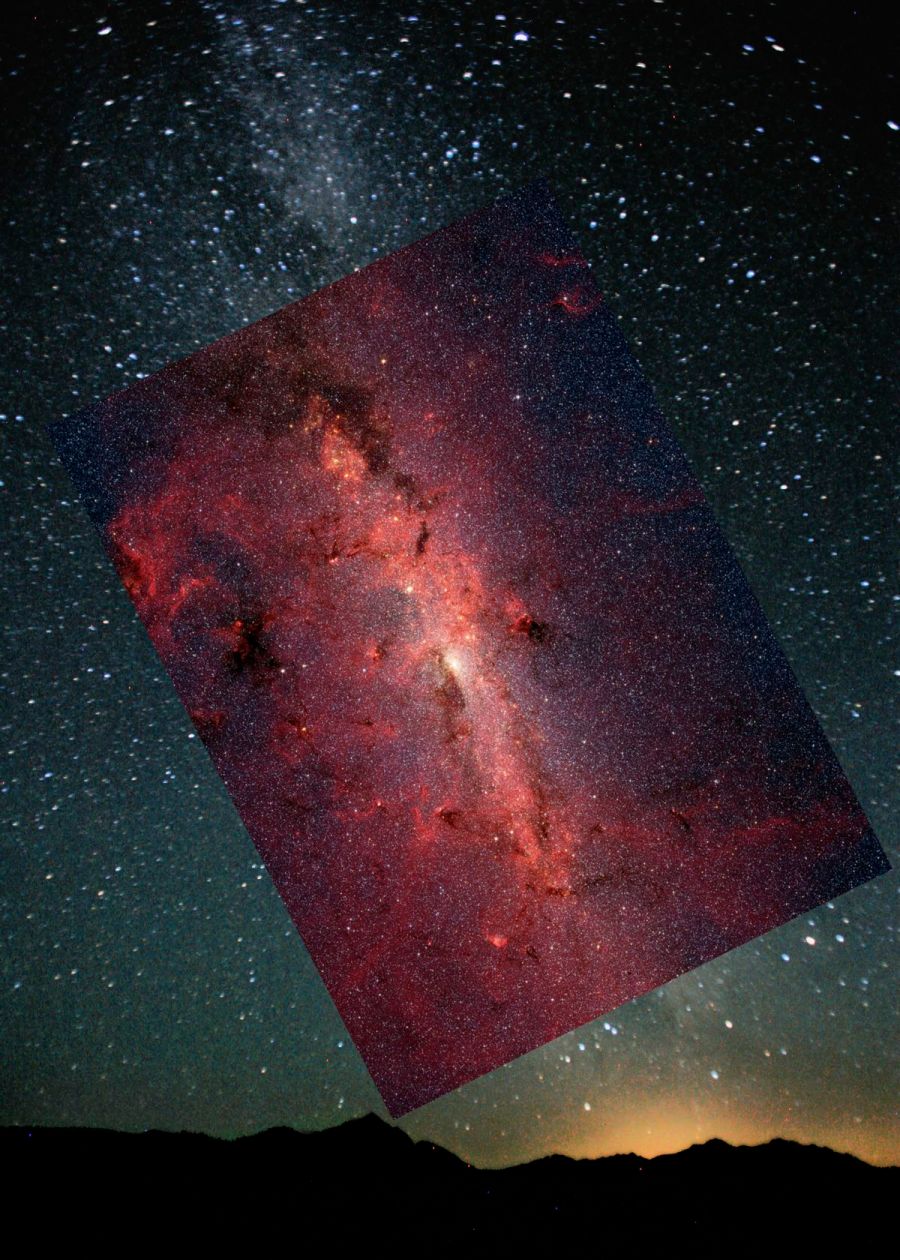
The Milky Way from Black Rock Desert NV
By Steve Jurvetson via Flickr, Wikimedia Commons, CC BY 2.0

“If Al’s gotten his video system working … ah, he has and it does. Look at this gorgeous shot of the Milky Way Galaxy. See all the dark areas? That’s dust blocking the visible light. The scattered stars in those areas are simply nearer to us than the clouds. We’d like to study what’s back beyond the clouds, especially near the galaxy’s core. That’s a really interesting region but the clouds block its visible light. Here’s the neat part — the clouds don’t block its infra-red light.”

<other voices> “Huh?” “Why wouldn’t they?”

“It’s the size of the waves versus the size of the particles. Take an extreme case — what’s the wavelength of Earth’s ocean tides?”

<Silence, so I speak up.> “Two high tides a day, so the wavelength is half the Earth’s circumference or about 12’500 miles.”

“Right. Now say you’re at the beach and you’re out there wading and the water’s calm. Would you notice the tide?”

“No, rise or fall would be too gentle to affect me.”

“Now let’s add a swell whose peak-to-peak wavelength is about human-height scale.”

“Whoa, I’d be dragged back and forth as each wave passes.”

“Just for grins, let’s replace that swell with waves the same height but only a millimeter apart. Oh, and you’re wearing SCUBA equipment.”

“Have mercy! Well, I should be able to stand in place because I wouldn’t even feel the peaks and troughs as separate waves, just a foamy massage. Thanks for the breathing assistance, though.”

“You’re welcome, and thanks for helping with the thought experiment. Most cosmic dust particles are less than 100 nanometers across. Infra-red wavelengths run 100 to 1000 times longer than that. Infra-red light from those cloud-hidden stars just curves around particles that can stop visible lightwaves cold. Spitzer Space Telescope and its IR-sensitive kin provide deeper and further views than visible light allows.”

~~ Rich Olcott

Above The Air, Below The Red

Vinnie and I walk into Al’s coffee shop just as he sets out a tray of scones. “Odd-looking topping on those, Al. What is it?”

“Dark cherry and dark chocolate, Sy. Something about looking infra-red. Cathleen special-ordered them for some Astronomy event she’s hosting in the back room. Carry this tray in there for me?”

Vinne grabs the tray and a scone. “Sure, Al. … Mmm, tasty. … Hi, Cathleen. Here’s your scones. What’s the event?”

“It’s a memorial symposium for the Spitzer Space Telescope, Vinnie. Spitzer‘s been an infra-red workhorse for almost 17 years and NASA formally retired it at the end of January.”

“What’s so special about infra-red? It’s just light, right? We got the Hubble for that.”

“A perfect cue for Jim’s talk. <to crowd> Grab a scone and settle down, everyone. Welcome to our symposium, ‘IR , Spitzer And The Universe.’ Our first presentation today is entitled ‘What’s So Special About Infra-red?‘ Jim, you’re on.”

“Thanks, Cathleen. This is an introductory talk, so I’ll keep it mostly non-technical. So, question for everybody — when you see ‘IR‘, what do you think of first?”

<shouts from the crowd> “Pizza warmer!” “Invisible light!” “Night-vision goggles!”

“Pretty much what I expected. All relevant, but IR’s much more than that. To begin with, many more colors than visible light. We can distinguish colors in the rainbow because each color’s lightwave has a different frequency. Everybody OK with that?”

<general mutter of assent>

“OK. Well, the frequency at the violet end of the visible spectrum is a bit less than double the frequency at the red end. In music when you double the frequency you go up an octave. The range of colors we see from red to violet is less than an octave, about like going from A-natural to F-sharp on the piano. The infra-red spectrum covers almost nine octaves. An 88-key piano doesn’t even do eight.”

<voice from the crowd, maybe an Art major> “Wow, if we could see infra-red think of all the colors there’d be!”

“But you’d need a whole collection of specialized eyes to see them. With light, every time you go down an octave you reduce the photon’s energy capacity by half. Visible light is visible because its photons have just enough energy to cause an electronic change in our retinas’ photoreceptor molecules. Five octaves higher than that, the photons have enough energy to knock electrons right out of a molecule like DNA. An octave lower than visible, almost nothing electronic.”

<Vinnie’s always-skeptical voice> “If there’s no connecting with electrons, how does electronic infra-red detection work?”

“Two ways. A few semiconductor configurations are sensitive to near- and mid-infra-red photons. The Spitzer‘s sensors are grids of those configurations. To handle really low-frequency IR you have to sense heat directly with bolometer techniques that track expansion and contraction.”

<another skeptical voice> “OK then, how does infra-red heating work?”

“Looks like a paradox, doesn’t it? Infra-red photons are too low-energy to make a quantum change in a molecule’s electronic arrangement, but we know that the only way photons can have an effect is by making quantum changes. So how come we feel infra-red’s heat? The key is, photons can interact with any kind of charged structure, not just electrons. If a molecule’s charges aren’t perfectly balanced a photon can vibrate or rotate part of a molecule or even the whole thing. That changes its kinetic energy because molecular motion is heat, right? Fortunately for the astronomers, gas vibrations and rotations are quantized, too. An isolated water molecule can only do stepwise changes in vibration and rotation.”

“Why’s that fortunate?”

“Because that’s how I do my research. Every kind of molecule has its own set of steps, its own set of frequencies where it can absorb light. The infra-red range lets us do for molecules what the visual range lets us do for atoms. By charting specific absorption bands we’ve located and identified interstellar clouds of water, formaldehyde and a host of other chemicals. I just recently saw a report of ‘helonium‘, a molecular ion containing helium and hydrogen, left over from when the Universe began. Infra-red is so cool.”

“No, it’s warm.”

Image suggested by Alex

~~ Rich Olcott

The Sight And Sound of Snow

<ring> “Moire here.”

“Uncle Sy! Uncle Sy! It’s snowing! It’s snowing!”

“Yes, Teena, it started last night after you went to bed. But it’s real early now and I haven’t had breakfast yet. I’ll be over there in a little while and we can do snow stuff.”

“Yaaay! I’ll have breakfast, too. Mommie, can we have oatmeal with raisins?” <click>


<knock, knock> “Uncle Sy! You’re here! I wanna go sledding! Get my sled out, please?”

“G’morning, Sis. G’morning, Teena. Get your snowsuit and boots on, Sweetie. Want to come along, Sis? It’s a cold, dry snow, not much wind.”

“No, I’ll just stay warm and get the hot chocolate ready.”

“Bless you for that, Sis. OK, young’un, ready to go?”

“Ready! Pull me on the sled to the sledding hill, Uncle Sy!”


“Ooo, it’s so quiet. Why’s it always quiet when snow’s falling, Uncle Sy? Is the world holding its breath? And why is snow white? When I hold snow in my hand it melts and then it’s no-color.”

“Always the good questions. Actually, these two are related and they both have to do with the shape of snowflakes. Here, hold out your arm and let’s see if you can catch a few. No, don’t try to chase them, the breeze from your arm will blow them away. Just let them fall onto your arm. That’s right. Now look at them real close.”

“They’re all spiky, not flat and pretty like the ones in my picture book!”

“That’s because they grew fast in a really cold cloud and didn’t have time to develop evenly. You have to work slow to make something that’s really pretty.”

“But if they’re spiky like this they can’t lay down flat together and be cozy!”

“Ah, that’s the key. Fresh spiky snowflakes make fluffy snow, which is why skiers love it. See how the flakes puff into the air when I scuff my boot? Those tiny spikes break off easily and make it easy for a ski to glide over the surface. Your sled, too — you’ve grown so big I’d be hard-put to pull you over wet snow. That fluffiness is why <hushed voice> it’s so quiet now.”

“Shhh … <whispered> yeah … <back to full voice> Wait, how does fluffy make quiet?”

“Because sound waves … Have we talked about sound waves? I guess we haven’t. OK, clap your hands once.”

<CLAP!>

“Good. When your hands came together they pushed away the air molecules that were between them. Those molecules pushed on the next molecules and those pushed on the next ones on and on until they got to your ear and you heard the sound. Make sense?”

“Ye-aa-uh. Is the push-push-push the wave?”

“Exactly. OK, now imagine that a wave hits a wall or some packed-down icy snow. What will happen?”

“It’ll bounce off like my paddle-ball toy!”

“Smart girl. Now imagine that a wave hits fluffy snow.”

“Um … it’ll get all lost bouncing between all the spikes, right?”

“Perfect. That’s exactly what happens. Some of the wave is scattered by falling snowflakes and much of what’s left spreads into the snow on the ground. That doesn’t leave much sound energy for us to hear.”

“You said that snow’s white because of what snow does to sound, but look, it’s so bright I have to squint my eyes!”

“That’s not exactly what I said, I said they’re related. Hmm… ah! You know that ornament your Mommie has hanging in the kitchen window?”

“The fairy holding the glass jewel? Yeah, when the sunlight hits it there’s rainbows all over the room! I love that!”

A beam or white light passing through two prisms.  The first produces a spectrum and the second remixes the colors to white.

“I do, too. White light like sunlight has all colors in it and that jewel splits the colors apart so you can see them. Well, suppose that jewel is surrounded by other jewels that can put the colors together again. Here’s a picture on my cellphone for a clue.”

“White goes to rainbow and back to white again … I’ll bet the snowflakes act like little jewels and bounce all the colors around but the light doesn’t get trapped and it comes out and we see the WHITE again! Right?”

“So right that we’re going home for hot chocolate.”

“Yaaay!”

~~ Rich Olcott

PS – A Deeper Look.

Solving Sleipnir’s Problem

Vinnie leans back in his chair, hands behind his head. “Lessee if I got this straight. The computer’s muscles are its processors. It can have a bunch of them, different kinds for different jobs like a horse has different muscles for different moves. Computers got internal networks to connect the processors like a horse has tendons and ligaments. Me and Sy got a beef going about the bones, whether it’s data or memory ’cause nothing happens without both of ’em. That a good summary?”

“That’s about the size of it.”

“So what was that crack about some eight-legged horse being the most interesting case?”

Sleipnir image adapted from the Tjängvide runestone
from Wikimedia Commons under CC 4.0 license

Robert grabs a paper napkin. Coffee shop proprietor Al winces. “Consider the kangaroo. It has two legs and it uses both at the same time when it hops around. I’ll diagram its feet with 1 and 2 and color them both red, OK?”

“Kangaroo hopped through some red paint, gotcha.”

“A human has two feet and we alternate between them when we walk. Like this second pattern — red foot, blue foot, over and over. Then there’s your standard horse with four legs — many more possibilities, right? For one, the front pair and the back pair each can act like a simple walk but independently, like the third row here.”

Meanwhile, I’m fiddling with Old Reliable and find this video. “That’s a good description of the basic gait that the horsemen call the walk, no surprise.”

Vinnie’s looking at the video over my shoulder. “Huh! Look here at the trot. The front and rear legs on opposite sides work together but in-between the beat of the other pair. I suppose you’d draw it like this fourth sketch, right?”

“That’s the idea. I’m only keeping track of which feet get used at the same time or opposite times. I’m sure there are other combinations that don’t fit the two-color model.”

Vinnie’s still watching the video. “Say this one. The gallop is like it’s walking with its front feet and kangarooing off that beat with its back ones.”

“Well, there you go. On to my point. Sy, what’s a horse’s most important decision if it’s not going to trip up?”

“Which foot it’s going to move next, I suppose. Oh, I see where you’re going. Odin’s eight-legged horse would have a serious coordination problem — which legs to pair together and what order they’d work in.”

“Exactly. No surprise, a computer has the same coordination problem unless it’s extremely specialized. As soon as you have multiple tasks demanding service, yet another task has to direct traffic. That’s basically where operating systems come into play. An OS has low-level code that stands between the application programs and the hardware resources.”

“What’s it doing there besides getting in the way?”

“Simplifying things, Vinnie. You don’t want to recode your program or buy a new version of your spreadsheet software when you plug in a new hard drive. When your application issues a call to transfer some data to or from your hard drive, the OS translates that into bit-level instructions the hard drive understands. A different device from a different manufacturer probably uses different command bits. No problem, your OS satisfies your next I/O call with whatever instructions that device understands. But an OS does more than that.”

“Like what else?”

“Lots of things. Security, for one — it makes sure you’re authorized to logon and touch certain data. Network interfacing for another. But for system performance the critical OS functions involve choosing who gets how much resource to work with.”

“Like disk space? I keep hitting my limit in the Cloud.”

“The Cloud’s a whole ‘nother level of complicated, but yeah, like that. The OS addresses performance by managing CPU time, throttling back low-priority tasks to give more time to high-priority work.”

“How’s it know the difference?”

“Depends on the OS. Generally it boils down to a list of privileged program names and user-ids versus everyone else.”

“How’s it do the throttling?”

“That also depends on the OS. Some of them meter out time slices, others fiddle with dispatch priority. Tricky business.”

“Tricky as running an eight-legged horse.”

~~ Rich Olcott