Worlds Enough And Time Reversed

Cathleen unmutes her mic. “Thanks, Kareem. Our next Crazy Theory presentation is from one of my Cosmology students, Jim.”

“Thanks, Cathleen. Y’all have probably heard about how Relativity Theory and Quantum Mechanics don’t play well together. Unfortunately, people have mixed the two of them together with Cosmology to spawn lots of Crazy Theories about parallel universes. I’m going to give you a quick look at a couple of them. Fasten your seat belt, you’ll need it.

“The first theory depends on the idea that the Universe is infinitely large and we can only see part of it. Everything we can see — stars, galaxies, the Cosmic Microwave Background — they all live in this sphere that’s 93 billion lightyears across. We call it our Observable Universe. Are there stars and galaxies beyond the sphere? Almost certainly, but their light hasn’t been in flight long enough to reach us. By the same token, light from the Milky Way hasn’t traveled far enough to reach anyone outside our sphere.

“Now suppose there’s an alien astronomer circling a star that’s 93 billion lightyears away from us. It’s in the middle of its observable universe just like we’re in the middle of ours. And maybe there’s another observable universe 93 billion lightyears beyond that, and so on to infinity. Oh, by the way, it’s the same in every direction so there could be an infinite number of locally-observable universes. They’re all in the same space, the same laws of physics rule everywhere, it’s just that they’re too far apart to see each other.

“The next step is a leap. With an infinite number of observable universes all following the same physical laws, probability says that each observable universe has to have twins virtually identical to it except for location. There could be many other people exactly like you, out there billions of lightyears away in various directions, sitting in front of their screens or jogging or whatever. Anything you might do, somewhere out there there’s at least one of you doing that. Or maybe a mirror image of you. Lots of yous in lots of parallel observable universes.”

“I don’t like that theory, on two grounds. First, there’s no way to test it so it’s not science. Second, I think it plays fast and loose with the notion of infinity. There’s a big difference between ‘the Universe is large beyond anything we can measure‘ and ‘the Universe is infinite‘. If you’ve been reading Sy Moire’s stuff you’ve probably seen his axiom that if your theory contains an infinity, you’ve left out physics that would stop that. Right, Cathleen?”

Cathleen unmutes her mic. “That quote’s good, Jim.”

“Thanks, so’s the axiom. So that’s one parallel universe theory. OK, here’s another one and it doesn’t depend on infinities. The pop‑science press blared excitement about time‑reversal evidence from the ANITA experiment in Antarctica. Unfortunately, the evidence isn’t anywhere as exciting as the reporting has been.

“The story starts with neutrinos, those nearly massless particles that are emitted during many sub‑atomic reactions. ANITA is one kind of neutrino detector. It’s an array of radio receivers dangling from a helium‑filled balloon 23 miles up. The receivers are designed to pick up the radio waves created when a high‑energy neutrino interacts with glacier ice, which doesn’t happen often. Most of the neutrinos come in from outer space and tell us about solar and stellar activity. However, ANITA detected two events, so‑called ‘anomalies,’ that the scientists can’t yet explain and that’s where things went nuts.

“Almost as soon as the ANITA team sent out word of the anomalies, over three dozen papers were published with hypotheses to account for them. One paper said maybe the anomalies could be interpreted as a clue to one of Cosmology’s long‑standing questions — why aren’t there as many antiprotons as protons? A whole gang of hypotheses suggest ways that maybe something in the Big Bang directed protons into our Universe and antiprotons into a mirror universe just like ours except charges and spacetime are inverted with time running backwards. There’s a tall stack of maybes in there but the New York Post and its pop‑sci allies went straight for the Bizarro parallel universe conclusion. Me, I’m waiting for more data.”

~~ Rich Olcott

Smart Dinosaurs?

<chirp, chirp> “Moire here, what can I do for you while staying six feet away?”

“Hi, Sy, this is Cathleen. you’re invited to to an experiment.”

“What sort of experiment?”

“You’ve been to a few of our ‘Crazy Theory’ events. We can’t do those now, of course, but we’re trying it online. Interested?”

“Sounds like fun. Email me the details and I’ll dial in.”


“Hi, everyone, welcome to our first-ever online ‘Crazy Theories’ seminar. I’m afraid it’ll be a bit different from our traditional affairs. Everyone but the presenter’s on mute so don’t bother shouting encouragement or booing. Any spitballs or wadded-up paper napkins you throw you get to clean up. As always at the end we’ll take a vote to award the Ceremonial Broom for the craziest theory. Type your questions and comments in the chat box; we’ll get to them after the presenter finishes. Everybody got all that? OK, our first presenter is from my Planetology class. Go ahead, Kareem.”

“Hey, everybody. I’m Kareem and my Crazy Theory isn’t mine, personally, but it’s the one that got me into Planetology class. Its was in this science fiction novel I read a couple of years ago. The story’s complicated and has a lot of science that I didn’t understand, but the part that caught my imagination was his idea that what killed off the dinosaurs was smart dinosaurs.”

<consults notes>

“A little history first. In the late 1970s two scientists named Alvarez discovered that all around the Earth there’s a thin layer of soil with more than ten times the normal amount of an element called iridium. They found that the layer was 66 million years old, which just matched the end of the Cretaceous Era when the last of the dinosaurs died off. They knew that some meteorites have a lot of iridium so in 1980 they suggested that a meteor strike must have done the deed.

“That idea was so controversial that John McLoughlin came up with his own explanation and based his book on it. He supposed that about 66 million years ago evolution produced intelligent dinosaurs that took over the planet the way that we humans have in our time. They weren’t huge like T‑rex but they were big enough to use Triceratops as draft and meat animals and smart enough to develop lots of iridium‑based technology like we use copper. Anyway, they got into a world war and that was what wiped everything out and left behind the traces of iridium.”

<gulps down soda>

“McLaughlin’s book came out in 1988. Since than we’ve learned that the Alvarez guys were basically right although there was some other stuff going on, too. But the book got me thinking that maybe there could have been a world‑wide civilization and the only things left after 66 million years were bones and this trace of a metal they used. Humans have only been around for like a hundred thousand years and we’ve only been doing metals big‑time for a few hundred which is teeny compared to a million years. A paleontologist wouldn’t even be able to detect a time period that small. So my Crazy Theory is, maybe there were smart dinosaurs or something and we just haven’t found evidence for them.”

<burp>

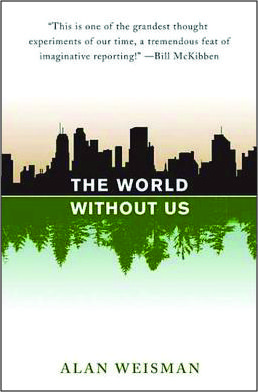
“Ever since then I’ve kept an eye out for publications about what a vanished civilization might leave behind for us to discover. In this book Weisman lays out survival times for our civilization’s stuff — plastic, houses, roads and so on. Pretty much everything but Mount Rushmore and the Chunnel will have dissolved or eroded away much sooner than a million years. Really readable if you want more details.”

<more soda>

“I also found a paper, ‘The Silurian Hypothesis,’ that took a more technical approach. Their big library research project pulled results from scores of geologic isotope analysis and fossil survey reports looking for ancient times that resemble Earth’s sudden change since the start of the Industrial Age — climate, species declines, whatever. They found about a dozen, but as they said, ‘the known unique markers might not be indicative, while the (perhaps) more expected markers are not sufficient.’ In other words, my Crazy Theory might be crazy. Or maybe not.”

~~ Rich Olcott

The Sound of Money

<chirp, chirp> “Moire, here, there’ll be a late-night surcharge for this call.”

“Hiya, Sy, it’s me, Vinnie. Got a minute? I wanna run something past you.”

“Sure, if it’s interesting enough to keep me awake.”

“It’s that Physics-money hobby horse you’ve been riding. I think I’ve got another angle on it for you.”

“Really? Shoot.”

“OK, a while ago you and me and Richard Feder talked about waves and how light waves and sound waves are different because light waves make things go up-and-down while the waves go forward but sound waves go back-and-forth.”

“Transverse waves versus compression waves, uh-huh.”

“Yeah and when you look close at a sound wave what you see is individual molecules don’t travel. What happens is like in a pool game where one ball bumps another ball and it stops but the bumped ball moves forward and the first ball maybe even moves back a little.”

“The compression momentum carries forward even though the particles don’t, right.”

“And that means that sound waves only travel as fast as the air molecules can move back and forth which is a lot slower than light waves which move by shaking the electric field. I got that, but why doesn’t sound move a lot faster in something like iron where the atoms don’t have to move?”

“Oh, it does, something like 200 times faster than in air. There’s a couple of factors in play. It all goes back to Newton —”

“Geez, he had a hand in everything Physics, didn’t he?”

“Except for electromagnetism and nuclear stuff. The available technology was just too primitive to let him experiment in those areas. Anyway, Newton discovered a formula connecting the speed of sound in a medium to its density. Like his Law of Gravity, it worked but he didn’t know why it worked. Also like gravity, we’ve got a better idea now.”

“What’s the better idea?”

“The key notions weren’t even invented until decades after Newton’s Principia was published. The magic words are the particulate nature of matter and intermolecular stiffness.”

“Hah?”

“One at a time. Newton was a particle guy to an extent. He believed that light is made of particles, but he didn’t take the next step to thinking of all matter as being made of particles. But it is, and the particles interact with each other. Think of it as stickiness. How effective the stickiness is depends on the temperature and which molecules you’re talking about. Gas molecules have so much kinetic energy relative to their sticky that they mostly just bounce off each other. In liquids and solids the molecules stay close enough together that the stickiness acts like springs. The springs may be more or less stiff depending on which molecules or ions or atoms are involved.”

“I see where you’re going. Stuff with stiffer springs doesn’t move as much as looser stuff at the same temperature; sound goes faster through a solid than through a liquid or gas. That’s what Newton figured out, huh?”

“No, he just measured and said, basically, ‘here’s the formula.‘ Just like with gravity, he didn’t suggest why the numbers were what they were. <yawn> So, you called with an idea about sound and money physics.”

“Right. Got off the track there, but this was helpful. What got me started was some newscaster saying how the Paycheck Protection Program is dumping money into the economy during the pandemic. My first thought was, ‘Haw, that’s gotta be a splash!‘ Then I imagined this pulse of money sloshing back and forth like a wave and that led me to sound waves and then I kept going. No dollar bill moves around that much, but when people spend them that’s like the compression wave moving out.”

“Interesting idea, Vinnie. From a Physics perspective, the question is, ‘How fast does the wave move?’ It’s another temperature‑versus‑stickiness thing.”

“Yeah, I figure money velocity measures the economy like temperature measures molecule motion. Money velocity goes up with inflation. If the velocity’s high people spend their money because why not.”

“Yup. From the government’s perspective the whole purpose of economic stimulation is getting the cash flowing again. Their problem is locating the money velocity kickover point.”

~~ Rich Olcott

Spare Change And Silly Putty

“Ok, Sy, you said Pascal explained the ‘water seeks its level‘ thing before Newton got a chance to. Newton was so smart, though — how’d Pascal beat him to it?”

“Pass me a strawberry scone, Al, and I’ll tell you why.”

“Anything for free food, eh, Sy? Alright, here.”

“Oferpitysake, Al, add it to my tab like always. Too much hassle putting on this face mask just to walk from my car to the scones. Pascal had a 20‑year head start — did his hydrostatics work when Newton wasn’t even in his teens. Unfortunately, Pascal died when Newton was only half-way through college. Whoa, if only Pascal had been alive and productive in France while Newton was in his science years in England and Leibniz was churning at everything in northern Germany. What advances might they have made arguing with each other? Where would our Math and Physics be today?”

“They didn’t like each other?”

“Newton didn’t like anybody. He and Leibniz feuded for decades over who invented calculus. Pascal and Leibniz probably would have gotten along fine — Leibniz could make nice with everyone except Newton. Come to think of it, Newton and Pascal had a lot in common. Newton was a preemie and Pascal was seriously ill for the first year of his life, never got much better. Newton wrote his first formal paper at 22; Pascal publicly proved that vacuums exist by creating some when he was 24. On the flip side, Pascal was 33 when he presented his studies of what we now call the Pascal Triangle but Newton waited until he was 44 to publish his Principia. And each of them spent much of the final quarter of his life on religious, even mystical matters.”

“So did Newton and Pascal both do much about money and water?”

“Not about the combination, though both had a lot to do about each one. Newton was Master of England’s Royal Mint and spent much of his time in office chasing down counterfeiters. Pascal wasn’t a gambler but Fermat was and the two of them teamed up to invent the probability theories that power today’s gaming, finance and insurance industries. So there’s that. Pascal and Newton both pioneered the science of fluids but from different perspectives. Pascal looked at static situations — comparing atmospheric pressure at two different altitudes, that sort of thing. Newton, as usual, studied change — in this case how fluids flow.”

“Pour water into a pipe and it pours out the other end. What’s to study?”

“Measuring how fast it pours and how that’s affected by the pressure and the pipe and what’s being poured. Newton explored the motion of fluids in exhausting detail in Book II of his Principia. As you’d expect, he found that the flow rate of water or any of the other fluids he investigated rises with the pressure and with the cross-sectional area of the pipe. Being Newton, though, he also also considered forces that resist flow. Think about it — the pipe itself doesn’t move and neither does the layer of fluid right next to the pipe’s walls. The flow rate ramps up from zero at the walls to full-on at the center of the pipe. The ramp-up rate depends on the fluid’s viscosity, another concept that Newton discovered or invented depending on how you look at it. Viscosity measures the drag force the slower layers exert on their faster neighbors. Fluids like molasses are viscous because their molecules are really good at grabbing onto molecules in the layers next door.”

“Where’s money fit into this picture?”

“I’m getting to that. Newton thought that each kind of fluid had its own viscosity, always the same. Not quite — temperature makes a difference and there’s non‑Newtonian materials like Silly Putty whose viscosity depends on how fast you yank on them. But the weirdest non‑Newtonian fluid is ultra‑low‑temperature liquid helium. It’s a superfluid and has zero viscosity. The helium atoms experience absolutely no drag from their neighbors and can sneak through the tiniest cracks. Money does the same, right? Each dime and dollar flows with no drag from its cousins.”

“Money’s a superfluid?”

“Yup. Think how it leaks out of your pocket.”

“Uh-huh. … Hey, Sy, about that tab…”

~~ Rich Olcott