Only a H2 in A Gilded Cage

“OK, Susan, you’ve led us through doing high-pressure experiments with the Diamond Anvil Cell and you’ve talked about superconductivity and supermagnetism. How do they play together?”

“It’s early days yet, Sy, but Dias and a couple of other research groups may have brought us a new kind of superconductivity.”

“Another? You talked like there’s only one.”

“It’s one of those ‘depends on how you look at it‘ things, Al. We’ve got ‘conventional‘ superconductors and then there are the others. The conventional ones — elements like mercury or lead, alloys like vanadium‑silicon — are the model we’ve had for a century. Their critical temperatures are generally below 30 kelvins, really cold. We have a 60‑year‑old Nobel‑winning theory called ‘BCS‘ that’s so good it essentially defines conventional superconductivity. BCS theory is based on quantum‑entangled valence electrons.”

“So I guess the unconventional ones aren’t like that, huh?”

“Actually, there seem to be several groups of unconventionals, none of which quite fit the BCS theory. Most of the groups have critical temperatures way above what BCS says should be the upper limit. There are iron‑based and heavy‑metals‑based groups that use non‑valence electrons. There are a couple of different carbon‑based preparations that are just mystical. There’s a crazy collection of copper oxide ceramics that can contain five or more elements. Researchers have come up with theories for each of them, but the theories aren’t predictive — they don’t give dependable optimization guidelines.”

“Then how do they know how to make one of these?”

“Old motto — ‘Intuition guided by experience.’ There are so many variables in these complex systems — add how much of each ingredient, cook for how long at what temperature and pressure, chill the mix quickly or anneal it slowly, bathe it in an electrical or magnetic field and if so, how strong and at what point in the process… Other chemists refer to the whole enterprise as witch’s‑brew chemistry. But the researchers do find the occasional acorn in the grass.”

“I guess the high‑pressure ploy is just another variable then?”

“It’s a little less random than that, Sy. If you make two samples of a conventional superconductor, using different isotopes of the same element, the sample with the lighter isotope has the higher critical temperature. That’s part of the evidence for BCS theory, which says that electrons get entangled when they interact with vibrations in a superconductor. At a given temperature light atoms vibrate at higher frequency than heavy ones so there’s more opportunity for entanglement to get started . That set some researchers thinking, ‘We’d get the highest‑frequency vibrations from the lightest atom, hydrogen. Let’s pack hydrogens to high density and see what happens.'”

“Sounds like a great idea, Susan.”

“Indeed, Al, but not an easy one to achieve. Solid metallic hydrogen should be the perfect case. Dias and his group reported on a sample of metallic hydrogen a couple of years ago but they couldn’t tell if it was solid or liquid. This was at 5 megabars pressure and their diamonds broke before they could finish working up the sample. Recent work has aimed at using other elements to produce a ‘hydrogen‑rich’ environment. When Dias tested H2S at 1.5 megabar pressure, they found superconductivity at 203 kelvins. Knocked everyone’s socks off.”

“Gold rush! Just squeeze and chill every hydrogen‑rich compound you can get hold of.”

“It’s a little more complicated than that, Sy. Extreme pressures can force weird chemistry. Dias reported that shining a green laser on a pressurized mix of hydrogen gas with powdered sulfur and carbon gave them a clear crystalline material whose critical temperature was 287 kelvins. Wow! A winner, for sure, but who knows what the stuff is? Another example — the H2S that Dias loaded into the DAC became H3S under pressure.”

“Wait, three hydrogens per sulfur? But the valency rules—”

“I know, Sy, the rules say two per sulfur. Under pressure, though, you get one unattached molecule of H2 crammed into the space inside a cage of H2S molecules. It’s called a clathrate or guest‑host structure. The final formula is H2(H2S)2 or H3S. Weird, huh? Really loads in the hydrogen, though.”

“Jupiter has a humungous magnetic field and deep‑down it’s got high‑density hydrogen, probably metallic. Hmmm….”

~~ Rich Olcott
Futile? Nope, Just Zero

“Megabar superconductivity.”

“Whoa, Susan. Too much information, too few words. Could you unpack that, please?”

“No problem, Sy. A bar is the barometric pressure (get it?) at sea level. A megabar is—”

“A million atmospheres, right?”

“Right, Al. So Ranga Dias and his crew were using their Diamond Anvil Cells to put their chemical samples under million-atmosphere pressures while they tested for superconductivity—”

“Like Superman uses?”

“Is he always like this, Sy?”

“Just when he gets excited, Susan. The guy loves Science, what can I say?”

“Sorry, Susan. So what makes conductivity into superconductivity?”

“Excellent question, Al. Answering it generated several Nobel Prizes and we still don’t have a complete explanation. I can tell you the what but I can’t give you a firm why. Mmm… what do you know about electrical resistance?”

“Just what we got in High School General Science. We built a circuit with a battery and a switch and an unknown resistor and a meter to measure the current. We figured the resistance from the voltage divided by the current. Or maybe the other way around.”

“You got it right the first try. The voltage drop across a resistor is the current times the resistance, V=IR so V/I=R. That’s for ordinary materials under ordinary conditions. But early last century researchers found that for many materials, if you get them cold enough the resistance is zero.”

“Zero? But … if you put any voltage across something like that it could swallow an infinite amount of current.”

“Whoa, Al, what’s my motto about infinities?”

“Oh yeah, Sy. ‘If your theory contains an infinity, you’ve left out physics that would stop that.’ So what’d stop an infinite current here?”

“The resistor wasn’t the only element in your experimental circuit. Internal resistance within the battery and meter would limit the current. Those 20th-century researchers had to use some clever techniques to measure what they had. Back to you, Susan.”

“Thanks, Sy. I’m going to remember that motto. Bottom line, Al, superconductors have zero resistance but only under the right conditions. You start with your test material, with a reasonable resistance at some reasonable temperature, and then keep measuring its resistance as you slowly chill it. If it’s willing to superconduct, at some critical temperature you see the resistance abruptly drop straight down to zero. The critical temperature varies with different materials. The weird thing is, once the materials are below their personal critical temperature all superconductors behave the same way. It’s seems to be all about the electrons and they don’t care what kind of atom they rode in on.”

“Wouldn’t copper superconduct better than iron?”

“Oddly enough, pure copper doesn’t superconduct at all. Iron and lead both superconduct and so do some weird copper-containing oxides. Oh, and superconductivity has another funny dependency — it’s blocked by strong magnetic fields, but on the other hand it blocks out weaker ones. Under normal conditions, a magnetic field can penetrate deep into most materials. However, a superconducting piece of material completely repels the field, forces the magnetic lines to go around it. That’s called the Meissner effect and it’s quantum and—”

“How’s it work?”

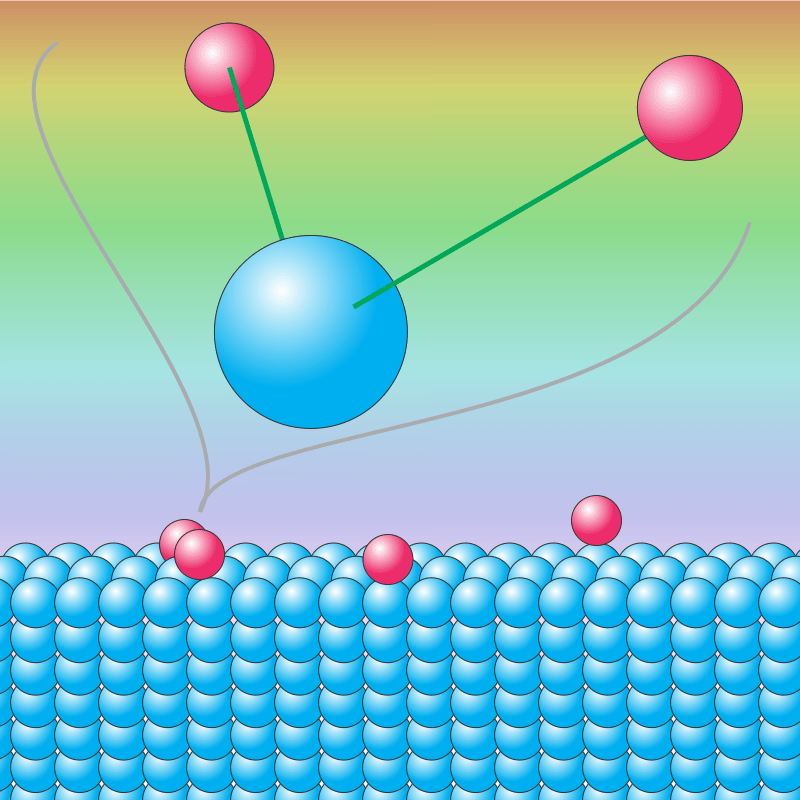
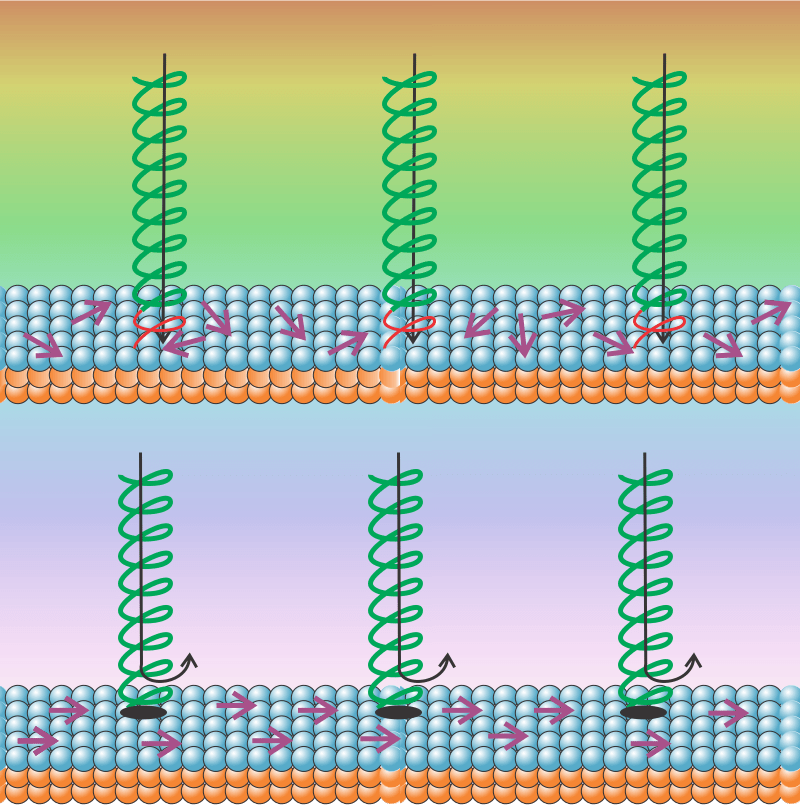
“Even though we’ve got a good theory for the materials with low critical temperature, the copper oxides and such are still a puzzle. Here’s a diagram I built for one of my classes…”

“The top half is the ordinary situation, like in a copper wire. Most of the current is carried by electrons near the surface, but there’s a lot of random motion there, electrons bouncing off of impurities and crystal defects and boundaries. That’s where ordinary conduction’s resistance comes from. Compare that with the diagram’s bottom half, a seriously simplified view of superconduction. Here the electrons act like soldiers on parade, all quantum‑entangled with each other and moving as one big unit.”

“The green spirals?”

“They represent an imposed magnetic field. See the red bits diving into the ordinary conductor? But the superconducting parade doesn’t make space for the circular motion that magnetism tries to impose. The force lines just bounce off. Fun fact — the supercurrent itself generates a huge magnetic field but only outside the superconductor.”

“How ’bout that? So how is megabar superconductivity different?”

~~ Rich Olcott

Diamonds in The Tough

“Excuse me, they said there’s a coffee shop over here somewhere. Could you please point me to it?”

“Sure. Al’s place is right around the next corner, behind the Physics building. I’ll walk you over there.”

“Oh, I don’t want to bother you.”

“No bother, it’s my coffee time anyway. Hi, Al, new customer for you.”

“Hi, Sy. What’ll it be, Ms … ?”

“I’m Susan, Susan Kim. A mocha latte, please, Al. And you’re Sy …?”

“Moire. Sy Moire, Consulting Physicist. Who’s the ‘they’ that told you about Al’s?”

“An office staffer in the Chemistry Department. I just joined the research faculty over there.”

Al’s ears perk up. “A chemist, at last! For some reason they don’t show up over here very much.”

“Hah, I bet it’s because they’re used to drinking lab coffee from beakers.”

“As a matter of fact, Sy, I do have a coffee beaker. A glass‑worker friend added a very nice handle to a 500‑milliliter beaker for me. It’s not unpacked yet which is why I was looking for a coffee shop. This latte is very good, Al, better than lab coffee any day.”

“Thanks. So what’s the news in Science, guys?”

“Mmm… On Mars, the Insight mission‘s ‘mole’ thermal probe has finally buried itself completely, on its way down we hope to its targeted 5‑meter depth. And the OSIRIS‑REx mission to Asteroid Bennu successfully collected maybe a little too much asteroid sample. One rock fragment blocked the sampler’s lid like a bit of souvenir sticking out of a tourist’s carry‑on bag. Fortunately the engineers figured out how to stow the stuff more neatly for the two‑year trip back home. How about in the Chemistry world, Susan?”

“Hmm… Ranga Dias and his team at the University of Rochester used a diamond anvil cell to—”

“Wait — a diamond anvil? Like the Village Blacksmith but made of diamond?”

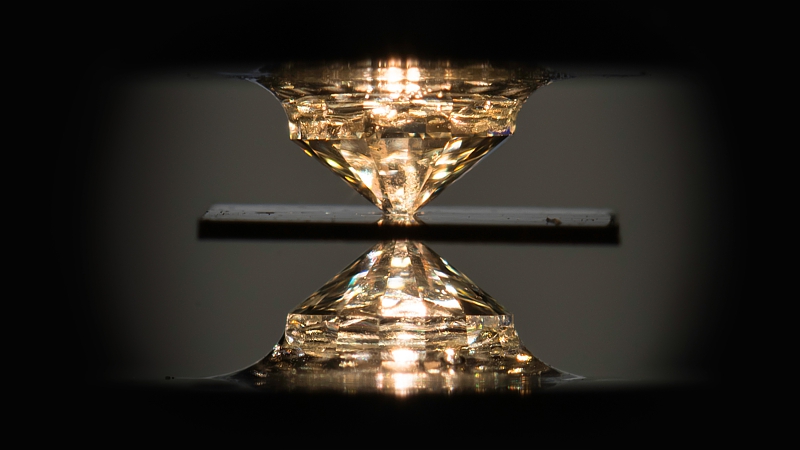
“No, Al, nothing like that. Diamond is the hardest substance we know of, right? A DAC uses a pair of quarter‑carat gem‑quality diamonds pushing against each other to create a small volume of crazy high pressure in the space between them, up into the million‑atmosphere range. Here, I’ve got a gorgeous photo of one on my phone…

Diamond anvil cell, photo by J. Adam Fenster / University of Rochester

“To give you an idea of the scale, that square black gasket between the two diamonds is a piece of rhenium metal foil that’s a quarter of a millimeter thick. The reaction vessel itself is a hole they spark-drilled through the gasket. This is teeny, nanoliter chemistry.”

“OK, they’re small diamonds, but .. DIAMONDS! I bet they crack some of them. That’s got to be ex‑PENsive, our tax dollars going CRUNCH!.”

“Not really. You’re right, some do crack, up around the seven million atmosphere mark. But here’s the fun part — the researchers don’t pay market price for those diamonds. They come from the government’s stock of smuggled goods that Customs agents have confiscated at the border.”

“Why go to all that trouble? What’s wrong with test tubes and beakers?”

“Because not all chemistry takes place at atmospheric pressure, Sy. High pressure crams molecules closer together. They get in each other’s way, maybe deform each other enough to react in ways that they wouldn’t under conditions we’d call ‘normal.’ Even water has something like 17 different forms of ice under different pressure‑temperature conditions. The whole discipline of high‑pressure chemistry got started because the seismologists needed to know how minerals transform, melt, flow and react under stress. The thing about diamond is that it doesn’t transform, melt, flow or react.”

“Oo, oo, you can see through a diamond, sorta. I’ll betcha people pipe laser beams down them, right?”

“Absolutely, Al. Before lasers came along researchers were using regular light and optics to track events in a pressurized DAC. Lasers and fiber optics completely changed the game. Not just for observation — you can use intense light to heat things up, get them even closer to deep‑Earth conditions.”

“I suppose chemists are like physicists — once a new tool becomes available everybody dives in to play.”

“You know it. There’s thousands of papers out there detailing work that used a DAC.”

“So what did Dias report on?”

~~ Rich Olcott

Zeroing In on Water

<chirp, chirp> “Moire here.”

“Hi, Sy, it’s me, Vinnie. I just heard this news story about finding water on the Moon. I thought we did that ten years ago. You even wrote about it.”

“The internet never forgets, does it? That post wasn’t quite right but it wasn’t wrong, either.”

“How can it be both?”

“There’s an old line in Science — ‘Your data’s fine but your conclusions are … nuts.’ They use a different word in private. Suppose you land on a desert island and find a pirate’s treasure chest. Should the headlines say you’d found a treasure?”

“Naw, the chest might be empty or full of rocks or something.”

“Mm-hm. So, going back to that post… I was working from some reports on NASA’s Lunar Reconnaissance Orbiter. Its LAMP instrument mapped how strongly different Moon features reflected a particular frequency of ultraviolet light. That frequency’s called ‘Lyman‑alpha.’ Astronomers care about it because it’s part of starlight, it’s reflected by rock, and it’s specifically absorbed by hydrogen atoms. Sure enough, LAMP found some places, typically in deepshadow craters, that absorbed a lot more Lymanalpha than other places.”

“And you wrote about how hydrogen atoms are in water molecules and the Moon’s deep crater floors near the poles are sheltered from sunlight that’d break up water molecules so LAMP’s dark spots are where there’s water. And you liked how using starlight to find water on the Moon was poetical.”

“Uhh… right. All that made a lot of sense at the time and it still might be true. Scientists leapt to the same hopeful conclusion when interpreting data from the MESSENGER mission to Mercury. That one used a neutron spectrometer to map emissions from hydrogen atoms interacting with incoming cosmic rays. There again, the instrument identified hydrogen collected in shaded craters at the planet’s poles. Two different detection methods giving the same positive indication at the same type of sheltered location. The agreement seemed to settle the matter. The problem is that water isn’t geology’s only way or even its primary way to accumulate hydrogen atoms.”

“What else could it be? Hydrogen ions in the solar wind grab oxide ions from Moon rock and you’ve got water, right?”

“But the hydrogens arrive one at a time, not in pairs. Any conversion would have to be at least a two‑step process. The Moon’s surface rocks are mostly silicate minerals. They’re a lattice of negative oxide ions that’s decorated inside with an assortment of positive metal ions. The first step in the conversion would be for one hydrogen ion to link up with a surface oxide to make a hydroxide ion. That species has a minus‑one charge instead of oxide’s minus‑two so it’s a bit less tightly bound to its neighboring metal ions. Got that?”

“Gimme a sec … OK, keep going.”

“Some time later, maybe a century maybe an eon, another hydrogen ion comes close enough to attack our surface hydroxide if it hasn’t been blasted apart by solar UV light. Then you get a water molecule. On balance and looking back, we’d expect most of the surface hydrogen to be hydroxide ions, not water, but both kinds would persist better in shadowed areas.”

“OK, two kinds of hydrogen. But how do we tell the difference?”

“We evaluate processes at lower‑energies. Lyman‑alpha photons pack over 10 electronvolts of energy, enough to seriously disturb an atom and blow a molecule apart. O‑H and H‑O‑H interact differently with light in the infra‑red range that just jiggles molecules instead of bopping them. For instance, atom pairs can stretch in‑out. Different kinds of atom bind together more‑or‑less tightly. That means each kind of atom pair resonates at its own stretch energy, generally around 6 microns or 0.41 electronvolts. NASA’s Cassini mission had a mapping spectrometer that could see down into that range. It found O‑H stretching activity all over the Moon’s surface.”

“But that could be either hydroxyls or water.”

“Exactly. The new news is that sensors aboard NASA’s airborne SOFIA mission map light even deeper into the infra‑red. It found the 3‑micron, 0.21‑electronvolt signal for water’s V‑shape scissors motion. That’s the water that everybody’s excited about.”

“Lots of it?”

“Thinly spread, probably, but stay tuned.”

~~ Rich Olcott

A Star’s Tale

It’s getting nippy outside so Al’s moved his out‑front coffee cart into his shop. Jeremy’s manning the curbside take‑out window but I’m walking so I step inside. Limited seating, of course. “Morning, Al. Here’s my hiking mug, fill ‘er up with high‑test and I’ll take a couple of those scones — one orange, one blueberry. Good news that the Governor let you open up.”

“You know it, Sy. Me and my suppliers have been on the phone every day. Good thing we’ve got long‑term relationships and they’ve been willing to carry me but it gets on my conscience ’cause they’re in a crack, too, ya know?”

“Low velocity of money hurts everybody, Al. Those DC doofuses and their political kabuki … but don’t get me started. Hey, you’ve got a new poster over the cash register.”

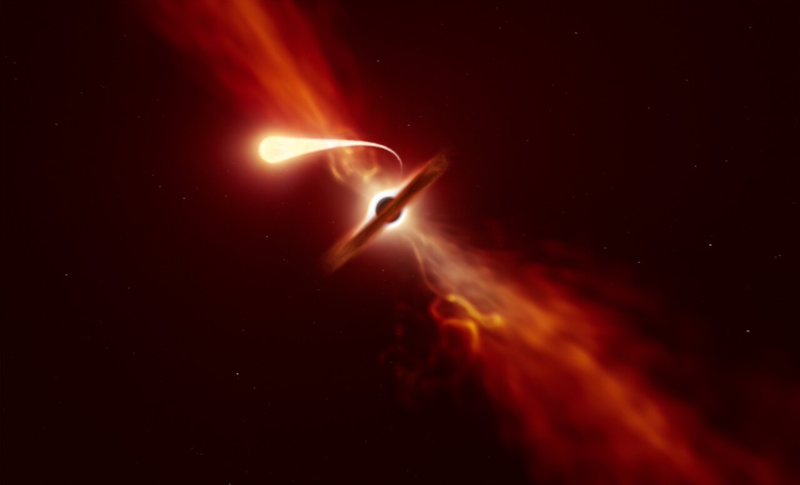
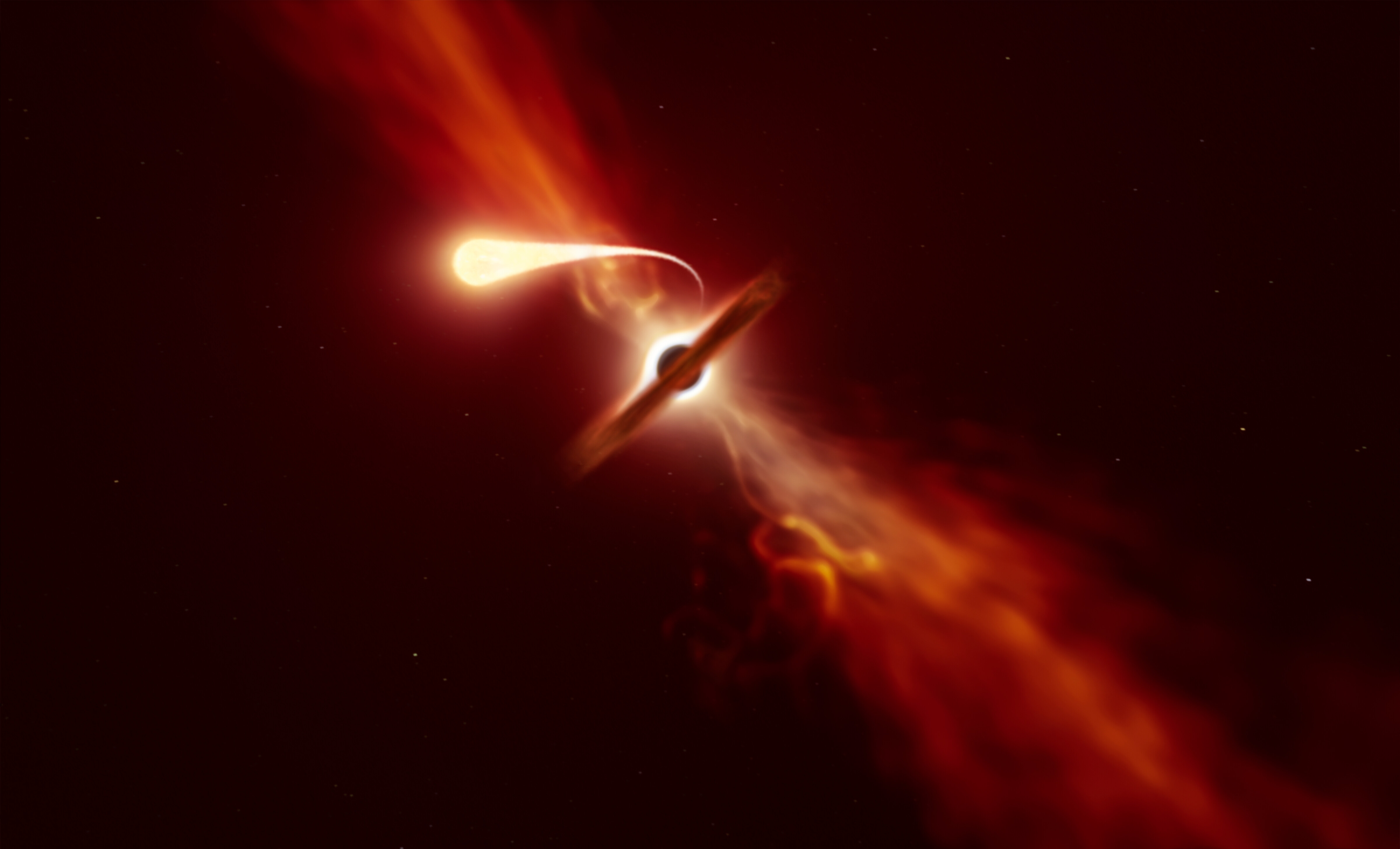
“You noticed. Yeah, it’s a beaut. Some artist’s idea of what it’d look like when a star gets spaghettified and eaten by a black hole. See, it’s got jets and a dust dusk and everything.”

“Very nice, except for a few small problems. That’s not spaghettification, the scale is all wrong and that tail-looking thing … no.”

Artist’s impression of AT2019qiz. Credit: ESO/M. Kornmesser
Under Creative Commons Attribution 4.0 International License

“Not spaghettification? That’s what was in the headline.”

“Sloppy word choice. True spaghettification acts on solid objects. Gravity’s force increases rapidly as you approach the gravitational center. Suppose you’re in a kilometer-long star cruiser that’s pointing toward a black hole from three kilometers away. The cruiser’s tail is four kilometers out. Newton’s Law of Gravity says the black hole pulls almost twice as hard on the nose as on the tail. If the overall field is strong enough it’d stretch the cruiser like taffy. Larry Niven wrote about the effect in his short story, Neutron Star.”

“The black hole’s stretching the star, right?”

“Nup, because a star isn’t solid. It’s fluid, basically a gas held together by its own gravity. You can’t pull on a piece of gas to stretch the whole mass. Your news story should have said ‘tidal disruption event‘ but I guess that wouldn’t have fit the headline space. Anyhow, an atom in the star’s atmosphere is subject to three forces — thermal expansion away from any gravitational center, gravitational attraction toward its home star and gravitational attraction toward the black hole. The star breaks up atom by atom when the two bodies get close enough that the black hole’s attraction matches the star’s surface gravity. That’s where the scale problem comes in.”

Al looks around — no waiting customers so he strings me along. “How?”

“The supermassive black hole in the picture, AT2019qiz, masses about a million Suns‑worth. The Sun‑size star can barely hold onto a gas atom at one star‑radius from the star’s center. The black hole can grab that atom from a thousand star‑radii away, about where Saturn is in our Solar System. The artist apparently imagined himself to be past the star and about where Earth is to the Sun, 100 star‑radii further out. Perspective will make the black hole pretty small.”

“But that’s a HUGE black hole!”

“True, mass‑wise, not so much diameter‑wise. Our Sun’s about 864,000 miles wide. If it were to just collapse to a black hole, which it couldn’t, its Event Horizon would be about 4 miles wide. The Event Horizon of a black hole a million times as massive as the Sun would be less than 5 times as wide as the Sun. Throw in the perspective factor and that black circle should be less than half as wide as the star’s circle.”

“What about the comet‑tail?”

“The picture makes you think of a comet escaping outward but really the star’s material is headed inward and it wouldn’t be that pretty. The disruption process is chaotic and exponential. The star’s gravity weakens as it loses mass but the loss is lop‑sided. Down at the star’s core where the nuclear reactions happen the steady burn becomes an irregular pulse. The tail should flare out near the star. The rest should be jagged and lumpy.”

“And when enough gets ripped away…”

“BLOOEY!”

~~ Rich Olcott

  • Thanks to T K Anderson for suggesting this topic.
  • Link to Technical PS — Where Do Those Numbers Come From?.