An Italianate Mantle Piece

Eddie has set out some tables in the Acme Building’s atrium in front of his pizza place. Mid‑morning as I walk by he’s sitting at one of them, reading a newspaper. “Morning, Eddie. Ready for walk‑in customers now that things are opening up?”

“I sure hope so, Sy. The building’s still half‑empty ’cause of the work‑from‑homers but I got hopes thanks to folks like you comin’ in.”

“I’ll drop down for lunch later. Don’t see many actual print newspapers these days. What’s in there?”

“Oh, this is the weekly from my cousin in Catania. Etna’s acting up again, as usual.”

“Catania?”

“City on the southeast coast of Sicily, about 20 miles away from the volcano. Even with the earthquakes and eruptions Catania’s almost 3000 years old. Funny, in Italy we got Etna and Vesuvius and Stromboli, Greece has Santorini and Methana, there’s a whole bunch strung out through Turkey — wonder why they all line up like that.”

A new voice behind me, but somehow familiar. “Tectonics.”

I turn. It’s the fellow with the dinosaur theory. “Hello, there. I thought you were a paleontologist.”

“Nah, I prefer really old rocks. The Paleontology course was part of my Geology program. You’re Cathleen’s friend Sy, aren’t you?”

“Guilty as charged. If I recall correctly, you’re Kareem who won the Ceremonial Broom?”

“Guilty as charged.”

“Will you guys quit playing games and just answer the question? What’s with those volcanoes?”

“Sorry, Eddie. You know about continental drift, right, that the continents are big slabs that float on top of the Earth’s molten‑metal insides?”

“Sort of, Kareem. Which brings up another question. If the layer underneath is molten metal, how come the volcanoes spit rock instead of metal? Anyway, how do we know it’s not rock all the way down?”

“Go easy on the guy, Eddie, you’re up to three questions already. Let him catch a breath.”

“Thanks, Sy. Last one first — we get a planet’s density from its size and orbit. For Earth it’s about 5.5 megagrams per cubic meter. For comparison, silicate rocks at the surface cluster around 2.7 and iron runs 7.9. Earth is just too heavy to be rock all the way down.”

“Those numbers put Earth almost exactly half-way between rock and iron. That tells me that half the planet’s mass is rocky. Surely the crust isn’t really that thick.”

“You might be surprised, Sy. Remember, volume goes up as the cube of the radius so it doesn’t take much crust thickness to make a large volume. Mind if I use a paper napkin, Eddie?”

“Nah, go ahead.”

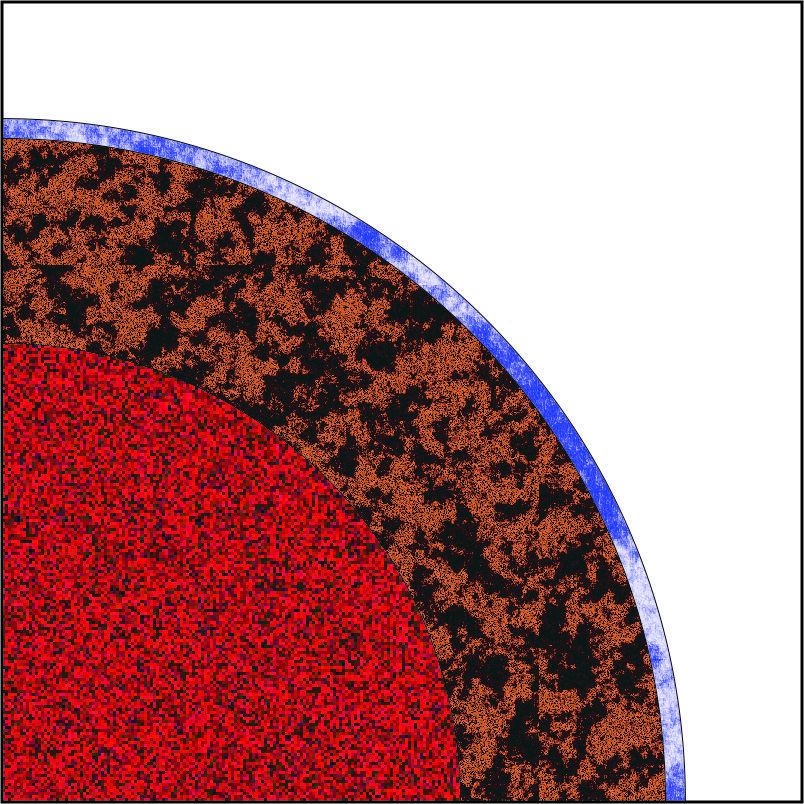
“OK, here’s a really simplistic model. Suppose there’s just two layers, core and silicates, and density within each is uniform which means that mass is strictly proportional to volume times density. Let’s guess that core density is twice silicate density. If the core mass is half the planet’s mass, the core radius comes to … 69% of the total and the silicate layer is 1900 kilometers thick. That’s 2/3 of the way down to the bottom of the mantle, Earth’s real middle layer between crust and core. Almost embarrassingly good agreement, considering. Anyway, Eddie, it can’t be rock all the way down and the metallic component is pretty well trapped below megameters of rock. What escapes is the heat that melts the rocks for volcanoes to spit.”

“You started out with metal in the middle of the Earth and then you switched to iron. Which is it and how do you know?”

“It is metallic, mostly iron and nickel. We’ve got four lines of evidence for that. Meteorites are the oldest. Lots of them are stony, but about 6% are a combination of two nickel‑iron alloys. We think those came to us from planetoids that weren’t harvested when the planets were under construction. Second is Earth’s magnetic field, which we think is generated by currents of molten metal deep within the planet. Third is seismic data combined with lab data on how waves travel through different materials at high temperature and pressure. The observed combination’s consistent with a nickel‑iron core. Fourth comes from nuclear theory and astrophysical observation — iron’s by far the most common metallic element in the Universe. Build with what you got.”

“But what about the volcanoes?”

~~ Rich Olcott
Chutes And Landers

From: Robin Feder <rjfeder@fortleenj.com>
To: Sy Moire <sy@moirestudies.com>
Subj: Questions

Hello again, Mr Moire. Kalif and I have a question. We were talking about falling out of stuff and we wondered how high you have to fall out of to break every bone in your body. We asked our science teacher Mr Higgs and he said it was something that you or Randall Munroe could answer and besides he (Mr Higgs) had to get ready for his next online. Can you tell us? Sincerely, Robin Feder


From: Sy Moire <sy@moirestudies.com>
To: Robin Feder <rjfeder@fortleenj.com>
Subj: Re: Questions

Hello again, Robin. You do take after your Dad, don’t you? Please give my best to him and to Mr Higgs, who has a massive job. Mr Munroe may already have answered your question somewhere, but I’ll give it a shot.

You’ve assumed that the higher the fall, the harder the hit and the more bones broken. It’s not that simple. Suppose, for instance, that your fall is onto the Moon, whose gravity is 1/6 that of Earth. For any amount of impact, however high the fall would have been on Earth, it’d be six times higher on the Moon. So the answer depends where you’re falling.

But the Moon doesn’t have an atmosphere worth paying attention to. That’s important because atmospheres impose a speed limit, technically known as terminal velocity, that depends on a whole collection of things

  • the Mass of the falling object
  • the local strength of Gravity
  • the Density of the atmosphere
  • the object’s cross‑sectional Area in the direction of fall

The first two produce the downward pull of gravity, the others produce the upward push of air resistance. Fun fact — in Galileo’s “All things fall alike” experiments, he always used spheres in order to cancel the effects of air resistance in his comparisons.

Let’s put some numbers to it. Suppose someone’s at Earth’s “edge of space” 100 kilometers up. From the PE=m·g·h formula for gravitational potential energy and dividing out their mass which I don’t know, they have 9.8×10⁵ joules/kilogram of potential energy relative to Earth’s surface. Now suppose they convert that potential to kinetic energy by falling to the surface with no air resistance. Using KE=m·v² I calculate they’d hit at about 1000 meters/second. But in real life, the terminal velocity of a falling human body is about 55 meters/second.

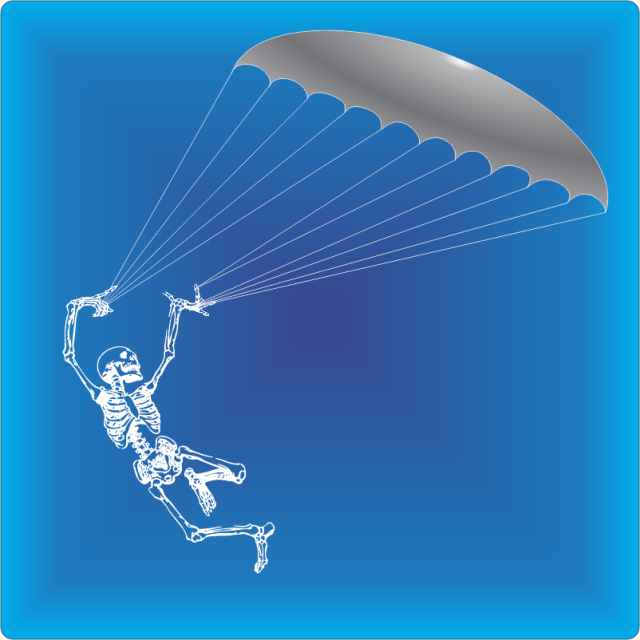
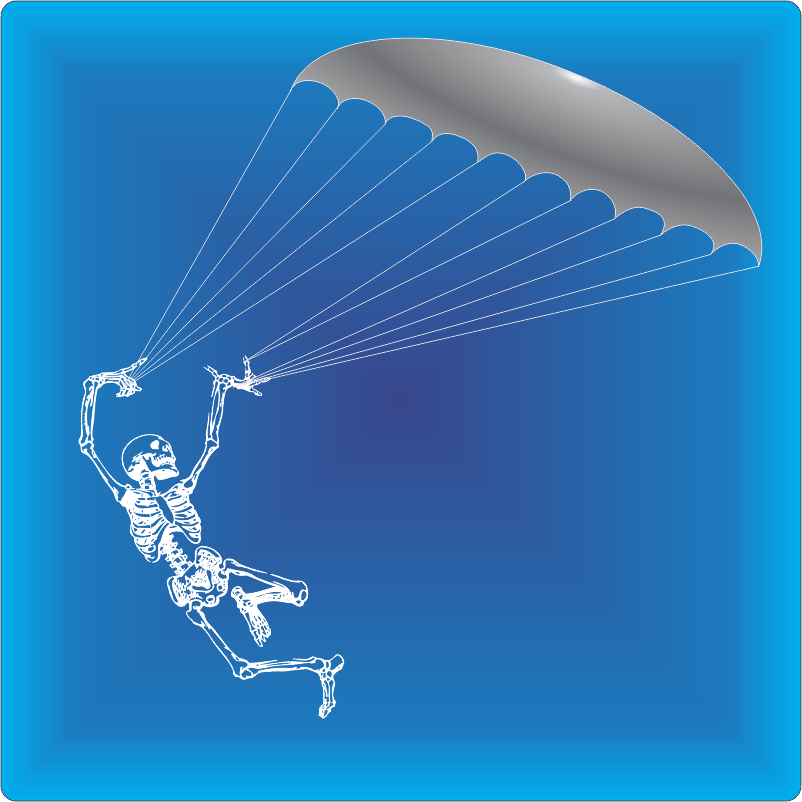
That Area item is why parachutes work. Make a falling object’s area larger and it’ll have to push aside more air molecules on its way down. Anyone wanting to survive a fall wants as much area as they can get. A parachute’s fabric canopy gives them a huge area and a big help. Parachute drops normally hit at about 5 meters/second. Trained people walk away from that all the time. Mostly.

Which gets to the matter of how you land. Parachute training schools and martial arts dojos give you the same advice — don’t try to stop your fall, just tuck in your chin and twist to convert vertical kinetic energy to rolling motion. Rigid limbs lead to bones breaking, ligaments tearing and joints going out of joint.

So let’s talk bones. Adults have about 210 of them, about 90 fewer than when they were a kid. Bones start out as separate bony patches embedded in cartilage. The patches eventually join together as boney tissue and the cartilage proportion decreases with age. Bottom line — kid bones are bendy, old bones snap more easily. For your question, breaking “every bone in your body” is a bigger challenge if you’re young.

But all bones aren’t equal — some are more vulnerable than others. Sesamoid bones, like the ones at the base of your thumb, are millimeter‑sized and embedded in soft tissue that protects them. The tiny “hammer, anvil and stirrup” ear bones are buried deep in hard bony tissue that protects them, too. Thanks to bones and soft tissues that would absorb nearly all the energy of impact, these small bones are almost invulnerable.

To summarize, no matter how high up from Earth you fall from, you can’t fall fast enough to hit hard enough to break every bone in your body. Be careful anyhow.

Regards,
Sy Moire.

~~ Rich Olcott

  • Thanks to Xander and Lucas for their input.

Elementary History

<chirp, chirp> “Moire here.”

“Hi, Sy, it’s Susan.”

“Well, hello. Good to hear from you. What’s up?”

“I’m out here on my back porch, fooling around on my laptop. It’s too nice to work in the lab today.”

“I agree with you. I’m outside, too, enjoying the Springtime. What’s your fooling around?”

“I found a discovery date list for all the chemical elements. Guess which element was the first that humanity worked with in pure form?”

“Mmm, I’d say carbon, in charcoal.”

“Nope, it’s copper.”

“Copper?”

“Mm-hm. Or maybe gold. They both occur as the raw metal but copper’s more common. There was a Copper Age before the Bronze age. The dates are fuzzy because they depend on what the archaeologists find after site scavengers have been there. I’m sending you the first few rows from the list.

Cumulative
Count
Element
(Symbol)
Atomic
number
Estimated
years ago
1Copper (Cu)2910000
2Lead (Pb)826000
3Carbon (C)65750
4Silver (Ag)475000
5Tin (Sn)505000
6Antimony (Sb)515000
7Gold (Au)794500
8Iron (Fe)264000
9Mercury (Hg)803500
10Sulfur (S)162500

“You can win most of them from the right ore with relatively simple processing. It makes sense they’re the ones we got to first.”

“Susan, I’m surprised it took a thousand years to realize you can get sulfur from cinnabar ore at the same time you’re cooking the mercury out of it. I wouldn’t want to be downwind from that process or most of the rest.”

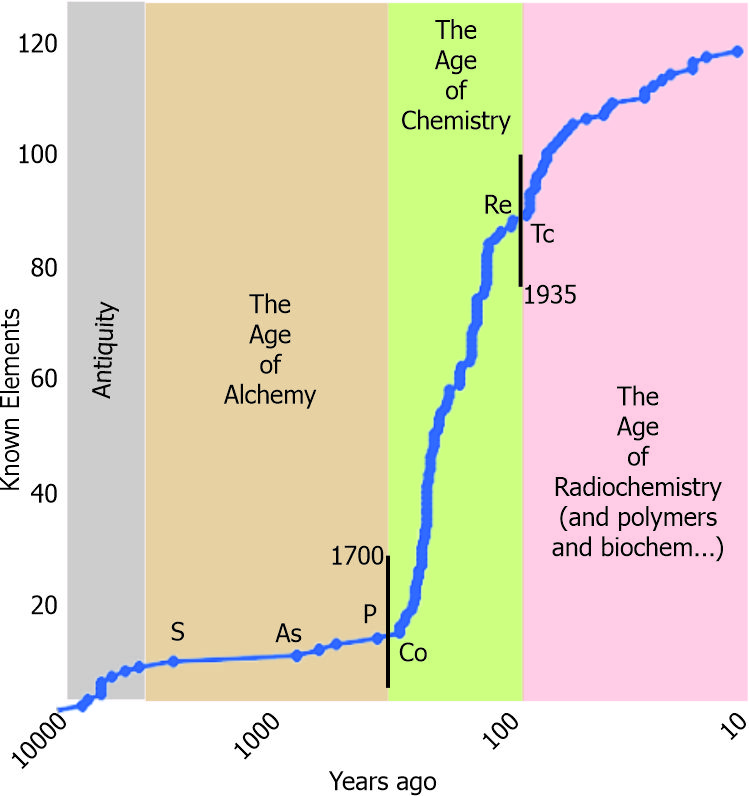
“Sure not. I’ll bet there just wasn’t much interest in sulfur until the alchemists started playing with it. Anyhow, I dumped the element data into a spreadsheet and got some fun facts when I graphed it. Look at this. Eight thousand years for 10 elements through sulfur, then 1800 years of nothing. Arsenic doesn’t show up until the Thirteenth Century when I guess royalty started using it to poison each other. And phosphorus — have you read Neal Stephenson’s Baroque Cycle trilogy?”

“Yes, and I know the episode you’re thinking of, where the hero routed a gang at night by coating himself with glowing phosphorus and bursting out of a cave pretending to be a demon. Stephenson put a lot of words into describing how factories obtained mercury and phosphorus back then.”

“Stephenson puts a lot of words into most everything nerdy. That’s why I enjoy reading him. Oh-ho, now I know how you knew about cinnabar being the source for mercury.”

“Hey, Susan, I don’t only do Physics, but yeah, that was from another Baroque Cycle episode. … Looking at your graph here — things certainly took off at the start of the Eighteenth Century.”

“Yes, indeed. Seventy-four elements, everything that’s not radioactive plus a couple that are. I get a chuckle from cobalt being the first element in that wave after phosphorus. You know the story?”

“What story is that?”

“Seventeenth Century miners kept digging up nasty rocks that emitted poisonous gas when smelted along with the desirable copper and nickel ores. They called the bad stuff kobald Oren, German for ‘goblin ores.’ When a Swedish chemist finally purified the material he simply re-spelled the adjective and called the metal cobalt. I love the linkage with Stephenson’s fictional phosphorus-covered demon.”

“Cute. Why the break between rhenium and technitium?”

“That second wave after 1935 is all radioactives. Funny how the timing paralleled Seaborg’s research career even though he never got involved with technitium, the first artificially-produced element. Imagine being the discoverer of ten different elements.”

“Seaborg practically invented that funny bottom row of the Periodic Table, didn’t he?”

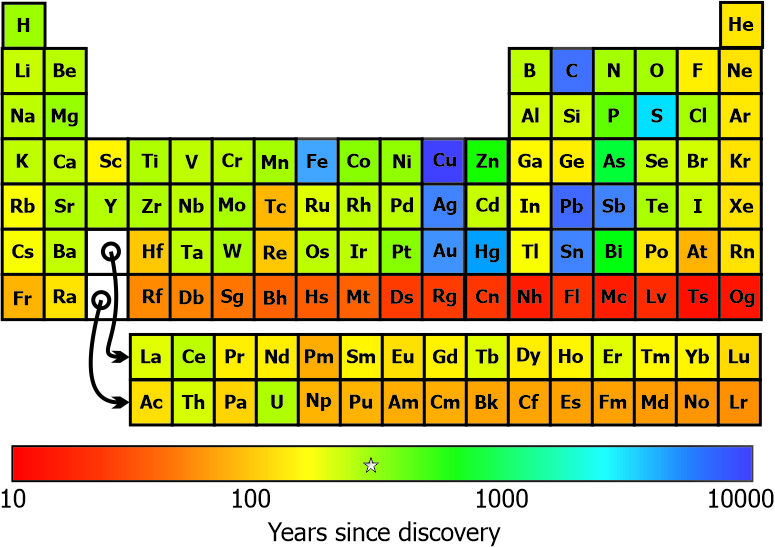
“Oh, yes. Not only did he discover or co-discover more than half of those elements, he was the one who proposed setting off the entire group as Actinides, in parallel with the Lanthanides above them. Oh, that reminds me, I meant to show you the other display I built. You’ve probably never seen one like this.”

“Whoa, you’ve colored each element block by how long we’ve known about it. That’s not the kind of thing you can do with crayons.”

“No, I had to do some programming to get the right tints.”

“What’s the little star for in the middle of the scale?”

“That’s when Mendeleev first proposed the Table, smack in the logarithmic center of my timeline. Don’t you love it?”

~~ Rich Olcott

Rotation, Revolution and The Answer

“Sy, I’m startin’ to think you got nothin’. Al and me, we ask what’s pushing the Moon away from us and you give us angular momentum and energy transfers. C’mon, stop dancin’ around and tell us the answer.”

“Yeah, Sy, gravity pulls things together, right, so how come the Moon doesn’t fall right onto us?”

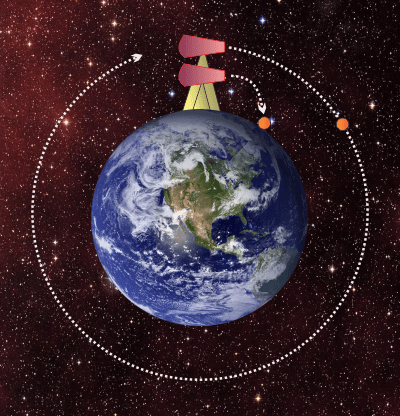
“Not dancing, Vinnie, just laying some groundwork for you. Newton answered Al’s question — the Moon is falling towards us, but it’s going so fast it overshoots. That’s where momentum comes in, Vinnie. Newton showed that a ball shot from a cannon files further depending on how much momentum it gets from the initial kick. If you give it enough momentum, and set your cannon high enough that the ball doesn’t hit trees or mountains, the ball falls beyond the planet and keeps on falling forever in an elliptical orbit.”

“Forever until it hits the cannon.”

“hahaha, Al. Anyway, the ball achieves orbit by converting its linear momentum to angular momentum with the help of gravity. The angular momentum pretty much defines the orbit. In Newton’s gravity‑determined universe, momentum and position together let you predict everything.”

“Linear and angular momentum work the same way?”

“Mostly. There’s only one kind of linear momentum — straight ahead — but there are two kinds of angular momentum — rotation and revolution.”

“Aw geez, there’s another pair of words I can never keep straight.”

“You and lots of people, Vinnie. They’re synonyms unless you’re talking technicalese. In Physics and Astronomy, rotation with the O gyrates around an object’s own center, like a top or a planet rotating on its axis. Revolution with the E gyrates around some external location, like the planet revolving around its sun. Does that help?”

“Cool, that may come in handy. So Newton’s cannon ball got its umm, revolution angular momentum from linear momentum so where does rotation angular momentum come from?”

“Subtle question, Vinnie, but they’re actually all just momentum. Fair warning, I’m going to avoid a few issues that’d get us too far into the relativity weeds. Let’s just say that momentum is one of those conserved quantities. You can transfer momentum from one object to another and convert between forms of momentum, but you can’t create momentum in an isolated system.”

“That sounds a lot like energy, Sy.”

“You’re right, Al, the two are closely related. Newton thought that momentum was THE conserved quantity and all motion depended on it. His arch‑enemy Leibniz said THE conserved quantity was kinetic energy, which he called vis viva. That disagreement was just one battle in the Newton‑Leibniz war. It took science 200 years to understand the momentum/kinetic energy/potential energy triad.”

“Wait, Sy, I’ve seen NASA steer a rocketship and give it a whole different momentum. I don’t see no conservation.”

“You missed an important word, Vinnie — isolated. Momentum calculations apply to mechanical systems — no inputs of mass or non‑mechanical energy. Chemical or nuclear fuels break that rule and get you into a different game.”

“Ah-hahh, so if the Earth and Moon are isolated…”

“Exactly, and you’re way ahead of me. Like we said, no significant net forces coming from the Sun or Jupiter, so no change to our angular momentum.”

“Hey, wait, guys. Solar power. I know we’ve got a ton of sunlight coming in every day.”

“Not relevant, Al. Even though sunlight heats the Earth, mass and momentum aren’t affected by temperature. Anyhow, we’re finally at the point where I can answer your question.”

“About time.”

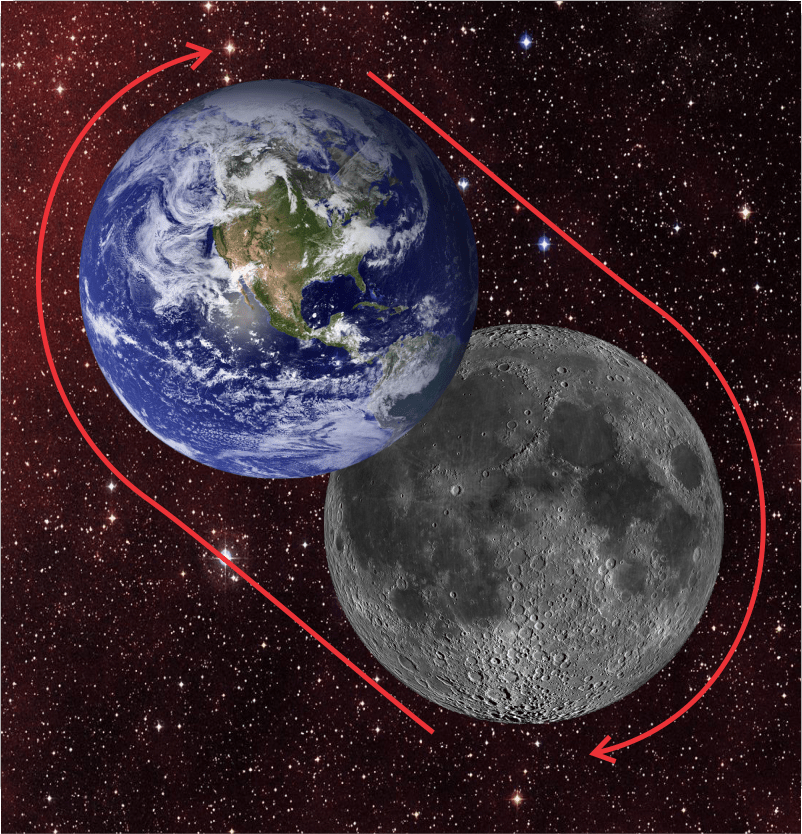
“Hush. OK, here’s the chain. Earth rotates beneath the Moon and gets its insides stirred up by the Moon’s gravity. The stirring is kinetic energy extracted from the energy of the Earth‑Moon system. The Moon’s revolution or the Earth’s rotation or both must slow down. Remember the M=m·r·c/t equation for angular momentum? The Earth‑Moon system is isolated so the angular momentum M can’t change but the angular velocity c/t goes down. Something’s got to compensate. The system’s mass m doesn’t change. The only thing that can increase is distance r. There’s your answer, guys — conservation of angular momentum forces the Moon to drift outward.”

“Long way to the answer.”

“To the Moon and back.”

~~ Rich Olcott