Turn This Way to Turn That Way

“I don’t understand, Sy. I get that James Webb Space Telescope uses its reaction wheels like a ship uses a rudder to change direction by pushing against something outside. Except the rudder pushes against water but the reaction wheels push against … what, the Universe?”

“Maybe probably, Al. We simply don’t know how inertia works. Newton just took inertia as a given. His Laws of Motion say that things remain at rest or persist in linear motion unless acted upon by some force. He didn’t say why. Einstein’s General Relativity starts from his Equivalence Principle — gravitational inertia is identical to mechanical inertia. That’s held up to painstaking experimental tests, but why it works is still an open question. Einstein liked Mach’s explanation, that we experience these inertias because matter interacts somehow with the rest of the Universe. He didn’t speculate how that interaction works because he didn’t like Action At A Distance. The quantum field theory people say that everything’s part of the universal field structure, which sounds cool but doesn’t help much. String theory … ’nuff said.”

“Hey, Moire, what’s all that got to do with the reaction wheel thing? JWST can push against one all it wants but it won’t go anywhere ’cause the wheel’s inside it. What’s magic about the wheels?”

JWST doesn’t want to go anywhere else, Mr Feder. We’re happy with it being in its proper orbit, but it needs to be able to point to different angles. Reaction wheels and gyroscopes are all about angular momentum, not about the linear kind that’s involved with moving from place to place.”

“HAH! JWST is moving place to place, in that orbit! Ain’t it got linear momentum then?”

Newton’s Principia, Proposition II, Theorem II

“In a limited way, pun intended. Angular momentum is linear momentum plus a radial constraint. This goes back to Newton and his Principia book. I’ve got a copy of his basic arc‑splitting diagram here in Old Reliable. The ABCDEF line is a section of some curve around point S. He treated it as a succession of short line segments ABc, BCd, CDe and so on. If JWST is at point B, for instance, Newton would say that it’s traveling with a certain linear momentum along the BCd line. However, it’s constrained to move along the arc so it winds up at D instead d. To account for the constraint Newton invented centripetal force to pull along the Sd line. He then mentally made the steps smaller and smaller until the sequence of short lines matched the curve. At the limit, a sequence of little bits of linear momentum becomes angular momentum. By the way, this step‑reduction process is at the heart of calculus. Anyway, JWST uses its reaction wheels to swing itself around, not to propel itself.”

“And we’re back to my original question, Sy. What makes that swinging happen?”

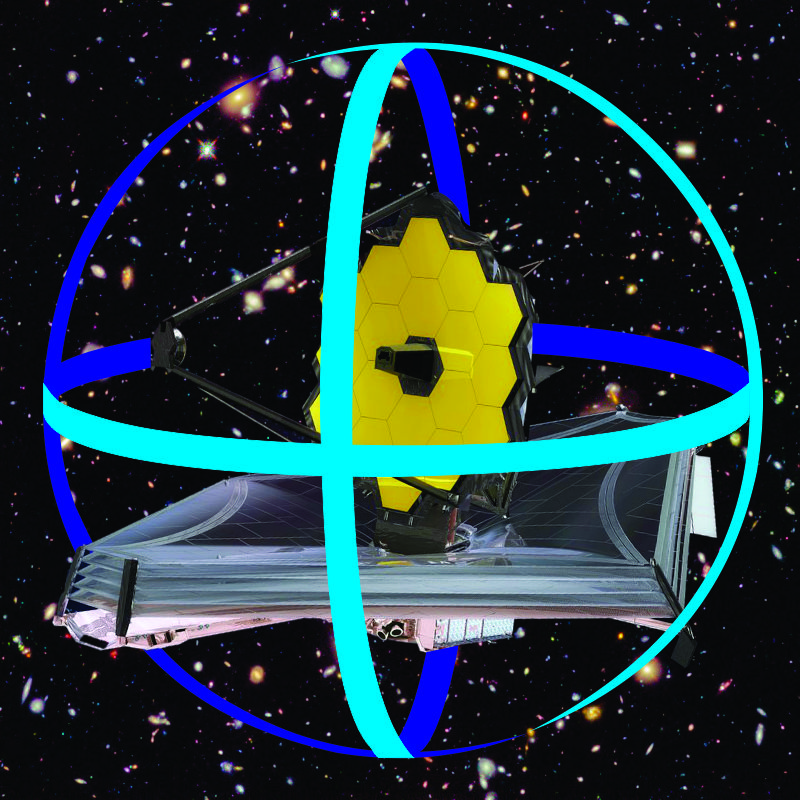
“Oh, you mean the mechanical reality. Easy, Al. Like I said, three pairs of motorized wheels are mounted on JWST‘s frame near the center of mass. Their axles are at mutual right angles. Change a wheel’s angular momentum, you get an equal opposing change to the satellite’s. Suppose the Attitude Control System wants the satellite to swing to starboard. That’d be clockwise viewed from the cold side. ACS must tell a port/starboard motor to spin its wheel faster counterclockwise. If it’s already spinning clockwise, the command would be to put on the brakes, right? Either way, JWST swings clockwise. With the forward/aft motors and the hot‑side/cold‑side motors, the ACS is equipped to get to any orientation. See how that works?”

“Hang on.” <handwaving ensues> “Yeah, I guess so.”

“Hey, Moire. What if the wheel’s already spinning at top speed in the direction the ACS wants more of?”

“Ah, that calls for a momentum dump. JWST‘s equipped with eight small rocket engines called thrusters. They convert angular momentum back to linear momentum in rocket exhaust. Suppose we need a further turn to starboard but a port/starboard wheel is nearing threshold spin rate. ACS puts the brakes on that wheel, which by itself would turn the satellite to port. However, ACS simultaneously activates selected thrusters to oppose the portward slew. Cute, huh?”

~~ Rich Olcott
Attitude Adjustment

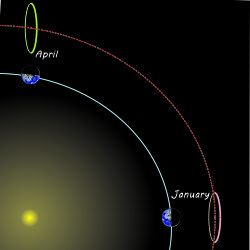
Mr Feder has a snarky grin on his face and a far‑away look in his eye. “Got another one. James Webb Space Telescope flies in this big circle crosswise to the Sun‑Earth line, right? But the Earth doesn’t stand still, it goes around the Sun, right? The circle keeps JWST the same distance from the Sun in maybe January, but it’ll fly towards the Sun three months later and get flung out of position.” <grabs a paper napkin> “Lemme show you. Like this and … like this.”

“Sorry, Mr Feder, that’s not how either JWST or L2 works. The satellite’s on a 6-month orbit around L2 — spiraling, not flinging. Your thinking would be correct for a solid gyroscope but it doesn’t apply to how JWST keeps station around L2. Show him, Sy.”

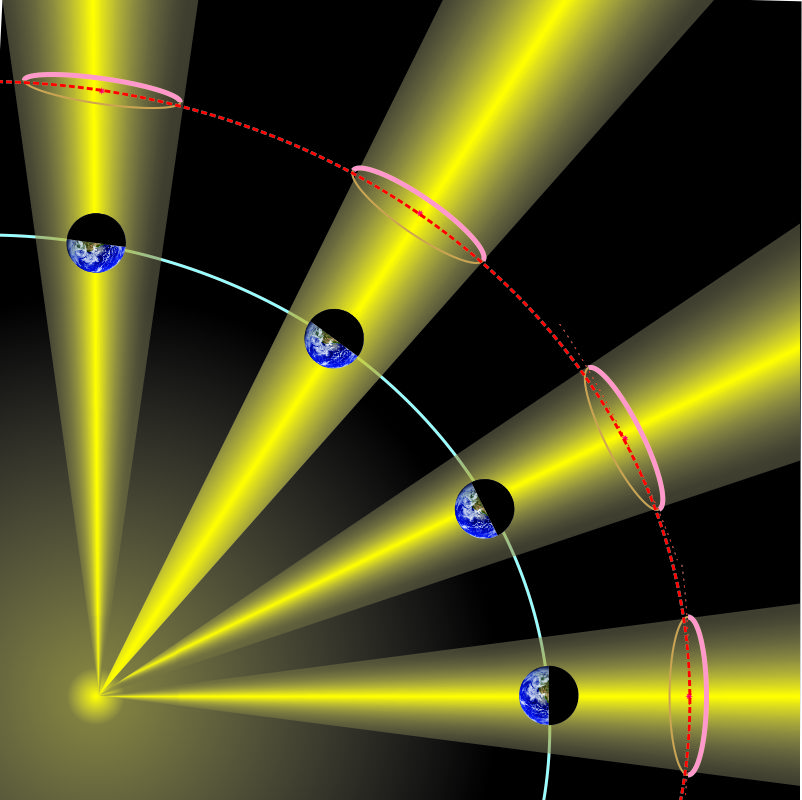
“Gimme a sec with Old Reliable, Cathleen.” <tapping> “OK, here’s an animation over a few months. What happens to JWST goes back to why L2 is a special point. The five Lagrange points are all about balance. Near L2 JWST will feel gravitational pulls towards the Sun and the Earth, but their combined attraction is opposed by the centrifugal force acting to move the satellite further out. L2 is where the three balance out radially. But JWST and anything else near the extended Sun‑Earth line are affected by an additional blended force pointing toward the line itself. If you’re close to it, sideways gravitational forces from the Sun and the Earth combine to attract you back towards the line where the sideways forces balance out. Doesn’t matter whether you’re north or south, spinward or widdershins, you’ll be drawn back to the line.”

Al’s on refill patrol, eavesdropping a little of course. He gets to our table, puts down the coffee pot and pulls up a chair. “You’re talking about the JWST. Can someone answer a question for me?”

“We can try.”
 ”What’s the question?”
  Mr Feder, not being the guy asking the question, pooches out his lower lip.

“OK, how do they get it to point in the right direction and stay there? My little backyard telescope gives me fits just centering on some star. That’s while the tripod’s standing on good, solid Earth. JWST‘s out there standing on nothing.”

JWST‘s Attitude Control System has a whole set of functions to do that. It monitors JWST‘s current orientation. It accepts targeting orders for where to point the scope. It computes scope and satellite rotations to get from here to there. Then it revises as necessary in case the first‑draft rotations would swing JWST‘s cold side into the sunlight. It picks a convenient guide star from its million‑star catalog. Finally, ACS commands its attitude control motors to swing everything into the new position. Every few milliseconds it checks the guide star’s image in a separate sensor and issues tweak commands to keep the scope in proper orientation.”

“I get the sequence, Sy, but it doesn’t answer the how. They can’t use rockets for all that maneuvering or they’d run out of fuel real fast.”

“Not to mention cluttering up the view field with exhaust gases.”

“Good point, Cathleen. You’re right, Al, they don’t use rockets, they use reaction wheels, mostly.”

“Uh-oh, didn’t broken reaction wheels kill Kepler and a few other missions?”

“That sounds familiar, Mr Feder. What’s a reaction wheel, Sy, and don’t they put JWST in jeopardy?”

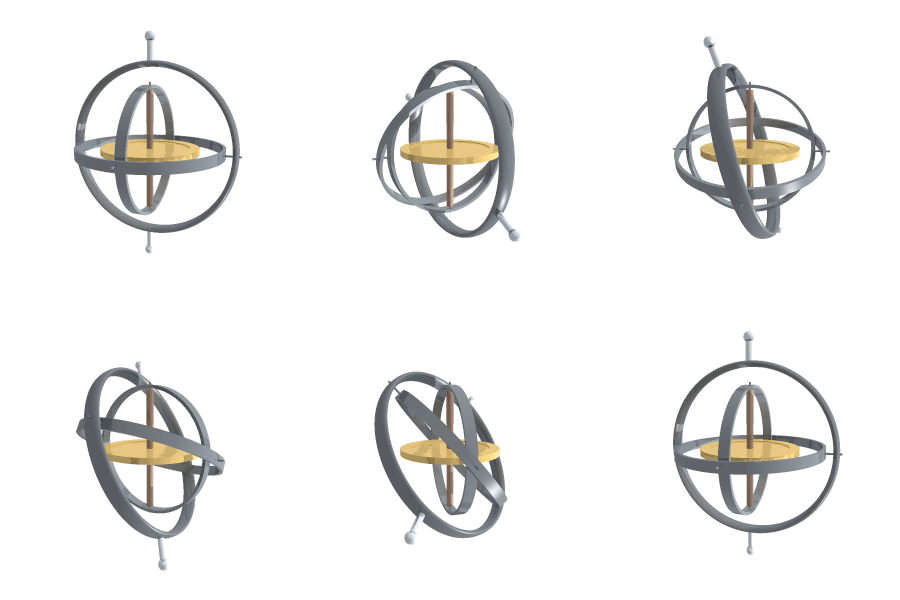
 Gyroscope, image by Lucas Vieira

“A reaction wheel is a massive doughnut that can spin at high speed, like a classical gyroscope but not on gimbals.”

“Hey, Moire, what’s a gimbal?”

“It’s a rotating frame with two pivots for something else that rotates. Two or three gimbals at mutual right angles let what’s inside orient independent of what’s outside. The difference between a classical gyroscope and a reaction wheel is that the gyroscope’s pivots rotate freely but the reaction wheel’s axis is fixed to a structure. Operationally, the difference is that you use a gyroscope’s angular inertia to detect change of orientation but you push against a reaction wheel’s angular inertia to create a change of orientation.”

“What about the jeopardy?”

Kepler‘s failing wheels used metal bearings. JWST‘s are hardened ceramic.”

<whew>

~~ Rich Olcott

Pinks In Space

Mr Feder, of Fort Lee NJ, is outraged. “A pretty pink parasol? NASA spent taxpayer dollars to decorate the James Webb Space Telescope with froufrou like that?”

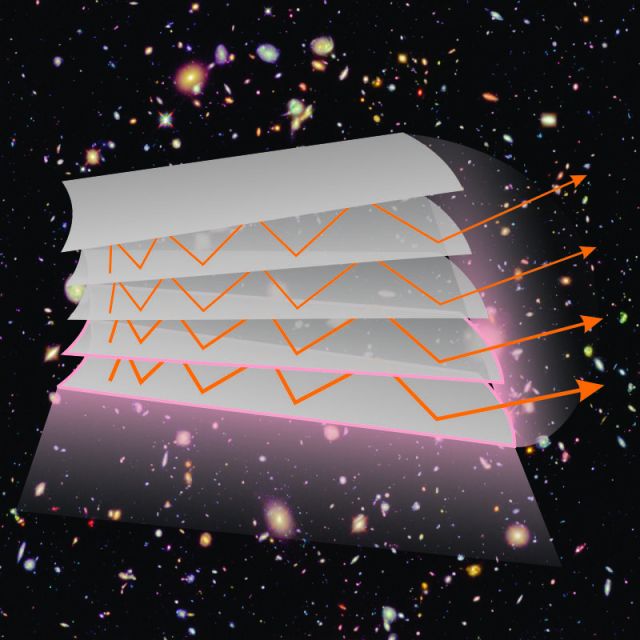
Astronomer Cathleen stays cool. “Certainly not, Mr Feder. This is no effete Victorian‑era parasol. It’s a big, muscular ‘defender against the Sun,’ which is what the word means when you break it down — para‑sol. Long and wide as a tennis court. Its job is to fight off the Sun’s radiation and keep JWST‘s cold side hundreds of degrees colder than the Sunfacing side. Five layers of highstrength Kapton film, the same kind that helped protect New Horizons against freezing and micrometeorites on its way to Pluto and beyond. Each layer carries a thin coat of aluminum, looks like a space blanket or those Mylar mirror balloons but this is a different kind of plastic.”

“Sounds like a lot of trouble for insulation. Why not just go with firebrick backed up with cinder blocks? That’s what my cousin used for her pottery kiln.”

I cut in, because Physics. “Two reasons, Mr Feder. First one is mass. Did you help your cousin build her kiln?”

“Nah, bad back, can’t do heavy lifting.”

“There you go. On a space mission, every gram and cubic centimeter costs big bucks. On a benefit/cost scale of 1 to 10, cinder blocks rate at, oh, about ½. But the more important reason is that cinder blocks don’t really address the problem.”

“They keep the heat in that kiln real good.”

“Sure they do, but on JWST‘s hot side the problem is getting rid of heat, not holding onto it. That’s the second reason your blocks fail the suitability test. Sunlight at JWST ‘s orbit will be powerful enough to heat the satellite by hundreds of degrees, your choice of Fahrenheit or centigrade. That’s a lot of heat energy to expel. Convection is a good way to shed heat but there’s no air in space so that’s not an option. Conduction isn’t either, because the only place to conduct the heat to is exactly where we don’t want it — the scope’s dish and instrument packages. Cinder blocks don’t conduct heat as well as metals do, but they do it a lot better than vacuum does.”

“So that leaves what, radiating it away?”

“Exactly.”

“Aluminum on the plastic makes it a good radiator, huh?”

“Sort of. The combo’s a good reflector, which is one kind of radiating.”

“So what’s the problem?”

“It’s not a perfect reflector. The challenge is 250 kilowatts of sunlight. Each layer blocks 99.9% but that still lets 0.1% through to heat up what’s behind it. The parasol has radiate away virtually all the incoming energy. That’s why there’s five layers and they’re not touching so they can’t conduct heat to each other.”

“Wait, they can still radiate to each other. Heat bounces back and forth like between two mirrors, builds up until the whole thing bursts into flames. Dumb design.”

“No flames, despite what the Space Wars movies show, because there’s no oxygen in space to support combustion. Besides, the designers were a lot smarter than that. The mirrors are at an angle to each other, just inches apart near the center, feet apart at the edges. Heat in the form of infrared light does indeed bounce between each pair of layers but it always bounces at an angle aimed outwards. The parasol’s edges will probably shine pretty brightly in the IR, but only from the sides and out of the telescope’s field of view.”

“OK, I can understand the aluminum shiny, but why make it pink?”

“That’s a thin extra coat of a doped silicon preparation, just on the outermost two layers. It’s not so good at reflection but when it heats up it’s good at emitting infrared. Just another way to radiate.”

“But it’s pink?”

“The molecules happen to be that color.”

“Why’s it dopey?”

“Doped, not dopey. Pure silicon is an electrical insulator. Mixing in the right amount of the right other atoms makes the coating a conductor so it can bleed off charge coming in on the solar wind.”

“Geez, they musta thought of everything.”

“They tried hard to.”

~~ Rich Olcott

Yardsticks

“Hi, Cathleen, meet Mr Richard Feder, of Fort Lee NJ. He’s got a question that’s more in your Astronomy bailiwick than mine. Have a strawberry scone.”

“Mmm, still warm from Al’s oven. Thanks, Sy. Hello and what’s your question, Mr Feder?”

“Hiya. So if the James Webb Space Telescope is gonna be a million miles behind the Moon, won’t the Moon block its signals to us?”

“Oh dear, he said ‘miles.’ Sy, you’d better get out Old Reliable to look up numbers and do unit conversions. Mr Feder, I don’t think in miles.”

“Huh? What do you use instead, like paces or something?”

“Depends on what objects I’m considering and why I’m thinking about them. There are so many useful ratios out there it’s often easier to use ratios than huge numbers one can’t wrap one’s head around. Jupiter’s radius, for instance, is eleven times Earth’s, and the Sun is ten times wider still. Diameter and circumference follow the same ratios, of course. Square those ratios for relative surface area, cube them for relative volume. Who needs miles or kilometers?”

“Those numbers right, Moire?”

“Mmm … 6371 kilometers or 3959 miles for Earth, 71492 kilometers or 42441 miles for Jupiter, 695700 kilometers or 432300 miles for the Sun. The Jupiter/Earth ratio’s 11.2, the Sun/Jupiter ratio’s 9.73. The lady knows what she’s talking about.”

“Here’s a few fun factoids. The Moon’s distance is 10 times Earth’s Equator which is 100 times the International Space Station’s altitude. For that matter, if you wrapped a string around Earth’s Equator, it’d be just long enough to reach up to a GPS satellite and back. But all those are near‑Earth measurements where it makes sense to think in miles or kilometers. That’s too cumbersome for the bigger picture.”

“What else you got?”

“Within the Solar System I generally use one or the other of two convenient yardsticks. They measure the same distances, of course, but they have different applications. One is the nominal radius of Earth’s orbit, about 150 million kilometers.’

“That’s 93 million miles, Mr Feder.”

“I knew that one, Moire.”

“Anyway, we call that distance an Astronomical Unit. It’s handy for locating bodies relative to the Sun. Parker Solar Probe has gotten within a tenth of an AU of the Sun, for instance, and Neptune’s about 30 AU out. The Oort Cloud begins near 2000 AU and may extend a hundred times as far.”

“I ain’t even gonna ask what the Oort‐thing is, but I’m glad it’s a long way away.”

“We think it’s where long‑period comets come from.”

“Far away is good then. So what’s your other yardstick?”

“Lightspeed.”

“186 thousand miles per second, Mr Feder.”

“Yeah, yeah.”

“It’s also 300 thousand kilometers per second, and one light‑second per second, and one light‑year per year. Within the Solar System my benchmarks are that Earth is 500 light-seconds from the Sun, and Pluto was 4½ light-hours away from us when New Horizons sent back those marvelous images. The Sun’s nearest star system, Alpha Centauri, is 4⅓ light‑years away, and when you compare hours to years that gives you an idea of how small we are on the interstellar scale.”

“Cathleen, when you mentioned New Horizons that reminded me of the JWST. We’ve gotten off the track from Mr Feder’s question. Why isn’t the Moon going to block those signals?”

“Because it’ll never be in the way.” <sketching on a paper napkin> “There’s a bunch of moving parts here so hold on. The Earth orbits the Sun and the Moon orbits the Earth once a month, right? The L2 point doesn’t orbit the Earth. It orbits the Sun, staying exactly behind Earth so yeah, once a month the Moon could maybe get between Earth and L2. But JWST won’t be at L2, it’ll be in a wide orbit around that point and mostly perpendicular to the orbits of the Earth and Moon.”

“How wide?”

“It’ll vary depending on what they need, but it’s big enough to keep the spacecraft’s solar panels in the sunlight.”

“Solar panels? I thought the IR sensors needed cold cold cold.”

“They do. JWST protects its cold side with a hot side featuring a pretty pink Kapton parasol.”

~~ Rich Olcott

Prime Contenders

Between COVID and the post‑holiday wind‑down, things are slow. Vinnie and I are playing cards on my office side table, except my only deck is missing the heart face cards (long story) so we’re just trying to edge‑stack them. It’s not going well. “Geez, Sy, these towers collapse so quick, it’s boring. What else you got around here?”

“Well, before you arrived I was chasing prime numbers on Old Reliable for a New Year piece. Did you know, for instance, there we’re smack in the middle of a decade-long prime year dearth?”

“Prime year dearth?”

Prime as in not divisible by any number other than itself and one, dearth as in no year’s name being a prime number since 2017 and the next one isn’t until 2027. In the forty‑four years leading up to 2017 we averaged one prime per 5½ years. On the other hand, after 2029 (also a prime year, by the way) there’s fifty‑two years with only five primes.””

“Is there some rule for how many to expect?”

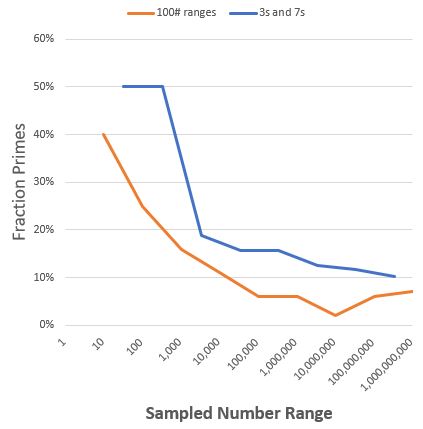
“Sort of. I sampled a series of hundred‑number ranges on up to a billion. The percentage of primes fell off as the numbers got larger, settled in at about 6%.”

“Makes sense — you got a bigger number, you got more little numbers that might divide into it.”

“Mm-hm. Something weird happens around ten million, though. The percentage drops down to only 2% but then it goes right back up to around 6% and stays there. I tried different scan resolutions but couldn’t locate any single especially long non‑prime string. The mathematicians have carried the research a lot further than my little experiment. The Prime Number Theorem gives a general curve that’s good ‘for sufficiently large numbers,’ but a million is a small number on their scale. As a physicist I’m a bit frustrated because the Theorem says, ‘This is the way it is‘ but it doesn’t give a reason. Although there probably isn’t a reason, any more than there’s a reason for 2017 being a prime to begin with.”

“I know what you mean. My car’s Owner Manual is the same way. Uhh… as I recall, you had a post a while ago about primes and 3’s and 7’s.”

“That was for New Year 2016, to be exact. Yeah, I found a collection of primes like 3337 and 733333 that have a string of 3’s or 7’s fronted and trailed by 3’s or 7’s. It wasn’t a bad bet. No primes (except 2 and 5) can have 0, 2, 4, 5, 6 or 8 as a trailing digit, right?”

“Lemme think for a minute. … Right.”

“That list didn’t include scrambled combinations like 37737, so what I did this year was to use Old Reliable to construct a big list of all possible 3’s‑and‑7’s numbers between 3 and a billion.”

“That’s a lot of numbers.”

“Not so many, actually, only about 1000. I told Old Reliable not to sample numbers that have any non‑3‑or‑7 digit buried in them somewhere. That’s a lot of pass‑overs.”

“That’s a lot of checking and skipping.”

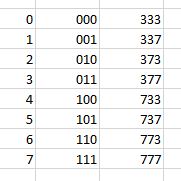
“I used a short cut. It’s easy to build a list of all possible numbers with a certain number of binary digits — just count in binary. The three‑digit binary numbers, for instance, give you every zero‑one combination between 000 is zero and 111 is seven. Then I converted all the zeroes to 3’s and all the ones to 7’s and got every 3’s‑and‑7’s number between a hundred and a thousand with no interlopers. As a bonus that method organizes the overall list by powers of ten, like 333 to 777 in a sublist, 3333 to 7777 in another and so on. I counted the primes in each sublist and charted all the sublist percentages in the same graph as the hundred‑number sampling. Pretty much the same curve, but no dip near 10 million. For the heck of it I played the same game with 1’s and 9’s. Same behavior. Oh well.”

“So that’s how you keep yourself occupied on a slow day, huh? I got a New Year prediction for you.”

“What’s that?”

“I’m gonna bring you a couple fresh decks of playing cards.”

~~ Rich Olcott