Math Poetry

Eddie serves a good pizza. I amble over to the gelato stand for a chaser. “Evening, Jeremy. You’re looking a little distraught.”

“I am, Mr Moire. Just don’t ask me to quantify it! Math is getting me down. Why do they shove so much of it at us? You don’t put much math into your posts and they make sense mostly.”

“Thanks for the mostly. … Do you enjoy poetry?”

“Once I read some poems I liked. Except in English class. They spend too much time classifying genre and rhyme scheme instead of just looking at what the poet wrote. All that gets in the way.”

“Interesting. What is it that you like about poetry?”

“Mmm, part of it is how it can imply things without really saying them, part of it is how compact a really good one is. I like when they cram the maximum impact into the fewest possible words — take out one word and the whole thing falls apart. That’s awesome when it works.”

“Well, how does it work?”

“Oh, there’s lots of techniques. Metaphor’s a biggie — making one thing stand for something else. Word choice, too — an unexpected word or one with several meanings. Sometimes it’s a challenge finding the word that has just the right rhythm and message.”

“Ah, you write, too. When you compose something, do you use English or Navajo?”

“Whichever fits my thought better. Each language is better at some things, worse at others. A couple of times I’ve used both together even though only rez kids would understand the mix.”

“Makes sense. You realize, of course, that we’ve got a metaphor going here.”

“We do? What standing for what?”

“Science and Poetry. I’ve often said that Physics is poetry with numbers. Math is as much a language as English and Navajo. It has its own written and spoken forms just like they do and people do poetry with it. Like them, it’s precise in some domains and completely unable to handle others. Leaning math is like learning a very old language that’s had time to acquire new words and concepts. No wonder learning it is a struggle.”

“Poetry in math? That’s a stretch, Mr Moire.”

“Prettiest example I can think of quickly is rhyming between the circular and hyperbolic trigonometric systems. The circular system’s based on the sine and cosine. The tangent and such are all built from them.”

“We had those in class — I’ll remember ‘opposite over hypotenuse‘ forever and I got confused by all the formulas — but why do you call them circular and what’s ‘hyperbolic‘ about?”

“Here, let me use Ole Reliable to show you some pictures. I’m sure you recognize the wavy sine and cosine graphs in the circular system. The hyperbolic system is also based on two functions, ‘hyperbolic sine‘ and ‘hyperbolic cosine,’ known in the trade as ‘sinh‘ and ‘cosh.’ They don’t look very similar to the other set, do they?”

“Sure don’t.”
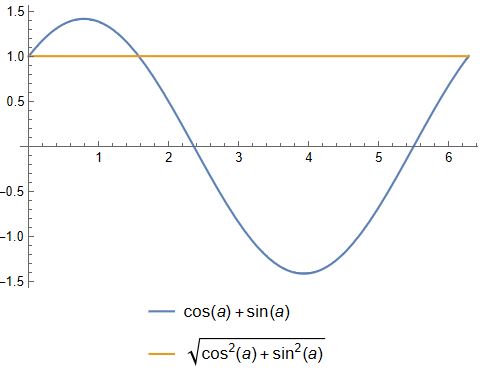
“But for every circular function and formula there’s a hyperbolic partner. Now watch what happens when we combine a sine and cosine. I’ll do it two ways, a simple sum and the Pythagorean sum.”

“Pythagorean?”

“Remember his a2+b2=c2? The orange curve comes from that, see in the legend underneath?”

“Oh, like a right triangle’s hypotenuse. But the orange curve is just a flat straight line.”

“True, as we’ve known since Euler’s day. Are you familiar with polar coordinates?”

“A little. There’s a center, one coordinate is distance from the center, and the other coordinate is the angle you’ve rotated something, right?”

“Good enough. Here’s what the same two combinations look like in polar coordinates..”

“Wow. Two circles. I never would have guessed that.”

“Mm-hm. Check the orange circle, the one that was just a level straight line on the simple graph. It’s centered on the origin. That tells us the sum of the squares is invariant, doesn’t change with the angle.”

“Do the hyperbolic thingies make hyperbolas when you add them that way?”

“Not really, just up-curving lines. The plots for their differences are interesting though. For these guys the Pythagorean difference is invariant. Einstein’s relativity is based on that property.”

“Pretty, like you say.”

~~ Rich Olcott

Imagine A Skyrocket Inside A Black Hole

Vinnie’s never been a patient man. “We’re still waiting, Sy. What’s the time-cause-effect thing got to do with black holes and information?”

“You’ve got most of the pieces, Vinnie. Put ’em together yourself.”

“Geez, I gotta think? Lessee, what do I know about black holes? Way down inside there’s a huge mass in a teeny singularity space. Gravity’s so intense that relativity theory and quantum mechanics both give up. That can’t be it. Maybe the disk and jets? No, ’cause some holes don’t have them, I think. Gotta be the Event Horizon which is where stuff can’t get out from. How’m I doing, Sy?”

“You’re on the right track. Keep going.”

“Okay, so we just talked about how mass scrambles spacetime, tilts the time axis down to point towards where mass is so axes stop being perpendicular and if you’re near a mass then time moves you even closer to it unless you push away and that’s how gravity works. That’s part of it, right?”

“As rain. So mass and gravity affect time, then what?”

“Ah, Einstein said that cause‑and‑effect runs parallel with time ’cause you can’t have an effect before what caused it. You’re saying that if gravity tilts time, it’ll tilt cause‑and‑effect?”

“So far as we know.”

“That’s a little weasel-ish.”

“Can’t help it. The time‑directed flow of causality is a basic assumption looking for counter‑examples. No‑one’s come up with a good one, though there’s a huge literature of dubious testimonials. Something called a ‘closed timelike curve‘ shows up in some solutions to Einstein’s equations for extreme conditions like near or inside a black hole. Not a practical concern at our present stage of technology — black holes are out of reach and the solutions depend on weird things like matter with negative mass. So anyhow, what happens to causality where gravity tilts time?”

“I see where you’re going. If time’s tilted toward the singularity inside a black hole, than so is cause‑and‑effect. Nothing in there can cause something to happen outside. Hey, bring up that OVR graphics app on Old Reliable, I’ll draw you a picture.”

“Sure.”

“See, way out in space here this circle’s a frame where time, that’s the red line, is perpendicular to the space dimensions, that’s the black line, but it’s way out in space so there’s no gravity and the black line ain’t pointing anywhere in particular. Red line goes from cause in the middle to effect out beyond somewhere. Then inside the black hole here’s a second frame. Its black line is pointing to where the mass is and time is tilted that way too and nothing’s getting away from there.”

“Great. Now add one more frame right on the border of your black hole. Make the black line still point toward the singularity but make the red line tangent to the circle.”

“Like this?”

“Perfect. Now why’d we put it there?”

“You’re saying that somewhere between cause-effect going wherever and cause-effect only going deeper into the black hole there’s a sweet spot where it doesn’t do either?”

“Exactly, and that somewhere is the Event Horizon. Suppose we’re in a mothership and you’re in our shuttlecraft in normal space. You fire off a skyrocket. Both spacecraft see sparks going in every direction. If you dive below an Event Horizon and fire another skyrocket, in your frame you’d see a normal starburst display. If we could check that from the mothership frame, we’d see all the sparks headed inward but we can’t because they’re all headed inward. All the sparkly effects take place closer in.”

“How about lighting a firework on the Horizon?”

“Good luck with that. Mathematically at least, the boundary is infinitely thin.”

“So bottom line, light’s trapped inside the black hole because time doesn’t let the photons have an effect further outward than they started. Do I have that right?”

“For sure. In fact, you can even think of the hole as an infinite number of concentric shells, each carrying a causality sign reading ‘Abandon hope, all ye who enter here‘. So what’s that say about information?”

“Hah, we’re finally there. Got it. Information can generate effects. If time can trap cause‑effect, then it can trap information, too.”

~~ Rich Olcott

Tilting at Black Holes

“What’s the cause-effect-time thing got to do with black holes and information?”

“We’re getting there, Al. What happens to spacetime near a black hole?”

“Everybody knows that, Sy, spacetime gets stretched and squeezed until there’s infinite time dilation at the Event Horizon.”

“As usual, Vinnie, what everybody knows isn’t quite what is. Yes, Schwarzschild’s famous solution includes that Event Horizon infinity but it’s an artifact of his coordinate system. Al, you know about coordinate systems?”

“I’m a star-watcher, Sy. Sure, I know about latitude and longitude, declination and right ascension, all that stuff no problem.”

“Good. Well, Einstein wrote his General Relativity equations using generalized coordinates, like x,y,z but with no requirement that they be straight lines or at right angles. Schwarzschild solved the equations for a non‑rotating sphere so naturally he used spherical coordinates — radius, latitude and longitude. Since then other people have solved the equations for more complicated cases using more complicated coordinate systems. Their solutions don’t have that infinity.”

“No infinity?”

“Not that one, anyhow. The singularity at the hole’s geometric center is a real thing, not an artifact. So’s a general Event Horizon, but it’s not quite where Schwarzschild said it should be and it doesn’t have quite the properties that everybody thinks they know it has. It’s still weird, though.”

“How so?”

“First thing you have to understand is that when you get close to a black hole, you don’t feel any different. Except for the spaghettification, of course.”

“It’s frames again, ain’t it?”

“With black holes it’s always frames, Vinnie. If you’re living in a distorted space you won’t notice it. Whirl a meter‑long sword around, you’d always see it as a meter long. A distant observer would see you and everything around you as being distorted right along with your space. They’ll see that sword shrink and grow as it passes through different parts of the distortion.”

“Weird.”

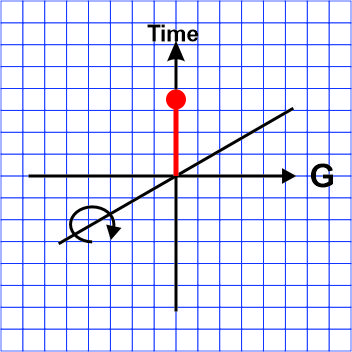
“We’re just getting started, Al. Time’s involved, too. <grabbing a paper napkin and sketching> Here’s three axes, just like x,y,z except one’s time, the G one points along a gravity field, and the third one is perpendicular to the other two. By the way, Al, great idea, getting paper napkins printed like graph paper.”

“My location’s between the Physics and Astronomy buildings, Sy. Gotta consider my clientele. Besides, I got a deal on the shipment. What’s the twirly around that third axis?”

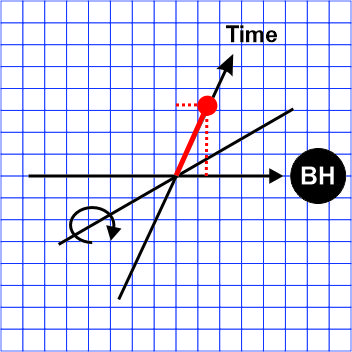
“It’s a reminder that there’s a couple of space dimensions that aren’t in the picture. Now suppose the red ball is a shuttlecraft on an exploration mission. The blue lines are its frame. The thick vertical red line shows it’s not moving because there’s no spatial extent along G. <another paper napkin, more sketching> This second drawing is the mothership’s view from a comfortable distance of the shuttlecraft near a black hole.”

“You’ve got the time axis tilted. What’s that about?”

“Spacetime being distorted by the black hole. You’ve heard Vinnie and me talk about time dilation and space compression like they’re two different phenomena. Thing is, they’re two sides of the same coin. On this graph that shows up as time tilted to mix in with the BH direction.”

“How about those twirly directions?”

“Vinnie, you had to ask. In the simple case where everything’s holding still and you’re not too close to the black hole, those two aren’t much affected. If the big guy’s spinning or if the Event Horizon spans a significant amount of your sky, all four dimensions get stressed. Let’s keep things simple, okay?”

“Fine. So the time axis is tilted, so what?”

“We in the distant mothership see the shuttlecraft moving along pure tilted time. The shuttlecraft doesn’t. The dotted red lines mark its measurements in its blue‑line personal frame. Shuttlecraft clocks run slower than the mothership’s. Worse, it’s falling toward the black hole.”

“Can’t it get away?”

“Al, it’s a shuttlecraft. It can just accelerate to the left.”

“If it’s not too close, Vinnie. The accelerative force it needs is the product of both masses, divided by the distance squared. Sound familiar?”

“That’s Newton’s Law of Gravity. This is how gravity works?”

“General Relativity cut its teeth on describing that tilt.”

~~ Rich Olcott

Cause, Effect And Time

We’re still at Vinnie’s table by the door of Al’s coffee shop. “Long as we’re talking about black holes, Sy, I read in one of my astronomy magazines that an Event Horizon traps information the same way it traps light. I understand how gravity makes escape velocity for photons go beyond lightspeed, but how does that trap information?”

“Well, to start with, Al, you understand wrong. The whole idea of escape velocity applies to massive objects like rockets that feel the force of gravity. Going up they trade kinetic energy for potential energy; given enough kinetic energy they escape. Photons have zero mass — the only way gravity influences them is by bending the spacetime they fly through.”

“Does the bending also affect information or is that something else?”

Minkowski’s spacetime diagram…

“Fair question, but it’ll take some background to answer it. Good thing I’ve got Old Reliable and my graphics files along. Let’s start with this one. Vinnie’s seen a lot of spacetime graphs like this, Al, but I don’t think you have. Time runs upward, distance runs sideward, okay? Naming a specific time and location specifies an event, just like a calendar entry. Draw a line between two events; the slope is the speed you have to go to get from one to the other.”

“Just the distance, you’re not worrying about direction?”

“Good question. You’re thinking space is 3D and this picture shows only one space dimension. Einstein’s spacetime equations take account of all four dimensions mixing together, which is one reason they’re so hard to solve except in special cases. For where we’re going, distance will be enough, okay?”

“Not gonna argue.”

… compartmentalized by Einstein’s speed limit …

“Now we roll in Einstein’s speed limit. Relativity says that nothing can go faster than light. On a Minkowski diagram like this we draw the lightspeed slope at a 45″ angle. Any physical motion has a slope more vertical than that.”

“Huh?”

“See, Al, you’re going one second per second along time, right? If you’re not making much progress distance‑wise, you don’t do much on Sy’s sideways axis. You move mostly up.”

“Exactly, Vinnie. The bottom and top sections are called ‘timelike‘ because, well, they’re mostly like time.”

“Are the other two sections spacelike?”

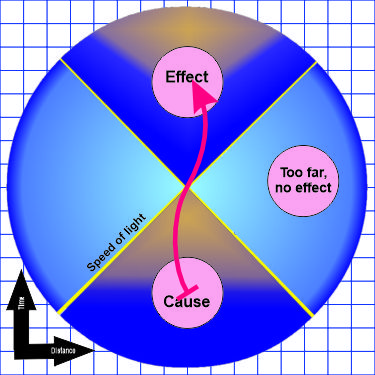
“Absolutely. You can’t get from ‘Here & Now‘ to the ‘Too far to see‘ event without going faster than light. Einstein said that’s a no‑no. Suppose that event’s a nova, ‘Now‘ but far away. Astronomers will have to just wait until the nova’s light reaches them at ‘Here‘ but at a later ‘Now.’ Okay, Vinnie, here’s a graphic you haven’t seen yet.”

… and re-interpreted in terms of causality.

“Looks pretty much the same, except for that arrow. What’s cause and effect got to do with time?”

“I don’t want to get into the metaphysical weeds here. There’s a gazillion theories about time — the Universe is expanding and that drives time; entropy always increases and that drives time; time is an emergent property of the underlying structure of the Universe, whatever that means. From an atomic, molecular, mechanical physics point of view, time is the result of causes driving effects. Causes always come first. Your finger bleeds after you cut it, not before. Cause‑effect runs along the time axis. Einstein showed us that cause‑effect can’t travel any faster than lightspeed.”

“That’s a new one. How’d he figure that?”

“Objects move objects to make things happen. They can’t move faster than lightspeed because of the relativity factor.”

“What if the objects are already touching?”

“Your hand and that cup are both made of atoms and it’s really their electric fields that touch. Shifting fields are limited by lightspeed, too.”

“So you’re saying that cause-effect is timelike.”

“Got it in one. Einstein would say causality is not only timelike, but exactly along the time axis. That’s one big reason he was so uncomfortable about action at a distance — a cause ‘Here‘ having an effect ‘There‘ with zero time elapsed would be a horizontal line, pure spacelike, on Minkowski’s graph. Einstein invented the principle of entanglement as a counterexample, thinking it impossible. He’d probably be shocked and distressed to see that today we have experimental proof of entanglement.”

~~ Rich Olcott