Climbing Out Of A Well

Al can’t contain himself. “Wait, it’s gravity!”

Vinnie and I are puzzled. “Come again?”

“Sy, you were going on about how much speed a rocket has to shed on the way to some special orbit around Mars, like that’s a big challenge. But it’s not. The rocket’s fighting the Sun’s gravity all the way. That’s where the speed goes. The Earth’s gravity, too, a little bit early on, but mostly the Sun’s, right?”

“Good point, Al. Sun gravity’s what bends the rocket onto a curve instead of a straight line. Okay, Sy, you got a magic equation that accounts for the shed speed? Something’s gotta, ’cause we got satellites going around Mars.”

“Good point, Vinnie, and you’re right, there is an equation. It’s not magic, you’ve already seen it and it ties kinetic energy to gravitational potential energy.”

“Wait, if I remember right, kinetic energy goes like mass times velocity squared. How can you calculate that without knowing how big the rocket is?”

“Good question. We get around that by thinking things through for a unit mass, one kilogram in SI units. We can multiply by the rocket’s mass when we’re done, if we need to. The kinetic energy per unit mass, we call that specific kinetic energy, is just ½v². Look familiar?”

“That’s one side of your v²=2GM/R equation except you’ve got the 2 on the other side.”

“Good eye, Al. The right-hand side, except for the 2, is specific gravitational potential energy, again for unit mass. But we can’t use the equation unless we know the kinetic energy and gravitational potential are indeed equal. That’s true if you’re in orbit but we’re talking about traveling between orbits where you’re trading kinetic for potential or vice versa. One gains what the other loses so Al’s right on the money. Traveling out of a gravity well is all about losing speed.”

Al’s catching up. “So how fast you’re going determines how high you are, and how high you are says how fast you have to be going.”

Vinnie frowns a little. “I’m thinking back to in‑flight refueling ops where I’m coming up to the tanker from below and behind while the boom operator directs me in. That doesn’t sound like it’d work for joining up to a satellite.”

“Absolutely. If you’re above and behind you could speed up to meet the beast falling, or from below and ahead you could slow down to rise. Away from that diagonal you’d be out of luck. Weird, huh?”

“Yeah. Which reminds me, now we’re talking about this ‘deeper means faster‘ stuff. How does the deep‑dive maneuver work? You know, where they dive a spacecraft close to a planet or something and it shoots off with more speed than it started with. Seems to me whatever speed it gains it oughta give up on the way out of the well.”

“It’s a surprise play, alright, but it’s actually two different tricks. The slingshot trick is to dive close enough to capture a bit of the planet’s orbital momentum before you fly back out of the well. If you’re going in the planet’s direction you come out going faster than you went in.”

“Or you could dive in the other direction to slow yourself down, right?”

“Of course, Al. NASA used both options for the Voyager and Messenger missions. Vinnie, I know what you’re thinking and yes, theoretically stealing a planet’s orbital momentum could affect its motion but really, planets are huge and spacecraft are teeny. DART hit the Dimorphos moonlet head-on and slowed it down by 5%, but you’d need 66 trillion copies of Dimorphos to equal the mass of dinky little Mercury.”

“What’s the other trick?”

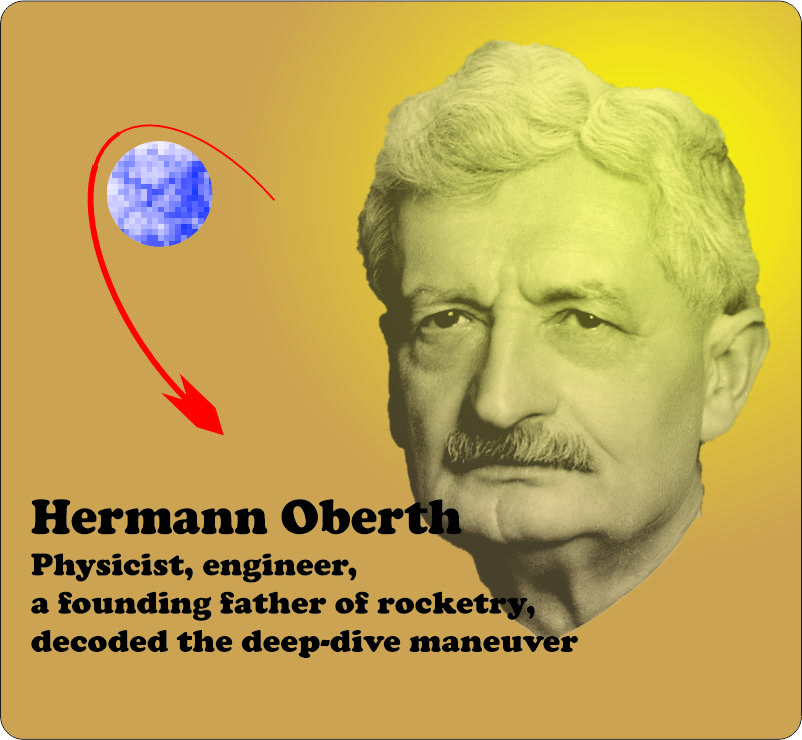
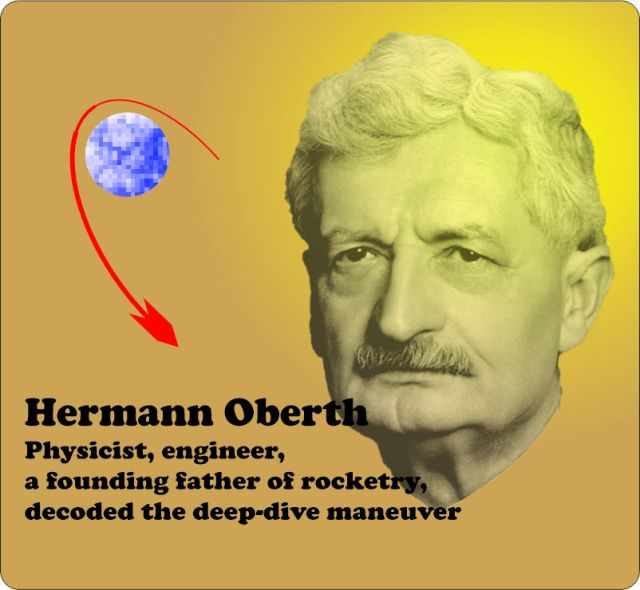
“Dive in like with the slingshot, but fire your rocket engine when you’re going fastest, just as the craft approaches its closest point to the planet. Another German rocketeer, Hermann Oberth, was the first to apply serious math to space navigation. This trick’s sometimes called the Oberth effect, though he didn’t call it that. He showed that rocket exhaust gets more effective the faster you’re going. The planet’s gravity helps you along on that, for free.”

“Free help is good.”
~~ Rich Olcott

Not Too Fast, Not Too Slow

“Vinnie, those nifty-looking transfer orbits that Hohmann invented but didn’t get to patent — you left something out.”

“What’s that, Sy?”

“The geometry looks lovely — a rocket takes off tangent to its orbit around one planet or something and inserts along a tangent to an orbit around something else. Very smooth and I can see how that routing avoids having to spend fuel to turn corners. But that ignores speeds.”

“What difference does that make?”

“It makes a difference whether or not you can get into the orbit you’re aiming for. Any orbit is a trade-off between gravity’s pull and the orbiter’s kinetic energy. Assuming you’re going for a circular orbit, there’s a strict relationship between your final height and your approach speed when you’re finally flying on the horizontal. You don’t want to come in too fast or too slow.”

“First thing I learned in pilot school. But that relationship’s an equation, ain’t it?”

“A couple, actually, but they’re simple. Let’s back into the problem. Say your mission is to put a communications relay satellite into lunastationary orbit around the Moon—”

“Lunastationary?”

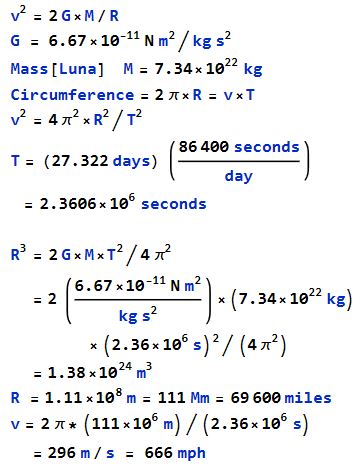
“Like geostationary, but with the Moon. The satellite’s supposed to hover permanently above one spot on the Moon’s equator, so its orbital period has to equal the Moon’s ‘day,’ <pulling out Old Reliable, tapping> which is 27.322 days. Your satellite must loop around the Moon in exactly that much time. Either it’s scooting at low altitude or it’s ambling along further up. If we knew the speed we could find the radius, and if we knew the radius we could find the speed. We need some math.”

“I knew it. You’re gonna throw calculus at me.”

“Relax, Vinnie, it’s only algebra and we’re only going to combine two formulas and you already know one of them. The one you don’t know connects the speed, which I’m calling v, with the radius, R. They’re tied together by the Moon’s mass, M and Newton’s gravitational constant G. The formula is v2=2G×M/R. You can handle that, right?”

“Lessee … that says if I either double the mass or cut the distance by two, the speed has to be four times larger. Makes sense ’cause that’s about being in a deeper gravity well or getting closer in. Am I on track?”

“Absolutely. Next formula is the one you know, the circumference of a circle or in this case, the distance around that orbit.”

“That’s easy, 2πR.”

“And that’s also speed times the time, T so I’ll set those equal. <tapping on Old Reliable> Okay, the first formula says v2 so I square the circumference equation and solve that for v2 . You still with me?”

“You’re gonna set those two v-squareds equal, I suppose.”

“You’re still on track. Yup and then I gather the Rs on one side and everything else on the other. That gives me something in R3 but that’s okay. Plug in all the numbers, take the cube root and we get that you need to position that satellite 111 megameters out from the Moon’s center, flying at 296 meters per second. Think you can manage that?”

“Given the right equipment, sure. Seventy thousand miles out from the Moon … pretty far.”

“It’s about ¾ of the way to the Moon from Earth.”

“Cool. Does that R3 formula work for the planets?”

“Sure. Works for the Sun, too, but that’s so massive and spins so fast the sol‑stationary orbit’s half way to Mercury. An orbiter would have to fly 205 000 miles an hour to keep up with an equatorial sunspot. Flying something‑stationary over other planets offers problems beyond targeting the orbit, though.”

“Besides how long the trip would be?”

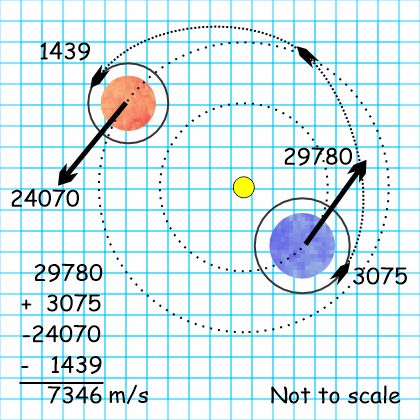
“Well, that, yes, but here’s another one. Suppose you’re going to Mars, aiming at an ares‑stationary orbit. It’ll be 20 megameters, 12500 miles from the center. You need to make your tangential injection at a Mars‑relative speed of 1439 meters per second. Problem is, you left Earth from a geostationary orbit at 3075 m/s relative to Earth. At the classic Hohmann positions, Earth’s going 5710 m/s relative to Mars, Somehow you’re going to have to shed 7346 m/s per second of excess speed.”

~~ Rich Olcott

Carefully Considered Indirection

“C’mon, Vinnie, you’re definitely doing Sy stuff. I ask you a question about how come rockets can get to the Moon easier than partway and you go round the barn with ballistics and cruisers. Stop dodging.”

“Now, Al, Vinnie’s just giving you background, right. Vinnie?”

“Right, Sy, though I gotta admit a lot of our talks have gone that way. So what’s your answer?”

“Nice try, Vinnie. You’re doing fine, so keep at it.”

“Okay. <deep breath> It has to do with vectors, Al, combination of amount and direction, like if you’re going 3 miles north that’s a vector. You good with that?”

“If you say so.”

“I do. Then you can combine vectors, like if you’re going 3 miles north and at the same time 4 miles east you’ve gone 5 miles northeast.”

“That’s a 3-4-5 right triangle, even I know that one. But that 5 miles northeast is a vector, too, right?”

“You got the idea. Now think about fueling a rocket going up to meet the ISS.”

“Sy said it’s 250 miles up, so we need enough fuel to punch that far against Earth’s gravity.”

“Not even close. If the rocket just went straight up, it’d come straight down again. You need some sideways momentum, enough so when you fall you miss the Earth.”

“Miss the Earth? Get outta here!”

“No, really. Hey, Sy, you tell him.”

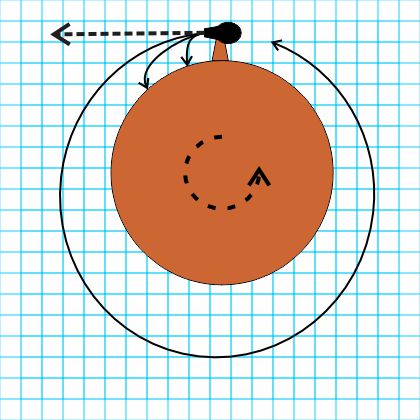
“Vinnie’s right, Al. That insight goes back to Newton. He proposed a thought experiment about building a powerful cannon to fire horizontally from a very tall mountain. <sketching on paper napkin> A ball shot with a normal load of powder might hit the adjacent valley. Shoot with more and more powder, balls would fly farther and farther before hitting the Earth. Eventually you fire with a charge so powerful the ball flies far enough that its fall continues all around the planet. Unless the cannon blows up or the ball shatters.”

“That’s my point, Al. See, Newton’s cannon balls started out going flat, not up. To get up and into orbit you need up and sideways velocity, like on the diagonal. You gotta calculate fuel to do both at the same time.”

“So what’s that got to do with easier to get to the Moon than into orbit?”

“‘S got everything to do with that. Not easier, though, just if you aim right the vectors make it simpler and cheaper to carry cargo to the Moon than into Earth orbit.”

“So you just head straight for the Moon without going into orbit!”

“Not quite that simple, but you got the general idea. Remember when I brought that kid’s top in here and me and Sy talked about centrifugal force?”

“Do I? And I made you clean up all those spit-wads.”

“Yeah, well, suppose that cannon’s at the Equator <adding dotted lines to Sy’s diagram> and aimed with the Earth’s spin and suppose we load in enough powder for the ball to go straight horizontal, which is what it’d do with just centrifugal force.”

“If I’m standing by the cannon it’d look like the ball’s going sideways.”

“Yup. Basically, you get the up‑ness for free. We’re not talking about escape velocity here, that’s different. We’re talking about the start of a Hohmann orbit.”

“Who’s Hohmann?”

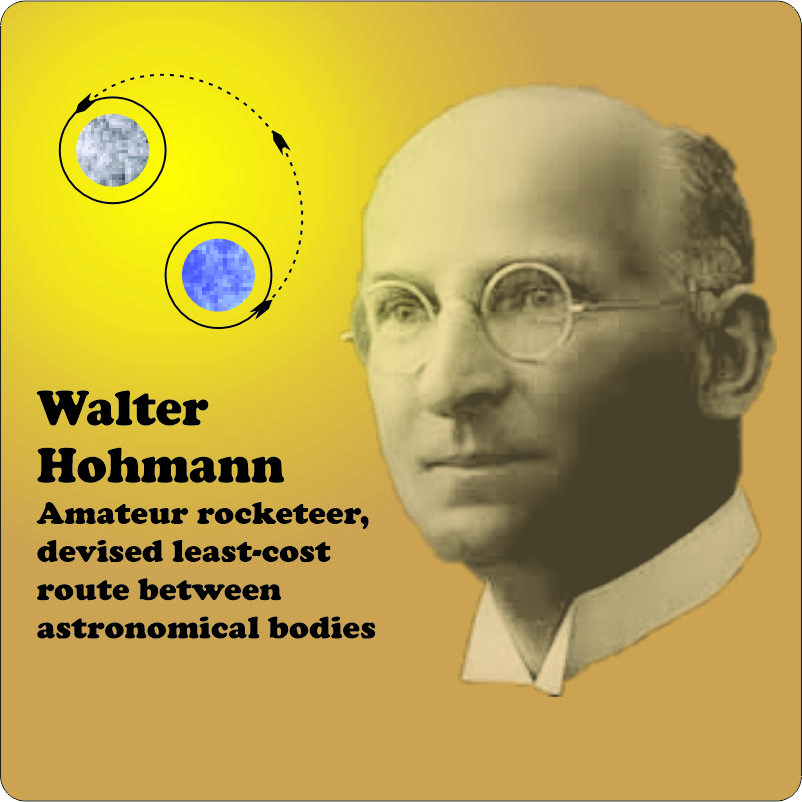
“German engineer. When he was a kid he read sci‑fi like the rest of us and that got him into the amateur rocketry scene. Got to be a leader in the German amateur rocket club, published a couple of leading‑edge rocket science books in the 1920s but dropped out of the field when the Nazis started rolling and he figured they’d build rocket weapons. Anyhow, he invented this orbit that starts off tangent to a circle around one planet or something, follows an ellipse to end tangent to a circle around something else. Smooth transitions at both ends, cheapest way you can get from here to there. Kinks in the routing cost you fuel and cargo capacity to turn. Guy shoulda patented it.”

“Wait, an orbit’s a mathematical abstraction, not a thing.”

“Patent Office says it’s a business method, Sy. Check out PAS-22, for example.”

“Incredible.”

~ Rich Olcott

  • Thanks to Ken, who asked another question.

The Cold Equation

Afternoon break time. I’m enjoying one of Al’s strawberry scones when he plops one of his astronomy magazines on Vinnie’s table. “Vinnie, you bein’ a pilot and all, could you ‘splain some numbers which I don’t understand? It’s this statistics table for super‑heavy lifter rockets. I think it says that some of them can carry more cargo to the Moon than if they only go partway there. That’s nuts, right?”

Vehicle Payload to LEO GSO Payload TLI Payload
Energia 100 20 32
Falcon Heavy 64 27 28
NASA’s SLS 1b 105 42
SpaceX Starship 100
Yenisei 103 26 28
Yenisei Don 140 30 33
LEO=Low Earth Orbit, GSO = Geosynchronous Orbit, TLI=Trans Lunar Injection
Payloads in metric tons (megagrams)

“Lemme think … LEO is anywhere up to about 2000 kilometers. GSO is about 36000 kilometers out, so it makes sense that with the same amount of fuel and stuff you can’t lift as much out there. TLI … that’s not to the Moon, that’s to a point where you can switch from orbiting the Earth to orbiting the Moon so, yeah, that’s gonna be way farther out, like a couple hundred thousand kilometers or more depending.”

“Depending on what?”

“Oh, lots of things — fuel, orbit, design philosophy—”

“Now wait, you been taking Sy lessons. Philosophy?”

“No, really. There’s two basic ways to do space travel, either you’re ballistic or you’re cruising. All the spacecraft blast‑offs you’ve seen are ballistic. Use up most of your fuel to get a good running start and then basically coast the rest of the way to your target. Ballistic means you gotta aim careful from the get‑go. That’s the difference between ballistic and cruise missiles. Cruisers keep burning fuel and accelerating. That lets ’em change directions whenever.”

“Cruisers are better, right, so you can point at different asteroids? I read about that weird orbit they had to send the Lucy mission on.”

“Actually, Lucy used the ballistic‑and‑coast model. NASA spent a bucketful of computer time calculating exactly where to point and when to lift off so Lucy could visit all those asteroids.”

“Why not just use a cruise strategy and skip around?”

“Cruisers are just fine once you’re up between planets. NASA’s Dawn mission to the Vesta and Ceres asteroids used a cruise drive — but only after the craft rode a boostered Delta‑II ballistic up to low Earth orbit. Nine boosters worth of ballistic. The problem is you’re caught in a double bind. You need to burn fuel to get the payload off the planet, but you need to burn fuel to get the fuel off, too. ‘S called diminishing returns. Hey, Sy, what’s that guy’s name?”

“Which guy?”

“The rocket equation guy, the Russian.”

“Ah. Tsiolkovsky. Lived in a log cabin but wrote a lot about space travel. Everything from rocket theory to airlocks and space stations. What about him?”

“I’m tellin’ Al about rockets. Tsiol… That guy’s equation says if you know how much you need to change velocity and you know your payload mass, you can figure how much fuel you need to burn to do that.”

“With some conditions, Vinnie. There’s a multiplier in there you have to calibrate for fuel, engine design. even whether you’re traveling through water or vacuum or different atmospheres. Then, the equation doesn’t figure in gravity. Oh, and it only works with straight‑line velocity change. If you want to change direction you need to use calculus to figure the—”

“Hey, I just realized why they use boosters!”

“Why’s that, Al?”

“The gravity thing. Gravity’s strongest near the Earth, right? Once the beast gets high enough, you’re not fighting as much gravity. You don’t need the extra power.”

“True, but that’s not the whole picture. The ISS orbit’s about 250 miles up, which puts it about 4250 miles from the planet’s center. Newton’s Law of Gravity says the field all the way up there is still about 88% of what’s at the surface. The real reason is that a booster’s basically a fuel tank. Once you’ve burned the fuel you don’t need the tank and that’s a lot of weight to carry for nothing.”

“Right, tank and engine don’t count as payload so dump ’em.”

“Seems cold‑hearted, though.”

~~ Rich Olcott