The Sky’s The Limit

Another meeting of the Acme Pizza and Science Society, at our usual big round table in Pizza Eddie’s place on the Acme Building’s second floor. (The table’s also used for after‑hours practical studies of applied statistics, “only don’t tell nobody, okay?“) It’s Eddie’s turn to announce the topic for the evening. “This one’s from my nephew, guys. How high up is the sky on Mars?”

General silence ensues, then Al throws in a chip. “Well, how high up is the sky on Earth?”

Being a pilot, Vinnie’s our aviation expert. “Depends on who’s defining ‘sky‘ and why they did that. I’m thinking ‘the sky’s the limit‘ and for me that’s the highest altitude I can get up to legal‑like. Private prop planes generally stay below 10,000 feet, commercial jets aren’t certified above 43,000 feet, private jets aren’t supposed to go above 51,000 feet.”

Eddie counters. “How about the Concorde? And those military high-flyers?”

“They’re special. The SST has, um, had unique engineering to let it go up to 60,000 feet ’cause they didn’t want sonic boom complaints from ground level. But it don’t fly no more anyhow. I’ve heard that the Air Force’s SR-71 could hit 85,000 feet but it got retired, too.”

Al’s not impressed. “All that’s legal stuff. There’s a helicopter flying on Mars but the FAA don’t make the rules there. What else we got?”

Geologist Kareem swallows his last bite of cheese melt. “How about the top of the troposphere? That’s the lowest layer of our atmosphere, the one where most of our weather and sunset colors happen. If you look at clouds in the sky, they’re inside the troposphere.”

“How high is that?”

“It expands with heating, so the top depends where you’re measuring. At the Equator it can be as high as 18½ kilometers; near a pole in local winter the top squeezes down to 6 kilometers or so. And to your next question — above the troposphere we’ve got the stratosphere that goes up to 50 kilometers. What’s that in feet, Sy?”

<drawing Old Reliable and screen-tapping…> “Says about 31.2 miles or 165,000 feet. Let’s keep things in kilometers from here on, okay?”

“Then you’ve got the mesosphere and the exosphere but the light scattering that gives us a blue sky happens below them so I’d say the sky stops at 50 kilometers.”

Al’s been rummaging through his astronomy magazines. “I read somewhere here that you’re not an astronaut unless you’ve gone past either 80 or 100 kilometers, which is weird with two cut‑offs. Who came up with those?”

Vinnie’s back in. “Who came up with the idea was a guy named von Kármán. One of the many Hungarians who came to the US in the 30s to get away from the Nazis. He did a bunch of advanced aircraft design work, helped found Aerojet and JPL. Anyway, he said the boundary between aeronautics and astronautics is how high you are when the atmosphere gets too thin for wings to keep you up with aerodynamic lift. Beyond that you need rockets or you’re in orbit or you fall down. He had equations and everything. For the Bell X‑2 he figured the threshold was around 52 miles up. What’s that in kilometers, Sy?”

“About 84.”

“So that’s where the 80 comes from. NASA liked that number for their astronauts but the Europeans rounded it up to 100. Politics, I suppose. Do von Kármán’s equations apply to Mars as well as Earth?”

“Now we’re getting somewhere, Vinnie. They do, sort of. It’s complicated, because there’s a four‑way tug‑of‑war going on. Your aircraft has gravity pulling you down, lift and centrifugal force pulling you up. Lift depends on the atmosphere’s density and your vehicle’s configuration. The fourth player is the kicker — frictional heat ruining the craft. Lift, centrifugal force and heating all get stronger with speed. Von Kármán based his calculations on the Bell X‑2’s configuration and heat‑management capabilities. Problem is, we’re not sending an X‑2 to Mars.”

“Can you re‑calibrate his equation to put a virtual X‑2 up there?”

“Hey, guys, I think someone did that. This magazine says the Karman line on Mars is 88 kilometers up.”

“Go tell your nephew, Eddie.”

~~ Rich Olcott

Well, well, well

<chirp, chirp> “Moire here.”

“Hi, Sy, it’s Susan Kim. I’m at a break point while this experiment runs. Do you want to check the scones at Al’s?”

“I’ve got a bad case of February, feel like just hibernating somewhere. Can’t get started on anything so I might as well head over there.”

“You need Al’s patented Morning Dynamite brew. See you in a couple of minutes.”


“Hi, Al. My usual mocha latte, please, and your special wake-up potion for Sy. He’s got the Februaries.”

“Here you go, Susan. Bottom of the pot coming at ya, Sy. It’ll get ya lively, for sure.”

<We grab a table.> “So, Susan, what’s this experiment that you can just let alone for a while?”

“One of your blog posts inspired it. Do you remember the one about warm water freezing faster than cold?”

“Sometimes it does that, but the point of the post was how it’s only randomly sometimes in some experiments and not at all in others. Are you experimenting with water freezing?”

“No, but I’m working on a related problem. I can’t say much about it other than that there’s an industrial process that depends on recovering a crystalline product from a hot, concentrated solution. The problem is that if the solution is too weak nothing crystallizes when it cools but if it’s too concentrated the whole batch solidifies in one big mass. The industry wants to find the right conditions for making lots of small crystals. I’ve got a grant to research ways to do that.”

“That does sound a little like water freezing. How did my blog post help?”

“I was thinking about how crystals form. We know a lot about how ions or molecules come in from solution to attach to the surface of a growing crystal. Either they’re electrostatically pulled to just the right spot or they bounce on and off the surface until they find a place they fit into. But how does that surface get started in the first place?”

“Well, I imagine it happens when two molecules love each other very mu— OW!”

“Sy Moire, get your mind back on Science! … Sorry, did it really hurt that much?”

“It wouldn’t have but that’s the same spot on the same shoulder that Cathleen got me on.”

“Actually, your flip remark isn’t that far from what we think happens except the correct verb is ‘attract,’ not ‘love.‘ Some researchers even call the initial speck ‘the embryo‘ but most of us say ‘nucleus.’ Nucleation might start with only a few molecules clicking into the right configuration, or it might require a cluster of hundreds being mostly right. The process might even require help from short‑lived solvent structures. So many variables. Nobody has a good predictive theory or even broadly useful models. It’s all by art and rule of thumb.”

“Sounds like a challenge.”

“Oh, it is. Here’s the tip I took from your blog post. You mentioned that some of the freezing studies used hundreds of trials and reported what percent of them froze. Most of the industrial crystallization studies work at pilot plant scale, with liters or gallons of solution going into each trial. I decided to go small instead. Lab supply companies sell culture plates for biological work. Typically they’re polystyrene trays holding up to a hundred one‑milliliter wells. I bought a bunch of those, and I also bought a machine that can automatically load the wells with whatever solutions I like. I’ve positioned it next to a temperature‑controlled cabinet with a camera to photograph a batch of trays at regular intervals.”

“Nice, so you can set up many duplicates at each chemical concentration and keep statistics on how many form crystals at each temperature.”

“At high concentrations I expect all the wells to show crystals. The obvious measurement will be crystal size range at each temperature. But with no change in apparatus I can go to lower and lower concentrations to where crystallization itself is random like the freezing experiments. Some wells will crystallize, some won’t. Statistics on those trays may tell us things about nucleation. It’s gonna be fun.”

“D’ya suppose the planets are culture plate wells for creation’s life experiments?”

~~ Rich Olcott

Visionaries Old And New

Cathleen’s back at the mic. “Let’s have a round of applause for Maria, Jeremy, Madison and C‑J. Thank you all. We have a few minutes left for questions… Paul, you’re first.”

“Thanks, Cathleen. A comment, not a question. As you know, archeoastronomy is my specialty so I applaud Jeremy’s advocacy for the field. I agree with his notion that the Colorado Plateau’s dry, thin air generally lets us see more stars than sea‑level Greeks do. When I go to a good dark sky site, it can be difficult to see the main stars that define a constellation because of all the background dimmer stars. However, I don’t think that additional stars would change the pictures we project into the sky. Most constellations are outlined from only the brightest stars up there. Dimmer stars may confuse the issue, but I very much doubt they would have altered the makeup of the constellations a culture defines. Each culture uses their own myths and history when finding figures among the stars.”

“Thanks for the confirmation from personal experience, Paul. Yes, Sy?”

“Another comment not a question. I’m struck by how Maria’s Doppler technique and Jeremy’s Astrometry complement each other Think of a distant stellar system like a spinning plate balanced on a stick. Doppler can tell you how long the stick is. Astrometry can tell you how wide the plate is. Both can tell you how fast it’s spinning. The strongest Doppler signal comes from systems that are edge‑on to us. The strongest Astrometry signal comes from systems we see face‑on. Those are the extreme cases, of course. Most systems are be at some in‑between angle and give us intermediate signals.”

“That’s a useful classification, Sy. Madison’s and C‑J’s transit technique also fits the edge‑on category. Jim, I can see you’re about to bust. What do you have to tell us about?”

“How about a technique that lets you characterize exoplanets inside a galaxy we see as only a blurry blob? This paper I just read blew me away.”

“Go ahead, you have the floor.”

“Great. Does everyone know about Earendel?” <blank looks from half the audience, mutters about ‘Lord Of The Rings?’ from several> “OK, quick refresher. Earendel is the name astronomers gave to the farthest individual star we’ve ever discovered. It’s either 13 or 28 billion lightyears away, depending on how you define distance. We only spotted it because of an incredible coincidence — the star happens to be passing through an extremely small region of space where light in our general direction is concentrated thousands‑fold into a beam towards us. Earendel may be embedded in a galaxy, but the amplification region is so narrow we can’t see stars that might be right next to it.”

<Feder’s voice> “Ya gonna tell us what makes the region?”

“Only very generally, because it’s complicated. You know what a magnifying lens does in sunlight.”

“Sure. I’ve burnt ants that way.”

“… Right. So what you did was take all the light energy hitting the entire surface of your lens and concentrate it on a miniscule spot. The concentration factor was controlled by the Sun‑to‑lens‑to‑spot distances and the surface area of the lens. Now bring that picture up to cosmological distances. The lens is the combined gravitational field of an entire galaxy cluster, billions of lightyears away from us, focusing light from Earendel’s galaxy billions of lightyears farther away. Really small spots at both ends of the light path and that’s what isolated that star.”

“That’s what got you excited?”

“That’s the start of it. This new paper goes in the other direction. The scientists used brilliant X‑ray light from an extremely distant quasar to probe for exoplanets inside a galaxy’s gravitational lens. Like one of your ants analyzing sunlight’s glare to assess dust flecks on your lens. Or at least their averaged properties. A lens integrates all the light hitting it so your ant can’t see individual grains. What it can do, though, is estimate numbers and size ranges. This paper suggests the lensing galaxy is cluttered with 2000 free‑floating planets per main‑sequence star — stars too far for us to see.”

~~ Rich Olcott

  • Thanks to Dave Martinez and Dr Ka Chun Yu for their informative comments.

To See Beneath The Starlight


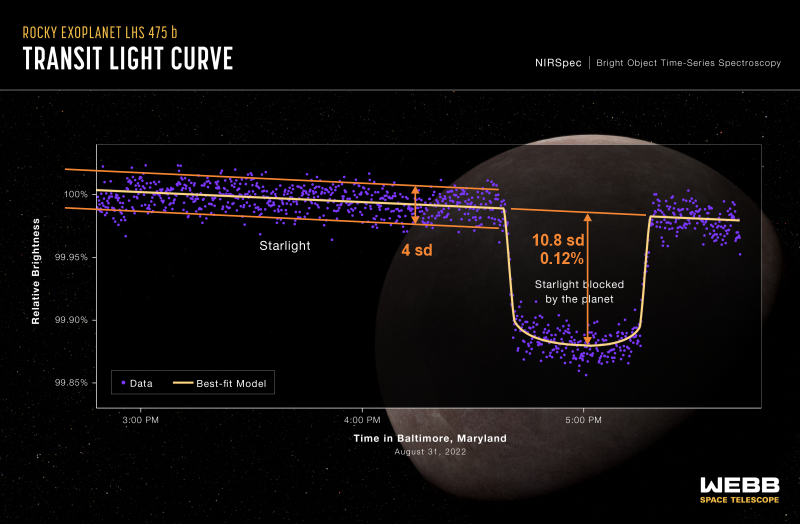
C‑J casts an image to Al’s video screen. “This is new news, just came out a couple of weeks ago. It’s the lead figure from NASA’s announcement of JWST’s first exoplanet examination. We’re picked this study because the scientists used the transit technique. I’ve added the orange stuff so we can make a point. Each blue dot is one measurement from JWST’s Near‑Infrared Spectrograph while it looked at a star named LHS 457. Even though the telescope is outside Earth’s atmosphere and operating at frigid temperatures, you can see that the numbers scatter. Surely the star’s light isn’t changing that quickly – the dots are about 9 seconds apart – the spread has to come from noise in JWST’s electronics.”

Adapted from image by NASA Credit: NASA, ESA, CSA, L. Hustak (STScI).

“We’re just partway through our statistics class but we know to expect 95% of noise to be within 2 standard deviations either way of the average. With about 400 dots per hour, C‑J drew his lines to put about 10 dots per hour each above and below.”

“Right, Madison, and the point we want to make is how small that range is. Only about 0.04% difference. That’s like one drop in a 2500‑drop titration. Professor Kim’s samples in our Chem lab generally take around 20 milliliters which is about 400 drops.”

“So anyway, look at that dip in the light curve. That’s way out of the noise range. The starlight really did dim, even though it wasn’t by much.”

“By the way, NASA’s press release is a little misleading and in fact missed the point of the research. JWST didn’t find this exoplanet, the TESS satellite system did. JWST looked where TESS said to and yup, there it was. This report was really about what JWST could tell us about the exoplanet’s atmosphere.”

“There’s a bunch of possibilities that the researchers can now eliminate. C‑J, please cast the next slide to the screen. We need to be clear, this isn’t the spectrum that JWST recorded during a transit.”

Adapted from image by NASA (Credit: NASA, ESA, CSA, L. Hustak (STScI)), and Figure 2 in Lustig-Yeager, et al.

“No, that would have been simply the star’s light after some of it was filtered through the planet’s atmosphere. The researchers used a lot of computer time to subtract out the right amount of the star’s own spectrum. This is what’s left — their estimate of the spectrum of the planet’s atmosphere if it has one. I added the orange error bar on each point and for the sake of comparisons I traced in that dotted curve marked ‘Metallicity‘ from the scientists’ paper. The other lines are models for four possible atmospheres.”

“Why orange again? And why are the bars longer to the right of that gap?”

“I like orange. I had to trace the bars for this slide because NASA’s diagram used dark grey that doesn’t show up very well. The dots in the wavelength range beyond 3.8 microns are from a noisier sensor. Professor O’Meara, we need some help here. What’s metallicity and why did the paper’s authors think it’s important?”

“We haven’t touched on that topic in class yet. ‘Metallicity’ is the fraction of a star’s material made up of atoms heavier than hydrogen and helium. A star could have high metallicity either because it was born in a dust cloud loaded with carbons and oxygens, or maybe it’s old and has generated them from its own nuclear reactions. Either way, a planet in a highmetallicity environment could have an atmosphere packed with molecules like O2, H2O, CH4 and CO2. That doesn’t seem to be the case here, does it?”

“No, ma’am. The measured points don’t have this model’s peaks or valleys. Considering the error bars, the transmission spectrum is pretty much flat. Most of the researchers’ other models also predict peaks that aren’t there. The best models are a tight cloud deck like Venus or Titan, or thin and mostly CO2 like Mars, or no atmosphere at all.”

“Even a null curve tells us more than we knew.”

~~ Rich Olcott