
“Okay, Moire, enough with the strings. I got another question.”
“Of course you do, Mr Feder, but step along more quickly, please. In this heat the sooner I get back to the air conditioning the better I’ll like it.”
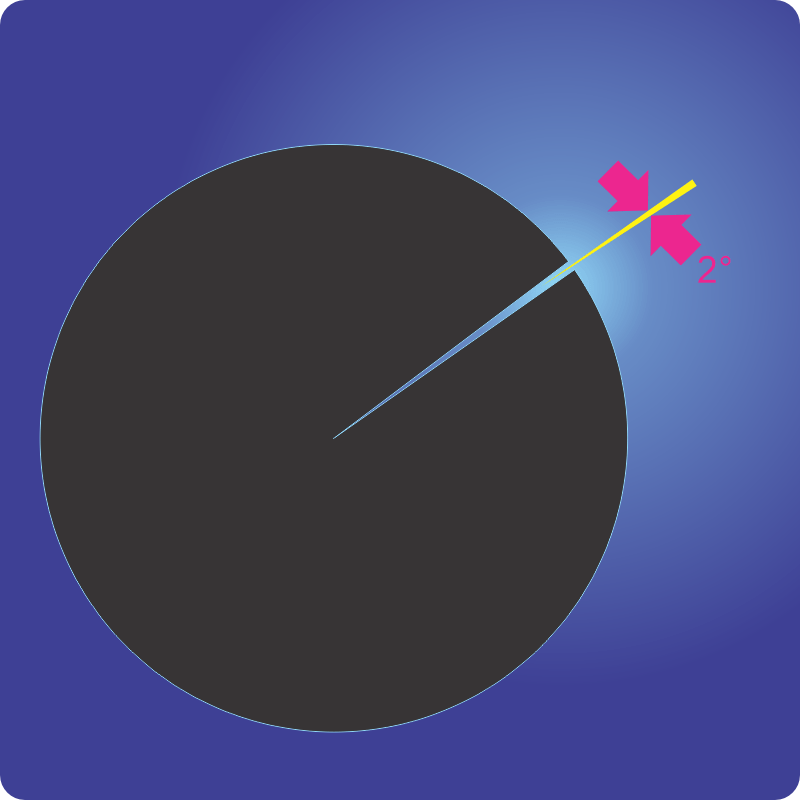
“Alright,” <puffing> “why all this fuss about the Voyager 2 spacecraft missing its target by two degrees? Earth’s pretty big, two degrees I can barely see on a protractor. Should be an easy hit.”
“Can you see the Moon?”
“Sure, if there’s no clouds in front of it. Sometimes even in the daytime.”
“A full Moon is only half a degree wide, ¼ of your two degrees.”
“No!”
“Yes.”
“But when it’s just rising it’s huge, takes up half the sky.”
“Check that carefully some evening. Hold up your hand at arm’s length. Your little finger’s about one degree wide. The Moon will be half as wide as that no matter where it is in the sky, we’ve talked about this. You can see half a degree easy and probably a lot less than that. Tycho Brahe, the last great pre‑telescope astronomer, was able to make measurements as small as 1/150 of a degree.”
“Okay, I guess two degrees is a little bigger than I was thinking. But still, Earth’s pretty big, there’s no excuse for Voyager 2 missing it by two degrees.”

“A two‑degree angle is huge when it extends across astronomical distances.” <drawing Old Reliable from its holster, tapping screen> “From Voyager 2‘s perspective at 12 billion miles out the short leg of a two‑degree isosceles triangle spans 419 million miles. That’s over twice the width of Earth’s orbit! Poor Voyager could be pointing past Mars away from us.”
“Big distances from a small angle make a long triangle, got it. What did NASA have to do to get things pointed right again?”
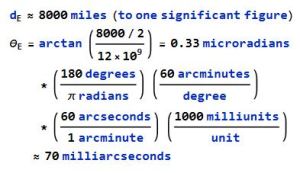
“I consider it a technological miracle. At Voyager‘s distance, Earth’s 8000‑mile diameter spans only 70 milliarcseconds. And before you ask, a milliarcsecond is a thousandth of 1/60 of 1/60 of a degree, about 3 billionths of the way across your little finger. Pretty darn small. Frankly, I’m amazed that Voyager 2 has been able to keep its antenna pointed at us so accurately for so long using tech that dates back to the mid‑70s and earlier. Our tax dollars working hard.”
“Amazing, yeah — something like that’s gotta have a kajillion moving parts. A lubrication nightmare in space I bet.”
“Not as many as you might think. The only parts that move on purpose are small things like its gyroscopes, its tracking optics and the valves on its attitude‑adjustment thrusters.”
“Wait, how’d they point the antenna towards us in the first place? I figured that was on gears.”
“Way too much play in a gear train for this level of accuracy. No, the antenna’s solidly fixed to the rest of the structure. Voyager 2‘s Attitude and Articulation Control System adjusts the whole probe as a unit using propellant bursts through its choice of little thrusters. The mass of a single burst is so small compared to the spacecraft mass that the AACS can manage milliarcsecond‑level orientation control.”
“I heard they finally got it talking to us again. How’d they manage that if it was pointed the wrong way?”
“The key is it was only mostly pointing the wrong way.”
“Like the guy’s ‘mostly dead’ in Princess Bride?”
“Mr Feder, you know that movie?”
“Hey, it’s got the greatest sword fight ever, plus the two‑cups poison challenge and the part where the pirate keeps insulting the prince. What’s not to like? Whaddaya mean, mostly the wrong way?”
“Voyager 2‘s antenna is parabolic, the best shape for transmitting a tight beam. Best doesn’t mean perfect — 50% of the beam’s power stays within a degree or so either side of the center but the rest leaks out to the sides. The same pattern applies to signal reception. Optimal reception happens when the antenna is pointing right at you. If it’s aimed off‑center, reception is worse. Our normal transmission power level wasn’t high enough to punch though the two-degree offset penalty but NASA’s extra-high-power ‘shout’ worked.”
“Caught the flash outta the corner of its eye, huh?”

~~ Rich Olcott
 Hard Science Ain't Hard