
A.I. and The Ouroboros Effect

The Acme Building Science and Pizza Society is meeting again around the big table near the kitchen in Eddie’s Pizza Place. It’s my deal so I set the next topic. “Artificial Intelligence.” There’s some muttering but play starts.

Cal has first honors. “Not my favorite thing. I hadda change my name ’cause of A.I., f’crying out loud.”

Eddie antes up a chip. “But Cal, your astronomy magazines are loaded with new discoveries that some A.I. made rummaging through godzillabytes of big telescope data. Train an A.I. on a few thousand normal galaxies and then let it chase through the godzillabytes. It says ‘Here’s a weird one‘ and the human team gets to publish papers about a square galaxy or something.”

Susan chips in. “What about all the people who’ve been saved from cancer because an A.I. found bad cells while screening histology images?”

Kareem folds. “Not much A.I. in Geology yet. Our biggest Big Data project these days is whole‑Earth tomography. That uses pretty much all the computer time we can get funds for. A.I.’s Large Language Models soak up all the research money.”

Vinnie raises by a chip. “I use autopilot a lot when I’m flying, but that’s up in the air, Great Circle point‑to‑point and no worries about pedestrian traffic. Autopilot in a car? Not for me, thanks — too many variables and I’ve seen too many crazy situations you couldn’t predict. Black ice in the winter, roadwork and bicyclists the rest of the year — I want to be able to steer and brake when I need to.”

Susan grins. “Are you a stick‑shift purist, Vinnie?”

“Naw, automatic transmissions are okay these days and besides my car uses electric motors and doesn’t even have a transmission. Lots of torque at low revs and that’s the way I like it. What about you, Cathleen? Got any A.I. war stories?”

Cathleen calls Vinnie’s raise. “A few. One thing I’ve learned — chatbots have a limited working memory. I once asked a bot to list Jupiter’s 35 biggest moons in decreasing order of size. It got the first 24 in the right order, then some more moons out of order and two of them were moons of Saturn. So ‘trust but verify‘ like the man said. Sy, you do a lot of writing. What’s your experience?”

I call Cathleen’s raise. “Mixed. I’m a generalist so I have to read a lot of papers or at least be aware of them. Summarizer bots do a decent job on some reports but miss badly when it comes to tying together material that’s not already well organized. Probably comes from that working memory limitation you noticed, Cathleen. The other problem I’ve seen doesn’t apply so much to technical work but it’s a killer for essays and fiction that have anything to do with interactions between people.”

“I’ve seen that, too. No soul.”

“Soul’s the word I’ve been looking for, Kareem. The bots are good at picking up styles and ‘who said what‘ surface material, but they fail completely at emotional subtext, the ‘why‘ that’s the actual thread of a conversation. Subtext is why we read good novels. From what I’ve been seeing recently, it’s not going to get any better.”

“Nothing does, I’m starting to think.”

“C’mon, Cal, your coffee’s improved since the city put in better water pipes. On the other hand, you owe the pot a bet.”

“Sorry. I’m still in, okay?” <sound of chips clinking> “So why’s A.I. not gonna get better? I keep reading how different ones passed tougher tests.”

“Well, that’s the thing. If you’re reading about it online, the bots are, too. What they read goes into their training database. Those impressive test scores may just be the result of inadvertent cheating — but the software’s so opaque that its developers simply don’t know whether or not that’s true. Just another case of the Ouroboros Effect.”

Eddie and Susan meet Cal’s bet, then Vinnie goes all‑in and shows his three queens. “Ouroboros, Sy?”

“The Norse World Snake that eats its tail. Bogus A.I.‑generated output used as A.I. input yields worse output. That’s a loss, not a gain. Unlike here where my four kings take the pot.”

“Geez, Sy, again?”

~~ Rich Olcott

To Fly on Another World

“Uncle Sy, why is PV=nRT the Ideal Gas Equation? Is it because it’s so simple but makes sense anyway?”

“It is ideal that way, Teena, but it’s simply an equation about gases that are ideal. Except there aren’t any. Real gases come close but don’t always follow the rule.”

“Why not? Are they sneaky?”

“Your kind of question. We like to think of gas particles as tiny ping‑pong balls that just bounce off of each other like … ping‑pong balls. That’s mostly true most of the time for most kinds of gas. One exception has to do with stickiness. Water’s one of the worst cases because its H2O molecules like to chain up. When two H2Os collide, if they’re pointed in the right directions they share a hydrogen atom like a bridge and stick together. If that sort of stickiness happens a lot then the quantity measure n acts like it’s less than we’d expect. That makes the PV product smaller.”

“I bet that doesn’t happen much when the gas is really hot. Two particles might stick and then BANG! another particle hits ’em and breaks it up!”

“Good thinking and that’s true. But there’s another kind of exception that holds even at high temperatures. A well‑behaved gas is mostly empty space because the ping‑pong balls are far apart unless they’re actually colliding. But suppose you squeeze out nearly all of the empty space and then try to squeeze some more.”

“Oh! The pressure gets even bigger than the equation says it should because you can’t squeeze the particles any smaller than they are, right?”

“Exactly.”

“Well, if the equation has these problems, why do we even use it at all?”

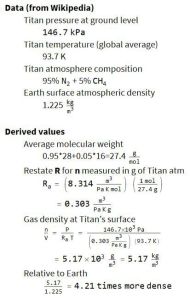
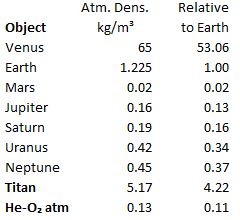
“Because it’s good enough, enough of the time, and we know when not to use it. I’ll give you an example. One of my clients wanted to know air density at ground level on Saturn’s moon Titan and all the planets that have an atmosphere.” <showing Old Reliable’s screen> “I found the planet data I needed in NASA’s Planetary Science website, but I had to do my own calculation for Titan. The pressure’s not crazy high and the temperature’s chilly but not quite cold enough to liquify nitrogen so the situation’s in‑range for the Ideal Gas Equation.”

“What’s a Pa?”

“That’s the symbol for a pascal, the unit of pressure. kPa is kilopascals, just like kg is kilograms. Earth’s atmospheric pressure is about 100 kPa.”

“Reliable says Wikipedia says Titan’s air is mostly nitrogen like Earth’s air is. Titan’s just a moon so it has to be smaller than Earth so its gravity must be smaller, too. Why is its atmosphere so much denser?”

“The cold. Titan’s air is 200 kelvins colder than Earth’s average temperature. You’re right, an individual gas particle feels a smaller pull of gravity on Titan, but it doesn’t have much kinetic energy to push its neighbors away so they all crowd closer together.”

“Why in the world does your client want to know that density number?”

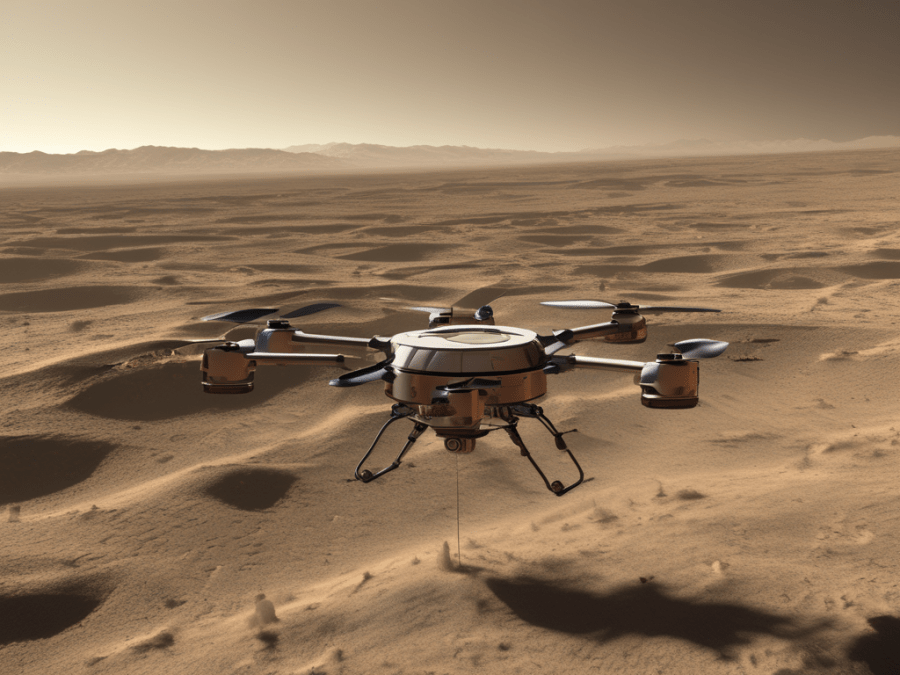
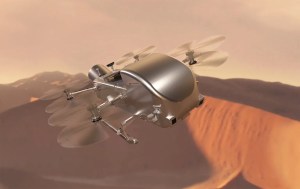
“Clients rarely give me reasons. I suspect this has to do with designing a Titan‑explorer aircraft.”

“Ooo! Wait, what does that have to do with air density?”

“It has to do with how hard the machine has to work to push itself up. It’ll probably have horizontally spinning blades that push the air downwards, like helicopters do. With a setup like that, the lift depends on the blade’s length, how fast it’s spinning, and how dense the air is. If the air is dense, like on Titan, the designers can get the lifting thrust they need with short blades or a slow spin. On Mars the density’s only 2% of Earth’s so Ingenuity‘s rotors were 4 feet across and spun about ten times faster than they’d have to on Earth.”

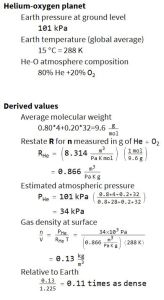
“What about on our helium‑oxygen Earth?”

“That’s pretty much the same calculation. Give me a sec.” <tapping on Old Reliable’s screen> “Gas density would be a tenth of Earth’s, but a HeO‑copter would have to work against full‑Earth gravity. Huge blades rotating at supersonic speeds. Probably not a practical possibility.”

“Aw.”

“Yeah.”

~ Rich Olcott

The Ideal Gas Game

“But Uncle Sy, you never did answer my real question!”

“What question was that, Teena?”

“About the helium planet. With oxygen. Oh, I guess I never did get around to asking that part of it. You side‑tracked us into how a helium‑oxygen atmosphere would be unstable unless it was really cold or the planet had more gravity than Earth so the helium wouldn’t fly away. But what I wanted to know was, what would it be like before the helium left? Like, could we fly a plane there?”

“Mmm, let’s get a leetle more specific. You asked about swapping all of Earth’s atmospheric nitrogen with helium. Was that one helium atom for each nitrogen molecule or each nitrogen atom?”

“What difference would that make?”

“Mass, to begin with. A helium atom weighs about 1/3 of a nitrogen atom, 1/7 of a nitrogen molecule. The atmospheric pressure we feel is the weight of all the air molecules above us. Swap out 80% of those molecules for something lighter, pressure goes down whether we swap helium for molecules or helium for atoms. We could calculate either one. But the change would be much harder to calculate for the atom‑for‑atom swap.”

“Why?”

“Mmm, have you gotten into equations yet in school?”

“You mean algebra, like 3x+7=8x+2? Yeah, they’re super‑easy.”

“This won’t even be as complicated as that. Here’s a famous Physics equation called The Ideal Gas Law — PV=nRT. Each letter stands for one quantity. Two adjacent quantities are multiplied together, okay? The pressure in a container is P, the container’s volume is V, T is the absolute temperature, and n is a measure of how much gas is in there.”

“You skipped R.”

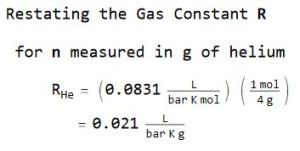
“Yes, I did. It’s a constant number. Its job is to make all the units come out right. For instance, if the pressure’s in atmospheres, the volume’s in liters, n is in grams of helium and the temperature is in kelvins, then R is 0.021. Suppose you’re holding a balloon filled with helium and it’s at room temperature. What can you say about the gas?”

“Umm, all the nRT stuff doesn’t change so P times V, whatever it is, doesn’t change either.”

“If we let it fly upward until the pressure was only half what it is here…?”

“Then V would double. The balloon would get twice as big. Unless it burst, right?”

“You got the idea. Okay, now let’s fiddle with the right-hand side. Suppose we double the amount of helium.”

P times V must get bigger but we don’t know which one.”

“Why not both?”

“Wooo… Each one could get some bigger… Oh, wait, I’m holding the balloon so the pressure’s not going to change so the balloon gets twice bigger.”

“Good thinking. One more thing and we can get back to your difference question. The Ideal Gas Law doesn’t care what kind of gas you’re working with. All the n quantity really cares about is how many particles are in the gas. A particle can be anything that moves about independently of anything else — helium atom or nitrogen molecule, doesn’t matter. If you change the definition of what n is measuring, all that happens is you have to adjust R so the units come out right. Then the equation works fine. Next step—”

“Wait, Uncle Sy, I want to think this atom‑or‑molecule thing through for myself. I’m gonna ignore R times T because both of them stay the same. So if we swap one atom of helium for one molecule of nitrogen, the number of particles doesn’t change and PV doesn’t change. But if we swap one atom of helium for each atom of nitrogen then n doubles and so does PV. But if we do that for the whole atmosphere then we can’t say that the pressure won’t change because the atmosphere could just expand and that’s the V but the pressures are all different as you go higher up anyway. Oh, wait, T changes, too, because it’s cold up there. It’s complicated, isn’t it?”

“It certainly is. Can we stick to just the simple atom‑for‑molecule swap?”

“Uh‑huh.”

~~ Rich Olcott

  • Thanks again, Xander, and happy birthday. Your question was deeper than I thought.

Drag Show

Vinnie lumbers into my office with a troubled look on his face. “Something’s bothering me, Sy.”

“What’s that, Vinnie?”

“This article says NASA’s just finalized a contract with SpaceX to get the International Space Station down, all burnt up and buried in the ocean. Seems a shame. I mean, all the engineering and sweat and risk it took to build it up there, the international cooperation no matter the Cold War, the science for figuring out how to live in space — they ought to leave ISS up there as a memorial or a museum, right?”

“It certainly is a shame, Vinnie, but they just can’t.”

“Why not? 400 kilometers up, it’s not in anyone’s way. It’s all in one piece, won’t contribute to that Kessel cascade problem.”

Kessler cascade. The Kessel Run is a Star Wars thing. But if we left ISS up there it would ultimately contribute to the cascade and in a big way.”

“It’s in space, what could break it up?”

“Actually, it’s in an outer layer of Earth’s atmosphere. Pressure up there is measured in microbars but it’s still billions of atoms per cubic meter. ISS‘ gawky structure induces retrograde drag forces, even in that sparse gas. Drag pulls ISS down about 2 kilometers per month so periodically ISS Mission Control fires rocket engines to boost it back up to nominal orbit. Takes tons of fuel each time. Smaller‑scale drag tries to rip the station apart starting with its solar panels and radiators.”

“Radiators?”

“The white panels hanging off the central truss near the middle. The big brown rectangles are solar panels that power all the station’s equipment. Any time you use energy, inevitably some of it is wasted as heat which builds up unless you eject it somehow. That’s the radiators’ job — can’t dump heat by conduction or convection up there. I read an article once that said your primary target in a space battle would be your enemy’s radiators, because once they’re knocked out whatever’s inside gets cooked.”

“HAW! Basic design flaw for the Millennium Falcon and all the Federation’s Enterprise starships. Fun to know. But I see what you mean about we can’t keep it up there. I’m a pilot, I know what drag can do when it gets a chance. Drag pulls one big chunk off ISS, the rest’d crumble quick. … Wait, now something else doesn’t make sense.”

“What’s that?”

“I thought when you’re in orbit and you slow down you go higher, not lower. You and me and Cal, we talked about that back when Cal was Al. But you just said that drag slowdown pushes ISS lower.”

“You’re right, but back then we considered the case when only gravity and momentum are in play. You’re in stable orbit when you’re going at just the right speed for centrifugal force to balance the pull of gravity at that altitude. Go higher, gravity’s weaker so you don’t need as much speed to balance out.”

“That’s what I remembered.”

“Now we’re looking at a three‑force game where drag is playing on gravity’s side. With both those guys cooperating, the balance shifts away from centrifugal force. Dragged objects slow down and drop down to a lower orbit. Come to think of it, your aircraft is in the same game. When you come in for a landing you deploy your flaps to increase your drag and reduce your lift, right?”

“Right. How ’bout that, ISS acts like an aircraft!”

“Sort of. Mostly spacecraft, a little bit aircraft. Two kilometers isn’t much against four hundred, and the air pressure’s way less. Anyway, NASA’s plan is for a SpaceX ‘US Deorbit Vehicle‘ to act like a super‑drag. If we let drag run its course with no constraints, ISS would eventually come down in pieces all over the place. Deorbit Mission Control should be able to use USDV‘s steerability to aim ISS‘ decaying orbit towards a minimal footprint near Point Nemo.”

“Point Nemo?”

“The ‘oceanic pole of inaccessibility,’ as far away as you can get from any piece of land. It’s also far away from regular shipping and air traffic. Can’t say much about whale traffic though.”

~~ Rich Olcott