
It’s a chilly day as I take my favorite elevator up to my office on the Acme Building’s 12th floor. Vinnie’s on my sofa, reading an old paperback. “Morning, Sy. Whaddaya think of Larry Niven?”
“One of the grand old men of hard science fiction. I gather you’re reading something of his there?”
“Yup, been bingeing on his Known Space series. His Neutron Star short story here won a Hugo back in 1967. It’s got so many numbers I wonder how good they are.”
“Probably pretty good. He and Heinlein both enjoyed showing off their celestial mechanics chops. What numbers stick out to you? Wait, what’s the story line again?”
“Story line? Most of Niven’s shorts were puzzles. When he had a good one he’d wrap some hokey story around it. This one, there’s a magical space ship that’s supposed to be invulnerable. Says here nothing can get through the hull, ‘no kind of electromagnetic energy except visible light. No kind of matter, from the smallest subatomic particle to the fastest meteor’ except something reached in and squashed two people to death in the nose of their ship. Our hero Mr Shaeffer’s in a ship just like theirs and has to figure out what the something was before it gets him, too.”
“Ah. What numbers did Niven give us?”
“Shaeffer’s ship was heading towards a neutron star. Lessee… ah, says the star’s mass is 1.3 times the Sun’s, diameter’s about 12 miles, and the ship’s on a fast in‑and‑out orbit, closest approach just a mile above the surface. Oh, and early on he drifts forward like something’s pulling on him but not on the ship. What does that tell you?”
“Enough to solve the puzzle, not enough to check his numbers. Anything about speed?”
“Mmm, he says the ship popped into the system a million miles out and it’d take 12 hours to reach the close‑approach point. The average speed’s just arithmetic, right?”
“Not really. A simple average doesn’t take account of acceleration changes or relativity effects. It’s easier and more accurate to apply conservation of energy. Okay with you if I assume the ship ‘pops into the system’ with zero velocity relative to the star and then free‑falls towards it?”
“That fits with the story, mostly.”
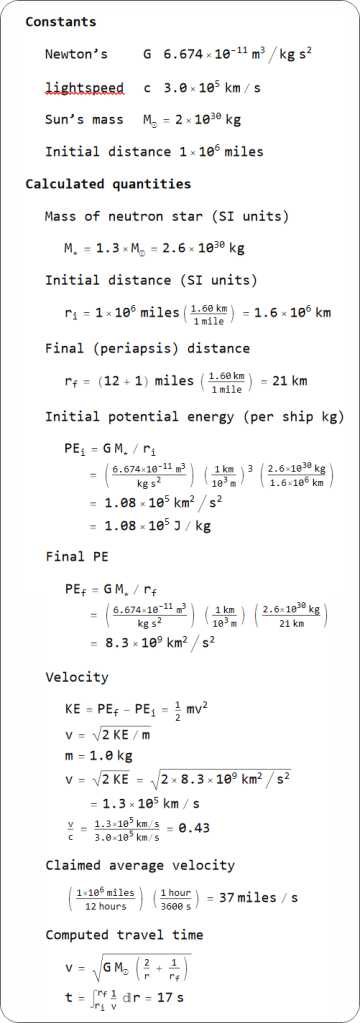
“Good. So right after the pop‑in” <tapping on Old Reliable’s screen> “the ship’s gravitational potential energy is ‑1.08×10⁵ joules/kilogram—”
“Negative?”
“It’s defined as the potential energy Shaeffer’d gave up en route from infinitely far away. At 13 miles from the star’s center, that’s zoomed to ‑8.3×10⁹ J/kg. The potential energy’s converted to kinetic energy ½mv² except we’re talking per kilogram so m is 1.0 and the velocity is —whoa!— 129 thousand kilometers/second. That’s 43% of lightspeed!”
“Well, Shaeffer did see the background stars shift blue even before he got deep into the gravity well. So, how about Niven’s 12‑hour, million‑mile claim?”
“That distance in that time works out to 37 miles per second, way less than lightspeed’s 186 000. Shaeffer was dawdling. You need calculus to figure the actual travel time — integrate 1/v between here and there. Ugly problem to solve manually but Old Reliable’s up to it. Given the appropriate orbit equation and the numbers we’ve worked out so far, Old Reliable says the trip should have taken him about 17 seconds.”
“HAW! I knew something seemed off. Wait, you said you’d solved the puzzle. What’s your answer?”
“Tides. That’s what moved him forward relative to the ship.”
“Yeah, that’s what Niven wrote, but I don’t see why what Shaeffer did saved him.”
“What did Shaeffer do?”
“Spread-eagled himself across a gangway at the ship’s center of gravity.”
“Brilliant — minimized his thickness along the star‑to‑ship line. Gravity’s pull on his sternum wasn’t much different from the pull on his spine. If he’d oriented himself perpendicular to that, his feet would feel a stronger pull than his head would have. Every transverse joint from neck to ankles would crackle or even tear. Talk about chiropractic.”
Vinne winces. “Why does thickness matter?”
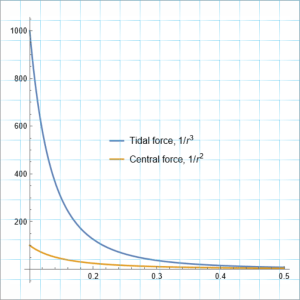
“Tidal force reflects how center‑to‑center force changes with distance. Center‑to‑center force rises with 1/r². Tidal force goes up as 1/r³. Cube grows faster than square. Small r, big tides.”

~ Rich Olcott
 Hard Science Ain't Hard
Hope you are hale and hearty. Remember to vote early and often! Bess
LikeLike
One of my favorite stories. Loved seeing the math on it.
LikeLike