Behold, a square?

It’s been a while since I heard that footstep in the hall outside my office. “Door’s open, Vinnie, c’mon in.”
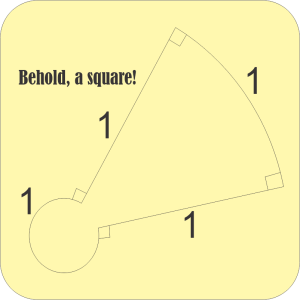
“Hi, Sy. Brought you a thing.” <lays a card on my desk> “So the question is, how is this a square?”

“Is this another puzzle you got from Larry?”

“Yeah. He said you could ‘splain it.”

“Well, the idea’s clear — four right angles, four equal sides, sounds square-ish to me.”

“Yeah, but is the picture lying to us the way that other one did?”

“Fair question. Let’s see whether we can construct it with some real numbers. Both of those arcs seem to be parts of concentric circles so I’ll assume that.” <drawing on card> “The one that’s most of a circle has a radius I’ll call r.”

“You’re gonna do equations, ain’t you? You know I hate equations.”

“You asked the question. Bear with me, this won’t take long. Those two straight lines seem to run radially out from the almost‑circle’s center. I’ll call the angle between them a. By the way, if the lines are indeed radial then we’re guaranteed that all four of those ‘right angle’ markers are truthful. Any radius meets its circumference in a right angle, right?”

“Learned that in Geometry class.”

“I certainly hope so. Okay, the radius of the outer arc is 1 plus the radius of the inner arc so the length of the outer arc is the angle times that or a(1+r) —”

“Wait, where did that come from? You can’t just multiply the angle and radius together like that.”

“Sure you can. What’s the formula for a circle’s circumference?”

2πr.”

“Which is an angle, , times the radius.”

“How is an angle? Should be 360°.”

“It’s like feet and meters ‑ same value, different units. Physicists like radians. 180° is π radians and the length of a semicircle is πr. Other arcs work the same way. It’s perfectly legal to multiply angle and radius if you express the angle in radians. So that outer arc length is a(1+r) and that’s 1 according to the diagram. Are you with me?”

“I suppose.”

“Now for the almost‑circle. Its angle is minus that bit that got stretched out. Are we agreed that the arc length is (2π-a)r?”

“And that’s also 1.”
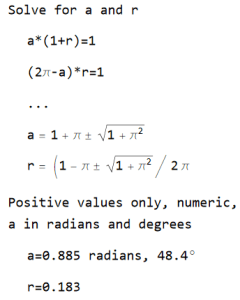
“Right. So we have two unknowns a and r, and two equations to settle them with: a(1+r)=1 and (2π-a)r=1. Simple high school algebra but I’ll spare you the pain and just ask Old Reliable for the result.”

“Thank you.”

“So there’s your answer. Yes, the keyhole figure can be truthful if the angle is 48.4° and the sticky‑out part is about 5½ times longer than the almost‑circle’s radius. Any other angle or radius and the diagram’s wrong. Happy?”

“Yeah.” <quiet moment> “Hey, I just figured out a different way. The latitude lines and longitude lines always cross at right angles, right?”

“Right.”

“So you could do a keyhole ‘square’ on the Earth, right? Circle the North Pole at some latitude, except take a detour straight south, then straight west for a while, then straight back north just in time to meet your part‑circle’s starting point. I’ve flown crazy routes a little like that but that’s always been point‑to‑point. How do you from‑scratch figure something like that so that all the sides are the same length?”

“Whoa, that’s a much harder problem. You’re flying over Earth’s surface so r is constant but now you’ve got two angular variables, latitude and longitude. The north‑south tracks are pretty straight‑forward — you’re good if one starts at the same latitude the other stops at. The tough part is how to split the 360° of longitude between the two east‑west tracks so that the southern arc is the same length as the northern one and they both match the north‑south distance which depends on the start‑stop latitudes. That’s not quadratic equations any more, we’re looking at transcendental equations involving trig functions. There may not be a closed‑form solution. To get those angles we’d need a load of computer time doing successive approximations toward a numerical solution. Surely keyhole‑square routes exist but they’re well‑hidden.”

“Regular squares’re much easier. Colorado or Wyoming’d be no problem.”

~~ Rich Olcott

Not Enough Monkeys

“Morning, Sy. You see the news about the Infinite Monkey thing?”

“No, Cal, with everything else going on I seem to have missed that.”

“Understandable. I only heard about it from a ‘lighter side of the news’ piece on the radio. Something about disproving what everybody used to believe. You wrote about it a while ago, didn’t you?”

“Mm-hm. Did a lot of arithmetic for that one. The idea is that if you somehow managed to get an infinite number of monkeys banging away on typewriters, sooner or later one of them would produce the complete works of Shakespeare. The piece I did, gee, years ago, used Terry Pratchett’s idea of a library that contains all the books that have been written, all those that will be written, and all those that would have been written but the author thought better of it. I asked, how big is that library?”

“That’s gotta be a lot of books. Here’s your coffee.”

“Thanks. I guessed maybe a billion, maximum. The Library of Congress has only 30‑some million, last I looked, and that’s real books. Anyhow, I decided to compare that to the number of possible books, printed up using some configuration of 500 characters.”

“500? What else besides ‘a, b, c‘?”

“Upper case, lower case, blanks, punctuation, math symbols, alphabets from other languages, whatever. No pictographic systems like Japanese kanji and Chinese but you can’t have everything. I defined ‘possible book’ as 500 pages, 4000 characters per page so two million per book.”

“All my books are shorter than that and they don’t scramble alphabets from different languages.”

“Short books you could pad to 500 characters with blanks at the end. Some of the experimental fanfic I’ve seen is pretty creative. At any rate, I calculated 5002,000,000 = 105,397,940 different possible books. Limit the library to 250 pages and 100 characters in, say, Spanish with no math that’d be 1001,000,000 = 102,000,000 different possible books, which is still huge, right?”

“My calculator doesn’t do numbers up in the air like that. I’ll believe you, it’s a big number. So where are you going with this?”

“So even a billion‑book library would be swamped by the other 105,397,931 books in an all‑possible‑books library. My point in that old post was that the monkeys could indeed type up Shakespeare but you wouldn’t be able to find it in the welter of absolute nonsense books.”

“Looks good to me, so what’d these guys prove?”

“Dunno, haven’t seen their paper yet. Give me a minute with Old Reliable … Ah, here it is, ‘A numerical evaluation of the Finite Monkeys Theorem by Woodcock and Falletta. Aand it’s not paywalled!” <reading> “Wait, finite — that’s different.”

“How’s it different? Arithmetic’s arithmetic, right?”

“Until you get into infinities. True infinity operates differently than ‘large beyond anything we can measure’. I highlighted the difference in a tech note I wrote a few years ago. How would you bet if someone suggested there’s an exact duplicate Earth existing somewhere else in the Universe?”

“That’s what that goofy ‘Everything Everywhere’ movie was all about, right? Multiverses?”

“Mmm, no, the bet’s about only in our Universe.”

“Knowing you, I’d stay out of the betting.”

“Wise choice. The right answer is ‘It depends’. I calculated that there could be 1.54×10154 possible Earths with exactly the same atom count that we have, just arranged differently, maybe swap one nickel atom with one iron atom inside a hematite rock. So 1.54×10154 chances for an identical copy of you. If the Universe is infinite, then you’re guaranteed to have not just one, but an infinite number of identical copies, each of whom thinks they’re the only you.”

“That’s comforting, somehow.”

“On the other hand, if the Universe is finite, then the planet creation process would have to run through something like 10150 creations before it had a good shot at re‑making you. Vanishingly small odds.”

“So what’s this got to do with finite monkeys?”

“Woodcock and Falletta maintain that there’s only a limited number of monkeys and they’re time‑constrained. Under those conditions, there’s vanishingly small odds for Shakespeare or even the word ‘bananas’.”

~ Rich Olcott

Caged But Free

Afternoon coffee time. Cal waves a handful of astronomy magazines at us as Cathleen and I enter his shop. “Hey, guys, there’s a ton of black hole stuff in the news all of a sudden.”

Cathleen plucks a scone from the rack. “Not surprised, Cal. James Webb Space Telescope looks harder and deeper than we ever could before and my colleagues have been feasting on the data. Black holes are highly energetic so the most extreme ones show up well. The Hubble and JWST folks find new extremes every week.”

Cal would be disappointed if I didn’t ask. “So what’s the new stuff in there?”

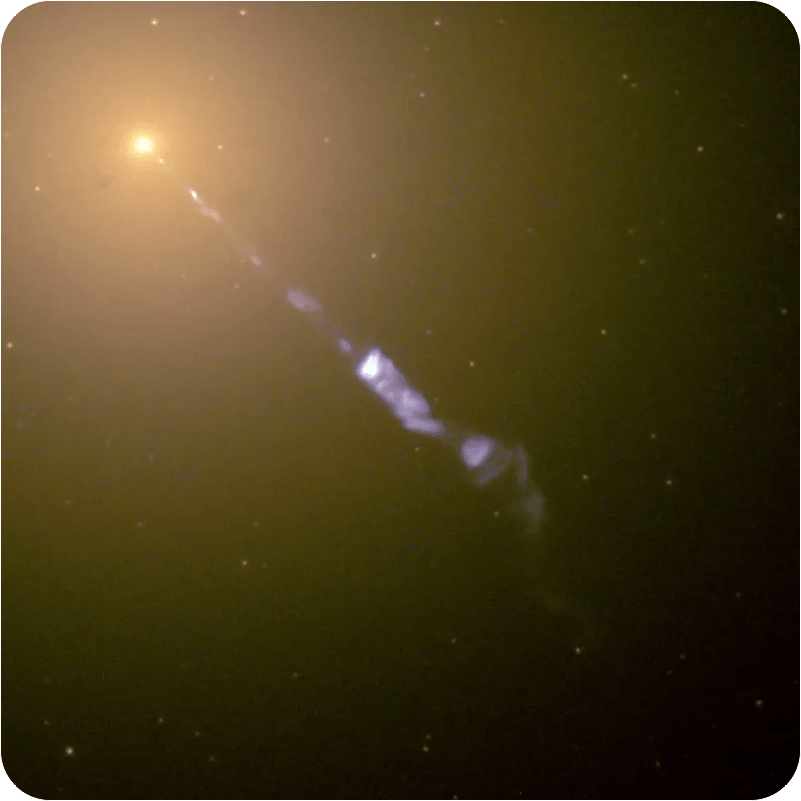
<flipping through the magazines> “This seems to be quasar jet month. We’ve got a new champion jet and this article says M87’s quasar makes novas.”

“Remind me, Cathleen, what’s a quasar?”

“A quasi‑stellar object, Sy, except we now know it’s a galaxy with a supermassive black hole—”

“I thought they all had super‑massives.”

“Most do, but these guys are special. For reasons researchers are still arguing about, they emit enormous amounts of energy, as much as a trillion average stars. Quasar luminosity is more‑or‑less flat all across the spectrum from X-rays down as low as we can measure. Which isn’t easy, because the things are so far away that Universe expansion has stretched their waves by z‑factors of 6 or 8 or more. We see their X‑ray emissions in the infrared range, which is why JWST’s optimized for infrared.”

“What does ‘flat’ tell you?”

“Sy’d give a better answer than I would. Sy?”

“Fun fact, Cal. Neither atoms nor the Sun have flat spectra and for the same reason: confinement. Electromagnetic waves come from jiggling charges, right? In an atom the electron charge clouds are confined to specific patterns centered on the nucleus. Each pattern holds a certain amount of energy. The atom can only move to a different charge pattern by emitting or absorbing a wave whose energy matches the difference between the pattern it’s in and some alternate pattern. Atomic and molecular spectra show peaks at the energies where those transitions happen.”

“But the Sun doesn’t have those patterns.”

“Not in the stepped energy‑difference sense. The Sun’s made of plasma, free electrons and nuclei all bouncing off each other, moving wherever but confined to the Sun’s spherical shape by gravity. Any particle that’s much more or less energetic than the local average eventually gets closer to average by exchanging energy with its neighbors. Free charged particles radiate over a continuous, not stepwise, spectrum of energies. The free‑particle combined spectrum has a single peak that depends on the average temperature. You only get flat spectra from systems that aren’t confined either way.”

“What I get from all that is a jet’s flat spectrum says that its electrons or whatever aren’t confined. But they must be — the things are thin as a pencil for thousands of lightyears. Something’s gotta be holding them together but why no peaks?”

“Excellent question, Cal. By the way, jets can be even longer than you said. I’ve read about your champion jet. It extends 23 million lightyears, more than a hundred times the width of the Milky Way galaxy. Straight as a string, no kinks or wiggles during a billion years of growth. I think what’s going on is that the charged particles are confined side‑to‑side somehow but they’re free to roam along the jet’s axis. If that’s the case, the flat‑spectrum light ought to be polarized. I’m sure someone is working on that test now. Your thoughts, Sy?”

“As a physicist I’m interested in the ‘somehow.’ We only know of four forces. The distances are too big for weak and strong nuclear forces. Gravity’s out, too, because it acts equally in all directions, not just crosswise to the axis. That leaves electromagnetic fields in some super‑strong self‑reinforcing configuration. The particles must be spiraling like mad about that central axis. I’ll bet that explains Cal’s quasar galaxy concentrating novae close to its SMBH jet axis. A field that strong could generate enough interference to wreak havoc on an unstable star’s plasma.”

Hubble’s view of the M87 galaxy and jet
Credit NASA and the Hubble Heritage Team (STScI/AURA)

~ Rich Olcott

The Importance of Saving Data

  • A repost from 8 years ago, but it’s become timely again. Eight years ago my concern was data related to Public Health and animal welfare. Subsequent event proved that concern was well‑founded. This time around the climate and Public Health issues are still with us but the likelihood of ideological meddling spreads much more broadly, to research related to psychoactives, guns, citizenship status and more. Forewarned is forearmed.

Sorry, but I’ve got to break into my normal Monday-morning stream to spread this around.  It’s a ProPublica document (click on the link to pull down a copy) detailing safe ways to leak information.

When I first heard about the data-stashing “parties” I thought it was something of an over-reaction.  Climate scientists and students organizing a massive effort to copy important data out of government files in case the new Administration decided to cover it all up somehow.

I’ve changed my mind.

What changed it was USDA’s suddenly blocking access to their animal welfare database, the one that keeps inspection records on research labs, companies, zoos, circuses, and animal transporters and how well they adhere to the Animal Welfare Act.

The agency said in a statement that it revoked public access to the reports “based on our commitment to being transparent …”  Being transparent by blocking information — there’s a certain Orwellian flavor to that, but it gets better.

I followed this article‘s link to see the original statement.  Well, I tried to follow it.  FireFox flat-out refused to show me the page because “Your connection is not secure. The owner of acis.aphis.educ.usda.gov has configured their website improperly.”  The error code was “SEC_ERROR_UNKNOWN_ISSUER.” Funny that an official .gov site mucked up its security certificate.

Then I tried Microsoft’s  edge browser, which has less alert security than my beefed-up FireFox.  edge showed me an imposing and somewhat threatening USDA e-Login page including the statements that “Unauthorized or improper use of this system may result in disciplinary action, as well as civil and criminal penalties…. You have no reasonable expectation of privacy regarding any communications or data transiting or stored on this information system…. Your consent is final and irrevocable…

disappearing-lorem-ipsum

All this before Mr Sonny Perdue III is confirmed as the new Secretary of Agriculture. That name rings a bell, right?  Yeah, Perdue Farms, the country’s #3 poultry farmer. It’s hard not to connect dots to the Department suddenly wanting to hide farm inspection records.

So, it’s now pretty clear that we can expect other government-funded databases to disappear without warning, especially databases even remotely related to climate change, drug safety, water supply degradation, … you know, the things that there are regulations about that get in the way when your object is to maximize profits.

So — if you’re in science and you have possession of or access to data (databases, files, whatever) that might be in jeopardy

  1. Get it to an offsite and secure backup ASAP
  2. When/if it becomes clear that your or the public’s access to that data is about to be restricted, take one or more of the actions laid out in the ProPublica document.

Sometimes it’s rational to be paranoid.

~~ Rich Olcott

The Spaghettification Zone

Vinnie’s still wincing. “That neutron star pulling all the guy’s joints apart — yuckhh! So that’s spaghettification? I thought that was a black hole thing.”

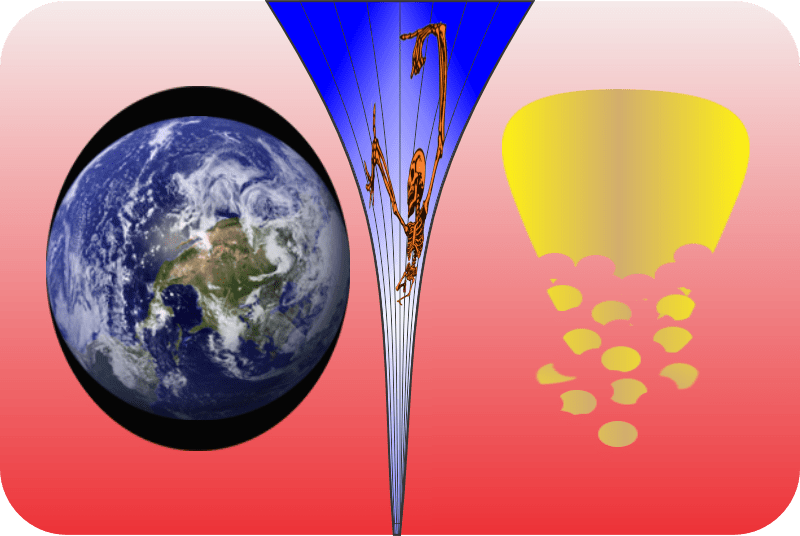
“Yes and no, in that order. Spaghettification’s a tidal phenomenon associated with lopsided gravity fields, black holes or otherwise. You know what causes the tides, of course.”

“Sure, Sy. The Sun pulls up on the water underneath it.”

“That’s not quite it. The Sun’s direct‑line pull on a water molecule is less than a part per million of the Earth’s. What really happens is that the Sun broadly attracts water molecules north‑south east‑west all across the Sun‑side hemisphere. There’s a general movement towards the center of attraction where molecules pile up. The pile‑up’s what we call the tide.”

“What explains the high tide on the other side of the Earth? You can’t claim the Sun pushes it over there.”

“Of course not. It goes back to our lopsided taste of the Sun’s gravitational field. If it weren’t for the Sun’s pull, sea level would be a nice round circle where centrifugal force balances Earth’s gravity. The Sun’s gravity puts its thumb on the scale for the near side, like I said. It’s weaker on the other side, though — balance over there tilts toward the centrifugal force, makes for a far‑side bulge and midnight tides. We get lopsided forces from the moon’s gravity, too. That generates lunar tides. The solar and lunar cycles combine to produce the pattern of tides we experience. But tides can get much stronger. Ever hear of the Roche effect?”

“Can’t say as I have.”

“Imagine the Earth getting closer to the Sun but ignore the heat. What happens?”

“Sun‑side tides get higher and higher until … the Sun pulls the water away altogether!”

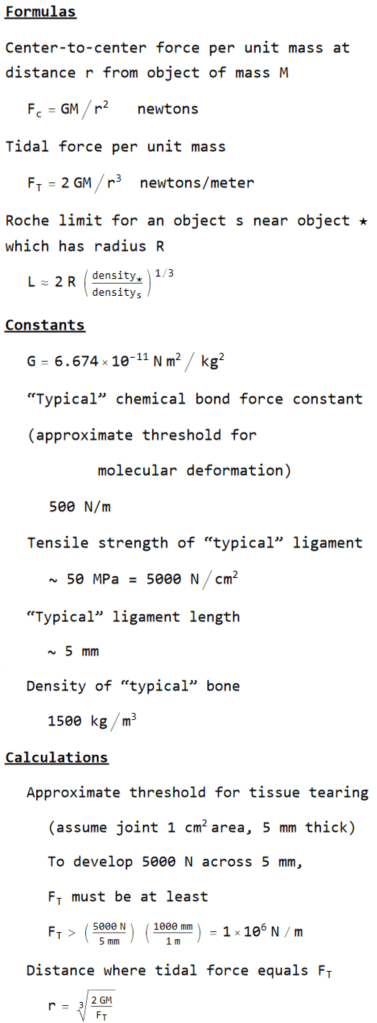
“That’s the idea. In the mid‑1800s Édouard Roche noticed the infinity buried in Newton’s F=GMm/r² equation. He realized that the forces get immense when the center‑to‑center distance, r, gets tiny. ‘Something’s got to give!’ he thought so he worked out the limits. The center‑to‑center force isn’t the critical one. The culprit is the tidal force which arises from the difference in the gravitational strength on either side of an object. When the force difference exceeds the forces holding the object together, it breaks up.”

“Only thing holding the ocean to Earth is gravity.”

“Exactly. Roche’s math applies strictly to objects where gravity’s the major force in play. Things like rubble‑pile asteroids like Bennu and Dimorphos or a black hole sipping the atmosphere off a neighboring blue supergiant star. We relate spaghettification to rubble piles but it can also compete with interatomic electronic forces which are a lot stronger.”

“You’re gonna get quantitative, right?”

“Of course, that’s how I operate.” <tapping on Old Reliable’s screen> “Okay, suppose Niven’s guy Shaffer is approaching some object from far away. I’ve set up tidal force calculations for some interesting cases. Turns out if you know or can estimate an object’s mass and size, you can calculate its density which is key to Roche’s distance where a rubble pile flies apart. You don’t need density for the other thresholds. Spagettification sets in when tidal force is enough to bend a molecule. That’s about 500 newtons per meter, give or take a factor of ten. I estimated the rip‑apart tidal force to be near the tensile strength of the ligaments that hold your bones together. Sound fair?”

“Fair but yucky.”

“Mm‑hm. So here’s the results.”

“What’s with the red numbers?”

“I knew you’d ask that first. Those locations are inside the central object so they make no sense physically. Funny how Niven picked the only object class where stretch and tear effects actually show up.”

“How come there’s blanks under whatever ‘Sgr A*’ is?”

“Astronomer‑ese for ‘Sagittarius A-star,’ the Milky Way’s super‑massive black hole. Can’t properly calculate its density because the volume’s ill‑defined even though we know the Event Horizon’s diameter. Anyhow, look at the huge difference between the Roche radii and the two thresholds that affect chemical bonds.”

“Hey, Niven’s story had Shaffer going down to like 13 miles, about 20 kilometers. He’d’ve been torn apart before he got there.”

“Roughly.”

~~ Rich Olcott