12345 and 8 and 2025

Okay, I’ve got this thing about prime numbers. Some people get all woozy for holiday music as December marches along, but the turning of the year puts me into numeric mode. I’ve done year‑end posts about the special properties of the integer 2016 and integers made up of 3s and 7s. (Sheldon Cooper’s favorite, 73, is just part of an interesting crowd.)

I looked up “2025” in the On-line Encyclopedia of Integer Sequences (the OED of numbers). That number is involved in 1028 different series or families. Sequence A016754, the Central Octagonal Numbers, has some fun visuals. Draw a dot. Then draw eight dots symmetrically around it. You have nine dots. Nine is O2, the second Central Octagonal Number (an octagon enclosing a center, such a surprise). It’s ‘second‘ after O1=1, for that first dot. Now draw another octagon of dots around the core you started, but with two dots on each side. Those 16 dots plus the 9 inside make 25, so O3=25. An octagon with three dots on each side has 24 dots so O4 is 1+8+16+24=49 (see the figure). And so on. If you do the arithmetic, you’ll find that O22, the 22nd Central Octagonal Number, is 2025. Its visual has 22 rings (including the central dot), 168 dots in its outermost ring, for 2025 dots in all.

In case you’re wondering, there is a non-centered series of octagonal numbers that grow out of a dot placed at a vertex of a starter octagon. 2025 isn’t in that series. See the hexagon equivalent in my 2015 post.

Sadly, 2025 isn’t a prime year. Prime‑number years, 2003 and 2011 for example, can be evenly divided by no integer other themselves (and one, of course). 2017 was a prime year, but we won’t see another until 2027. Leap year numbers are divisible by 4 so they can’t ever be prime. That property disqualified 2020 and 2024. It’ll do the same for 2028 and 2032.

Two primes that are as close together as possible, separated only by a single (necessarily even) number, are called twins. There were no twin‑prime years in the 700s, the 900s or the 1500s. The thirteen prime years in the twenty‑first century include three sets of twins, 2027‑2029, 2081‑2083 and 2087‑2089.

If a number’s not prime, then it must be divisible by at least two factors other than itself and one. 2018 and 2019, for example, each have just two factors (2×1009 and 3×673, respectively). Numbers could have more factors, naturally — 2010 is 2×3×5×67 and 2030 is 2×5×7×29, four factors each.

A single factor could be used multiple times — 2024 is 2×2×2×11×23, also written as 23×11×23, for a total of 5 factors. We’re just entering a 6‑factor year (see below) but a formidable factor‑champion is on the horizon. Computer geeks may be particularly fond of the year 2048, known in the trade as 2k (not to be confused with Y2K). The number 2048 has eleven factors, more than any year number of last or this millennium. 2048 is 211, the result of eleven 2s multiplied together. Change just one of those 2s to a 3 and you have 3072 which is a long time from now.

So anyhow, I was poking at 2025, just seeing what was in there. The 5 at the tail‑end is a dead give‑away non‑prime‑wise because the only prime that ends in a 5 is … 5. Another useful trick – add up the digits. If the sum is divisible by 3, so is the number. If the sum is divisible by 9 so is the number. Easy to figure 2+0+2+5=9, so two easy ways to know that 2025‘s not prime.

By the time I got done breaking the number down into all six of its factors, look what a pretty pattern appeared:

Finally, 2025 appears 8 times in this post’s text. Happy New Year.

~~ Rich Olcott
The Trough And The Plateau

Particularly potent pepperoni on Pizza Eddie’s special tonight so I dash to the gelato stand. “Two dips of pistachio in a cup, please, Jeremy, and hurry. Hey, why the glum look?”

“The season’s moving so slowly, Mr Moire. I’m a desert kid, used to bright skies. I need sunlight! We’re getting just a few hours of cloudy daylight each day. It seems like we’re never gonna leave this pattern. Here’s your gelato.”

“Thanks. Sorry about the cloudiness, it’s the wintertime usual around here. But you’re right, we’re on a plateau.”

“Nosir, the Plateau’s the Four Corners area, on the other side of the Rockies, miles and miles away from here.”

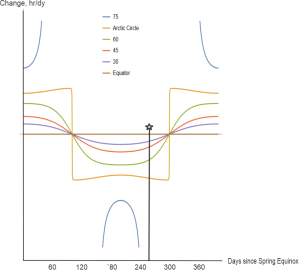
<chuckle> “Not the Colorado Plateau, the darkness plateau. Or the daylight trough, if you prefer. Buck up, we’ll get a daylight plateau starting in a few months.” <unholstering Old Reliable> “Here’s a plot of daylight hours through the year at various northern latitudes. We’re in between the red and green curves. For folks south of the Equator that’d just turn upside‑down, of course. I added a star at today’s date in mid‑December, see. We’re just shy of the winter solstice; the daylight hours are approaching the minimum. You’re feeling stressed because these curves don’t change much day-to-day near minimum or maximum. In a couple of weeks the curve will bend upwards again. Come the Spring equinox, you’ll be shocked at how rapidly the days lengthen.”

“Yeah, my Mom says I’m too impatient. She says that a lot. Okay, above the Arctic Circle they’ve got months‑long night and then months‑long day, I’ve read about that. I hadn’t realized it was a one‑day thing at the Circle. Hey, look at the straight lines leading up to and away from there. Is that the Summer solstice? Those low‑latitude curves look like sine waves. Are they?”

“Summer solstice in the northern hemisphere, Winter solstice for the southerners. The curves are distorted sines. Ready for a surprise?”

<Looks around the nearly empty eatery.> “With business this slow I’m just sitting here so I’m bored. Surprise me, please.”

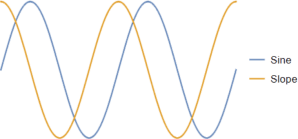
“Sure. One of the remarkable things about a sine wave is, when you graph its slopes you get another sine wave shifted back a quarter. Here, check it out.”

“Huh! When the sine wave’s mid-climb, the slope’s at its peak. When the sine wave’s peaking, the slope’s going through zero on the way down. And they do have exactly the same shape. I see where you’re going, Mr Miore. You’re gonna show me the slopes of the daylight graphs to see if they’re really sine waves.”

“You’re way ahead of me and Old Reliable, Jeremy.” <frantic tapping on OR’s screen> “There, point‑by‑point slopes for each of the graphs. Sorta sine‑ish near the Equator but look poleward.”

“The slopes get higher and flatter until the the Arctic Circle line suddenly drops down to flip its sign. Those verticals are the solstices, right?”

“Right. Notice that even at the Circle the between‑solstice slopes aren’t quite constant so the straight lines you eye‑balled aren’t quite that. North of the Circle the slopes go nuts because of the abrupt shifts between varying and constant sun.”

“How do you get these curves, Mr Moire?”

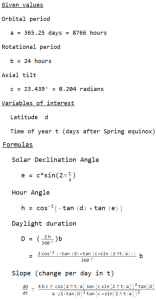
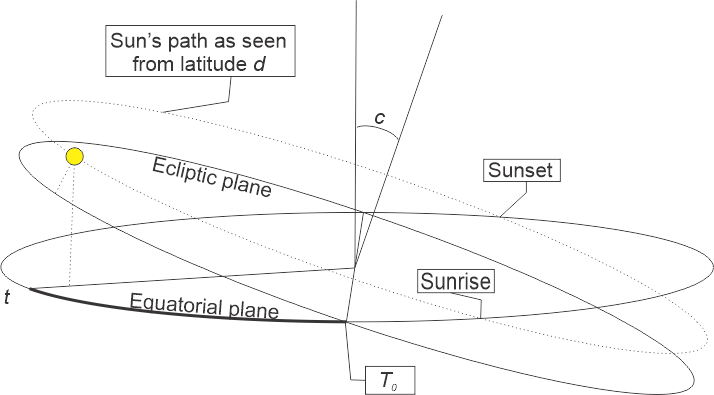
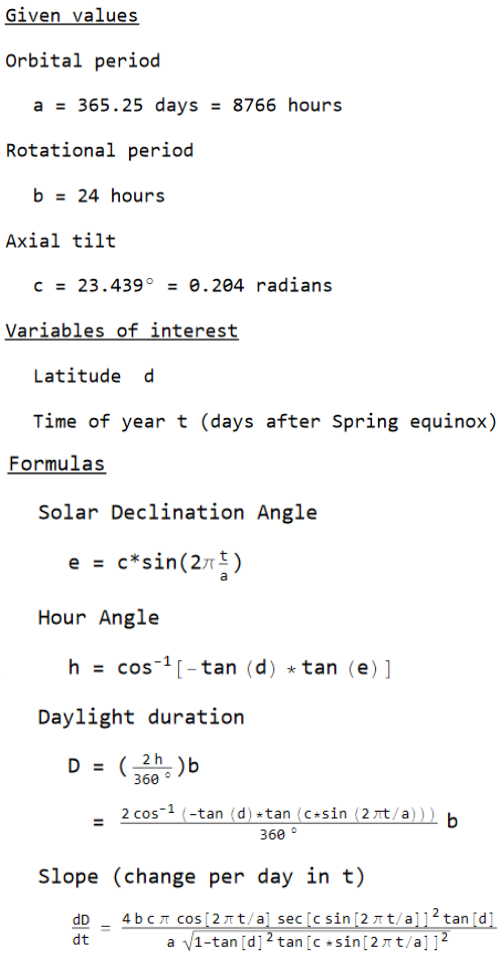
“It’s a series of formulas. Dust off your high school trig. The Solar Declination Angle equation is about the Sun’s height above or below the horizon. It depends on Earth’s year length, its axial tilt and the relative date, t=T‑T0. For these charts I set T0 to the Spring equinox. If the height’s negative the Sun’s below the horizon, okay?”

“Sine function is opposite‑over‑hypotenuse and the height’s opposite alright or we’d burn up, yup.”

“The second formula gives the the Hour Angle between your longitude and whichever longitude has the Sun at its zenith.”

“Why would you want that?”

“Because it’s the heart of the duration formula. When you roll all three formulas together you get one big expression that gives daylight duration in terms of Earth’s constants, time of year and your location. That’s what I plotted.”

“How about the slope curves?”

“Calculus, Jeremy, d/dt of that combined duration function. It’s beyond my capabilities but Old Reliable’s up to it.”

~ Rich Olcott

New (Old) Word: Frigorific!

A quiet morning at Cal’s Coffee. I’m sipping my morning mud when Susan Kim bustles to my table, mocha latte in hand. “There you are, Sy. I loved your posts in tribute to the well‑thumbed copy of the CRC Handbook on my desk.”

“Glad you enjoyed them.”

“Your Rumford stuff made it even better because I did a class report on him once so I caught your ‘frigorific‘ reference. What do you know about the background to that?”

“Not much. Didn’t sound like a real word when I ran across it.”

“Oh, it’s a real word but it has a technical meaning now that it didn’t in Newton’s time. Back then it was only about making something cold. These days we also use the word for a mixture that maintains a dependable cold temperature. Liquid water and ice, for instance, stays at 0°C as long as there’s still ice in the cold bath. I used to use an ammonium chloride/water frigorific when I needed something down around -15°C. Now of course I use a benchtop refrigerator.”

“Rumford would have liked that. What were the ‘frigorific rays‘ he got all excited about?”

“Long story but there’s a couple of fun twists. Background first. At the end of the 1700s there was a <grin> heated debate about heat. The phlogiston theory was dead by that time but people still liked the idea that heat was a material fluid. It addressed some chemical puzzles but heat transmission was still mysterious. Everyone knew that a hot object gives off heat by radiation, that the radiation travels in straight lines and that it’s reflected by metal mirrors.”

“Right, the Greeks are supposed to have used huge sun‑focusing mirrors to burn up attacking Roman ships.”

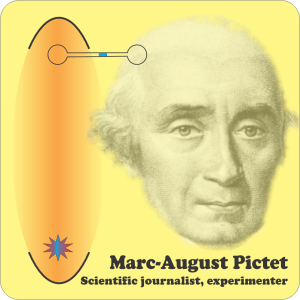
“Maybe. Anyhow, those properties connected heat with light. However, a pane of glass blocks radiated heat, at least until the glass gets hot. People argued this meant heat and light weren’t connected. About 1790 a group of physicists loosely associated with the Academy of Geneva dove into the fray. Rumford was in the group, along with Prévost, Saussure and his student Pictet. They had lots of fun with heat theories and experiments. One of Pictet’s experiments lit Rumford’s fire, so to speak.”

“Good one.”

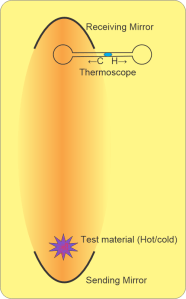
<smile> “It’s a fairly simple setup that a high school science teacher could do. Pictet hung a concave metallic mirror facing down from the ceiling of a draft‑free room. He placed another concave metallic mirror at floor level immediately beneath it, facing upward. He probably used spherical mirrors which are easy to make, but they could have been elliptical or parabolic sections. Anyhow, he put a thermoscope at the upper mirror’s focal point and a hot object at the lower focal point. Sure enough, the upper focal point got hotter, just as you’d expect.”

“No great surprise, the Greeks would have expected that, too.”

“The surprise happened when he put a cold object in there. The thermoscope’s droplet moved in the cold direction.”

“Wait, like anti‑infrared?”

“That’s the effect. Wave‑theory supporter Rumford took that thought, called it ‘frigorific radiation‘ and ran with it. He constructed a whole thesis around cold waves and heat waves as symmetric partners. He maintained wave intensity, both kinds, increases with temperature difference. Our heat sources are hundreds or thousand of degrees hotter than we are but our cold sources are at most a few dozen degrees colder. By his theory that’s why cold wave phenomena are masked by heat waves.”

“Give me a minute. … Ah, got it. The very meaning of a focal point is that all waves end or start there. A cold object at the sending station emits much less infrared than the warm object did. The thermoscope bulb now gets less than it emits. With less input from below its net energy drops. It chills.”

“Nice, Sy. Now for the other twist. Rumford published his theory in 1805. Herschel had already identified infrared radiation in the Sun’s spectrum in 1800. Two strikes against Herschel, I guess — he was British and he was an astronomer. Continental physicists wouldn’t bother to read his stuff.”

~ Rich Olcott

Rumford’s Boring Story

“Okay, Mr Moire, my grandfather’s engineering handbook has Specific Heat tables because Specific Heat measures molecular wabbling. If he’s got them, though, why’s Enthalpy in the handbook, too?”

“Enthalpy’s not my favorite technical term, Jeremy. It’s wound up in a centuries‑old muddle. Nobody back then had a good, crisp notion of energy. Descartes, Leibniz, Newton and a host of German engineers and aristocratic French hobby physicists all recognized that something made motion happen but everyone had their own take on what that was and how to calculate its effects. They used a slew of terms like vis viva, ‘quantity of motion,’ ‘driving force,’ ‘quantity of work,’ a couple of different definitions of ‘momentum‘ — it was a mess. It didn’t help that a lot of the argument went on before Euler’s algebraic notations were widely adopted; technical arguments without math are cumbersome and can get vague and ambiguous. Lots of lovely theories but none of them worked all that well in the real world.”

“Isn’t that usually what happens? I always have problems in the labs.”

“You’re not alone. Centuries ago, Newton’s Laws of Motion and Gravity made good predictions for planets, not so good for artillery trajectories. Gunners always had to throw in correction factors because their missiles fell short. Massachusetts‑born Benjamin Thompson, himself an artilleryman, found part of the reason.”

“Should I know that name?”

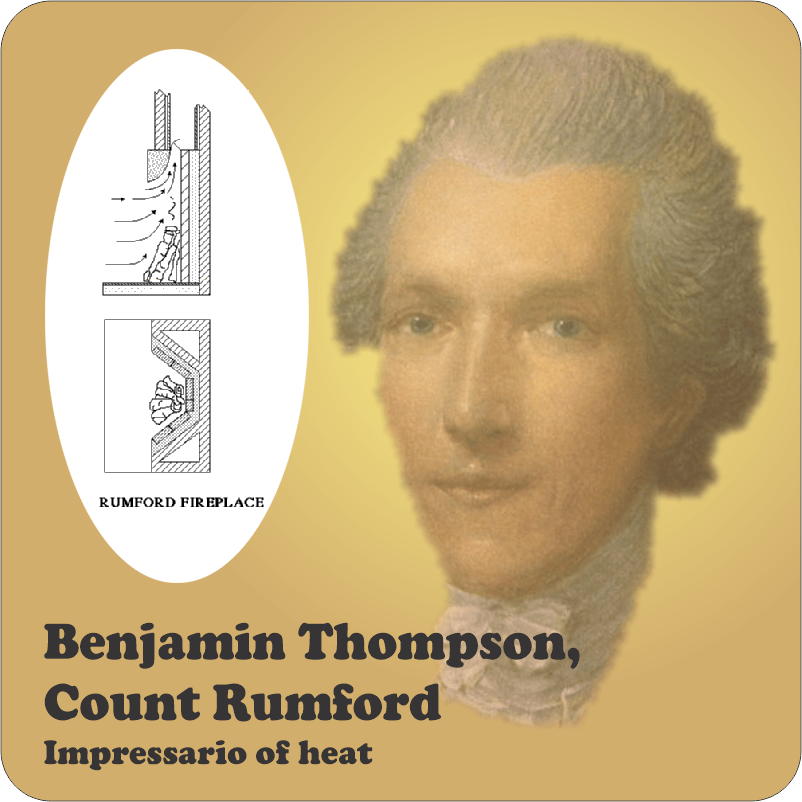
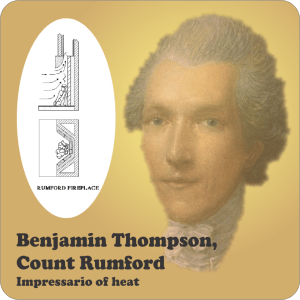
“In later years he became Count Rumford. One of those people who get itchy if they’re not creating something. He was particularly interested in heat — how to trap it and how to make it go where you want.”

“Wait, he was an American but he was a Count? I thought that was illegal.”

“Oh, he left the States before they were the States. During the Revolution he organized a Royalist militia in New York and then lit out for Europe. The Bavarians made him a Count after he spent half‑a‑dozen years doing creative things like reorganizing their army, building public works and introducing potato farming. He concocted a nourishing soup for the poor and invented the soup line for serving it up. But all this time his mind was on a then‑central topic of Physics — what is heat?”

“That was the late 1700s? When everyone said heat was some sort of fluid they called ‘caloric‘?”

“Not everyone, and in fact there were competing theories about caloric — an early version of the particle‑versus‑wave controversy. For a while Rumford even supported the notion that ‘frigorific’ radiation transmitted cold the same way that caloric rays transmitted heat. Whatever, his important contributions were more practical and experimental than theoretical. His redesign of the common fireplace was such an improvement that it took first England and then Europe by storm. Long‑term, though, we remember him for a side observation that he didn’t think important enough to measure properly.”

“Something to do with heat, I’ll bet.”

“Of course. As a wave theory guy, Rumford stood firmly against the ‘caloric is a fluid‘ camp. ‘If heat is material,‘ he reasoned, ‘then a heat‑generating process must eventually run out of caloric.’ He challenged that notion by drilling out a cannon barrel while it was immersed in cold water. A couple of hours of steady grinding brought the water up to boiling. The heating was steady, too, and apparently ‘inexhaustible.’ Better yet, the initial barrel, the cleaned‑out barrel and the drilled‑out shavings all had the same specific heat so no heat had been extracted from anything. He concluded that heat is an aspect of motion, totally contradicting the leading caloric theories and what was left of phlogiston.”

<chuckle> “He was a revolutionary, after all. But what about ‘Enthalpy‘?”

“Here’s an example. Suppose you’ve got a puddle of gasoline, but its temperature is zero kelvins and somehow it’s compressed to zero volume. Add energy to those waggling molecules until the puddle’s at room temperature. Next, push enough atmosphere out of the way to let the puddle expand to its normal size. Pushing the atmosphere takes energy, too — the physicists call that ‘PV work‘ because it’s calculated as the pressure times the volume. The puddle’s enthalpy is its total energy content — thermal plus PV plus the chemical energy you get when it burns.”

~~ Rich Olcott

It’s in The Book

A young man’s knock, eager yet a bit hesitant. “Door’s open, Jeremy, c’mon in.”

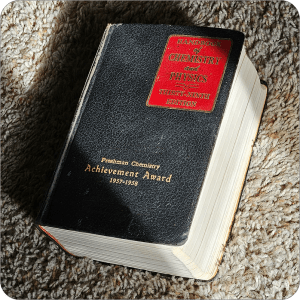
“Hi, Mr Moire, I’ve got something to show you. It’s from my acheii, my grandfather. He said he didn’t need it any more now he’s retired so he gave it to me. What do you think?”

“Wow, the CRC Handbook of Chemistry And Physics, in the old format, not the 8½×11″ monster. An achievement award, too — my congratulations to your grandfather. Let’s see … over 3000 pages, and that real thin paper you can read through. It’s still got the math tables in front — they moved those to an Appendix by the time I bought my copy. Oooh yeah, lots of data in here, probably represents millions of grad student lab hours. Tech staff, too. And then their bosses spent time checking the work before publishing.”

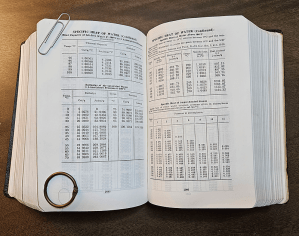
Acheii said I’d have to learn a lot before I could use it properly. I see lots of words in there I don’t recognize.” <opens book to a random page> “See, five- and six‑figure values for, what’re Specific Heat and Enthalpy?”

“Your grandfather’s absolutely correct. Much of the data’s extremely specialized. Most techs, including me, have a few personal‑favorite sections they use a lot, never touch the rest of the book. These particular pages, for instance, would be gold for a someone who designs or operates steam‑driven equipment.”

“But what do these numbers mean?”

“Specific Heat is the amount of heat energy you need to put into a certain mass of something in order to raise its temperature by a certain amount. In the early days the Brits, the Scots really, defined the British Thermal Unit as the amount of energy it took to raise the temperature of one pound of liquid water by one degree Fahrenheit. You’d calculate a fuel purchase according to how many BTUs you’d need. Science work these days is metric so these pages tabulate Specific Heat for a substance in joules per gram per °C. Tech in the field moves slow so BTUs are still popular inside the USA and outside the lab.”

“But these tables show different numbers for different temperatures and they’re all for water. Why water? Why isn’t the Specific Heat the same number for every temperature?”

“Water’s important because most power systems use steam or liquid water as the working fluid or coolant. Explaining why heat capacity varies with temperature was one of the triumphs of 19th‑century science. Turns out it’s all about how atomic motion but atoms were a controversial topic at the time. Ostwald, for instance—”

“Who?”

“Wilhelm Ostwald, one of science’s Big Names in the late 1800s. Chemistry back then was mostly about natural product analysis and seeing what reacted with what. Ostwald put his resources into studying chemical processes themselves, things like crystallization and catalysis. He’s regarded as the founder of Physical Chemistry. Even though he invented the mole he steadfastly maintained that atoms and molecules were nothing more than diffraction‑generated illusions. He liked a different theory but that one didn’t work out.”

“Too bad for him.”

“Oh, he won the first Nobel Prize in Chemistry so no problem. Anyway, back to Specific Heat. In terms of its molecules, how do you raise something’s temperature?”

“Um, temperature’s average kinetic energy, so I’d just make the molecules move faster.”

“Well said, except in the quantum world there’s another option. The molecules can’t just waggle any which way. There are rules. Different molecules do different waggles. Some kinds of motion take more energy to excite than others do. Rule 1 is that the high‑energy waggles don’t get to play until the low‑energy ones are engaged. Raising the temperature is a matter of activating more of the high‑energy waggles. Make sense?”

“Like electron shells in an atom, right? Filling the lowest‑energy shells first unless a photon supplies more energy?”

“Exactly, except we’re talking atoms moving within a molecule. Smaller energies, by a factor of 100 or more. My point is, the heat capacity of a substance depends on which waggles activate as the temperature rises. We didn’t understand heat capacity until we applied quantum thinking to the waggles.”

“What about ‘Enthalpy’ then?”

~ Rich Olcott