The Beaming Beacon

“So, Vinnie, that first article’s bogus. Blobs in M87’s supermassive black hole’s jet don’t travel faster than light. Your second article — is it also about M87*?”
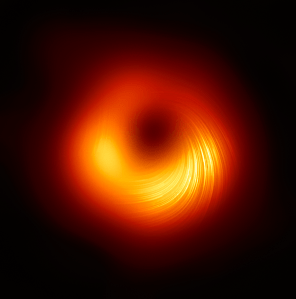
“Yeah, Cathleen. It’s got this picture which a while ago Sy explained looks like a wrung‑out towel because that’s the way the thing’s magnetic field forces electrons to line up and give off polarized light.”

“As always, Vinnie, your memory impresses.”

“Thanks, I work at it. Anyhow, this one‑paragraph article says they figured out from the picture that everything’s spinning around as fast as it’s possible to spin. How fast is that, and how’d they get the spin speed if they only used one frequency so redshift/blueshift doesn’t apply?”

Cathleen’s been poking at her tablet. “HAH! Found the real paper behind your pop‑sci article, Vinnie. Give me a minute…” <pause, with mumbling> “Wow, not much there in the disk. They estimate even at the crowded innermost orbit, they call it ISCO, the density’s about 10-14 kg/m3 which would be one nanopascal of pressure. Most labs consider that ultrahigh vacuum. They get angular momentum from something called ‘Doppler beaming’, which I’m not familiar with.” <passes tablet to me> “Your turn, Sy.”

“ISCO’s the Innermost Stable Circular Orbit. ISCO’s radius depends on the black hole’s mass and spin.” <pause, with mumbling> “Doppler beaming’s a velocity‑dependent brightness shift from outbound to inbound sides of ISCO. They connected brightness range within the images to ISCO velocity, multiplied that by ISCO radius and the black hole’s mass to get the disk’s angular momentum, J. The lightspeed rotation angular momentum Jmax comes from theory. The paper puts a number to M87*’s J/Jmax.

“My article says it’s near 100%.”

“That’s not what the paper says, Vinnie. ‘…our value of 0.8 would appear to be a lower limit,’ in other words, something above 80% but definitely not 100%. Like I said, pop‑sci journalism. So what’s Doppler beaming, Sy?”

“Classical Doppler shifts happen when a wave source moves relative to us. Motion toward us crams successive wave peaks into decreasing distance. Motion away increases wavelength. The same principle applies to light waves, sound waves, even ocean waves.”

“Blueshifting.”

“Mm‑hm. By contrast, beaming is about how a source’s motion affects the photon count we receive per second. Imagine a beacon steadily sending us photons as it whips at near‑lightspeed around M87*. When the beacon screams towards us its motion crams more photons into one of our seconds than when it dashes away.”
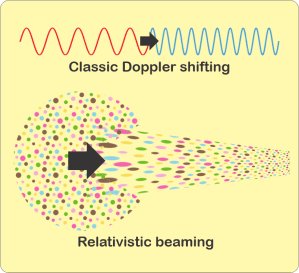
“More blueshifting.”

“Not quite. Photon‑count compression sort‑of resembles the blueshifting process but wavelength isn’t relevant. It combines with the other part of beaming, Special Relativity space compression, which concentrates a moving beacon’s photons in the direction of motion. It’s like focusing a fancy flashlight, narrowing the beam to concentrate it. The faster the beacon travels in our direction, the greater proportion of its photons are sent towards us.”

Vinnie looks up and to the left. “If ISCO’s going near lightspeed, won’t the disk’s inertia drag on the black hole?”
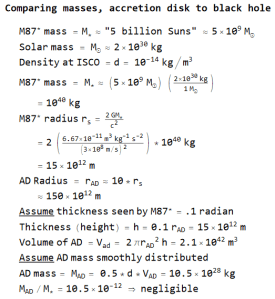
“Sure, within limits. M87* and Sagittarius-A* both have magnetic fields; most black holes probably do. Accretion disk plasma must be frozen into the field. The whole structure would rotate like a spongy wheel with a fuzzy boundary. The lightspeed limit could cut in at the wheel’s rim, much farther out than the Event Horizon’s sphere.”

Count on Vinnie to jump on vagueness. “Spongy? Fuzzy?”

“Because nothing about a black hole’s extended architecture is rigid. It’s a messy mix of gravitational, electric and magnetic fields, all randomly agitated by transients from inbound chunks of matter and feeding outbursts from inside ISCO. The disk’s outer boundary is the raggedy region where the forces finally give way as centrifugal force works to fling particles out into the Universe. I don’t know how to calculate where the boundary is, but this image suggests it’s out about 10 times the Horizon’s radius. The question is, how does the boundary’s speed limit affect spin?” <tapping rapidly on Old Reliable’s screen>

“And the answer is…?”

“Disk particles driven close to lightspeed do push back. They lightly scramble those mushy fields but much too feebly to slow the central spin.”

~ Rich Olcott
Look, Look Again, Then Think

Cathleen and I are sharing scones and memories when Vinnie trundles up to our table. “Glad I got you two together. I just ran across a couple news items and I need some explanations.”

“Astronomy AND Physics in the same news items? Do tell.”

“They’re only one paragraph each and read like someone wrote ’em before their morning coffee. They’re both about that big black hole they’ve been taking pictures of.”

“The one in our galaxy or the M87* supermassive black hole in the Messier‑87 galaxy?”

“The second one, Cathleen. This item says it shot out a jet traveling faster than light.”

<sigh> “Pop‑sci journalism at its worst, right, Sy? I know the work that’s based on and the academic reports don’t say that. Good observations leading to less flamboyant conclusions.”

“Maybe it was supposed to be a bigger article but the editors cut it down badly. That happens. I’m sure it’s not really a superluminal jet—”

“Superluminal’s faster‑than‑light, right?”

“Right, Vinnie. Sorry to get technical. Anyway, it’s an illusion.”

“Ah geez, it’ll be frames again, right?” <eyes suddenly open wide> “Wait, I got it! I betcha it’s about the time difference. Take a blob in that jet, it’s flying out at near lightspeed. Time dilation happens when relativity’s in the game, me and Sy talked about that, so blob‑frame seconds look like they take longer than ours do. We see the blob cramming a lightsecond of distance traveled into less than one of our seconds and that’s superluminal. Am I right, Sy?”

“Right answer to a different question, I’m afraid. You’re straight on the time dilation but it doesn’t apply to this situation. Something happening within the blob’s frame, maybe a star blowing up or something weird metabolizing in there, Special Relativity’s time distortion hijinks would show us that action taking place in slow motion. But this superluminal blob claim hinges on how the blob’s whole frame moves relative to ours. That motion isn’t superluminal but it can look that way if conditions are right. As I understand it, the M87* jet qualifies. Your bailiwick rather than mine, Cathleen.”

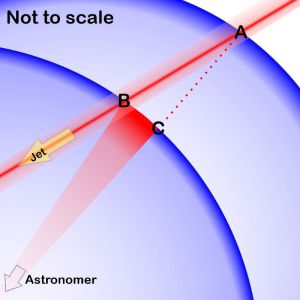
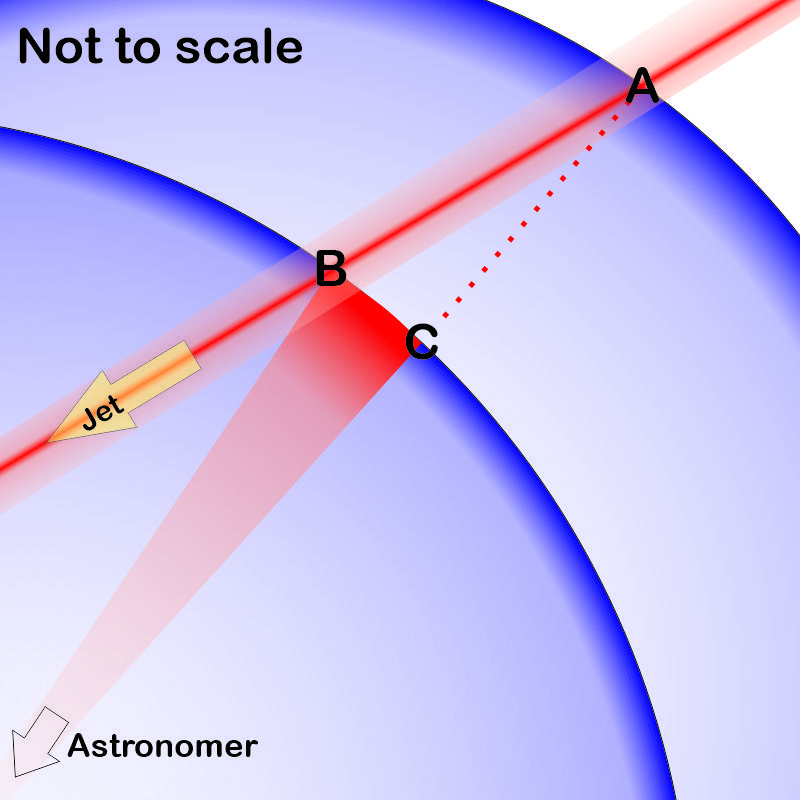
“Actually it is a frames thing, Vinnie, but timeframes, not spacetime. Those blobs move too slowly in our sky to watch in real time. We take snapshot A and then maybe a few years later we take snapshot B and compare. Speed is the ratio of distance to time. We need the A‑B distance in 3‑D space to compare to the known time between snapshots. But we can’t see the blob’s trajectory in 3‑D. All we can capture is its 2‑D arc C‑B across an imaginary spherical shell we call the sky. If the M87* jet were perpendicular to our line of sight the C‑B image on the sky‑sphere would match the 3‑D path. Multiply the image’s angle in radians by the distance to M87* and we’re done.”

“We’re not done?”

“Nope. This jet points only 20° away from our direct line of sight. I’ll spare you the trigonometry and just say that distance A‑B is about 3 times longer than C‑B.”

“So we measure C‑B, triple the angle and multiply by the M87* distance. No problem.”

“Problem. That tripling is what makes the blob’s A‑B journey appear to go faster than light. Three times 0.4c equals 1.2c. But you missed something important. Your arithmetic assumed you could use a simple ‘M87* distance’. Not in this case, because the blob moves towards us at close to lightspeed. Visualize two concentric sky‑spheres. The outer one’s radius runs from us to the blob’s location at A‑time. The inner sphere’s radius runs to the blob’s location at B‑time. The B‑sphere is our reference frame. The light we saw at A‑time had to travel from the outer sphere to the inner one before we could register the C‑B image.”

“Can’t be very far.”

“We’re talking years at lightspeed, so lightyears, so significant. A properly illusion‑free A‑B travel calculation must include the A‑C travel time in the denominator of the distance/time ratio. The true kilometers per second come out well below lightspeed. Oh, and relativity’s not involved.”

“Dang, Cathleen, it was such a cool illusion.”

~ Rich Olcott

Not Even A Sneeze in A Hurricane

Quite a commotion at the lakeshore this morning. I walk over to see what’s going on. Not surprised at who’s involved. “Come away from there, Mr Feder, you’re too close to their goslings.” Doesn’t work, of course, so I resort to stronger measures. “Hey, Mr Feder, any questions for me?”

That did the trick. “Hey, yeah, Moire, I got one. There’s this big problem with atomic power ’cause there’s leftovers when the fuel’s all used up and nobody wants it buried their back yard and I unnerstand that. How about we just load all that stuff into one of Musk’s Starships and send it off to burn up in the Sun? Or would that make the Sun blow up?”

“Second part first. Do you sneeze?”

“What kinda question is that? Of course I sneeze. Everyone sneezes.”

“Ever been in a hurricane?”

“Oohyeah. Sandy, back in 2012. Did a number on my place in Fort Lee. Took out my back fence, part of the roof, branches down all over the place—”

“Did you sneeze during the storm?”

“Who remembers that sort of thing?”

“If you had, would it have made any difference to how the winds blew?”

“Nah, penny‑ante compared to what else was going on. Besides, the storm eye went a couple hundred miles west of us.”

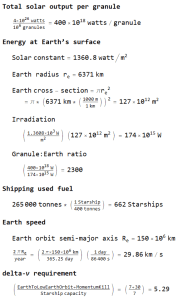
“Well, there you go. The Sun’s surface is covered by about a million granules, each about the size of Texas, and each releasing about 400 exawatts—”.

“Exawha?”

“Exawatt. One watt is one joule of energy per second. Exa– means 1018. So just one of those granules releases 400×1018 joules of energy per second. By my numbers that’s about 2300 times the total energy that Earth gets from the Sun. There’s a million more granules like that. Still think one of our rockets would make much difference with all that going on?”

“No difference anybody’d notice. But that just proves it’d be safe to send our nuclear trash straight to the Sun.”

“Safe, yes, but not practical.”

“When someone says ‘practical’ they’re about to do numbers, right?”

“Indeed. How much nuclear waste do you propose to ship to the Sun?”

“I dunno. How much we got?”

“I saw a 2022 estimate from the International Atomic Energy Agency that our world‑wide accumulation so far is over 265 000 tonnes, mostly spent fuel. Our heaviest heavy‑lift vehicle is the SpaceX Starship. Maximum announced payload to low‑Earth orbit is 400 tonnes for a one‑way trip. You ready to finance 662 launches?”

“Not right now, I’m a little short ’til next payday. How about we just launch the really dangerous stuff, like plutonium?”

“Much easier rocket‑wise, much harder economics‑wise.”

“Why do you say that?”

“Because most of the world’s nuclear power plants depend on MOX fuel, a mixture of plutonium and uranium oxides. Take away all the plutonium, you mess up a significant chunk of our carbon‑free‑mostly electricity production. But I haven’t gotten to the really bad news yet.”

“I’m always good for bad news. Give.”

“Even with the best of intentions, it’s an expensive challenge to shoot a rocket straight from Earth into the Sun.”

“Huh? It’d go down the gravity well just like dropping a ball.”

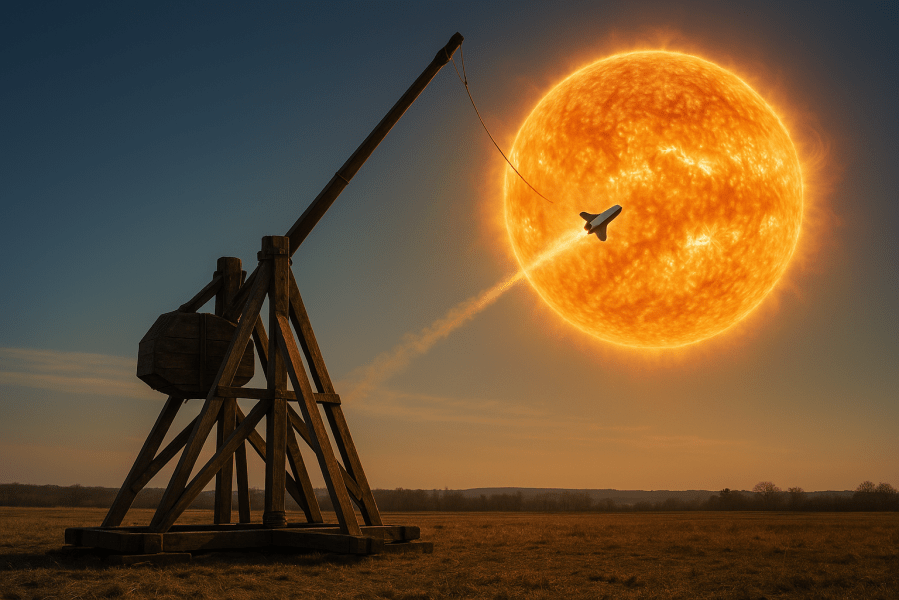
“Nope, not like dropping a ball. More like flinging it off to the side with a badly‑aimed trebuchet. Guess how fast the Earth moves around the Sun.”

“Dunno. I heard it’s a thousand miles an hour at the Equator.”

“That’s the planet’s rotation on its own axis. My question was how fast we go taking a year to do an orbit around the Sun. I’ll spare you the arithmetic — the planet speeds eastward at 30 kilometers per second. Any rocket taking off from Earth starts with that vector, and it’s at right angles to the Earth‑Sun line. You can’t hit the Sun without shedding all that lateral momentum. If you keep it, the rules of orbital mechanics force the ship to go faster and faster sideways as it drops down the well — you flat‑out miss the Sun. By the way, LEO delta‑v for SpaceX’s most advanced Starship is about 7 km/s, less than a fifth of the minimum necessary for an Earth‑to‑Sun lift.”

~ Rich Olcott

The Phase Rue

Stepping past the fourth wall again. You may have noticed that some of my recent posts have included A.I.‑generated illustrations. The creation process has been fun and often frustrating. Sometimes I’ve gone through half‑a‑dozen or more iterations, refining and re‑refining a prompt until I got the effect I wanted. Or not.

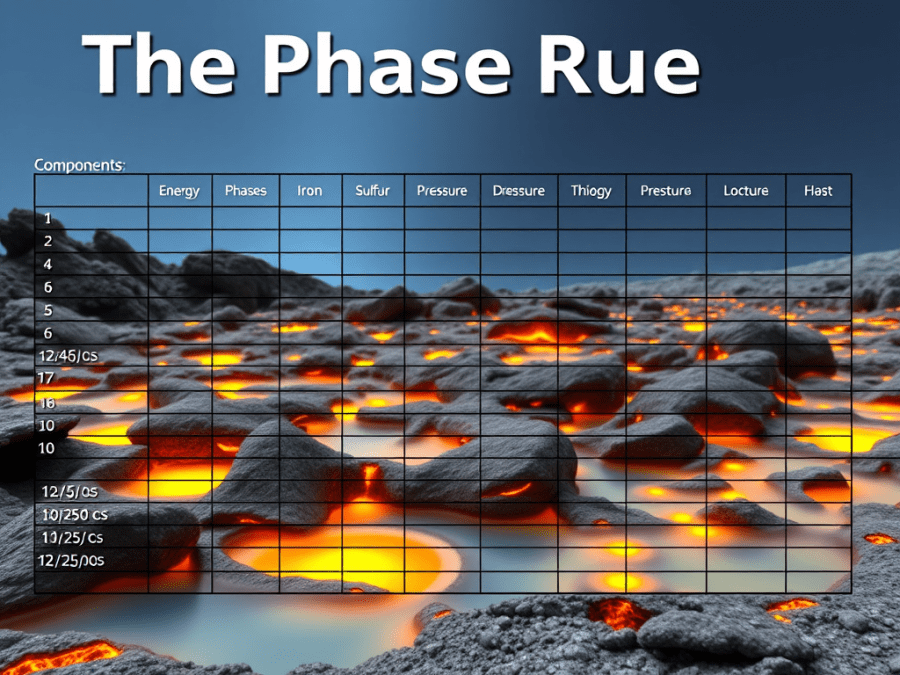
A couple of times I just gave the beast the text of the post and was delighted with the results (see in particular this one and this one). I used prompts for most of the space scenery in the “Sulfur on Io” series; on the whole they came out well. For some posts (for instance this one) I had to haul out my toolkit and tinker with the generated image. Other times I simply gave up and went back to my trusty digital artsy processes. I had to do that when I turned the A.I. loose on one of the “Phase Rule” posts:

The title (which I hadn’t asked for) was almost too good, but the column headings (“Thiogy”? “Presture”?) definitely went off the deep end.

Then there’s the following image, the final unfortunate result of an extended series of prompts I went through trying to illustrate a post about the three-body problem. So many issues:

  • The mise-en-scène just isn’t my visualization of Pizza Eddie’s place and I couldn’t get the A.I. to adjust it properly.
  • That “clock” has only ten, or maybe 9½, numbers. Besides, it’s in a stupid place, at the ceiling above the crown molding.
  • Vinnie’s holding a pizza fragment but neither pizza in front of him has been touched.
  • Eddie has no flour dust on his apron.
  • Sy’s right shoulder is too hyper‑developed for an office worker who doesn’t bowl or do archery. He’s the kind of guy who would wear a sport jacket any time he’s out of the house. Finally, in all of my prompts I had him facing the other two. Sy may be a shy person, but he’s not one to avoid the camera.

And then I watched John Oliver’s harangue about “A.I. slop.” As usual, he’s on‑target. The tech is fundamentally unfair because it has been built using work from real live working artists with whom it now competes. Moreover, A.I. is gleefully being abused by rapacious click‑harvesters who flood the internet with rubber‑stamp crap*, generally either political or cringey. Like the guy said, “It ain’t right.”

So in the future I’m going to avoid using A.I.‑generated images in favor of hand-made ones. Mostly.

* See Theodore Sturgeon’s First Law — “95% of everything is crap.” On recent evidence, that number’s probably too low these days.

[/rant]

~ Rich Olcott