
Chasing the number 16830 led me down a rabbit hole, this time in the On-line Encyclopedia of Integer Sequences®, a.k.a. OEIS. You can search it for someone’s name (Euler‘s appears in 8651 entries), a descriptive phrase (“sum of cubes” hits 2679 entries), an integer series (the software’s smart enough to recognize “3,14,15,92,65,35,89,79” as the base‑10 expansion of π) or even just a single integer. After writing A Numbers Game, I had to check where else that particular number has cropped up.
My search on “16830” brought back 48 results. Entry A097811 listed 16830 among “Numbers n such that n3 is the sum of three or more consecutive positive cubes” — that’s how Elspeth won her game, after all. Some of the posts are pretty arcane. For example, I hadn’t known that “digitally balanced” (having equal numbers of each digit) is even a thing, but entry A049355 says 16830 is digitally balanced in base‑4: 1683010 = 100123324. 16830‘s also in the list for entry A136154 “Composites one larger than a prime, with exactly five distinct prime factors.” Sure enough, 16830–1=16829 is indeed prime and 16830 itself is 2×32×5×11×17 (though 3 being in there twice feels like cheating). Who would need to know things like that?
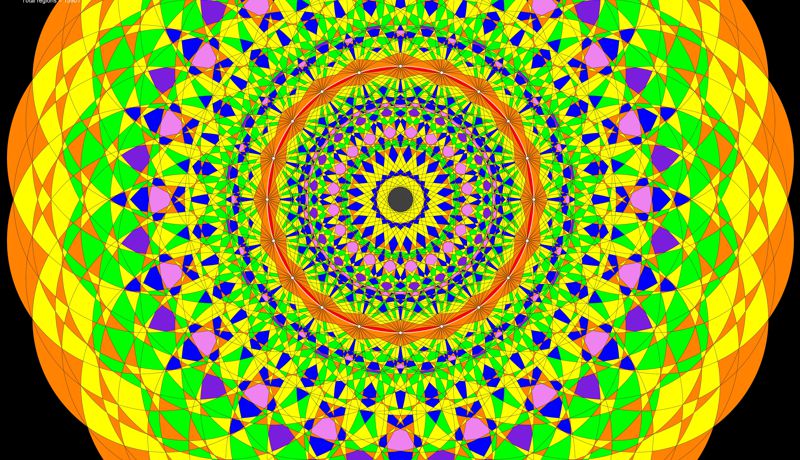
The most eye-worthy fruit of this survey was the series of “stained glass windows” (his words) that Scott R. Shannon had generated as part of his graph theory studies. Graph theory is all about pairwise relationships (you and each of your friends, plus each of them and each of their their friends…).
One of graph theory’s goals is to enumerate and classify all possible pairwise structures. Represent each member of some pair by a dot on a plane (naturally, the mathematicians go for more complicated surfaces but let’s keep things simple). Represent each relationship by a line (straight or curved) between corresponding dots. Then look for patterns.
Incidentally, Euler helped invent graph theory back in 1736. He pointed out that any set of connected lines encloses an area. Count up dots, lines and areas. On a plane, the dot count plus the area count minus the line count will always equal 1. That’s true even for the limiting case of two dots and one line — area count is zero, so 2+0–1=1. Dots plus areas minus lines may sum up to something else on a different surface, but we’re keepin’ it simple, okay?
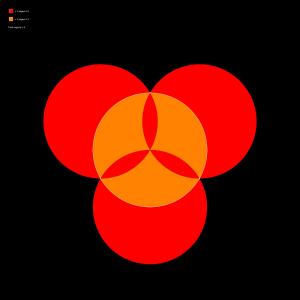
In one Shannon & Co project, they pick a rule for placing dots on a shape, then classify by counting the dots, lines and areas that the rule generates. For example:
- Draw a unit circle.
- Choose a number n. In this example, n=3.
- Mark off n equally-spaced points around the circle.
- Draw n more unit circles, each passing through a pair of points on the original circle.
That’s the simplest useful example — n=2 puts two dots 180° apart so a second circle would lie right on top of the first one and that’s boring. Three dots on the circle plus the generated intersection at the center makes 4. Nine areas and twelve arcs (count ’em) between dots: 4+9–12=1 as Euler predicted. To make the picture interesting, Shannon colored each area according to the number of arcs that enclose it: red for 2 arcs, orange for three.
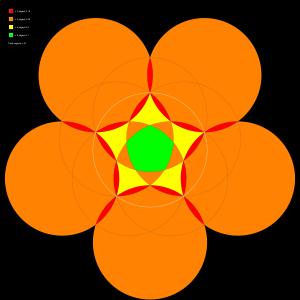
The 4-dot case is pretty much the same, except the generated circles don’t overlap so there’s no central intersection. Euler’s equation still prevails: 4+9–12=1.
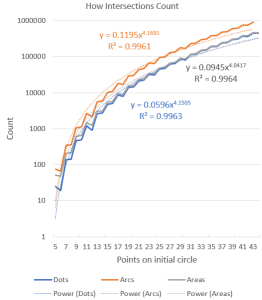
Data from oeis.org/A371373/ and oeis.org/A371374/
Just one more dot on the circle makes a drastic change. The dot count balloons from 4 to 25, connected by 75 arcs that enclose 51 areas (25+51–75=1, Euler wins again). Click the picture or the link and see the ten generated grey circles cut by lots of generated dots. The proliferation of intersections generates more complexity than you’d expect from the first 3 cases.
“Proliferation” puts it mildly — the thingy count rises as roughly the fourth power of n (see the “Combinatorial explosion” chart).
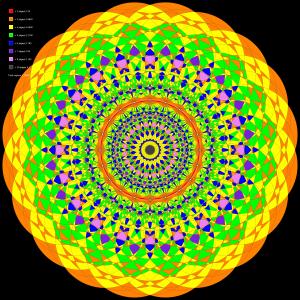
So about 16830 — that number shows up as the number of arcs in the structure generated by 18 dots on the initial circle. Unfortunately, Shannon didn’t give us that picture, so here’s the one for n=20. Pretty, huh?
~ Rich Olcott


