

“So, Vinnie, that first article’s bogus. Blobs in M87’s supermassive black hole’s jet don’t travel faster than light. Your second article — is it also about M87*?”
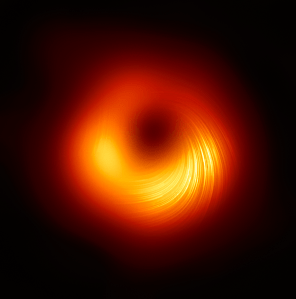
“Yeah, Cathleen. It’s got this picture which a while ago Sy explained looks like a wrung‑out towel because that’s the way the thing’s magnetic field forces electrons to line up and give off polarized light.”
“As always, Vinnie, your memory impresses.”
“Thanks, I work at it. Anyhow, this one‑paragraph article says they figured out from the picture that everything’s spinning around as fast as it’s possible to spin. How fast is that, and how’d they get the spin speed if they only used one frequency so redshift/blueshift doesn’t apply?”
Cathleen’s been poking at her tablet. “HAH! Found the real paper behind your pop‑sci article, Vinnie. Give me a minute…” <pause, with mumbling> “Wow, not much there in the disk. They estimate even at the crowded innermost orbit, they call it ISCO, the density’s about 10-14 kg/m3 which would be one nanopascal of pressure. Most labs consider that ultrahigh vacuum. They get angular momentum from something called ‘Doppler beaming’, which I’m not familiar with.” <passes tablet to me> “Your turn, Sy.”
“ISCO’s the Innermost Stable Circular Orbit. ISCO’s radius depends on the black hole’s mass and spin.” <pause, with mumbling> “Doppler beaming’s a velocity‑dependent brightness shift from outbound to inbound sides of ISCO. They connected brightness range within the images to ISCO velocity, multiplied that by ISCO radius and the black hole’s mass to get the disk’s angular momentum, J. The lightspeed rotation angular momentum Jmax comes from theory. The paper puts a number to M87*’s J/Jmax.“
“My article says it’s near 100%.”
“That’s not what the paper says, Vinnie. ‘…our value of 0.8 would appear to be a lower limit,’ in other words, something above 80% but definitely not 100%. Like I said, pop‑sci journalism. So what’s Doppler beaming, Sy?”
“Classical Doppler shifts happen when a wave source moves relative to us. Motion toward us crams successive wave peaks into decreasing distance. Motion away increases wavelength. The same principle applies to light waves, sound waves, even ocean waves.”
“Blueshifting.”
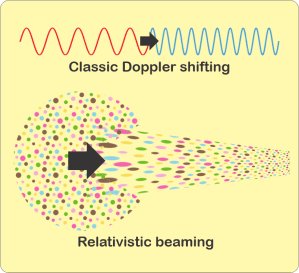
“Mm‑hm. By contrast, beaming is about how a source’s motion affects the photon count we receive per second. Imagine a beacon steadily sending us photons as it whips at near‑lightspeed around M87*. When the beacon screams towards us its motion crams more photons into one of our seconds than when it dashes away.”
“More blueshifting.”
“Not quite. Photon‑count compression sort‑of resembles the blueshifting process but wavelength isn’t relevant. It combines with the other part of beaming, Special Relativity space compression, which concentrates a moving beacon’s photons in the direction of motion. It’s like focusing a fancy flashlight, narrowing the beam to concentrate it. The faster the beacon travels in our direction, the greater proportion of its photons are sent towards us.”
Vinnie looks up and to the left. “If ISCO’s going near lightspeed, won’t the disk’s inertia drag on the black hole?”
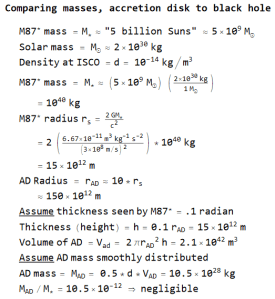
“Sure, within limits. M87* and Sagittarius-A* both have magnetic fields; most black holes probably do. Accretion disk plasma must be frozen into the field. The whole structure would rotate like a spongy wheel with a fuzzy boundary. The lightspeed limit could cut in at the wheel’s rim, much farther out than the Event Horizon’s sphere.”
Count on Vinnie to jump on vagueness. “Spongy? Fuzzy?”
“Because nothing about a black hole’s extended architecture is rigid. It’s a messy mix of gravitational, electric and magnetic fields, all randomly agitated by transients from inbound chunks of matter and feeding outbursts from inside ISCO. The disk’s outer boundary is the raggedy region where the forces finally give way as centrifugal force works to fling particles out into the Universe. I don’t know how to calculate where the boundary is, but this image suggests it’s out about 10 times the Horizon’s radius. The question is, how does the boundary’s speed limit affect spin?” <tapping rapidly on Old Reliable’s screen>
“And the answer is…?”
“Disk particles driven close to lightspeed do push back. They lightly scramble those mushy fields but much too feebly to slow the central spin.”
~ Rich Olcott
 Hard Science Ain't Hard