

Vinnie looks up when I walk into Cal’s coffee shop. “Afternoon, Sy. You’ve got the look of a man deflated. What happened?”
“Dove down a rabbit hole, burned a lot of Old Reliable’s compute time, thought I’d discovered something, but then learned it’s been known since 1830.”
“Big disappointment, huh?”
“Oh, there’s a lot of disappointment in science. You get used to stubborn data blowing away a perfectly good hypothesis. But to be scooped by 200 years — embarrassing! Also frustrating.”
Cal’s pouring coffee. “Spill the story, Sy.”
“It all started with 16830.”
“He got that out of a book by Ken Follett, Cal. Take a number, times itself is a square, times itself again you got a cube. Do that to a thousand numbers in a row, add ’em all up and the total just happens to be the cube of 16830.”
“Vinnie’s right, Cal, except the trick only works if the number you start with is 1134. Start with any other number, one thousand successive cubes don’t add up to any exact cube.”
“You used Old Reliable to check that, right?”
“Naturally. That was the beginning. Once I’d built its program to do that 1000‑cube calculation, I said, ‘Let’s look for other numbers that start a 1000‑cube series that adds up to a cube.’ That program scanned starters up to twenty million. No hits. Well, I did find one other one.”
“Ah-hah!”
“Don’t get excited. Cubing a negative number gives you a negative cube. Cubes from minus‑500 to plus‑500 add up to zero, which is zero cubed.”
“That’s a cheat, Sy. Minus‑500 to plus‑500 is 1001 steps.”
“Good point, Vinnie. My correction stands corrected and you’ve led into my next step. Follett’s novel mentions a four‑member sequence, 113+123+133+143, that adds up to 203. Didn’t take me long to come up with a three‑member chain, 33+43+53=63. Surely there are other windows onto the number line that fit the same pattern if you pick the right starters. I tried a few significant window sizes, like 42 and 100 and 666, no luck. I re‑programmed Old Reliable to try every window from 3 members out to 5000. For each window size, I told it to try every starter from 1 to a million. If it hit an exact‑cube sum the program would print out the starter, the window and the cube‑root of the sum.'”
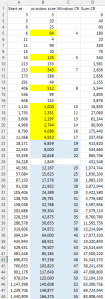
“Wow. Old Reliable musta been smokin’ when that finished.”
“Pretty much. I did apologize to it. Anyhow, I was happy to see 16830 was in the list, but so were a bunch of other combinations. Then I noticed a pattern in the window sizes. I recognized 1000 as 103, 1331 as 113, and 4096 as 163. Many of the other successful window sizes all the way down to 64=43 were also cubes. Here, I’ve highlighted them in yellow in this screenshot.”
“I thought you only did windows up to 5000.”
“Mm‑hm, but that led to my next experiment. I told Old Reliable to scan perfect‑cube window sizes up to 553. That’s the blue‑highlighted cells. See all the hits?”
“But you’re missing some. Where’s 23=8? Or 33, 63 and 93, for that matter?”
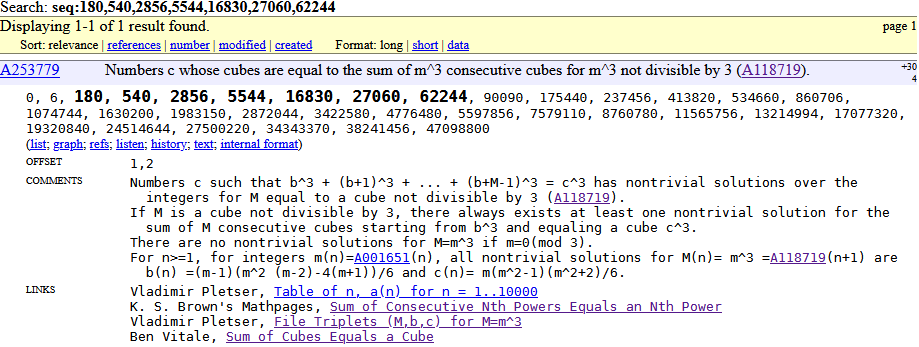
“Good questions. The quick answer is, ‘Because arithmetic,’ but I’m a physicist. I always want to know why. Now that I’d done the calculation I had some samples to ask about. I grabbed a segment from column D and searched it in the Online Encyclopedia of Integer Sequences. Only one hit but it was almost perfect. Even mentioned that the series skips any windows like 63 that are 3‑divisible.”
“So why’s that happen?”
“I had to dig deeper for that. The OEIS just says ‘Here it is,’ leaves explanations to the links. Ben Vitalis posted a collection of formulas in his blog but the real explanation was buried in some hairy algebra in one of Kevin Brown‘s blog posts. Mr Brown’s an old‑school algebraist — used some tricks it took me two days to understand — but he proved that windows divisible by 3 don’t qualify for that family of cube‑making cubes. His post is where I learned about Pagliani and his 1830 book that solved the 1000 case.”
“There’s other families?”
“Small ones. There’s a sparse set where the window size is a perfect square, and a handful of complete mavericks.”
“Could there be others with windows between your blue ones?”
“Maybe, but I’ll let Old Reliable cool off before I look.”
~ Rich Olcott

