The Acme Building’s elevator takes me to the 12th floor with no hiccups, for a change. I unlock my office door and there’s “Walt,” standing in the middle of the room brandishing his cane with what looks like a fat cell phone plugged into it somehow. “The place is clean, Mr Moire. No listeners in the elevator shaft, corridor or office space, and I put temporary foam over your windows to block laser‑bounce sound pickup.”
“That’s good to know, Walt. Should I give you credit for fixing the elevator?”
“Not publicly. Found a dark web relay routine freeloading elevator’s controller computer. Disabled it so the machine can do its real job.”
“Nice work. But why so surreptitious? You know I don’t do military consults. And why come up to my office instead of meeting at Eddie‘s or the park as usual?”
“Tradecraft, Mr Moire — never use the same location too often. Espionage is a thing, military or not, and it doesn’t recognize national boundaries. My people have their secrets, too.”
“Naturally. What are your people curious about this time?”
“Neutronium.”
“Neutronium?”
“Yes, what can you tell me about it?”
“It’s really dense. You’ve heard the line that atoms are mostly empty space. An atomic nucleus is maybe a few femtometers across, but it floats in a ball of space that’s a thousand to ten thousand times wider. The space isn’t empty, of course — it’s occupied by spread‑out electronic charge. Neutronium doesn’t have that not‑quite‑empty space. A neutronium ball with the Sun’s mass would be a dozen kilometers across.”
“Mashed‑together charge like a metal. Would neutronium be shiny?”
“Possibly. I’ve never seen any.”
“Are there neutronium ores you could mine for?”
“Not on Earth, guaranteed. Except for the noble metals like gold, ore atoms are isolated from each other, dispersed in minerals like oxides or sulfides. Neutronium by its nature would have to be in a massive isolated deposit.”
“By its nature?”
“An isolated neutron lives about 15 minutes before it spits out an electron and becomes a proton. A neutron near enough to another nuclear particle is stabilized by the weak nuclear force, but that’s ineffective beyond a few femtometers. Either a neutron’s in an atomic nucleus or it’s mashed up against other neutrons in neutronium or it’s dead.”
“How about a chunk of neutronium buried in one of these ultra‑dense asteroids I’ve read about, like 33 Polyhymnia, or 16 Psyche that we’ve sent a space mission to look at?”
“You have read up, haven’t you? Not even those two asteroids are dense enough to host more than a speck of neutronium. Asteroid mass and volume are separate measurements; you need both to figure mass‑per‑volume density. Each component is a challenging exercise in accurate observation. The first guesstimate for Polyhymnia was that it was more than 10 times denser than iron. That’s why you’ve heard of it. With better data now we think both Polyhymnia and Psyche are at about the density of iron. Higher than most but too low for neutronium by a factor of quintillions.”
“Where else could we go for neutronium?”
“This’ll take some background. The more massive the star, the bigger its diameter and the longer it lives, right?”
Walt gives me a suspicious eye. “You’re fudging, Mr Moire.”
“Nothing gets past you, Walt. More massive stars burn hotter. The heat bulges them out, as you’d expect. The fudge is they exhaust their fuel faster so they die sooner. When the fuel gives out and they go nova, big guys collapse harder than smaller ones can. Their collapse squeezes their residual core tighter. Collapsing a really big star crams its remains into a volume smaller than its Schwartzschild radius. That makes a black hole. Smaller stars can’t go that far. The crush might stop when the residue’s electrons are squeezed into its atomic nuclei. Protons there could capture them and become neutrons. If so, you’ve got neutronium and a neutron star.”
“A nova’s pretty violent, shoots material out randomly?”
“One of the sloppiest, most violent events in the Universe.”
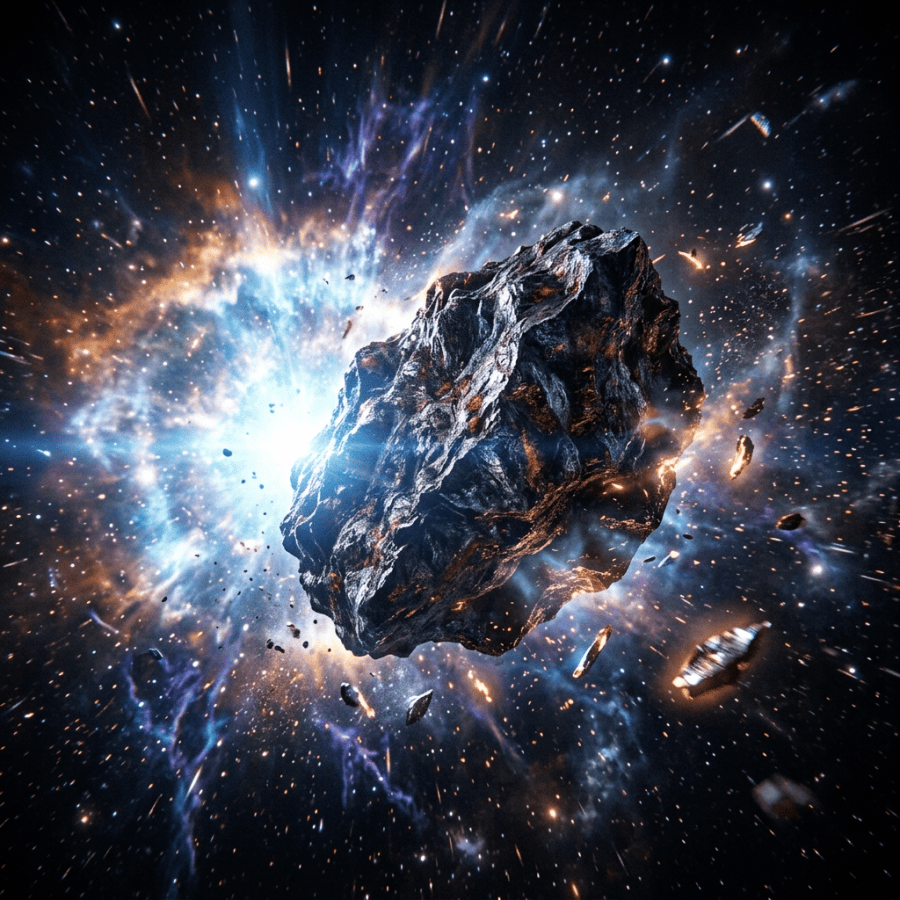
“Could a nova have flung a neutronium fragment through our Solar System like something flung ‘Oumuamua? Could we detect that?”
“Not likely but probably.”
~ Rich Olcott

