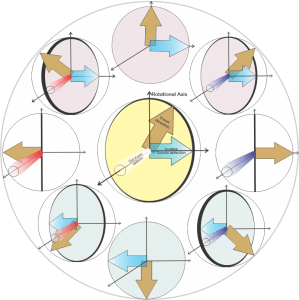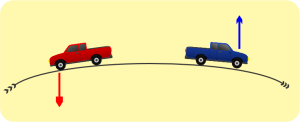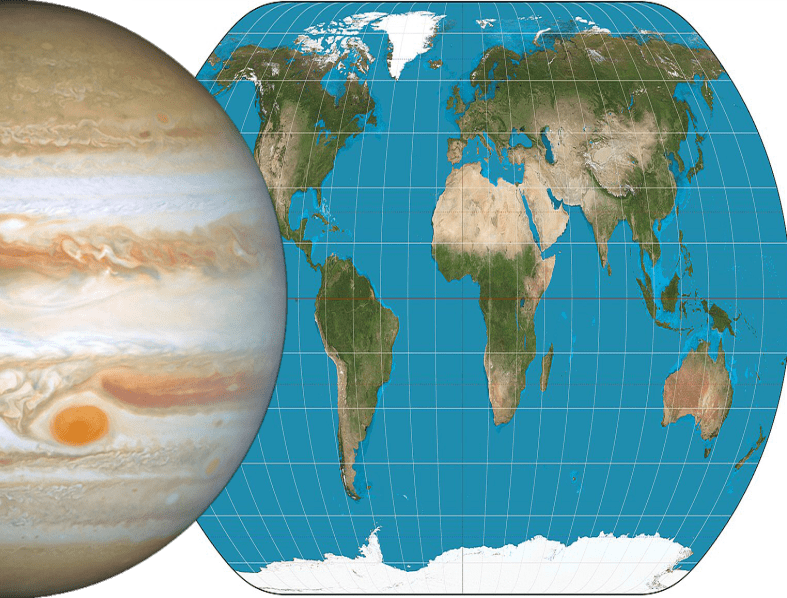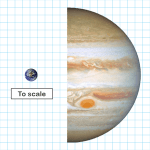
Tropical beach with palm trees next to icy polar region with glaciers.

The Big Water Pump

“Springtime! Could you make me a lilac latte, Cal?”

“Maybe if I left out the coffee, Cathleen. Lilac’s too delicate to stand up to coffee’s punch. How about a cold brew of light roast? I just made a batch. Plenty of caffeine in there, not too much intensity and you can imagine the flowery part.”

“I’ll have that, and a lemon scone, please.”

“Here you go, fresh from the filter. Hey, you sure lit a fire under Sy. He’s done a whole string of posts about Coriolois Effects.”

“Tsk, Cal, the scientist’s name was Coriolis. I’m not surprised there’s been multiple posts — the same pseudo‑force shows up in many ways.”

“Pseudo‑force?”

<looks around> “Good, Sy’s not here. He’d talk our ears off about inertial frames. My quick answer from a planet scientist perspective is that real forces are the ones that make things happen in systems where everything’s moving in straight lines at a steady pace.”

“Like on a pool table?”

“Mm-hm. You can generally make good predictions on systems like that, which is how pool sharks make their money. But if part of the system is accelerating in some way, maybe it’s rotating, you’ve got two choices for predicting how the system will behave. The hard way is to calculate each individual component’s motion in a single coordinate system using just the real forces. The easier way is to group components that have a common acceleration. Pick a convenient group to serve as your base subsystem. Define another subsystem for the components that all have the same acceleration relative to the first subsystem and so on. Then you pretend a pseudo‑force drives the interactions between your subsystems.”

“Like Earth and our Moon make a subsystem ’cause they orbit the Sun together and you said rotation’s a kind of acceleration. The pseudo‑force is centrifugal, fighting against the Sun’s gravity to keep Earth’s subsystem in orbit!”

“I love it when that kind of connection‑making happens in my classroom. Thank you, Cal.”

“You’re welcome. So your subsystems are what Sy calls frames?”

“Pretty much. Skipping some technical caveats, that’s the idea. When I think about atmosphere dynamics, I could try to calculate the planet’s whole atmosphere as an incredibly messy collection of atoms. I prefer to think of the Earth as a subsystem hosting some number of air mass subsystems, all embedded in the Universe system. The Universe enforces straight‑line inertia and the Earth adds rotational acceleration but the air masses are constrained to the planet’s spherical geometry. The Coriolis pseudo‑force summarizes all three effects. The calculation’s still messy, but it’s a lot more manageable. And then there’s water.”

“Water?”

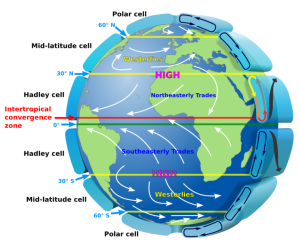
“The piston that drives the climate. Water molecules are small so they move easily through the atmosphere. The important thing is, they’re good at transporting heat energy.”

“How’s that? They’d be the same temperature as everything else.”

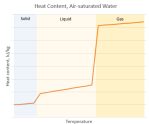
“Temperature doesn’t always measure energy. Water molecules like to hold onto other water molecules. It takes energy to get them apart. When they get back together, the energy’s released so it’s like the freed‑up molecules store heat energy. In solid water, every molecule is locked into position. Melting a given mass of water amounts to breaking those locks. The liquid mass at freezing temperature contains more energy than the ice did. When liquid water evaporates, the gas contains even more energy, because the molecules can roam even more freely. Visualize a bucket of water someplace warm.”

“A Hawai’ian beach.”

“That bucketful absorbs heat energy as it evaporates, cooling the Pacific Ocean. Winds sweep up the gas and carry it north to the Arctic where it freezes. In the process it warms the ice cap by giving up its liquid‑to‑gas heat and also its solid‑to‑liquid heat. Water’s two active phase transitions make it a far more efficient heat transporter than dry air alone.”

“One bucket’s teeny in the ocean, though.”

“Multiply that by gazillions. We have gigatons of surface water. The evaporate/freeze/melt process cycles as the icecaps degrade, continuously acting to moderate Earth’s temperature differences. If Earth were dry, the gradient would be far steeper. Thermal gradients drive air movement. A dry Earth’s extreme temperature discrepancies would generate permanent gale‑force winds towards the poles.”

~ Rich Olcott

Atmospheric Jiu-jitsu

A gorgeous early Spring day for a walk by the lake — blue sky, air just the right side of crisp, trees showing their young green leaves, geese goosily paddling around. As I pass the park bench I hear a familiar voice. “Hello, Mr Moire.”

“Morning, Walt. It’s been a while. What do your people want to know about now?”

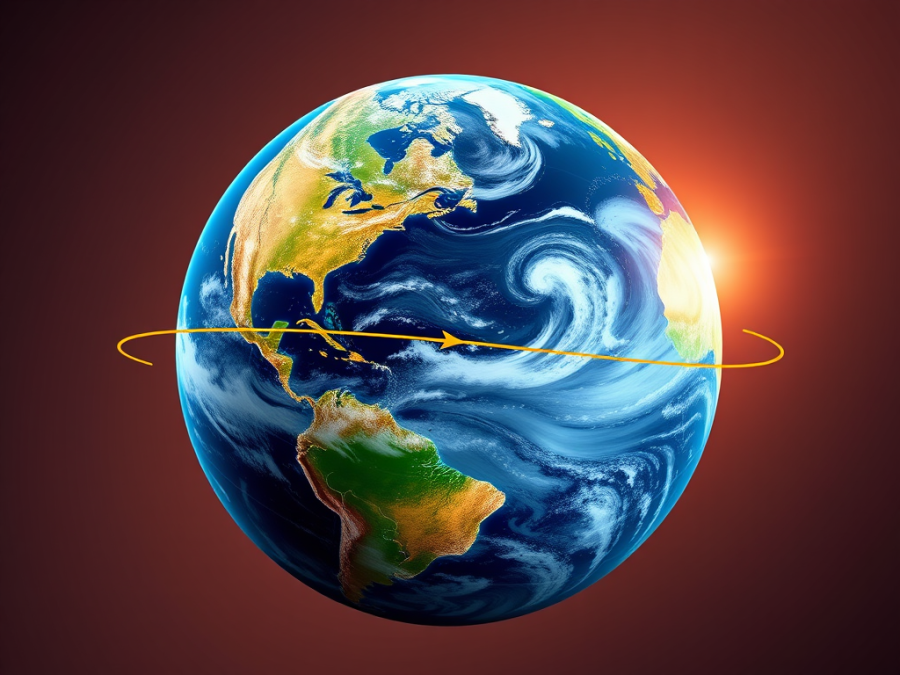
“We’ve been reading your series of posts about the Coriolis Effect. You have masses of air pushing each other around, you have pendulums twisting about, and you have objects flying weird orbits around latitudes instead of the planet’s center. Which is the real Effect?”

“All three.”

“They’re so different. How can all three be right?”

“Knowing something of your interests, I can think of another Coriolis application will help clarify the connection. How do you steer an old‑fashioned artillery shell?”

“You don’t, you aim it.” <His eyes are looking inward.> “Those old howitzers, you traverse to the target’s coordinates, set the elevation for the distance and your munitions and whatever your barrel’s still good for, load ‘er up, let ‘er rip and wait for the forward observer to tell you how to adjust.”

“No correction for the Earth turning west‑to‑east beneath the shell’s trajectory?”

“No need. Inside a max 10‑mile range, the artillery, target and shell all share the same initial eastward vector. Windage and temperature inversions are more of a problem than Coriolis forces. That’s where judgement, feedback and reload speed come in.”

“Now stand that up against a cruise missile.”

“Very different situation. With cannons, all the propulsion happens at the start. That’s why they call it ballistic. Cruise missiles have an extended boost phase, maybe more than one, so they can do in‑flight steering. On the other hand, range is hundreds of miles or more so you do need to figure in relative easting.”

“And the easting correction takes power, right?”

“Of course.”

“From the missile’s point of view, that power goes to counteract the Coriolis force pushing it off‑course. You don’t see it from the ground but the missile does. Clearer now?”

“Give me a minute.” <sketches on his notepad> “Okay, counteracting attempt to deflect course — got it. Hmm, a pendulum’s even simpler, because it’s not trying to keep in sync with the Earth’s rotation. No forces in play crosswise to the swing plane so it can maintain orientation relative to the Universe. To museum visitors it looks like something’s twisting, but it’s us doing the moving. The air masses, though … forces are in play with that one.”

“It’s always important to keep track of who’s doing what to whom. That system has four distinct frames of reference: the Earth, a moving air mass, the air mass it collides with, and the Universe.”

“The Universe?”

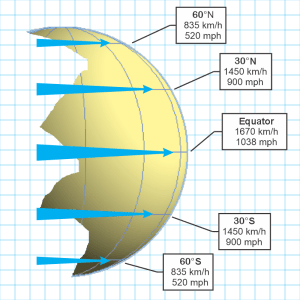
“Sets the stage for Newton’s First Law, about conservation of linear momentum. Say there’s an air mass hovering over Dallas, latitude 30° north. Relative to the Earth it’s stationary, but relative to the Sun and the rest of the Universe it has an eastward vector clocking 1450 km/hour. Now suppose that mass moves north relative to the Earth.”

“But there’s already an airmass taking up space there, say in Manitoba. There’ll be a collision, northbound momentum against Manitoban inertia.”

“Here’s where Coriolis gets into the game. Manitoba may have zero motion relative to Earth, but Manitoba and its air mass are also moving eastward relative to the Universe. Manitoba’s speed is slower than Dallas’ but it’s not zero. Manitoba’s momentum deflects the Dallas mass into an even more easterly vector.”

“You’re saying that Coriolis plays jiu‑jitsu with the atmosphere.”

“I wouldn’t have come up with that interpretation, but it’s reasonable.”

“What about the weird orbits?”

“Not really orbits, more like equilibrium bands. The concept comes from the theoretical notion that every latitude along a meridian has a natural equilibrium speed where air pressure balances other forces. The bands would be parallel circles around the globe except for geography and transient disturbances. Dallas’ 1450‑km/h number was an example. If you exceed your local natural speed, centrifugal force moves you towards the Equator; if you’re a slowpoke, you’re shoved towards the nearest pole. Real weather’s more complicated.”

“Everything’s always more complicated.”

~ Rich Olcott

The Polar Expression

“Good afternoon, Mr … Moire, yes?”

“The same. Can I help you?”

“Yes. I am Tomas Frashko. I am new to this University. I could not help overhearing—”

“The whole neighborhood couldn’t help overhearing.”

“Mmm, yes. My sympathy. But I have some questions, if you have a moment.”

“My coffee mug’s not empty yet. Please sit down. I’ll help if I can.”

“Thank you. I have often seen the Coriolis Effect explained as an atmospheric effect — northbound air with high‑speed low‑latitude momentum deflected eastward by slower‑moving air already at higher latitudes. The last part of your recent post goes to some trouble to avoid that explanation. Why is that?”

“Because the Effect doesn’t only play with the atmosphere. It drives gyre currents in the oceans and probably the magma flows deep inside Earth’s mantle.”

“So fluids, not just air. But it is still a matter of fluid with a velocity in one direction being diverted by fluid with a different velocity. Also, these cases are planet‑scale effects operating over large distances. Surely systems at small scale do not experience a measurable amount of Coriolis force.”

“But they do. Museum Foucault pendulums swing on a scale measured in meters. There’s dozens of them on display all over the world, they act just as Coriolis’ ideas predicted, and the host institutions go to a great deal of trouble to ensure the steady swinging isn’t disturbed by rushing air.”

“Ah, yes. I have seen the pendulum exhibit in our museum in the city where I grew up. A hypnotic thing, swinging back and forth on its wire, each swing a little closer to knocking down a pin … finally! Then slowly turning direction to knock down another one. The museum docent said the plane of the pendulum’s swing pivots to demonstrate Earth’s rotation, but then she mentioned that the full circle takes more than a day to complete. She couldn’t explain why.”

“If it were swinging from a point above the North or South Pole it would be a one-day completion, 15 arcseconds per second.. Scientists tried mounting one at the South Pole and that’s exactly what they determined. The poles are the only points on Earth’s surface where the the pendulum’s inertial frame matches Earth’s so it looks like the Earth is simply turning beneath the pendulum. On the other hand, along the Equator the Coriolis force doesn’t affect a pendulum’s motion at all.”

“Not at all?”

“Nope. Centrifugal force, a little bit, but not Coriolis force.”

“Does the one become the other?”

“Oh no, they’re quite different. Centrifugal force represents competition between dissimilarly rotating frames; Coriolis force represents their coupling. If you’re riding on a merry‑go‑round—”

“A what?”

“Mm, you’d probably call it a carousel.”

“Ah. Yes, go on.”

“If you’re riding on a carousel, your straight‑line inertia in the fairgrounds frame tries to drive you forward. To stay in position on the rotating carousel, you fight that outward inertial impetus by holding onto something. In the ride’s rotating frame, that looks like you’re exerting centripetal force to counterbalance a centrifugal force that the fairgrounds frame doesn’t see.”

“Yes, yes, but how does that differ from Coriolis force?”

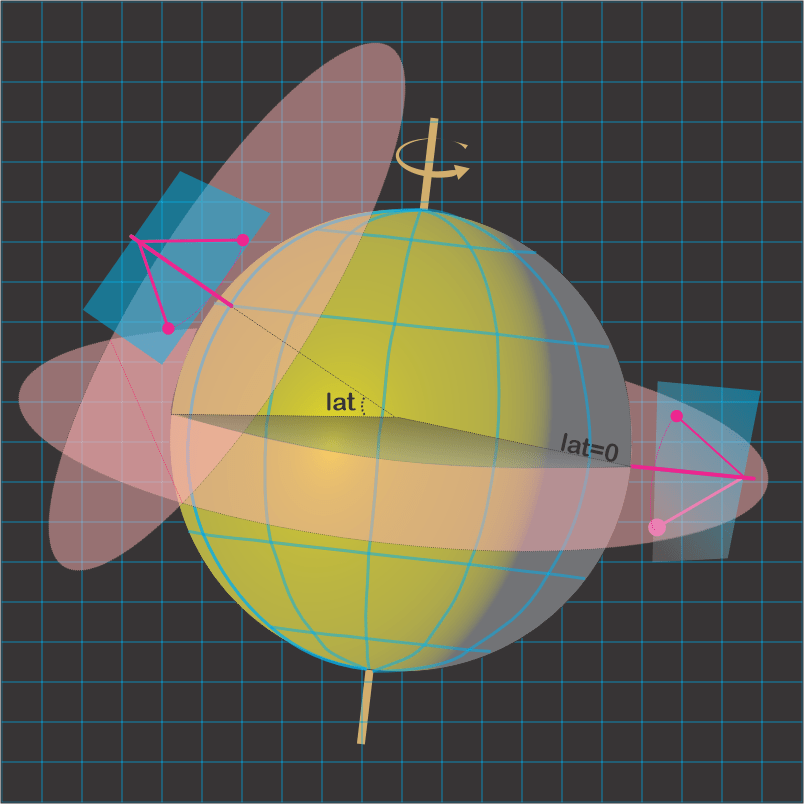
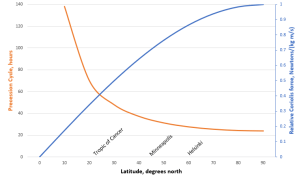
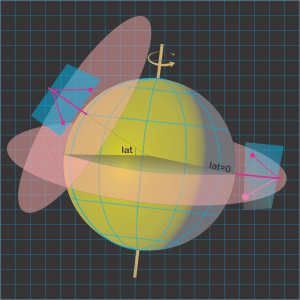
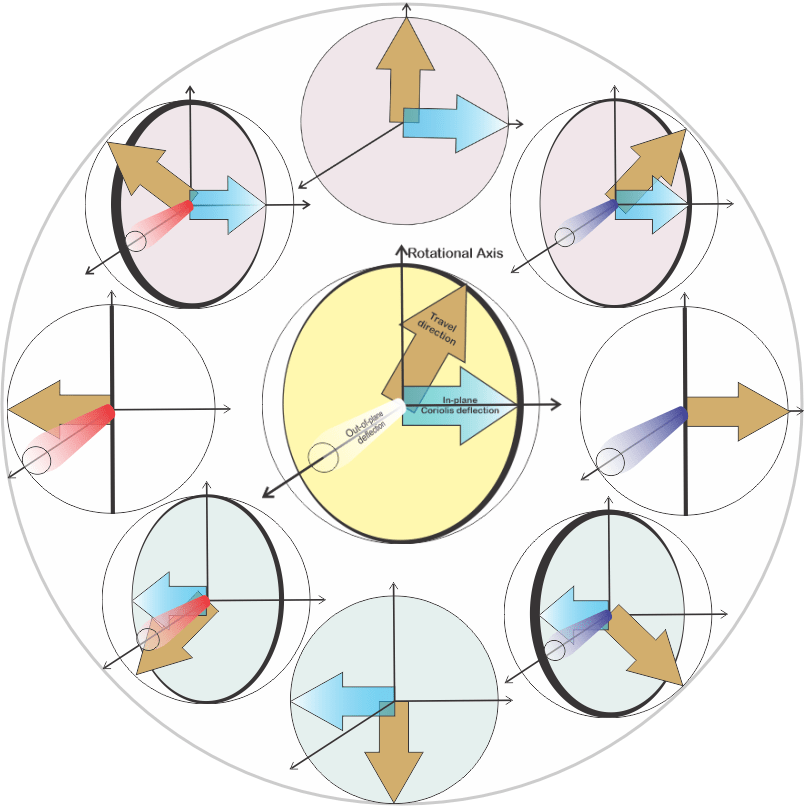
“Centrifugal force depends on an object’s distance from the center of rotation. Coriolis force doesn’t care about that. It rises with the sine of the angle between the object’s vector and the axis of rotation. On a sphere the relevant angle is the latitude. A northbound object, could be a pendulum bob, arrives at the North Pole traveling perpendicular to the Earth’s axis. Perpendicular angles have the maximum sine, 1.0. The Coriolis coupling is strongest there and that’s why a pendulum’s reference frame is locked to the Earth’s 24‑hour period. At the equator a northbound object moves parallel to the polar axis. Parallel lines have zero angle with zero sine so the Coriolis coupling’s zero. A pendulum’s plane of motion at the equator stays where it started, infinite precession completion time.”

“And in‑between?”

“In between. A pendulum’s cycle would run 27.7 hours in Helsinki, more than 60 hours at the Tropic of Cancer.”

“Small coupling, not much swerving.”

~ Rich Olcott

  • Thanks to Ric Werme for his thoughtful comments and suggestions.

Directional Reset

Professor of Astronomy Cathleen O’Meara barges into Cal’s Coffee Shop. “There you are, Sy Moire! You numbskull! You addlepate! You … nincompoop!

We’ve known each other since we were kids but I’ve rarely seen her this angry. “What have I done this time, Cathleen? I apologize, but what for?”

That last post you put up. One of the hardest things to get across to planet science students is the Coriolis Effect. You got it exactly backwards, you lummox! Confused the be-jeepers out of half my students and it’s going to take a whole class period to unwind it.”

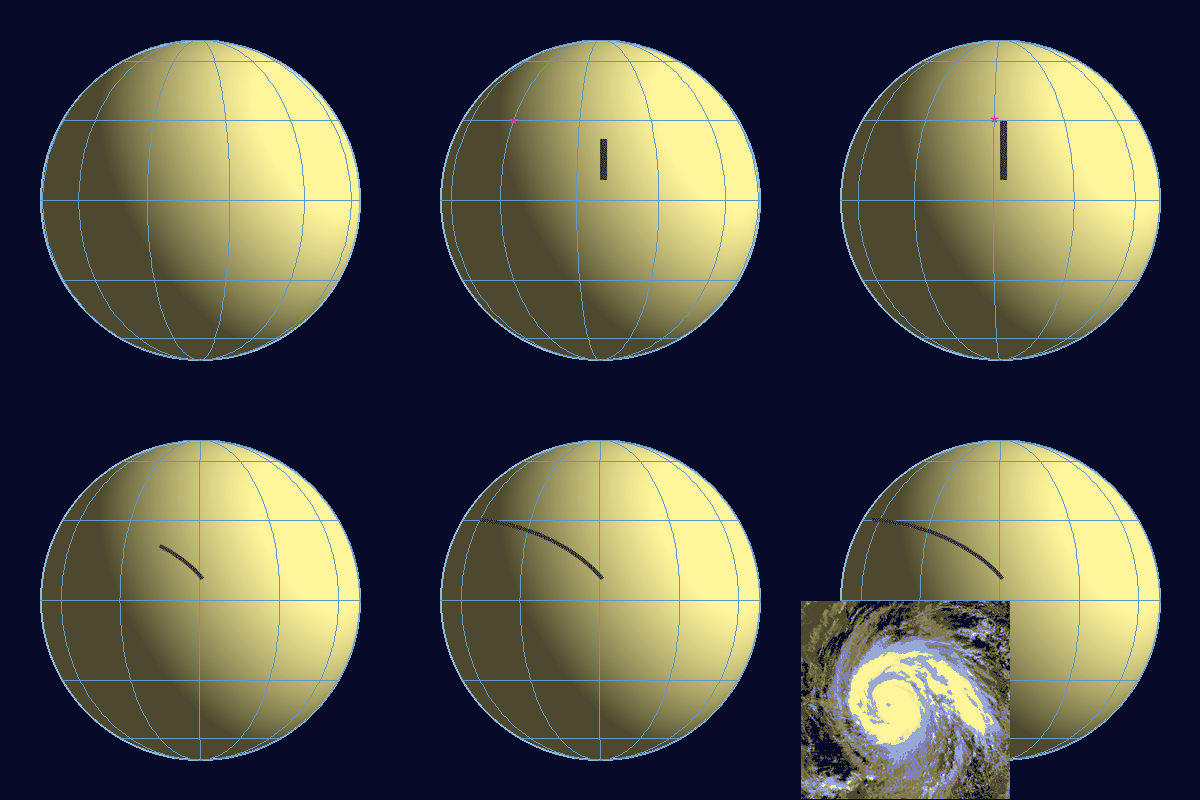
All those exclamation points sting when they strike home. “It did feel funny. All the sources I checked said Coriolis skews travel to the right in the northern hemisphere but I worked hard for hours on that video and it clearly shows ‘left‘.”

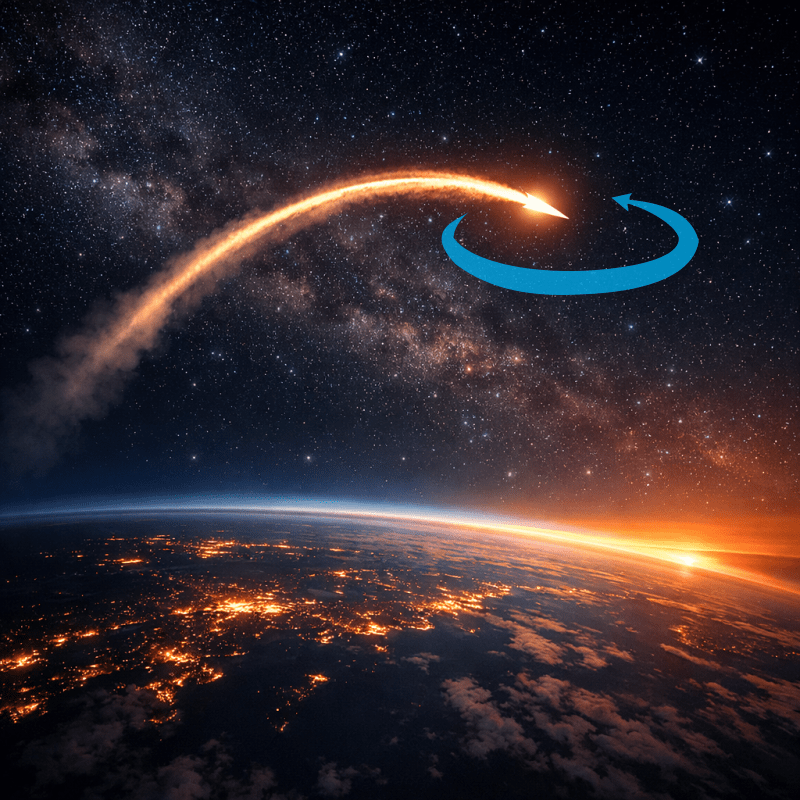
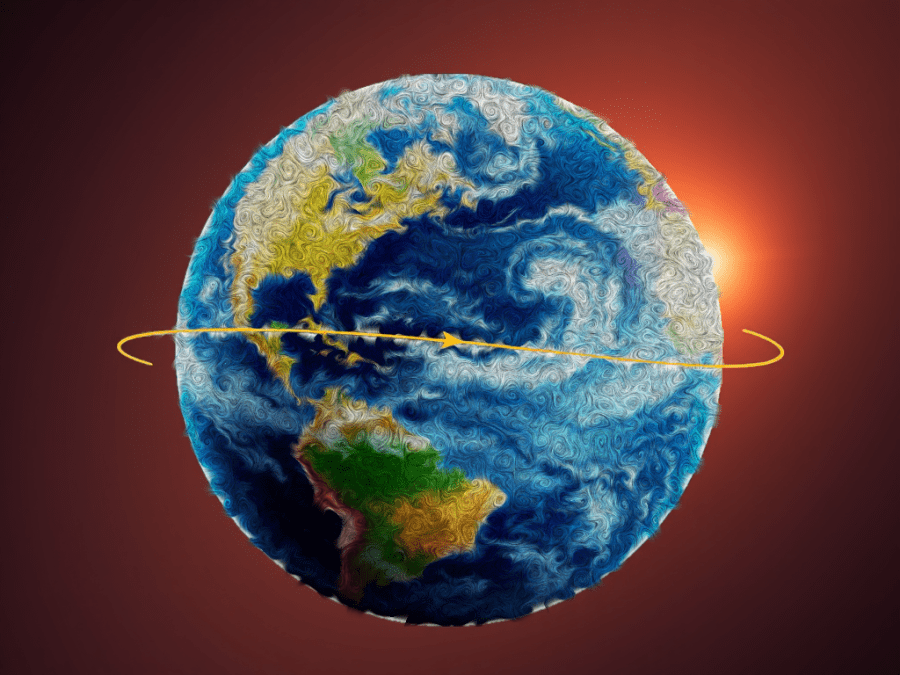
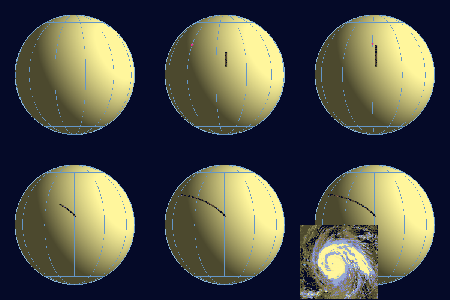
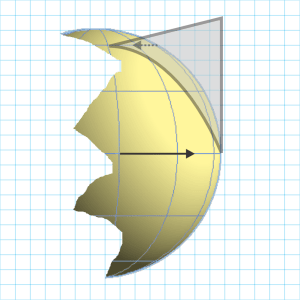
<sniff> “Stupid waste of time, chump! That video doesn’t show Coriolis.” <she grabs one of Cal’s graph-paper napkins and starts sketching> “Your balloon or whatever isn’t traveling north along Earth’s surface. It’s going out into space. That dark line tracks the thing’s shadow, or it would if you had the Sun behind it instead of off to the side. It has nothing at all to do with the cloud stream at the top of the hurricane and by the way those winds in the picture are outward, not inward as you’d’ve known if you’d’ve thought about for even a moment, blockhead! Here, look at a sideways view.”

“You’re saying my balloon’s not following the surface, it’s vectored away from the surface parallel to the north‑south axis. Also that the shadow points that I plotted on Earth trend westward only because the Earth turns west‑to‑east underneath the balloon. … Okay, I can see that. Goes so high up I guess it can’t be a balloon, huh?”

“Don’t try to deflect the conversation, nitwit. Figure out what you got wrong and put up a correction post that gives a proper account of Coriolis. Sorry, Cal, I’ll need my coffee in a sippy‑cup. Gotta go revise my lesson plan, again.”

She grabs her caffeine to‑go, flings me a final “Dolt! ” and storms out the door trailing a cloud of grumbles.

Vinnie’s open-mouthed. “Geez, Sy, she does have a temper.”

“You know it, Vinnie. Fortunately she saves it up for deserving occasions but don’t ever get her started on politics. So let’s see, what part of what I posted did I get right?”

“Well, there’s the part about Helsinki’s rotation around the Earth runs fewer kilometers per hour than Quito’s. That’s just fact, can’t argue with it.”

“Yeah, Mr Moire, and there’s Conservation of Momentum.”

“Right, Jeremy.” Synapses connect in my head. “Got it! Vinnie, what’s the rule between speed and orbit size?”

“The closer the faster. The Moon’s a quarter‑million miles away, takes a month to go round the Earth; the ESS is 250 miles up, circles us every 90 minutes. If you’re in some orbit and wanna go lower, you gotta speed up. Took me an hour to convince Larry that’s the way it works. He was all about centrifugal force forcing you outward, but if you want to get deeper in the gravity well you need the extra speed to balance the extra gravity.”

“That’s the rule for space orbits, alright, but things work exactly the opposite for travel on the surface of a rotating sphere. Gravity pulls centerward with the same strength everywhere so gravity’s not what balances the centrifugal force.”

“What does?”

“Geometry. In space orbits, velocity and kinetic energy increase toward the core. On a sphere’s surface, the highest velocity is farthest away from the rotational axis, at the equator. Velocity falls off to zero at both poles. Every latitude has its characteristic velocity and kinetic energy. Suppose you’re loose on Earth’s northern hemisphere and moving east too fast for your latitude. You’ll drift southward, away from the axis, until you hit a latitude that matches your speed. Meanwhile, because you’re moving east the landscape will flow westward beneath you. The blend is the Coriolis Effect.”

“So if I’m slower than my latitude I drift north and Coriolis sends me east?”

“Cathleen would agree, Jeremy.”

~ Rich Olcott

When It’s Not The Same Frame – Never Mind

  • Author‘s note — Please ignore everything below the separator line. It’s bogus. No excuses, it’s just wrong. I intend to embarrass Vinnie and Sy just as soon as I get my head straight. My apologies to every reader, especially teachers, that I’ve confused.

“Hey, Sy, I couldn’t help overhearing—”

<chuckle> “Of course not, Cal. Overhearing what?”

“When you said Quito goes round the world twice as fast as Helsinki. That can’t be true! Things would collide and we’d get all kinds of earthquakes and stuff.”

“Well, sure, Cal, if those two airports moved relative to each other. But they don’t, they’re stuck 10750 kilometers apart just like they’ve always been. I hated flying that route. Mountains to dodge at both ends, in between there’s bad weather a lot of the time and no place good to set down if something goes wrong. … Wait — different speeds — it’s frames again, ain’t it, Sy?”

“Exactly, Vinnie, even though it’s not black holes for a change. Relative to an inertial frame on the Earth’s surface, the Earth itself doesn’t move and neither does either city. Relative to a Sun‑centered frame, though, the Earth spins on its axis once every 24 hours. In the Sun’s frame, Quito on Earth’s 40‑thousand kilometer Equator does 1666 kilometers per hour. Helsinki’s at 60° North. Its circle around the spin axis is only 20 thousand kilometers so its linear speed is 833 kilometers per hour even though it does the same 15 degrees per hour that Quito does.”

“Hi, Mr Moire. Welcome back. I couldn’t help overhearing—”

<chuckle> “Of course not, Jeremy. Overhearing what?”

“You talking about places on Earth moving different speeds. We just studied about that in Dr O’Meara’s planet science class but it’s still loose in my head. It has to do with why storms go counterclockwise, right?”

“It has everything to do with that, except the counterclockwise storms are only in the northern hemisphere. Southern hemisphere storms rotate the other way.”


“I got this, Sy. Bring up that movie you got on Old Reliable, the one that shows the northern hemisphere. Yeah, that one. Jeremy, some guy in a balloon is the dark line on his way from Kansas to the North Pole to meet Santa. In his frame the earth is moving left‑to‑right relative to his northbound course. See how the red star’s moving?”

“Yeah, it’s moving towards sunrise so his movie’s got the rotation right. Why Kansas?”

“‘Cause he’s got a good long shot over flatlands before any mountains or big lakes get in the way, okay? So, the other section of Sy’s movie is like it was shot from a satellite in geostationary orbit. In its frame the Earth is standing still, but the balloon guy’s swerving to his left which is west. Also counterclockwise.”

“Mmm, okay. So you’re saying that in our earthbound frame we see northerly winds getting twisted to their left which is west but it’s really the Earth turning under the atmosphere and that’s why hurricanes turn the way they do.”

“There are other ways to analyze it, guys.”

“Like what, Sy?”

“Let’s get back to Quito and Helsinki. In the northern hemisphere the latitude lines make shorter circles as you go north so your distance traveled per day gets smaller.”

“Makes sense, yeah.”

“Right. Your balloon guy’s at rest somewhere in the Earth’s frame before he starts his trip so the satellite sees him traveling eastward at say 1200 kilometers per hour. The atmosphere around him is doing about the same. Suppose he suddenly moves a few hundred kilometers north where the atmosphere’s moving significantly slower but he still has his original eastward momentum. What happens?”

“He gets slowed down.”

“Why?”

“Drag from the slower air. He dumps some of his momentum to the air molecules.”

“Conservation of Momentum does apply, Vinnie. That’s an explanation I see a lot in the pop‑sci press, but I’m not happy with it. An astronaut in a shuttlecraft going point‑to‑point across the airless Moon would see the same between‑frames contrast.”

“Oh! Newton’s First Law says you can’t change momentum unless an external force acts on you. So that’s the Coriolis Force, Mr Moire?”

“It’s related, Jeremy. Gravity restricts planet‑bound travelers to surface motion. Geometry and the force of gravity give that westward push in the planet’s frame to northbound objects in the northern hemisphere. The balloon guy and the astronaut don’t observe the Coriolis Effect unless they look out the window.”

~ Rich Olcott

When It’s Not The Same Frame

  • Author‘s note — Please ignore everything below the separator line. It’s bogus. No excuses, it’s just wrong. I intend to embarrass Vinnie and Sy just as soon as I get my head straight. My apologies to every reader, especially teachers, that I’ve confused.

“Hey, Sy, I couldn’t help overhearing—”

<chuckle> “Of course not, Cal. Overhearing what?”

“When you said Quito goes round the world twice as fast as Helsinki. That can’t be true! Things would collide and we’d get all kinds of earthquakes and stuff.”

“Well, sure, Cal, if those two airports moved relative to each other. But they don’t, they’re stuck 10750 kilometers apart just like they’ve always been. I hated flying that route. Mountains to dodge at both ends, in between there’s bad weather a lot of the time and no place good to set down if something goes wrong. … Wait — different speeds — it’s frames again, ain’t it, Sy?”

“Exactly, Vinnie, even though it’s not black holes for a change. Relative to an inertial frame on the Earth’s surface, the Earth itself doesn’t move and neither does either city. Relative to a Sun‑centered frame, though, the Earth spins on its axis once every 24 hours. In the Sun’s frame, Quito on Earth’s 40‑thousand kilometer Equator does 1666 kilometers per hour. Helsinki’s at 60° North. Its circle around the spin axis is only 20 thousand kilometers so its linear speed is 833 kilometers per hour even though it does the same 15 degrees per hour that Quito does.”

“Hi, Mr Moire. Welcome back. I couldn’t help overhearing—”

<chuckle> “Of course not, Jeremy. Overhearing what?”

“You talking about places on Earth moving different speeds. We just studied about that in Dr O’Meara’s planet science class but it’s still loose in my head. It has to do with why storms go counterclockwise, right?”

“It has everything to do with that, except the counterclockwise storms are only in the northern hemisphere. Southern hemisphere storms rotate the other way.”


“I got this, Sy. Bring up that movie you got on Old Reliable, the one that shows the northern hemisphere. Yeah, that one. Jeremy, some guy in a balloon is the dark line on his way from Kansas to the North Pole to meet Santa. In his frame the earth is moving left‑to‑right relative to his northbound course. See how the red star’s moving?”

“Yeah, it’s moving towards sunrise so his movie’s got the rotation right. Why Kansas?”

“‘Cause he’s got a good long shot over flatlands before any mountains or big lakes get in the way, okay? So, the other section of Sy’s movie is like it was shot from a satellite in geostationary orbit. In its frame the Earth is standing still, but the balloon guy’s swerving to his left which is west. Also counterclockwise.”

“Mmm, okay. So you’re saying that in our earthbound frame we see northerly winds getting twisted to their left which is west but it’s really the Earth turning under the atmosphere and that’s why hurricanes turn the way they do.”

“There are other ways to analyze it, guys.”

“Like what, Sy?”

“Let’s get back to Quito and Helsinki. In the northern hemisphere the latitude lines make shorter circles as you go north so your distance traveled per day gets smaller.”

“Makes sense, yeah.”

“Right. Your balloon guy’s at rest somewhere in the Earth’s frame before he starts his trip so the satellite sees him traveling eastward at say 1200 kilometers per hour. The atmosphere around him is doing about the same. Suppose he suddenly moves a few hundred kilometers north where the atmosphere’s moving significantly slower but he still has his original eastward momentum. What happens?”

“He gets slowed down.”

“Why?”

“Drag from the slower air. He dumps some of his momentum to the air molecules.”

“Conservation of Momentum does apply, Vinnie. That’s an explanation I see a lot in the pop‑sci press, but I’m not happy with it. An astronaut in a shuttlecraft going point‑to‑point across the airless Moon would see the same between‑frames contrast.”

“Oh! Newton’s First Law says you can’t change momentum unless an external force acts on you. So that’s the Coriolis Force, Mr Moire?”

“It’s related, Jeremy. Gravity restricts planet‑bound travelers to surface motion. Geometry and the force of gravity give that westward push in the planet’s frame to northbound objects in the northern hemisphere. The balloon guy and the astronaut don’t observe the Coriolis Effect unless they look out the window.”

~ Rich Olcott

Not Even A Sneeze in A Hurricane

Quite a commotion at the lakeshore this morning. I walk over to see what’s going on. Not surprised at who’s involved. “Come away from there, Mr Feder, you’re too close to their goslings.” Doesn’t work, of course, so I resort to stronger measures. “Hey, Mr Feder, any questions for me?”

That did the trick. “Hey, yeah, Moire, I got one. There’s this big problem with atomic power ’cause there’s leftovers when the fuel’s all used up and nobody wants it buried their back yard and I unnerstand that. How about we just load all that stuff into one of Musk’s Starships and send it off to burn up in the Sun? Or would that make the Sun blow up?”

“Second part first. Do you sneeze?”

“What kinda question is that? Of course I sneeze. Everyone sneezes.”

“Ever been in a hurricane?”

“Oohyeah. Sandy, back in 2012. Did a number on my place in Fort Lee. Took out my back fence, part of the roof, branches down all over the place—”

“Did you sneeze during the storm?”

“Who remembers that sort of thing?”

“If you had, would it have made any difference to how the winds blew?”

“Nah, penny‑ante compared to what else was going on. Besides, the storm eye went a couple hundred miles west of us.”

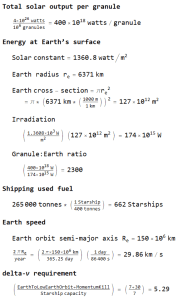
“Well, there you go. The Sun’s surface is covered by about a million granules, each about the size of Texas, and each releasing about 400 exawatts—”.

“Exawha?”

“Exawatt. One watt is one joule of energy per second. Exa– means 1018. So just one of those granules releases 400×1018 joules of energy per second. By my numbers that’s about 2300 times the total energy that Earth gets from the Sun. There’s a million more granules like that. Still think one of our rockets would make much difference with all that going on?”

“No difference anybody’d notice. But that just proves it’d be safe to send our nuclear trash straight to the Sun.”

“Safe, yes, but not practical.”

“When someone says ‘practical’ they’re about to do numbers, right?”

“Indeed. How much nuclear waste do you propose to ship to the Sun?”

“I dunno. How much we got?”

“I saw a 2022 estimate from the International Atomic Energy Agency that our world‑wide accumulation so far is over 265 000 tonnes, mostly spent fuel. Our heaviest heavy‑lift vehicle is the SpaceX Starship. Maximum announced payload to low‑Earth orbit is 400 tonnes for a one‑way trip. You ready to finance 662 launches?”

“Not right now, I’m a little short ’til next payday. How about we just launch the really dangerous stuff, like plutonium?”

“Much easier rocket‑wise, much harder economics‑wise.”

“Why do you say that?”

“Because most of the world’s nuclear power plants depend on MOX fuel, a mixture of plutonium and uranium oxides. Take away all the plutonium, you mess up a significant chunk of our carbon‑free‑mostly electricity production. But I haven’t gotten to the really bad news yet.”

“I’m always good for bad news. Give.”

“Even with the best of intentions, it’s an expensive challenge to shoot a rocket straight from Earth into the Sun.”

“Huh? It’d go down the gravity well just like dropping a ball.”

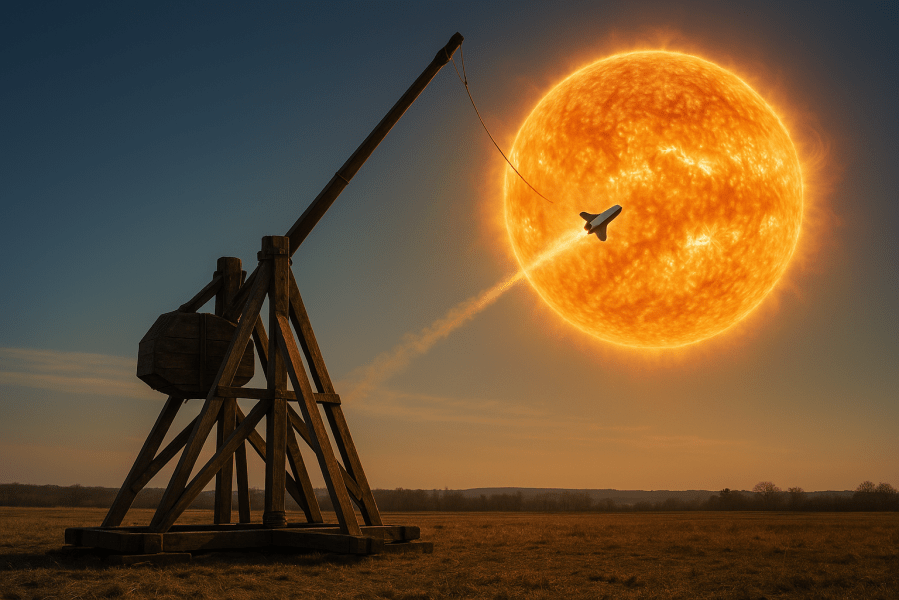
“Nope, not like dropping a ball. More like flinging it off to the side with a badly‑aimed trebuchet. Guess how fast the Earth moves around the Sun.”

“Dunno. I heard it’s a thousand miles an hour at the Equator.”

“That’s the planet’s rotation on its own axis. My question was how fast we go taking a year to do an orbit around the Sun. I’ll spare you the arithmetic — the planet speeds eastward at 30 kilometers per second. Any rocket taking off from Earth starts with that vector, and it’s at right angles to the Earth‑Sun line. You can’t hit the Sun without shedding all that lateral momentum. If you keep it, the rules of orbital mechanics force the ship to go faster and faster sideways as it drops down the well — you flat‑out miss the Sun. By the way, LEO delta‑v for SpaceX’s most advanced Starship is about 7 km/s, less than a fifth of the minimum necessary for an Earth‑to‑Sun lift.”

~ Rich Olcott
Two’s Company, Three Is Perturbing

Vinnie does this thing when he’s near the end of his meal. He mashes his pizza crumbs and mozzarella dribbles into marbles he rolls around on his plate. Mostly on his plate. Eddie hates it when one escapes onto his floor. “Vinnie, you lose one more of those, you’ll be paying extra.”

“Aw, c’mon, Eddie, I’m your best customer.”

“Maybe, but there’ll be a surcharge for havin’ to mop extra around your table.”

Always the compromiser, I break in. “How about you put on less sauce, Eddie?”

Both give me looks you wouldn’t want.
  ”Lower the quality of my product??!?”
    ”Adjust perfection??!?”

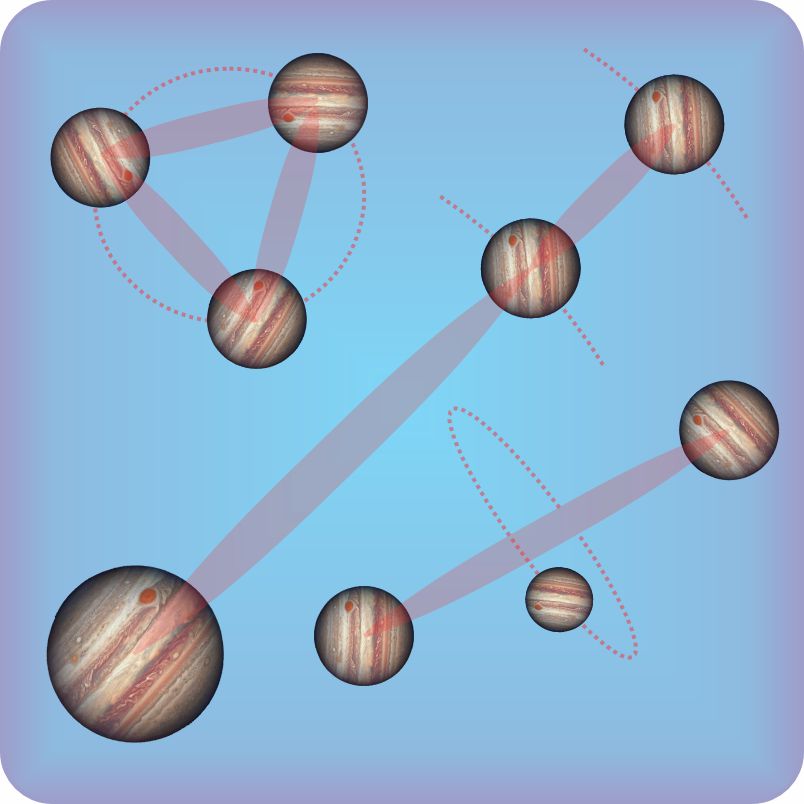
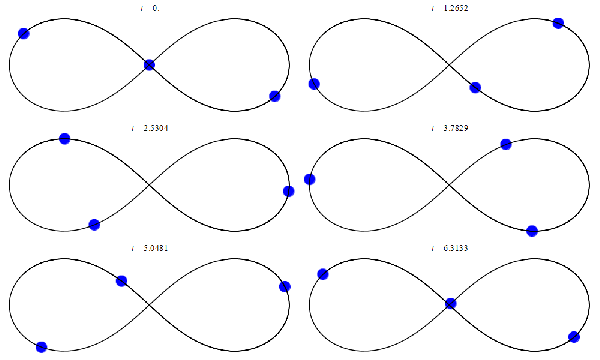
“Looks like we’ve got a three‑body problem here.” Blank looks all around. “You two were just about to go at it until I put in my piece and suddenly you’re on the same side. Two‑way interaction predictable results, three‑way interaction hard to figure. Like when Newton calculated celestial orbits to confirm his Laws of Gravity and Motion. They worked fine for the Earth going around the Sun, not so good for the Moon going around the Earth. The Sun pulls on the Moon just enough to play hob with his two‑body Earth‑Moon predictions.”

“Newton again. So how did he solve it?”

“He didn’t, not exactly anyway.”

“Not smart enough?”

“No, Eddie, plenty smart. Later mathematicians have proven that the three‑body problem simply doesn’t have a general exact solution.”

“Ah-hah, Sy, I heard weaseling — general?”

“Alright, Vinnie, there are some stable special cases. Three bodies at relative rest in an equilateral triangle; certain straight‑line configurations; two biggies circling each other and a third, smaller one in a distant orbit around the other two’s center of gravity. There are other specials but none stable in the sense that they wouldn’t be disrupted by a wobbly gravity field from a nearby star or the host galaxy.”

“So if NASA’s mission planners are looking at a four‑body Sun‑Jupiter‑Europa‑Juno situation, what’re they gonna do? ‘Give up’ ain’t an option.”

“Sure not. There’s a grand strategy with variations. The oldest variation goes back to before the Egyptian builders and everybody still uses it. Vinnie, when you fly a client to Tokyo, do you target a specific landing runway?”

“Naw, I aim for Japan, contact ATC Narita when I get close and they vector me in to wherever they want me to land.”

“How about you, Eddie? How do you get that exquisite balance in your flavoring?”

“Ain’t easy, Sy. Every batch of each herb is different — when it was picked, how it was stored, even the weather while it was growing. I start with an average mix which is usually close, then add a pinch of this and a little of that until it’s right.”

“For both of you, the critical word there was ‘close’. Call it in‑flight course adjustments, call it pinch‑and‑taste, everybody uses the ‘tweaking’ strategy. It’s a matter of skill and intuition, usually hard to generalize and even harder to teach in a systematic fashion. Engineers do it a lot, theoretical physicists work hard to avoid it.”

“What’ve they got that’s better?”

” ‘Better’ depends on your criteria. The method’s called ‘perturbation theory’ and strictly speaking, you can only use it for certain kinds of problems. Newton’s, for instance.”

“Good ol’ Newton.”

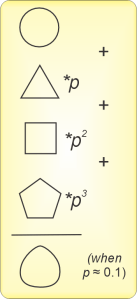
“Of course. Newton’s calculations almost matched Kepler’s planetary observations, but finagling the ‘not quite’ gave Newton headaches. More than 150 years passed before Laplace and others figured out how to treat a distant object as a perturbation of an ideal two‑body situation. It starts with calculating the system’s total energy, which wasn’t properly defined in Newton’s day. A perturbation factor p controls the third body’s contribution. The energy expression lets you calculate the orbits, but they’re the sum of terms containing powers of p. If p=0.1, p2=0.01, p3=0.001 and so on. If p isn’t zero but is still small enough, the p3 term and maybe even the p2 term are too small to bother with.”

“I’ll stick with pinch‑and‑taste.”

“Me and NASA’ll keep course‑correcting.”

~ Rich Olcott
The Spaghettification Zone

Vinnie’s still wincing. “That neutron star pulling all the guy’s joints apart — yuckhh! So that’s spaghettification? I thought that was a black hole thing.”

“Yes and no, in that order. Spaghettification’s a tidal phenomenon associated with lopsided gravity fields, black holes or otherwise. You know what causes the tides, of course.”

“Sure, Sy. The Sun pulls up on the water underneath it.”

“That’s not quite it. The Sun’s direct‑line pull on a water molecule is less than a part per million of the Earth’s. What really happens is that the Sun broadly attracts water molecules north‑south east‑west all across the Sun‑side hemisphere. There’s a general movement towards the center of attraction where molecules pile up. The pile‑up’s what we call the tide.”

“What explains the high tide on the other side of the Earth? You can’t claim the Sun pushes it over there.”

“Of course not. It goes back to our lopsided taste of the Sun’s gravitational field. If it weren’t for the Sun’s pull, sea level would be a nice round circle where centrifugal force balances Earth’s gravity. The Sun’s gravity puts its thumb on the scale for the near side, like I said. It’s weaker on the other side, though — balance over there tilts toward the centrifugal force, makes for a far‑side bulge and midnight tides. We get lopsided forces from the moon’s gravity, too. That generates lunar tides. The solar and lunar cycles combine to produce the pattern of tides we experience. But tides can get much stronger. Ever hear of the Roche effect?”

“Can’t say as I have.”

“Imagine the Earth getting closer to the Sun but ignore the heat. What happens?”

“Sun‑side tides get higher and higher until … the Sun pulls the water away altogether!”

“That’s the idea. In the mid‑1800s Édouard Roche noticed the infinity buried in Newton’s F=GMm/r² equation. He realized that the forces get immense when the center‑to‑center distance, r, gets tiny. ‘Something’s got to give!’ he thought so he worked out the limits. The center‑to‑center force isn’t the critical one. The culprit is the tidal force which arises from the difference in the gravitational strength on either side of an object. When the force difference exceeds the forces holding the object together, it breaks up.”

“Only thing holding the ocean to Earth is gravity.”

“Exactly. Roche’s math applies strictly to objects where gravity’s the major force in play. Things like rubble‑pile asteroids like Bennu and Dimorphos or a black hole sipping the atmosphere off a neighboring blue supergiant star. We relate spaghettification to rubble piles but it can also compete with interatomic electronic forces which are a lot stronger.”

“You’re gonna get quantitative, right?”

“Of course, that’s how I operate.” <tapping on Old Reliable’s screen> “Okay, suppose Niven’s guy Shaffer is approaching some object from far away. I’ve set up tidal force calculations for some interesting cases. Turns out if you know or can estimate an object’s mass and size, you can calculate its density which is key to Roche’s distance where a rubble pile flies apart. You don’t need density for the other thresholds. Spagettification sets in when tidal force is enough to bend a molecule. That’s about 500 newtons per meter, give or take a factor of ten. I estimated the rip‑apart tidal force to be near the tensile strength of the ligaments that hold your bones together. Sound fair?”

“Fair but yucky.”

“Mm‑hm. So here’s the results.”

“What’s with the red numbers?”

“I knew you’d ask that first. Those locations are inside the central object so they make no sense physically. Funny how Niven picked the only object class where stretch and tear effects actually show up.”

“How come there’s blanks under whatever ‘Sgr A*’ is?”

“Astronomer‑ese for ‘Sagittarius A-star,’ the Milky Way’s super‑massive black hole. Can’t properly calculate its density because the volume’s ill‑defined even though we know the Event Horizon’s diameter. Anyhow, look at the huge difference between the Roche radii and the two thresholds that affect chemical bonds.”

“Hey, Niven’s story had Shaffer going down to like 13 miles, about 20 kilometers. He’d’ve been torn apart before he got there.”

“Roughly.”

~~ Rich Olcott

Stretch

It’s a chilly day as I take my favorite elevator up to my office on the Acme Building’s 12th floor. Vinnie’s on my sofa, reading an old paperback. “Morning, Sy. Whaddaya think of Larry Niven?”

“One of the grand old men of hard science fiction. I gather you’re reading something of his there?”

“Yup, been bingeing on his Known Space series. His Neutron Star short story here won a Hugo back in 1967. It’s got so many numbers I wonder how good they are.”

“Probably pretty good. He and Heinlein both enjoyed showing off their celestial mechanics chops. What numbers stick out to you? Wait, what’s the story line again?”

“Story line? Most of Niven’s shorts were puzzles. When he had a good one he’d wrap some hokey story around it. This one, there’s a magical space ship that’s supposed to be invulnerable. Says here nothing can get through the hull, ‘no kind of electromagnetic energy except visible light. No kind of matter, from the smallest subatomic particle to the fastest meteor’ except something reached in and squashed two people to death in the nose of their ship. Our hero Mr Shaeffer’s in a ship just like theirs and has to figure out what the something was before it gets him, too.”

“Ah. What numbers did Niven give us?”

“Shaeffer’s ship was heading towards a neutron star. Lessee… ah, says the star’s mass is 1.3 times the Sun’s, diameter’s about 12 miles, and the ship’s on a fast in‑and‑out orbit, closest approach just a mile above the surface. Oh, and early on he drifts forward like something’s pulling on him but not on the ship. What does that tell you?”

“Enough to solve the puzzle, not enough to check his numbers. Anything about speed?”

“Mmm, he says the ship popped into the system a million miles out and it’d take 12 hours to reach the close‑approach point. The average speed’s just arithmetic, right?”

“Not really. A simple average doesn’t take account of acceleration changes or relativity effects. It’s easier and more accurate to apply conservation of energy. Okay with you if I assume the ship ‘pops into the system’ with zero velocity relative to the star and then free‑falls towards it?”

“That fits with the story, mostly.”

“Good. So right after the pop‑in” <tapping on Old Reliable’s screen> “the ship’s gravitational potential energy is ‑1.08×10⁵ joules/kilogram—”

“Negative?”

“It’s defined as the potential energy Shaeffer’d gave up en route from infinitely far away. At 13 miles from the star’s center, that’s zoomed to ‑8.3×10⁹ J/kg. The potential energy’s converted to kinetic energy ½mv² except we’re talking per kilogram so m is 1.0 and the velocity is —whoa!— 129 thousand kilometers/second. That’s 43% of lightspeed!”

“Well, Shaeffer did see the background stars shift blue even before he got deep into the gravity well. So, how about Niven’s 12‑hour, million‑mile claim?”

“That distance in that time works out to 37 miles per second, way less than lightspeed’s 186 000. Shaeffer was dawdling. You need calculus to figure the actual travel time — integrate 1/v between here and there. Ugly problem to solve manually but Old Reliable’s up to it. Given the appropriate orbit equation and the numbers we’ve worked out so far, Old Reliable says the trip should have taken him about 17 seconds.”

“HAW! I knew something seemed off. Wait, you said you’d solved the puzzle. What’s your answer?”

“Tides. That’s what moved him forward relative to the ship.”

“Yeah, that’s what Niven wrote, but I don’t see why what Shaeffer did saved him.”

“What did Shaeffer do?”

“Spread-eagled himself across a gangway at the ship’s center of gravity.”

“Brilliant — minimized his thickness along the star‑to‑ship line. Gravity’s pull on his sternum wasn’t much different from the pull on his spine. If he’d oriented himself perpendicular to that, his feet would feel a stronger pull than his head would have. Every transverse joint from neck to ankles would crackle or even tear. Talk about chiropractic.”

Vinne winces. “Why does thickness matter?”

“Tidal force reflects how center‑to‑center force changes with distance. Center‑to‑center force rises with 1/r². Tidal force goes up as 1/r³. Cube grows faster than square. Small r, big tides.”

~ Rich Olcott