That Lump in The Table

The Acme Building Science and Pizza Society is back in session. It’s Cal’s turn to deal the cards and the topic. “This TV guy was talking about rare earths that China’s got a lock on and it’s gonna mess up our economy, but he didn’t say what they are or why we should care about them. What’s goin’ on?”

Vinnie passes but Susan tosses a chip into the pot. “The rare earths are oxides of the lanthanide elements—”

“Wait, they’re from the planet that the Strange New Worlds engineering prof is from?”

“Put in a chip, Vinnie, you know the rules.” <He does.> “No, they have nothing to do with Pelia or her home planet. She’s a Lanthanite, these elements are lanthanides. Although these days we’re supposed to call them lanthanoids because ‑ides are ionic compounds like oxides.”

It’s not Kareem’s turn yet but he chuckles and flips in a chip. “Funny. The geology community settled on meteoroids as rocks floating in space, meteors when they flash through the sky, and meteorites when they hit the ground. I don’t think there’s such a thing as a meteoride. Sorry, Susan, go on.”

“As a matter of fact, Kareem, I once did a high‑rated downhill mountain bike path in Arizona called the Meteoride. Once. Didn’t wipe out but I admit I used my brakes a whole lot. Where was I? Oh, yes, the lanthanides. They’re a set of fourteen near‑identical twins, chemistry so similar that it took decades of heroic effort by 19th‑century Swedish chemists in the long, cold Swedish nights to separate and identify them.”

“Similar how?”

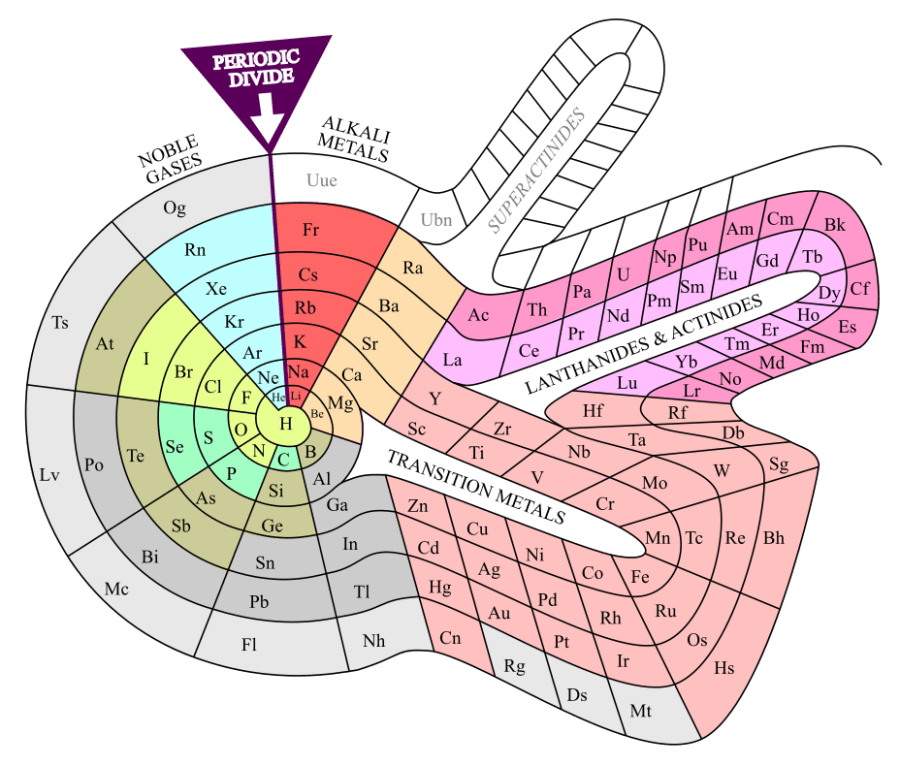
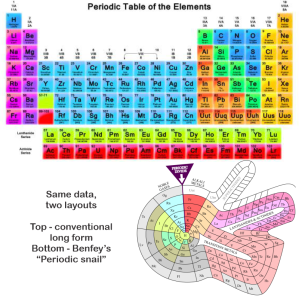
“They all act like aluminum.” <pulls laptop from her purse, points to two stickers on its lid> “You’ve all at least heard of the Periodic Table, right? Back in the mid-1800s, the chemists had isolated dozens of chemical elements, enough that they could start classifying them. They didn’t know what atoms were yet but they had developed ways to measure average atomic weights. Some theorists played with the idea of arranging elements with similar chemistries according to their atomic weights. Mendeleev did the best job, even predicting three elements to fill empty slots in his tabulation. These guys in the lime green row and the pale pink bulge were his biggest puzzlement.”

“Why’s that? They’re all spread out nice.”

“Because like I said, Vinnie, they all have pretty much the same chemistry. Aluminum’s a soft silvery metal, oxidizes readily to a 3+ ion and stays there. Same for almost all the lanthanides. Worse yet, all their atoms are nearly the same size, less than 8% difference from the largest to the smallest.”

“Why’s that make a difference?”

“Because they can all fit into the same crystalline structure. Nineteenth‑century chemistry’s primary technique for isolating a metallic element was to dissolve a likely‑looking ore, purify the solution, add an organic acid or something to make crystalline salts, burn away the organics, add more acid to dissolve the ash, purify the solution and re‑crystallize most it. Do that again and again until you have a provably pure product. All the lanthanide ions have the same charge and nearly the same size so the wrong ions could maliciously infiltrate your crystals. It took a lot of ingenious purification steps to isolate each element. There were many false claims.”

Kareem contributes another chip. “Mm‑hm, because geology doesn’t use chemically pure materials to create its ores. Four billion years ago when our planet was coated with molten magma, the asteroids striking Earth in the Late Heavy Bombardment brought megatons of stone‑making lithophile elements. The lanthanides are lithophiles so random mixtures of them tended to concentrate within lithic silicate and phosphate blobs that later cooled to form rocky ores. Industry‑scale operations can tease lanthanides out of ores but the processes use fierce chemicals and require close control of temperature and acidity. Tricky procedures that the Chinese spent billions and decades to get right. For the Chinese, those processes are precious national security assets.”

Cal’s getting impatient. “Hey, guys, are we playing cards or what?”

~ Rich Olcott

A Cosmological Horse Race

A crisp Fall day, perfect for a brisk walk around the park. I see why the geese are huddled at the center of the lake — Mr Feder, not their best friend, is on patrol again. Then he spots me. “Hey, Moire, I gotta question!”

“Of course you do, Mr Feder. What is it?”

“Some guy on TV said Einstein proved gravity goes at the speed of light and if the Sun suddenly went away it’d take eight minutes before we went flying off into space. Did Einstein really say that? Why’d he say that? Was the TV guy right? And what would us flying across space feel like?”

“I’ll say this, Mr Feder, you’re true to form. Let’s see… Einstein didn’t quite prove it, the TV fellow was right, and we’d notice being cold and in the dark well before we’d notice we’d left orbit. As to why, that’s a longer story. Walk along with me.”

“Okay, but not too fast. What’s not quite about Einstein’s proving?”

“Physicists like proofs that use dependable mathematical methods to get from experimentally-tested principles, like conservation of energy, to some result they can trust. We’ve been that way since Galileo used experiments to overturn Aristotle’s pure‑thought methodology. When Einstein linked gravity to light the linkage was more like poetry. Beautiful poetry, though.”

“What’s so beautiful about something like that?”

“All the rhymes, Mr Feder, all the rhymes. Both gravity and light get less intense with the square of the distance. Gravity and light have the same kinds of symmetries—”

“What the heck does that mean?”

“If an object or system has symmetry, you can execute certain operations on it yet make no apparent difference. Rotate a square by 90° and it looks just the same. Gravity and light both have spherical symmetry. At a given distance from a source, the field intensity’s the same no matter what direction you are from the source. Because of other symmetries they both obey conservation of momentum and conservation of energy. In the late 1890s researchers found Lorentz symmetry in Maxwell’s equations governing light’s behavior.”

“You’re gonna have to explain that Lorentz thing.”

Lorentz symmetry has to do with phenomena an observer sees near an object when their speed relative to the object approaches some threshold. Einstein’s Special Relativity theory predicted that gravity would also have Lorentz symmetry. Observations showed he was right.”

“So they both do Lorentz stuff. That makes them the same?”

“Oh, no, completely different physics but they share the same underlying structure. Maxwell’s equations say that light’s threshold is lightspeed.”

“Gravity does lightspeed, too, I suppose.”

“There were arguments about that. Einstein said beauty demands that both use the same threshold. Other people said, ‘Prove it.’ The strongest argument in his favor at the time was rough, indirect, complicated, and had to do with fine details of Earth’s orbit around the Sun. Half a century later pulsar timing data gave us an improved measurement, still indirect and complicated. This one showed gravity’s threshold to be with 0.2% of lightspeed.”

“Anything direct like I could understand it?”

“How about a straight‑up horse race? In 2017, the LIGO facility picked up a gravitational signal that came in at the same time that optical and gamma ray observatories recorded pulses from the same source, a colliding pair of neutron stars in a galaxy 130 million lightyears away. A long track, right?”

“Waves, not horses, but how far apart were the signals?”

“Close enough that the measured speed of gravity is within 10–15 of the speed of light.”

“A photo-finish.”

“Nice pun, Mr Feder. We’re about 8½ light-minutes away from the Sun so we’re also 8½ gravity-minutes from the Sun. As the TV announcer said, if the Sun were to suddenly dematerialize then Earth would lose the Sun’s orbital attraction 8½ minutes later. We as individuals wouldn’t go floating off into space, though. Earth’s gravity would still hold us close as the whole darkened, cooling planet leaves orbit and heads outward.”

“I like it better staying close to home.”

~ Rich Olcott

Hillerman, Pratchett And Narrativium

No-one else in the place so Jeremy’s been eavesdropping on my conversation with Cal. “Lieutenant Leaphorn says there are no coincidences.”

“Oh, you’ve read Tony Hillerman’s mystery stories then?”

“Of course, Mr Moire. It’s fun getting a sympathetic outsider’s view of what my family and Elders have taught me. He writes Leaphorn as a very wise man.”

“With some interesting quirks for a professional crime solver. He doesn’t trust clues, yet he does trust apparent coincidences enough to follow up on them.”

“It does the job for him, though.”

“Mm‑hm, but that’s in stories. Have you read any of Terry Pratchett’s Discworld books?”

“What are they about?”

“Pretty much everything, but through a lens of laughter and anger. Rather like Jonathan Swift. Pratchett was one of England’s most popular authors, wrote more than 40 novels in his too‑brief life. He identified narrativium as the most powerful force in the human universe. Just as the nuclear strong force holds the atomic nucleus together using gluons and mesons, narrativium holds stories together using coincidences and tropes.”

“Doesn’t sound powerful.”

“Good stories, ones that we’d say have legs, absolutely must have internal logic that gets us from one element to the next. Without that narrative flow they just fall apart; no‑one cares enough to remember them. As a writer myself, I’ve often wrestled with a story structure that refused to click together — sparse narrativium — or went in the wrong direction — wayward narrativium.”

“You said ‘the human universe’ like that’s different from the Universe around us.”

“The story universe is a multiverse made of words, pictures and numbers, crafted by humans to explain why one event follows another. The events could be in the objective world made of atoms or within the story world itself. Legal systems, history, science, they’re all pure narrativium. So is money, mostly. We don’t know of anything else in the Universe that builds stories like we do.”

“How about apes?”

“An open question, especially for orangutans. One of Pratchett’s important characters is The Librarian, a university staff member who had accidentally been changed from human to orangutan. He refuses to be restored because he prefers his new form. Which gives you a taste of Pratchett’s humor and his high regard for orangutans. But let’s get back to Leaphorn and coincidences.”

“Regaining control over your narrativium, huh?”

“Guilty as charged. Leaphorn’s standpoint is that there are no coincidences because the world runs on patterns, that events necessarily connect one to the next. When he finds the pattern, he solves the mystery.”

“Very Diné. Our Way is to look for and restore harmony and balance.”

“Mm‑hm. But remember, Leaphorn is only a character in Hillerman’s narrativium‑driven stories. The atom‑world may not fit that model. A coincidence for you may not be a coincidence for someone else, depending. Those two concurrent June novas, for example. For most of the Universe they’re not concurrent.”

“I hope this doesn’t involve relativistic clocks. Professor Hanneken hasn’t gotten us to Einstein’s theories yet.”

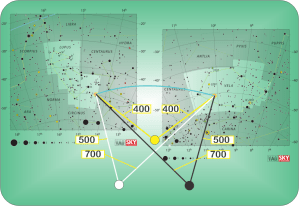
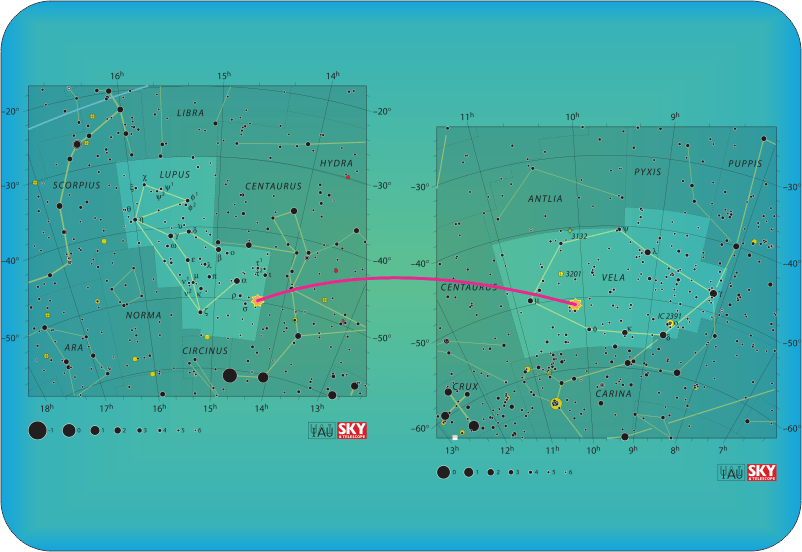
“No relativity; this is straight geometry. Rømer could have handled it 350 years ago.” <brief tapping on Old Reliable’s screen> “Here’s a quick sketch and the numbers are random. The two novas are connected by the blue arc as we’d see them in the sky if we were in Earth’s southern hemisphere. We live in the yellow solar system, 400 lightyears from each of them so we see both events simultaneously, 400 years after they happened. We call that a coincidence and Cal’s skywatcher buddies go nuts. Suppose there are astronomers on the white and black systems.”

<grins> “Those four colors aren’t random, Mr Moire.”

<grins back> “Caught me, Jeremy. Anyway, the white system’s astronomers see Vela’s nova 200 years after they see the one in Lupus. The astronomers in the black system record just the reverse sequence. Neither community even thinks of the two as a pair. No coincidence for them, no role for narrativium.”

~ Rich Olcott

  • This is the 531st post in an unbroken decade‑long weekly series that I originally thought might keep going for 6 months. <whew!>

Confluence

“My usual cup of — Whoa! Jeremy, surprised to see you behind the counter here. Where’s Cal?”

“Hi, Mr Moire. Cal just got three new astronomy magazines in the same delivery so he’s over there bingeing. He said if I can handle the pizza place gelato stand he can trust me with his coffee and scones. I’m just happy to get another job ’cause things are extra tough back on the rez these days. Here’s your coffee, which flavor scone can I get for you?”

“Thanks, Jeremy. Smooth upsell. I’ll take a strawberry one. … Morning, Cal. Having fun?”

“Morning, Sy. Yeah, lotsa pretty pictures to look at. Funny coincidence, all three magazines have lists of coincidences. This one says February 23, 1987 we got a neutrino spike from supernova SN 1987A right after we saw its light. The coincidence told us that neutrinos fly almost fast as light so the neutrino’s mass gotta be pretty small. 1987’s also the year the Star Tours Disney park attractions opened for the Star Wars fans. The very same year Gene Roddenberry and the Paramount studio released the first episodes of Star Trek: The Next Generation. How about that?”

“Pretty good year.”

“Mm‑hm. Didja know here in 2025 we’ve got that Mercury‑Venus‑Jupiter-Saturn‑Uranus‑Neptune straight‑line arrangement up in the sky and sometimes the Moon lines up with it?”

“I’ve read about it.”

“Not only that, but right at the September equinox, Neptune’s gonna be in opposition. That means our rotation axis will be broadside to the Sun just as Neptune will be exactly behind us. It’ll be as close to us as it can get and it’s face‑on to the Sun so it’s gonna be at its brightest. Cool, huh?”

“Good time for Hubble Space Telescope to take another look at it.”

“Those oughta be awesome images. Here’s another coincidence — Virgo’s the September sign, mostly, and its brightest star is Spica. All the zodiac constellations are in the ecliptic plane where all the planet orbits are. Planets can get in the way between us and Spica. The last planet to do that was Venus in 1783. The next planet to do that will be Venus again, in 2197.”

“That’ll be a long wait. You’ve read off things we see from Earth. How about interesting coincidences out in the Universe?”

“Covered in this other magazine’s list. Hah, they mention 1987, too, no surprise. Ummm, in 2017 the Fermi satellite’s GRB instrument registered a gamma‑ray burst at the same time that LIGO caught a gravitational wave from the same direction. With both light and gravity in the picture they say it was two neutron stars colliding.”

“Another exercise in multi-messenger astronomy. Very cool.”

“Ummm … Galaxy NGC 3690 shot off two supernovas just a few months apart last year. Wait, that name’s familiar … Got it, it’s half of Arp 299. 299’s a pair of colliding galaxies so there’s a lot of gas and dust and stuff floating around to set off stars that are in the brink. If I remember right, we’ve seen about eight supers there since 2018.”

“Hmm, many events with a common cause. Makes sense.”

“Oh, it’s a nice idea, alright, but explain V462 Lupi and V572 Velorum. Just a couple months ago, two novas less than 2 weeks apart in two different constellations 20 degrees apart in the sky. Bright enough you could see ’em both with good eyes if you were below the Equator and knew where to look and looked in the first week of June. My skywatcher internet buddies down there went nuts.”

“How far are those events from us?”

“The magazine doesn’t say. Probably the astronomers are still working on it. Could be ten thousand lightyears, but I’d bet they’re a lot closer than that.”

“On average, visible stars are about 900 lightyears away. Twenty degrees would put them about 300 lightyears apart. They’re separated by a slew of stars that haven’t blown up. One or both could be farther away than that, naturally. Whatever, it’s hard to figure a coordinating cause for such a distant co‑occurrence. Sometimes a coincidence is just a coincidence.”

~ Rich Olcott

Sussing Out The Unseeable

<chirp, chirp> “Moire here.”

“Hello, Mr Moire.”

“Afternoon, Walt. Pizza time again?”

“No, too public. Poor craft to be seen too often in the same place. There’s a park bench by the lake.”

“I know the spot.”

“Fifteen minutes.”

“Twenty.”


“Afternoon, Walt. What are your people curious about this time?”

“Word is that astronomers uncovered a huge amount of matter they’d been searching for. We’re interested in concealment techniques, so we want to know how it was hidden and how was it found.”

“Forty percent of all baryonic matter—”

“Baryonic?”

“Made out of atoms. Baryons are multi-quark particles like protons and—”

“Leave the weeds and get back to the topic. Where was that 40% hiding?”

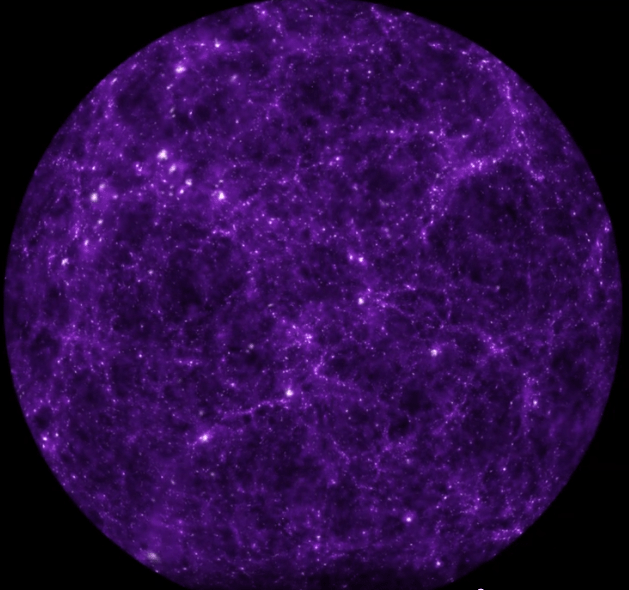
“In plain sight, all over the sky, in strands forming a network that connects galaxies and galaxy clusters. They’re calling it the Cosmic Web.”

“Something that big … how was hidden?”

“Some techniques I’m sure you’ll recognize. First, the material in the strands is diffuse — just an atom or two per cubic meter. An Earth laboratory would be proud to pump down a vacuum ten million times more dense.”

<taking notes> “Spread your forces so there’s no prime target for counter‑attack, mm‑hm. But if the material’s that thin, surely it doesn’t mass much.”

“Remember how big space is. These filaments span the widths of multiple galaxies. Do the math. A thread could be on the order of 100 million lightyears long by 1000 lightyears in diameter. A lightyear is 1016 meters. The thread has a volume of about 1062 cubic meters. At 10-26 kilogram per cubic meter that’s 1036 kilograms which is comparable to the mass of a small galaxy. That’s just one thread. Add them up and you get roughly half the baryons in the Universe, all hiding in the Web.”

“Concealment by dispersal, got it. What’s another technique?”

“Camouflage. No, not tiny uniforms in a woodland pattern. These atoms fade into the background because oncoming light waves pass right by them unless the wave has exactly the right wavelength for an absorption.”

“So how did astronomers detect these scattered and camouflaged atoms?”

“A couple of different ways. X‑rays, for one.”

“But these atoms are camouflaged against passing light. X‑rays are light waves.”

“X‑rays the atoms emit. Everybody thinks that space is cold, but those lonely atoms bounce around with a kinetic energy equivalent to million‑degree temperatures. When two of them collide some of that kinetic energy escapes as high‑frequency light, X‑ray range. Not a whole lot, because the atoms are sparse, but enough that European and Japanese space telescopes were able to tweeze it out of the background.”

“Use sensitive mics to pick up whispered convo in the opposing line.”

<pause> “Right, more or less. What do you know about refraction?”

“Mmm… Newton and his prism, splitting white light into different colors. I’ve no idea how that works.”

“The short answer is that the speed of light depends on its wavelength and the medium it’s traversing. In a perfect vacuum, light always goes at top speed just like Einstein said, but charged particles in its path slow it down.”

“Even those atoms in space that you said can’t absorb light?”

“Yup. It’s called virtual coupling; quantum’s involved. One inaccurate way to describe the interaction is that atoms occasionally absorb wrong‑wavelength photons but spit them right back out again after a brief delay. Short wavelengths see more of that effect than long wavelengths do. With me?”

<pause> “Go on.”

“Does the phrase ‘Fast Radio Burst’ sound familiar?”

“Of course, but probably not the way you mean.”

“Ah. Right. For this context, Fast Radio Bursts are isolated pulses of radio‑frequency light from incredibly bright extra-galactic sources we don’t understand. They’re all over the sky. A pulse lasts only a millisecond or so. What’s important here is that refraction skews each pulse’s wavelength profile as it travels through the intergalactic medium. Researchers analyze the distortions to detect and characterize Web filaments in the direction each pulse came from.”

“Intercept the oppo’s communications to the front.”

“That’s about the size of it.”

“Bye.”

“Don’t mention it.”

~ Rich Olcott

Why A Disk?

Late Summer is quiet time on campus and in my office. Too quiet. I head over to Cal’s coffee shop in search of company. “Morning, Cal.”

“Morning, Sy. Sure am glad to see you. There’s no‑one else around.”

“So I see. No scones in the rack?”

“Not enough traffic yet to justify firing up the oven on such a hot day. How about a biscotti instead?”

“If it’s only the one it’s a biscotto. Pizza Eddie’s very firm on that. Yeah, I’ll have one.”

“Always learning. By the way, a photo spread in one of my astronomy magazines got me thinking. How come there’s so much flat out there?”

“Huh? I know you’re not one of those flat‑Earthers.”

“Not the planets, I mean the way their orbits go all in the same plane. Same for most of the asteroids and the Kuiper belt, even. Our Milky Way galaxy’s basically flat, too, and so are a lot of the others. Black hole accretion disks are flat. You’d think if some baby star or galaxy was attracting stuff from everywhere to grow itself, the incoming would make a big globe. But it’s not, we get flatness. How come?”

“Bad aim and angular momentum.”

“What’s aim got to do with it?”

“Suppose there’s only two objects in the Universe and they’re closing in on each other. If they’re aimed dead‑center to each other, what happens?”

“CaaaRUNCH!!!”

“Right. Now what if the aim’s off so they don’t quite touch?”

“Oh, I know that one … it’ll come to me … yeah, Roche’s limit, it was in an article a few months ago. Whichever’s less dense will break up and all the pieces go like Saturn’s rings. Which are also flat, by the way.”

“In orbit around the survivor, mm‑hm. The pieces can’t fall straight down because they still have angular momentum.”

“I know about momentum like when you crash a car if you go too fast for your brakes. Heavier car or faster speed, you get a worse crash. How does angle fit into that — bigger angle, more angular momentum?”

“Not quite. In general, momentum is mass multiplied by speed. It’s a measure of the force required to stop something or at least slow it down. You’ve described linear momentum, where ‘speed’ is straight‑line distance per time. If you’re moving along a curve, ‘speed’ is arc‑length per time.”

“Arc‑length?”

“Distance around part of a circle. Arc‑length is angle in radians, multiplied by the circle’s radius. If you zip halfway around a big circle in the same time it took me to go halfway around a small circle, you’ve got more angular momentum than I do and it’d take more force to stop you. Make sense?”

“What if it’s not a circle? The planet orbits are all ellipses.”

“It’s still arc‑length except that you need calculus to figure it. That’s why Newton and Leibniz invented their methods. A falling something that misses a gravity center keeps falling but on an orbit. Whatever momentum it has acts as angular momentum relative to that center. There’s no falling any further in without banging into something else coming the other way and each object canceling the other’s momentum.”

“Or burning fuel if it’s a spaceship.”

“… Right. … So anyway, suppose you’ve got a star or something initially surrounded by a spherical cloud of space junk whirling around in all different orbits. What’s going to happen?”

“Lots of banging and momentum canceling until everything’s swirling more‑or‑less in the same direction and closer in than at come‑together time. But it’s still a ball.”

“Gravity’s not done. Think about northern debris. It’s attracted to the center, but it’s also attracted to the southern debris and vice-versa. They’ll meet midway and build a disk. The ball‑to‑disk collapse isn’t even opposed by angular momentum. Material at high latitudes, north and south, can lose gravitational potential energy by dropping straight in toward the equator and still be at the orbitally correct distance from the axis of rotation.”

“That’d work for stuff collecting around a planet, wouldn’t it?”

“It’d even work for stuff collecting around nothing, just a clump in a random density field. That may be how stars are born. Collapsing’s the hard part.”

~ Rich Olcott

The Beaming Beacon

“So, Vinnie, that first article’s bogus. Blobs in M87’s supermassive black hole’s jet don’t travel faster than light. Your second article — is it also about M87*?”

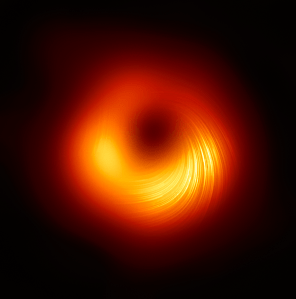
“Yeah, Cathleen. It’s got this picture which a while ago Sy explained looks like a wrung‑out towel because that’s the way the thing’s magnetic field forces electrons to line up and give off polarized light.”

“As always, Vinnie, your memory impresses.”

“Thanks, I work at it. Anyhow, this one‑paragraph article says they figured out from the picture that everything’s spinning around as fast as it’s possible to spin. How fast is that, and how’d they get the spin speed if they only used one frequency so redshift/blueshift doesn’t apply?”

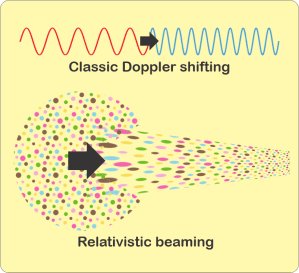
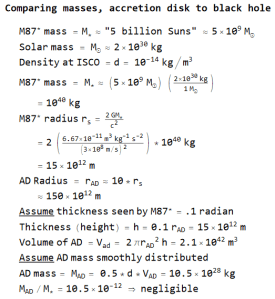
Cathleen’s been poking at her tablet. “HAH! Found the real paper behind your pop‑sci article, Vinnie. Give me a minute…” <pause, with mumbling> “Wow, not much there in the disk. They estimate even at the crowded innermost orbit, they call it ISCO, the density’s about 10-14 kg/m3 which would be one nanopascal of pressure. Most labs consider that ultrahigh vacuum. They get angular momentum from something called ‘Doppler beaming’, which I’m not familiar with.” <passes tablet to me> “Your turn, Sy.”

“ISCO’s the Innermost Stable Circular Orbit. ISCO’s radius depends on the black hole’s mass and spin.” <pause, with mumbling> “Doppler beaming’s a velocity‑dependent brightness shift from outbound to inbound sides of ISCO. They connected brightness range within the images to ISCO velocity, multiplied that by ISCO radius and the black hole’s mass to get the disk’s angular momentum, J. The lightspeed rotation angular momentum Jmax comes from theory. The paper puts a number to M87*’s J/Jmax.

“My article says it’s near 100%.”

“That’s not what the paper says, Vinnie. ‘…our value of 0.8 would appear to be a lower limit,’ in other words, something above 80% but definitely not 100%. Like I said, pop‑sci journalism. So what’s Doppler beaming, Sy?”

“Classical Doppler shifts happen when a wave source moves relative to us. Motion toward us crams successive wave peaks into decreasing distance. Motion away increases wavelength. The same principle applies to light waves, sound waves, even ocean waves.”

“Blueshifting.”

“Mm‑hm. By contrast, beaming is about how a source’s motion affects the photon count we receive per second. Imagine a beacon steadily sending us photons as it whips at near‑lightspeed around M87*. When the beacon screams towards us its motion crams more photons into one of our seconds than when it dashes away.”

“More blueshifting.”

“Not quite. Photon‑count compression sort‑of resembles the blueshifting process but wavelength isn’t relevant. It combines with the other part of beaming, Special Relativity space compression, which concentrates a moving beacon’s photons in the direction of motion. It’s like focusing a fancy flashlight, narrowing the beam to concentrate it. The faster the beacon travels in our direction, the greater proportion of its photons are sent towards us.”

Vinnie looks up and to the left. “If ISCO’s going near lightspeed, won’t the disk’s inertia drag on the black hole?”

“Sure, within limits. M87* and Sagittarius-A* both have magnetic fields; most black holes probably do. Accretion disk plasma must be frozen into the field. The whole structure would rotate like a spongy wheel with a fuzzy boundary. The lightspeed limit could cut in at the wheel’s rim, much farther out than the Event Horizon’s sphere.”

Count on Vinnie to jump on vagueness. “Spongy? Fuzzy?”

“Because nothing about a black hole’s extended architecture is rigid. It’s a messy mix of gravitational, electric and magnetic fields, all randomly agitated by transients from inbound chunks of matter and feeding outbursts from inside ISCO. The disk’s outer boundary is the raggedy region where the forces finally give way as centrifugal force works to fling particles out into the Universe. I don’t know how to calculate where the boundary is, but this image suggests it’s out about 10 times the Horizon’s radius. The question is, how does the boundary’s speed limit affect spin?” <tapping rapidly on Old Reliable’s screen>

“And the answer is…?”

“Disk particles driven close to lightspeed do push back. They lightly scramble those mushy fields but much too feebly to slow the central spin.”

~ Rich Olcott

Look, Look Again, Then Think

Cathleen and I are sharing scones and memories when Vinnie trundles up to our table. “Glad I got you two together. I just ran across a couple news items and I need some explanations.”

“Astronomy AND Physics in the same news items? Do tell.”

“They’re only one paragraph each and read like someone wrote ’em before their morning coffee. They’re both about that big black hole they’ve been taking pictures of.”

“The one in our galaxy or the M87* supermassive black hole in the Messier‑87 galaxy?”

“The second one, Cathleen. This item says it shot out a jet traveling faster than light.”

<sigh> “Pop‑sci journalism at its worst, right, Sy? I know the work that’s based on and the academic reports don’t say that. Good observations leading to less flamboyant conclusions.”

“Maybe it was supposed to be a bigger article but the editors cut it down badly. That happens. I’m sure it’s not really a superluminal jet—”

“Superluminal’s faster‑than‑light, right?”

“Right, Vinnie. Sorry to get technical. Anyway, it’s an illusion.”

“Ah geez, it’ll be frames again, right?” <eyes suddenly open wide> “Wait, I got it! I betcha it’s about the time difference. Take a blob in that jet, it’s flying out at near lightspeed. Time dilation happens when relativity’s in the game, me and Sy talked about that, so blob‑frame seconds look like they take longer than ours do. We see the blob cramming a lightsecond of distance traveled into less than one of our seconds and that’s superluminal. Am I right, Sy?”

“Right answer to a different question, I’m afraid. You’re straight on the time dilation but it doesn’t apply to this situation. Something happening within the blob’s frame, maybe a star blowing up or something weird metabolizing in there, Special Relativity’s time distortion hijinks would show us that action taking place in slow motion. But this superluminal blob claim hinges on how the blob’s whole frame moves relative to ours. That motion isn’t superluminal but it can look that way if conditions are right. As I understand it, the M87* jet qualifies. Your bailiwick rather than mine, Cathleen.”

“Actually it is a frames thing, Vinnie, but timeframes, not spacetime. Those blobs move too slowly in our sky to watch in real time. We take snapshot A and then maybe a few years later we take snapshot B and compare. Speed is the ratio of distance to time. We need the A‑B distance in 3‑D space to compare to the known time between snapshots. But we can’t see the blob’s trajectory in 3‑D. All we can capture is its 2‑D arc C‑B across an imaginary spherical shell we call the sky. If the M87* jet were perpendicular to our line of sight the C‑B image on the sky‑sphere would match the 3‑D path. Multiply the image’s angle in radians by the distance to M87* and we’re done.”

“We’re not done?”

“Nope. This jet points only 20° away from our direct line of sight. I’ll spare you the trigonometry and just say that distance A‑B is about 3 times longer than C‑B.”

“So we measure C‑B, triple the angle and multiply by the M87* distance. No problem.”

“Problem. That tripling is what makes the blob’s A‑B journey appear to go faster than light. Three times 0.4c equals 1.2c. But you missed something important. Your arithmetic assumed you could use a simple ‘M87* distance’. Not in this case, because the blob moves towards us at close to lightspeed. Visualize two concentric sky‑spheres. The outer one’s radius runs from us to the blob’s location at A‑time. The inner sphere’s radius runs to the blob’s location at B‑time. The B‑sphere is our reference frame. The light we saw at A‑time had to travel from the outer sphere to the inner one before we could register the C‑B image.”

“Can’t be very far.”

“We’re talking years at lightspeed, so lightyears, so significant. A properly illusion‑free A‑B travel calculation must include the A‑C travel time in the denominator of the distance/time ratio. The true kilometers per second come out well below lightspeed. Oh, and relativity’s not involved.”

“Dang, Cathleen, it was such a cool illusion.”

~ Rich Olcott

Sharpening The Image

“One coffee, one latte and two scones, Cal. Next time is Cathleen’s turn. Hey, you’ve got a new poster behind the cash register. What are we looking at?”

“You like it, Sy? Built the file myself from pics in my astronomy magazines, used the Library’s large‑format printer for the frameable copy. Came out pretty well, didn’t it, Cathleen?”

“Mm‑hm. Sy, you should recognize the pebbly-looking one. It’s granules at the bottom of the Sun’s atmosphere. The image came from the Inouye Solar Telescope at Haleakala Observatory on Maui, probably Earth’s best ground‑based facility for studying the Sun. I showed the image to your niece in that phone call. For scale, those granules of super‑heated rising gas are each about the size of Texas.”

“My magazine article didn’t mention Texas but it said there’s about ten million granules. What it was mostly about was the IST and its resolution. Those edges in the picture are as narrow as 18 miles across. It’s that good ’cause the beast has a 4‑meter mirror, which used to be amazing, but they made it even better with active and adaptive optics.”

“Hmm. It’s obvious that the bigger the mirror, the better it is for catching photons. If someone’s going to build a big mirror they’re going to put it behind a big aperture, which is important for resolving points that are close together. But what are ‘active and adaptive optics’ and why did you say that like they’re two different things?”

” ‘Cause they are two different things, Sy. Different jobs, different time‑scales. Gravity here on Earth can make a big mirror sag, and the sag changes depending on where the machine is pointed and maybe part of it gets the wrong temperature. Active optics is about keeping the whole mirror in the right shape to focus the photons where they’re supposed to go. There’s a bunch of actuators rigged up to give adjustable support at different points behind the mirror. The astronomer tells the system to watch a certain guide point and there’s a computer that directs each actuator’s pushing to sharpen the point’s image.”

“And adaptive optics?”

“That’s about solving a different problem. Stars twinkle, right, and the reason they twinkle is because of the atmosphere. One part refracts light one way, another part maybe warmer or with different humidity sends the light another way. Everything moves second to second. By the time a light‑wave gets down to us it’s been jiggled a lot. Adaptive optics is a small mirror, also with a lot of actuators, placed up in the light path after the primary mirror. Again with a guide point and a computer, the little mirror’s job is to cancel the jiggles so the scope’s sensors see a smooth wave. Adaptive works a lot faster than active, which sounds backwards, but I guess active came first.”

“The granules must be in the Sun’s disk somewhere. The other two images look like they’re on the edge.”

“That’s right, Sy. The bottom one is from the Solar Dynamic Observatory satellite a few years ago. That’s not visible light, it’s EUV—”

“EUV?”

“Extreme UltraViolet, light‑waves too short even for hydrogen so it’s mostly from iron atoms heated to millions of degrees. SDO had to be a satellite to catch that part of the spectrum because the atmosphere absorbs it. Of course, up there there’s no need for active or adaptive optics but imaging EUV has its own problems.”

“How tall is that photogenic tree?”

“It’s a prominence. The article said it’s about twenty times Earth’s diameter.”

“What about the pink one?”

“That’s new, Cathleen, from another Maui telescope. Adaptive optics were in play but there’s a problem. If you’re probing inside the corona there’s no fixed guide point. The team focused their adjustment system on corona features where they were a few seconds ago. The article said the process was ‘tricky,’ but look at the results. The loop is about the size of Earth, and those fine lines are about the width of Vancouver Island. They discovered details no‑one’s ever seen before.”

Top left: Schmidt et al./NJIT/NSO/AURA/NSF;
Top right: NSO/AURA/NSF under CC A4.0 Intl license;
Bottom: NASA/SDO

~ Rich Olcott

Snap The Whip

“You say Alfven invented a whole science, Sy, but his double‑layer structures in plasma don’t look like much compared with the real ground‑breakers like Herschel or Hubble.”

“Your Astronomy bias is showing, Cathleen. The double‑layer thing was only a fraction what he gave to magnetohydrodynamics. To begin with, he dreamed up a new kind of wave.”

“There’s more than light waves, sound waves and ocean waves?”

“Certainly. There’s dozens of different kinds — look up waves in Wikipedia some day. Some move, some make other things move; sometimes things move in the direction the wave does, sometimes crosswise to it. From a Physics perspective waves are about repetition. Something that happens just once, where do you go from there?”

“That used to be Astronomy’s problem — only one solar system with fewer than a dozen planets, only two galaxies we could inspect closely. Now our space telescopes and monster‑mirror ground‑based observatories have given us thousands of planets and billions of stars and galaxies. If we get our classifications right we can follow an object type through every stage of development. It’s almost like watching Chemistry happen.”

“I doubt Susan Kim would agree but I get your point. Anyhow, most waves have a common underlying process. Many systems have an equilibrium condition. Doing something energetic like plucking on a guitar string moves the system away from equilibrium. That provokes some force to restore equilibrium. For the guitar, tension in the wire pulls it straight. Usually the restoration overshoots so the restoring force turns around to act in the opposite direction. That’s when the repetition starts, right?”

“Mm-hm, that’s sound waves in a nutshell. Ocean waves, too, because gravity’s the restoring force fighting with the wind to pull things flat.”

“Same idea. Well, Alfven’s first trick was to demonstrate that in a plasma or any conducting medium, a magnetic field acts like that guitar string. The field’s equilibrium configuration is straight and smooth. If you perturb the medium somehow to put a bend or kink in the field, magnetic tension kicks in to restore equilibrium. Waves restored by magnetic fields are important enough that they’re now called Alfven waves in his honor.”

“First trick, mmm? There’s more?”

“Yup, an old one he borrowed from Maxwell — the flux tube. Maxwell worked before atoms were a conceptual thing. He thought about magnetism in terms of immaterial ‘lines of force’ that followed the rules laid out in his equations. Think of grabbing a handful of barely cooked spaghetti, still mostly stiff.”

“Yuck.”

“You’re wearing gloves, okay? The point is, you’ve got a more‑or‑less cylindrical bundle of parallel strands. Pretend each strand is a line of magnetic force. Maxwell’s rules say the number of lines of force, the total magnetic flux, coming out one end of the bundle exactly equals the flux that went in the other end. There’s no sourcing or destroying magnetic flux in between.”

“What if I squeeze real hard?”

“Nope. The flux per unit area intensifies — that’s called ‘the pinch effect’ and particle beam folks love it — but the total flux stays the same. Here’s where it gets interesting. Alfven showed that if the flux tube passes through a plasma or other conducting medium, the medium’s charged particles get frozen into the field. Waggle the field, you waggle the particles. Now put that together with his waves.”

“Oh, that’s what those guys have been talking about! There’s a slew of recent papers built on observations from the Parker Solar Probe mission. One of the biggest outstanding problems in solar physics is, how can the corona, the outermost layer of the Sun’s atmosphere, be millions of degrees hotter than the 6000‑degree photosphere beneath it? Well, PSP and other satellite missions have recorded many observations where the ambient magnetic field suddenly flipped from one direction to its near‑opposite. It’s like the probe had flown through a flux tube zig‑zag in space.”

“Those sharp angles indicate a lot of pent‑up magnetic tension.”

“Absolutely! Now imagine those zig‑zags in the crowded chaos inside the Sun’s atmosphere, colliding, criss‑crossing, disconnecting, reconnecting, releasing their magnetic flux energy into frozen‑in particles that aren’t frozen any more. What do you get, Sy?”

“Immense amounts of kinetic energy. Hot times, indeed”

~ Rich Olcott