Surf Lake Loki? No, Thanks.

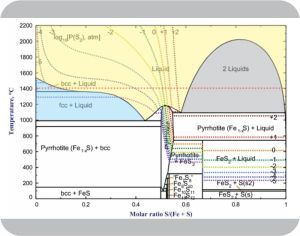
Vinnie’s been eavesdropping (he’s good at that). “You guys said that these researcher teams looked at how iron and sulfur play together at a bunch of different temperature, pressures and blend ratios. That’s a pretty nice chart, the one that shows mix and temperature. Got one for pressure, like the near‑vacuum over Loki’s lava lake on Io?”

“Not to my knowledge, Vinnie. Of course I’m a lab chemist, not a theoretical astrogeochemist. Kareem’s phase diagram is for normal atmospheric pressure. I’d bet virtually all related lab work extends from there to the higher pressures down toward Earth’s center. Million‑atmosphere experiments are difficult — even just trying to figure out whether a microgram sample’s phase in a diamond anvil cell is solid or liquid. Right, Kareem?”

“Mm‑hm, but the computer work’s hard, too, Susan. We’ve got several suites of software packages for modeling whatever set of pressure-temperature-composition parameters you like. The problem is that the software needs relevant thermodynamic data from the pressure and temperature extremes like from those tough‑to‑do experiments. There’s been surprises when a material exhibited new phases no‑one had ever seen or measured before. Water’s common, right, but just within the past decade we may have discovered five new high‑pressure forms of ice.”

“May have?”

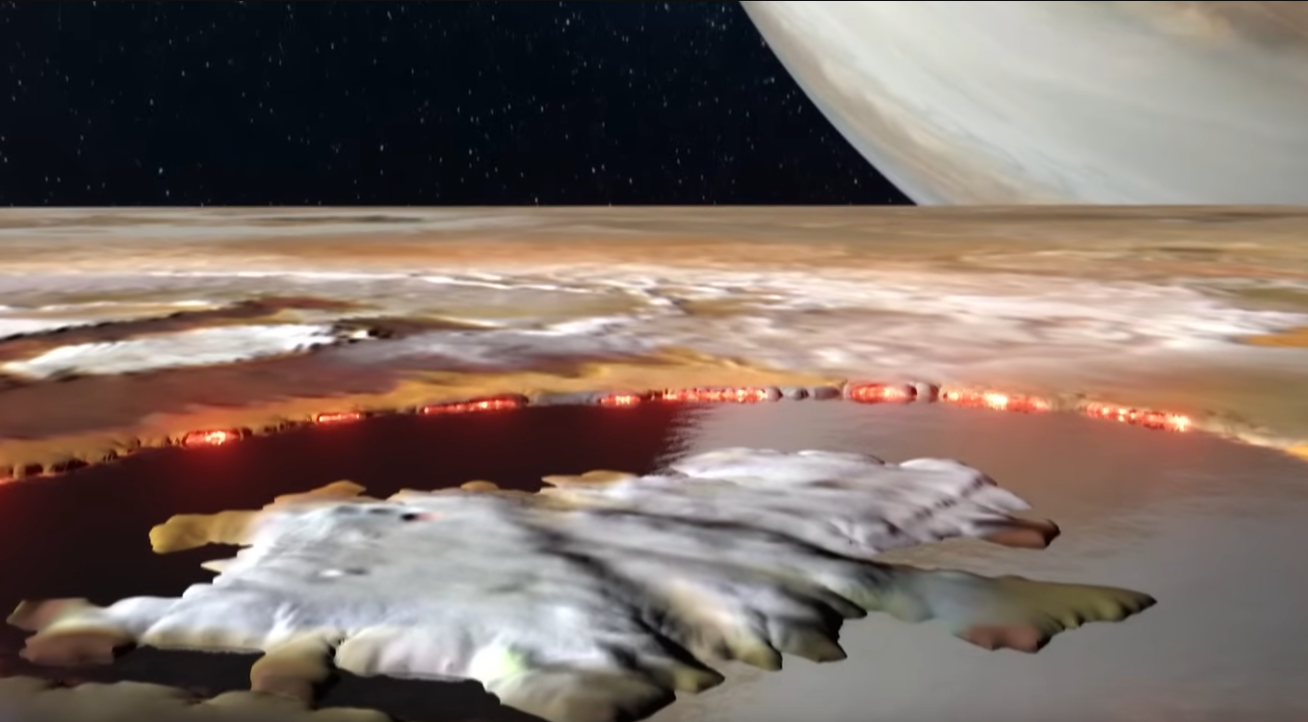
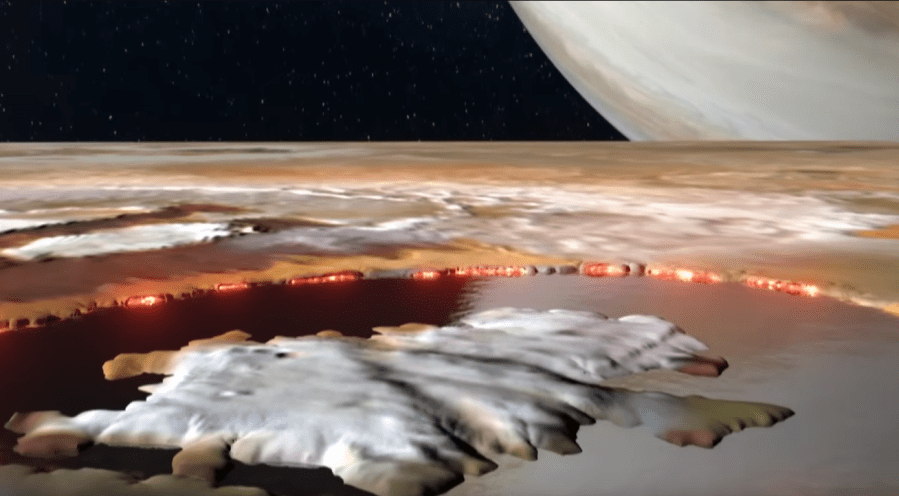
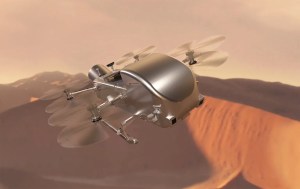
Artist’s concept of Loki Patera,
a lava lake on Jupiter’s moon Io
Credit: NASA/JPL-Caltech/SwRI/MSSS

“The academics are still arguing about each of them. Setting aside that problem, modeling Io’s low‑pressure environment is a challenge because it’s not a lab situation. Consider Cal’s pretty picture there. See those glowing patches all around the lava lake’s shore? They’re real. Juno‘s JIRAM instrument detected hot rings around Loki and nearly a dozen of its cousins. Such continual heat release tells us the lakes are being stirred or pumped somehow. Whatever delivers heat to the shore also must deliver some kind of hot iron‑sulfur phase to the cooler surface. That’ll separate out like slag in a steel furnace.”

“It’s worse than that, Kareem. Sulfur’s just under oxygen in the periodic table, so like oxygen it’s willing to be gaseous S2. Churned‑up hot lava can’t help but give off sulfur vapor that the models will have to account for.”

I cut in. “It’s worse than that, Susan. I’ve written about Jupiter’s crazy magnetic field, off‑center and the strongest of any planet. Io’s the closest large moon to Jupiter, deep in that field. Sulfur molecules run away from a magnetic field; free sulfur atoms dive into one. Either way, if you’re some sulfur species floating above a lava lake when Jupiter’s field sweeps past, you won’t be hanging around that lake for long. Most likely, you’ll join the parade across the Io‑to‑Jupiter flux tube bridge.”

Susan chortles. “Obviously not an equilibrium. It’s a steady state!”

“Huh?” from everyone. Cal gives her, “Steady state?”

Chemical equilibrium is when a reaction and its reverse go at equal rates, right, so the overall composition doesn’t change. That’s the opposite of situations where there’s a forward reaction but for some reason the products don’t get a chance to back‑react. Classic case is precipitation, say when you bubble smelly H2S gas through a solution that may contain lead ions. If there’s lead in there you get a black lead sulfide sediment that’s so insoluble there’s no re‑dissolve. Picture an industrial vat with lead‑contaminated waste water coming in one pipe and H2S gas bubbling in from another. If you adjust the flow rates right, all the lead’s stripped out, there’s no residual stink in the effluent water and the net content of the vat doesn’t change. That’s a steady state.”

“What’s that got to do with Loki’s lake?”

“Sulfur vapors come off it and those glowing rings tell us it’s giving off heat. It’s just sitting there not getting hotter and probably not changing much in composition. There’s got to be sulfur and heat inflow to make up for the outflow. The lake’s in a steady state, not an equilibrium. Thermodynamic calculations like Gibbs’ phase rule can’t tell you anything about the lake’s composition because that depends on the kinetics — how fast magma comes in, how fast heat and sulfur go out. Kareem’s phase diagram just doesn’t apply.”

~ Rich Olcott

A Lazy Summer Day at 1400°C

Susan Kim and Kareem are supervising while Cal mounts a new poster in the place of honor behind his cash register. “A little higher on the left, Cal.”

“How’s this, Susan? Hey, Sy, get over here and see this. Ain’t it a beaut?”

“Nice, Cal. What’s it supposed to be? Is that Jupiter in the background?”

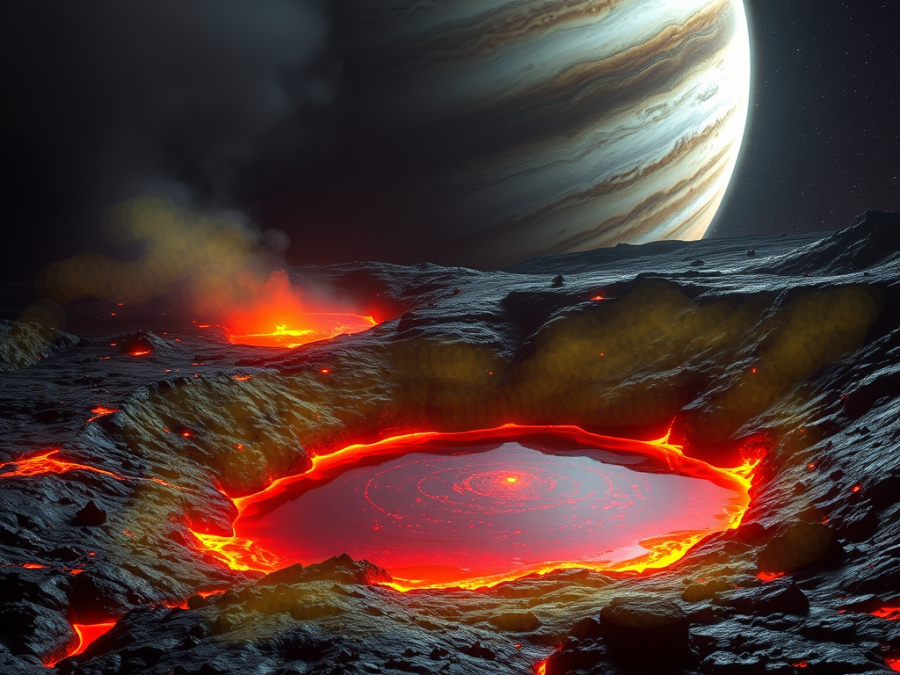
“Yeah, Jupiter all right. Foreground is supposed to be a particular spot on its moon Io. They think it’s a lake of molten sulfur!”

“No way, from that picture at least! I’ve seen molten sulfur. It goes from pale yellow to dark red as you heat it up, but never black like that.”

“It’s not going to be lab-pure sulfur, Susan. This is out there in the wild so it’s going to be loaded with other stuff, especially iron. But the molten sulfur I’ve seen in volcanoes is usually burning with a blue flame. I guess the artist left that out.”

“No oxygen to burn it with, Kareem. Why did you mention iron in particular?”

“Yeah, this article I took the image from says that lake’s at 1400°C. I thought blast furnaces ran hotter than that.”

I’ve been looking things up on Old Reliable. “They do, Cal, typically peaking near 2000°C.”

“So if this lake has iron in it, why isn’t the iron solid?”

“Same answer as I gave to Susan, Cal. The iron’s not pure, either. Mixtures generally melt or freeze at lower temperatures than their pure components. Sy would probably start an entropy lecture—”

“I would.”

“But I’m a geologist. Earth is about ⅓ iron. That’s mixed in with about 10% as much sulfur, mostly in the core where pressures and temperatures are immense. We want to understand conditions down there so we’ve spent tons of lab time and computer time to determine how various iron‑sulfur mixtures behave at different temperatures and pressures. It’s complicated.” <brings up an image on his phone> “Here’s what we call the system’s phase diagram.”

“You’re going to have to read that to us.”

“I expected to. Temperature increases along the y‑axis. Loki’s temp is at the dotted red line. Left‑to‑right we’ve got increasing sulfur:iron ratios — pure iron on the left, pure sulfur on the right. The idea is, pick a temperature and a mix ratio. The phase diagram tells you what form or forms dominate. The yellow area, for instance, is liquid — molten stuff with each kind of atom moving around randomly.”

“What’s the ‘bcc’ and ‘fcc’ about?”

“I was going to get to that. They’re abbreviations for ‘body‑centered cubic’ and ‘face‑centered cubic’, two different crystalline forms of iron. The fcc form dominates below that horizontal line at about 1380°C, converts to bcc above that temperature. Pure bcc freezes at about 1540°C, but add some sulfur to the molten material and you drive that freezing temperature down along the blue‑yellow boundary.”

“And the gray area?”

“Always a fun thing to explain. It’s basically a no‑go zone. Take the point at 1400°C and 80:20 sulfur:iron, for instance. The line running through the gray zone along those red dots, we call it a tie line, skips from 60:40 to 95:5, right? That tells you the 60:40 mix doesn’t accept additional sulfur. The extra part of the 80:20 total squeezes out as a separate 95:5 phase. Sulfur’s less dense than iron so the molten 95:5 will be floating on top of the 60:40. Two liquids but they’re like oil and water. If you want a uniform 80:20 liquid you have to shorten the tie line by raising the temp above 2000°C.”

“All that’s theory. Is there evidence to back it up?”

“Indeed, Sy, now that Juno‘s up there taking pictures. When the spacecraft rounded Io last February JunoCam caught several specular reflections of sunlight just like it had bounced off mirrors. At first the researchers suspected volcanic glass but the locations matched Loki and other hot volcanic calderas. The popular science press can say ‘sulfur lakes’ but NASA’s being cagey, saying ‘lava‘ — composition’s probably somewhere between 10:90 and 60:40 but we don’t know.”

~ Rich Olcott
The Trough And The Plateau

Particularly potent pepperoni on Pizza Eddie’s special tonight so I dash to the gelato stand. “Two dips of pistachio in a cup, please, Jeremy, and hurry. Hey, why the glum look?”

“The season’s moving so slowly, Mr Moire. I’m a desert kid, used to bright skies. I need sunlight! We’re getting just a few hours of cloudy daylight each day. It seems like we’re never gonna leave this pattern. Here’s your gelato.”

“Thanks. Sorry about the cloudiness, it’s the wintertime usual around here. But you’re right, we’re on a plateau.”

“Nosir, the Plateau’s the Four Corners area, on the other side of the Rockies, miles and miles away from here.”

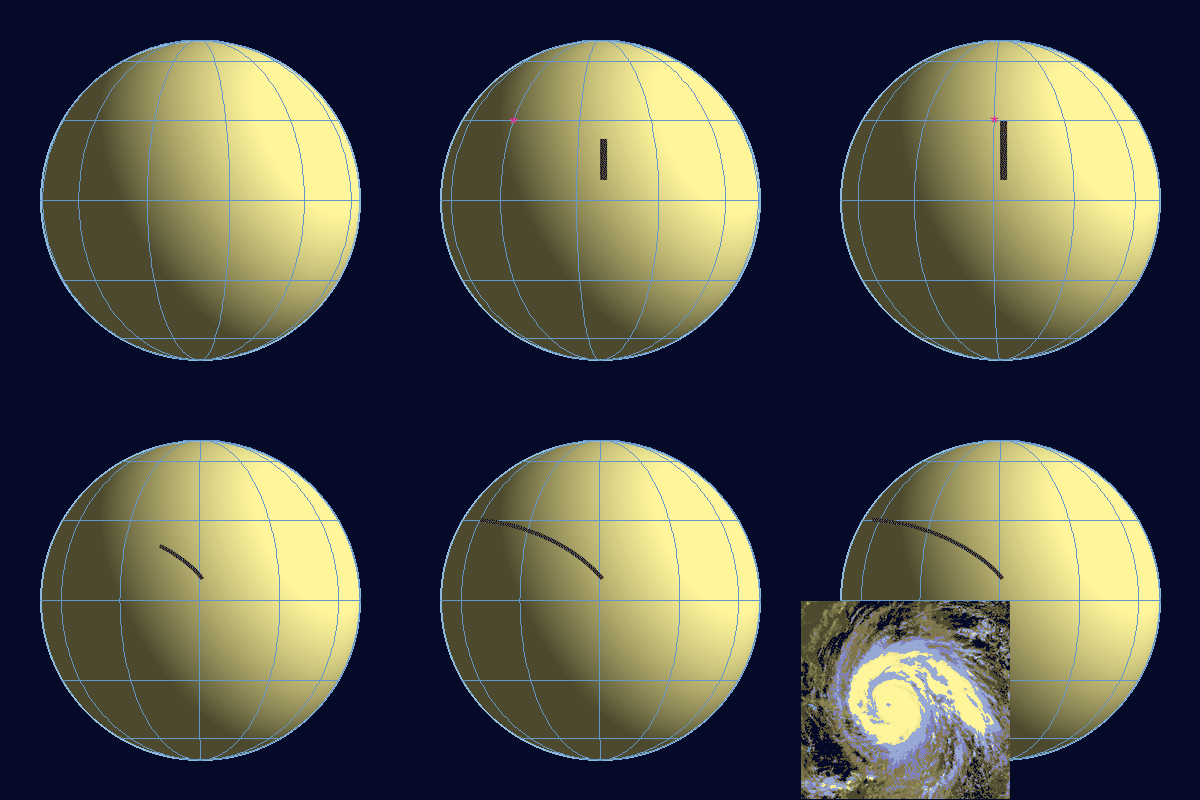
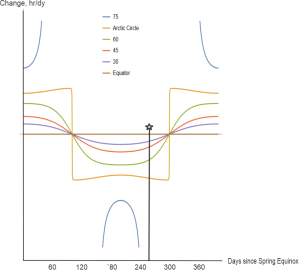
<chuckle> “Not the Colorado Plateau, the darkness plateau. Or the daylight trough, if you prefer. Buck up, we’ll get a daylight plateau starting in a few months.” <unholstering Old Reliable> “Here’s a plot of daylight hours through the year at various northern latitudes. We’re in between the red and green curves. For folks south of the Equator that’d just turn upside‑down, of course. I added a star at today’s date in mid‑December, see. We’re just shy of the winter solstice; the daylight hours are approaching the minimum. You’re feeling stressed because these curves don’t change much day-to-day near minimum or maximum. In a couple of weeks the curve will bend upwards again. Come the Spring equinox, you’ll be shocked at how rapidly the days lengthen.”

“Yeah, my Mom says I’m too impatient. She says that a lot. Okay, above the Arctic Circle they’ve got months‑long night and then months‑long day, I’ve read about that. I hadn’t realized it was a one‑day thing at the Circle. Hey, look at the straight lines leading up to and away from there. Is that the Summer solstice? Those low‑latitude curves look like sine waves. Are they?”

“Summer solstice in the northern hemisphere, Winter solstice for the southerners. The curves are distorted sines. Ready for a surprise?”

<Looks around the nearly empty eatery.> “With business this slow I’m just sitting here so I’m bored. Surprise me, please.”

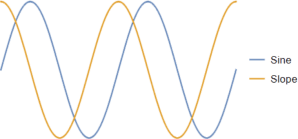
“Sure. One of the remarkable things about a sine wave is, when you graph its slopes you get another sine wave shifted back a quarter. Here, check it out.”

“Huh! When the sine wave’s mid-climb, the slope’s at its peak. When the sine wave’s peaking, the slope’s going through zero on the way down. And they do have exactly the same shape. I see where you’re going, Mr Miore. You’re gonna show me the slopes of the daylight graphs to see if they’re really sine waves.”

“You’re way ahead of me and Old Reliable, Jeremy.” <frantic tapping on OR’s screen> “There, point‑by‑point slopes for each of the graphs. Sorta sine‑ish near the Equator but look poleward.”

“The slopes get higher and flatter until the the Arctic Circle line suddenly drops down to flip its sign. Those verticals are the solstices, right?”

“Right. Notice that even at the Circle the between‑solstice slopes aren’t quite constant so the straight lines you eye‑balled aren’t quite that. North of the Circle the slopes go nuts because of the abrupt shifts between varying and constant sun.”

“How do you get these curves, Mr Moire?”

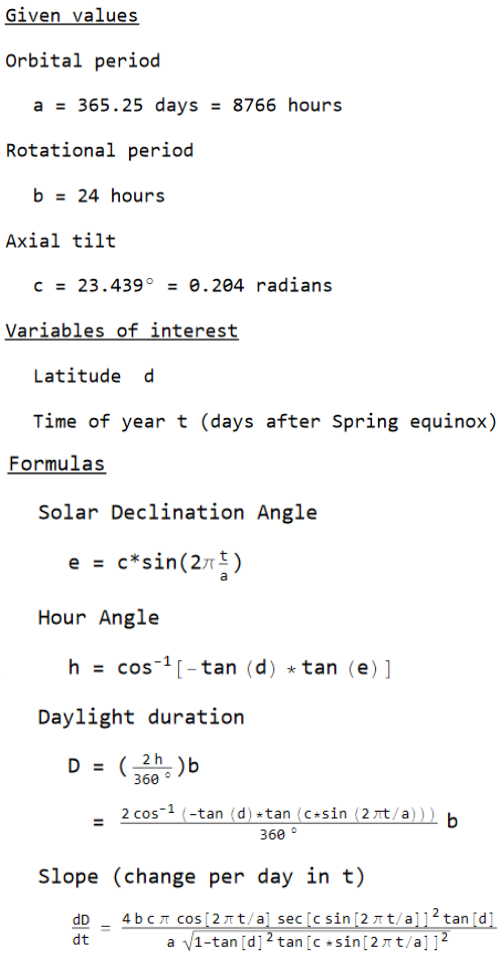
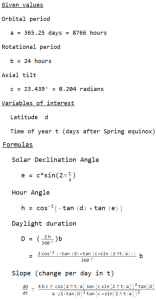
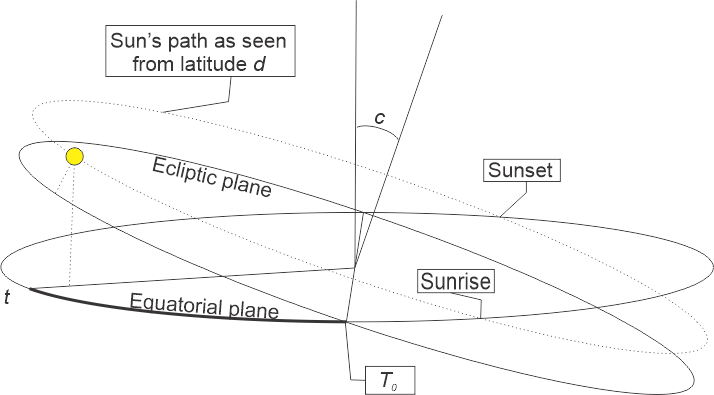
“It’s a series of formulas. Dust off your high school trig. The Solar Declination Angle equation is about the Sun’s height above or below the horizon. It depends on Earth’s year length, its axial tilt and the relative date, t=T‑T0. For these charts I set T0 to the Spring equinox. If the height’s negative the Sun’s below the horizon, okay?”

“Sine function is opposite‑over‑hypotenuse and the height’s opposite alright or we’d burn up, yup.”

“The second formula gives the the Hour Angle between your longitude and whichever longitude has the Sun at its zenith.”

“Why would you want that?”

“Because it’s the heart of the duration formula. When you roll all three formulas together you get one big expression that gives daylight duration in terms of Earth’s constants, time of year and your location. That’s what I plotted.”

“How about the slope curves?”

“Calculus, Jeremy, d/dt of that combined duration function. It’s beyond my capabilities but Old Reliable’s up to it.”

~ Rich Olcott
A Big Purple Snowball

Cathleen’s back at the mic. “Okay, folks, now for the third speaker in tonight’s Crazy Theory seminar. Kareem, you have the floor.”

“Thanks, Cathleen. Some of you already know I do old‑rock geology. If a rock has a bone in it, I’m not interested. Paleontology to me is like reading this morning’s newspaper. So let me take you back to Precambrian times when Earth may have been purple.”

Kareem’s a quiet guy but he’s got the story‑teller’s gift, probably honed it at field expedition campfires, so we all settle back to listen.

“Four and a half billion years ago, Earth was bright orange. That’s not the color it reflected, that’s the color it glowed. You’ve all seen glass‑blowers at work, how the material gives off a bright orange light coming out of the flame or furnace, soft and ready to be formed. That’s what the planet’s surface was like after its Moon‑birthing collision with Theia. Collisions like that release so much heat that there’s no rocks, just layers of smooth molten glassy slag floating on fluid silicates and nickel‑iron like in a blast furnace. No atmosphere, all the volatiles have been boiled off into space. Got the picture?”

General nodding, especially from maybe‑an‑Art‑major who’s good at pictures.

“Time passes. Heat radiating away cools the world from the outside inward. Now the surface is a thin glassy cap, black like obsidian and basalt, mostly smooth. The cooling contracting cap fractures from the tension while the shrinking interior pulls inward, slow but not gentle. The black glassy surface becomes low craggy mountains and razor‑rubble, sharp enough to slice hiking boots to ribbons. There’s no erosive wind or water yet to round things off. Everything stays sharp‑edged.”

Voice from the back of the room — “Where’s our water from then?”

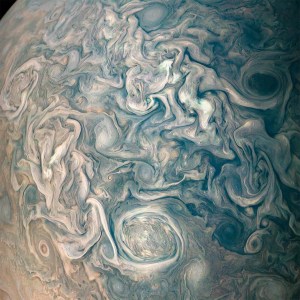
“Good question. Could be buried water that never got the chance to escape past the cap, could be water ferried in on icy comets or worldlets. People argue about it and I’m not taking sides. The planet gets a new color after it cools enough to hold onto water molecules however they got there — but that water doesn’t stay on the surface. Raindrops hitting still‑hot rock hiss back into steamy clouds. If you were on the moon at the time you’d see a white‑and‑grey Earth like Jupiter’s curdled cloud-tops. Visualize a series of million‑year Hurricane Debbies, all over the world.”

He pauses to let that sink in.

“When things finally cool down enough to allow surface water there’s oceans, but they’re not blue. Millions of years of wind and water erosion have ground the sharp rubble to spiky dust. Most of the thrust‑raised mountains, too. Much of the dust is suspended or dissolved in the ocean turning it black. For a while. The dust is loaded with minerals, especially sulfides, very nutritious for a group of not‑quite bacteria called Archaea that eat sulfides using a molecule that’s powered by green light but reflects red and blue. When the Archaea take over, the oceans look magenta from the reflected red and blue.”

Maybe‑an‑Art‑major giggles.

“Next major event, we think, was the Huronian Glaciation, when most or all of the Earth was a solid white because it was covered with ice. Killed off most or the Archaea. When that melted, different parts of the ocean turned black from floating dead Archaea and and then milky turquoise from sulfur particles. Next stage was purple, from a different group of sulfur‑eating purple almost‑bacteria. Then we had snowball whiteness again, which gave green‑reflecting chlorophyll‑users a chance to take over, clear our the sulfur and leave the oceans blue.”

VBOR — “That’s your Crazy Theory?”

“No, that’s mostly mainstream. Question is, what terminated the deepfreezes? Lots of ideas out there — solar dimming and brightening, different combinations of CO2 and methane from volcanoes or bacteria, even meteorites. Anyone remember Ian Malcom’s repeated line in the Jurassic Park movies?”

Everyone — “Life will find a way!”

“Right on. My crazy’s about the two almost‑bacteria. Suppose each kind managed to infiltrate their day’s Great Extinction glaciers. Suppose planet‑wide bacterial purple pigments absorbed sunlight’s energy, melting the ice. Karma, yes?”

~ Rich Olcott
To Fly on Another World

“Uncle Sy, why is PV=nRT the Ideal Gas Equation? Is it because it’s so simple but makes sense anyway?”

“It is ideal that way, Teena, but it’s simply an equation about gases that are ideal. Except there aren’t any. Real gases come close but don’t always follow the rule.”

“Why not? Are they sneaky?”

“Your kind of question. We like to think of gas particles as tiny ping‑pong balls that just bounce off of each other like … ping‑pong balls. That’s mostly true most of the time for most kinds of gas. One exception has to do with stickiness. Water’s one of the worst cases because its H2O molecules like to chain up. When two H2Os collide, if they’re pointed in the right directions they share a hydrogen atom like a bridge and stick together. If that sort of stickiness happens a lot then the quantity measure n acts like it’s less than we’d expect. That makes the PV product smaller.”

“I bet that doesn’t happen much when the gas is really hot. Two particles might stick and then BANG! another particle hits ’em and breaks it up!”

“Good thinking and that’s true. But there’s another kind of exception that holds even at high temperatures. A well‑behaved gas is mostly empty space because the ping‑pong balls are far apart unless they’re actually colliding. But suppose you squeeze out nearly all of the empty space and then try to squeeze some more.”

“Oh! The pressure gets even bigger than the equation says it should because you can’t squeeze the particles any smaller than they are, right?”

“Exactly.”

“Well, if the equation has these problems, why do we even use it at all?”

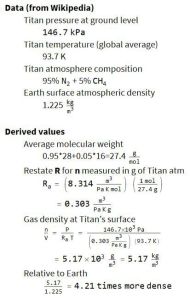
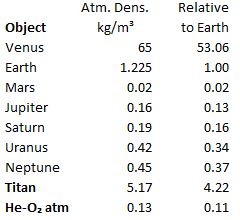
“Because it’s good enough, enough of the time, and we know when not to use it. I’ll give you an example. One of my clients wanted to know air density at ground level on Saturn’s moon Titan and all the planets that have an atmosphere.” <showing Old Reliable’s screen> “I found the planet data I needed in NASA’s Planetary Science website, but I had to do my own calculation for Titan. The pressure’s not crazy high and the temperature’s chilly but not quite cold enough to liquify nitrogen so the situation’s in‑range for the Ideal Gas Equation.”

“What’s a Pa?”

“That’s the symbol for a pascal, the unit of pressure. kPa is kilopascals, just like kg is kilograms. Earth’s atmospheric pressure is about 100 kPa.”

“Reliable says Wikipedia says Titan’s air is mostly nitrogen like Earth’s air is. Titan’s just a moon so it has to be smaller than Earth so its gravity must be smaller, too. Why is its atmosphere so much denser?”

“The cold. Titan’s air is 200 kelvins colder than Earth’s average temperature. You’re right, an individual gas particle feels a smaller pull of gravity on Titan, but it doesn’t have much kinetic energy to push its neighbors away so they all crowd closer together.”

“Why in the world does your client want to know that density number?”

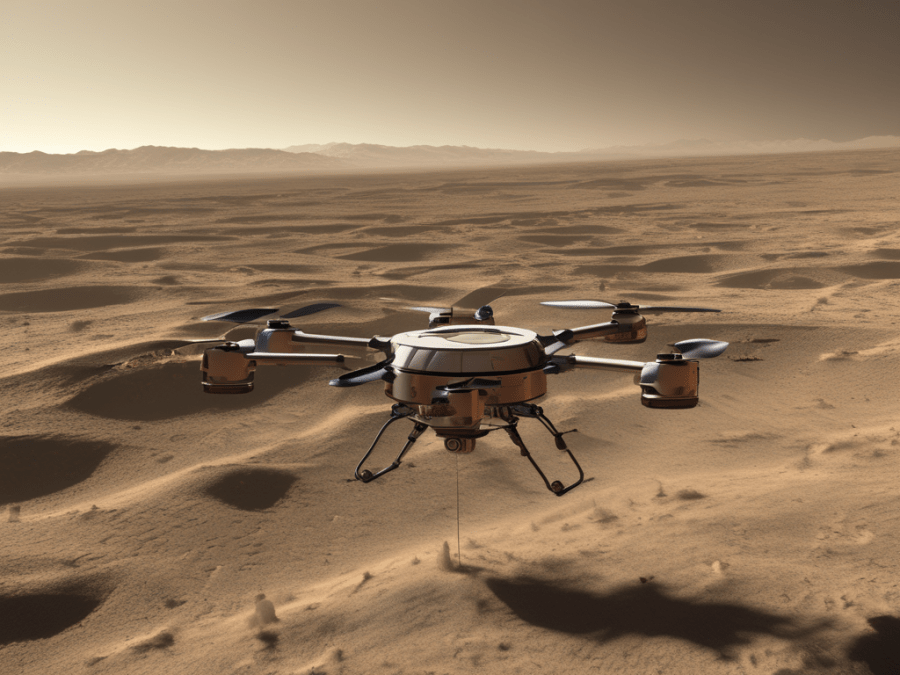
“Clients rarely give me reasons. I suspect this has to do with designing a Titan‑explorer aircraft.”

“Ooo! Wait, what does that have to do with air density?”

“It has to do with how hard the machine has to work to push itself up. It’ll probably have horizontally spinning blades that push the air downwards, like helicopters do. With a setup like that, the lift depends on the blade’s length, how fast it’s spinning, and how dense the air is. If the air is dense, like on Titan, the designers can get the lifting thrust they need with short blades or a slow spin. On Mars the density’s only 2% of Earth’s so Ingenuity‘s rotors were 4 feet across and spun about ten times faster than they’d have to on Earth.”

“What about on our helium‑oxygen Earth?”

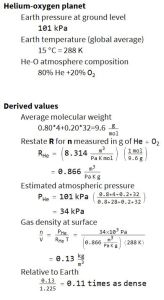
“That’s pretty much the same calculation. Give me a sec.” <tapping on Old Reliable’s screen> “Gas density would be a tenth of Earth’s, but a HeO‑copter would have to work against full‑Earth gravity. Huge blades rotating at supersonic speeds. Probably not a practical possibility.”

“Aw.”

“Yeah.”

~ Rich Olcott
The Ideal Gas Game

“But Uncle Sy, you never did answer my real question!”

“What question was that, Teena?”

“About the helium planet. With oxygen. Oh, I guess I never did get around to asking that part of it. You side‑tracked us into how a helium‑oxygen atmosphere would be unstable unless it was really cold or the planet had more gravity than Earth so the helium wouldn’t fly away. But what I wanted to know was, what would it be like before the helium left? Like, could we fly a plane there?”

“Mmm, let’s get a leetle more specific. You asked about swapping all of Earth’s atmospheric nitrogen with helium. Was that one helium atom for each nitrogen molecule or each nitrogen atom?”

“What difference would that make?”

“Mass, to begin with. A helium atom weighs about 1/3 of a nitrogen atom, 1/7 of a nitrogen molecule. The atmospheric pressure we feel is the weight of all the air molecules above us. Swap out 80% of those molecules for something lighter, pressure goes down whether we swap helium for molecules or helium for atoms. We could calculate either one. But the change would be much harder to calculate for the atom‑for‑atom swap.”

“Why?”

“Mmm, have you gotten into equations yet in school?”

“You mean algebra, like 3x+7=8x+2? Yeah, they’re super‑easy.”

“This won’t even be as complicated as that. Here’s a famous Physics equation called The Ideal Gas Law — PV=nRT. Each letter stands for one quantity. Two adjacent quantities are multiplied together, okay? The pressure in a container is P, the container’s volume is V, T is the absolute temperature, and n is a measure of how much gas is in there.”

“You skipped R.”

“Yes, I did. It’s a constant number. Its job is to make all the units come out right. For instance, if the pressure’s in atmospheres, the volume’s in liters, n is in grams of helium and the temperature is in kelvins, then R is 0.021. Suppose you’re holding a balloon filled with helium and it’s at room temperature. What can you say about the gas?”

“Umm, all the nRT stuff doesn’t change so P times V, whatever it is, doesn’t change either.”

“If we let it fly upward until the pressure was only half what it is here…?”

“Then V would double. The balloon would get twice as big. Unless it burst, right?”

“You got the idea. Okay, now let’s fiddle with the right-hand side. Suppose we double the amount of helium.”

P times V must get bigger but we don’t know which one.”

“Why not both?”

“Wooo… Each one could get some bigger… Oh, wait, I’m holding the balloon so the pressure’s not going to change so the balloon gets twice bigger.”

“Good thinking. One more thing and we can get back to your difference question. The Ideal Gas Law doesn’t care what kind of gas you’re working with. All the n quantity really cares about is how many particles are in the gas. A particle can be anything that moves about independently of anything else — helium atom or nitrogen molecule, doesn’t matter. If you change the definition of what n is measuring, all that happens is you have to adjust R so the units come out right. Then the equation works fine. Next step—”

“Wait, Uncle Sy, I want to think this atom‑or‑molecule thing through for myself. I’m gonna ignore R times T because both of them stay the same. So if we swap one atom of helium for one molecule of nitrogen, the number of particles doesn’t change and PV doesn’t change. But if we swap one atom of helium for each atom of nitrogen then n doubles and so does PV. But if we do that for the whole atmosphere then we can’t say that the pressure won’t change because the atmosphere could just expand and that’s the V but the pressures are all different as you go higher up anyway. Oh, wait, T changes, too, because it’s cold up there. It’s complicated, isn’t it?”

“It certainly is. Can we stick to just the simple atom‑for‑molecule swap?”

“Uh‑huh.”

~~ Rich Olcott

  • Thanks again, Xander, and happy birthday. Your question was deeper than I thought.

A Fleeting Shadowed Sky

“Hey, Uncle Sy, I’ve got a what‑if for you.”

“What’s that, Teena?”

“Suppose we switched Earth’s air molecules with helium. No, wait, except for the oxygen molecules. I know we need them.”

“First off, a helium-oxygen atmosphere wouldn’t last very long, not on the geological time scale. That’s an unstable situation.”

“Why, would the helium burn up like I’ve seen hydrogen do?”

“No, helium doesn’t burn. Helium atoms are smug. They’re happy with exactly the electrons they have. They don’t give, take or share electrons with oxygen or anything else. No, the issue is that helium’s so light.”

“What difference does that make?”

“The oxygen and helium won’t stay mixed together.”

“The air’s oxygen and nitrogen molecules are all mixed together. They told us that in Science class.”

“That’s correct. But oxygen and nitrogen molecules weigh nearly the same. It would take eight balloon‑fulls of helium to match the weight of one balloon‑full of oxygens. Suppose you had a bunch of equal‑weighted marbles, say red ones and blue ones. Pretend you pour them into a big bucket and stir them around like an atmosphere does. Which color would wind up on top?”

“Both, they’d stay mixed together.”

“Uh-huh. Now replace the blue marbles with marble‑sized ping‑pong balls and stir well.”

“The heavy marbles slide to the bottom. The light balls need to be somewhere so they get bullied up to the top.”

“Exactly. That’s what the oxygen molecules would do — sink down toward the ground and shove the helium atoms up to the top of the atmosphere. Funny thing though — the shoving happens faster than the sinking.”

“Why’s that?”

“It’s the mass thing again. At any given temperature, helium atoms in a gas zip around four times faster than oxygen molecules do. Anyway, the helium atoms that arrive up top won’t stay there.”

“Where else would they go?”

“Anywhere else, basically. Have you heard the phrase, ‘escape velocity‘?”

“It has something to do with rockets, doesn’t it?”

“Well, them, too. The general idea is that once you reach a certain threshold speed relative to a planet or something, you’re going too fast for its gravity to pull you back down. There’s a formula for calculating the speed. The fun thing is, the speed depends on the mass of what you’re escaping from and your distance from the object’s center, but it doesn’t depend on your own mass. It applies to everything from rockets to gas molecules.”

“And we were just talking about helium being zippy. Is it zippy enough to escape Earth?”

“Good thinking! That’s exactly where I was going. The answer is, ‘Maybe.’ It depends on temperature. Warm molecules are zippy, cold molecules not so much. At the same temperature, light molecules are zippier than heavy ones. There’s a chart that shows thresholds for different molecules escaping from different planets. Earth could hold onto its helium atoms, but only if our atmosphere were more than a hundred degrees colder than it is. Warm as we are, bye‑bye helium.”

“How long would that take?”

“That’s a complicated question with lots of ‘It depends’ in the answer. Probably the most important has to do with water.”

“I didn’t say anything about water, just helium and oxygen.”

“I know, but much of Earth’s weather is driven by water vaporizing or condensing or just carrying heat from place to place. Water‑powered hurricanes and even big thunderstorms stir up the atmosphere enough to swoosh helium up to bye‑bye territory. On the other hand, suppose our helium‑Earth is dry. The atmosphere’s layers would be mostly stable, light atoms would be slow to rise. We’d have a very odd‑looking sky.”

“No clouds.”

“Pretty much. But it wouldn’t be blue, either.”

“Would it be pink? I like pink.”

“Sorry, sweetie, it’d be dark dark blue, some lighter near the horizon. Light going past an atomic or molecular particle can scatter from its temporarily distorted electron cloud. Nitrogen and oxygen molecules distort more easily than helium atoms do. Earth skies are blue thanks to sunlight scattered by oxygen and nitrogen. Helium skies wouldn’t have much of that.”

~ Rich Olcott
  • Thanks again to Xander, who asked a really good helium question.

New Volcano, Old Crater

Now Eddie’s dealing the cards and the topic choice. “So I saw something on TV about a new volcano on Mars. You astronomy guys have been saying Mars is a dead planet, so what’s with a new volcano? Pot’s open.”

Vinnie’s got nothing, throws down his hand. So does Susan, but Kareem antes a few chips. “I doubt there’s a new volcano, it’s probably an old one that we just realized is there. We find a new old caldera on Earth almost every year. Sy, I’ll bet your tablet knows about it.”

I match Kareem’s bet and fire up Old Reliable. A quick search gets me to the news item. “You’re right, Kareem, it’s a new find of an old volcano. This article’s a puff‑piece but the subject’s in your bailiwick, Cathleen.”

Cathleen puts in her bet and pulls out her tablet. “You’re right, Kareem. It’s a volcano we all saw but no‑one recognized until this two‑person team did. Here’s a wide‑angle view of Mars to get you oriented. North is up top, east is to the right just like usual.”

“Gaah. Looks like a wound!”

“We’ll get to that. The colors code for elevation, purple for lowlands up through the rainbow to red, brown and white. Y’all know about Olympus Mons, the 22‑kilometer tallest volcano in the Solar System, and there’s Valles Marineris, at 4000 kilometers the longest canyon. The Tharsis bulge is red‑to‑pink because it’s higher than most all the rest of the planet’s surface. Do you see the hidden volcano?”

“It’s hard to tell the volcanos from the meteor craters.”

“Understandable. Let me switch to a closer view of the canyon’s western end. This one’s in visible light, no color‑coding games. The middle one of the three Tharsis volcanos is to the left, no ginormous meteor craters in the view. Noctis labyrinthus, ‘the Labyrinth of Night.’ is that badlands region left of center. Lots of crazy canyons that go helter‑skelter.”

“That’s more Mars‑ish, but it’s still unhealthy‑looking.”

“It is a bit rumpled. Do you see the volcano?”

“Mmm, no.”

“This should help. It’s a close-up using the elevation colors to improve contrast.”

“Wow, the area inside that circle sure does look like it’s organized around its center, not higgledy-piggledy like what’s west of it. That brown image had something peaky right about there. What’s ‘prov’?”

“Good eye, Susan. The ‘prov’ means ‘provisional‘ because names aren’t real until the International Astronomical Union blesses them. The peak is nine kilometers high, almost half the height of Olympus Mons. The concentric array of canyons and mesas around it certainly make it look like a collapsed and eroded volcano. But IAU demands more evidence than just ‘look like.’ Using detailed spectroscopic data from two different Mars orbiters, the team found evidence of hydrated minerals plus structural indications that their proposed volcano either punched through a glacier or flowed onto one. Better yet, the mesas all tilt away from the peak, and the minerals are what you’d expect from water reacting with fresh lava.”

“Did they use the word ‘ultramafic‘?”

“I don’t think so, Kareem, just ‘mafic‘.”

“From underground but not deep down, then.”

“I suppose.”

Cal bets. “You said we’d get back to wounds. What was that about?”

“Well, just look at all that mess related to the Tharsis bulge — higher than all its surroundings, massive volcanos nearby, the Noctis badlands, Valles Marineris that doesn’t look water‑carved but has that delta at its eastern end. Why is all of that clustered in just one part of the planet? Marsologists have dozens of hypotheses. My own favorite centers on Hellas basin. It’s the third largest meteor strike in the Solar System and just happens to be almost exactly on the opposite side of Mars.”

Eddie looks a bit gobsmacked. “A wallop like that would carry a lot of momentum. Kareem, can a planet’s interior just pass that along in a straight line?”

“Could be, depending. If it’s solid or high‑viscosity, I guess so. If it’s low‑viscosity you’d get a doughnut‑shaped circulatory pattern inside that’d turn the energy into heat and vulcanism. How long was Mars cooling before the hit?”

“We don’t know.”

Cal’s pair of jacks apologetically takes the pot.

~~ Rich Olcott

No Symphony on Mars

“Evening, Jeremy, a scoop of your pistachio gelato, please. What’re you reading there?”

“Hi, Mr Moire. It’s A City on Mars by Kelly and Zach Weinersmith. One of my girlfriends read it and passed it along to me. She said it’s been nominated for a Hugo even though it’s non‑fiction and it argues against the kind of go‑to‑Mars‑soon planning that Mr Musk is pushing.”

“Is she right about the argument?”

“Pretty much, so far, but I’m not quite done. You get a clue, though, from the book’s subtitle — ‘Can we settle space, should we settle space, and have we really thought this through?‘ Here’s your gelato.”

“Thanks. Not just Mars, space also?”

“That’s right. It’s about the requirements and implications for people living in space and on the Moon and on Mars. The discussion starts with making and raising babies.”

“That first part sounds like fun.”

“Well, you’d think so, but apparently you need special equipment. Hard to stay in contact if there’s no gravity to key on. But that’s only the start of a problem cascade. Suppose the lady gets pregnant. The good news is in zero gravity it’s easy for her to move around. The bad news is we don’t know whether Earth gravity’s important for making babies develop the way they’re supposed to. Also, delivering a baby isn’t the only medical procedure that’d be a real challenge in zero‑g where you need to keep fluid droplets from bouncing around the cabin and into the air system.”

“Whoa. Hmm, never thought about it in this context before, but babies leak. Diapers can help, but babies burp up stuff along with the air. Yuck! Tears they cry in space would just stay on their eyes instead of rolling down cheeks. So … we’d need OB/GYN clinics and nurseries somewhere down a gravity well.”

“For sure, although no‑one knows whether even the Moon’s 1/6g is strong enough for good development. I know my little cousins burn up a lot of energy just running around. Can’t give a toddler resistance bands or trust it on a treadmill.”

“So we need an all‑ages gym down there, too, with enough room for locals and visiting spacers.”

“You’re coming round to the Weinersmiths’ major recommendation — don’t go until you can go big! Don’t plan on growing from a small colony, plan on starting with a whole city that can support everything you need to be mostly self‑sufficient.”

“So you’re young, Jeremy. Are you looking forward to being a Mars explorer?”

“I’ll admit all that rusty landscape reminds me of Navajoland, but I think I’d rather stay here. On Mars I’d be trapped in tunnels and domes and respirators and protective coveralls. I wouldn’t be able to just go out and run under the sky the way I was brought up to do.”

“Wouldn’t be able to do a lot of things. Concerts would sound weird, according to a paper I just read.”

“Sure, wind instruments wouldn’t work with bubble helmets. We could still have strings, percussion and electronics, though, right?”

“Sure you could have them. But it’s worse than that. Mars atmosphere is very different from Earth’s. Its temperature measured in kelvins is 25% colder. The pressure’s 99% lower. Most important, molecule for molecule Mars’ mostly‑CO2 atmosphere’s is 50% heavier than Earth’s N2‑O2 mixture. Those differences combine to muffle sounds so they don’t carry near as far as they would on Earth. Most sounds travel about 30% more slowly, too, but that’s where a CO2 molecule’s internal operation makes things weird.”

“Internal? I thought molecules in sound waves just bounced off each other like little billiard balls.”

“That’s usually the case unless you’re at such high pressures that molecules can start sticking to each other. CO2 under Mars conditions is different. If there’s enough time between bounces, CO2 can convert some of its forward kinetic energy into random heat. The threshold is about 4 milliseconds. A sound wave frequency longer than that travels noticeably slower.”

“Four milliseconds is 250 Hertz — that’s a middle B.”

“Mm-hm. Hit a cymbal and base drum simultaneously, your audience hears the cymbal first. Terrible acoustics for a band.”

~~ Rich Olcott
A Spherical Bandstand

“Whoa, Sy, something’s not right. Your zonal harmonics — I can see how latitudes go from pole to pole and that’s all there are. Your sectorial harmonic longitudes start over when they get to 360°, fine. But this chart you showed us says that the radius basically disappears crazy close to zero. The radius should keep going forever, just like x, y and z do.”

“Ah, I see the confusion, Susan. The coordinate system and the harmonic systems and the waves are three different things, um, groups of things. You can think of a coordinate system as a multilevel stage where chords of harmonic musicians can interact to play a composition of wave signals. The spherical system has latitude and longitude levels for the brass and woodwind players, plus one in back for the linear percussion section. Whichever direction the brass and woodwinds point, that’s where the signals go out, but it’s the percussion that determines how far they get. Sure, radius lines extend to infinity but except for R0 radial harmonics damp out pretty quickly.”

“Signals… Like Kaski’s team interpreted Juno‘s orbital twitches as a signal about Jupiter’s gravitational unevenness. Good thing Juno got close enough to be inside the active range for those radial harmonics. How’d they figure that?”

“They probably didn’t, Cathleen, because radial harmonics don’t fit easily into real situations. First problem is scale — what units do you measure r in? There’s an easy answer if the system you’re working with is a solid ball, not so easy if it’s blurry like a protein blob or galaxy cluster.”

“What makes a ball easy?”

“Its rigid surface that doesn’t move so it’s always a node. Useful radial harmonics must have a node there, another node at zero and an integer number of nodes between. Better yet, with the ball’s radius as a natural length unit the r coordinate runs linearly between zero at the center and 1.0 at the surface. Simplifies computation and analysis. In contrast, blurries usually don’t have convenient natural radial units so we scrabble around for derived metrics like optical depth or mixing length. If we’re forced into doing that, though, we probably have worse challenges.”

“Like what?”

“Most real-world spherical systems aren’t the same all the way through. Jupiter, for instance, has separate layers of stratosphere, troposphere, several chemically distinct cloud‑phases, down to helium raining on layers of hydrogen in liquid, maybe slushy or even solid form. Each layer has its own suite of physical properties that put kinks into a radial harmonic’s smooth curve. Same problem with the Sun.”

“How about my atoms? The whole Periodic Table is based on atoms having a shell structure. What about the energy level diagrams for atomic spectra? They show shells.”

“Well, they do and they don’t, Susan. Around the turn of the last Century, Lyman, Balmer, Paschen, Brackett and Pfund—”

“Sounds like a law firm.”

“<ironically> Ha, ha. No, they were experimental physicists who gave the theoreticians an important puzzle. Over a 40‑year period first Balmer and then the others, one series at a time, measured the wavelengths of dozens of lines in hydrogen’s spectrum. ’Okay, smarties, explain those!‘ So the theoreticians invented quantum mechanics. The first shot did a pretty good job for hydrogen. It explained the lines as transitions between discrete states with different energy levels. It then explained the energy levels in terms of charge being concentrated at different distances from the nucleus. That’s where the shell idea came from. Unfortunately, the theory ran into problems for atoms with more than one electron.”

“Give us a second… Ah, I get why. If one electron avoids a node, another one dives in there and that radius isn’t a node any more.”

“Got it in one, Cathleen. Although I prefer to think of electrons as charge clouds rather than particles. Anyhow, when an atom has multiple charge concentrations their behavior is correlated. That opens the door to a flood of transitions between states that simply aren’t options for a single‑electron system. That’s why the visible spectrum of helium, with just one additional electron, has three times more lines than hydrogen does.”

“So do we walk away from spherical harmonics for atoms?”

“Oh, no, Susan, your familiar latitude and longitude harmonics fit well into the quantum framework. These days, though, we mostly use combinations of radial fade‑aways like my Sn00 example.”

~~ Rich Olcott