Far out, man

Egg in the UniverseThe thing about Al’s coffee shop is that there’s generally a good discussion going on, usually about current doings in physics or astronomy.  This time it’s in the physicist’s corner but they’re not writing equations on the whiteboard Al put up over there to save on paper napkins.  I step over there and grab an empty chair.

“Hi folks, what’s the fuss about?”

“Hi, Mr Moire, we’re arguing about where the outer edge of the Solar System is.  I said it’s Pluto’s orbit, like we heard in high school — 325 lightminutes from the Sun.”

The looker beside him pipes up.  “Jeremy, that’s just so bogus.”  Kid keeps scoring above his level, don’t know how he does it.  “Pluto doesn’t do a circular orbit, it’s a narrow ellipse so average distance doesn’t count.  Ten percent of the time Pluto’s actually closer to the Sun than Neptune is, and that’s only 250 lightminutes out.”

Then the looker on his other side chimes in.  Doing good, kid.  “How about the Kuiper Belt?  A hundred thousand objects orbiting the Sun out to maybe twice Neptune’s distance, so it’s 500 lightminutes.”

Third looker, across the table.  You rock, Jeremy.  “Hey, don’t forget the Scattered Disk, where the short-period comets drop in from.  That goes out to 100 astronomical units, which’d be … 830 lightminutes.”

One of Cathleen’s Astronomy grad students can’t help diving in despite he’s only standing nearby, not at the table.  “Nah, the edge is at the heliopause.”

<several voices> “The what?”

“You know about the solar wind, right, all the neutral and charged particles that get blown out of the Sun?  Mass-density-wise it’s a near-vacuum, but it’s not nothing.  Neither is the interstellar medium, maybe a few dozen hydrogen and helium atoms per cubic meter but that adds up and they’re not drifting on the same vector the Sun’s using.  The heliopause is the boundary where the two flows collide.  Particles in the solar wind are hot, relatively speaking, compared to the interstellar medium.  Back in 2012, our outbound spacecraft Voyager 1 detected a sharp drop in temperature at 121 astronomical units.  You guys are talking lightminutes so that’d be <thumb-pokes his smartphone> how about that? almost exactly 1000 lightminutes out.  So there’s your edge.”

Now Al’s into it.  “Hold on, how about the Oort Cloud?”

“Mmm, good point.  Like this girl said <she bristles at being called ‘girl’>, the short-period comets are pretty much in the ecliptic plane and probably come in from the Scattered Disk.  But the long-period comets seem to come in from every direction.  That’s why we think the Cloud’s a spherical shell.  Furthermore, the far points of their orbits generally lie in the range between 20,000 and 50,000 au’s, though that outer number’s pretty iffy.  Call the edge at 40,000 au’s <more thumb-poking> that’d be 332,000 lightminutes, or 3.8 lightdays.”

“Nice job, Jim.”  Cathleen speaks up from behind him.  “But let’s think a minute about why that top number’s iffy.”

“Umm, because it’s dark out there and we’ve yet to actually see any of those objects?”

“True.  At 40,000 au’s the light level is 1/40,000² or 1/1,600,000,000 the sunlight intensity we get on Earth.  But there’s another reason.  Maybe that ‘spherical shell’ isn’t really a sphere.”

I have to ask.  “How could it not be?  The Sun’s gravitational field is spherical.”

“Right, but at these distances the Sun’s field is extremely weak.  The inverse-square law works for gravity the same way it does for light, so the strength of the Sun’s gravitational field out there is also 1/1,600,000,000 of what keeps the Earth on its orbit.  External forces can compete with that.”

“Yeah, I get that, Cathleen, but 3.8 lightdays is … over 400 times closer than the 4½ lightyear distance to the nearest star.  The Sun’s field at the Cloud is stronger than Alpha Centauri’s by at least a factor of 400 squared.”

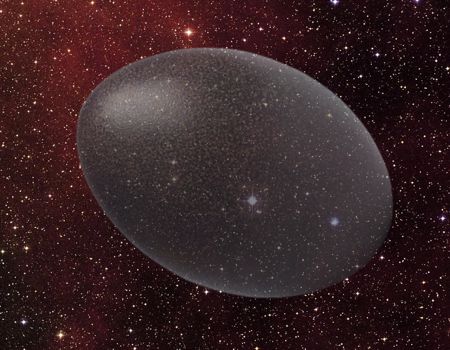
“Think bigger, Sy.  The galactic core is 26,000 lightyears away, but it’s the center of 700 billion solar masses.  I’ve run the numbers.  At Jim’s Oort-Cloud ‘edge’ the Galaxy’s field is 11% as strong as the Sun’s.  Tidal forces will pull the outer portion of the Cloud into an egg shape pointed to the center of the Milky Way.”

Jeremy’s agog.  “So the edge of the Solar System is 1,000 times further than Pluto?  Wow!”

“About.”

“Maybe.”

~~ Rich Olcott
Water, Water Everywhere — How Come?

Lunch time, so I elbow my way past Feder and head for the elevator.  He keeps peppering me with questions.

“Was Einstein ever wrong?”

“Sure. His equations pointed the way to black holes but he thought the Universe couldn’t pack that much mass into that small a space.  It could.  There are other cases.”

We’re on the elevator and I punch 2.  “Where you going?  I ain’t done yet.”

“Down to Eddie’s Pizza.  You’re buying.”

“Awright, long as I get my answers.  Next one — if the force pulling an electron toward a nucleus goes as 1/r², when it gets to where r=0 won’t it get stuck there by the infinite force?”

“No, because at very short distances you can’t use that simple force law.  The electron’s quantum wave properties dominate and the charge is a spread-out blur.”

The elevator stops at 7.  Cathleen and a couple of her Astronomy students get on, but Feder just peppers on.  “So I read that everywhere we look in the Solar System there’s water.  How come?”

I look over at Cathleen.  “This is Mr Richard Feder of Fort Lee, NJ.  He’s got questions.  Care to take this one?  He’s buying the pizza.”

“Well, in that case.  It all starts with alpha particles, Mr Feder.”

The elevator door opens on 2, we march into Eddie’s, order and find a table.  “What’s an alpha particle and what’s that got to do with water?”

Alpha particle
Two protons and two neutrons, assembled as an alpha particle

“An alpha particle’s a fragment of nuclear material that contains two protons and two neutrons.  99.999% of all helium atoms have an alpha particle for a nucleus, but alphas are so stable relative to other possible combinations that when heavy atoms get indigestion they usually burp alpha particles.”

“And the water part?”

“That goes back to where our atoms come from — all our atoms, but in particular our hydrogen and oxygen.  Hydrogen’s the simplest atom, just a proton in its nucleus.  That was virtually the only kind of nucleus right after the Big Bang, and it’s still the most common kind.  The first generation of stars got their energy by fusing hydrogen nuclei to make helium.  Even now, that’s true for stars about the size of the Sun or smaller.  More massive stars support hotter processes that can make heavier elements.  Umm, Maria, do you have your class notes from last Tuesday?”

“Yes, Professor.”

“Please show Mr Feder that chart of the most abundant elements in the Universe.  Do you see any patterns in the second and fourth columns, Mr Feder?”

Element Atomic number Mass % *103 Atomic weight Atom % *103
Hydrogen 1 73,900 1 92,351
Helium 2 24,000 4 7,500
Oxygen 8 1,040 16 81
Carbon 6 460 12 48
Neon 10 134 20 8
Iron 26 109 56 2
Nitrogen 7 96 14 <1
Silicon 14 65 32 <1

“Hmm…  I’m gonna skip hydrogen, OK?  All the rest except nitrogen have an even atomic number, and all of ’em except nitrogen the atomic weight is a multiple of four.”

“Bravo, Mr Feder.  You’ve distinguished between two of the primary reaction paths that larger stars use to generate energy.  The alpha ladder starts with carbon-12 and adds one alpha particle after another to go from oxygen-16 on up to iron-56.  The CNO cycle starts with carbon-12 and builds alphas from hydrogens but a slow step in the cycle creates nitrogen-14.”

“Where’s the carbon-12 come from?”

“That’s the third process, triple alpha.  If three alphas with enough kinetic energy meet up within a ridiculously short time interval, you get a carbon-12.  That mostly happens only while a star’s going nova, simultaneously collapsing its interior and spraying most of its hydrogen, helium, carbon and whatever out into space where it can be picked up by neighboring stars.”

“Where’s the water?”

“Part of the whatever is oxygen-16 atoms.  What would a lonely oxygen atom do, floating around out there?  Look at Maria’s table.  Odds are the first couple of atoms it runs across will be hydrogens to link up with.  Presto!  H2O, water in astronomical quantities.  The carbon atoms can make methane, CH4; the nitrogens can make ammonia, NH3; and then photons from Momma star or somewhere can help drive chemical reactions  between those molecules.”

“You’re saying that the water astronomers find on the planets and moons and comets comes from alpha particles inside stars?”

“We’re star dust, Mr Feder.”

~~ Rich Olcott

Teena Meets The Eclipses

“Don’t look up until it suddenly gets really dark, Teena.  I’ll tell you when it’s time.”

“OK, Uncle Sy.  Oooo, look at the house where our tree makes a shadow!  It’s all over crescents!”

“Yep, wherever leaves overlap to make a pinhole, it’s like the one we made in our cardboard.  See, those crescents are just like the one our pinhole beams onto the sidewalk.”

“Yeah.  ‘Cause it’s the same Sun, right?”

“Sure is.”

“Are other little kids seeing the eclipse all over the world?  They’ve got the same Sun, too.”

“No, just the ones who happen to be on the shadow stripe that the Moon paints on the Earth.”

“How many kids is that?”

“Hard to tell.  Some families live where the shadow passes through, some families travel to be there, lots of other families just stay where they are.  No-one knows how many of each.  But we can make some not-very-good guesses.”

“The crescent’s going so slow.  Let’s make guesses while we’re waiting.”

“OK.  Let’s start by imagining that all the world’s people are spread evenly over the land and sea.”

“Even on the ocean?  Like everyone has a little boat?”

“Yep, and sleds or whatever on polar ice, people everywhere.  In our city there are eight blocks to a mile, so if we spread out the people there’d be one person every other block.”

“Every other block.  Like just on the black squares on our checker board.”

“Uh-huh.  The Moon’s shadow today will be a circle about 80 miles across and it’ll travel about 2500 miles across the whole country.  The stripe it paints would cover about 6½ million spread-out people.  Maybe 10 million if you count the people in little boats, ’cause the eclipse starts and ends over the ocean.”Local eclipses

“Lots of people.”

“Yes, but only about one person out of every thousand people in the world.”

“We’re pretty lucky then, huh?”

“Oh, yeah.”

“Are there eclipses on other planets?”

“Of a sort, but only for planets that have a moon.  Poor Mercury and Venus don’t have moons so they never see an eclipse.”

“Aww. … Wait — you said ‘of a sort.’  Are there different kinds of eclipses?”

“You’re very alert this morning.  And yes, there are.  Two that get the publicity and two that we never see on Earth.  It has to do with perspective.”

“Per … perspec…?”

“Perspective.  The word originally meant very careful looking but it’s come to be about how things look from a particular point of view.  See that tree across the street?”

“Yeah.”

“Think your hand is bigger than the tree?”

“Of course not.  I climb that tree.”

“OK, put your hand between your eyes and the tree.”

“Oh!  My hand covers the whole tree!”

“Yup.  Nearer things look big and farther things look small.  That’s perspective.  Eclipses are all about perspective.”How big is the Sun

“How come?”

“The perspective principle works in the Solar System, too.  If you were to travel from Earth to Mars to Jupiter and so on, the Sun would look smaller at each planet.”

“Like the far-away trees look smaller than the close trees.  But what does that have to do with eclipses?”

“A planet gets an eclipse when one of its moons comes between it and the Sun.  That’s what’s happening right now here.  Our Moon is moving between us and the Sun and blocking its light.”

“But I don’t see the Moon, just the carved-out piece.”

“That’s because we’re looking at the unlit side of the Moon.  It’s so dim compared to the rest of the sky.  Anyway, the Moon’s width we see is just about the same as the Sun’s width.  The moons on the other planets don’t match up that well.  On Mars, for instance, its moon Phobos appears less than half the width of the Sun even though the Sun appears only 2/3 as wide as we see it.  Phobos can never cover the Sun entirely, so no true eclipse, just a transit.”

“Can the planet’s moon be bigger?”

“Sure.  On Jupiter, Europa’s width completely blocks out the Sun.  That’s called an occultation.  You can look up now.  Jupiter people can never see that corona.”

“Oooooo, so pretty.  We’re lucky, aren’t we?”

“In more ways than you know, sweetie.”

~~ Rich Olcott

Twinkle, Twinkle, Tabby’s Star

Al was carrying his coffee pot past our table.  “Refills?  Hey, I heard you guys talking about Tabby’s Star.  Have you seen the latest?”

“Ohmigawd, there’s more?”

“Yeah, Cathleen.  They’ve finally found something that’s periodic.”

“Catch us up, Al.  Cathleen said that the dimmings are irregular.”

“They’ve been, Sy.  But remember Cathleen’s chart that showed big dips in 2011 and 2013, about 750 days apart?  Well, guess what?”

“They’ve seen more dips at 750-day intervals, in 2015 and 2017.”

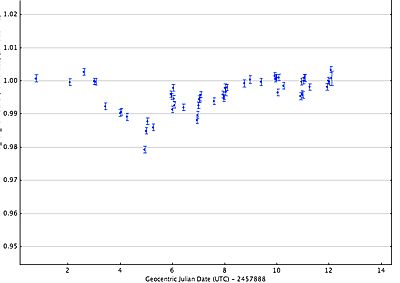
“Well, not quite.  Nobody was looking in 2015.  But Kickstarter funding let the team buy observing time in 2017.  A dip came in right on schedule.  Here’s the picture. [shows smartphone around]”

WTF 2017 peak after day 5
Visible-light photometry of Tabby’s Star
14-28 May 2017
Image from Dr Boyajian’s blog

Cathleen snorted.  “Damn shame we need crowd-funding to support Science these days.”

“True,” I agreed, “but the good news is that the support is there.  Suddenly you’re scribbling on the back of that envelope.  So what does this chart tell us?”

“I’m sure every astronomer out there will tell you, ‘It’s too soon to say anything for sure.‘  This is raw data, which means it’s hasn’t gone through the usual clean-up process to account for instrumental issues, long-term trending, things like that.  The timing is great, though.  The bottom of this dip is at 18May2017.  The first dip bottomed out 2267 days earlier on 4March2011.  Counting the 2015 case that no-one saw, there’d be three intervals from first to most recent.  2267÷3 makes the average 756 days.  Add 756 to the first date and we’re at 28Mar2013, right in the midst of that year’s complex mess.  It does fit together.”

“So whatever’s causing it has a 756-day orbit?”

“Could be.  I know your next question.  If the eclipsing material were in our Solar System, it’d be a bit outside the 687-day orbit of Mars.  But we’ve already ruled out causes near our solar system.  Tabby’s Star is about 1½ times our Sun’s mass.  That 756-day orbit around Tabby, if it is one, is maybe 30% wider than the orbit of Mars.  But.”

[both] “But?”

“But the dip profiles don’t match up from one cycle to the next.  This dip’s only 2% or so, a tenth of the ones in 2011 and 2013.  Of course, the 2013 event spanned multiple dips so Heaven knows which one we should match to.  Even 2011 and 2017 don’t look the same.  The usual quick-and-dirty way to compare dips is to pair up widths at half depth.  That statistic for 2011 is about a day.  This one is twice that or more.  If the absorber is orbiting the star, it’s changing shape and can’t be a planet.”Tabby in orbit
“So what do we got, Sy?”

“Damifino, Al.  Everything Cathleen just told us points to something like an enormous comet loaded with loose rocks that go flying along random paths away from the star.”

“Sorry, Sy, the infrared data rules out the comet dust that would have to be spewed out along with the rocks.  Besides, someone calculated just how much rocky material would be required to reproduce the dimming we’ve seen already.  You’d need a ‘comet’ somewhere between Earth-size and Jupiter-size, and maybe more than one, and with that much mass the rocks wouldn’t fly apart very well.  Oh, and there’s that long-term fading, which the comet idea doesn’t account for.”

“So we’re down to…”

[sigh] “The explanation of last resort, which astronomers are very reluctant to talk about because journalists tend to go overboard.  Maybe, just maybe, we’re witnessing an advanced civilization at work, constructing a Dyson sphere around a star 1500 light years away.  People have talked about such things for decades.  Think about it — the Sun sends out light in all directions.  Earth intercepts only a billionth of that.  If we could completely surround the Sun with solar panels we’d have access to a billion times more energy than if we covered our own planet with panels.  Better yet, it’s all renewable and producing 24 hours a day.  But even with advanced technology, panels around Tabby’s Star would still radiate in the infrared and we don’t see that.”

My smartphone chirped that same odd ringtone and it was that same odd number, 710-555-1701. “Hello, Ms Baird.”

“The Universe is not only stranger than you imagine, Mr Moire, it’s stranger than you can imagine.”

~~ Rich Olcott

Tabby’s Star — Weird Or Really Weird?

I needed some time to mull over what Cathleen had told me about Tabby’s Star, so I went to the counter to replenish our coffee and scones. When I returned I said, “OK, let’s recap.  Dr Boyajian’s Planet Hunters citizen scientists found a star that dims oddly.  But I understand there’s lots of variable stars out there.  What’s so special about this one that the SETI project got interested?”

“There’s variable stars and variable stars, but this one shouldn’t vary.  Look, one of the triumphs of 20th-century science is that we pretty much understand how stars work.  You tell me a handful of a star’s properties, things like radius, surface temperature, iron/hydrogen ratio, a couple more, and I can give you its whole life story from light-up to nova.  We’ve catalogued about 70,000 variable stars.  Virtually all of them do episodic brightening — pulsating or flaring up.  There’s about a hundred that dim more or less regularly, but they’re supergiants with cool, sooty atmospheres.  Tabby’s Star is a flat-out normal F-type main sequence star, about 1½ times the Sun’s mass and a little bit warmer.  Like the clean-cut kid next door — no reason to expect trouble from it.”

“So if it’s not the star itself that’s dimming, then something must be getting between it and us.”

“Well, yeah.  The question is what.  There’s so many theories that one pair of authors wrote a 15-page paper just classifying and rating them.”

“Gimme a few.”
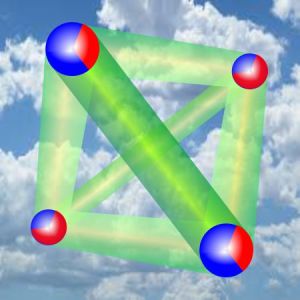
Multi-Tabby Star

“Clouds of interstellar dust, for starters.  Sodium’s sparse in stars and the interstellar medium, but it’s got two easily recognized strong absorption lines in the yellow part of the visible spectrum.  Tabby’s sodium lines are broad and weak like you’d expect in a star’s atmosphere, but in the data they’re overlain by sharp, intense absorption peaks that can only come from sodium-bearing gas or dust in the nine-quadrillion-mile journey from there to here.  So there’s dispersed matter in the line of sight, but it can account for at most 35% of the dimming.  Furthermore, an interstellar cloud would have a hard time maintaining structures small enough to produce the sharp dim-and-recover pattern Boyajian found.  Loosely-bound stuff like dust clouds and gas tends to smear out in space.”

“How about comets, or rings, or clumps of asteroids orbiting the star?”

“There’s evidence against all those, but I guess I haven’t mentioned it yet.  You’ve seen the heat lamps over Eddie’s pizza bar?”

“Sure.  Infrared radiation heats things up.”

“And warm things give off infrared radiation.  ‘Warm’ meaning anything above absolute zero.  Better yet, there’s a well-known relation between an object’s temperature and its infrared spectrum.  Rocks or dust anywhere near the star would absorb energy from whatever kind of light and re-radiate it as heat infrared we could see.  The spectrum would show more infrared than you’d expect from the star itself.  And there isn’t any extra infrared.”

“None?”

“Not so’s our technology can detect.  If there’s any there, it’s less than 0.2% of the total coming from the star, nowhere near enough to account for those 8%, 16% and 22% dips.  So no, no comets or rings or asteroid clumps orbiting Tabby’s Star.”

“How about something orbiting our Sun, way far out where we’ve not found it yet?”

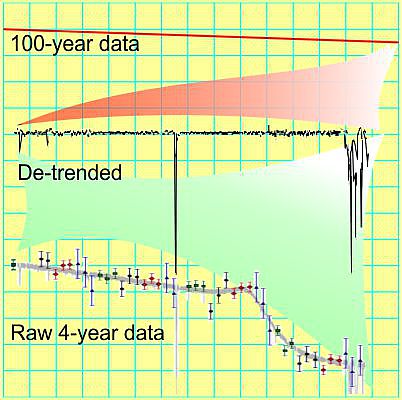
“Any light-blocking object near us, like maybe in the Oort Cloud that sends us long-term comets, should produce the same sort of weirdness from Tabby’s near neighbors.  We don’t see that.  One astronomer studied a star only 25 arc-seconds away — steady as a rock.  So whatever’s causing the dimming is probably close to Tabby’s star.  Oh, wait, here’s one more weirdness.  I just saw a report…” [twiddles on tablet] “Yeah, here it is.  Check out this chart.”Dimming montage“You’ll have to unravel that for me.”

“Sure.  The Planet Hunter team was looking for transits, which generally take at most a few days, so the Kepler science team filtered out slow variations before passing the data along.  After Boyajian’s report came out, two Keplerians looked back at the raw data.  I told you about the 3-6% dimming (estimates vary) since 1890.  The raw Kepler data show a 3% drop in four years!”

“I’m starting to think about Dyson Spheres and Larry Niven’s Ringworld.”

“Now you know why SETI got excited.”

~~ Rich Olcott

The Weirdest, And Naughtiest, Star in The Galaxy

It was an interesting ringtone — aggressive but feminine, with a hint of desperation.  And it was a ringtone I hadn’t programmed into my phone.  The number was intriguing, too — 710-555-1701.  It didn’t add up, so I answered the ring. “Moire here.”

“Hello, Mr Moire, this is Victoria Baird.”

It’s been a long time, Ms Baird.  What can I do for you?”  Her voice and the memory of her pointed ears sent chills down my spine.

“This time it’s what I can do for you, Mr Moire.  Here’s a tip — Tabby’s star.”  I could hear the italics.  I wanted to ask questions but the line went dead.

Considering the context, I called my Astronomy Department source.  “Morning, Cathleen.  It’s break time, can I buy you some of Al’s coffee and a scone?”

“You’re going to ask me questions, aren’t you?  What am I going to have to bone up on?  I know, it’s Tabby’s Star, right?”

“Got it in one, Cathleen.  Meet you at Al’s?”

“Yeah, give me 15 minutes.”Tabbystar 400

A quarter-hour later we had a table, two mugs of coffee and a plate of scones in front of us.  “So how’d you know I’d be asking about Tabby’s star?  And what is it?  And who is Tabby?”

“Tabby is Tabetha (she spells it with an ‘e’) Boyajian, PhD.  She teaches Astronomy at Louisiana State, does research specializing in high-precision star measurement.  In her spare time she manages a citizen-scientist project called Planet Hunters.  The Hunters get their kicks combing through databases from the Kepler satellite telescope.  They get all excited if the records indicate that a star’s been transited.”

“Oh, like that star-dimming that found the TRAPPIST-1 planets?”

“Exactly.  I think they’ve got over a hundred candidate planetary systems and a couple-dozen confirmed ones to their credit by now.  Anyhow, 2012 was a banner year for them, ’cause they raised an alert on what’s now being called the weirdest star in the galaxy.”

“Which would be Tabby’s Star.  Got it.  But what’s weird about it?”

“Poets like to write about ‘the constant stars.’  This star is world-champion not-constant.  You know how stars seem to flicker when you look at them?”

“Yeah, that’s how I tell them apart from planets.”

“Then you know that the flickering comes from starlight getting messed up going through our turbulent atmosphere.  Astronauts don’t see the flickering.  Neither does Kepler up there, so it can reliably detect miniscule variations in a star’s output.  Virtually all of the 150,000 stars it tracked for four years had rock-steady production.  A few of them occasionally dimmed or flared by maybe a percent, but Tabby’s Star (formally known as KIC 8462852) got the Hunters’ attention when it dimmed by 16%.”

“Twenty times a normal dimming!  Did it stay that way or did the light come back up again?”

“Oh, it came back all right, but the curve on the way up didn’t match the curve on the way down.  That was even weirder.  So the team scoured through the star’s 4-year record and found a dozen events on the 0.05-2% scale, plus one at 8% and another at 21%.”

“21%?  That’s a big shadow.”

“Ya think?  Especially since the between-event timing was seriously irregular and some of those events were complex with three or more separate components.  But that’s not all the weirdness. Those dips lasted for hours or even days, longer than most planetary transits.  After Boyajian and her 48 collaborators published their initial report, which has to have one of the naughtiest titles in the astronomical literature, some other —”

“Wait, a naughty title?  C’mon, don’t tease.”

“OK <sigh>.  The technical term for a star’s light output is flux.  That paper was half about the observations and half about what might be causing the variation.  Assuming the star’s real output is constant, the question becomes, ‘What happened to that missing light?‘  Or as the authors put it, ‘Where’s The Flux?‘  Since then both the paper and the star have been informally referred to as WTF.  OK?”

“OK <sigh>.  So you were saying there’s something else.”

“Yeah.  Some other astronomers went digging in the archives.  WTF has been dimming gradually for at least the past 100 years.  Weird, eh?”

“Yeah.  So what’s causing it?”

“We don’t even have good guesses.”

~~ Rich Olcott

Gozer, The Stay Puft Black Hole

We’re downstairs at Eddie’s Pizza.  Vinnie orders his usual pepperoni.  In memory of Sam Panapoulos, I order a Hawaiian.  Then we’re back to talking black holes.

“I been thinking, Sy.  These regular-size black holes, the ones close to the Sun’s mass, we got a lot of ’em?”

“I’ve seen an estimate of 50,000 in the Milky Way Galaxy so you could say they’re common.  That’s one way to look at it.  The other way is to compare 50,000 with the 250 billion stars in the galaxy.  One out of 5,000,000 is a black hole, so they’re rare.  Your choice, Vinnie.”

“But all three confirmed LIGO signals were the next bigger size range, maybe 10 to 30 solar masses; two of ’em hittin’ each other and they’ve all been more than a billion lightyears away.  How come LIGO doesn’t see the little guys that are close to us?”

“Darn good question.  Lessee… OK, I’ve got several possibilities.  Maybe the close-in little guys do collide, but the signal’s too weak for us to detect.  But we can put numbers to that.  In each LIGO event we’ve seen, the collision released about 10% of their 40-to-60-Sun total mass-energy in the form of gravitational waves.  LIGO’s just barely able to detect that, right?”

“They were excited they could, yeah.”

“So if a pair of little-guy black holes collided they’d release about 10% of two makes 0.2 solar masses worth of energy.  That’d be way below our detection threshold if the collision is a billion light-years away.  But we’re asking about collisions inside the Milky Way.  Suppose the collision happened near the center, about 26,000 lightyears from us.  Signal strength grows as the square of how close the source is, so multiply that ‘too weak to detect’ wave by (1 billion/26000)² =15×1012, fifteen quadrillion.  LIGO’d be deafened by a signal that strong.”

“But LIGO’s OK, so we can rule that out.  Next guess.”

“Maybe the signal’s coming in at the wrong frequency.  The equations say that just before a big-guy collision the two objects circle each other hundreds of times a second.  That frequency is in the lower portion of the 20-20,000 cycles-per-second human audio range.  LIGO’s instrumentation was tuned to pick up gravitational waves between 30 and 7,000.  Sure enough, LIGO recorded chirps that were heard around the world.”

“So what frequency should LIGO be tuned to to pick up little-guy collisions?”

“We can put numbers to that, too.  Physics says that at a given orbit radius, revolution frequency varies inversely with the square root of the mass.   The big-guy collisions generated chirps between 100 and 400 cps.  Little guy frequencies would be f2/f50=√(50/2)=5 times higher, between 500 and 2000 cps.  Well within LIGO’s range.”

“We don’t hear those tweets so that idea’s out, too.  What’s your third try?”

“Actually I like this one best.  Maybe the little guys just don’t collide.”

“Why would you like that one?”

“Because maybe it’s telling us something.  It could be that they don’t collide simply because they’re surrounded by so many other stars that they never meet up.  But it also could be that binary black holes, the ones that are fated to collide with each other, are the only ones that can grow beyond 10 solar masses.  And I’ve got a guess about how that could happen.”

“Alright, give.”

“Let’s start with how to grow a big guy.  Upstairs we talked about making little guys.  When a star’s core uses up one fuel, like hydrogen, there’s an explosive collapse that sets off a hotter fuel, like helium, until you get to iron which doesn’t play.  At each step, unburnt fuel outside the core gets blown away.  If the final core’s mass is greater than about three times the Sun’s you wind up with a black hole.  But how about if you don’t run out of fuel?”

“How can that happen?  The star’s got what it’s got.”Binary protoBHs

“Not if it’s got close neighbors that also expel unburnt fuel in their own burn-collapse cycles.  Grab their cast-off fuel and your core can get heavier before you do your next collapse.  Not impossible in a binary or cluster where all the stars are roughly the same age.  Visualize kids tossing marshmallows into each other’s mouths.”

“Or paying for each other’s pizzas.  And it’s your turn.”

~~ Rich Olcott

Prelude to A Waltz

An excited knock, but one I recognize.  In comes Vinnie, waving his fresh copy of The New York Times.

LIGO‘s done it again!  They’ve seen another black hole collision!”

“Yeah, Vinnie, I’ve read the Abbott-and-a-thousand paper.  Three catastrophic collisions detected in less than two years.  The Universe is starting to look like a pretty busy place, isn’t it?”

“And they all involve really big black holes — 15, 20, even 30 times heavier than the Sun.  Didn’t you once say black holes that size couldn’t exist?”

“Well, apparently they do.  Of course the physicists are busily theorizing how that can happen.  What do you know about how stars work, Vinnie?”

“They get energy from fusing hydrogen atoms to make helium atoms.”

“So far, so good, but then what happens when the hydrogen’s used up?”

“They go out, I guess.”

“Oh, it’s a lot more exciting than that. Does the fusion reaction happen everywhere in the star?”

“I woulda said, ‘Yes,’ but since you’re asking I’ll bet the answer is,  ‘No.'”

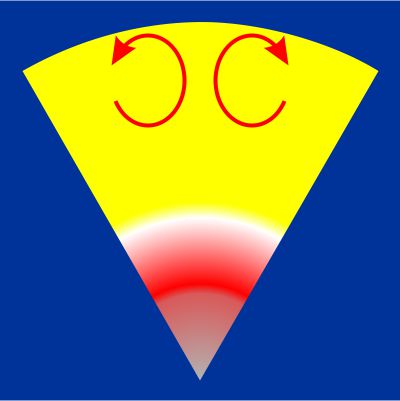
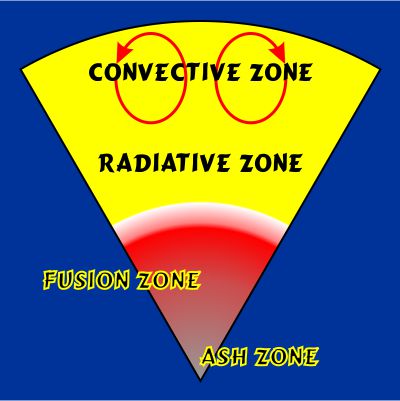
“Properly suspicious, and you’re right.  It takes a lot of heat and pressure to force a couple of positive nuclei close enough to fuse together despite charge repulsion.  Pressures near the outer layers are way too low for that.  For our Sun, for instance, you need to be 70% of the way to the center before fusion really kicks in.  So you’ve got radiation pressure from the fusion pushing everything outward and gravity pulling everything toward the center.  But what’s down there?  Here’s a hint — hydrogen’s atomic weight is 1, helium’s is 4.”

“You’re telling me that the heavier atoms sink to the center?”

“I am.”

“So the center builds up a lot of helium.  Oh, wait, helium atoms got two protons in there so it’s got to be harder to mash them together than mashing hydrogens, right?”Star zones
“And that’s why that region’s marked ash zone in this sketch.  Wherever conditions are right for hydrogen fusion, helium’s basically inert.  Like ash in a campfire it just sinks out of the way.  Now the fire goes out.  What would you expect next?”

“Radiation pressure’s gone but gravity’s still there … everything must slam inwards.”

Slam is an excellent word choice, even though the star’s radius is measured in thousands of miles.  What’s the slam going to do to the helium atoms?”

“Is it strong enough to start helium fusion?”

“That’s where I’m going.  The star starts fusing helium at its core.  That’s a much hotter reaction than hydrogen’s.  When convective zone hydrogen that’s still falling inward meets fresh outbound radiation pressure, most of the hydrogen gets blasted away.”

“Fusing helium – that’s a new one on me.  What’s that make?”

“Carbon and oxygen, mostly.  They’re as inert during the helium-fusion phase as helium was when hydrogen was doing its thing.”

“So will the star do another nova cycle?”

“Maybe.  Depends on the core’s mass.  Its gravity may not be intense enough to fuse helium’s ashes.  In that case you wind up with a white dwarf, which just sits there cooling off for billions of years.  That’s what the Sun will do.”

“But suppose the star’s heavy enough to burn those ashes…”

“The core’s fresh light-up blows away infalling convective zone material.  The core makes even heavier atoms.  Given enough fuel, the sequence repeats, cycling faster and faster until it gets to iron.  At each stage the star has less mass than before its explosion but the residual core is more dense and its gravity field is more intense.  The process may stop at a neutron star, but if there was enough fuel to start with, you get a black hole.”

“That’s the theory that accounts for the Sun-size black holes?”

“Pretty much.  I’ve left out lots of details, of course.  But it doesn’t account for black holes the size of 30 Suns — really big stars go supernova and throw away so much of their mass they miss the black-hole sweet spot and terminate as a neutron star or white dwarf.  That’s where the new LIGO observation comes in.  It may have clued us in on how those big guys happen.”

“That sketch looks like a pizza slice.”

“You’re thinking dinner, right?”

“Yeah, and it’s your turn to buy.”

~~ Rich Olcott

The Luck o’ The (insert nationality here)

“Afternoon, Al.  What’s the ruckus in the back room?”

“Afternoon, Sy.  That’s the Astronomy crew and their weekly post-seminar coffee-and-critique session.  This time, though, they brought their own beer.  You know I don’t have a beer license, just coffee, right?  Could you go over there and tell ’em to keep it covered so I don’t get busted?”

“Sure, Al.  … Afternoon, folks.  What’s all the happy?”

“Hey, Sy, welcome to the party.  Trappist beer, straight from Belgium!”

“Don’t mind if I do, Cathleen, but Al sure would like for you to put that carton under the table.  Makes him nervous.”

“Sure, no problem.”

“Thanks.  I gather your seminar was about the new seven-planet system.  How in the world do the Trappists connect to that story?”

“Patriotism.  The find was announced by a team from Belgium’s University of Liege.  They’ve built a pair of robotic telescopes tailored for seeking out rocks and comets local to our Solar System.  Exoplanets, too.  Astronomers love tying catchy acronyms to their projects.  This group’s proudly Belgian so they called their robots TRAnsiting Planets and Planetesimals Small Telescopes, ergo TRAPPIST, to honor the country’s 14 monasteries.  And their beer.  Mainly the beer, I’ll bet.”

“So the planets are a Belgian discovery?”

“Well, the lead investigator, Michaël Gillon, is at Liege, and so are half-a-dozen of his collaborators.  Their initial funding came from the Belgian government.  But by the time the second paper came out, the one that claimed a full seven planets spanning a new flavor of Goldilocks Zone, they’d pulled in support and telescope time from over a dozen other countries — USA, India, UK, France, Morocco, Saudi Arabia… the list goes on.  So it’s Belgian mostly but not only.”

“I love international science.  Next question — I see the planets are listed as TRAPPIST-1b, TRAPPIST-1c, and so on up to TRAPPIST-1h.  What happened to TRAPPIST-1a?”

“Rules of nomenclature, Sy.  TRAPPIST-1a is the star itself.  Actually, the star already had a formal name, which I just happen to have written down in my seminar notes somewhere … here it is, 2MASS J23062928 – 0502285.  You can see why TRAPPIST-1 is more popular.”

“I’m not even going to ask how that other name unwinds.  So what was the seminar topic this week?”

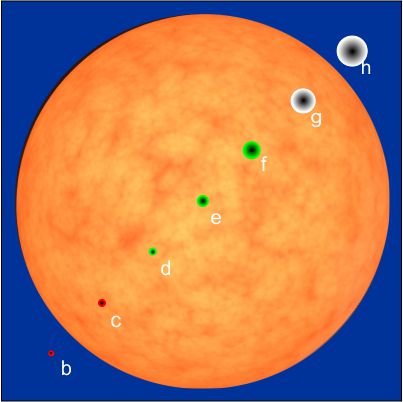
7 planets
TRAPPIST-1’s planets,
drawn to scale against their star. The
green ones are in the Goldilocks Zone.

“The low probability for us ever noticing those planets blocking the star’s light.”

“I’d think seeing a star winking on and off like it’s sending Morse code would attract attention.”

“That’s not close to what it was doing.  It’s all about the scale.  You know those cartoons that show planets together with their host sun?”

(showing her my smartphone) “Like this one?”

“Yeah.  It’s a lie.”

“How is it lying?”

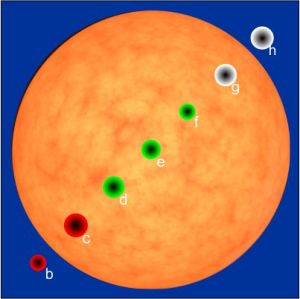
“It pretends they’re all right next to the star.   7 planets perspectiveThis image is a little better.”  (showing me her phone)  “This artist at least tried to build in some perspective.  Even in this tiny solar system, about 1/500 the radius of ours, the star’s distance to each planet is hundreds to a thousand times the size of the planet.  You just can’t show planets AND their orbits together in a linear diagram.  Now, think about how small these planets are compared to their sun.”

“Aaaa-hah!   When there’s an eclipse, only a small fraction of the light is blocked.”

“That’s part of it.  Each eclipse (we call them transits) dims the measured brightness by only a percent or so.  But it’s worse than that.”

eclipses“How so?”

“All those orbits lie in a single plane.  We can’t see the transits unless our position lines up with that plane.  If we’re as little as 1½° out of the plane, we miss them.  But it’s worse than that.”

“How so?”

“During a transit, each planet casts a conical shadow that defines a patch in TRAPPIST-1’s sky.  You can tile TRAPPIST-1’s sky with about 150,000  patches that size.  There’s one chance in 150,000 of being in the right patch to see that 1% dimming.  In our sky there are over 6×10¹⁵ patches the size of TRAPPIST-1h’s orbit.  The team had to inspect the just right patch to find it.”

“With odds like that, no wonder TRAPPIST uses robots.”

“Yep.”

~~ Rich Olcott

The New System’s in Tune

<We interrupt our running story line to bring you this important development…>

“Morning, Sy.  What can I get you?”

“My usual mugfull of black, Al.  What’s the Scone-of-The-Day?”

“I’m calling this The Trappist.  It’s got raspberry jam!”

“Why that name?”

“In honor of TRAPPIST-1, you know, that star they just found a bunch of planets around.”

“Your coffee shop being right next to the Astronomy building, I guess you’ve heard a lot about it.”

“Sy, you couldn’t believe.  The planetologists are going nuts of course, even though no-one’s actually seen the planets, and the astrometrics folks are lining up for telescope time ’cause they’ve got a whole new class of stars to monitor and of course the astrophysicists get to figure out how the system even works.”

“Astrometrics folks?  New class of stars?”

“Yeah, the high-precision star-measurers.  They didn’t used to pay attention to the small, dim stars because why bother.  But now … woo-hoo, whole new ballgame.”

“Nobody’s seen those planets?  How do they know they’re there?”

“Process of elimination, Sy.  The TRAPPIST telescopes picked up repetitive dark blips in the light coming from that star.  It’s a close, fast-moving star so there’s no sense supposing it’s like going behind or in front of a regular array of rocks or stars or something.  It’s not wobbling side-to-side like it would if it was a binary so it’s not traveling along with another star.  If the blips were sunspots going around as the star rotates there’d be only one rhythm, but these blips come in too complicated for that.  Besides, the star’s low-activity, too cool for lotsa sunspots.  Gotta be planets eclipsing it.”

trappist-1-system-450
NASA’s artistic (and cute) rendition
of the TRAPPIST-1 system
Note the close-in steam and the frost further out

“Sounds pretty good, but…”

“Hey Sy, there was something else, maybe you could explain it.  One astrophysics guy was real impressed that the planets had residences.  I didn’t understand that.”

“Residences?  That’s a new one on me.”

“Had something to do with the blip periods.  Yeah, here’s the paper napkin he wrote ’em all down on.”

Object
TRAPPIST-1x
Period, days
Resonance
Actual /
Expected
b
1.51
c
2.42
5c:8b
1.002
d
4.05
3d:5c
1.004
e
6.10
2e:3d
1.004
f
9.20
2f:3e
1.006
g
12.35
3g:4f
1.007
h
20?
5h:8g
1.012?

“Oh, resonances! That I recognize, and yeah, those numbers are much more convincing.  Remember my post about gear logic?”

“Sorry, Sy, that must’ve been a long time ago and who has time to read?”

“I understand.  OK, that post explained how planets that survive the early chaos of a forming solar system tend to wind up in orbits whose relative year-lengths form ratios of small whole numbers.  In our system, for instance, the length of Pluto’s year is exactly 3/2 of Neptune’s, Neptune’s year is twice that of Uranus, and so on.  If a planet doesn’t synch up with its neighbors, it’ll collide with someone or be flung out of the system.  Put another way, a system’s not stable if its planetary orbit periods are just any old numbers.  Make sense?”

“I suppose, so…?”

“So look at this guy’s table.  The periods of each pair of adjacent objects follow that rule almost exactly.  Five times c‘s period is less than 0.25% away from eight times b‘s, and so on all the way out to h, which I take it has an uncertain period because the guy put in that question mark.  In fact, I think this system follows the rule more tightly than our Solar System does.  As far as I’m concerned that regularity in the periods makes the case for TRAPPIST-1 having planets.  You hear anything else?”

“Yeah, there was a lot of excitement about the middle three planets being in some kind of Goldilocks zone.  What’s that about?”

“Hah, I’d be excited, too.  If a planet’s too close to the star, like Mercury is to ours, it’ll be too hot for liquid water.  If the planet’s too far, any water it has would be frozen stiff.  Either way, not good for life to grow there.  In the Goldilocks zone, it’s…”

“Just right, huh, Sy?”

“On the nose, Al.  I’m going to have to read up on TRAPPIST-1.”

~~ Rich Olcott