Beyond The Shadow of A…?

“Alright, Vinnie, what’s the rest of it?”

“The rest of what, Sy?”

“You wouldn’t have hauled that kid’s toy into Al’s shop here just to play spitballs with it. You’re building up to something and what is it?”

“My black hole hobby, Sy. The things’re just a few miles wide but pack more mass than the Sun. A couple of my magazines say they give off jets top and bottom because of how they spin. That just don’t fit. The stuff ought to come straight out to the sides like the paper wads did.”

“Well, umm… Ah. You know the planet Saturn.”

“Sure.”

“Are its rings part of the planet?”

“No, of course not, they go around it. I even seen an article about how the rings probably came from a couple of collided moons and how water from the Enceladus moon may be part of the outside ring. Only thing Saturn does for the rings is supply gravity to keep ’em there.”

“But our eyes see planet and rings together as a single dot of light in the sky. As far as the rest of the Solar System cares, Saturn consists of that big cloudy ball of hydrogen and the rings and all 82 of its moons, so far. Once you get a few light-seconds away, the whole collection acts as a simple point-source of gravitational attraction.”

“I see where you’re going. You’re gonna say a black hole’s more than just its event horizon and whatever it’s hiding inside there.”

“Yup. That ‘few miles wide’ — I could make a case that you’re off by trillions. A black hole’s a complicated beast when we look at it close up.”
“How can you look at a thing like that close up?”

“Math, mostly, but the observations are getting better. Have you seen the Event Horizon Telescope’s orange ring picture?”

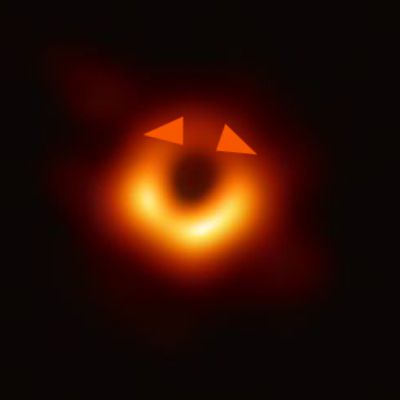
“You mean the one that Al messed with and posted for Hallowe’en? It’s over there behind his cash register. What’s it about, anyway?”

“It’s an image of M87*, the super-massive black hole at the center of the M87 galaxy. Not the event horizon itself, of course, that’s black. The orange portion actually represents millimeter-radio waves that escape from the accretion disk circling the event horizon. The innermost part of the disk is rotating around the hole at near-lightspeed. The arc at the bottom is brighter because that’s the part coming toward us. The photons get a little extra boost from Special Relativity.”

Frames again?”

“With black holes it’s always frames. You’ll love this. From the shell’s perspective, it spits out the same number of photons per second in every direction. From our perspective, time is stretched on the side rotating away from us so there’s fewer photons per one of our seconds and it’s dimmer. In the same amount of our time the side coming toward us emits more photons so it’s brighter. Neat demonstration, eh?”

“Cute. So the inner black part’s the hole ’cause it can’t give off light, right?”

“Not quite. That’s a shadow. Not a shadow of the event horizon itself, mind you, but of the photon sphere. That’s a shell about 1½ times the width of the event horizon. Any photon that passes exactly tangent to the sphere is doomed to orbit there forever. If the photon’s path is the slightest bit inward from that, the poor particle heads inward towards whatever’s in the center. The remaining photons travel paths that look bent to a distant observer, but the point is that they keep going and eventually someone like us could see them.”

“The shadow and the accretion disk, that’s what the EHT saw?”

“Not exactly.”

“There’s more?”

“Yeah. M87* is a spinning black hole, which is more complicated than one that’s sitting still. Wrapped around the photon sphere there’s an ergosphere, as much as three times wider than the event horizon except it’s pumpkin-shaped. The ergosphere’s widest at the rotational equator, but it closes in to meet the event horizon at the two poles. Anything bigger than a photon that crosses its boundary is condemned to join the spin parade, forever rotating in sync with the object’s spin.”

“When are you gonna get to the jets, Sy?”

~~ Rich Olcott

Dark Horizon

Charlie's table sign says "Dark Energy is bogus"

Change-me Charlie attacks his sign with a rag and a marker, rubbing out “Matter” and writing in “Energy.” Turns out his sign is a roll-up dry-erase display and he can update it on site. Cool. I guess with his rotating-topic strategy he needs that. “OK, maybe dark matter’s a thing, but dark energy ain’t. No evidence, someone just made that one up to get famous!”

And of course Physicist-in-training Newt comes back at him. “Lots of evidence. You know about the Universe expanding?”

“Prove it.” At least he’s consistent.

<sigh> “You know how no two snowflakes are exactly alike but they can come close? It applies to stars, too. Stars are fairly simple in a complicated way. If you tell me a star’s mass, age and how much iron it has, I can do a pretty good job of computing how bright it is, how hot it is, its past and future life history, all sort of things. As many stars as there are, we’re pretty much guaranteed that there’s a bunch of them with very similar fundamentals.”

“So?”

“So when a star undergoes a major change like becoming a white dwarf or a neutron star or switching from hydrogen fusion to burning something else, any other star that has the same fundamentals will behave pretty much the same way. They’d all flare with about the same luminosity, pulsate with about the same frequency —”

“Wait. Pulsate?”

“Yeah. You’ve seen campfires where one bit of flame coming out of a hotspot flares up and dies back and flares up and dies back and you get this pulsation —”

“Yeah. I figured that happens with a sappy log where the heat gasifies a little sap then the spot cools off when outside air gets pulled in then the cycle goes again.”

“That could be how it works, depending. Anyhow, a star in the verge of mode change can go through the same kind of process — burn one kind of atom in the core until heat expansion pushes fuel up out of the fusion zone; that cools things down until fuel floods back in and off we go again. The point is, that kind of behavior isn’t unique to a single star. We’ve known about variable stars for two centuries, but it wasn’t until 1908 that Henrietta Swan Leavitt told us how to determine a particular kind of variable star’s luminosity from its pulsation frequency.”

“Who cares?”

“Edwin Hubble cared. Brightness dies off with the distance squared. If you compare the star’s intrinsic luminosity with how bright the star appears here on Earth, it’s simple to calculate how far away the star is. Hubble did that for a couple dozen galaxies and showed they had to be far outside the Milky Way. He plotted red-shift velocity data against those distances and found that the farther away a galaxy is from us, the faster it’s flying away even further.”

“A couple dozen galaxies ain’t much.”

“That was for starters. Since the 1930s we’ve built a whole series of ‘standard candles,’ different kinds of objects whose luminosities we can convert to distances out to 400 million lightyears. They all agree that the Universe is expanding.”

“Well, you gotta expect that, everything going ballistic from the Big Bang.”

“They don’t go the steady speed you’re thinking. As we got better at making really long-distance measurements, we learned that the expansion is accelerating.”

“Wait. I remember my high-school physics. If there’s an acceleration, there’s gotta be a force pushing it. Especially if it’s fighting the force of gravity.”

“Well there you go. Energy is force times distance and you’ve just identified dark energy. But standard candles aren’t the only kind of evidence.”

“There’s more?”

“Sure — ‘standard sirens‘ and ‘standard rulers.’ The sirens are events that generate gravitational waves we pick up with LIGO facilities. The shape and amplitude of the LIGO signals tell us how far away the source was — and that information is completely immune to electromagnetic distortions.”

“And the rulers?”

“They’re objects, like spiral galaxies and intergalactic voids, that we have independent methods for connecting apparent size to distance.”

“And the candles and rulers and sirens all agree that acceleration and dark energy are real?”

“Yessir.”

~~ Rich Olcott

Dancing in The Dark

Change-me Charlie at his argument table

The impromptu seminar at Change-me Charlie’s “Change My Mind” table is still going strong, but it looks like Physicist-in-training Newt and Astronomer-in-training Jim have met his challenge. He’s switched from arguing that dark matter doesn’t exist to asking how it worked in the Bullet Cluster’s massive collision between two collections of galaxies with their clouds of plasma and dark matter. “OK, the individual galaxies are so spread out they slide past each other without slowing down but the plasma clouds obstruct each other by friction. Wouldn’t friction in the dark matter hold things back, too?”

Jim’s still standing in front of the table. “Now that’s an interesting question, so interesting that research groups have burned a bazillion computer cycles trying to answer it.”

“Interesting, yes, but that interesting?”

“For sure. What we know about dark matter is mostly what it doesn’t do. It doesn’t give off light, it doesn’t absorb light, it doesn’t seem to participate in the strong or weak nuclear forces or interact with normal matter by any means other than gravity, and no identifiable dark matter particles have been detected by bleeding-edge experiments like IceCube and the Large Hadron Collider. So people wonder, does dark matter even interact with itself? If we could answer that question one way or the other, that ought to tell us something about what dark matter is.”

“How’re we gonna do that?”

Newt’s still perched on Charlie’s oppo chair. “By using computers and every theory tool on the shelf to run what-if? simulations. From what we can tell, nearly everywhere in the Universe normal matter is embedded in a shell of dark matter. The Bullet Cluster and a few other objects out there appear to break that rule and give us a wonderful check on the theory work.”

The Bullet Cluster, 1E 0657-56 (NASA image)

“Like for instance.”

“Simple case. What would the collision would looked like if dark matter wasn’t involved? Some researchers built a simulation program and loaded it with a million pretend plasma particles in two cluster-sized regions moving towards each other from 13 million pretend lightyears apart. They also loaded in position and momentum data for the other stars and galaxies shown in the NASA image. The simulation tracked them all as pretend-time marched along stepwise. At each time-step the program applied known or assumed laws of physics to compute every object’s new pretend position and momentum since the prior step. Whenever two pretend-particles entered the same small region of pretend-space, the program calculated a pretend probability for their collision. The program’s output video marked each successful collision with a pink pixel so pinkness means proton-electron plasma. Here’s the video for this simulation.”

“Doesn’t look much like the NASA picture. The gas just spreads out, no arc or cone to the sides.”

“Sure not, which rules out virtually all models that don’t include dark matter. So now the team went to a more complicated model. They added a million dark matter particles that they positioned to match the observed excess gravity distribution. Those’re marked with blue pixels in the videos. Dark matter particles in the model were allowed to scatter each other, too, under control of a self-interaction parameter. The researchers ran the simulations with a whole range of parameter values, from no-friction zero up to about twice what other studies have estimated. Here’s the too-much case.”

“Things hold together better with all that additional gravity, but it’s not a good match either.”

“Right, and here’s the other end of the range — no friction between dark matter particles. Robertson, the video’s author/director, paused the simulation in the middle to insert NASA’s original image so we could compare.”

“Now we’re getting somewhere.”

“It’s not a perfect match. Here’s an image I created by subtracting a just-after-impact simulation frame from the NASA image, then amplifying the red. There’s too much left-over plasma at the outskirts, suggesting that maybe no-friction overstates the case and maybe dark matter particles interact, very slightly, beyond what a pure-gravity theory predicts.”

“Wait, if the particles don’t use gravity, electromagnetism or the nuclear forces on each other, maybe there’s a fifth force!”

“New Physics!”

A roar from Cap’n Mike — “Or they’re not particles!”

~~ Rich Olcott

Dark Passage

Change-me Charlie’s not giving up easily. “You said that NASA picture did three things, but you only told us two of them — that dark matter’s a thing and that it’s separate from normal matter. What’s the third thing? What exactly is in that picture? Does it tell us what dark matter is?”

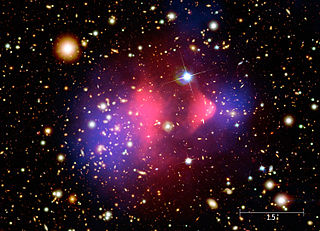
The Bullet Cluster ( 1E 0657-56 )

Physicist-in-training Newt’s ready for him. “Not much of a clue about what dark matter is, but a good clue about how it behaves. As to what’s in the picture, we need some background information first.”

“Go ahead, it’s not dinner-time yet.”

“First, this isn’t two stars colliding. It’s not even two galaxies. It’s two clusters of galaxies, about 40 all together. The big one on the left probably has the mass of a couple quintillion Suns, the small one about 10% of that.”

“That’s a lot of stars.”

“Oh, most of it’s definitely not stars. Maybe only 1-2%. Those stars and the galaxies they form are embedded in ginormous clouds of proton-electron plasma that make up 5-20% of the mass. The rest is that dark matter you don’t like.”

“Quadrillions of stars are gonna make a super-super-nova when they collide!”

“Well, no. That doesn’t even happen when two galaxies collide. The average distance between neighboring stars in a galaxy is 200-300 times the diameter of a star so it’s unlikely that any two of them will come even close. Next level up, the average distance between galaxies in a cluster is about 60 galaxy diameters or more, depending. The galaxies will mostly just slide past each other. The real colliders are the spread-out stuff — the plasma clouds and of course the dark matter, whatever that is.”

Astronomer-in-training Jim cuts in. “Anyway, the collision has already happened. The light from this configuration took 3.7 billion years to reach us. The collision itself was longer ago than that because the bullet’s already passed through the big guy. From that scale-bar in the bottom corner I’d say the centers are about 2 parsecs apart. If I recall right, their relative velocity is about 3000 kilometers per second so…” <poking at his smartphone> “…the peak intersection was about 700 million years earlier than that. Call it 4.3 billion years ago.”

“So what’s with the cotton candy?”

Newt looks puzzled. “Cotton… oh, the pink pixels. They’re markers for where NASA’s Chandra telescope saw X-rays coming from.”

“What can make X-rays so far from star radiation that could set them going?”

“The electrons do it themselves. An electron emits radiation every time it collides with another charged particle and changes direction. When two plasma clouds interpenetrate you get twice as many particles per unit volume and four times the collision rate so the radiation intensity quadruples. There’s always some X-radiation in the plasma because the temperature in there is about 8400 K and particle collisions are really violent. The Chandra signal pink shows the excess over background.”

“The blue in the Jim’s picture is supposed to be what, extra gravity?”

“Basically, yeah. It’s not easy to see from the figure, but there are systematic distortions in the images of the background galaxies in the blue areas. Disks and ellipsoids appear to be bent, depending on where they sit relative to the clusters’ centers of mass. The researchers used Einstein’s equations and lots of computer time to work back from the distortions to the lensing mass distributions.”

“So what we’ve got is a mostly-not-from-stars gravity lump to the left, another one to the right, and a big cloud in the middle with high-density hot bits on its two sides. Something in the middle blew up and spread gas around mostly in the direction of those two clusters. What’s that tell us?”

“Sorry, that’s not what happened. If there’d been a central explosion the excess to the right would be arc-shaped, not a cone like you see. No, this really is the record of one galaxy cluster bursting through another one. Particle-particle friction within the plasma clouds held them back while the embedded galaxies and dark matter moved on.”

“OK, the galaxies aren’t close-set enough for them to slow each other down, but wouldn’t friction in the dark matter hold things back, too?”

“Now that’s an interesting question…”

~~ Rich Olcott

The Prints of Darkness

There’s a commotion in front of Al’s coffee shop. Perennial antiestablishmentarian Change-me Charlie’s set up his argument table there and this time the ‘establishment’ he’s taking on is Astrophysics. Charlie’s an accomplished chain-yanker and he’s working it hard. “There’s no evidence for dark matter, they’ve never found any of the stuff and there’s tons of no-dark-matter theories to explain the evidence.”

Big Cap’n Mike’s shouts from the back of the crowd. “What they’ve been looking for and haven’t found is particles. By my theory dark matter’s an aspect of gravity which ain’t particles so there’s no particles for them to find.”

Astronomer-in-training Jim spouts off right in Charlie’s face. “Dude, you can’t have it both ways. Either there’s no evidence to theorize about, or there’s evidence.”

Physicist-in-training Newt Barnes takes the oppo chair. “So what exactly are we talking about here?”

“That’s the thing, guy, no-one knows. It’s like that song, ‘Last night I saw upon the stair / A little man who wasn’t there. / He wasn’t there again today. / Oh how I wish he’d go away.‘ It’s just buzzwords about a bogosity. Nothin’ there.”

I gotta have my joke. “Oh, it’s past nothing, it’s a negative.”

“Come again?”

“The Universe is loaded with large rotating but stable structures — solar systems, stellar binaries, globular star clusters, galaxies, galaxy clusters, whatever. Newton’s Law of Gravity accounts nicely for the stability of the smallest ones. Their angular momentum would send them flying apart if it weren’t for the gravitational attraction between each component and the mass of the rest. Things as big as galaxies and galaxy clusters are another matter. You can calculate from its spin rate how much mass a galaxy must have in order to keep an outlying star from flying away. Subtract that from the observed mass of stars and gas. You get a negative number. Something like five times more negative than the mass you can account for.”

“Negative mass?”

“Uh-uh, missing positive mass to combine with the observed mass to account for the gravitational attraction holding the structure together. Zwicky and Rubin gave us the initial object-tracking evidence but many other astronomers have added to that particular stack since then. According to the equations, the unobserved mass seems to form a spherical shell surrounding a galaxy.”

“How about black holes and rogue planets?”

Newt’s thing is cosmology so he catches that one. “No dice. The current relative amounts of hydrogen, helium and photons say that the total amount of normal matter (including black holes) in the Universe is nowhere near enough to make up the difference.”

“So maybe Newton’s Law of Gravity doesn’t work when you get to big distances.”

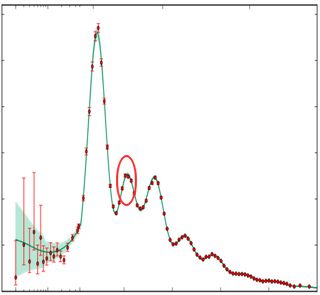
“Biggest distance we’ve got is the edge of the observable Universe. Jim, show him that chart of the angular power distribution in the Planck satellite data for the Cosmological Microwave Background.” <Jim pulls out his smart-phone, pulls up an image.> “See the circled peak? If there were no dark matter that peak would be a valley.”

Charlie’s beginning to wilt a little. “Ahh, that’s all theory.”

The Bullet Cluster ( 1E 0657-56 )

<Jim pulls up another picture.> “Nope, we’ve got several kinds of direct evidence now. The most famous one is this image of the Bullet Cluster, actually two clusters caught in the act of colliding head-on. High-energy particle-particle collisions emit X-rays that NASA’s Chandra satellite picked up. That’s marked in pink. But on either side of the pink you have these blue-marked regions where images of further-away galaxies are stretched and twisted. We’ve known for a century how mass bends light so we can figure from the distortions how much lensing mass there is and where it is. This picture does three things — it confirms the existence of invisible mass by demonstrating its effect, and it shows that invisible mass and visible mass are separate phenomena. I’ve got no pictures but I just read a paper about two galaxies that don’t seem to be associated with dark matter at all. They rotate just as Newton would’ve expected from their visible mass alone. No surprise, they’re also a lot less dense without that five-fold greater mass squeezing them in.”

“You said three.”

“Gotcha hooked, huh?

~~ Rich Olcott

Fierce Roaring Beast

A darkish day calls for a fresh scone so I head for Al’s coffee shop. Cathleen’s there with some of her Astronomy students. Al’s at their table instead of his usual place behind the cash register. “So what’s going on with these FRBs?”

She plays it cool. “Which FRBs, Al? Fixed Rate Bonds? Failure Review Boards? Flexible Reed Baskets?”

Jim, next to her, joins in. “Feedback Reverb Buffers? Forged Razor Blades?
Fennel Root Beer?”

I give it a shot. “Freely Rolling Boulders? Flashing Rapiers and Broadswords? Fragile Reality Boundary?”

“C’mon, guys. Fast Radio Bursts. Somebody said they’re the hottest thing in Astronomy.”

Cathleen, ever the teacher, gives in. “Well, they’re right, Al. We’ve only known about them since 2007 and they’re among the most mystifying objects we’ve found out there. Apparently they’re scattered randomly in galaxies all over the sky. They release immense amounts of energy in incredibly short periods of time.”

“I’ll say.” Vinnie’s joins the conversation from the next table. “Sy and me, we been talking about using the speed of light to measure stuff. When I read that those radio blasts from somewhere last just a millisecond or so, I thought, ‘Whatever makes that blast happen, the signal to keep it going can’t travel above lightspeed. From one side to the other must be closer than light can travel in a millisecond. That’s only 186 miles. We got asteroids bigger than that!'”

“300 kilometers in metric.” Jim’s back in. “I’ve played with that idea, too. The 70 FRBs reported so far all lasted about a millisecond within a factor of 3 either way — maybe that’s telling us something. The fastest way to get lots of energy is a matter-antimatter annihilation that completely converts mass to energy by E=mc².  Antimatter’s awfully rare 13 billion years after the Big Bang, but suppose there’s still a half-kilogram pebble out there a couple galaxies away and it hits a hunk of normal matter. The annihilation destroys a full kilogram; the energy release is 1017 joules. If the event takes one millisecond that’s 1020 watts of power.”

“How’s that stand up against the power we receive in an FRB signal, Jim?”

“That’s the thing, Sy, we don’t have a good handle on distances. We know how much power our antennas picked up, but power reception drops as the square of the source distance and we don’t know how far away these things are. If your distance estimate is off by a factor of 10 your estimate of emitted power is wrong by a factor of 100.”

“Ballpark us.”

<sigh> “For a conservative estimate, say that next-nearest-neighbor galaxy is something like 1021 kilometers away. When the signal finally hits us those watts have been spread over a 1021-kilometer sphere. Its area is something like 1049 square meters so the signal’s power density would be around 10-29 watts per square meter. I know what you’re going to ask, Cathleen. Assuming the radio-telescope observations used a one-gigahertz bandwidth, the 0.3-to-30-Jansky signals they’ve recorded are about a million million times stronger than my pebble can account for. Further-away collisions would give even smaller signals.”

Looking around at her students, “Good self-checking, Jim, but for the sake of argument, guys, what other evidence do we have to rule out Jim’s hypothesis? Greg?”

“Mmm… spectra? A collision like Jim described ought to shine all across the spectrum, from radio on up through gamma rays. But we don’t seem to get any of that.”

“Terry, if the object’s very far away wouldn’t its shorter wavelengths be red-shifted by the Hubble Flow?”

“Sure, but the furthest-away one we’ve tagged so far is nearer than z=0.2. Wavelengths have been stretched by 20% or less. Blue light would shift down to green or yellow at most.”

“Fran?”

“We ought to get even bigger flashes from antimatter rocks and asteroids. But all the signals have about the same strength within a factor of 100.”

“I got an evidence.”

“Yes, Vinnie?”

“That collision wouldn’t’a had a chance to get started. First contact, blooie! the gases and radiation and stuff push the rest of the pieces apart and kill the yield. That’s one of the problems the A-bomb guys had to solve.”

Al’s been eaves-dropping, of course. “Hey, guys. Fresh Raisin Bread, on the house.”

~~ Rich Olcott

Friendly Resting Behemoths

For the VLA, Timing Is Everything

Eddie’s pizza is especially tasty after a long walk down a stairwell. Vinnie and I are polishing off the last of our crumbs when he says, “OK, so we got these incredibly accurate clocks. Two questions. What do we use them for besides sending out those BBC pips, and what do they have to do with the new kilogram standard?”

“Pips? Oh, the top-of-the-hour radio station beeps we used to depend upon to set our watches. Kept us all up-to-the-minute, us and the trains and planes — but we don’t need 10-digit accuracy for that. What we do get from high-quality time signals is the ability to create distributed instruments.”

“Distributed instruments?”

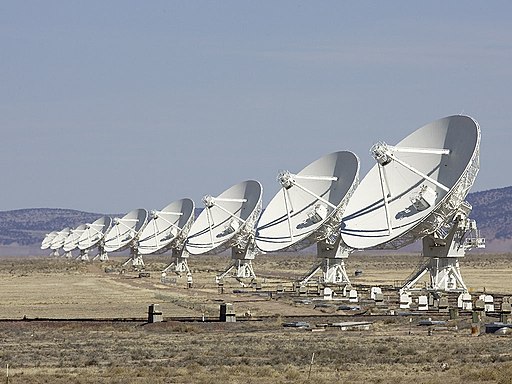
“Ones with pieces in different places. You know about the Jansky Very Large Array, that huge multi-dish radio telescope in New Mexico?”

Karl G. Jansky Very Large Array, photo by Mihaiscanu
via Wikimedia Commons licensed under Creative Commons

“Been there. Nice folks in Pie Town up the road.”

“Did you look around?”

“Of course. What I didn’t understand is why they got 27 dishes and they’re all pointed the same direction. You’d think one would be enough for looking at something.”

“Ah, that’s the thing. All of them together make one telescope.”

<sets smartphone to calculator mode> “Lessee … dish is 25 meters across, πD2/4, 27 dishes, convert square meters to… Geez, 3¼ acres! A single dish that size would be a bear to keep steady in the wind down there. No wonder they split it up.”

“That was one concern, but the total area’s not as important as the distance between the pairs.”

“Why’s that even relevant?”

“Because radio telescopes don’t work the way that optical ones do. No lens or mirror, just a big dish that accepts whatever comes in along a narrow beam of radio waves.”

“How narrow?”

“About the size of the full Moon.”

“That can cover a lot of stars and galaxies.”

“It sure can, which is why early radio astronomy was pretty low-resolution. Astronomers needed a way to pick out the signals from individual objects within that field of view. Turns out two eyes are better than one.”

“3D vision?”

“Kinda related, but not really. Our two eyes give us 3D vision because each eye provides a slightly different picture of close-by objects, say, less than about 5 yards away. For everything further, one eye’s view is no different from the other’s. You’d get the same effect if distant things were painted on a flat background, which is how come a movie set backdrop still looks real.”

“You’re saying that the stars are so far away that each dish gets the same picture.”

“Yeah.”

“So why have more than one?”

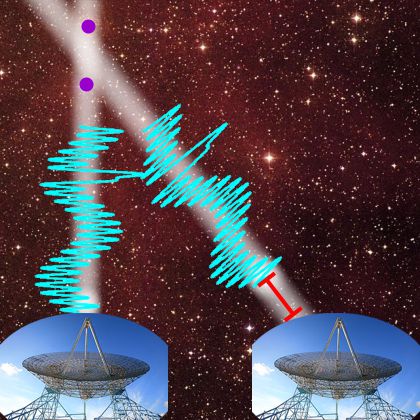
“They don’t get the picture at the same time. With an atomic clock you can take account of when each signal arrives at each dish. Here’s a diagram I did up on Old Reliable. It’s way out of scale but it makes the point, I think. We’ve got two dishes at the bottom here, and those purple dots are two galaxies. Each dish sees them on top of each other and can’t distinguish which one sent that peaky signal. What’s important is, the dish on the right receives the signal later. See that red bar? That’s the additional path length the signal has to travel to reach the second dish.”

“Can’t be much later, light travels pretty fast.”

“About 30 centimeters per nanosecond, which adds up. When the VLA dishes are fully spread out, the longest dish-to-dish distance is about 36 kilometers which is about 120 microseconds as the photon flies. That’s over a million ticks on the cesium clock – no problem tracking the differences.”

“Same picture a little bit later. Doesn’t seem worth the trouble.”

“What makes it worth the trouble is what you can learn from the total space-time pattern after you combine the signals mathematically. Under good conditions the VLA can resolve signals from separate objects only 40 milliarcseconds apart, about 1/45000 the diameter of the Moon. That’s less than the width of a dime seen from 50 miles away.”

“The time pattern is how the dishes act like a single spread-around telescope, huh? Without the high-precision time data, they’re just duplicates?”

“Atomic clocks let us see the Universe.”

~~ Rich Olcott

Time in A Bottle, Sort Of

We’re in the Acme Building’s elevator, headed down to Eddie’s for pizza, when there’s a sudden THUNK.  Vinnie’s got his cellphone out and speed-dialed before I’ve registered that we’ve stopped.  “Michael, it’s me, Vinnie.  Hi.  Me and Sy are in elevator three and it just stopped between floors.  Yeah, between six and five.  Of course I know that’s where, I always count floors.  Look, you get us outta here quick and I won’t have to call the rescue squad and you don’t have paperwork, OK?  Warms my heart to hear you say that.  Right.  And there’s pizza in it for you when we’re out.  Thanks, Michael.”  <to me>  “Says it’ll be a few minutes.  You good for climbing out when he levers the doors?”

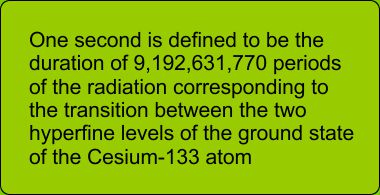
“Sure, no problem.  Might as well keep on about why the kilogram definition changed.  Oddly enough, the story starts with one of the weirdest standards in Science.  Here, I’ll pull it up on Old Reliable…”

“OK, that’s a weird number in the fraction, but what’s weird about the whole definition?”

“Think about it — when they defined this standard in 1960, it essentially said, ‘Go back sixty years, see how long it took for the Sun to return to exactly where it was in the sky a year earlier, capture exactly that weird fraction of the one-year interval in a bottle and bring it back to the present for comparison with an interval you want to report a time for.  Sound doable to you?”

“Mmm, no.  But these guy’s weren’t stupid.  There had to be a way.”

“The key is in those words, ephemeris time.”

“Something like Greenwich Time?  How would that help?” 

“Greenwich Mean Time would be better — ‘mean’ as in ‘average.’  You know the Earth doesn’t spin perfectly, right?”

“Yeah, it wobbles.  The Pole Star won’t be at the pole in a few thousand years.”

“That’s the idea but things are messier than that.  For instance, when a large mass moves around, like a big volcano eruption or a major ice-sheet breakup or monsoon rains using Indian Ocean water to drench Southwest Asia, that causes a twitch in the rotation.”

“Hard to see how those twitches would be measurable.”

“They are when you’re working at 9-digit precision, which atomic clocks exceeded long ago.  Does your GPS unit have that spiffy dual-frequency function for receiving satellite time signals?”

“Sure does  — good to within a foot.”

“That’d be about 30 centimeters.  Speed of light’s 3×10⁸ meters per second so you’re depending on satellite radio time-checks good to about, um, 100 nanoseconds, in a data field holding week number and seconds down to nanoseconds.  So you’d expect measurement jitter within … about 2 parts in 1015.  Pretty good, and on that scale those twitches count.”

“What do they do about them?”

“Well, you can’t fix Earth, but you can measure the twitches very carefully and then average over them.  Basically, you list all the Sun-position measurements made over many years, along with the corresponding time as reported by then-current science’s best clocks.  Use those observations to build a mathematical model of where an averaged fake Sun would appear to be at any given moment if it were absolutely regular, no twitches.  When the fake Sun would be at its highest during a given day, that’s noon GMT.”

“Fine, but what’s that got to do with your weird definition?”

“You can run your mathematical model backward in time to see how many times your best-we’ve-got-now clock would tick between fake noon and fake 12:00:01 on that date.  That calibrates your clock.”

“Seems a little circular to me — Sun to clock to model to fake-Sun to clock.”

“Which is why, now that we’ve got really good clocks, they’ve changed the operational definition by dropping the middleman.  The most precise measurements for anything depend on counting.  We now have technology that can count individual peaks in a lightwave signal.  These days the second is defined this way.  If a counter misses one peak, that’s one part in 10 million, three counts per year.  That’s so much better than Solar time they sometimes have to throw in a ‘leap-second’ so the years can keep up with the clocks.”

“Michael’s way overdue.  I’m callin’ him again.”

Clock image from vecteezy.com

~~ Rich Olcott


A Three-dog Night Would Be So Cool

“So we’ve got three fundamentally different messengers from the stars, Mr Feder.  The past couple of years have given us several encouraging instances of receiving two messengers from the same event.  If we ever receive all three messengers from the same event, that might give us what we need to solve the biggest problem in modern physics.”

“That’s a pretty deep statement, Moire.  Care to unpack it?  The geese here would love to hear about it.”

“Lakeside is a good place for thoughts like this.  The first messenger was photons.  We’ve been observing starlight photons for tens of thousand of years.  Tycho Brahe and Galileo took it to a new level a few centuries ago with their careful observation, precision measurements and Galileo’s telescope.”

“That’s done us pretty good, huh?”

“Oh sure, we’ve charted the heavens and how things move, what we can see of them.  But our charts imply there’s much we can’t see.  Photons only interact with electric charge.  Except for flat-out getting absorbed if the wavelength is right, photons don’t care about electrically neutral material and especially they don’t care about dark matter.”

“So that’s why we’re interested in the other messengers.”

“Exactly.  Even electrically neutral things have mass and interact with the gravitational field.  You remember the big news a few years ago, when our brand-new LIGO instruments caught a gravitational wave signal from a couple of black holes in collision.  Black holes don’t give off photons, so the gravitational wave messenger was our only way of learning about that event.”

“No lightwave signal at all?”

“Well, there was a report of a possible gamma-ray flare in that patch of sky, but it was borderline-detectable.  No observatory using lower-energy light saw anything there.  So, no.”

“You’re gonna tell me and the geese about some two-messenger event now, right?”

“That’s where I’m going, Mr Feder.  Photons first.  Astronomers have been wondering for decades about where short, high-energy gamma-ray bursts come from.  They seem to happen randomly in time and space.  About a year ago the Fermi satellite’s gamma-ray telescope detected one of those bursts and sent out an automated ‘Look HERE’ alert to other observatories.  Unfortunately, Fermi‘s resolution isn’t wonderful so its email pointed to a pretty large patch of sky.  Meanwhile back on Earth and within a couple of seconds of Fermi‘s moment, the LIGO instruments caught an unusual gravitational wave signal that ran about a hundred times slower than the black-hole signals they’d seen.  Another automated ‘Look HERE’ alert went out.  This one pointed to a small portion of that same patch of sky.  Two messengers.”

“Did anyone find anything?”

“Seventy other observatories scrutinized the overlap region at every wavelength known to Man.  They found a kilonova, an explosion of light and matter a thousand times brighter than typical novae.  The gravitational wave evidence indicated a collision between two neutron stars, something that had never before been recorded.  Photon evidence from the spewed-out cloud identified a dozen heavy elements theoreticians hadn’t been able to track to an origin.  Timing details in the signals gave cosmologists an independent path to resolving a problem with the Hubble Constant.  And now we know where those short gamma-ray bursts come from.”

“Pretty good for a two-messenger event.  Got another story like that?”

“A good one.  This one’s neutrinos and photons, and the neutrinos came in first.  One neutrino.”

One neutrino?”

“Yup, but it was a special one, a super-high-powered neutrino whose incoming path our IceCube observatory could get a good fix on.  IceCube sent out its own automated ‘Look HERE’ alert.  The Fermi team picked up the alert and got real excited because the alert’s coordinates matched the location of a known and studied gamma-ray source.  Not a short-burster, but a flaring blazar.  That neutrino’s extreme energy is evidence for blazars being one of the long-sought sources of cosmic rays.”

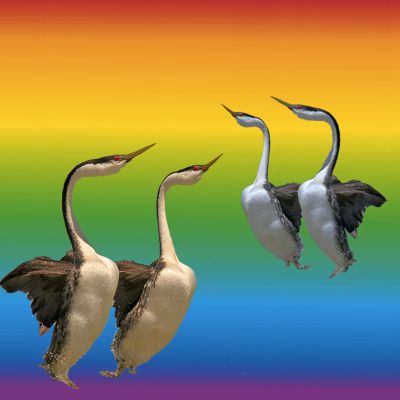
“Puzzle solved, maybe.  Now what you said about a three-messenger signal?”grebe messenger pairs“Gravitational waves are relativity effects and neutrinos are quantum mechanical.  Physicists have been struggling for a century to bridge those two domains.  Evidence from a three-messenger event could provide the final clues.”
“I’ll bet the geese enjoyed hearing all that.”

“They’re grebes, Mr Feder.”

~~ Rich Olcott

Heavenly Messengers

A gorgeous Fall day, a little bit cool-ish, perfect for a brisk walk in the park.  I’m striding along the lake-bound path when there’s a breathless shout behind me.  “Hey, Moire, wait up!  I got questions!”

“Hello, Mr Feder.  What’s the topic this time?  And keep up, please, I’ve got geese to watch.”

“I been reading in the business pages <puff, puff> about all the money different countries are putting into ‘multi-messenger astronomy.’  <puff>  What’s that about, anyway?  Who’s sending messages and ain’t the Internet good enough?”

“It’s not who, Mr Feder, it’s what — stars, galaxies, black holes, the Universe.  And the messages are generally either ‘Here I am‘ or ‘Something interesting just happened‘.  The Internet just doesn’t reach that far and besides, no kitten pictures.”

“Pretty simple-sounding messages, so why the big bucks for extra message-catchers?”

“Fair question.  It has to do with what kind of information each messenger carries.  Photons, for instance.”

“Yeah, light-waves, the rainbow.”

“Way more than the rainbow.  Equating light-waves to just the colors we see is like equating sound-waves to just the range from A4 through F4# on a piano.”

“Hey, that’s less than an octave.”

“Yup, and electromagnetism’s scale is hugely broader than that.  Most of the notes, or colors, are way out of our range.  A big tuba makes a deep, low-frequency note but a tiny piccolo makes a high note.  Photon characteristics also scale with the size of where they came from.  Roughly speaking, the shorter the light’s wave-length, the smaller the process it came out of and the smaller its target will be.  Visible light, for instance, is sent and received by loosely-held charge sloshing inside an atom or molecule.  Charge held tight to a nucleus gives rise to higher-energy photons, in the ultra-violet range or beyond.”

“Like how beyond?”

“X-rays can rip electrons right out of a molecule.  Gamma rays are even nastier and involve charge activity inside a nucleus, like during a nuclear reaction.”

“How about in the other direction?  Nothing?”

“Hardly.  Going that way is going to bigger scales.  Infra-red is about parts of molecules vibrating against each other, microwave is about whole molecules rotating.  When your size range gets out to feet-to-miles you’re looking at radio waves that probably originated from free electrons or ions slammed back and forth by electric or magnetic fields.”

“So these light ranges are like messengers that clue us in on what’s going on out there?  Different messengers, different kindsa clues?”

“You got the idea.  Add in that what happens to the light on the way here is also important.  Radio and microwave photons with their long wavelengths swerve around dust particles that block out shorter-wavelength ones.  Light that traversed Einstein-bent space lets us measure the masses of galaxies.  Absorption and polarization at specific wavelengths tell us what species are out there and what they’re doing.  Blue-shifts and red-shifts tell us how fast things are moving towards and away from us.  And of course, atmospheric distortions tell us we’ve got to put satellite observatories above the atmosphere to see better.”

“One messenger, lots of effects.”

“Indeed, but in the past few years we’ve added two more, really important messengers.  Photons are good, but they’re limited to just one of the four fundamental forces.”

“Hey, there’s gotta be more than that.  This is a complicated world.”

“True, but physicists can account for pretty much everything at the physical and chemical level with only four — electromagnetism, gravity, the strong force that holds nuclei together and the weak force that’s active in nuclear transformation processes.  Photons do electromagnetism and that’s all.”

“So you’re saying we’ve got a line on two of the others?”

“Exactly.  IceCube and its kin record the arrival of high-energy neutrinos.  In a sense they are to the weak force what photons are to electromagnetism.  We don’t know whether gravitation works through particles, but LIGO and company are sensitive to changes in the gravitational field that’s always with us.  Each gives us a new perspective on what’s happening out there.”

“So if you get a signal from one of the new messengers at the same time you get a photon signal…”

“Oh, look, the geese are coming in.”

Heavenly messengers

~~ Rich Olcott