Several Big Sloshes

“I call distraction, Sy. You were going to explain how come the Moon’s drifting away from us but you got us into radians and stuff. What’s that got to do with the Moon flying away by dragging a big wave around the Earth?”

“It’s not dragging a localized bulge of water like you’re thinking, Vinnie, nothing like that wave on Miller’s Planet. For that matter, the Miller’s Planet wave had a sharply‑rising front which also doesn’t look like the textbook tidal bulge.”

“There’s a textbook on this stuff?”

“Many, Al. Heavy-duty people have spent a lot of time on tides. Think about all the military and commercial navies that depend on boats being able to leave port and dock on schedule.”

“And not run aground <heh heh>”

“Well, yes, Vinnie. Anyhow, like a lot of pre‑computer Physics, that work was based on a simplified ideal system — a moon orbiting a smooth planet with a world‑covering ocean. Water’s drawn horizontally towards the sub‑lunar points making an egg‑shaped surface and everything’s neat.”

“Probably nothing like real life.”

“Of course. Here’s a video I built from satellite altimetry data. The grey dot is roughly the point underneath the Moon as that day progressed. The red‑to‑blue height scale’s in meters.. Not as neat as theory, is it?”

“Wow, that’s a mess. Looks like the Moon’s pulling water along the Canada‑Alaska coast okay, and the western Pacific starts to get a dome going. But the water never catches up before the Moon’s gone.”

“Hey, Vinnie, look how the tides just go round and round New Zealand. And what’s that, Hudson Bay, it’s a pinwheel.”

“Yeah, and in between Africa and Madagascar it’s completely out of phase from what it oughta be.”

“What you’re looking at is slosh. Once again, reality overwhelms a pretty theory. Each basin has its own preferred set of oscillations. None of them match up with the Moon. But the other thing — “

“Tiny numbers. Everything’s like less than a couple meters, not not a big bulge at all.”

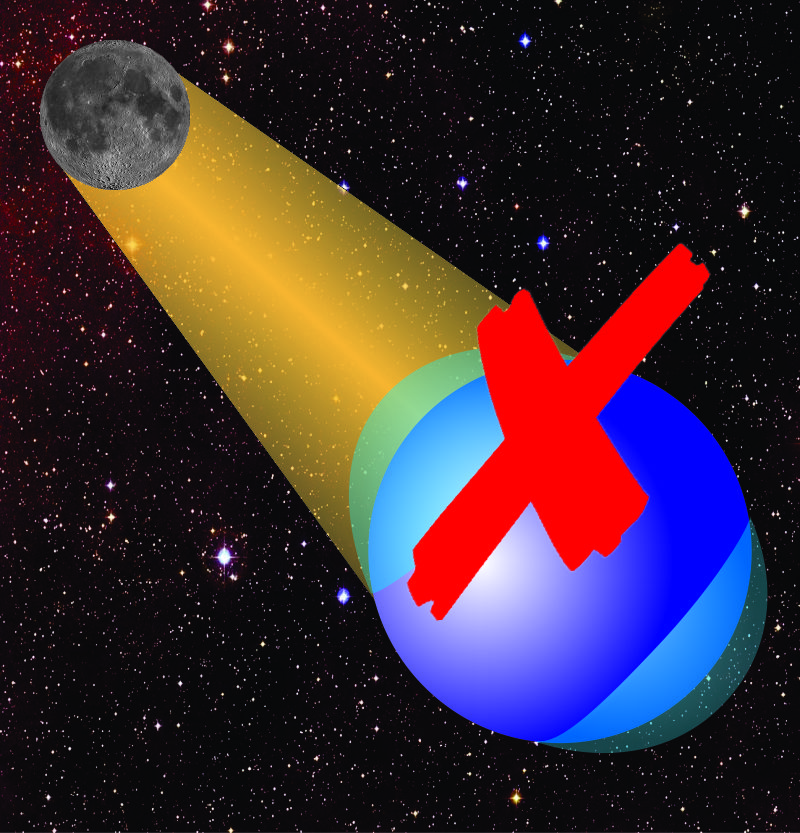
“Bingo, Vinnie. Against Earth’s 6.4‑million‑meter radius, those small chaotic sloshes don’t make for effective energy transfer driving the Moon away from us. That theory’s toast.”

“So what’s doing it?”

“There’s two theories that I know of, and they’re probably both right. The first one is Earth tides — that bump you think of as traveling around the planet, but the bump is rock instead of water.”

“That can’t be a big effect. Rocks don’t bend.”

“On a planetary scale they’re not as solid as you think, Vinnie. The rock crust is brittle and really thin, less than half a percent of Earth’s radius. It floats on molten outer mantle which has the fluidity of tapioca pudding. When that structure gives under stress the crust layer cracks. The seismologists and GPS techs have measured surface motion all over the world. When they analyze the maps, the lunar component accounts for up to a meter of coordinated vertical daily movement. Figure the whole Earth is continually being squeezed and pulled to that extent and you’ve got a lot of energy being expended every 24 hours.”

“How about the other theory?”
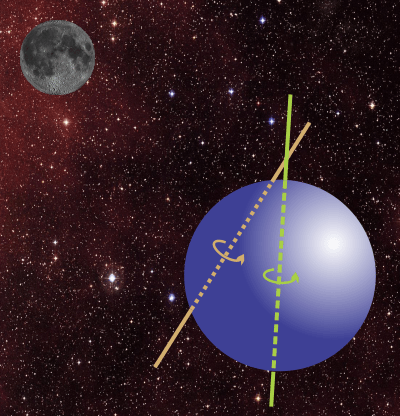
“There’s no direct evidence, so far as I know, but it seems reasonable on physical grounds. We’ve got two gyrations going on here, right? The Moon is on a 29½‑day orbit while the Earth rotates about thirty times faster. But the two motions use different frames. The Earth’s spin axis runs through the geometric center of the planet and tilts 23° from its orbit axis. Meanwhile the whole Earth‑Moon system rotates about its barycenter, their common center of gravity, which stays inside the Earth about ¾ of the way moonward from the Earth’s middle. That rotation is about 5° away from Earth’s orbit’s axis. Imagine a molten blob near the barycenter, happily following the Moon in the Earth-Moon frame, but the rest of the planet is saying, ‘No, no, you’re supposed to be moving hundreds of miles an hour in a different direction!‘ If the blob’s the least bit lighter or heavier than its neighbor blobs, inertial forces expend energy to kick it out of there.”

“So we got two ways to transfer energy steady-like.”

“I think so.”

~~ Rich Olcott
Here’s a Different Angle

“OK, Sy, so there’s a bulge on the Moon’s side of the Earth and the Earth rotates but the bulge doesn’t and that makes the Moon’s orbit just a little bigger and you’ve figured out that the energy it took to lift the Moon raised Earth’s temperature by a gazillionth of a degree, I got all that, but you still haven’t told Al and me how the lifting works.”

“You wouldn’t accept it if I just said, ‘The Moon lifts itself by its bootstraps,’ would you?”

“Not for a minute.”

“And you don’t like equations. <sigh> OK, Al, pass over some of those paper napkins.”

“Aw geez, Sy.”

“You guys asked the question and this’ll take diagrams, Al. Ante up. … Thanks. OK, remember the time Cathleen and I caught Vinnie here at Al’s shop playing with a top?”

“Yeah, and he was spraying paper wads all over the place.”

“I wasn’t either, Al, it was the top sending them out with centri–…, some force I can never remember whether it’s centrifugal or centripetal.”

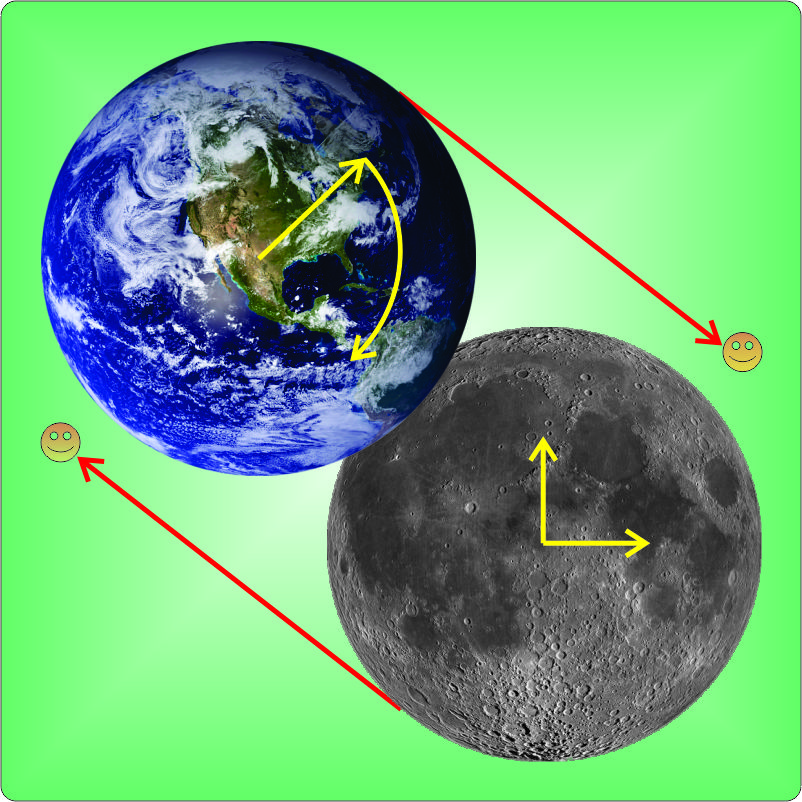
“Centrifugal, Vinnie, –fugal– like fugitive, outward‑escaping force. It’s one of those ‘depends on how you look at itfictitious forces. From where you were sitting, the wads looked like they were flying outward perpendicular to the top’s circle. From a wad’s point of view, it flew in a straight line tangent to the circle. It’s like we have two languages, Room and Rotor. They describe the same phenomena but from different perspectives.”

“Hey, it’s frames again, ain’t it?”

“Newton’s inertial frames? Sort‑of but not quite. Newton’s First Law only holds in the Room frame — no acceleration, motion is measured by distance, objects at rest stay put. Any other object moves in a straight line unless its momentum is changed by a force. You can tackle a problem by considering momentum and force components along separate X and Y axes. Both X and Y components work the same way — push twice as hard in either direction, get twice the acceleration in that direction. Nice rules that the Rotor frame doesn’t play by.”

“I guess not. The middle’s the only place an object can stay put, right?”

“Exactly, Al. Everything else looks like it’s affected by weird, constantly‑varying forces that’re hard to describe in X‑Y terms.”

“So that breaks Newton’s physics?”

“Of course not. We just have to adapt his F=m·a equation (sorry, Vinnie!) to Rotor conditions. For small movements we wind up with two equations. In the strict radial direction it’s still F=m·a where m is mass like we know it, a is acceleration outward or inward, and F is centrifugal or centripetal, depending. Easy. Perpendicular to ‘radial‘ we’ve got ‘angular.’ Things look different there because in that direction motion’s measured by angle but Newton’s Laws are all about distances — speed is distance per time, acceleration is speed change per time and so forth.”

“So what do you do?”

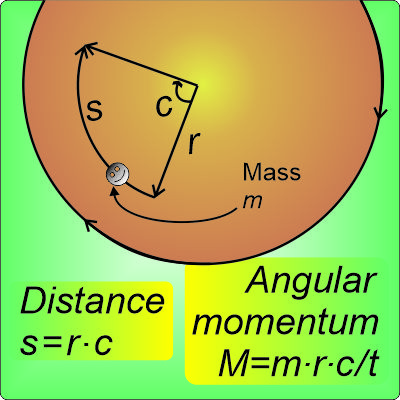
“Use arc length. Distance along an arc is proportional to the angle, and it’s also proportional to the radius of the arc, so just multiply them together.”

“What, like a 45° bend around a 2-foot radius takes 90 feet? That’s just wrong!”

“No question, Al. You have to measure the angle in the right units. Remember the formula for a circle’s circumference?”

“Sure, it’s 2πr.”

“Which tells you that a full turn’s length is times the radius. We can bridge from angle to arc length using rotational units so that a full turn, 360°, is units. We’ll call that unit a radian. Half a circle is π radians. Your 45° angle in radians is π/4 or about ¾ of a radian. You’d need about (¾)×(2) or 1½ feet of whatever to get 45° along that 2-foot arc. Make sense?”

“Gimme a sec … OK, I’m with you.”

“Great. So if angular distance is radius times angle, then angular momentum which is mass times distance per time becomes mass times radius times angle per time.”

“”Hold on, Sy … so if I double the mass I double the momentum just like always, but if something’s spinning I could also double the angular momentum by doubling the radius or spinning it twice as fast?”

“Couldn’t have put it better myself, Vinnie.”

~~ Rich Olcott

Two Against One, And It’s Not Even Close


On a brisk walk across campus when I hear Vinnie yell from Al’s coffee shop. “Hey! Sy! Me and Al got this argument going you gotta settle.”

“Happy to be a peacemaker, but it’ll cost you a mug of Al’s coffee and a strawberry scone.”

“Coffee’s no charge, Sy, but the scone goes on Vinnie’s tab. What’s your pleasure?”

“It’s morning, Al, time for black mud. What’s the argument, Vinnie?”

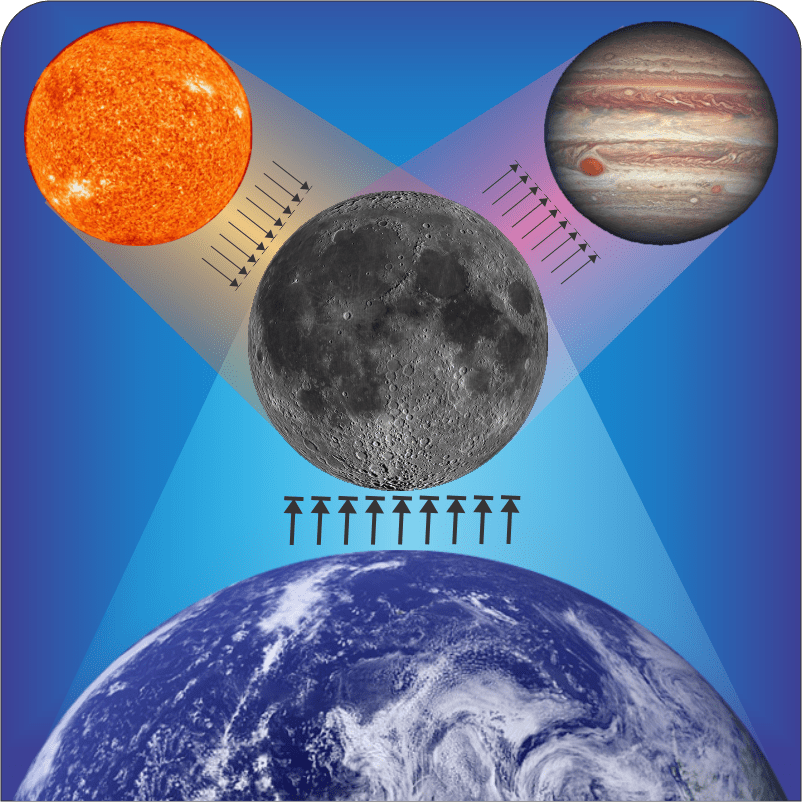
“Al read in one of his astronomy magazines that the Moon’s drifting away from us. Is that true, and if it is, how’s it happen? Al thinks Jupiter’s gravity’s lifting it but I think it’s because of Solar winds pushing it. So which is it?”

“Here you go, Sy, straight from the bottom of the pot.”

“Perfect, Al, thanks. Yes, it’s true. The drift rate is about 1¼ nanometers per second, 1½ inches per year. As to your argument, you’re both wrong.”

“Huh?”
 ”Aw, c’mon!”

“Al, let’s put some numbers to your hypothesis. <pulling out Old Reliable and screen‑tapping> I’m going to compare Jupiter’s pull on the Moon to Earth’s when the two planets are closest together. OK?”

“I suppose.”

“Alright. Newton’s Law tells us the pull is proportional to the mass. Jupiter’s mass is about 320 times Earth, which is pretty impressive, right? But the attraction drops with the square of the distance. The Moon is 1¼ lightseconds from Earth. At closest approach, Jupiter is almost 2100 lightseconds away, 1680 times further than the Moon. We need to divide the 320 mass factor by a 1680‑squared distance factor and that makes <key taps> Jupiter’s pull on the Moon is only 0.011 percent of Earth’s. It’ll be <taps> half that when Jupiter’s on the other side of the Sun. Not much competition, eh?”

“Yeah, but a little bit at a time, it adds up.”

“We’re not done yet. The Moon feels the big guy’s pull on both sides of its orbit around Earth. On the side where the Moon’s moving away from Jupiter, you’re right, Jupiter’s gravity slows the Moon down, a little. But on the moving-toward-Jupiter side, the motion’s sped up. Put it all together, Jupiter’s teeny pull cancels itself out over every month’s orbiting.”

“Gotcha, Al. So what about my theory, Sy?”

“Basically the same logic, Vinnie. The Solar wind varies, thanks to the Sun’s variable activity, but satellite measurements put its pressure somewhere around a nanopascal, a nanonewton per square meter. Multiply that by the Moon’s cross‑sectional area and we get <tap, tap> a bit less than ten thousand newtons of force on the Moon. Meanwhile, Newton’s Law says the Earth’s pull on the Moon comes to <tapping>
  G×(Earth’s mass)×(Moon’s mass)/(Earth-Moon distance)²
and that comes to 2×10¹¹ newtons. Earth wins by a 107‑fold landslide. Anyway, the pressure slows the Moon for only half of each month and speeds it up the other half so we’ve got another cancellation going on.”

“So what is it then?”
 ”So what is it then?”

“Tides. Not just ocean tides, rock tides in Earth’s fluid outer mantle. Earth bulges, just a bit, toward the Moon. But Earth also rotates, so the bulge circles the planet every day.”

“Reminds me of the wave in the Interstellar movie, but why don’t we see it?”

“The movie’s wave was hundreds of times higher than ours, Al. It was water, not rock, and the wave‑raiser was a huge black hole close by the planet. The Moon’s tidal pull on Earth produces only a one‑meter variation on a 6,400,000‑meter radius. Not a big deal to us. Of course, it makes a lot of difference to the material that’s being kneaded up and down. There’s a lot of friction in those layers.”

“Friction makes heat, Sy. Rock tides oughta heat up the planet, right?”

“Sure, Vinnie, the process does generate heat. Force times distance equals energy. Raising the Moon by 1¼ nanometers per second against a force of 2×10²¹ newtons gives us <taping furiously> an energy transfer rate of 4×10‑23 joules per second per kilogram of Earth’s 6×1024‑kilogram mass. It takes about a thousand joules to heat a kilogram of rock by one kelvin so we’re looking at a temperature rise near 10‑27 kelvins per second. Not significant.”

“No blaming climate change on the Moon, huh?”

~~ Rich Olcott

Moon Shot

<chirp, chirp> “Moire here.”

“Hi, Mr Moire, it’s Jeremy. Hey, I’ve been reading through some old science fiction stories and I ran across some numbers that just don’t look right.”

“Science fiction can be pretty clunky. Some Editors let their authors play fast and loose on purpose, just to generate Letters to The Editor. Which author and what story?”

“This is Heinlein, Mr Moire. I know his ideas about conditions on Mars and Venus were way off but that was before we had robot missions that could go there and look. When he writes about space navigation, though, he’s always so specific it looks like he’d actually done the calculations.”

“OK, which story and what numbers?”

“This one’s called, let me check, Gentlemen, Be Seated. It’s about these guys who get trapped in a tunnel on the Moon and there’s a leak letting air out of the tunnel so they seal the leak when one of the guys —”

“I know the story, Jeremy. I’ve always wondered if it was Heinlein or his Editor who got cute with the title. Anyway, which numbers bothered you?”

“I kinda thought the title came first. Anyway, everybody knows that the Earth’s gravity is six times the Moon’s, but he says that the Earth’s mass is eighty times the Moon’s and that’s why the Earth raises tides on the Moon except they’re rock tides, not water tides, and the movement makes moonquakes and one of them might have caused the leak. So why isn’t the Earth’s gravity eighty times the Moon’s, not six?”

“Read me the sentence about eighty.”

“Umm … here it is, ‘Remember, the Earth is eighty times the mass of the Moon, so the tidal stresses here are eighty times as great as the Moon’s effect on Earth tides.‘ I checked the masses in Wikipedia and eighty is about right.”

“I hadn’t realized the ratio was that large, I mean that the Moon is that small. One point for Heinlein. Anyway, you’re comparing north and east. The eighty and the six both have to do with gravity but they’re pointing in different directions.”

“Huh? I thought gravity’s pull was always toward the center.”

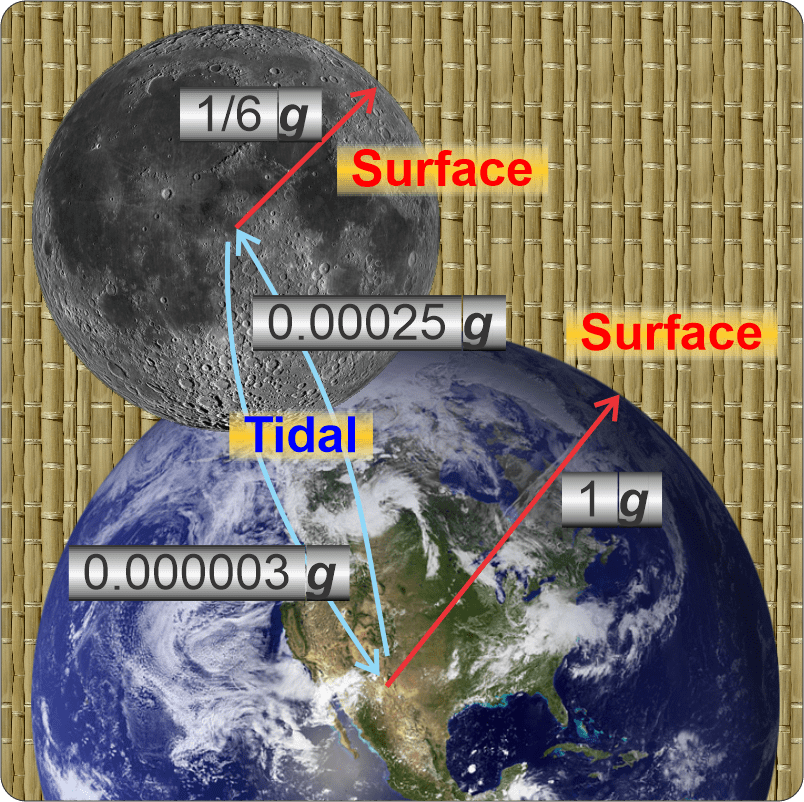
“It is, but it makes a difference where you are and which center you’re thinking about. You’re standing on the Earth so the closest center to you is Earth’s and most of the gravity you feel is the one-gravity pull from there. Suppose you’re standing on the Moon —”

“One-sixth, I know, Mr Moire, but why isn’t it one‑eightieth?”

“Because on the Moon you’re a lot closer to the center of the Moon than you were to the center of the Earth back on Earth. Let’s put some numbers to it. Got a calculator handy?”

“Got my cellphone.”

“Duh. OK, Newton showed us that an object’s gravitational force is proportional to the object’s mass divided by the square of the distance to the center. Earth’s radius is about 4000 miles and the Moon’s is about a quarter of that, so take the mass as 1/80 and divide by 1/4 squared. What do you get?”

“Uhh … 0.2 gravities.”

“One-fifth g. Close enough to one-sixth. If we used accurate numbers we’d be even closer. See how distance makes a difference?”

“Mm-hm. What about Heinlein’s tidal stuff?”

“Ah, now that’s looking in the other direction, where the distance is a lot bigger. Earth-to-Moon is about 250,000 miles. Standing on the Moon, you’d feel Earth’s one‑g gravity diminished by a factor of 4000/250000 squared. What’s that come to?”

“Umm… the distance factor is (4000/250000)² … I get 250 microgravities. Not much. Heinlein made a good bet with his characters deciding that the leak was caused by a nearby rocket crash instead of a moonquake.”

“How about Heinlein’s remark about the Moon’s effect on Earth?”

“Same distance but one eightieth the mass so I divide by 80 — three microgravities. Wow! That can’t possibly be strong enough to raise tides here.”

“It isn’t, though that’s the popular idea. What really happens is that the Moon’s field pulls water sideways from all directions towards the sub‑Lunar point. Sideways motion doesn’t fight Earth’s gravity, it just makes the water pile up in the center.”

“Hah, piled-up water. Weird. Well, I feel better about Heinlein now.”

~~ Rich Olcott

Conjunction Function

Author’s note — This was supposed to have been posted on 13 December, a week before the conjunction, but then Arecibo happened. That topic took precedence and two parts. Please pretend you’re reading this before 21 December.

hi, Sy. taking orders for tonite’s delivery. u want pizza? calzone?
Hi, Eddie. How about a veggie stromboli?

sure, no problem. @ your office about 6:45, OK?

That’ll be good. See you then.

btw, question for you about the jupiter-saturn thing coming up

The conjunction? Sure. We can talk when you get here.

<bah-dap-dap> “C’mon in, Eddie, the door’s open.”

“Hiya, Sy. Here’s your stromboli. Sorry I’m a little late. I figured we’d be talking so I took care of my other customers first. I wrapped it real good, is it still hot enough?”

<tasting pause> “Perfect, Eddie. So what’s your question?”

“OK, I been reading on the internet about how Jupiter and Saturn are gonna collide on December 21 and we’re all gonna die so don’t bother about Christmas. But I also read that this happened before like 800 years ago and we’re still here so the ‘all gonna die‘ part don’t sound right.”

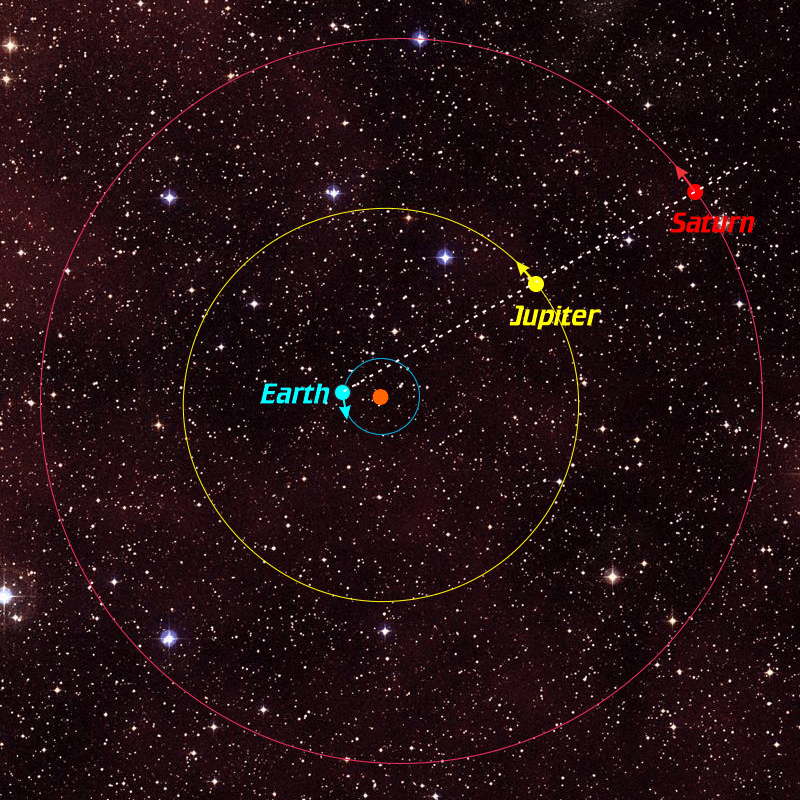
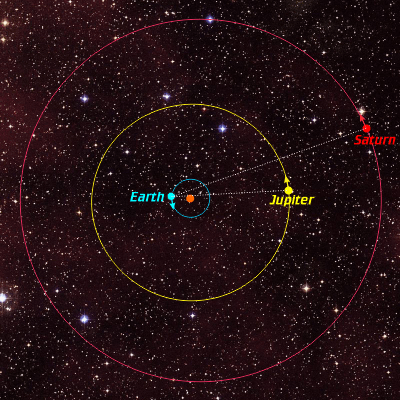
“Good thinking. We’re not going to die, they’re not going to collide, and Great Conjunctions happen way more often than every 800 years. You said you’d be asking about that so I built a couple of diagrams using planet positions I pulled from NASA’s slick Eyes on The Solar System app. OK, let’s start with this south‑facing view of the system as it was a year ago.”

Planetary positions, 15 Dec 2019

“Pretty, kinda, but what’s it mean?”

“That orange dot in the center is the Sun. The circles are planet orbits, and the colored dots show the position of each planet. All the planets and most of their moons go counterclockwise when viewed from Solar north — that’s what the little arrows show.”

“I thought Jupiter was way bigger than Earth.”

“It is. There’s no way you can get planet distances and planet sizes to scale in the same diagram. Distances are too big and even Jupiter’s too small. These distances are about right, but all the dots are just markers.”

“Funny, Sy — you dropped Jupiter half-way between Earth and Saturn.”

“That’s where it is. The distance between each pair of orbits is almost exactly 4½ times the distance between Earth and the Sun. Of course, the distance between the planets themselves depends on where each one is in its orbit and that changes all the time. Earth flies along its path three times faster than Saturn goes. Last December, Earth was 186 million miles further away from Saturn than it was in July.”

“Those dotted lines are sight-lines? That picture says that last December we had a clear view of Saturn but Earth and Jupiter were playing peek-a-boo around the Sun.”

“Exactly, and what a great lead‑in to my second diagram, calculated for next Monday.”

Planetary positions, 21 Dec 2020

“The two sight-lines overlap. They’ll look like just one planet, sorta. So that’s what all the fuss is about? They’re still that huge distance away from each other, not close to us at all.”

“Overlap’s a good word, though the official term is conjunction. The only things close together are images as seen from Earth. That last qualifier is important. What you see depends on where you stand. Our Curiosity rover on Mars won’t see a Great Conjunction like this for another month, on 31 Jan 2021.”

“What makes it a Great Conjunction? Is it brighter or something?”

“In a way. In principle you can have a conjunction of any two visible astronomical bodies. The phrase Great Conjunction only applies to Jupiter‑Saturn events. Of the classical planets Jupiter and Saturn are the slowest‑moving so their conjunction happens least often. They’re also the biggest and reflect more sunlight than Mercury or Mars so, yeah, their conjunctions tend to be especially bright.”

“But you said it happens a lot.”

“About every 20 years. You’re thinking about that 800‑year‑old event. That was the last time the two images were so close, less than a tenth of a degree apart.”

“So anyhow, we’re not all gonna die. Guess I’ll go Christmas shopping after all.”

“You do that, but shop local, OK?”

“That’s my motto now.”

~~ Rich Olcott

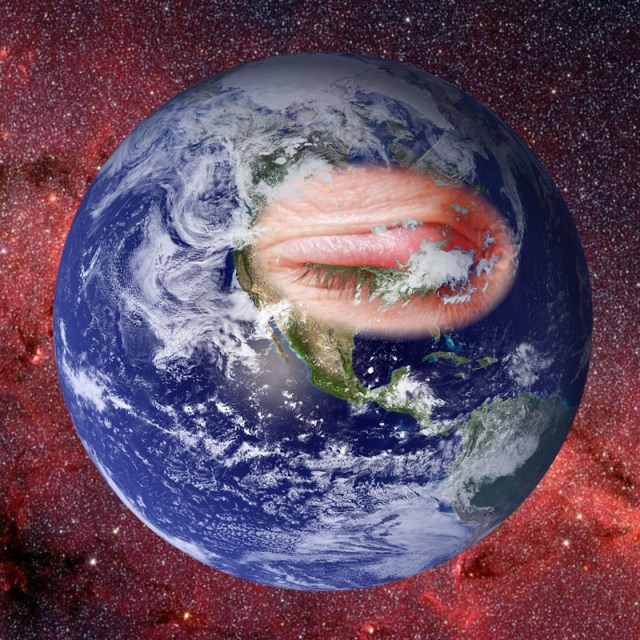
Earth’s Closed Eye

Question in the chat box, Maria, and I paraphrase to preserve anonymity — ‘So the Arecibo telescope won’t work any more. Why should we care? There’s lots of other telescopes that could so the same job.‘”

“But profesora, there aren’t. Arecibo is special in many ways. First, it is a very good telescope. That means it has high sensitivity and high resolution. Compare two radio telescopes with different‑size dishes and the same kinds of antennas and everything else. The one with the bigger dish is more sensitive because it can capture more photons. Arecibo’s 300‑meter dish used to be the largest in the world. China activated their FAST instrument five years ago. Its 500‑meter dish should make it more than 200 times as sensitive as Arecibo, but it doesn’t because neither telescope is designed to use the entire dish surface at once except for looking straight up. Their active areas are about the same.”

Is FAST another one of those goofy acronyms?

“Of course. It stands for ‘Five‑hundred‑meter Aperture Spherical radio Telescope‘ but in Chinese its name is Tianyan, which means ‘Heaven Eye.’ I think that is more pretty. FAST and Arecibo overlap their wavelength ranges, although FAST can receive some longer wavelengths and Arecibo can receive some shorter ones. Oh, there is also a big Russian radio telescope, RATAN‑600, with an even bigger diameter. But it is a ring, not a disk, so not as sensitive as Arecibo or FAST.”

A ring? Why did they build it that way?

“Because of the other thing you need in a good telescope, resolution. If you have good resolution in an image, you can see points that are very close together. The how‑close limit angle comes from dividing the light wavelength by the dish diameter. The diameter of RATAN’s ring is 600 meters, so RATAN’s resolving power is twice as good as Arecibo’s 300‑meter disk. RATAN doesn’t need to be sensitive, though, because it is used mostly for looking close at the Sun, not at stars and galaxies. That is OK because RATAN is so far north.”

What difference does that make?

“No telescope can see what is below its horizon. RATAN is at 43° north, almost 1400 miles north of Arecibo. It has a good view of the northern sky but cannot see down to the Equator where many asteroids and all the planets are.”

Sorry, Maria, that’s not quite correct. Earth is tilted relative to the orbital plane by 23° so even Arecibo only sees the northern portion of planetary orbits. While I’ve got the mic I’ll add some background on RATAN‑600. RATAN is the acronym for ‘Academy of Sciences Radio Telescope’ in Russian. It was built in the Cold War era when that part of the world was the USSR. Although I don’t believe it’s ever been publicly confirmed, many people think that RATAN‑600‘s original purpose was detection of ICBMs coming in over the North Pole. However, over the decades it has been a productive source of information for the solar physics community. Back to you, Maria.

“That is good to know, profesora. Thank you. So, Arecibo is — was —special because of its sensitivity and its resolution. It is also about 500 miles further south than FAST. But Arecibo has one additional feature that FAST cannot have — radar. Arecibo has high-powered transmitters that can send out terawatt pulses to things in the Solar System that are closer than Saturn. The dish gathers echoes that give us detailed knowledge of those objects. For instance, Arecibo’s radar echoes from Mercury showed us that the planet is not tidally locked to the Sun. We used to think Mercury’s day was 88 days long, like its year, but now we know it rotates in only 59 days.”

Why can’t the Chinese just add transmitters to FAST?

“The Chinese designers gave FAST a light‑weight antenna carriage to hang over its dish. Arecibo’s 900‑ton carriage can handle massive transmitters, but FAST’s cannot. There is one other radio telescope with radar, at Goldstone, California, but it has less than one‑millionth the power of Arecibo’s transmitters. Without Arecibo’s sensitivity, resolution, location and high-powered radar capability we cannot find near‑Earth asteroids on track to hit us.”

~~ Rich Olcott

Author’s note — Early in the morning of 1 December, after I completed last week’s and this post, the National Science Foundation reported that Arecibo’s central instrument platform has fallen onto the dish as a result of further cable failures.
“Vale, nostri servi boni et fidelis”
Farewell, our good and faithful servant.

Arecibo ¡que lástima!

Hello, Astronomy video class. I’ve made room in the syllabus schedule for a quick talk from someone with a personal connection to a timely topic. You may know we’ve lost one of Astronomy’s premier radio telescopes, Puerto Rico’s Arecibo Observatory. I’ve asked Maria to fill us in on the what and the why. If you have a question, type it into your chat window and I’ll relay it to her. Maria, you’re on.”

“Thank you, profesora. Yes, I do know Arecibo because I have worked there. I grew up in Hatillo, a small city on the north coast about half an hour away from the Observatory. My teacher of science in high school, somehow he got me a summer job there. Sometimes I worked in the gift shop, sometimes I helped the guided tours, but my best thing was running errands because then I could visit the science offices and chat with people about what they were doing. There I fell in love with Astronomy and that is why I came here to study.

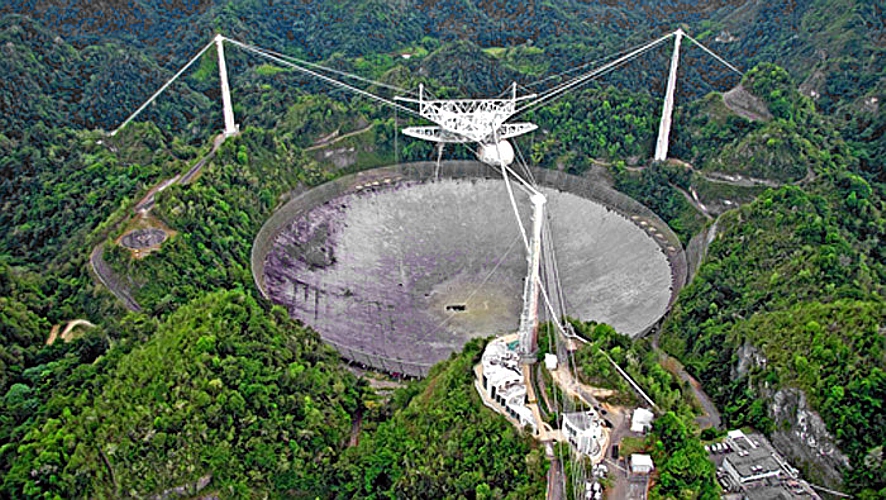
“When people think of Arecibo they think of the big 300 meter dish, about 1000 feet across. Sharing my screen for you… there. This picture I got from Wikipedia:

The Arecibo Observatory
photo by JidoBG, licensed under the Creative Commons Attribution-Share Alike 4.0 International

“The installation sits in very rough mountains. They are so rough because they are mostly limestone that slowly dissolves in water. The water seeps in through cracks to attack the rock and make cliffs and holes and caves. The Arecibo observatory is where it is because water eroded a cavern close to the surface. The topmost material fell into the empty space to make a huge round sinkhole like very few other places in the world.”

Question from the chat, Maria. Did the rock actually dissolve into that convenient smooth reflector shape?

“¡Por Dios no! The circular shape, yes, but the sinkhole floor is nearly flat. The dish itself is many aluminum panels fixed to a floating steel grid. Here is a picture Mr Phil Perillat took from beneath the dish. I don’t know Mr Perillat’s title but he is always very busy keeping things running.

“Above you see the grid, five meters or more above the ground. The grid is supported by concrete all around the edges. Coming down from the grid you see cables leading to those round concrete piers. These cables pull the grid down into its curved shape which is actually a piece of a sphere.”

A sphere, not a parabola?

“No, profesora, and that is important. A fixed dish with a parabola shape like most telescope mirrors always would aim straight up. It would see targets at the top of the sky but for only a few minutes as the Earth turns through the day. With a sphere‑shaped dish and the antennas mounted where the center of the sphere would be, then the whole sky is in focus. The scientists aim the telescope by moving the antennas to point at different parts of the dish like you look at different parts of one of those funny mirrors in, sorry I don’t know the word, una casa de la diversión.”

A funhouse.”

“Thank you. The antenna carriage is so complicated because it must look at different parts of the dish. Here you see the carriage:

The Arecibo receiver mounting and dome
Photo by Phil Perillat, National Astronomy and Ionosphere Center

“The antennas point downward from inside that dome. When motors swing the dome along that crescent‑shaped arc, the antennas scan along an arc of the dish. More motors can rotate the arc around that circular track. By swinging and rotating together, the antennas can follow the reflection of any object that moves through the sky.”

All those motors and tracks and antennas must be heavy.”

“Yes, 900 tons hanging 500 feet above the grid. Eighteen cables hold it up. Each is many strands of steel braided together. Compressed air blows through the braids to prevent corrosion, but the storms won out in the end. Three cables have failed and it is too dangerous for repair. So sad.”

~~ Rich Olcott

Author’s note — Early in the morning of 1 December, after I completed this and next week’s posts, the National Science Foundation reported that Arecibo’s central instrument platform had fallen onto the dish as a result of further cable failures.
“Vale, nostri servi boni et fidelis”
Farewell, our good and faithful servant.

Only a H2 in A Gilded Cage

“OK, Susan, you’ve led us through doing high-pressure experiments with the Diamond Anvil Cell and you’ve talked about superconductivity and supermagnetism. How do they play together?”

“It’s early days yet, Sy, but Dias and a couple of other research groups may have brought us a new kind of superconductivity.”

“Another? You talked like there’s only one.”

“It’s one of those ‘depends on how you look at it‘ things, Al. We’ve got ‘conventional‘ superconductors and then there are the others. The conventional ones — elements like mercury or lead, alloys like vanadium‑silicon — are the model we’ve had for a century. Their critical temperatures are generally below 30 kelvins, really cold. We have a 60‑year‑old Nobel‑winning theory called ‘BCS‘ that’s so good it essentially defines conventional superconductivity. BCS theory is based on quantum‑entangled valence electrons.”

“So I guess the unconventional ones aren’t like that, huh?”

“Actually, there seem to be several groups of unconventionals, none of which quite fit the BCS theory. Most of the groups have critical temperatures way above what BCS says should be the upper limit. There are iron‑based and heavy‑metals‑based groups that use non‑valence electrons. There are a couple of different carbon‑based preparations that are just mystical. There’s a crazy collection of copper oxide ceramics that can contain five or more elements. Researchers have come up with theories for each of them, but the theories aren’t predictive — they don’t give dependable optimization guidelines.”

“Then how do they know how to make one of these?”

“Old motto — ‘Intuition guided by experience.’ There are so many variables in these complex systems — add how much of each ingredient, cook for how long at what temperature and pressure, chill the mix quickly or anneal it slowly, bathe it in an electrical or magnetic field and if so, how strong and at what point in the process… Other chemists refer to the whole enterprise as witch’s‑brew chemistry. But the researchers do find the occasional acorn in the grass.”

“I guess the high‑pressure ploy is just another variable then?”

“It’s a little less random than that, Sy. If you make two samples of a conventional superconductor, using different isotopes of the same element, the sample with the lighter isotope has the higher critical temperature. That’s part of the evidence for BCS theory, which says that electrons get entangled when they interact with vibrations in a superconductor. At a given temperature light atoms vibrate at higher frequency than heavy ones so there’s more opportunity for entanglement to get started . That set some researchers thinking, ‘We’d get the highest‑frequency vibrations from the lightest atom, hydrogen. Let’s pack hydrogens to high density and see what happens.'”

“Sounds like a great idea, Susan.”

“Indeed, Al, but not an easy one to achieve. Solid metallic hydrogen should be the perfect case. Dias and his group reported on a sample of metallic hydrogen a couple of years ago but they couldn’t tell if it was solid or liquid. This was at 5 megabars pressure and their diamonds broke before they could finish working up the sample. Recent work has aimed at using other elements to produce a ‘hydrogen‑rich’ environment. When Dias tested H2S at 1.5 megabar pressure, they found superconductivity at 203 kelvins. Knocked everyone’s socks off.”

“Gold rush! Just squeeze and chill every hydrogen‑rich compound you can get hold of.”

“It’s a little more complicated than that, Sy. Extreme pressures can force weird chemistry. Dias reported that shining a green laser on a pressurized mix of hydrogen gas with powdered sulfur and carbon gave them a clear crystalline material whose critical temperature was 287 kelvins. Wow! A winner, for sure, but who knows what the stuff is? Another example — the H2S that Dias loaded into the DAC became H3S under pressure.”

“Wait, three hydrogens per sulfur? But the valency rules—”

“I know, Sy, the rules say two per sulfur. Under pressure, though, you get one unattached molecule of H2 crammed into the space inside a cage of H2S molecules. It’s called a clathrate or guest‑host structure. The final formula is H2(H2S)2 or H3S. Weird, huh? Really loads in the hydrogen, though.”

“Jupiter has a humungous magnetic field and deep‑down it’s got high‑density hydrogen, probably metallic. Hmmm….”

~~ Rich Olcott

Zeroing In on Water

<chirp, chirp> “Moire here.”

“Hi, Sy, it’s me, Vinnie. I just heard this news story about finding water on the Moon. I thought we did that ten years ago. You even wrote about it.”

“The internet never forgets, does it? That post wasn’t quite right but it wasn’t wrong, either.”

“How can it be both?”

“There’s an old line in Science — ‘Your data’s fine but your conclusions are … nuts.’ They use a different word in private. Suppose you land on a desert island and find a pirate’s treasure chest. Should the headlines say you’d found a treasure?”

“Naw, the chest might be empty or full of rocks or something.”

“Mm-hm. So, going back to that post… I was working from some reports on NASA’s Lunar Reconnaissance Orbiter. Its LAMP instrument mapped how strongly different Moon features reflected a particular frequency of ultraviolet light. That frequency’s called ‘Lyman‑alpha.’ Astronomers care about it because it’s part of starlight, it’s reflected by rock, and it’s specifically absorbed by hydrogen atoms. Sure enough, LAMP found some places, typically in deepshadow craters, that absorbed a lot more Lymanalpha than other places.”

“And you wrote about how hydrogen atoms are in water molecules and the Moon’s deep crater floors near the poles are sheltered from sunlight that’d break up water molecules so LAMP’s dark spots are where there’s water. And you liked how using starlight to find water on the Moon was poetical.”

“Uhh… right. All that made a lot of sense at the time and it still might be true. Scientists leapt to the same hopeful conclusion when interpreting data from the MESSENGER mission to Mercury. That one used a neutron spectrometer to map emissions from hydrogen atoms interacting with incoming cosmic rays. There again, the instrument identified hydrogen collected in shaded craters at the planet’s poles. Two different detection methods giving the same positive indication at the same type of sheltered location. The agreement seemed to settle the matter. The problem is that water isn’t geology’s only way or even its primary way to accumulate hydrogen atoms.”

“What else could it be? Hydrogen ions in the solar wind grab oxide ions from Moon rock and you’ve got water, right?”

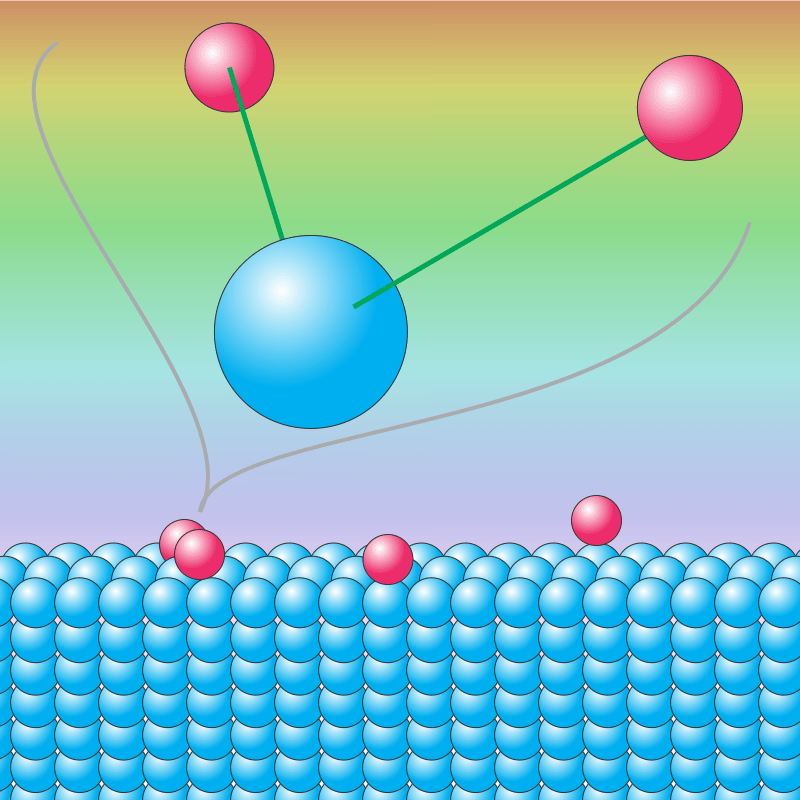
“But the hydrogens arrive one at a time, not in pairs. Any conversion would have to be at least a two‑step process. The Moon’s surface rocks are mostly silicate minerals. They’re a lattice of negative oxide ions that’s decorated inside with an assortment of positive metal ions. The first step in the conversion would be for one hydrogen ion to link up with a surface oxide to make a hydroxide ion. That species has a minus‑one charge instead of oxide’s minus‑two so it’s a bit less tightly bound to its neighboring metal ions. Got that?”

“Gimme a sec … OK, keep going.”

“Some time later, maybe a century maybe an eon, another hydrogen ion comes close enough to attack our surface hydroxide if it hasn’t been blasted apart by solar UV light. Then you get a water molecule. On balance and looking back, we’d expect most of the surface hydrogen to be hydroxide ions, not water, but both kinds would persist better in shadowed areas.”

“OK, two kinds of hydrogen. But how do we tell the difference?”

“We evaluate processes at lower‑energies. Lyman‑alpha photons pack over 10 electronvolts of energy, enough to seriously disturb an atom and blow a molecule apart. O‑H and H‑O‑H interact differently with light in the infra‑red range that just jiggles molecules instead of bopping them. For instance, atom pairs can stretch in‑out. Different kinds of atom bind together more‑or‑less tightly. That means each kind of atom pair resonates at its own stretch energy, generally around 6 microns or 0.41 electronvolts. NASA’s Cassini mission had a mapping spectrometer that could see down into that range. It found O‑H stretching activity all over the Moon’s surface.”

“But that could be either hydroxyls or water.”

“Exactly. The new news is that sensors aboard NASA’s airborne SOFIA mission map light even deeper into the infra‑red. It found the 3‑micron, 0.21‑electronvolt signal for water’s V‑shape scissors motion. That’s the water that everybody’s excited about.”

“Lots of it?”

“Thinly spread, probably, but stay tuned.”

~~ Rich Olcott

A Star’s Tale

It’s getting nippy outside so Al’s moved his out‑front coffee cart into his shop. Jeremy’s manning the curbside take‑out window but I’m walking so I step inside. Limited seating, of course. “Morning, Al. Here’s my hiking mug, fill ‘er up with high‑test and I’ll take a couple of those scones — one orange, one blueberry. Good news that the Governor let you open up.”

“You know it, Sy. Me and my suppliers have been on the phone every day. Good thing we’ve got long‑term relationships and they’ve been willing to carry me but it gets on my conscience ’cause they’re in a crack, too, ya know?”

“Low velocity of money hurts everybody, Al. Those DC doofuses and their political kabuki … but don’t get me started. Hey, you’ve got a new poster over the cash register.”

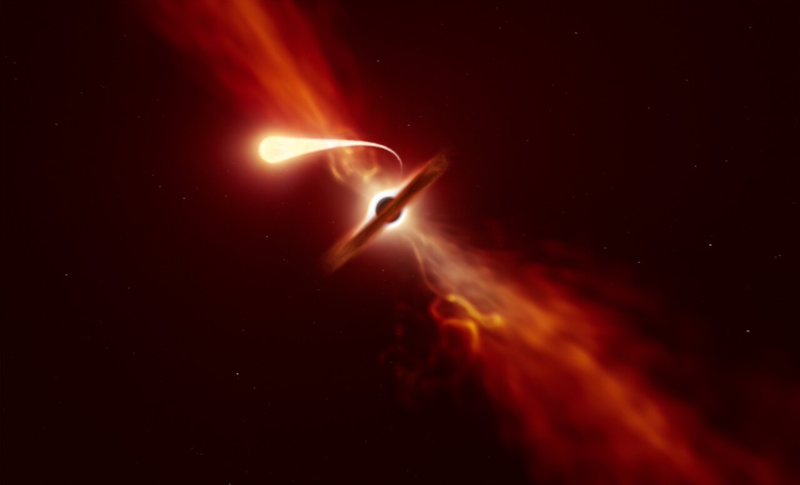
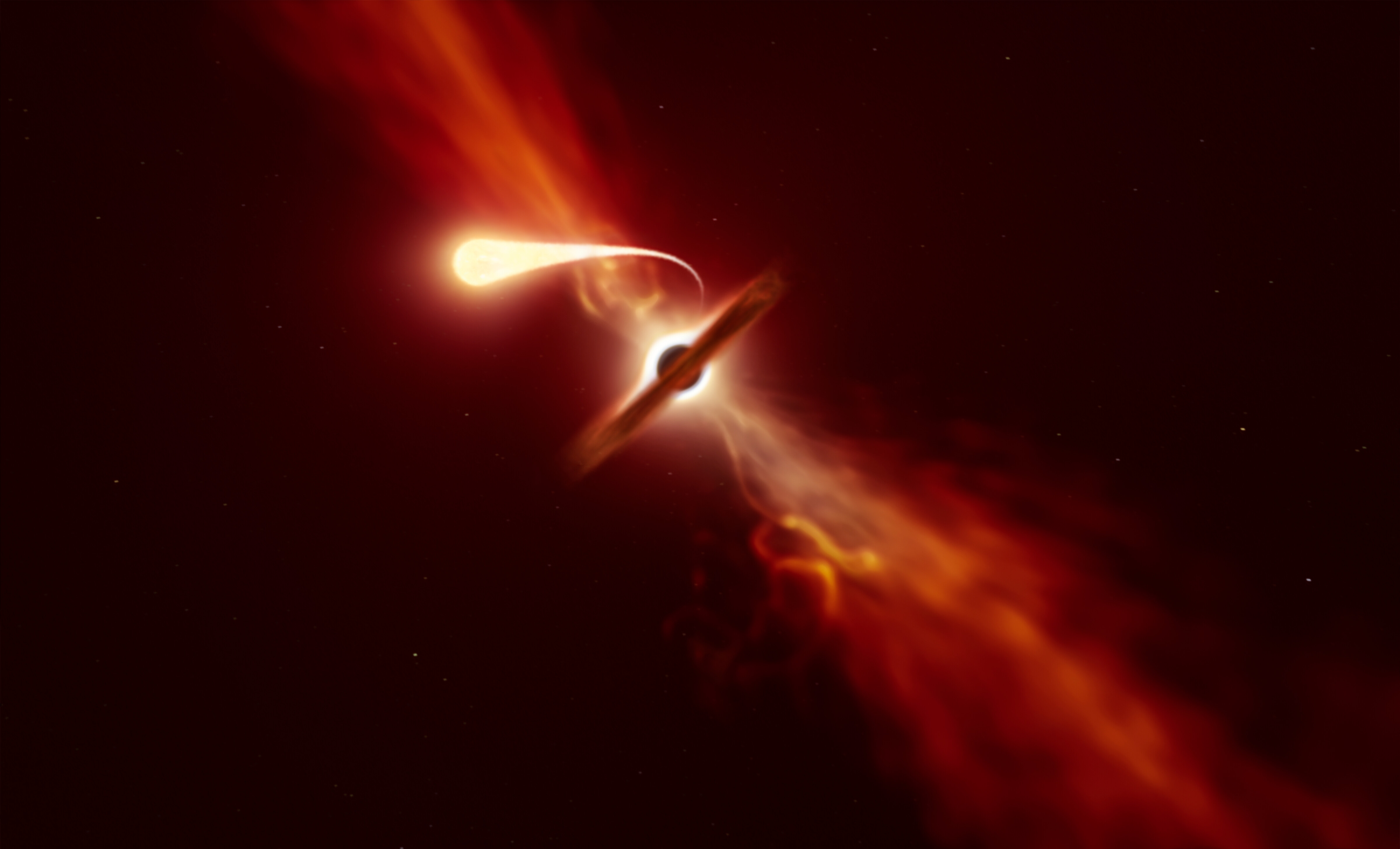
“You noticed. Yeah, it’s a beaut. Some artist’s idea of what it’d look like when a star gets spaghettified and eaten by a black hole. See, it’s got jets and a dust dusk and everything.”

“Very nice, except for a few small problems. That’s not spaghettification, the scale is all wrong and that tail-looking thing … no.”

Artist’s impression of AT2019qiz. Credit: ESO/M. Kornmesser
Under Creative Commons Attribution 4.0 International License

“Not spaghettification? That’s what was in the headline.”

“Sloppy word choice. True spaghettification acts on solid objects. Gravity’s force increases rapidly as you approach the gravitational center. Suppose you’re in a kilometer-long star cruiser that’s pointing toward a black hole from three kilometers away. The cruiser’s tail is four kilometers out. Newton’s Law of Gravity says the black hole pulls almost twice as hard on the nose as on the tail. If the overall field is strong enough it’d stretch the cruiser like taffy. Larry Niven wrote about the effect in his short story, Neutron Star.”

“The black hole’s stretching the star, right?”

“Nup, because a star isn’t solid. It’s fluid, basically a gas held together by its own gravity. You can’t pull on a piece of gas to stretch the whole mass. Your news story should have said ‘tidal disruption event‘ but I guess that wouldn’t have fit the headline space. Anyhow, an atom in the star’s atmosphere is subject to three forces — thermal expansion away from any gravitational center, gravitational attraction toward its home star and gravitational attraction toward the black hole. The star breaks up atom by atom when the two bodies get close enough that the black hole’s attraction matches the star’s surface gravity. That’s where the scale problem comes in.”

Al looks around — no waiting customers so he strings me along. “How?”

“The supermassive black hole in the picture, AT2019qiz, masses about a million Suns‑worth. The Sun‑size star can barely hold onto a gas atom at one star‑radius from the star’s center. The black hole can grab that atom from a thousand star‑radii away, about where Saturn is in our Solar System. The artist apparently imagined himself to be past the star and about where Earth is to the Sun, 100 star‑radii further out. Perspective will make the black hole pretty small.”

“But that’s a HUGE black hole!”

“True, mass‑wise, not so much diameter‑wise. Our Sun’s about 864,000 miles wide. If it were to just collapse to a black hole, which it couldn’t, its Event Horizon would be about 4 miles wide. The Event Horizon of a black hole a million times as massive as the Sun would be less than 5 times as wide as the Sun. Throw in the perspective factor and that black circle should be less than half as wide as the star’s circle.”

“What about the comet‑tail?”

“The picture makes you think of a comet escaping outward but really the star’s material is headed inward and it wouldn’t be that pretty. The disruption process is chaotic and exponential. The star’s gravity weakens as it loses mass but the loss is lop‑sided. Down at the star’s core where the nuclear reactions happen the steady burn becomes an irregular pulse. The tail should flare out near the star. The rest should be jagged and lumpy.”

“And when enough gets ripped away…”

“BLOOEY!”

~~ Rich Olcott

  • Thanks to T K Anderson for suggesting this topic.
  • Link to Technical PS — Where Do Those Numbers Come From?.