Dark Passage

Change-me Charlie’s not giving up easily. “You said that NASA picture did three things, but you only told us two of them — that dark matter’s a thing and that it’s separate from normal matter. What’s the third thing? What exactly is in that picture? Does it tell us what dark matter is?”

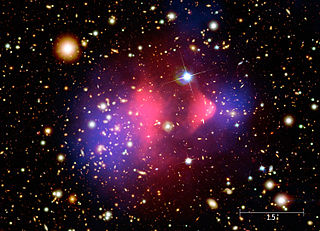
The Bullet Cluster ( 1E 0657-56 )

Physicist-in-training Newt’s ready for him. “Not much of a clue about what dark matter is, but a good clue about how it behaves. As to what’s in the picture, we need some background information first.”

“Go ahead, it’s not dinner-time yet.”

“First, this isn’t two stars colliding. It’s not even two galaxies. It’s two clusters of galaxies, about 40 all together. The big one on the left probably has the mass of a couple quintillion Suns, the small one about 10% of that.”

“That’s a lot of stars.”

“Oh, most of it’s definitely not stars. Maybe only 1-2%. Those stars and the galaxies they form are embedded in ginormous clouds of proton-electron plasma that make up 5-20% of the mass. The rest is that dark matter you don’t like.”

“Quadrillions of stars are gonna make a super-super-nova when they collide!”

“Well, no. That doesn’t even happen when two galaxies collide. The average distance between neighboring stars in a galaxy is 200-300 times the diameter of a star so it’s unlikely that any two of them will come even close. Next level up, the average distance between galaxies in a cluster is about 60 galaxy diameters or more, depending. The galaxies will mostly just slide past each other. The real colliders are the spread-out stuff — the plasma clouds and of course the dark matter, whatever that is.”

Astronomer-in-training Jim cuts in. “Anyway, the collision has already happened. The light from this configuration took 3.7 billion years to reach us. The collision itself was longer ago than that because the bullet’s already passed through the big guy. From that scale-bar in the bottom corner I’d say the centers are about 2 parsecs apart. If I recall right, their relative velocity is about 3000 kilometers per second so…” <poking at his smartphone> “…the peak intersection was about 700 million years earlier than that. Call it 4.3 billion years ago.”

“So what’s with the cotton candy?”

Newt looks puzzled. “Cotton… oh, the pink pixels. They’re markers for where NASA’s Chandra telescope saw X-rays coming from.”

“What can make X-rays so far from star radiation that could set them going?”

“The electrons do it themselves. An electron emits radiation every time it collides with another charged particle and changes direction. When two plasma clouds interpenetrate you get twice as many particles per unit volume and four times the collision rate so the radiation intensity quadruples. There’s always some X-radiation in the plasma because the temperature in there is about 8400 K and particle collisions are really violent. The Chandra signal pink shows the excess over background.”

“The blue in the Jim’s picture is supposed to be what, extra gravity?”

“Basically, yeah. It’s not easy to see from the figure, but there are systematic distortions in the images of the background galaxies in the blue areas. Disks and ellipsoids appear to be bent, depending on where they sit relative to the clusters’ centers of mass. The researchers used Einstein’s equations and lots of computer time to work back from the distortions to the lensing mass distributions.”

“So what we’ve got is a mostly-not-from-stars gravity lump to the left, another one to the right, and a big cloud in the middle with high-density hot bits on its two sides. Something in the middle blew up and spread gas around mostly in the direction of those two clusters. What’s that tell us?”

“Sorry, that’s not what happened. If there’d been a central explosion the excess to the right would be arc-shaped, not a cone like you see. No, this really is the record of one galaxy cluster bursting through another one. Particle-particle friction within the plasma clouds held them back while the embedded galaxies and dark matter moved on.”

“OK, the galaxies aren’t close-set enough for them to slow each other down, but wouldn’t friction in the dark matter hold things back, too?”

“Now that’s an interesting question…”

~~ Rich Olcott

The Prints of Darkness

There’s a commotion in front of Al’s coffee shop. Perennial antiestablishmentarian Change-me Charlie’s set up his argument table there and this time the ‘establishment’ he’s taking on is Astrophysics. Charlie’s an accomplished chain-yanker and he’s working it hard. “There’s no evidence for dark matter, they’ve never found any of the stuff and there’s tons of no-dark-matter theories to explain the evidence.”

Big Cap’n Mike’s shouts from the back of the crowd. “What they’ve been looking for and haven’t found is particles. By my theory dark matter’s an aspect of gravity which ain’t particles so there’s no particles for them to find.”

Astronomer-in-training Jim spouts off right in Charlie’s face. “Dude, you can’t have it both ways. Either there’s no evidence to theorize about, or there’s evidence.”

Physicist-in-training Newt Barnes takes the oppo chair. “So what exactly are we talking about here?”

“That’s the thing, guy, no-one knows. It’s like that song, ‘Last night I saw upon the stair / A little man who wasn’t there. / He wasn’t there again today. / Oh how I wish he’d go away.‘ It’s just buzzwords about a bogosity. Nothin’ there.”

I gotta have my joke. “Oh, it’s past nothing, it’s a negative.”

“Come again?”

“The Universe is loaded with large rotating but stable structures — solar systems, stellar binaries, globular star clusters, galaxies, galaxy clusters, whatever. Newton’s Law of Gravity accounts nicely for the stability of the smallest ones. Their angular momentum would send them flying apart if it weren’t for the gravitational attraction between each component and the mass of the rest. Things as big as galaxies and galaxy clusters are another matter. You can calculate from its spin rate how much mass a galaxy must have in order to keep an outlying star from flying away. Subtract that from the observed mass of stars and gas. You get a negative number. Something like five times more negative than the mass you can account for.”

“Negative mass?”

“Uh-uh, missing positive mass to combine with the observed mass to account for the gravitational attraction holding the structure together. Zwicky and Rubin gave us the initial object-tracking evidence but many other astronomers have added to that particular stack since then. According to the equations, the unobserved mass seems to form a spherical shell surrounding a galaxy.”

“How about black holes and rogue planets?”

Newt’s thing is cosmology so he catches that one. “No dice. The current relative amounts of hydrogen, helium and photons say that the total amount of normal matter (including black holes) in the Universe is nowhere near enough to make up the difference.”

“So maybe Newton’s Law of Gravity doesn’t work when you get to big distances.”

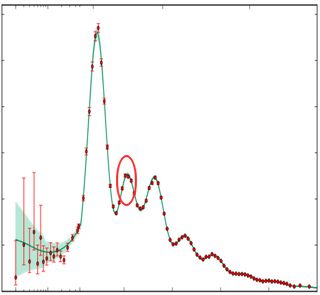
“Biggest distance we’ve got is the edge of the observable Universe. Jim, show him that chart of the angular power distribution in the Planck satellite data for the Cosmological Microwave Background.” <Jim pulls out his smart-phone, pulls up an image.> “See the circled peak? If there were no dark matter that peak would be a valley.”

Charlie’s beginning to wilt a little. “Ahh, that’s all theory.”

The Bullet Cluster ( 1E 0657-56 )

<Jim pulls up another picture.> “Nope, we’ve got several kinds of direct evidence now. The most famous one is this image of the Bullet Cluster, actually two clusters caught in the act of colliding head-on. High-energy particle-particle collisions emit X-rays that NASA’s Chandra satellite picked up. That’s marked in pink. But on either side of the pink you have these blue-marked regions where images of further-away galaxies are stretched and twisted. We’ve known for a century how mass bends light so we can figure from the distortions how much lensing mass there is and where it is. This picture does three things — it confirms the existence of invisible mass by demonstrating its effect, and it shows that invisible mass and visible mass are separate phenomena. I’ve got no pictures but I just read a paper about two galaxies that don’t seem to be associated with dark matter at all. They rotate just as Newton would’ve expected from their visible mass alone. No surprise, they’re also a lot less dense without that five-fold greater mass squeezing them in.”

“You said three.”

“Gotcha hooked, huh?

~~ Rich Olcott

Fierce Roaring Beast

A darkish day calls for a fresh scone so I head for Al’s coffee shop. Cathleen’s there with some of her Astronomy students. Al’s at their table instead of his usual place behind the cash register. “So what’s going on with these FRBs?”

She plays it cool. “Which FRBs, Al? Fixed Rate Bonds? Failure Review Boards? Flexible Reed Baskets?”

Jim, next to her, joins in. “Feedback Reverb Buffers? Forged Razor Blades?
Fennel Root Beer?”

I give it a shot. “Freely Rolling Boulders? Flashing Rapiers and Broadswords? Fragile Reality Boundary?”

“C’mon, guys. Fast Radio Bursts. Somebody said they’re the hottest thing in Astronomy.”

Cathleen, ever the teacher, gives in. “Well, they’re right, Al. We’ve only known about them since 2007 and they’re among the most mystifying objects we’ve found out there. Apparently they’re scattered randomly in galaxies all over the sky. They release immense amounts of energy in incredibly short periods of time.”

“I’ll say.” Vinnie’s joins the conversation from the next table. “Sy and me, we been talking about using the speed of light to measure stuff. When I read that those radio blasts from somewhere last just a millisecond or so, I thought, ‘Whatever makes that blast happen, the signal to keep it going can’t travel above lightspeed. From one side to the other must be closer than light can travel in a millisecond. That’s only 186 miles. We got asteroids bigger than that!'”

“300 kilometers in metric.” Jim’s back in. “I’ve played with that idea, too. The 70 FRBs reported so far all lasted about a millisecond within a factor of 3 either way — maybe that’s telling us something. The fastest way to get lots of energy is a matter-antimatter annihilation that completely converts mass to energy by E=mc².  Antimatter’s awfully rare 13 billion years after the Big Bang, but suppose there’s still a half-kilogram pebble out there a couple galaxies away and it hits a hunk of normal matter. The annihilation destroys a full kilogram; the energy release is 1017 joules. If the event takes one millisecond that’s 1020 watts of power.”

“How’s that stand up against the power we receive in an FRB signal, Jim?”

“That’s the thing, Sy, we don’t have a good handle on distances. We know how much power our antennas picked up, but power reception drops as the square of the source distance and we don’t know how far away these things are. If your distance estimate is off by a factor of 10 your estimate of emitted power is wrong by a factor of 100.”

“Ballpark us.”

<sigh> “For a conservative estimate, say that next-nearest-neighbor galaxy is something like 1021 kilometers away. When the signal finally hits us those watts have been spread over a 1021-kilometer sphere. Its area is something like 1049 square meters so the signal’s power density would be around 10-29 watts per square meter. I know what you’re going to ask, Cathleen. Assuming the radio-telescope observations used a one-gigahertz bandwidth, the 0.3-to-30-Jansky signals they’ve recorded are about a million million times stronger than my pebble can account for. Further-away collisions would give even smaller signals.”

Looking around at her students, “Good self-checking, Jim, but for the sake of argument, guys, what other evidence do we have to rule out Jim’s hypothesis? Greg?”

“Mmm… spectra? A collision like Jim described ought to shine all across the spectrum, from radio on up through gamma rays. But we don’t seem to get any of that.”

“Terry, if the object’s very far away wouldn’t its shorter wavelengths be red-shifted by the Hubble Flow?”

“Sure, but the furthest-away one we’ve tagged so far is nearer than z=0.2. Wavelengths have been stretched by 20% or less. Blue light would shift down to green or yellow at most.”

“Fran?”

“We ought to get even bigger flashes from antimatter rocks and asteroids. But all the signals have about the same strength within a factor of 100.”

“I got an evidence.”

“Yes, Vinnie?”

“That collision wouldn’t’a had a chance to get started. First contact, blooie! the gases and radiation and stuff push the rest of the pieces apart and kill the yield. That’s one of the problems the A-bomb guys had to solve.”

Al’s been eaves-dropping, of course. “Hey, guys. Fresh Raisin Bread, on the house.”

~~ Rich Olcott

Friendly Resting Behemoths

What Time Is It on Mars?

I’m puffing a little after hiking up a dozen flights of stairs. That whole bank of Acme Building elevators is closed off while the repair crew tries to free up the one that trapped us. The crowd waiting for the other bank is forgetaboutit. I unlock my office door and there’s Vinnie, tinkering with the thermostat. “Geez, Sy, it’s almost as cold in here as it is out in the hall. Hey, ya think there’s anything to the rumor that building management is gonna rent out that elevator as office space? And how does time work on Mars?”

“Morning, Vinnie. You’re right, I don’t think so, and where’d that last question come from?”

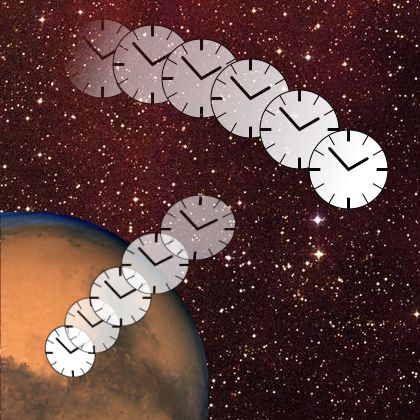
“I been thinking about those ultra-accurate clocks and how they’d play into that relativity stuff we talked about with Ramona.” <short lull in the conversation as we both consider Ramona> “Suppose there’s one of those clocks in a satellite going around Earth. If I remember right, it’s going ZIP around the planet so its clock ought to run faster than my wristwatch, but it’s further out of Earth’s gravity well so its clock ought to run slower. Which would win?”

“You remembered right — you’ve got Special Relativity and General Relativity in a couple of nutshells, and yes, they sometimes work in opposite directions. You have to look at the numbers. Give me a sec to work up a few examples on Old Reliable… OK, let’s start with the speed part. That’s Special Relativity because they both start with ‘SP’.”

“Cute.”

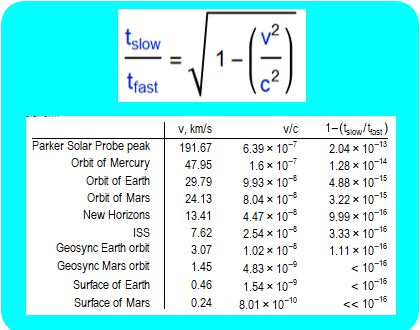
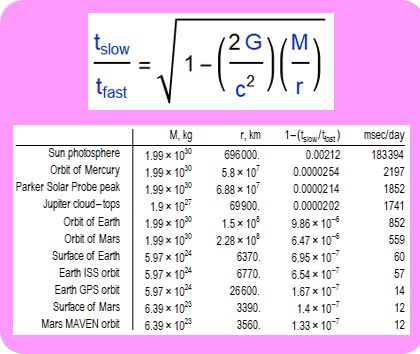
“I thought so.  OK, here’s a handful of locations and their associated straight-line speeds relative to some star far away. That last column shows a difference factor for a clock at each location compared to a far-away motionless clock in a zero gravitational field. Multiply the factor by 86,400 seconds per day to get the time difference per day. The fastest thing on the list is that spacecraft we’re sending to the Sun by way of some slingshot maneuvers around Venus to speed it up. The Special Relativity difference comes to less than two nanoseconds per day. That’s barely in the range we can detect. It’s way less for everyplace else. ”

“Hey, Mars is down at the bottom. Lemme think why… OK, slower rotation than Earth’s, AND smaller radius so you don’t move as far for the same degrees of spin, so the formula barely subtracts anything from 1.0, right?”

“Yup, the slower you go compared to lightspeed the smaller the time adjustment. The difference between unity and the ratio for a point on Mars’ surface is so small that Old Reliable suffered a floating-point underflow trying to calculate it. That’s hard to make it do. Bottom line, the SR effect doesn’t really kick in unless you’re going faster than practically everything larger than an atom.”

“So how about the gravity wells? I’ll bet the deeper the well, the more time gets stretched.”

“Good bet. The well gets deeper as the attracting mass increases. But your clock feels less of a squeeze if it’s further away. The net effect is controlled by the mass-to-distance ratio inside that square root. Worst case in this table is at the top. A clock embedded in the Sun’s photosphere loses 0.00212*(86400 sec/day)=183 seconds compared to a far-away motionless clock in free-fall. We here on Earth lose 912 milliseconds a day total, but the astronauts on the ISS lose about 3 milliseconds less than we do because they’re further away from Earth’s center.”

“Yeah, I read about those twin astronauts. The one flying on the ISS didn’t get older as fast as the one that stayed on Earth.”

“About a second’s-worth over a year. So, do you have your relativity and Mars-time answer?”

“Sorta. But what time is it up there right now?”

“Hey, Mars is a whole world and has different times at different places just like Earth does. Wherever you are on Mars, ‘noon’ is when the Sun is overhead. Mars spins about 3% slower than Earth does — noon-to-noon there is Earth’s 24 hours plus 37 minutes and change. Add in the net 340-millisecond relativistic daily drift away from Earth time. No way can you sync up Earth and Mars times.”

“Nothin’s simple, huh?”

~~ Rich Olcott
For the VLA, Timing Is Everything

Eddie’s pizza is especially tasty after a long walk down a stairwell. Vinnie and I are polishing off the last of our crumbs when he says, “OK, so we got these incredibly accurate clocks. Two questions. What do we use them for besides sending out those BBC pips, and what do they have to do with the new kilogram standard?”

“Pips? Oh, the top-of-the-hour radio station beeps we used to depend upon to set our watches. Kept us all up-to-the-minute, us and the trains and planes — but we don’t need 10-digit accuracy for that. What we do get from high-quality time signals is the ability to create distributed instruments.”

“Distributed instruments?”

“Ones with pieces in different places. You know about the Jansky Very Large Array, that huge multi-dish radio telescope in New Mexico?”

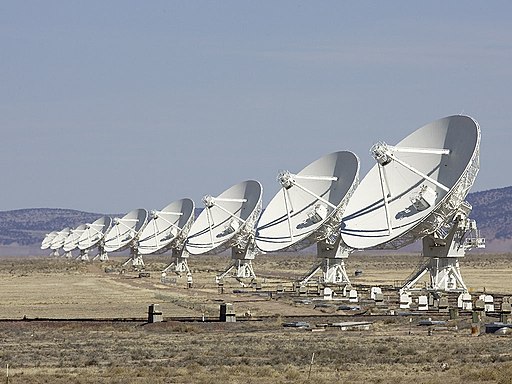
Karl G. Jansky Very Large Array, photo by Mihaiscanu
via Wikimedia Commons licensed under Creative Commons

“Been there. Nice folks in Pie Town up the road.”

“Did you look around?”

“Of course. What I didn’t understand is why they got 27 dishes and they’re all pointed the same direction. You’d think one would be enough for looking at something.”

“Ah, that’s the thing. All of them together make one telescope.”

<sets smartphone to calculator mode> “Lessee … dish is 25 meters across, πD2/4, 27 dishes, convert square meters to… Geez, 3¼ acres! A single dish that size would be a bear to keep steady in the wind down there. No wonder they split it up.”

“That was one concern, but the total area’s not as important as the distance between the pairs.”

“Why’s that even relevant?”

“Because radio telescopes don’t work the way that optical ones do. No lens or mirror, just a big dish that accepts whatever comes in along a narrow beam of radio waves.”

“How narrow?”

“About the size of the full Moon.”

“That can cover a lot of stars and galaxies.”

“It sure can, which is why early radio astronomy was pretty low-resolution. Astronomers needed a way to pick out the signals from individual objects within that field of view. Turns out two eyes are better than one.”

“3D vision?”

“Kinda related, but not really. Our two eyes give us 3D vision because each eye provides a slightly different picture of close-by objects, say, less than about 5 yards away. For everything further, one eye’s view is no different from the other’s. You’d get the same effect if distant things were painted on a flat background, which is how come a movie set backdrop still looks real.”

“You’re saying that the stars are so far away that each dish gets the same picture.”

“Yeah.”

“So why have more than one?”

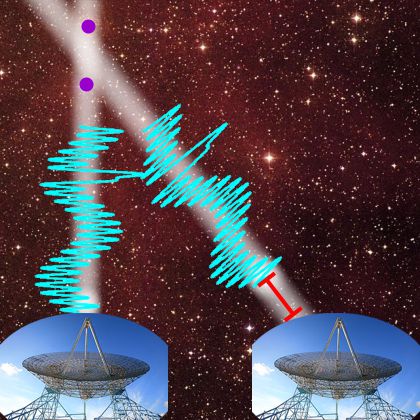
“They don’t get the picture at the same time. With an atomic clock you can take account of when each signal arrives at each dish. Here’s a diagram I did up on Old Reliable. It’s way out of scale but it makes the point, I think. We’ve got two dishes at the bottom here, and those purple dots are two galaxies. Each dish sees them on top of each other and can’t distinguish which one sent that peaky signal. What’s important is, the dish on the right receives the signal later. See that red bar? That’s the additional path length the signal has to travel to reach the second dish.”

“Can’t be much later, light travels pretty fast.”

“About 30 centimeters per nanosecond, which adds up. When the VLA dishes are fully spread out, the longest dish-to-dish distance is about 36 kilometers which is about 120 microseconds as the photon flies. That’s over a million ticks on the cesium clock – no problem tracking the differences.”

“Same picture a little bit later. Doesn’t seem worth the trouble.”

“What makes it worth the trouble is what you can learn from the total space-time pattern after you combine the signals mathematically. Under good conditions the VLA can resolve signals from separate objects only 40 milliarcseconds apart, about 1/45000 the diameter of the Moon. That’s less than the width of a dime seen from 50 miles away.”

“The time pattern is how the dishes act like a single spread-around telescope, huh? Without the high-precision time data, they’re just duplicates?”

“Atomic clocks let us see the Universe.”

~~ Rich Olcott
Time in A Bottle, Sort Of

We’re in the Acme Building’s elevator, headed down to Eddie’s for pizza, when there’s a sudden THUNK.  Vinnie’s got his cellphone out and speed-dialed before I’ve registered that we’ve stopped.  “Michael, it’s me, Vinnie.  Hi.  Me and Sy are in elevator three and it just stopped between floors.  Yeah, between six and five.  Of course I know that’s where, I always count floors.  Look, you get us outta here quick and I won’t have to call the rescue squad and you don’t have paperwork, OK?  Warms my heart to hear you say that.  Right.  And there’s pizza in it for you when we’re out.  Thanks, Michael.”  <to me>  “Says it’ll be a few minutes.  You good for climbing out when he levers the doors?”

“Sure, no problem.  Might as well keep on about why the kilogram definition changed.  Oddly enough, the story starts with one of the weirdest standards in Science.  Here, I’ll pull it up on Old Reliable…”

“OK, that’s a weird number in the fraction, but what’s weird about the whole definition?”

“Think about it — when they defined this standard in 1960, it essentially said, ‘Go back sixty years, see how long it took for the Sun to return to exactly where it was in the sky a year earlier, capture exactly that weird fraction of the one-year interval in a bottle and bring it back to the present for comparison with an interval you want to report a time for.  Sound doable to you?”

“Mmm, no.  But these guy’s weren’t stupid.  There had to be a way.”

“The key is in those words, ephemeris time.”

“Something like Greenwich Time?  How would that help?” 

“Greenwich Mean Time would be better — ‘mean’ as in ‘average.’  You know the Earth doesn’t spin perfectly, right?”

“Yeah, it wobbles.  The Pole Star won’t be at the pole in a few thousand years.”

“That’s the idea but things are messier than that.  For instance, when a large mass moves around, like a big volcano eruption or a major ice-sheet breakup or monsoon rains using Indian Ocean water to drench Southwest Asia, that causes a twitch in the rotation.”

“Hard to see how those twitches would be measurable.”

“They are when you’re working at 9-digit precision, which atomic clocks exceeded long ago.  Does your GPS unit have that spiffy dual-frequency function for receiving satellite time signals?”

“Sure does  — good to within a foot.”

“That’d be about 30 centimeters.  Speed of light’s 3×10⁸ meters per second so you’re depending on satellite radio time-checks good to about, um, 100 nanoseconds, in a data field holding week number and seconds down to nanoseconds.  So you’d expect measurement jitter within … about 2 parts in 1015.  Pretty good, and on that scale those twitches count.”

“What do they do about them?”

“Well, you can’t fix Earth, but you can measure the twitches very carefully and then average over them.  Basically, you list all the Sun-position measurements made over many years, along with the corresponding time as reported by then-current science’s best clocks.  Use those observations to build a mathematical model of where an averaged fake Sun would appear to be at any given moment if it were absolutely regular, no twitches.  When the fake Sun would be at its highest during a given day, that’s noon GMT.”

“Fine, but what’s that got to do with your weird definition?”

“You can run your mathematical model backward in time to see how many times your best-we’ve-got-now clock would tick between fake noon and fake 12:00:01 on that date.  That calibrates your clock.”

“Seems a little circular to me — Sun to clock to model to fake-Sun to clock.”

“Which is why, now that we’ve got really good clocks, they’ve changed the operational definition by dropping the middleman.  The most precise measurements for anything depend on counting.  We now have technology that can count individual peaks in a lightwave signal.  These days the second is defined this way.  If a counter misses one peak, that’s one part in 10 million, three counts per year.  That’s so much better than Solar time they sometimes have to throw in a ‘leap-second’ so the years can keep up with the clocks.”

“Michael’s way overdue.  I’m callin’ him again.”

Clock image from vecteezy.com

~~ Rich Olcott


Why So Big?

“How come so big, kid?”

“Beg pardon, Mr Feder?”

“Mars has the biggest volcanoes and all, like that canyon you can’t even see across.  Earth’s bigger than Mars, right?  How come we don’t have stuff like that?”

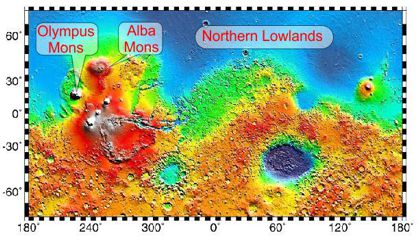
“Maybe we do but we’ve not found it yet.  Earth’s land area is only 4% greater than the surface area of Mars.  Our ocean floor and what’s beneath the Greenland and Antarctic ice sheets are like a whole second planet twice as big as the land we’ve explored so far.  Some people refer to the Mid-Atlantic Ridge as a 10000-mile-long volcano.  No-one knows for sure what-all else is down there.  Even on land we’ve probably had enormous landforms like Alba Mons but on the geologic timescale they don’t last long here.”

“So like I said, how come?”

“Because of what we have that Mars doesn’t.  Massive forces of erosion — wind, water, Goldilocks temperatures — that grind down landforms something fierce.”

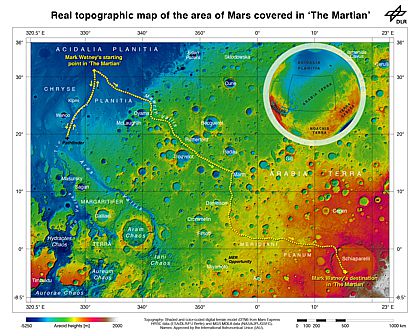
Watney_s route 420
Mark Watney’s travel route in The Martian.
Image by ESA/DLR/FU Berlin
under Creative Commons license

“Wait, Mars has winds.  What about those dust storms, and that windstorm that damn near destroyed Watney’s spaceship?”

“Um, Watney’s a fictional character.  The dust storms do exist, though —  one of them created a blackout that may have killed the Opportunity rover’s solar power.  But Martian dust grains are about the size of smoke particles.  Doesn’t take much of a wind to get those grains into the air and keep them there even in Martian atmosphere that’s only 1% as thick as Earth’s.  A 120-mph wind on Earth would blow you over, but one on Mars would just give you a gentle push.  Martian winds can barely roll a sand grain along the ground.  They definitely can’t sandblast a volcano like Earth winds can.  Which, by the way is why planetologists panned that storm scene in your The Martian movie.  Couldn’t happen.  The film production team admitted that.  The rest of the science was pretty good, though.”

“OK then, water.  You talking like dripping water can wear a hole in a rock?”

“More like water in quantity — glaciers carving off mountaintops and rivers digging canyons and ocean waves smashing shorelines to sandy powder.  Dripping water works, too — water’s corrosive enough even at low temperatures that it can dissolve most kinds of rock if you give it enough time.  But Mars has no glaciers or rivers or oceans.  Probably no dripping water, either”

“You were kidding about Goldilocks, right?  Talk about fictional characters!”

“Not in this case.  To planetologists, ‘Goldilocks’ is a technical term.  You know, ‘not too cold, not too warm…”

“‘Just right,’ yeah, yeah.  But just right for what?  What’s Mars got that’s Goldilocks-ish?”

“Sorry, it’s Earth that has the Goldilocks magic, not Mars, and what’s just right is that we’re in the right temperature range for water to exist in gas and liquid and solid forms.  Mars’ surface is way too cold for liquid water.”

“Wait, I read that they’d found liquid water there.”

“Not on the surface.  The radar experiment aboard European Space Agency’s Mars Express spacecraft found an indication of liquid water, but it’s a kilometer below the surface.  Twenty kilometers wide, maybe a meter thick — more of a pond than the ‘lake’ the media were talking about.”

“Why should it make a difference that Earth’s Goldilocks-ish?  I mean, we’re comfortable but we’re not rocks.  What’s that got to do with the volcanoes?”

“Recycling, Mr Feder, recycling.  On Mars, if enough gaseous water molecules could get together to make rain, which they can’t, they’d freeze to the ground and stay there for a long, long time.  On Earth, though, most rain stays liquid and you get ground water or run-off which eventually evaporates and rains down again.  The same molecules get many, many chances to grind down a mountain.”

“But Earth water can freeze, too.”

“Remember we’re Goldilocks-ish.  Liquid water soaks into a cracked rock where it freezes, expands to pry off a chip or two, and thaws to freeze again.  Water’s freeze-thaw cycle can do a lot of damage if it gets to repeat often enough.”

“So Mars has big stuff because…”

“The planet’s too cold to wear it away.”

~~ Rich Olcott

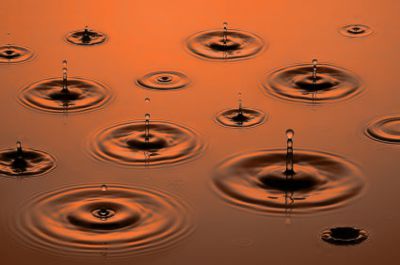
Raindrops landing in a red-brown puddle
Adapted image from Clipart-library.com

The Big Splash? Maybe.

You’ve not seen half of it, Mr Feder.  Mars has the Solar System’s tallest volcano, most massive volcano, biggest planetary meteor strike, deepest and longest  canyon…”

“Wait, kid, I’ve been to the Grand Canyon.  Thing is … BIG!  What’d they say?  A mile deep, 18 miles wide, 250 miles long.  No way Mars can beat that.”

“Valles Marineris is 4½ miles deep, 120 miles wide and 2500 miles long.  The Grand Canyon meanders, packing its length into only 150 miles of bee-line distance.  Marineris stretches straight as a string.  No river carved that formation, but the planetologists can’t agree on what did.”

Labeled Mars map 2 420
Mars map from NASA/JPL/GSFC

“They got evidence, don’t they?”

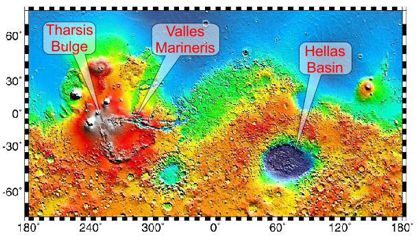
“Not enough.  Different facts point in different directions and no overall theory has won yet.  Most of it has to do with the landforms.  Start with the Tharsis Bulge, big as a continent and rising kilometers above Mars’ average altitude.  Near the Bulge’s highest point, except for the volcanoes, is a fractured-looking region called Noctis Labyrinthus.  Starting just west of  the Labyrinth a whole range of wrinkly highlands and mountains arcs around south and then east to point towards the eastern end of Marineris.  Marineris completes the arc by meeting the Labyrinth to its west.  Everything inside that arc is higher than everything else around it.  Except for the volcanoes, of course.”

“Looks like something came up from underneath to push all that stuff up.”

“Mm-hm, but we don’t know what, or what drove it, or even how fast everything happened.  There are theories all over the place”

“Like what?”

“Well, maybe it’s upwellng from a magma hotspot, like the one under the Pacific that’s been creating Hawaiian Islands one at a time for the past 80 million years.  Some people think the upwelling mostly lifted the existing crust like expanding gas bubbles push up the crust of baking bread.  Other people think that the upwelling’s magma broke through the crust to form enormous lava flows that covered up whatever had been there before.”

“You said ‘maybe.'”

“Yeah.  Another group of theories sees a connection between Tharsis and Hellas Basin, which is almost exactly on the other side of the planet.  Hellas is the rock-record of a mega-sized meteorite strike, the third largest confirmed one in the Solar System.  Before you ask, the other two are on the Moon.  Like I said, it’s a group of theories.  The gentlest one, if you can call it that, is that energy from the impact rippled all around the planet to focus on the point opposite the impact.  That would have disrupted the local equilibrium between crustal weight and magma’s upward pressure.  An imbalance like that would encourage uplift, crustal cracking and, ultimately, Valles Marineris.”

“Doesn’t sound very gentle.”

“It wouldn’t have been but it might even have been nastier.  Another possibility is that the meteorite may not have stopped at the crust.  It could have hit hard enough, and maybe with enough spin, to drill who knows how far through the fluid-ish body of the planet, raising the Bulge just by momentum and internal slosh.  Worst case, some of Tharsis’ rock might even have come from the intruder.”

Realistic Orange-red Liquid Splash Vector
Adapted from an image by Vecteezy

“Wow, that would have been a sight to see!”

“Yeah, from a distance.  Any spacecraft flying a Mars orbit would be in jeopardy from rock splatter.  We’ve found meteors on Earth that we know originated on Mars because they have bubbles holding trapped gas that matches the isotope signature of Martian atmosphere.  A collision as violent as the one I just described could certainly have driven rocky material past escape velocity and on its way to us.  Oh, by the way and speaking of sights — you’d be disappointed if you actually visited Valles Marineris.”

“How could anything that ginormous be a disappointment?”

“You could look down into it but you probably couldn’t see the far side.  Mars is smaller than Earth and its surface curves downward more rapidly.  Suppose you stood on one side of the valley’s floor where it’s 4 miles deep.  The opposite wall, maybe 100 miles away, would be beyond your 92-mile horizon limit for an object that tall.”

“Aw, phooey!”

~~ Rich Olcott
Holes in The Ground — Big Ones

Al’s stacking chairs on tables, trying to close his coffee shop, but Mr Richard Feder (of Fort Lee, NJ) doesn’t let up on Jim.  “What’s all this about Gale Crater or Mount Sharp that Curiosity‘s running around?  Is it a crater or a mountain?  How about it’s a volcano?  How do you even tell the difference?”

That’s a lot of questions but Jim’s got game.  “Gale is an impact crater, about three and a half billion years old.  The impacting meteorite must have hit hard, because Mount Sharp’s in the middle of Gale.”

Mud drop
Adapted from a photo
by Davide Restivo, Aarau, Switzerland
[CC BY-SA 2.0] via Wikimedia Commons
“How’s that follow?”

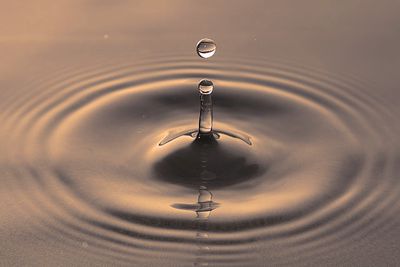
“Have you ever watched a rain drop hit a puddle?  It forces the puddle water downward and then the water springs back up again to form a peak.  The same general process  happens when a meteorite hits a rocky surface except the solid peak doesn’t flatten out like water does.  We know that’s the way many meteor craters on the Moon and here on Earth were formed.  We’re pretty sure it’s what happened at Gale — the core of Mount Sharp (formal astronomers call it Aeolis Mons) is probably that kind of peak.”

“Only the core?  What about the rest of it?”

“That’s what Curiosity has been digging into.”  <I have to smile — Jim’s not one to do puns on purpose.>  “The rover’s found evidence that the core’s wrapped up in lots of sedimentary clays, sulfates, hematites and other water-derived minerals of a sort that wouldn’t be there unless Gale had once been a lake like Oregon’s Crater Lake.  That in turn says that Mars once had liquid water on its surface.  That’s why everyone got so excited when those results came in.”

“Oregon’s Crater Lake was from a meteorite?”

“Oops, bad example.  No, that one’s a water-filled volcanic caldera.”

“How do you know?  Any chance its volcano will blow?”

“The best evidence, of course, is the mineralogy.  Volcanoes are made of igneous rocks — lava, tefra and everything in between.  Impact craters are made of whatever was there when the meteorite hit, although the heat and the pressure spike transform a lot of it into some metamorphic form.”

“But you can’t check for that on Mars or the Moon.”

“Mostly not, you’re right, so we have to depend on other clues.  Most volcanoes, for instance, are above the local landscape; most impact structures are below-level.  There are other subtler tests, like the pattern and distance that ejecta were thrown away from the event.  In general we can be 95-plus percent sure whether we’re looking at a volcano or an impact crater.  And no, it won’t any time soon.”

“What won’t do what?”

“You asked whether Crater Lake’s volcano will erupt.  Mount Mazama blew up 7700 years ago and it’s essentially been dormant ever since.”

“There’s some weasel-wording back there — most volcanoes do this, most impacts do that.  What about the exceptions?”

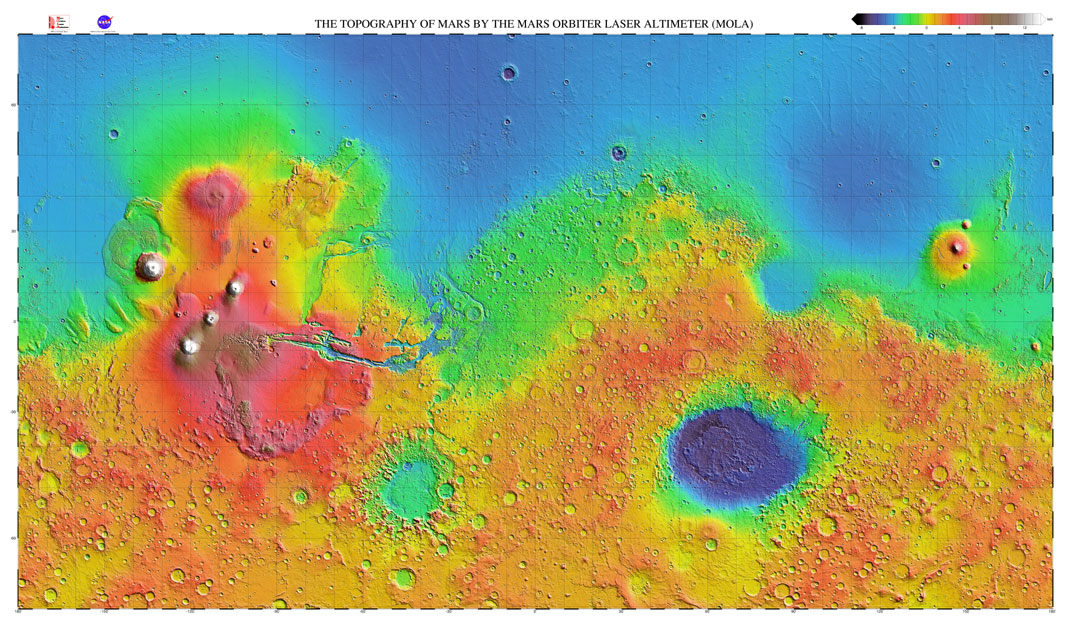
“Those generally have to do with size.  The really enormous features are often hard to even recognize, much less classify.  On Mars, for instance the Northern Lowlands region is significantly smoother than most of the rest of the planet.  Some people think that’s because it’s a huge lava flow that obliterated older impact structures.  Other people think the Lowlands is old sea bottom, smooth because meteorites would have splashed water instead of raising rocky craters.”

Labeled Mars map 420
Mars map from NASA/JPL/GSFC

“I’ll bet ocean.”

“There’s more.  You’ve heard about Olympus Mons on Mars being the Solar System’s biggest volcano, but that’s really only by height.  Alba Mons lies northeast of Olympus and is far huger by volume — 600 million cubic miles of rock but it’s only 4 miles high.  Average slope is half a degree — you’d never notice the upward grade if you walked it.  Astronomers thought Alba was just a humungous plain until they got detailed height data from satellite measurements.”

“The other one’s more than 4 miles high?”

“Oh, yeah.  Olympus Mons rises about 13.5 miles from the base of its surrounding cliffs.  That’s more than the jump from the bottom of the Mariana Trench to the top of Mount Everest.”

“Things on Mars are big, alright.”

~~ Rich Olcott


Why Is Mars Red But Earth Is Blue?

The grad students’ Crazy Theory Contest event at Al’s coffee shop is breaking up.  Amanda’s flaunting the Ceremonial Broom she won with her ‘Spock and the horseshoe crabs‘ theory.  Suddenly a voice from behind me outroars the uproar.  “Hey, Mars guy, I got questions.”

Jim looks up and I look around.  Sure enough, it’s Mr Richard Feder.  I start with the introductions but he barrels right along.  “People call Mars the Red Planet, but I seen NASA pictures and it’s brown, right?  All different kinds of brown, with splotches.  There’s even one picture with every color in the rainbow.  What’s with that and what color is Mars really?”

Jim’s a newly-fledged grad student so I step in to give him a chance to think.  “That rainbow picture, Mr Feder, did it have a circular purple spot about a third of the way up from the bottom and was it mostly blue along the top?”

“Yeah, sounds about right.”

“That’s a NASA topographic map, color-coded for relative elevations, purple for low areas to red high-up.  The blue area is the Northern Lowlands surrounding the North Pole, and that purple spot is Hellas Basin, a huge meteor crater billions of years old.  It’s about 5 miles deep which is why they did it in purple.  The map colors have nothing to do with the color of the planet.”

“About your question, Mr …. Feder is it?”

“Yeah, kid, Richard Feder, Fort Lee, New Jersey.”

“Good to meet you, sir.  The answer to your question is, ‘It depends.’  Are you looking down from space or looking around on the surface?  And where are you looking?  Come to think of it, when are you looking?”

“All I’m asking is, is it red or not?  Why make it so complicated?”

“Because it is complicated.  A few months ago Mars had a huge dust storm that covered the whole planet.  At the surface it was far darker than a cloudy moonless night on Earth.  From space it was a uniform butterscotch color, no markings at all.”

“OK, say there’s no dust in the air.”

“Take away all the floating dust and it almost wouldn’t be Mars any more.  The atmosphere’s only 1% of Earth’s and most of that is CO2 — clear and colorless.”

“So what would we see looking down at the surface?”

“Uh … you’re from New Jersey, right?  What color is New Jersey’s surface?”

<a little defensively> “We got a lot of trees and farms, once you get away from all the buildings along the coast and the Interstates, so it’s green.”

“Mars doesn’t have trees, farms, buildings or roads.  What color is New Jersey underneath all that?”

“The farmland soil’s black of course, and the Palisades cliffs near me are, too.  Down-state to the south we got sand-colored sand on the beaches and clay-colored clay.”

“Mars has clay, the Curiosity rover confirmed that, and it’s got basalt like your cliffs, but it has no soil.”

“Huh? How could it not have soil?  That’s just ground-up rocks, right, and Mars has rocks.”

“Soil’s way more then that, Mr Feder.  If all you have is ground-up rocks, it’s regolith.  The difference is the organic material that soil has and regolith doesn’t — rotted vegetable matter, old roots, fungus, microorganisms.  All that makes the soil black and helps it hold moisture and generally be hospitable to growing things.  So far as we know, Mars has none of that.  We’ve found igneous, sedimentary and metamorphic rocks just like on Earth; we’ve found clays, hematites and gypsum that had to have been formed in a watery environment.  But so far no limestone — no fossilized shelly material like that would indicate life.”

“What you’re saying is that Mars colors look like Earth colors except no plants.  So why do astronomers call Earth a ‘pale blue marble’ but Mars is ‘the red planet’?”

“Earth looks pale blue from space.  The blue is the dominant color reflected from the 70% of Earth’s surface that’s ocean-covered.  It’s pale because of white light reflected from our clouds of water vapor.  Mars lacks both.  What Mars does have is finely-divided iron oxide dust, always afloat above the surface.”

“Mars looks red ’cause it’s atmosphere is rusty?”

“Yessir.”Earth and Mars

~~ Rich Olcott