

Ponder for a moment what Space throws at you. Photons of all sizes, of course — infra-red ones that warm your skin, visible ones that show you the beach, ultra-violet ones that give you tan and sunburn. Neutrinos and maybe dark matter particles that pass right through you without even pausing. All of those act upon you in little bits at little places — gravity pervades you. You can put up a parasol or step into a cave, but there’s no shielding yourself from gravity.
Gravity’s special character has implications for LIGOs. A word first about words. LIGO as a generic noun unwinds to Laser Interferometer Gravitational-Wave Observatory, a class of astronomical instruments. LIGO as a proper noun denotes a project that culminated in the construction of a specific pair of devices that went live in 2002.
That hardware wasn’t sensitive enough to detect the gravitational waves it was created to seek. To improve the initial LIGO’s power and sensitivity, the LIGO infrastructure and organization morphed into the Advanced LIGO (aLIGO) project. Concurrently, the LIGO instrument was upgraded and renamed. No surprise, the instrument’s new name is aLIGO. An early phase of aLIGO bore uncannily fortunate fruit with the Sept 14 gravitational wave detection.
Four other LIGOs are proposed, under construction or in operation around the world — KARGA in Japan, INDIGO in India, GEO600 in Germany and VIRGO in Italy. Why so many, and why even consider space-borne LIGOs like LISA Pathfinder and eLISA?
Astronomers ask a series of questions of the Universe:
- What objects are out there?
- Where are they?
- What are they doing?
- Why are they doing that?
September’s aLIGO incident gave us a gratifyingly unexpected answer to the first question. To the surprise of theoreticians, the detected event was the collision of two black holes, each of which was in a size range that current theory says shouldn’t be populated. Even more surprising, such objects are apparently common enough to meet up, form binary pairs and eventually merge.
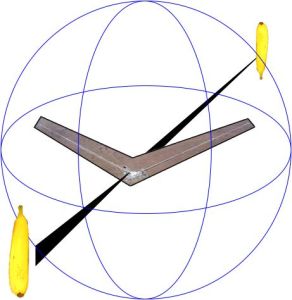 The second question is harder. The best the aLIGO team could do was point to a “banana-shaped region” (their words, not mine) that covers about 1% of the sky. The team marshaled a world-wide collaboration of observatories to scan that area (a huge search field by astronomical standards), looking for electromagnetic activities concurrent with the event they’d seen. Nobody saw any. That was part of the evidence that this collision involved two black holes. (If one or both of the objects had been something other than a black hole, the collision would have given off all kinds of photons.)
Why such poor localization? Blame gravity’s pervasive character and Geometry. With a telescope, any kind of telescope, you know which direction you’re looking. Telescopes work only with photons that enter through the front; photons aimed at the back of the instrument stop there.
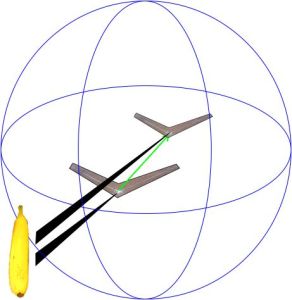 In contrast, a LIGO facility is (roughly speaking) omni-directional. When a LIGO installation senses a gravitational pulse, it could be coming down from the visible sky or up through the Earth from the other hemisphere — one signal doesn’t carry the “which way?” information. The diagram above shows that situation. (The “chevron” is an image of the LIGO in Hanford WA.) Models based on the signal from that pair of 4-km arms can narrow the source field to a “banana-shaped region,” but there’s still that 180o ambiguity.
The good news is that the LIGO project built not one but two installations, 2500 miles apart. With two LIGOs (the second diagram) there’s enough information to resolve the ambiguity. The two also serve as checks on each other — if one sees a signal that doesn’t show up at the other that’s probably a red herring that can be discarded.
 The great “if only” is that the VIRGO installation in Italy was not recording data when the Hanford WA and Livingston LA saw that September signal. With three recordings to reconcile, the aLIGO+VIRGO combination would have had enough information to slice that banana and localize the event precisely.
When the European Space Agency puts Evolved LISA (eLISA) in orbit (watch the animation, it’s cool) in 2034, there’ll be a million-kilometer triangle of spacecraft up there, slicing bananas all over the sky.
~~ Rich Olcott


 We can investigate things that take longer than an instrument’s characteristic time by making repeated measurements, but we can’t use the instrument to resolve successive events that happen more quickly than that. We also can’t resolve events that take place much closer together than the instrument’s characteristic length.
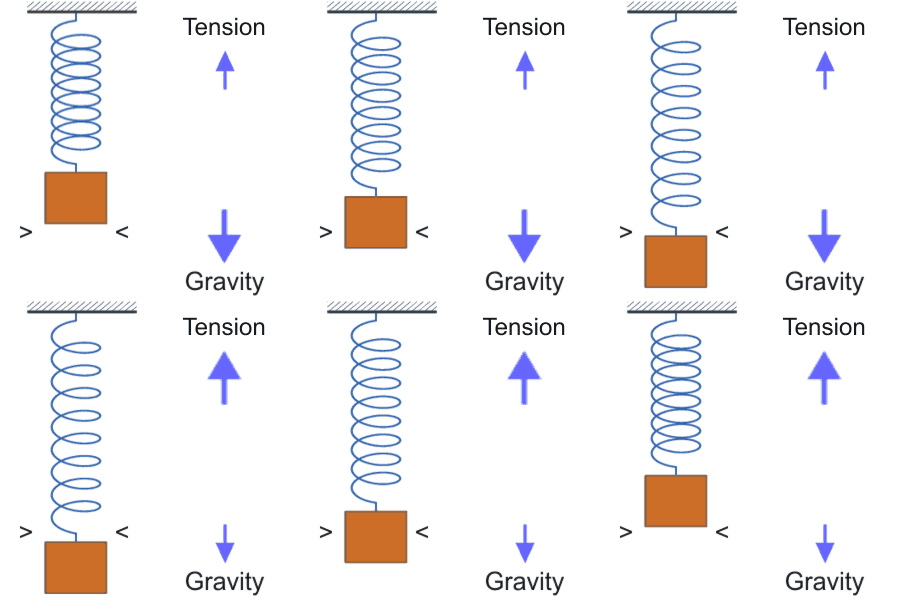 A wave happens in a system when a driving force and a restoring force take turns overshooting an equilibrium point AND the away-from-equilibrium-ness gets communicated around the system. The system could be a bunch of springs tied together in a squeaky old bedframe, or labor and capital in an economic system, or the network of water molecules forming the ocean surface, or the fibers in the fabric of space (whatever those turn out to be).
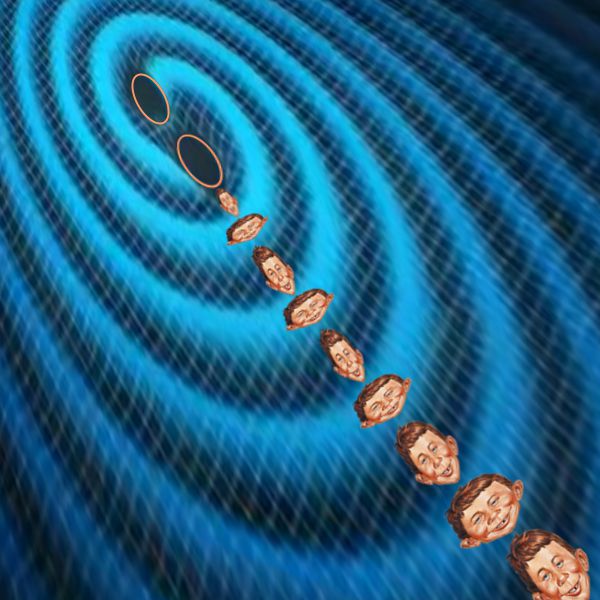
 An isolated black hole is surrounded by an intense gravitational field and a corresponding compression of spacetime. A pair of black holes orbiting each other sends out an alternating series of tensions, first high, then extremely high, then high…
 Almost a century later, James Clerk Maxwell (the bearded fellow at left) wrote down his electromagnetism equations that explain how light works. Half a century later, Einstein did the same for gravity.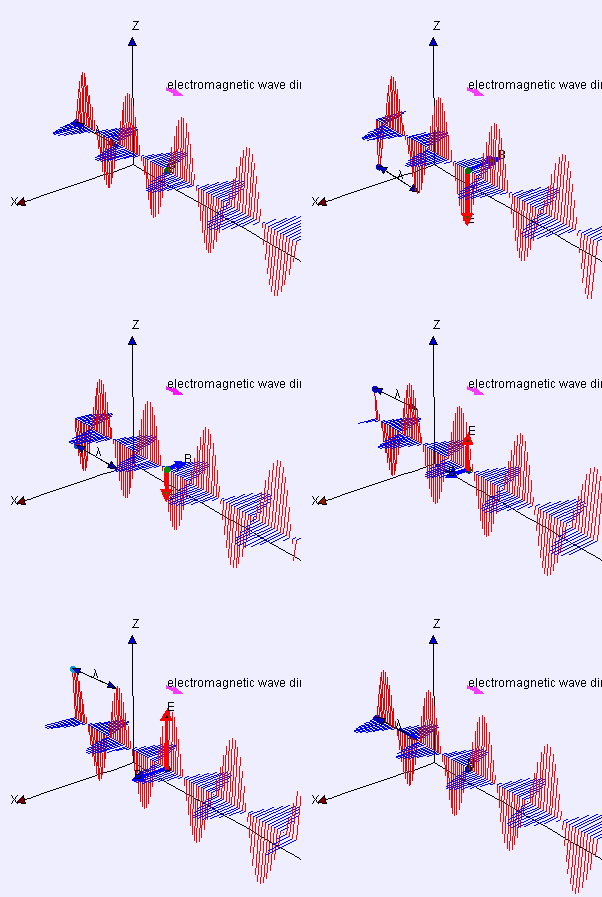
 Gravitodynamics is completely unlike electrodynamics. Gravity’s transverse “force” doesn’t act to move a whole mass up and down like Maxwell’s picture at left. Instead, as shown by Einstein’s picture, gravitational waves stretch and compress while leaving the center of mass in place. I put “force” in quotes because what’s being stretched and compressed is space itself. See
 The experiment consists of shooting laser beams out along both arms, then comparing the returned beams.
 in his Les Miz role of Inspector Javert,
 And then there’s
 Hard Science Ain't Hard
