Soggy Euclid

It’s Cal’s turn to deal the cards and topic. “Water, water everywhere, especially where you wouldn’t expect it.”

Eddie bets a few chips. “Say what, Cal?”

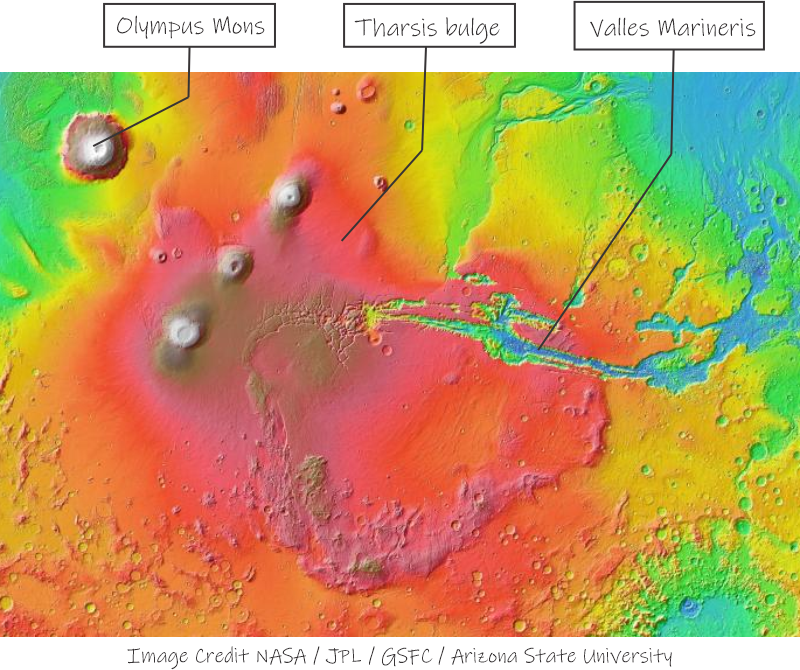
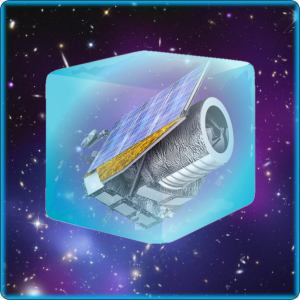
“Oh, this article in one of my Astronomy magazines, says Euclid has an ice problem.”

“None of Euclid’s problems are nice. I barely got out of Geometry class alive.”

“Not that Euclid, Eddie. The European Space Agency’s Euclid space telescope that’s gonna catalog whatever it can see in a third of the sky. They’re looking to pick up everything out to 10 billion lightyears. S’posed to help us chase down dark energy, get a better handle on really big structures and voids, stuff like that. Anyhow, it’s in a potato‑chip orbit around the Earth‑Sun L2 point like JWST does but twice as far out. The ESA engineers noticed that Euclid‘s readings of some calibration stars were dropping and they figured out it was ice getting in the way.”

“Ice? In space?”

“Yeah, that’s what I said. Turns out all our space missions bring water out with ’em even if they don’t want to.”

Vinnie’s bet doubles the pot. “Ain’t gonna happen. Every ounce of payload gotta have a good excuse or they don’t let it ride.”

“No, really. This ain’t payload, it’s like a stowaway. Mostly in the thermal insulation which has a lot of surface area inside with nooks and crannies where water molecules can stick. Makes no difference to most missions, but when you’ve got world‑class optics that you’re pushing to their limits, a layer of ice a few dozen molecules thick in the wrong place can hurt.”

“Okay, I get there’s problems if the ice is in the optics but you said it was in the insulation. And what’s it even doing there in the first place? If they know it’s gonna be a problem they can just bake it out during construction.”

Chemist Susan chucks a handful of chips into the pot. “Water molecules are small and sneaky. They always surprise you, especially when you don’t want them to. When they’re frozen‑solid ice you’d think they’d stay there, right? Oh, no, they evaporate without going through a liquid phase which lets them migrate around. It’s called sublimation. And do they migrate — just try to keep them out of somewhere. Pour absolute ethanol through humid air, it’s not absolute any more. Dry solids? If the substance has any surface oxygens you’re guaranteed to have water molecules hanging onto them even after you bake the stuff. So, Vinnie — that insulation wrap in the telescope? If it ever saw humidity the fibers are carrying water that could migrate to the optics.”

“Oh yeah, there’ll be humidity. Okay, Baikonur’s pretty much in the middle of a near‑desert, but the Guiana Space Center that France uses is right by the ocean and have you ever looked at a map of Cape Canaveral? That insulation’ll be soggy enough to spew water molecules onto the optics even at space temperatures. C’mon, Kareem, you gonna bet or what?”

“I’m deciding whether to talk about watery moons or the deep‑down Earth water we’re discovering. Jupiter’s moon Europa, for instance. We now know it has a kilometers‑thick shell of ice surrounding an ocean with twice as much water as our oceans put together. Meanwhile,” <meets Susan’s bet> “there’s another huge ocean beneath our feet.”

“Not our feet. This place is built on bedrock.”

“Think below the bedrock, Cal. We live on top of crust, maybe a couple dozen kilometers thick, floating on molten magma. You guys know about subduction, right, where chunks of sea-bottom crust are forced under the edges of continental crust. The further down you go, the hotter things get. The sea‑bottom stuff eventually melts to form lighter magma that ultimately rises to make volcanoes. Thing is, the sinking crust drags water with it, either in cracks or as water of crystallization. A melting chunk releases its water into a kilometers‑thick layer of steamy silicate slurry roughly 400 kilometers below us. That water ‘rains’ upward into our oceans, completing the cycle. Full house, queens and aces. Any challengers?”

Kareem’s surprisingly impatient for a geologist. Nobody counters so the pot’s his. Eddie gets next deal.

~~ Rich Olcott

No Symphony on Mars

“Evening, Jeremy, a scoop of your pistachio gelato, please. What’re you reading there?”

“Hi, Mr Moire. It’s A City on Mars by Kelly and Zach Weinersmith. One of my girlfriends read it and passed it along to me. She said it’s been nominated for a Hugo even though it’s non‑fiction and it argues against the kind of go‑to‑Mars‑soon planning that Mr Musk is pushing.”

“Is she right about the argument?”

“Pretty much, so far, but I’m not quite done. You get a clue, though, from the book’s subtitle — ‘Can we settle space, should we settle space, and have we really thought this through?‘ Here’s your gelato.”

“Thanks. Not just Mars, space also?”

“That’s right. It’s about the requirements and implications for people living in space and on the Moon and on Mars. The discussion starts with making and raising babies.”

“That first part sounds like fun.”

“Well, you’d think so, but apparently you need special equipment. Hard to stay in contact if there’s no gravity to key on. But that’s only the start of a problem cascade. Suppose the lady gets pregnant. The good news is in zero gravity it’s easy for her to move around. The bad news is we don’t know whether Earth gravity’s important for making babies develop the way they’re supposed to. Also, delivering a baby isn’t the only medical procedure that’d be a real challenge in zero‑g where you need to keep fluid droplets from bouncing around the cabin and into the air system.”

“Whoa. Hmm, never thought about it in this context before, but babies leak. Diapers can help, but babies burp up stuff along with the air. Yuck! Tears they cry in space would just stay on their eyes instead of rolling down cheeks. So … we’d need OB/GYN clinics and nurseries somewhere down a gravity well.”

“For sure, although no‑one knows whether even the Moon’s 1/6g is strong enough for good development. I know my little cousins burn up a lot of energy just running around. Can’t give a toddler resistance bands or trust it on a treadmill.”

“So we need an all‑ages gym down there, too, with enough room for locals and visiting spacers.”

“You’re coming round to the Weinersmiths’ major recommendation — don’t go until you can go big! Don’t plan on growing from a small colony, plan on starting with a whole city that can support everything you need to be mostly self‑sufficient.”

“So you’re young, Jeremy. Are you looking forward to being a Mars explorer?”

“I’ll admit all that rusty landscape reminds me of Navajoland, but I think I’d rather stay here. On Mars I’d be trapped in tunnels and domes and respirators and protective coveralls. I wouldn’t be able to just go out and run under the sky the way I was brought up to do.”

“Wouldn’t be able to do a lot of things. Concerts would sound weird, according to a paper I just read.”

“Sure, wind instruments wouldn’t work with bubble helmets. We could still have strings, percussion and electronics, though, right?”

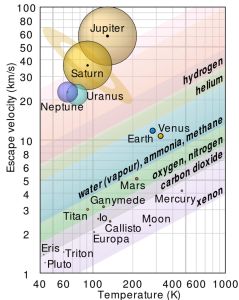
“Sure you could have them. But it’s worse than that. Mars atmosphere is very different from Earth’s. Its temperature measured in kelvins is 25% colder. The pressure’s 99% lower. Most important, molecule for molecule Mars’ mostly‑CO2 atmosphere’s is 50% heavier than Earth’s N2‑O2 mixture. Those differences combine to muffle sounds so they don’t carry near as far as they would on Earth. Most sounds travel about 30% more slowly, too, but that’s where a CO2 molecule’s internal operation makes things weird.”

“Internal? I thought molecules in sound waves just bounced off each other like little billiard balls.”

“That’s usually the case unless you’re at such high pressures that molecules can start sticking to each other. CO2 under Mars conditions is different. If there’s enough time between bounces, CO2 can convert some of its forward kinetic energy into random heat. The threshold is about 4 milliseconds. A sound wave frequency longer than that travels noticeably slower.”

“Four milliseconds is 250 Hertz — that’s a middle B.”

“Mm-hm. Hit a cymbal and base drum simultaneously, your audience hears the cymbal first. Terrible acoustics for a band.”

~~ Rich Olcott

A Million Times Weaker Than Moonlight

Big Vinnie’s getting downright antsy, which is something to behold. “C’mon, Sy. We get it that sonication ain’t sonification and molecules bumping into each other can carry a sound wave across space if the frequency’s low enough and that can maybe account for galaxies having spiral arms, but you said the Cosmic Hum is a sound, too. That’s a gravity thing, not molecules, right?”

“Not quite what I said, Vinnie. The Hum’s sound‑related, but it’s not ‘sound’ even by our extended definition.”

“Then what’s the connection?”

“Waves.”

“Not frames like always?”

“Not frames, for a change.”

“So it’s waves, but they go though empty space. Can’t happen like sound waves from molecules bumping into each other ’cause molecules are too small to have enough gravity do that when they’re so far apart. What’s carrying the waves?”

“Good question. Einstein figured out one answer. A whole cohort of mid‑20th‑century theoreticians came to a slightly different conclusion.”
“Okay, I’ll bite. What was Einstein’s answer?”

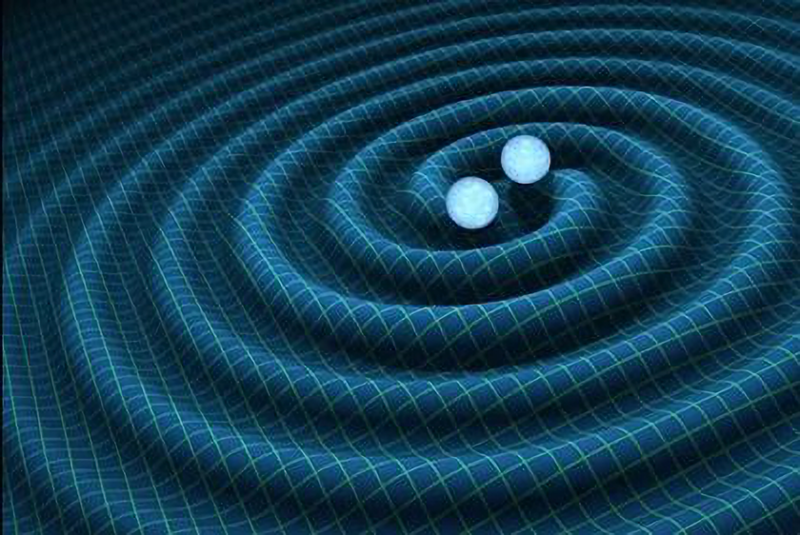
“Relativity, of course. Gravity’s the effect we see from mass deforming nearby space. Moving a mass drives corresponding changes in the shapes of space where it was and where it has moved to. The shape‑changes generate follow‑on gravitational effects that propagate outward over time. Einstein even showed that the gravitational propagation speed is equal to lightspeed.”

“Gimme a sec … Okay, that black hole collision signal LIGO picked up back in 2015, the holes lost a chunk of their combined mass all of a sudden. Quick drop in the gravity thereabouts. You’re saying it took time for the missing gravity strength to get noticed where we’re at. If I remember right, the LIGO people said the event was something like a billion lightyears away so that tells me it happened about a billion years ago and what the LIGO gadget picked up was space waves, right?”

“Right, but it wasn’t just the mass loss, it was the rapid and intense waggles in the gravitational field as those two enormous bodies, each 30 times as massive as the Sun, whirled around each other multiple times per second. The ever‑faster whirling shook the field with a frequency that swept upward to the ‘POP‘ when your mass‑loss happened. LIGO eventually picked up that signal. Einstein would say there’s no ‘action at a distance‘ in the collision‑LIGO interaction, because the objects acted on the gravitational field which acted on the LIGO system.”

“Like using a towel to pop someone in the locker room. The towel’s just transmi– ulp.”

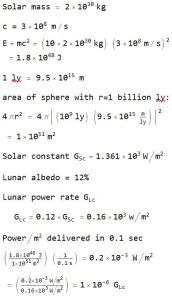
“An admission of guilt if I ever heard one. Yes, like that, except a towel pop carries all the initial energy to its final destination. Gravitational waves spread their energy across the surface of an expanding sphere. The energy per unit area goes down as the square of the distance.” <keying a calculation on Old Reliable> “Suppose the collision releases 10 solar masses worth of energy, we’re a billion lightyears away, and the ‘POP‘ signal is delivered in a tenth of a second. We’d see a signal power … about a millionth as strong as moonlight.”

“Not much there.”

“Right, which is why LIGO and its kin have been such pernickety instruments to build and run. LIGO’s sensors are mirrors roughly a meter across. You get a million times more power sensitivity if your detector’s diameter is a mile across. That was part of the NANOGrav team’s strategy, but they went much bigger.”

“Yeah, that’s the multi-telescope thing, so NANOGrav faked a receiver the size of the Earth, like the Event Horizon Telescope.”

“Much bigger. Their receiver is the entire Milky Way. Instead of LIGO’s mirrors, NANOGrav’s signal generators are neutron stars a dozen or more miles wide scattered across the galaxy.”

“Gotcha, Sy. Two ways. Neutron stars are billions heavier than a LIGO mirror so they’d be less power‑sensitive, not more. Then, power is about moving stuff closer or farther but if I got you right these space waves don’t really do that anyway, right?”

“Right and right, Vinnie, but not relevant. What NANOGrav’s been watching for is pulsar beams being twitched by a gravitational wave. A waltzing black hole pair should generate years‑long or decades‑long wavelengths. NANOGrav may have found one.”

~~ Rich Olcott

Sounds, Harsh And Informative

Vinnie’s frowning. “Wait, Sy. I get how molecules bumping into each other can carry a sound wave across space if the frequency’s low enough and that can maybe account for galaxies having spiral arms. So what’s that got to do with the Sonication Project?”

Now Jeremy’s frowning. “What’s sonication got to do with Astronomy? One of my girl friends uses sonication in Biology lab when she’s studying metabolism in plant cells.”

“Whoa! Sonification, not sonication — they could have called it soundify‑cation but sonification‘s classier. ‘Sonication‘ uses high‑intensity ultrasound to jiggle a sample so roughly that cell walls can’t take the stress. They break open and spill the cell’s internal soup out where your friend’s probes can get to it. Tammy, the chemist down the hall from my lab, uses sonication, too.”

“Whoa, Susan, wouldn’t sonication break up molecules?”

“Depends on the frequency and intensity, Vinnie. Sonication can mess up big floppy proteins and DNA, but chemists who play with little peptides and such don’t care. Tammy does solid‑state chemistry. She’s looking for superconductors and she actually does want to break things. The field’s hot category these days is complex copper oxides doped with other metals. You synthesize those compositions by sintering a mix of oxide powders. To maximize contact for a good reaction you need really fine‑grained powders. Sonication does a great job of shattering brittle oxide grains down to bits just a few‑score atoms wide. But Tammy’s technique is even more elegant than that.”

“Elegant sneezes from the powder?”

Susan wallops my shoulder. “No, Sy, the powders are so small they’d be a lung hazard and some of them are toxic. Everything’s done behind respiratory protection.” <Susan doesn’t joke about lab safety.> “There’s evidence that some of these materials are only superconductive if they have the right kind of layered structure. Turns out that if Tammy has her sonicator setup just right when she preps a sample for sintering, the sound wave peaks and valleys inside the machine make the shattered particles settle out in interesting layers.”

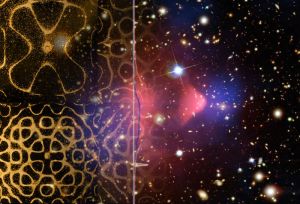
“Like Chladni figures.”

“Oh, you know about them.”

“Yeah, I wrote about them a few years ago. Waves do surprising things.”

Vinnie’s getting impatient. “So what’s sonification then?”

Tinkly music bursts from Cathleen’s tablet. “This one’s listenable, Susan, and it’s a nice demonstration of what sonification’s about and how arbitrary it can be. You start with complicated multi‑dimensional data and use some process to turn it into audible signals. The process algorithm can use any sound characteristics you like — loudness, pitch, timbre, whatever. This example started with the famous Bullet Cluster image that most people accept as the first direct confirmation of dark matter. All the white‑ish thingies are galaxies except for the ones with pointy artifacts — those are stars. The pink haze is X‑ray light from the same region. The blue haze comes from a point‑by‑point assessment of how badly the galaxy images have been distorted by gravitational lensing — that’s an estimate of the dark matter mass between us and that region of sky. Got all that?”

“And that vertical line is like a scan going across the picture?”

“It’s not like a scan, it is a scan. Imagine a collection of tiny multi‑spectral cameras arranged along a carrier bar. As the bar travels across the picture, each camera emits three signals proportional to the amount of white, pink and blue light it sees. If you look close, just to the right of the line, you’ll see moving white, red and blue line‑charts of the respective signals.”

“That’s fine, but what’s with the sound effects?”

“The Project’s sonification processing generated hiss and rumble sounds whose loudness is proportional to the red and blue signals. Each white‑ish peak became a ping whose pitch indicates position along that bar.”

“Why go to all that trouble?”

“The sounds encode the picture for vision‑challenged people. Beyond that, the Project participants hope that with the right algorithms, their music will reveal things the pictures don’t.”

“They should avoid screamy sounds.”

~~ Rich Olcott

Galaxies Sing In A Low Register

Jeremy gets a far‑away look. ”It’s gotta be freakin’ noisy inside the Sun.” just as our resident astronomer steps into Cal’s Coffee.

“Wouldn’t bet that, Jeremy. Depends on where you are in the Sun and on how you define noise.”

Vinnie booms, quietly. ”We just defined it, Cathleen. Atoms or molecules bumping each other in compression waves. Oh, wait, that’s ‘sound,’ you said ‘noise.’ Is that different?”

Susan slurps the last of her chocolate latte. ”Depends on your mood, I guess. All noise is sound, but some sound can be signal. Some people don’t like my slurping so for them it’s noise but Cal hears it as an order for another which makes him happy.”

“Comin’ up, Susan. Hey, Cathleen, maybe you can slap down Sy. He said spiral galaxies have something to do with sound which don’t make sense. Set him straight, okay?”

“Sy, have you all settled that sound isn’t limited to what humans hear?”

“Sure. Everybody’s agreed that infrasound and ultrasound are sound, and that Bishop Berkeley’s fallen tree made a sound even though nobody heard it. That’s probably what got Jeremy thinking about sound inside the Sun.” Jeremy nods.

“Then Vinnie’s definition is too limited and Sy’s statement is correct. Probably.”

That gets a reaction from everyone, though mine is a smile. ”Let ’em have it, Cathleen.”

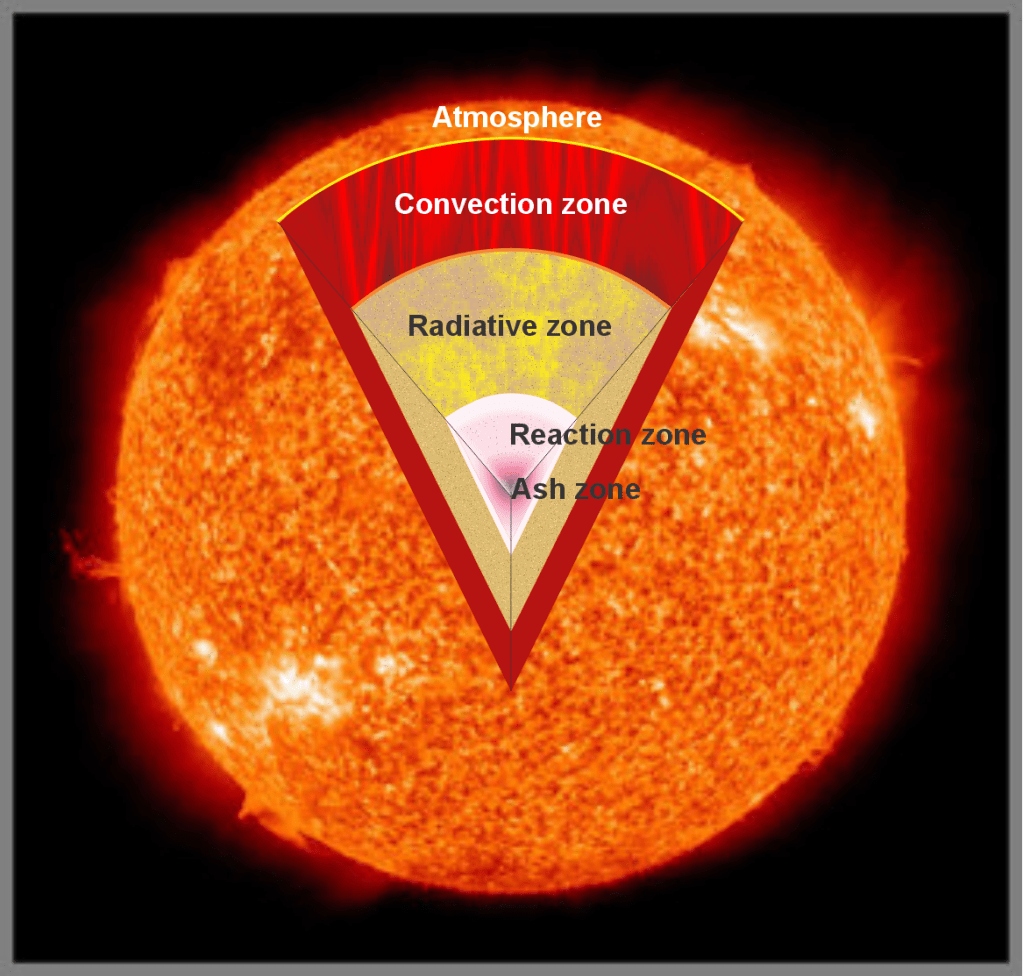
“Okay. Let’s take Jeremy’s idea first and then we’ll get to galaxies.” <fetches her tablet from her purse and a display on her tablet> “Here’s a diagram of the Sun I did for class. If you restrict ‘sound‘ to mean only coherent waves borne by atoms and molecules, there’s no sound in the innermost three zones. The only motion, if Sy grants I can call it that, is photons and subnuclear particles randomly swapping between adjacent nuclei that are basically locked into position by the pressure. Not much actual atomic motion until you’re up in the Convection Zone where rising turbulence is the whole game. Even there most of the particles are ions and electrons rather than neutral atoms. Loud? You might say so but it’d be a continuous random crackle‑buzz, not anything your ears would recognize. Sound waves as such don’t happen until you reach the atmospheric layers. Up there, oh yes, Jeremy, it’s loud.”

Geologist Kareem is a quiet guy, normally just sits and listens to our chatter, but Cathleen’s edging onto his turf. ”How about seismic waves? If there’s a big flare or CME up top, won’t that send vibrations all the way through?”

“Good point, Kareem. Yes, the Sun has p and s waves just like Earth does, but they travel no deeper than the Convection Zone. A different variety we may not have, g waves, would involve the core. Unfortunately, theory says g waves are so weak that the Convection Zone’s chaos swamps them. Anyway, the Sun’s s, p and g waves wouldn’t contribute to what Jeremy would hear because their frequencies are measured in hours or days. Can I get to galaxies now?”

“Please do.”

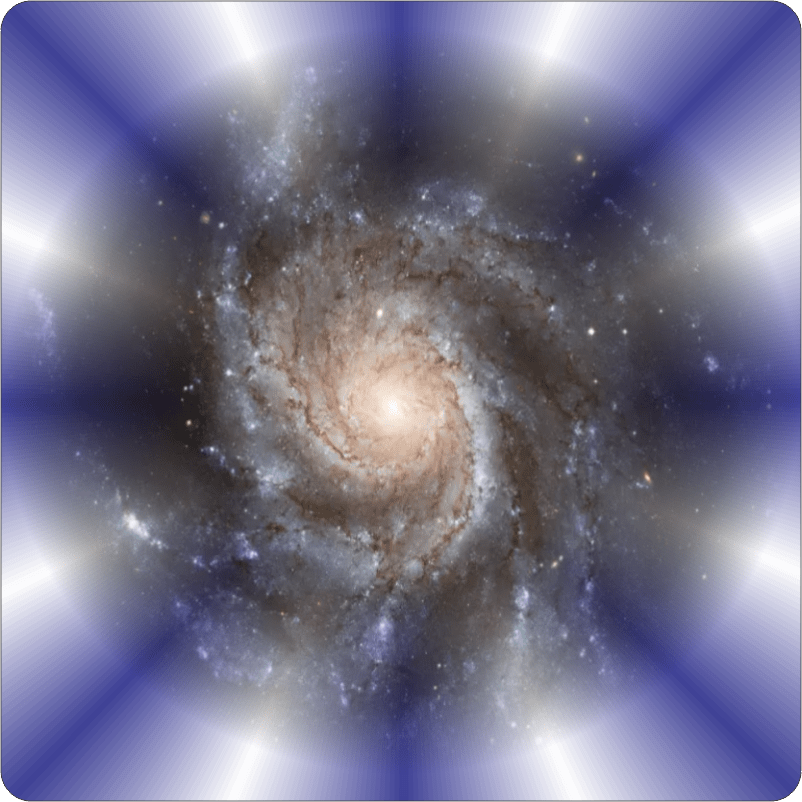
“Thanks.” <another display on her tablet> “Here’s a classic spiral galaxy. Gorgeous, huh? The obvious question is, is it winding in or spraying out? The evidence says ‘No‘ to both. The stars are neither pulled into a whirlpool nor flung out from a central star‑spawner. By and large, the stars or clusters of them are in perfectly good Newtonian orbits around the galactic center of gravity. So why are they collected into those arms? Here’s a clue — most of the blue stars are in the arms.”

“What’s special about blue stars?”

“In general, blue stars are large, hot and young. Our Sun is yellow, about halfway through a 10‑million‑year lifetime. The blue guys burn through their fuel and go nova in a tenth of that time. Blue stars out there tell us that the arms serve as stellar nurseries. It’s not stars gathering into arms, it’s galaxy‑wide rotating waves of gas birthing stars there. There’s argument about whether the wave rotation is intrinsic or whether there’s feedback as each wave is pulled along by star formation at the leading edge and pushed by novae at the trailing edge. Sy’s point, though, is that an arm‑dwelling old red star would experience the spinning gas density pattern as a basso profundo sound wave with a frequency even lower than the million‑year range. Right, Sy?”

“As always, Cathleen.”

~~ Rich Olcott

  • More thanks to Alex.

Screams And Thunders

Coffee time. I step into Cal’s shop and he’s all over me. ”Sy, have you heard about the the NASA sonification project?”

Susan puts down her mocha latte. “I didn’t like some of what they’ve released. Sounds too much like people screaming.”

Jeremy looks up from the textbook he’s reading. ”In space, no-one can hear you scream.”

Vinnie rumbles from his usual table by the door. “Any of these got anything to do with the Cosmic Hum?”

“They have nothing to do with each other, except they do. Spiral galaxies, too.”

“Huh?”
 ”Huh?”
  ”Huh?”
   ”Huh?”

“A mug of my usual, Cal, please, and a strawberry scone.”

“Sure, Sy, here ya go, but you can’t say something like that around here without you tellin’ us how come.”

“Does the name Bishop Berkeley ring a bell with anyone?”

Vinnie’s on it. ”That the ‘If a tree falls in the forest…‘ guy, right? Claimed there’s no sound unless somebody’s there to hear it?”

“And by extension, no sound outside human hearing range.”

“But bats and them use sound we can’t hear.”
 ”So do elephants and whales.”

“Well there you go. So are we agreed that he was wrong?”

“Not quite, Mr Moire. His definition of ‘sound‘ was different from one you’d like. He was a philosopher theorizing about perception, but you’re a physicist. You two don’t even define reality the same way.”

Vinnie’s rumble. ”Good shot, Jeremy. Sound is waves. Sy and me, we talked about them a lot. One molecule bangs into the next one and so on. The molecules don’t move forward, mostly, but the banging does. Sy showed me a video once. So yeah, people listening or not, that tree made a sound. There’s molecules up in space, so there’s sound up there, too, right, Sy?”

“Mmm, depends on where you are. And what sounds you’re equipped to listen for. The mechanism still works, things advancing a wave by bouncing off each other, but the wave’s length has to be longer than the average distance between the things.” <drawing Old Reliable, pulling up display> “Here’s that video Vinnie saw. I’ve marked two of the particles. You see them moving back and forth over about a wavelength. Suppose a much shorter wave comes along.”

“Umm… Each one would get a forward kick before they got back into position. They wouldn’t oscillate, they’d just keep moving in that direction. No sound wave, just a whoosh.”

“Right, Jeremy. Each out‑of‑sync interaction converts some of the wave’s oscillating energy into one‑way motion. The wave doesn’t get energy back. A dozen wavelengths along, no more wave. So the average distance between particles, we call it the mean free path, sets limits to the length and frequency of a viable wave. Our ears would say it filters out the treble.”

“Space ain’t quite empty so it still has a few atoms to bump together. What kinds of limits do we get out there?”

“Well, there’s degrees of empty. Interplanetary space has more atoms per cubic meter than interstellar which is more crowded than intergalactic. Nebulae and molecular clouds can be even less empty. Huge range, but in general we’re talking wavelengths longer than a million kilometers. Frequencies measured in months or years — low even for your voice, Vinnie.”

Jeremy gets a look on his face. ”One of my girlfriends is a soprano. We tested her in the audio lab and she could hit a note just under two kilohertz, that’s two thousand cycles per second. My top screech was below half that. I could scream in space, but I guess not low enough to be heard.”

“Yeah, keep that spacesuit helmet closed and be sure your radio intercom’s working.”

“Wait, what about screaming over the radio?”

“Radio operates with electromagnetic waves, not bumping atoms. Mean free path limits don’t apply. Radio’s frequency range is around a hundred megahertz, screeching’s no problem. Your broadcast equipment’s response range would set your limits.”

“Sy, those screamy sounds I objected to — you say they can’t have traveled across space as sound waves. Was that a radio transmission?”

“Maybe, Susan. From what I’ve read, we’ve picked up beaucoodles of radio sources, all different types and all over the sky. Each broadcasts a spectrum of different radio frequencies. Some of them are constant radiators, some vary at different rates. You may have heard a recording of a kilohertz variable source.”

<shudder> “All nasty treble, no bass or harmony.”

~~ Rich Olcott

  • Thanks to Alex, who raised several questions.

A Spherical Bandstand

“Whoa, Sy, something’s not right. Your zonal harmonics — I can see how latitudes go from pole to pole and that’s all there are. Your sectorial harmonic longitudes start over when they get to 360°, fine. But this chart you showed us says that the radius basically disappears crazy close to zero. The radius should keep going forever, just like x, y and z do.”

“Ah, I see the confusion, Susan. The coordinate system and the harmonic systems and the waves are three different things, um, groups of things. You can think of a coordinate system as a multilevel stage where chords of harmonic musicians can interact to play a composition of wave signals. The spherical system has latitude and longitude levels for the brass and woodwind players, plus one in back for the linear percussion section. Whichever direction the brass and woodwinds point, that’s where the signals go out, but it’s the percussion that determines how far they get. Sure, radius lines extend to infinity but except for R0 radial harmonics damp out pretty quickly.”

“Signals… Like Kaski’s team interpreted Juno‘s orbital twitches as a signal about Jupiter’s gravitational unevenness. Good thing Juno got close enough to be inside the active range for those radial harmonics. How’d they figure that?”

“They probably didn’t, Cathleen, because radial harmonics don’t fit easily into real situations. First problem is scale — what units do you measure r in? There’s an easy answer if the system you’re working with is a solid ball, not so easy if it’s blurry like a protein blob or galaxy cluster.”

“What makes a ball easy?”

“Its rigid surface that doesn’t move so it’s always a node. Useful radial harmonics must have a node there, another node at zero and an integer number of nodes between. Better yet, with the ball’s radius as a natural length unit the r coordinate runs linearly between zero at the center and 1.0 at the surface. Simplifies computation and analysis. In contrast, blurries usually don’t have convenient natural radial units so we scrabble around for derived metrics like optical depth or mixing length. If we’re forced into doing that, though, we probably have worse challenges.”

“Like what?”

“Most real-world spherical systems aren’t the same all the way through. Jupiter, for instance, has separate layers of stratosphere, troposphere, several chemically distinct cloud‑phases, down to helium raining on layers of hydrogen in liquid, maybe slushy or even solid form. Each layer has its own suite of physical properties that put kinks into a radial harmonic’s smooth curve. Same problem with the Sun.”

“How about my atoms? The whole Periodic Table is based on atoms having a shell structure. What about the energy level diagrams for atomic spectra? They show shells.”

“Well, they do and they don’t, Susan. Around the turn of the last Century, Lyman, Balmer, Paschen, Brackett and Pfund—”

“Sounds like a law firm.”

“<ironically> Ha, ha. No, they were experimental physicists who gave the theoreticians an important puzzle. Over a 40‑year period first Balmer and then the others, one series at a time, measured the wavelengths of dozens of lines in hydrogen’s spectrum. ’Okay, smarties, explain those!‘ So the theoreticians invented quantum mechanics. The first shot did a pretty good job for hydrogen. It explained the lines as transitions between discrete states with different energy levels. It then explained the energy levels in terms of charge being concentrated at different distances from the nucleus. That’s where the shell idea came from. Unfortunately, the theory ran into problems for atoms with more than one electron.”

“Give us a second… Ah, I get why. If one electron avoids a node, another one dives in there and that radius isn’t a node any more.”

“Got it in one, Cathleen. Although I prefer to think of electrons as charge clouds rather than particles. Anyhow, when an atom has multiple charge concentrations their behavior is correlated. That opens the door to a flood of transitions between states that simply aren’t options for a single‑electron system. That’s why the visible spectrum of helium, with just one additional electron, has three times more lines than hydrogen does.”

“So do we walk away from spherical harmonics for atoms?”

“Oh, no, Susan, your familiar latitude and longitude harmonics fit well into the quantum framework. These days, though, we mostly use combinations of radial fade‑aways like my Sn00 example.”

~~ Rich Olcott

Jupiter And The Atoms

“Okay, Sy, what’s your third solution?”

“Solution to what, Susan?”

These harmonic thingies. They’re about angles so it makes sense to chart them in polar or spherical coordinates, but when they take on negative values the radius goes the wrong way. You said one solution was to chart the negatives in a different color. That’s confusing, though. Another solution is to square all the values to get everything into positive territory. That’s okay for chemists like me because the peaks and nodes we care about stay in the same places. What’s the third option?”

“One that gets to why these ‘harmonic thingies’ are interesting at all. When Juno‘s orbiting Jupiter, does it feel each of Kaspi’s Jn shapes individually?”

“No, of course not, she just reacts to how they all add togethherrr … Oh! So you’re saying we can handle negative values from one harmonic by adding it to another one that’s more positive and plotting the combination.”

<pointing to paper napkin> “Bingo! Remember this linear plot of J2 where I colored its negative section pink?” <pointing to display on Old Reliable> “When you multiply J2 by C0 you get S220. I added that to four helpings of Sn00 to get this combination.”

“Ah, that negative region in S220‘s middle shaves back the equator on Sn00‘s sphere while the positive part adds bumps top and bottom.” <Susan gives me the side‑eye> “Why’d you pick that 4‑to‑1 ratio, and what’s with those n subscripts instead of numbers?”

“Getting a little ahead of myself. For the moment let’s concentrate on Juno‘s experience with Jupiter’s gravity. One reason I chose that ratio was that it’s pretty easy to see in the picture. In real cases the physical system determines the ratios. Kaspi’s team derived their ratios experimentally. They used math to fit a model to Juno‘s very slightly wobbly orbit. Their model of Jupiter’s gravity field started from the spherical J0 shape. They tweaked that by adding different ratios of J2 through J40, adjusting the ratios until the model’s total gravity field predicted an orbit that matched the real‑world one. J2‘s share was about 15 parts per thousand but most of the rest contributed less than a part per million. Jupiter probably uses multiple mass blobs to make the J2 shape. The point is, the planet’s really a mess but we can analyze the mess in terms of the harmonics.”

“So that’s how you drew what Cal called your wiggle-waggles — you followed Kaski’s Jn recipe and then added some constant to push the polar plot out far enough that the negatives didn’t poke out the wrong side. That constant — what value did you use and why that one?”

“That’s exactly what I did do, Cathleen. Frankly, I don’t even remember what constant I added, just something that was big enough to make the negatives behave nicely, not so large that the peaks vanished by comparison. Calibrating accurately to Jupiter’s J0 would shrink the peaks down to parts‑per‑thousand invisibility. After all, I was more concerned with peak position than peak size.”

“Now we’re back to your 4‑to‑1 ratio. Was that arbitrary, too?”

“No, it wasn’t, Susan. Would it have been closer to Chemistry if I’d labeled that figure as 1s22s22p1?”

“Two electrons in the 1s‑shell, two in the 2s‑shell plus one 2p electron … that’s a boron atom? But you’re showing only one radial shell, not two separate ones.”

“True, but that’s to make another point. There isn’t an electron in the 1s shell, or even a pair of them nicely staying on opposite sides. The atom’s charge, all five electrons‑worth of it, is smeared out as a wave pattern across the entire structure. The Sn00 pattern captures everything that’s spherical. The S220 pattern gets what’s left.”

“But what about the radial nodes? Isn’t that the difference between 1s and 2s, that 2s has a node?”

“Oh there are nodes, alright, but they don’t have much effect. Each radial harmonic is the product of two factors — a polynomial and an exponential. The exponential part squeezes the polynomial so hard that adjacent peaks and valleys are barely bumps and dents.”

“So Jupiter and atoms use the same math, huh?”

“So does the Sun.”

~~ Rich Olcott

A Loose-end Lagniappe

<chirp, chirp> “Moire here.”

“We have some loose ends to tie up. Too early for pizza. Coffee at Cal’s?”

“Hello, ‘Walt‘. Fifteen minutes?”

“Confirmed.”


He’s at a back table, facing the door, of course. He points to the steaming mug and strawberry scone beside it on the table. I nod to acknowledge. ”So, Walt, what are these loose ends?”

“My people say that Juno‘s not on a 53‑day orbit any more. NASA’s jiggled it down to 33 days. What’s that do to the numbers you gave me?”

<sliding a folded paper scrap across the table> “I had a hunch you’d want more so I worked up estimates. Juno started with a 53‑day orbit but a Ganymede flyby dropped it to 43 days. A Europa flyby took Juno to a 38‑day orbit. Now it’s swerved by Io and we’re at 33 days. I threw in the 23‑day line for grins, no extra charge.”

“Half the orbit size but no significant change in the close‑in specs. That’s surprising.”

“Not really. It’s like a dog’s butt wagging its tail. At close approach, we call it perijove, Juno is only 76 500 kilometers out from Jupiter’s center. Its orbit thereabouts is pretty much nailed down by the big guy’s central field. But there’s no second attractor to constrain the orbit’s other extreme millions of kilometers out. Do an Oberth burn near perijove or arrange for a gravity tweak from a convenient moon, you get a big difference at the far end.”

“That wraps that.” <reaches for his cane, then settles back to do a Columbo> “Just one more thing, Moire. I came in with a question about the Sun’s effect on Juno. You took care of that pretty quick but spent a load of my time and consultancy budget on these spherical harmonics. How come?”

“As I recall, you and your people kept coming back for more detail. Also, the 225 000‑kilometer radius I got from R2‘s structure was essential in calculating these close‑in numbers. You’re getting your money’s worth. I’ll even throw in a lagniappe.”

“A free gift? I never trust them.”

“Such a mean world you live in, Walt.” <displaying an image on Old Reliable> “Here it is, take it or leave it.”

Top: F000 plus a time-varying contribution from F660
Bottom: C0 plus a time-varying contribution from C4

“What is it?”

“It’s a bridge between the physics of light and sound, and the physics of atoms and stars. When I say ‘coordinates,’ what words spring to your mind?”

“Traverse and elevation.”

“Interesting choice. Any other systems?”

“Mm, latitude, longitude and altitude. And x‑y‑z if you’re in a classroom.”

“Way beyond the classroom. You use spreadsheets, right?”

“Doesn’t everyone?”

“Rowscolumnssheets is xyz. On digital screens, pixelslinesluminosity is xyz. Descarte’s rectilinear invention is so deeply embedded in our thinking we don’t even notice it. Perpendicular straight‑line coordinates fit things that are flat or nearly so, not so good for spheres and central‑force problems. Movement there is mostly about rotation, which is why your first two picks were angular instead of linear.”

“Okay, but our choice of coordinates is our choice. What have xyz or your Fnnm to do with natural things?”

“Overtones and resonance. Look at that black line in the movie. It could be a guitar string or a violin string, doesn’t matter. One end’s fixed to the instrument’s bridge, the other end’s under somebody’s finger. All other points on the string are free to move, subject to tension along the string. Then someone adds energy to the string by plucking or bowing it.”

“At one of those peaks or valleys, right?”

“Nope, anywhere, which goes to my point. The energy potentially could contort the string to any shape. Doesn’t happen. The only stable shapes are combinations of sine waves with an integer number of nodes, like C4‘s quartet. Adding even more energy gives you overtones, waves that add in‑between nodes to lower‑energy waves. C0‘s no‑nodes black line could run along x, y or z in any flat system.”

“So you’re going to tell me that your C‘s, J‘s and R‘s support wave structures for spheres.”

“Indeed. All four giant planets have stripes along their J arcs. Solar seismologists have uncovered C, R and maybe J wave structures inside the Sun.”

“Bye.”

“Don’t mention it.”

~ Rich Olcott

Completing The Triad

Walt’s mustache bristles as he gives me the eye. ”You claim three harmonics control how the Sun’s gravity could affect spacecraft orbits around a target planet like Jupiter. You said we don’t have to care about Jupiter’s gravitational zones and isolating the sectors probably isn’t doable. What’s the third?”

Time to twist the screws. ”Three harmonic systems, Walt, all working together and you’ve got their names wrong. They control nothing, they’re a framework for analysis. And Jupiter’s special. Solar gravity doesn’t affect its zonal harmonic arcs but that’s only because Jupiter’s polar axis is nearly perpendicular to its orbital plane. Zonal‑effect N‑S twisting at Jupiter is pennies on a C‑note. Any mission we send to Mars, Saturn or Uranus we’ll care a lot about their zonal harmonics because their axes have more tilt. An 82° tilt for Uranus, can’t get much more tilted than that. Sectorial harmonics may still help us navigate there because Uranus probably has a lot less magnetism than Jupiter.”

That rocks him but he comes back strong. ”The third kind of harmonic?!! C’mon, give!”

“Radial, the center‑out dimension. The gravitational force between bodies depends on center‑to‑center distances so yeah, your people would be interested.”

“I presume radial harmonics have numbers like Jn and Cm do?”

“They do. Sorry, this’ll get technical again but I’ll go as light as I can. Each radial harmonic is the product of two factors. You know about factors, right?”

“Sure, force multipliers.”

“You would know that kind. More generally, factors are things that get multiplied together. I’ll call the general radial harmonic Rn. It’s the product of two factors. The first is a sum of terms that begin with rn, where r is the distance. For instance, R3‘s first factor would look like a*r³+b*r²+c*r+d, where the a,b,c,d are just some numbers. Different radial harmonics have different exponents in their lead terms. You still with me?”

“Polynomials from high school algebra. Tell me something new.”

“The second factor decreases exponentially with n*r. No matter how large rn gets, when you multiply an rn polynomial by something that decreases exponentially, the (polynomial)×(exponential) product eventually gets really small.”

“Give me a second. … So what you’re saying is, at a big enough distance these radial harmonics just die away.”

“That’s where I was going.”

“How far is ‘enough’?”

“Depends on n. Higher values of n shut down faster.”

“So these Cms and Jns and Rns just add together?” <pauses, squints at me suspiciously> “Is there some reason you used n for both Jn and Rn?”

“No but yes, and yes. You combine a C, a J and an R using multiplication to get a full harmonic F, except there are rules. The J and R must belong to the same n. The m can’t be larger than n. From far away we’d model Jupiter’s gravity as F000=R0×J0×C0, which is an infinite sphere — R0 never dies away and J0×C0 says ‘no angular dependence.’ The Sun’s gravity acts along R0 and that’s what keeps Jupiter in orbit. If the problem demands combining full harmonics, you use addition.” <rousing a display on Old Reliable> “Here’s how a particular pair of harmonics combine to increase or decrease spherical gravity in specific directions.”

“But Juno doesn’t see those gravity lumps until it gets close‑in. How close?”

R2‘s down to less than a part per thousand at three planetary radii, call it 225 000 kilometers away from the planet’s center.”

“How much time is it closer than that distance?”

“Complicated question. A precise answer requires some calculus — is your smart phone set up for elliptic integrals?”
“Of course not. A good estimate will do.”

“Okay, here’s the plan. What we’d like is total time spent while Juno travels along the ellipsoidal arc between points A and D where the orbit crosses the 225 000‑km circle. Unfortunately, Juno speeds up approaching point P, slows down going away — calculating the A‑D time is tricky. I’ll assume Juno travels straight lines AB and CD at the A-speed. I’ll also approximate the orbit’s close pass as a semicircle at P‑speed.” <tapping> “I get a 3.6-hour duration, less than 0.3% of the full 53-day orbit. Will that satisfy your people?”

“You’ll know if it doesn’t.”

~~ Rich Olcott