To See Beneath The Starlight


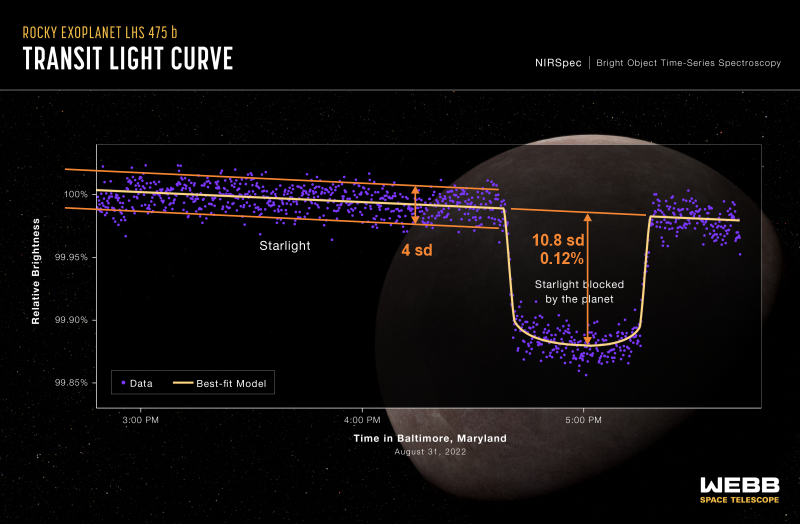
C‑J casts an image to Al’s video screen. “This is new news, just came out a couple of weeks ago. It’s the lead figure from NASA’s announcement of JWST’s first exoplanet examination. We’re picked this study because the scientists used the transit technique. I’ve added the orange stuff so we can make a point. Each blue dot is one measurement from JWST’s Near‑Infrared Spectrograph while it looked at a star named LHS 457. Even though the telescope is outside Earth’s atmosphere and operating at frigid temperatures, you can see that the numbers scatter. Surely the star’s light isn’t changing that quickly – the dots are about 9 seconds apart – the spread has to come from noise in JWST’s electronics.”

Adapted from image by NASA Credit: NASA, ESA, CSA, L. Hustak (STScI).

“We’re just partway through our statistics class but we know to expect 95% of noise to be within 2 standard deviations either way of the average. With about 400 dots per hour, C‑J drew his lines to put about 10 dots per hour each above and below.”

“Right, Madison, and the point we want to make is how small that range is. Only about 0.04% difference. That’s like one drop in a 2500‑drop titration. Professor Kim’s samples in our Chem lab generally take around 20 milliliters which is about 400 drops.”

“So anyway, look at that dip in the light curve. That’s way out of the noise range. The starlight really did dim, even though it wasn’t by much.”

“By the way, NASA’s press release is a little misleading and in fact missed the point of the research. JWST didn’t find this exoplanet, the TESS satellite system did. JWST looked where TESS said to and yup, there it was. This report was really about what JWST could tell us about the exoplanet’s atmosphere.”

“There’s a bunch of possibilities that the researchers can now eliminate. C‑J, please cast the next slide to the screen. We need to be clear, this isn’t the spectrum that JWST recorded during a transit.”

Adapted from image by NASA (Credit: NASA, ESA, CSA, L. Hustak (STScI)), and Figure 2 in Lustig-Yeager, et al.

“No, that would have been simply the star’s light after some of it was filtered through the planet’s atmosphere. The researchers used a lot of computer time to subtract out the right amount of the star’s own spectrum. This is what’s left — their estimate of the spectrum of the planet’s atmosphere if it has one. I added the orange error bar on each point and for the sake of comparisons I traced in that dotted curve marked ‘Metallicity‘ from the scientists’ paper. The other lines are models for four possible atmospheres.”

“Why orange again? And why are the bars longer to the right of that gap?”

“I like orange. I had to trace the bars for this slide because NASA’s diagram used dark grey that doesn’t show up very well. The dots in the wavelength range beyond 3.8 microns are from a noisier sensor. Professor O’Meara, we need some help here. What’s metallicity and why did the paper’s authors think it’s important?”

“We haven’t touched on that topic in class yet. ‘Metallicity’ is the fraction of a star’s material made up of atoms heavier than hydrogen and helium. A star could have high metallicity either because it was born in a dust cloud loaded with carbons and oxygens, or maybe it’s old and has generated them from its own nuclear reactions. Either way, a planet in a highmetallicity environment could have an atmosphere packed with molecules like O2, H2O, CH4 and CO2. That doesn’t seem to be the case here, does it?”

“No, ma’am. The measured points don’t have this model’s peaks or valleys. Considering the error bars, the transmission spectrum is pretty much flat. Most of the researchers’ other models also predict peaks that aren’t there. The best models are a tight cloud deck like Venus or Titan, or thin and mostly CO2 like Mars, or no atmosphere at all.”

“Even a null curve tells us more than we knew.”

~~ Rich Olcott

Significant Twinkles

Cathleen’s got a bit of fire in her eye. “Good exposition, Jeremy, but only just barely on‑assignment. You squeezed in your exoplanet search material at the very end. <sigh> Okay, for our next presentation we have two of our freshmen, Madison and C‑J.”

“Hello, everybody, I’m Madison. I fell in love with Science while watching Nova and Star Trek with my family. Doctor O’Meara’s Astronomy class is my first step into the real thing. C‑J?”

“Hi, I’m C‑J, like she said. What started me on Astronomy was just looking at the night sky. My family’s ranch is officially in dark sky country, but really it’s so not dark. Jeremy’s also from the High Plateau and we got to talking. We see a gazillion stars up there, probably more stars than the Greeks did because they were looking up through humid sea-level air. On a still night our dry air’s so clear you can read by the light of those stars. I want to know what’s up there.”

“Me, too, but I’m even more interested in who‘s up there living on some exoplanet somewhere. How do we find them? We’ve just heard about spectroscopy and astrometry. C‑J and I will be talking about photometry, measuring the total light from something. You can use it even with light sources that are too dim to pick out a spectrum. Photometry is especially useful for finding transits.”

“A transit is basically an eclipse, an exoplanet getting between us and its star—”

“Like the one we had in 2017. It was so awesome when that happened. All the bird and bug noises hushed and the corona showed all around where the Sun was hiding. I was only 12 then but it changed my Universe when they showed us on TV how the Moon is exactly the right size and distance to cover the Sun.”

“Incredible coincidence, right? Almost exactly 100% occultation. If the Moon were much bigger or closer to us we’d never see the corona’s complicated structure. We wouldn’t have that evidence and we’d know so much less about how the Sun works. But even with JWST technology we can’t get near that much detail from other stars.”

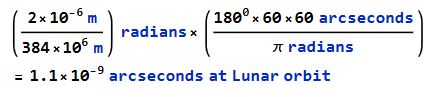
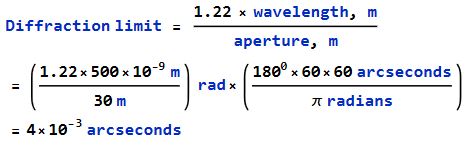
“Think of trying to read a blog post on your computer, but your only tool is a light meter that gives you one number for the whole screen. Our nearest star, Alpha Centauri, is 20% larger than our Sun but it’s 4.3 lightyears away. I worked out that at that distance its image would be about 8½ milliarcseconds across. C‑J found that JWST’s cameras can’t resolve details any finer than 8 times that. All we can see of that star or any star is the light the whole system gives off.”

“So here’s where we’re going. We can’t see exoplanets because they’re way too small and too far away, but if an exoplanet transits a star we’re studying, it’ll block some of the light. The question is, how much, and the answer is, not very. Exoplanets block starlight according to their silhouette area. Jupiter’s diameter is about a tenth the Sun’s so it’s area is 1% of the Sun’s. When Jupiter transits the Sun‑‑‑”

“From the viewpoint of some other solar system, of course—”

“Doesn’t matter. Jupiter could get in between the Sun and Saturn; the arithmetic works out the same. The maximum fraction of light Jupiter could block would be its area against the Sun’s area and that’s still 1%.”

“Well, it does matter, because of perspective. If size was the only variable, the Moon is so much smaller than the Sun we’d never see a total eclipse. The star‑planet distance has to be much smaller than the star‑us distance, okay?”

“Alright, but that’s always the way with exoplanets. Even with a big planet and a small star, we don’t expect to measure more than a few percent change. You need really good photometry to even detect that.”

“And really good conditions. Everyone knows how atmospheric turbulence makes star images twinkle—”

“Can’t get 1% accuracy on an image that’s flickering by 50%—”

“And that’s why we had to get stable observatories outside the atmosphere before we could find exoplanets photometrically.”

~~ Rich Olcott

Astrometers Are Wobble-Watchers

letter A Hi, Sy, what’s going on in Cathleen’s seminar?

You were right, Al.
It’s about exoplanets and how to find them.
Jeremy’s pitching astrometry.
That’s about measuring star locations in the sky.
I’ll fill you in later.

“So that’s my cultural colonialism rant, thanks for listening. On to the real presentation. Maria showed us how to look for exoplanets when they wobble along our line of sight. But what if they wobble perpendicular to that? Careful measurement should show that, right? The ancients thought that holy forces had permanently set the positions of all the stars except for the planets so they didn’t measure that close. Tycho Brahe took meticulous measurements with room‑sized instruments—”

<voice from the back> “Room‑sized? What difference does that make?”

“What if I told you that two stars are 3 millimeters apart in the sky?”

<another voice> “How far out’s your ruler? Sky stuff, you need to talk angles because that’s all you got.”

“Well there you go. That’s why Tycho went for maximum angle‑measuring accuracy. He built a sextant with a 5‑foot radius. He used an entire north‑south wall as a quadrant. His primary instrument was an armillary sphere three yards across.”

<first voice again> “Wait, a sphere, like a big bubble? Why north‑south? What’s a quadrant?”

  • I give him a nudge. “He’s just a kid, Mr Feder. Be nice. One question at a time.”
  • “But I got so many!”

“Think about Tycho’s goal. Like astrometers before him, he wanted to build an accurate map of the heavens. Native Americans a thousand years or more ago carved free‑hand star maps on cave ceilings and turtle shells. Tycho followed the Arabic and Chinese quantitative mapping traditions. There’s two ways to do that. One is to measure and map the visual angles between many pairs of stars. That strategy fails quickly because errors accumulate. Four or five steps along the way you’re plotting the same star in two different locations.”

<Feder’s voice again> “There’s a better way?”

“Yessir. Measure and map each star relative to a standard coordinate system. If your system’s a good one, errors tend to average out. The latitude‑longitude system works well for locating places on Earth. Two thousand years ago the Babylonians used something similar for places in the crystal sphere they thought supported the stars above us. Where the equinoctial Sun rose on the horizon was a special direction. Their buildings celebrated it. Starting from that direction the horizontal angle to a star was its longitude. The star’s latitude was its angle up from the horizon towards the zenith straight above. But those map coordinates don’t work for another part of the world. Astrometers needed something better.”

<Feder again> “So what did they do already?”

“They may or may not have believed the Earth itself is round, but they recognized the Pole Star’s steady position that the rest of the sky revolved around. They also noticed that as each month went by the constellations played ring‑a‑rosie in a plane perpendicular to the north‑south axis. Call that the Plane of The Ecliptic. Pick a star, measure its angle away from the Ecliptic and you’ve got an ecliptic latitude. Measure its angle around the Ecliptic away from a reference star and you’ve got a ecliptic longitude. Tycho’s instruments were designed to measure star coordinates. His quadrant was a 90° bronze arc he embedded in that north‑south wall, let him measure a star’s latitude as it crossed his meridian. His ‘Sphere’ was simply a pair of calibrated metal rings on a gimbal mounting so he could point to target and reference stars and measure the angle between them. If his calibration used degree markings they’d be about 25 millimeters apart. His work was the best of his time but the limit of his accuracy was a few dozen arcseconds.”

“Is that bad?”

“It is if you’re looking for exoplanets by watching for stellar wobble. Maria’s Jupiter example showed the Sun wobbling by 1½ million kilometers. I worked this example with a bigger wobble and a star that would be mid‑range for most of our constellations. Best case, we’d see its image jiggling by about 90 microarcseconds. Tycho’s instruments weren’t good enough for wobbles.”

~~ Rich Olcott
The Stars from A Different Viewpoint

“Thank you, Maria, nice job showing us why the Doppler method had such a hard time finding exoplanets. Next up, Jeremy. You’re not going to talk about black holes, are you?”

“No, ma’am, my subject today is astrometry, but that’s useful for both exoplanets and black holes. I have to be careful when I say the word because it sounds so much like astronomy but they’re different things. It helped when I looked the words up. Turns out that ‘astronomy‘ means ‘naming stars‘ but ‘astrometry‘ means ‘measuring‘ them. Not weighing one or any of that, just measuring accurately where that star is in the sky at a certain moment. Everyone on Earth has the sky above. In the days before city life and city lights brought their eyes down, cultures all over the world were doing astronomy and astrometry. Professional astronomers generally use Greek and Arabic names, but that’s Eurocentrism and it got silly.”

<voice from the back> “Like how?”

“The Greeks couldn’t name constellations in the southern hemisphere’s skies because they never saw those stars. Polynesian navigators and Indigenous Australians saw them. Those cultures had their own perfectly good constellations. Did official Astronomy ask any of those people? Of course not, so we’ve got contrived designations like The Microscope and The Air Pump. Some of you know that I’m doing a research project with Professor Begaye to correlate constellations from different cultures. I’ve found some surprises.”

<voice from the back> “Like what?”

“Practically everyone in the northern hemisphere has a special image for the Pole Star and the stars close to it. Europeans picked out Ursa Minor, the Little Bear. For us Navajos the same stars make up The Northern Fire in the sky’s dome like the fire in our traditional domed hogan homes. Staying close to the Northern Fire we see two human figures, a woman and a man. One surprise for me was that the woman’s most prominent stars are the same ones the Greeks chose for Cassiopeia, also a female. The man’s image includes many of the same stars that Europeans call Ursa Major, the Big Bear. Did you know that the word ‘Artic‘ comes from the Greek word ‘arktos‘ which means ‘bear‘? Anyway, further out there’s a winter constellation containing three bright stars in a straight line plus a few more that could be shoulders and knees.”

<voice from the back> “Orion!”

“Mm-hm. We have almost exactly the same constellation. It’s also a hunter, except that the Greeks picture the three stars as his belt and we say it’s the quiver for his arrows. Right in front of the hunter are—”

<voice from the back> “The Pleaides!”

“But for us they’re Dilyehe, the Planting Stars. When they go below the horizon it’s time to plant corn. Which gets me to astrometry. The stars and constellations have always been clocks and calendars for the world’s cultures. Typically they compare the position of the Sun or certain stars with special structures.”

<voice from the back> “Like Stonehenge and the Pyramids!”

“There’s claims and doubts about both of those. People have searched out apparent special locations, like ‘This doorway and that window were placed to show a certain star rising on Midsummers Eve,’ but without explicit markings there’s no way to be sure it wasn’t just accidental. Besides, both structures were built with huge stone blocks, a real challenge to place accurately enough to pick out just one star on one day. We Navajos don’t build structures to track special times. We use mountains.”

<voice from the back> “What, you move mountains around?”

“No, we honor and respect the natural landscape for its beauty. What we do is find the special places that help the mountains and other landmarks tell us what time of year it is. My favorite example is the Double Sunset.”

<voice from the back> “Can’t have two!”

“Yes, you can, if the mountains are sharp and stand close to one another. On the right day of the year, the Sun sets behind one mountain, then peeks for just a minute through the cleft between the two. You just have to know where to stand to see that.”

~ Rich Olcott

Useful Eccentricity

“Hi, Al. What’s the hubbub in the back room?”

“Cathleen’s doing another astronomy class group seminar. This one’s about exoplanets. I’d like to listen in but I’ve got to tend the cash register here. Take notes, okay?”

“Sure, no problem.”

Professor Cathleen’s at the podium. “Okay, class, settle down. I hope everyone’s ready with their presentations. Maria, you’ve got a good topic to start us off.”

“Thank you. Everyone here knows I’ve been interested in spectroscopy since I was a student intern at Arecibo. It is such a powerful thing to know that a particular kind of atom, anywhere in the Universe, absorbs or gives off exactly the same pattern of light frequencies. Suppose you are looking at the spectrum of a star or a galaxy and you recognize a pattern, like sodium’s yellow doublet or hydrogen’s Lyman series. The pattern won’t be at its normal frequencies because of the Doppler effect. That’s good because the amount of blue‑shift or red‑shift tells us how quick the object is moving toward or away from us. That was how Dr Hubble proved that most other galaxies are flying away.”

<casts a slide to Al’s video screen> “I’ll begin with a review of some class material. The spectroscopy we see in the sky is light that was emitted at some peak wavelength lambda. Lambda with the little ‘o‘ is what we see for the same emission or absorption process in the laboratory. The wavelength difference between sky and laboratory is the absolute shift. Divide that by the laboratory wavelength to get the relative shift, the z‑scale. All the light from one object should have the same z value. It is important that z also gives us the object’s velocity if we multiply by the speed of light.”

<voice from the rear> “What’s the ‘fe ka‘ stuff about?”

“I was getting to that. Those two lines describe a doublet, a pair of peaks that always appear together. This is in the X‑ray spectrum of iron which is Fe for the chemists. K-alpha is a certain process inside the iron atom. Astronomers like to use that doublet because it’s easy to identify. Yes, profesora?”

“Two additional reasons, Maria. Iron’s normally the heaviest element in a star because stellar nuclear fusion processes don’t have enough energy to make anything heavier than that. Furthermore, although every element heavier than neon generates a K-alpha doublet, the peak‑to‑peak split increases with atomic mass. Iron’s doublet is the widest we see from a normal star.”

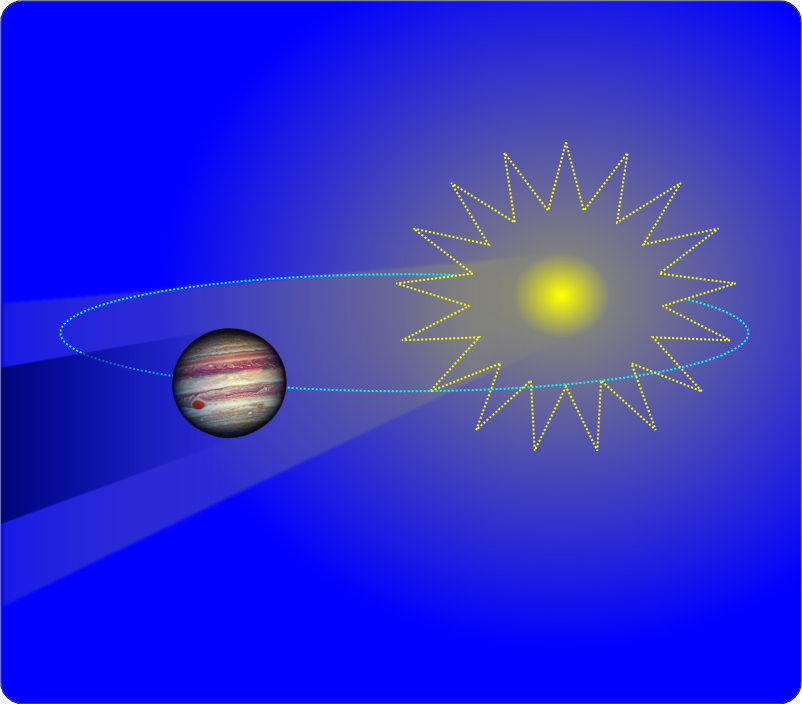
“Thank you. So, the arithmetic on the rest of the slide shows how Dr Hubble might have calculated the speed of a galaxy. But that’s steady motion. Exoplanets orbiting a star appear to speed ahead then fall behind the star, yes? We need to think about how a planet affects its star. This next slide talks about that. My example uses numbers for the Sun and Jupiter. We say Jupiter goes around the Sun, but really, they both go around their common center of gravity, their barycenter. You see how it’s calculated here — MP is the planet’s mass, MS is the star’s mass, dSP is the star-to-planet distance and dB is the distance from the star’s center to the barycenter. I’ve plugged in the numbers. The barycenter is actually ten thousand kilometers outside the Sun!”

“So you could say that our Sun counterbalances Jupiter by going in a tight circle around that point.”

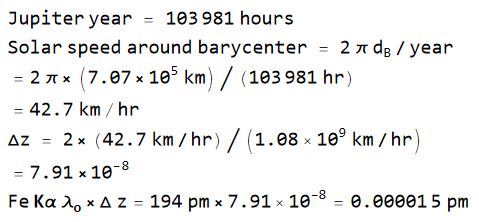
“Exactly! For my third slide I worked out whether a distant astronomer could use Doppler logic to detect Sun‑Jupiter motion. The first few lines calculate the size of the Sun’s circle and than how fast the Sun flies around it. Each Jupiter year’s blue shift to red shift totals only 79 parts per billion. The Sun’s iron K‑alpha1 wavelength varies only between 193.9980015 and 193.9979985 picometers. This is far too small a change to measure, yes?”

<dramatic pause> “I summarize. To make a good Doppler signal, a star must have a massive exoplanet that’s close enough to push its star fast around the barycenter but far enough away to pull the barycenter outside of the star.”

“Thank you, Maria.”

“X” marks the barycenter

~~ Rich Olcott

Dinner Rolls And Star Dust

“MAH-ahm! Uncle Sy’s here! Hi, Uncle Sy, dinner’s almost ready. I’ve saved up some questions for you”

“Hi, Teena, let’s have—”

“Now Teena, we said we’d hold the questions until after the meal. Hi, Sy.”

“Hi, Sis. Smells wonderful. One of Mom’s recipes?”

“Nope, I’m experimenting. Mom’s pasta sauce, though. You toss the salad and we’ll dig in.”

<later> “Wow. Sis, that lasagna was amazing. Five different meats, I think, and four different cheeses? Every mouthful was a new experience. A meal that Mom would’ve been proud of.”

“Six meats, you missed one. Full credit — Teena did the dinner rolls, from scratch, and she composed the salad.”

“Well, young lady, I think your grandma would be proud of you, too. You’ve earned questions. I may stay awake long enough to answer them.”

“Yay.”

“First the dishes, guys, then to the living room.”

“Sure, Sis. And you get a question, too.”

“As a matter of fact…”

<later> “Okay, Teena, question number one.”

“Alright. Umm. Brian tries to annoy me by saying over and over that the Sun’s gonna supernova into a black hole. That’s not true, is it?”

“You can tell Brian that the Sun’s way too small to make either a supernova or a black hole. Yes, the Sun will collapse in something like five billion years, but when that happens it’ll only be a garden‑variety nova. When things calm down there’ll be a white dwarf in the middle of our Solar System, not a black hole. Supernovas come from really big stars and they leave neutron stars behind or sometimes just emptiness. To get a black hole you need a star at least half again bigger than ours. D’ya think that’ll shut Brian down?”

“No-o, because there’s other things he says to annoy me.”

“Like what?”

“That our galaxy’s gonna collide with another one and we’ll all burn up in the explosion.”

“He’s got a thing for disasters, doesn’t he? Well, he’s partially right but mostly wrong. Yes, galaxy Andromeda is on a collision course with the Milky Way. But that collision won’t be anything like what he’s talking about. Remember those bird flocks we talked about?”

“Oh that was so long ago. What was the word? Mur, mur .. something?”

“Murmuration. That was your favorite word back then.”

“Oh, yes. It still is, now that I remember it.” <Sis and I give each other a look.> “What do birds have to do with galaxies?”

“Imagine two flocks colliding. Think there’ll be feathers all over the place?”

“No, the flocks would pass right through each other, except maybe some birds from one flock might fly off with the other one.”

“That’s pretty much what will happen with us and Andromeda. Stars in each galaxy are lightyears apart, hundreds of star‑widths apart, like cars miles apart on a highway. Star‑star collisions during a galaxy collision will be very rare. The galaxy’s own shapes will be distorted and gravity will pull stars from one galaxy to the other, but that’s about the extent of it. Anyway, that’s also about five billion years into the future. So Brian’s off on that prediction, too. Anything else?”

“Actually, yes. He says we’re made of stardust. I thought we’re made of atoms.”

“Indeed we are, but the atoms come from stars. Quick story about how stars work. The oldest and most common kind of atom is hydrogen. Back at the beginning of the Universe that’s all there was. If you shove hydrogen atoms together with enough heat and pressure, like inside stars, they combine to form heavier atoms like carbon and oxygen. You’re made of hydrogen and carbon and oxygen and such, but all your atoms except hydrogen were cooked up inside stars.”

“But how did they get inside me?”

“Remember those novas and supernovas? Doesn’t matter which kind of star collapses, half or more of its atoms spray into the Universe. They become star dust adrift in the winds of space, waiting to become part of another solar system and whatever’s in it. Brian’s right on this one, you are made of star dust.”

“Whooo, that’s awesome!”

“My question’s after dessert, Sy.”

~~ Rich Olcott

  • Thanks to the young Museum visitors who asked these questions.

DARTing to A Conclusion

The park’s trees are in brilliant Fall colors, the geese in the lake dabble about as I walk past but then, “Hey Moire, I gotta question!”

“Good morning, Mr Feder. What can I do for you?”

“NASA’s DART mission to crash into Diddy’s mos’ asteroid—”

“The asteroid’s name is Didymos, Mr Feder, and DART was programmed to crash into its moon Dimorphos, not into the asteroid itself.”

“Whatever. How’d they know it was gonna hit the sunny side so we could see it? If it hits in the dark, nobody knows what happened. They sent that rocket up nearly a year ago, right? How’d they time that launch just right? Besides, I thought we had Newton’s Laws of Motion and Gravity to figure orbits and forces. Why this big‑dollar experiment to see if a rocket shot would move the thing? Will it hit us?”

“You’re in good form today, Mr Feder.” <unholstering Old Reliable> “Let me pull some facts for you. Ah, Didymos’ distance from the Sun ranges between 1.01 and 2.27 astronomical units. Earth’s at 1.00 AU or 93 million miles, which means that the asteroid’s orbit is 930 000 miles farther out than ours, four times our distance to the Moon. That’s just orbits; Earth is practically always somewhere else than directly under Didymos’ point of closest approach. Mm… also, DART flew outward from Earth’s orbit so if the impact has any effect on the Didymos‑Dimorphos system it’ll be to push things even farther away from the Sun and us. No, I’m not scared, are you?”

“Who me? I’m from Jersey; scare is normal so we just shrug it off. So why the experiment? Newton’s not good enough?”

“Newton’s just fine, but collisions are more complicated than people think. Well, people who’ve never played pool.”

“That’s our national sport in Jersey.”

“Oh, right, so you already know about one variable we can’t be sure of. When the incoming vector doesn’t go through the target’s center of mass it exerts torque on the target.”

“We call that ‘puttin’ English on it.'”

“Same thing. If the collision is off‑center some of the incoming projectile’s linear momentum becomes angular momentum in the target object. On a pool table a simple Newtonian model can’t account for frictional torque between spinning balls and the table. The balls don’t go where the model predicts. There’s negligible friction in space, you know, but spin from an off‑center impact would still waste linear momentum and reduce the effect of DART’s impact. But there’s another, bigger variable that we didn’t think much about before we actually touched down on a couple of asteroids.”

“And that is…?”

“Texture. We’re used to thinking of an asteroid as just a solid lump of rock. It was a surprise when Ryugu and Bennu turned out to be loose collections of rocks, pebbles and dust all held together by stickiness and not much gravity. You hit that and surface things just scatter. There’s little effect on the rest of the mass. Until we do the experiment on a particular object we just don’t know whether we’d be able to steer it away from an Earth‑bound orbit.”

“Okay, but what about the sunny‑side thing?”

“Time for more facts.” <tapping on Old Reliable> “Basically, you’re asking what are the odds the moonlet is in eclipse when DART arrives on the scene. Suppose its orbit is in the plane of the ecliptic. Says here Dimorphos’ orbital radius is 1190 meters, which means its orbit is basically a circle 3740 meters long. The thing is approximately a cylinder 200 meters long and 150 meters in diameter. Say the cylinder is pointed along the direction of travel. It occupies (200m/3740m)=5% of its orbit, so there’s a 5% chance it’s dark, 95% chance it’s sunlit.”

“Not a bad bet.”

“The real odds are even better. The asteroid casts a shadow about 800 meters across. Says here the orbital plane is inclined 169° to the ecliptic so the moonlet cycles up and down. At that tilt and 1190 meters from Didymos, 200‑meter Dimorphos dodges the shadow almost completely. No eclipses. DART’s mission ends in sunlight.”

~~ Rich Olcott

  • Thanks to my brother Ken, who asked the question but more nicely.

Stars Are REALLY Warm-hearted

“I don’t understand, profesora. The Sun’s fuel is hydrogen. The books say when the Sun runs out of fuel it will eject much hydrogen and collapse to a white dwarf. So it didn’t run out of fuel, yes?”

“That’s an excellent question, Maria. Your simple sketch of layered zones is adequate for a stable star like our Sun is now. When things go unstable we need to pay more attention to dynamic details like mass, pressure and diffusion. The numbers matter.”

“I had that the fusion zone is 30% up from the center, and the top of the radiation zone is at 70%.”

“Yes, but percentages of a straight line don’t really give us a feel for the volumes and masses. Volumes grow as the radius cubed. The Sun’s core, the part inside your 30% radius, holds (30%)3 which is less than 3% of the Sun’s volume. The convection shell on the outside is also 30% thick, but that zone accounts for ⅔ of the star’s volume.”

“But not ⅔ of the mass, I think. The core is the most dense, yes?”

“Truly. The core is <chuckle> at the core of the matter. It’s obviously under compression from all the mass above it, but there’s a subtler and more important reason. The Sun’s internal temperatures are so high that everything acts like an ideal gas, even near the center. Once you’re beneath the convection zone, the only transport mechanism is diffusion influenced by gravity. Helium nuclei weigh four times what hydrogen nuclei do. Helium and heavier things tend to sink toward the center, hydrogen tends to float upward. What effect does that have on the core’s composition?”

“The core is heavy with much helium, not as much hydrogen.”

“Good. Now, what’s next above the core?”

“The fusion zo– Oh! The place where there’s enough hydrogen to do the fusing.”

“If the temperature and pressure are right. That turns out to be a delicate balance. Too much heat makes that region expand, average distance between atoms increases and that slows down the fusion reaction. Too much pressure slows diffusion which then slows the reaction by hindering hydrogen’s entry and helium’s exit. Too little heat or too little pressure do the opposite. Now you know why the fusion zone is so narrow in our diagrams, only about 10% of a radius.”

“No fusion in the other layers?”

“Less than 1% of the total. So we’ve got nearly all the heat in the star coming from hydrogen‑to‑helium fusion in this diffusion‑controlled gaseous reaction zone buried deep in the star.”

“Ah! Now I see. It is wrong to say the star dies because it runs out of fuel. There is still much hydrogen in the upper zones, but the diffusion doesn’t let enough enter the fusion zone. That is why the fire goes out. What happens then?”

“It mostly depends on the star’s mass. Really big ones have a sequence of deeper, hotter fusion layers in their core, forming heavier and heavier atoms all the way down to iron. Each layer is diffusion‑limited, of course, and the whole thing is like a stack of Jenga blocks supported by heat coming from below. If reaction in any layer overruns its fuel delivery then it stops producing heat. The whole stack collapses violently to form a neutron star or a black hole. Nearby infalling atoms collide and radiate in an exponential heat‑up. But the stars are many millions of kilometers across. The outermost layers don’t have time to fall all the way in. Their imploding gases slam into gases exploding from the collapse zone — BLOOEY! — there’s a nova spewing hydrogen and stardust across the Universe.”

“That is how our Sun will die?”

“No, it’s too small for such violence so it’s fated for a gentler old age. Five billion years from now its core will be mostly carbon and oxygen. Fuel delivery won’t be able to sustain further fusion reactions. The radiation and convection layers will simply settle inward, releasing enough gravitational potential energy to start hydrogen fusion in an expanding cool red shell outside the core.”

“Hee-hee — no lo va la nova, profesora, the nova doesn’t go.

  • Thanks to Victoria, who asked the question.

~~ Rich Olcott

Layer Upon Layer

“Excuse me, profesora, you wanted me to come to your office?”

“Yes, Maria. Come in, please. I wanted to have a chat with you before you give your class presentation tomorrow.”

“I am a little nervous about it.”

“I thought you might be. I wanted to help with that. I’ll start by saying that your English language skills have gotten much better than you give yourself credit for. Better yet, you’ll be speaking before friends who want you to succeed. I’m sure you’ll do fine. I think if we go over your material together you’ll be more confident. Come open your laptop on my desk where we can both see it. Now bring up your first slide.”

“Yes, profesora. Already you know that the title of my presentation is ‘The Structure of The Sun.’ I only have one slide, this one, that shows a slice of a star like our Sun.”

“How did the star get that way?”

“It condensed from a galactic gas cloud that was mostly hydrogen. I plan to talk about that with waving of the hands because a good picture of it needs to be in motion and I don’t know how to do that yet.”

“Fair enough, just don’t skip over it. Beginnings are important. Now talk me through your diagram.”

“It starts in the middle ¿see the fusion zone? where protons, that’s hydrogen atoms without their electrons, are squeezed together to release energy and make alpha particles, that’s helium atoms without their electrons. The protons have the same charge so they push each other away, but they are beneath many kilometers of mass that push them together. Also, the temperature is very hot, tens of millions of degrees. Hot atoms move fast, so when the protons are pushed together it happens with enough force and speed .. sorry, I need a word, superar?”

“Overcome.”

“Thank you. The protons are pushed together with enough force and speed to overcome the charge barrier. The actual reactions are complicated. At the end there is an alpha particle, four times heavier than a proton, and there is much more energy than the overcoming used up. The fusion zone makes heat and the heavy alpha particles fall down into the ash zone. The heat must go somewhere. Already the center is hotter so the new heat goes upward into the radiation zone.”

“And it’s called that because…?”

“Because atom motion is so, mm, frantic?”

“Good word.”

“… So frantic that there’s no moving in the same direction together, no convection like when steam rises over boiling water. Heat can only travel by convection, conduction or radiation. If there is no convection, moving heat must go neighbor‑to‑neighbor by conduction which is collision or by radiation which is photons jumping between atoms again and again until they escape. I have read that one photon’s energy can take 10000 years to cross the radiation zone.”

“So how is the next zone different?”

“It is much higher up from the center, nearly ¾ of the way to the surface. The pressure is 100 times less than in the fusion zone. The atoms have more room to move around together and form winds to carry the heat up by convection. But they can’t only go up, they have to come down, too, and that’s why my drawing has loops.”

“Is there a name for the loops?”

“Oh, yes, they are called Bénard cells and they’re very much like what I see looking into a pot of water just before it boils.”

“What’s the orange above the convection zone?”

“That’s the part of the Sun that we see, the photosphere that emits light in a continuous spectrum. The Fraunhofer lines, the dark lines in the astronomer’s spectrum, are the shadows of atoms high in in the photosphere that absorb only certain colors. I was surprised to learn how narrow the photosphere is, not even 0.02% of the Sun’s radius. Anyway, that’s my presentation, but now I have a question. The Sun’s fuel is hydrogen. The books say when the Sun runs out of fuel it will eject much of its hydrogen mass and collapse to a white dwarf. So it didn’t run out of fuel, yes?”

~~ Rich Olcott

Generation(s) of Stars

“How’re we gonna tell, Mr Moire?”

“Tell what, Jeremy?”

“Those two expanding Universe scenarios. How do we find out whether it’s gonna be the Big Rip or the Big Chill?”

“The Solar System will be recycled long before we’d have firm evidence either way. The weak dark energy we have now is most effective at separating things that are already at a distance. In the Big Rip’s script a brawnier dark energy would show itself first by loosening the gravitational bonds at the largest scale. Galaxies would begin scattering into the voids between the multi‑galactic sheets and filaments we’ve been mapping. Only later would the galaxies themselves release their stars to wander off and dissolve when dark energy gets strong enough to overcome electromagnetism.”

“How soon will we see those things happen?”

“If they happen. Plan on 188 billion years or so, depending on how fast dark energy strengthens. The Rip itself would take about 2 billion years, start to finish. Remember, our Sun will go nova in only five billion years so even the Rip scenario is far, far future. I prefer the slower Chill story where the Cosmological Constant stays constant or at least the w parameter stays on the positive side of minus‑one. Weak dark energy doesn’t mess with large gravitationally‑bound structures. It simply pushes them apart. One by one galaxies and galaxy clusters will disappear beyond the Hubble horizon until our galaxy is the only one in sight. I take comfort in the fact that our observations so far put w so close to minus‑one that we can’t tell if it’s above or below.”

“Why’s that?”

“The closer (w+1) approaches zero, the longer the timeline before we’re alone. We’ll have more time for our stars to complete their life cycles and give rise to new generations of stars.”

“New generations of stars? Wow. Oh, that’s what you meant when you said our Solar System would be recycled.”

“Mm-hm. Think about it. Back when atoms first coalesced after the Big Bang, they were all either hydrogen or helium with just a smidgeon of lithium for flavor. Where did all the other elements come from? Friedmann’s student George Gamow figured that out, along with lots of other stuff. Fascinating guy, interested in just about everything and good at much of it. Born in Odessa USSR, he and his wife tried twice to defect to the West by kayak. They finally made it in 1933 by leveraging his invitation to Brussels and the Solvay Conference on Physics where Einstein and Bohr had their second big debate. By that time Gamow had produced his ‘liquid drop‘ theory of how heavy atomic nuclei decay by spitting out alpha particles and electrons. He built on that theory to explain how stars serve as breeder reactors.”

“I thought breeder reactors are for turning uranium into plutonium for bombs. Did he have anything to do with that?”

“By the start of the war he was a US citizen as well as a top-flight nuclear theorist but they kept him away from the Manhattan Project. That undoubtedly was because of his Soviet background. During the war years he taught university physics, consulted for the Navy, and thought about how stars work. His atom decay work showed that alpha particles could escape from a nucleus by a process a little like water molecules in a droplet bypassing the droplet’s surface tension. For atoms deep inside the Sun, he suggested that his droplet process could work in reverse. He calculated the temperatures and pressures it would take for gravity to force alpha particles or electrons into different kinds of nuclei. The amazing thing was, his calculations worked.”

“Wait — alpha particles? Where’d they come from if the early stars were just hydrogen and helium?”

“An alpha particle is just a helium atom with the electrons stripped off. Anyway, with Gamow leading the way astrophysicists figured out how much of which elements a given star would create by the time it went nova. Those elements became part of the gas‑dust mix that coalesces to become the next generation of stars. We may have gone through 100 such cycles so far.”

“A hundred generations of stars. Wow.”

~~ Rich Olcott