
Titan’s Atmosphere Is A Gas

One year ago I kicked off these weekly posts with some speculations about how Life might exist on Saturn’s moon Titan. My surmises were based on reports from NASA’s Cassini-Huygens mission, plus some Physical Chemistry expectations for Titan’s frigid non-polar mix of liquid ethane and methane. Titan offers way more fun than that.

The environment on Titan is different from everything we’re used to on Earth. For instance, the atmosphere’s weird.earth-vx-titanTitan’s atmosphere is heavy-duty compared with Earth’s — 6 times deeper and about 1½ times the surface pressure. When I read those numbers I thought, “Huh? But Titan’s diameter is only 40% as big as Earth’s and its surface gravity is only 10% of ours. How come it’s got such a heavy atmosphere?”
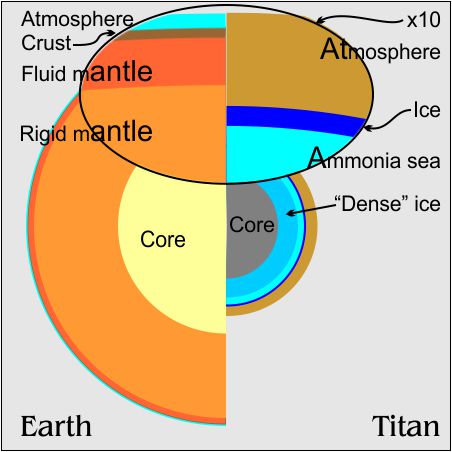
Wait, what’s gravity got to do with air pressure? (I’m gonna use “air pressure” instead of “surface atmospheric pressure” because typing.) Earth-standard sea level air pressure is 14.7 pounds of force per square inch. That 14.7 pounds is the total weight of the air molecules above each square inch of surface, all the way out to space.

(Fortunately, air’s a hydraulic fluid so its pressure acts on sides as well as tops. Otherwise, a football’s shape would be even stranger than it is.)

Newton showed us that weight (force) is mass times the the acceleration of gravity. Gravity on Titan is 1/10 as strong as Earth’s, so an Earth-height column of air on Titan should weigh about 1½ pounds.

But Titan’s atmosphere (measured to the top of each stratosphere) goes out 6 times further than Earth’s. If we built out that square-inch column 6 times taller, it’d weigh only 9 pounds on Titan, well shy of the 22 pounds the Huygens lander measured. Where does the extra weight come from?

My first guess was, heavy molecules. If gas A has molecules that are twice as heavy as gas B’s, then a given volume of A would weigh twice as much as the same volume of B. An atmosphere composed of A will press down on a planet’s surface twice as hard as an atmosphere composed of B.

Good guess, but doesn’t apply. Earth’s atmosphere is 78% N2 (molecular weight 28) and 21% O2 (molecular weight 32) plus a teeny bit of a few other things. Their average molecular weight is about 29. Titan’s atmosphere is 98% N2 so its average molecular weight (28) is virtually equal to Earth’s. So no, those tarry brown molecules that block our view of Titan’s surface aren’t numerous enough to account for the high pressure.

My second guess is closer to the mark, I think. I remembered the Ideal Gas Law, the one that says, “pressure times volume equals the number of molecules times a constant times the absolute temperature.” In symbols, P·V=n·R·T.

Visualize one gas molecule, Fred, bouncing around in a cube sized to match the average volume per molecule, V/n=R·T/P. If Fred goes outside his cube in any direction he’s likely to bang into an adjacent molecule. If Fred has too much contact with his neighbors they’ll all stick together and become a liquid or solid.

The equation tells us that if the pressure doesn’t change, the size of Fred’s cube rises with the temperature. Just for grins I calculated the cube’s size for standard Earth conditions: (22.4 liters/mole)×(1 cubic meter/1000 liters)×(1 mole/6.02×1023 molecules)=37.2×10⁻²⁷ cubic meter/molecule. The cube root of that is the length of the cube’s edge — 3.3 nanometers, about 8.3 times Fred’s 0.40-nanometer diameter.

titan-boxes
Fred and neighbors

Earth-standard surface temperature is about 300°K (absolute temperatures are measured in Kelvins). Titan’s surface temperature is only 94°K. On Titan that cube-edge would be 8.3*(94/300)=2.6 times Fred’s diameter — if air pressure were Earth-standard.

But really Titan’s air pressure is 1.5 times higher because its column is so tall and contains so much gas. The additional pressure squeezes Fred’s cube-edge down to 2.6*(1/1.5)=1.8 times his diameter. Still room enough for Fred to feel well-separated from his neighbors and continue acting like a proper gas.

The primary reason Titan’s atmosphere is so dense is that it’s chilly up there. Also, there’s a lot of Freds.

~~ Rich Olcott

– For the technorati… The cube-root of the Van der Waals volume for N2. And yeah, I know I’m almost writing about Mean Free Path but I think the development’s simpler this way.
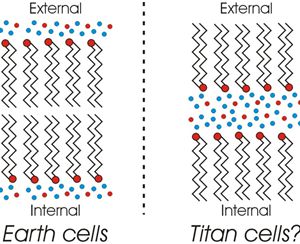
Bilayer membranes - Earth-standard and reversed

The basis for life on Titan — maybe

When the Huygens probe flashed us those images of lakes on Saturn’s moon Titan, people chattered that maybe there’s life in those hydrocarbon “waters.”

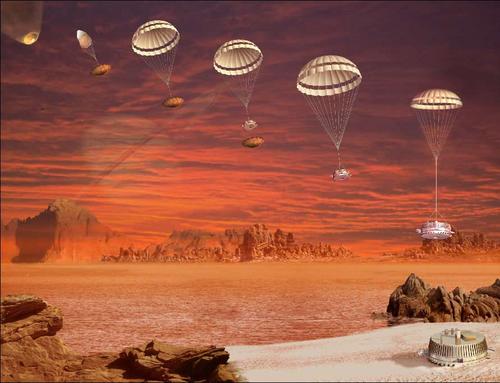
Huygens descending on Titan (image courtesy NASA/JPL-Caltech)

If there is life there, we might not even recognize it as such. Not just because of the frigid temperatures and other reasons laid out in en.wikipedia.org/wiki/Life_on_Titan, but for a couple of reasons having to do with the physical chemistry of solvents.

Water is a polar solvent, good at dissolving salts and other substances in which centers of positive and negative charge are in different parts of the molecule. Conversely, water molecules interact so strongly with each other that interspersed hydrocarbons and other non-polar molecules are forced away and out of solution. Hence the existence of oil slicks … and cell membranes.

Every kind of life on Earth, or at least everything that a biologist would be willing to call life, is composed of units whose integrity depends upon hydrocarbon moieties (molecules that contain significant amounts of hydrocarbon structure) being forced together in escape from a polar environment.

For bacteria and multi-cellular life forms, the boundary between interior and exterior is the cell membrane (see diagram), two layers of two-tailed molecules laid tail-to-tail with their non polar (black) hydrocarbon chains sandwiched between negative (red) polar groups that face out of and into the polar (red and blue) cell. Bilayer membranes - Earth-standard and reversedFurthermore, our cellular life also depends upon a whole collection of two-layer membranes that isolate different metabolic functions within the cell — respiration over here, protein construction over there, and so forth.

By some definitions we have smaller kinds of life, too: viruses and phages. Many viruses (e.g., herpes) have a non-polar fatty coating. Others make do with proteins to hide their DNA.  However, biochemistry tells us that these structural proteins are almost certainly held together in large part by patches of non-polar regions with precisely matching shapes.

However, Titan’s surface is dominated by a hydrocarbon solvent, a liquid mix of methane and ethane, that behaves very differently from water. Critically, hydrocarbon solvents do not dissolve water and other polar materials. The amino acids from which we build our proteins, the nucleic acids from which we build our RNA and DNA, even the carbohydrate groups from which plants build sugars and cellulose — all are essentially insoluble in hydrocarbons.

If lightning or some other process were to generate some nucleic acids in a Titan lake (as in the Miller-Urey experiment, see en.wikipedia.org/wiki/Miller_experiment), those molecules would immediately aggregate and fall as a sludgy solid onto the lake floor. There’d be no opportunity for those small molecules to interact with each other, much less find some amino acids to tie together to produce a protein. Life as we know it could not begin.

Well, how about a non-polar kind of life? The properties of hydrocarbon solvents permit two possibilities, both of which are very strange from an Earth-life perspective.

The easier one to visualize turns that double-layered cell membrane inside out. A Titanic cell membrane could be a sandwich with a layer of polar stuff between two non-polar layers. Given that structure, the cell’s internal non-polar metabolic processes could operate in isolation from the non-polar outside, just as our cell membranes isolate our watery internal cellular metabolism from our watery outside. A reversed cell membrane on a Titanic cell would wrap around some very interesting biochemistry.

But things could be even stranger. All hydrocarbons can intermix in all proportions with all hydrocarbons. That’s why petroleum crude is such a complex mix, and why different crudes break out differently at the refinery.  Any non-polar molecule can slide in between any other hydrocarbon molecules with very little effort.  On Titan, then, non-polar materials can diffuse freely throughout those ethane seas.

Moreover, liquid hydrocarbons have very low surface tension compared to water.  At the surface of a pool or droplet of water, those H2O molecules cling to each other so tightly that another object must exert force to get between them and into the bulk liquid.  The threshold force, measured by the surface tension, is so high for water that pond skaters and similar bugs can live their lives on a pond rather than in it.  In contrast, surface tension for a liquid hydrocarbon is only one-third that of water.

What’s important here is that surface tension is the force that works to minimize the surface to-volume ratio of a blob of liquid.  The form with the smallest possible ratio is a sphere.  Sure enough, small droplets of water are spherical.  Hydrocarbon fluids, with their much lower surface tension, tend to accept looser forms.  Water on a tarry surface beads up; oil on a wet surface spreads out.  Scientists think that water’s powerful sphere forming propensity was crucial in creating proto-cells during Earth-life’s early stages.

Suppose that Titan’s hydrocarbon life doesn’t depend on nearly-spherical cells.  Maybe Titan life has no cell boundary as we know it. Titan’s “biology” could be one titanic (in both senses) “cell” with different metabolic processes isolated by geography rather than by membranes the way Earth life does it.

Maybe the lakes closest to Titan’s equator generate long-chain hydrocarbons.  Maybe another set of lakes links those molecules to form complex benzenes and graphenes that catalyze reactions in still other lakes.

Maybe Titan’s rivers and streams carry information the way our nerve cells do.

Maybe Titan thinks.

I wonder what Titan thought of the Huygens probe.

~~ Rich Olcott