A No-Charge Transaction

I ain’t done yet, Sy. I got another reason for Dark Matter being made of faster‑then‑light tachyons.”

“I’m still listening, Vinnie.”

“Dark Matter gotta be electrically neutral, right, otherwise it’d do stuff with light and that doesn’t happen. I say tachyons gotta be neutral.”

“Why so?”

“Stands to reason. Suppose tachyons started off as charged particles. The electric force pushes and pulls on charges hugely stronger than gravity pulls—”

“1036 times stronger at any given distance.”

“Yeah, so right off the bat charged tachyons either pair up real quick or they fly away from the slower‑than‑light bradyon neighborhood leaving only neutral tachyons behind for us bradyon slowpokes to look at.”

“But we’ve got un‑neutral bradyon matter all around us — electrons trapped in Earth’s Van Allen Belt and Jupiter’s radiation belts, for example, and positive and negative plasma ions in the solar wind. Couldn’t your neutral tachyons get ionized?”

“Probably not much. Remember, tachyon particles whiz past each other too fast to collect into a star and do fusion stuff so there’s nobody to generate tachyonic super‑high‑energy radiation that makes tachyon ions. No ionized winds either. If a neutral tachyon collides with even a high-energy bradyon, the tachyon carries so much kinetic energy that the bradyon takes the damage rather than ionize the tachyon. Dark Matter and neutral tachyons both don’t do electromagnetic stuff so Dark Matter’s made of tachyons.”

“Ingenious, but you missed something way back in your initial assumptions.”

“Which assumption? Show me.”

“You assumed that tachyon mass works the same way that bradyon mass does. The math says it doesn’t.” <grabbing scratch paper for scribbling> “Whoa, don’t panic, just two simple equations. The first relates an object’s total energy E to its rest mass m and its momentum p and lightspeed c.”

E² = (mc²)² + (pc)²

“I recognize the mc² part, that’s from Einstein’s Equation, but what’s the second piece and why square everything again?”

“The keyword is rest mass.”

“Geez, it’s frames again?”

“Mm‑hm. The (mc²)² term is about mass‑energy strictly within the object’s own inertial frame where its momentum is zero. Einstein’s famous E=mc² covers that special case. The (pc)² term is about the object’s kinetic energy relative to some other‑frame observer with relative momentum p. When kinetic energy is comparable to rest‑mass energy you’re in relativity territory and can’t just add the two together. The sum‑of‑squares form makes the arithmetic work when two observers compare notes. Can I go on?”

“I’m still waitin’ to hear about tachyons.”

“Almost there. If we start with that equation, expand momentum as mass times velocity and re‑arrange a little, you get this formula

E = mc² / √(1 – v²/c²)

The numerator is rest‑mass energy. The v²/c² measures relative kinetic energy. The Lorentz factor down in the denominator accounts for that. See, when velocity is zero the factor is 1.0 and you’ve got Einstein’s special case.”

“Give me a minute. … Okay. But when the velocity gets up to lightspeed the E number gets weird.”

“Which is why c is the upper threshold for bradyons. As the velocity relative to an observer approaches c, the Lorentz factor approaches zero, the fraction goes to infinity and so does the object’s energy that the observer measures.”

“Okay, here’s where the tachyons come in ’cause their v is bigger than c. … Wait, now the equation’s got the square root of a negative number. You can’t do that! What does that even mean?”

“It’s legal, when you’re careful, but interpretation gets tricky. A tachyon’s Lorentz factor contains √(–1) which makes it an imaginary number. However, we know that the calculated energy has to be a real number. That can only be true if the tachyon’s mass is also an imaginary number, because i/i=1.”

“What makes imaginary energy worse than imaginary mass?”

“Because energy’s always conserved. Real energy stays that way. Imaginary mass makes no sense in Newton’s physics but in quantum theory imaginary mass is simply unstable like a pencil balanced on its point. The least little jiggle and the tachyon shatters into real particles with real kinetic energy to burn. Tachyons disintegrating may have powered the Universe’s cosmic inflation right after the Big Bang — but they’re all gone now.”

“Another lovely theory shot down.”
~ Rich Olcott
Got To Be Good-lookin’ ‘Cause He’s So Hard To See

I’ll be sorry when Acme Building’s management swaps out our old‑style door locks for electronic ones. Vinnie has such fun lock‑picking his way past my office door in the morning. “Morning, Vinnie.”

“Morning, Sy. Hey, I got a new Crazy Theory for you. Nobody knows what Dark Matter is, right?”

“Right. All we know is that it has about five times as much mass as normal matter so it participates in gravitational interactions. Some of it seems to gather in spherical halos around galaxies and some of it seems to collect in spikes near their centers. Cosmologists are arguing about whether or not Dark Matter is particles, much less how they’d be quantized. And we call it Dark because it absolutely doesn’t care about electromagnetism.”

“That’s what I thought. I remember you said if Dark Matter did play with light waves at all it’d block our view of the CMB. So yeah, absolute. Good.”

“I gather your theory is about Dark Matter.”

“Mm-hm. I thought of a way that all that mass could be hiding in plain sight except we can’t see it.”

“Alright, I’m listening.”

“Tachyons.”

“Come again?”

“Tachyons — particles that fly around faster than light. I read an article about ’em. Some people say they can’t exist but hear me out, okay? The reason they’re not supposed to exist is ’cause it would take an infinite amount of energy to boost something up past lightspeed. I got that, but suppose they were born above lightspeed, back when the Big Bang singularity had energy packed so tight the Physics laws we know don’t apply. A lot of particles got flung out below lightspeed, but maybe even more got flung out above it.”

“What does this have to do with dark matter?”

“I’m gettin’ there. The thing with tachyons is, the article said it’d take infinite energy to slow one down to lightspeed. A tachyon rock hits a slow rock, it don’t stop ’cause the slow rock don’t have the juice for that. The collision may take a little energy from the tachyon rock but that just changes its trajectory.”

“Mmm, those tachyon rocks can’t be a thing. The — what can I call it? slow matter?”

“The article called ’em bradyons.”

“Thanks. We know that 92% of all … bradyonic atoms in the Universe are hydrogens. Rocks are made of silicon, oxygen and other atoms that are even heavier. Everything heavier than hydrogen and maybe some helium was created by nuclear reactions inside a star. Tachyonic atoms zooming beyond lightspeed couldn’t gather together to form a star or even join one. No significant tachyonic fusion, no tachyonic rocks.”

“Okay, they all stay tachy‑hydrogen, still not a problem. The point is, there could be a lot of them and they could add up to a lot of mass. So the next thing I asked is, where would tachyons hang out? Gotta be around galaxies, but being tachyons going super‑lightspeed they can’t just hang, they orbit around the centers. They’d spend the most time where they go slowest which is where they’re farthest away ’cause that’s how orbits work. But they’d be thickest close in ’cause of gravity but that’s where they go fastest.”

“Cute, so you’re predicting galaxies with halos of tachyons, plus spikes of them at each center. That just happens to be the dark matter distribution the astronomers find.”

“It gets better, Sy. I’m not so sure of this because math, but it feels right. I don’t think tachyons can do electromagnetism things.”

“Why not?”

“No blue glow — you know, that blue glow in nuclear reactors when electrons go through the cooling water faster than light?”

“Cherenkov radiation, happens when fast electrons polarize the water. The polarizing slows light in water relative to a vacuum.”

“Right, but tachyons in space travel through vacuum. They ought to polarize the vacuum like what fast electrons do to water. Electromagnetic tachyons orbiting galaxies ought to make a blue glow but there isn’t one, so tachyons don’t do electromagnetism things and that makes them Dark Matter.”

“You’re going to have to do better than that, Vinnie. Absence of evidence just might be evidence of absence. Maybe they’re not there to begin with.”

~ Rich Olcott

The Time Is Out of Joint

Vinnie galumphs over to our table. “Hi, guys. Hey, Sy, I just read your Confluence post. I thought that we gave up on things happening simultaneous because of Einstein and relativity but I guess that wasn’t the reason.”

“Oh, things do happen simultaneously, no‑one claims they don’t, it’s just that it’s impossible for two widely‑separated observers to have evidence that two widely‑separated events happened simultaneously. That’s a very different proposition.”

“Ah, that makes me feel better. The ‘nothing is simultaneous‘ idea was making me itchy ’cause I know for sure that a good juggler lets go with one hand just as they’re catching with the other. How’s Einstein involved then?”

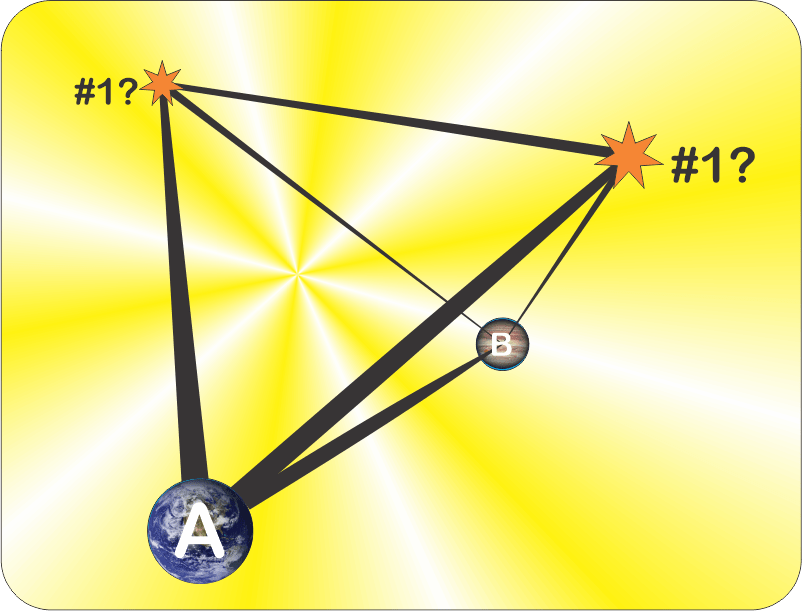
“Lightspeed’s a known constant. Knowing distance and lightspeed lets you calculate between‑event time, right? The key to simultaneity was understanding why lightspeed is a constant. We’d known lightspeed wasn’t infinite within the Solar System since Rømer’s time, but people doubted his number applied everywhere. Maxwell’s theory of electromagnetism derived lightspeed from the properties of space itself so it’s universal. Only in Newton’s Universe was it possible for two distant observers to agree that two also‑distant events were simultaneous.”

“Why was Newton’s Universe special?

“Space held still and didn’t bend. Astronomers A and B had a stable baseline between them. After measuring the baseline with light they could measure the angles each observed between the events. Some trigonometry let them send each other congratulatory messages on seeing a simultaneous pair of incidents. After Einstein’s work, they knew better.”

“It’s frames again, ain’t it?”

“Of course, Vinnie. A‘s frame is almost certainly moving relative to B‘s frame. Motion puts the Lorentz relativity factor into the game, making each astronomer’s clock run faster than the other’s. Worse, each astronomer sees that the other’s yardsticks are too short.”

Jeremy gives me a confused look.

Space compression goes along with time dilation, Jeremy. Professor Hanneken will explain it all when your class gets to that unit. Bottom line, things can happen simultaneously in Einstein’s Universe, but no‑one can agree on which things.”

“Wait, if every frame has its own time‑rate, how can two spaceships rendezvous for an operation?”

“Good question, Jeremy. Einstein had an answer but complications hide under the covers. He suggested that A start a timer when sending a light pulse to a mirror at B. A waits for the reflection. B starts a timer when they see A‘s pulse. A measures the pulse’s round‑trip time. Each creates a clock that advances one tick for half of the round-trip time. B sets their clock back by one tick. That done, they agree to meet some number of ticks later.”

“Hmm… That should work, but you said there are complications.”

“There are always complications. For instance, suppose B is slingshotting around a black hole so that pulse and reflection travel different pathlengths. Or suppose one frame is rotating edge‑on to the other. In practice the ships would re‑sync repeatedly while approaching the rendezvous point.”

Vinnie erupts. “HAW! Successive approximation again!”

“Indeed. If we could extend the method to more than two participants we’d have a true Universal Coordinated Time.”

“Don’t we have that, Mr Moire? The Big Bang happened 14 billion years ago. Couldn’t we measure time from that?”

“Sort of. Last I looked the number was 13.787 plus‑or‑minus 20 million years. Too much slop for an instantaneous fleet‑level rendezvous like the final battle scene in StarTrek:Picard. But you’ve brought up an interesting question for a Crazy Theories seminar. One of Cosmology’s deepest unsolved questions is, ‘How does inertia work?’ Do you remember Newton’s First Law?”

<closes eyes> “In an inertial reference frame, an object either remains at rest or continues to move at a constant velocity, unless acted upon by a net force.

“Right. In other words, every object resists change to its current steady motion along a geodesic. Why is that? There’s no coherent, well‑founded, well‑tested theory. Einstein liked Mach’s Principle, which says inertia exists because every object is attracted through space to all the mass in the Universe. Suppose there’s a Mach’s Principle for Time, saying that objects squirt up the Time axis because they’re repelled by all the mass in the Universe.”

Vinnie hoots, “Bo-o-o-ohh-GUS!”

~ Rich Olcott

Black, White And Wormy

“Whaddaya mean, Sy, if white holes exist? You just told me how they’re in the equations just like black holes.”

“Math gives us only models of reality, Vinnie. Remarkably good models, some of them, but they’re only abstractions. Necessarily they leave out things that might skew math results away from physical results or the other way around. Einstein believed his math properly reflected how the Universe works, but even so, he doubted that black holes could exist. He didn’t think it’d be possible to collect that much mass into such a small space. Two decades after he said that, Oppenheimer figured out how that could happen.”

“Oppenheimer like the A‑bomb movie guy?”

“Same Oppenheimer. He was a major physicist even before they put him in charge of the Manhattan Project. He did a paper in 1939 showing how a star‑collapse could create the most common type of black hole we know of. Twenty‑five years after that the astronomers found proof that black holes exist.”

“Well, if Einstein was wrong about black holes, why wasn’t he wrong about white holes?”

“We need another Oppenheimer to solve that. So far, no‑one has come up with a mechanism that would create a stand‑alone white hole. That level of stress on spacetime requires an enormous amount of mass‑energy in a tiny volume. Whatever does that must somehow do it with a time‑twist opposite to how a black hole is formed. Worse yet, by definition the white hole’s Event Horizon leaks matter and energy. The thing ought to evaporate almost as soon as it’s formed.”

“I heard weaseling. You said, ‘a stand‑alone white hole,’ like there’s maybe another kind. How about that?”

“Could be, maybe not, depending on who’s talking and whether or not they’re accounting for magnetic fields, neutrinos or quantum effects. The discussion generally involves wormholes.”

“Wormholes.”

“Mm-hm. Some cosmologists think that wormholes might bridge between highly stressed points in spacetime. Black hole or white, the stress is what matters. The idea’s been around nearly as long as our modern idea of black holes. No surprise, ‘wormhole’ was coined by John Archibald Wheeler, the same guy who came up with the phrases ‘black hole’ and ‘quantum foam’.”

“Quantum—. Nope, not gonna bite. Get back to white holes.”

“I’m getting there. Anyway, the relativity theory community embraced black holes, white holes and wormholes as primary tools for studying how spacetime works.”

“How’re they gonna do that? That squib Cal showed me said we’ve never seen a white hole.”

“Fair question. Last I heard, the string theory community confidently predicted 10500 different Universes with little hope of narrowing the field. In contrast, relativity theory is firmly constrained by well‑founded math, a century of confirmation from experimental tests and a growing amount of good black hole data. Perfectly good math says that wormholes and white holes could form but only under certain unlikely conditions. Those conditions constrain white holes like Oppenheimer’s conditions constrained forming a stellar‑size black hole.”

“So how do we make one?”

We don’t. If the Universe can make the right conditions happen somewhere in spacetime, it could contain white holes and maybe a network of wormholes; otherwise, not. Maybe we don’t see them because they’ve all evaporated.”

“I remember reading one time that with quantum, anything not forbidden must happen.”

“Pretty much true, but we’re not talking quantum here. Macro‑scale, some things don’t happen even though they’re not forbidden.”

“Name one.”

“Anti‑matter. The laws of physics work equally well for atoms with positive or negative nuclear charge. We’ve yet to come up with an explanation for why all the nuclear matter we see in the Universe has the positive‑nucleus structure. The mystery’s got me considering a guess for Cathleen’s next Crazy Theories seminar.”

“Oh, yeah? Let’s have it.”

“Strictly confidential, okay?”

“Sure, sure.”

“Suppose the Big Bang’s chaos set up just the right conditions to make a pair of CPT‑twin black holes, expanding in opposite directions along spacetime’s time dimension. Suppose we’re inside one twin. Our time flows normally. If we could see into the other twin, we’d see inside‑out atoms and clocks running backwards. From our perspective the twin would be a white hole.”

“Stay outta that wormhole bridge.”

~ Rich Olcott

Five More Alternate Universes?

I unlock my office door and there’s Vinnie inside, looking out the window. “Your 12th‑floor view’s pretty nice, Sy. From above the tree tops you can see leaf buds just starting to show their early green colors.”

“What are you doing here, Vinnie? I thought you were charter‑flying to Vancouver.”

“The guy canceled. Said with all the on‑again, off‑again tariffs there’s no sense traveling to make a deal when he doesn’t know what he’s dealing with. So I got some time to think.”

“And you came here so it’s something physics‑technical.”

“Yeah, some. I notice colors a lot when I’m flying. Some of those trees down there this time of year are exactly the same bright yellow‑green as some of the rice paddies I’ve flown over. But all the trees get the same hard dark green by August before they go every different color when the chlorophyll fades away.”

I’ve noticed that. So you came here to talk about spectra?”

“Some other time. This time I want to talk about dark matter.”

“But we call it dark matter precisely because it doesn’t do light. All our normal matter is made of atoms and the atoms are made of electrons and nuclei and each nucleus is made of protons and neutrons and protons and neutrons are made of quarks. Electrons and quarks carry electrical charge. Anything with electrical charge is subject to electromagnetism, one way or another. Dark matter doesn’t notice electromagnetism. If dark matter had even the slightest interaction with light’s electromagnetic field, we wouldn’t be able to see galaxies billions of lightyears away.”

“Calm down, Sy, breath a couple times. Stay with me here. From your stuff and what else I’ve read, all we know about dark matter is a lot of things it isn’t or doesn’t do. The only force we know it respects is gravity so it attracts itself and also normal matter and they all clump up to make galaxies and such, right?”

<a bit reluctantly and on a rising note> “Mm‑hnn…?”

“I read your three‑part series about the Bullet Cluster, where we think two galaxy clusters went though each other and their gas clouds gave off a lot of X‑rays that didn’t match where the stars were or where the gravity was so the astronomers blame dark matter for the gravity, right?”

“That’s pretty much it. So?”

“So the other thing I got from that series was maybe there’s friction between dark matter and other dark matter, like it doesn’t just slide past itself. If dark matter is particles, maybe they’re sorta sticky and don’t bounce off each other like billiard balls. That doesn’t make sense if all they do is gravity.”

“I see where you’re going. You’re thinking that maybe dark matter feels some kind of force that’s not gravity or electromagnetism.”

“That’s it! We’ve got light photons carrying electromagnetic forces to hold our molecules and rocks together. Could there be dark photons carrying some dark‑sticky force to connect up dark molecules and dark rocks and stuff?”

“That’s an interesting—”

“I ain’t done yet, Sy. It gets better. I’ve read a bunch of articles saying there’s about five times as much dark matter in the Universe as normal matter. You physicists love symmetry, suppose it’s exactly five times as much. There’d be six kinds of force, one called electromagnetism and a different snooty force each for five kinds of dark matter and that’ll add up to the 25% we can’t see. Like, a purple dark force for purple dark rocks, naturally they’re not really purple, and a yellow dark force and so on.”

“You’re proposing that each kind of dark matter responds only to its own special force, so no cross‑communication?”

“Yup, gravity’s the only thing they’d all agree on. That bein’ the case, the galaxies would hold six times as many stars as we think, except 5/6 of them are invisible to our 1/6. Five alternate universes sharing space with ours. Cozy, huh?”

“Clever, Vinnie, except for the evidence that most galaxies are embedded in huge nearly‑spherical halos of dark matter. The halos would have collapsed long ago if only gravity and stickiness were in play.”

“Dang.”

~ Rich Olcott

Mushy stuff

“Amanda! Amanda! Amanda!”

“All right, everyone, settle down for our final Crazy Theorist. Jim, you’re up.”

“Thanks, Cathleen. To be honest I’m a little uncomfortable because what I’ve prepared looks like a follow-on to Newt’s idea but we didn’t plan it that way. This is about something I’ve been puzzling over. Like Newt said, black holes have mass, which is what everyone pays attention to, and charge, which is mostly unimportant, and spin. Spin’s what I’ve been pondering. We’ve all got this picture of a perfect black sphere, so how do we know it’s spinning?”

Voice from the back of the room — “Maybe it’s got lumps or something on it.”

“Nope. The No-hair Theorem says the event horizon is mathematically smooth, no distinguishing marks or tattoos. Question, Jeremy?”

“Yessir. Suppose an asteroid or something falls in. Time dilation makes it look like it’s going slower and slower as it gets close to the event horizon, right? Wouldn’t the stuck asteroid be a marker to track the black hole’s rotation?”

“Excellent question.” <Several of Jeremy’s groupies go, “Oooh.”> “Two things to pay attention to here. First, if we can see the asteroid, it’s not yet inside the horizon so it wouldn’t be a direct marker. Beyond that, the hole’s rotation drags nearby spacetime around with it in the ergosphere, that pumpkin‑shaped region surrounding the event horizon except at the rotational poles. As soon as the asteroid penetrates the ergosphere it gets dragged along. From our perspective the asteroid spirals in instead of dropping straight. What with time dilation, if the hole’s spinning fast enough we could even see multiple images of the same asteroid at different levels approaching the horizon.”

Jeremy and all his groupies go, “Oooh.”

“Anyhow, astronomical observation has given us lots of evidence that black holes do spin. I’ve been pondering what’s spinning in there. Most people seem to think that once an object crosses the event horizon it becomes quantum mush. There’d be this great mass of mush spinning like a ball. In fact, that was Schwarzchild’s model for his non-rotating black hole — a simple sphere of incompressible fluid that has the same density throughout, even at the central singularity.”

VBOR — “Boring!”

“Well yeah, but it might be correct, especially if spaghettification and the Firewall act to grind everything down to subatomic particles on the way in. But I got a different idea when I started thinking about what happened to those two black holes that LIGO heard collide in 2015. It just didn’t seem reasonable that both of those objects, each dozens of solar masses in size, would get mushed in the few seconds it took to collide. Question, Vinnie?”

“Yeah, nice talk so far. Hey, Sy and me, we talked a while ago about you can’t have a black hole inside another black hole, right, Sy?”

“That’s not quite what I said, Vinnie. What I proved was that after two black holes collide they can’t both still be black holes inside the big one. That’s different and I don’t think that’s where Jim’s going with this.”

“Right, Mr Moire. I’m not claiming that our two colliders retain their black hole identities. My crazy theory is that each one persists as a high‑density nubbin in an ocean of mush and the nubbins continue to orbit in there as gravity propels them towards the singularity.”

VBOR —”Orbit? Like they just keep that dance going after the collision?”

“Sure. What we can see of their collision is an interaction between the two event horizons and all the external structures. From the outside, we’d see a large part of each object’s mass eternally inbound, locked into the time dilation just above the joined horizon. From the infalling mass perspective, though, the nubbins are still far apart. They collide farther in and farther into the future. The event horizon collision is in their past, and each nubbin still has a lot of angular momentum to stir into the mush. Spin is stirred-up mush.”

Cathleen’s back at the mic. “Well, there you have it. Amanda’s male-pattern baldness theory, Newt’s hyper‑planetary gear, Kareem’s purple snowball or Jim’s mush. Who wins the Ceremonial Broom?”

The claque responds — “Amanda! Amanda! Amanda!”

~ Rich Olcott

A Big Purple Snowball

Cathleen’s back at the mic. “Okay, folks, now for the third speaker in tonight’s Crazy Theory seminar. Kareem, you have the floor.”

“Thanks, Cathleen. Some of you already know I do old‑rock geology. If a rock has a bone in it, I’m not interested. Paleontology to me is like reading this morning’s newspaper. So let me take you back to Precambrian times when Earth may have been purple.”

Kareem’s a quiet guy but he’s got the story‑teller’s gift, probably honed it at field expedition campfires, so we all settle back to listen.

“Four and a half billion years ago, Earth was bright orange. That’s not the color it reflected, that’s the color it glowed. You’ve all seen glass‑blowers at work, how the material gives off a bright orange light coming out of the flame or furnace, soft and ready to be formed. That’s what the planet’s surface was like after its Moon‑birthing collision with Theia. Collisions like that release so much heat that there’s no rocks, just layers of smooth molten glassy slag floating on fluid silicates and nickel‑iron like in a blast furnace. No atmosphere, all the volatiles have been boiled off into space. Got the picture?”

General nodding, especially from maybe‑an‑Art‑major who’s good at pictures.

“Time passes. Heat radiating away cools the world from the outside inward. Now the surface is a thin glassy cap, black like obsidian and basalt, mostly smooth. The cooling contracting cap fractures from the tension while the shrinking interior pulls inward, slow but not gentle. The black glassy surface becomes low craggy mountains and razor‑rubble, sharp enough to slice hiking boots to ribbons. There’s no erosive wind or water yet to round things off. Everything stays sharp‑edged.”

Voice from the back of the room — “Where’s our water from then?”

“Good question. Could be buried water that never got the chance to escape past the cap, could be water ferried in on icy comets or worldlets. People argue about it and I’m not taking sides. The planet gets a new color after it cools enough to hold onto water molecules however they got there — but that water doesn’t stay on the surface. Raindrops hitting still‑hot rock hiss back into steamy clouds. If you were on the moon at the time you’d see a white‑and‑grey Earth like Jupiter’s curdled cloud-tops. Visualize a series of million‑year Hurricane Debbies, all over the world.”

He pauses to let that sink in.

“When things finally cool down enough to allow surface water there’s oceans, but they’re not blue. Millions of years of wind and water erosion have ground the sharp rubble to spiky dust. Most of the thrust‑raised mountains, too. Much of the dust is suspended or dissolved in the ocean turning it black. For a while. The dust is loaded with minerals, especially sulfides, very nutritious for a group of not‑quite bacteria called Archaea that eat sulfides using a molecule that’s powered by green light but reflects red and blue. When the Archaea take over, the oceans look magenta from the reflected red and blue.”

Maybe‑an‑Art‑major giggles.

“Next major event, we think, was the Huronian Glaciation, when most or all of the Earth was a solid white because it was covered with ice. Killed off most or the Archaea. When that melted, different parts of the ocean turned black from floating dead Archaea and and then milky turquoise from sulfur particles. Next stage was purple, from a different group of sulfur‑eating purple almost‑bacteria. Then we had snowball whiteness again, which gave green‑reflecting chlorophyll‑users a chance to take over, clear our the sulfur and leave the oceans blue.”

VBOR — “That’s your Crazy Theory?”

“No, that’s mostly mainstream. Question is, what terminated the deepfreezes? Lots of ideas out there — solar dimming and brightening, different combinations of CO2 and methane from volcanoes or bacteria, even meteorites. Anyone remember Ian Malcom’s repeated line in the Jurassic Park movies?”

Everyone — “Life will find a way!”

“Right on. My crazy’s about the two almost‑bacteria. Suppose each kind managed to infiltrate their day’s Great Extinction glaciers. Suppose planet‑wide bacterial purple pigments absorbed sunlight’s energy, melting the ice. Karma, yes?”

~ Rich Olcott

A Great Big Mesh

Cal has my coffee mug filled as soon as I step into his shop. “Get to the back room quick, Sy. Cathleen’s got another Crazy Theories seminar going back there.”

So I do. First thing I hear is Amanda finishing her turn at the mic. “And that’s why humans evolved male pattern baldness.”

A furor of “Amanda! Amanda! Amanda!” then Cathleen regains control. “Thank you, Amanda. Next up — Newt Barnes. What’s your Crazy Theory, Newt?”

“Crazy idea, not a theory, but I like it. Everybody’s heard of black holes, right?”

<general nodding>

“And we’ve all heard that nothing can leave a black hole, not even light.”

<more nodding>

“Well in fact that’s mostly not true. There’s so much confusion about black holes. We’ve known about a black hole’s event horizon and its internal mass since the 1920s. It took years for us to realize that the central mass could wrap a shiny accretion disk around itself, and an ergosphere, and maybe spit out jets. So, close outside the Event Horizon there’s a lot of light‑emitting structure, right?”

<A bit less nodding, but still.>

“Right. So I’ll skip in past a few controversial layers and get down to the famously black event horizon. Why’s it black?”

Voice from the back of the room — “Because photons can’t get out because escape velocity’s faster than lightspeed.”

“That’s the answer I expected, but it’s also one of the confusing parts. You’re right, the horizon marks the level where outward‑bound massy particles can’t escape. The escape velocity equation depends on trading off kinetic and gravitational potential energy. Any particle with mass would have to convert an impossible amount of kinetic energy into gravitational potential energy to get through the barrier. But zero‑mass particles, photons and such, are pure kinetic energy. They aren’t bound by a gravitational potential so escape velocity trade‑offs simply don’t apply. There’s a deeper reason photons also can’t get out.”

VBOR — “So what’s trapping them?”

“Time. It traps photons and any kind of information. The other thing about the Event Horizon is, it’s the level where spacetime is so bent around that the time‑coordinate is just on the verge of pointing inward. Once you’re inside that boundary the cause‑and‑effect arrow of time is against you. Whatever direction you point your flashlight, its beam will emerge in your future and that’s away from the horizon. Trying to send a signal outside would be like sending it into your past, which you can’t do. Nothing gets away from a black hole except…”

“Except?”

“Roger Penrose found a loophole and I may have found another one. There’s something that Wheeler called the No-Hair Theorem. It says that the Event Horizon hides everything inside it except for its mass, electric charge and angular momentum.”

“How do those get out?”

“They don’t get out so much as serve as backdrop for all the drama in the rest of the structure. If you know the mass, for instance, you can calculate its temperature and the Horizon’s diameter and a collection of other properties.”

Cathleen senses a teachable moment and breaks in. “Talk about charge and spin, Newt.”

“I was going there, Cathleen. Kerr and company’s equations take account of both of those. Turns out the attractive forces between opposite charges are so much stronger than gravity that it’s hard for an object in space to build up a significant amount of either kind of charge without getting neutralized almost immediately. Kind of ironic that the Coulomb force, far stronger than gravity, generates net energy contributions that are much smaller than the gravity‑based ones. Spin, though, that’s where the loopholes are. Penrose figured out how particles from the accretion disk could dip into the black hole’s spinning ergosphere, steal some of its energy, and stream up to power the jets.”

VBOR — “What’s your loophole then?”

“Speed contrast between layers. The black hole mass is spinning at a great rate, dragging nearby spacetime and the ergosphere and the accretion disk around with it. But the layers go slower as you move outward. Station a turbine generator like an idler gear between any two layers and you’re pulling power from the black hole’s spin.”

Silence … then, “Amanda! Amanda! Amanda!”

~ Rich Olcott

Maybe It’s Just A Coincidence

Raucous laughter from the back room at Al’s coffee shop, which, remember, is situated on campus between the Physics and Astronomy buildings. It’s Open Mic night and the usual crowd is there. I take a vacant chair which just happens to be next to the one Susan Kim is in. “Oh, hi, Sy. You just missed a good pitch. Amanda told a long, hilarious story about— Oh, here comes Cap’n Mike.”

Mike’s always good for an offbeat theory. “Hey, folks, I got a zinger for you. It’s the weirdest coincidence in Physics. Are you ready?” <cheers from the physicists in the crowd> “Suppose all alone in the Universe there’s a rock and a planet and the rock is falling straight in towards the planet.” <turns to Al’s conveniently‑placed whiteboard> “We got two kinds of energy, right?”

Potential Energy    Kinetic Energy

Nods across the room except for Maybe-an-Art-major and a couple of Jeremy’s groupies. “Right. Potential energy is what you get from just being where you are with things pulling on you like the planet’s gravity pulls on the rock. Kinetic energy is what potential turns into when the pulls start you moving. For you Physics smarties, I’m gonna ignore temperature and magnetism and maybe the rock’s radioactive and like that, awright? So anyway, we know how to calculate each one of these here.”

PE = GMm/R    KE = ½mv²

“Big‑G is Newton’s gravitational constant, big‑M is the planet’s mass, little‑m is the rock’s mass, big‑R is how far apart the things are, and little‑v is how fast the rock’s going. They’re all just numbers and we’re not doing any complicated calculus or relativity stuff, OK? OK, to start with the rock is way far away so big‑R is huge. Big number on the bottom makes PE’s fraction tiny and we can call it zero. At the same time, the rock’s barely moving so little‑v and KE are both zero, close enough. Everybody with me?”

More nods, though a few of the physics students are looking impatient.

“Right, so time passes and the rock dives faster toward the planet Little‑v and kinetic energy get bigger. Where’s the energy coming from? Gotta be potential energy. But big‑R on the bottom gets smaller so the potential energy number gets, wait, bigger. That’s OK because that’s how much potential energy has been converted. What I’m gonna do is write the conversion as an equation.

GMm/R=½mv²

“So if I tell you how far the rock is from the planet, you can work the equation to tell me how fast it’s going and vice-versa. Lemme show those straight out…”

v=(2GM/R)    R=2GM/v²

Some physicist hollers out. “The first one’s escape velocity.”

“Good eye. The energetics are the same going up or coming down, just in the opposite direction. One thing, there’s no little‑m in there, right? The rock could be Jupiter or a photon, same equations apply. Suppose you’re standing on the planet and fire the rock upward. If you give it enough little‑v speed energy to get past potential energy equals zero, then the rock escapes the planet and big‑R can be whatever it feels like. Big‑R and little‑v trade off. Is there a limit?”

A couple of physicists and an astronomy student see where this is going and start to grin.

“Newton physics doesn’t have a speed limit, right? They knew about the speed of light back then but it was just a number, you could go as fast as you wanted to. How about we ask how far the rock is from the planet when it’s going at the speed of light?”

R=2GM/

Suddenly Jeremy pipes up. “Hey that’s the Event Horizon radius. I had that in my black hole term paper.” His groupies go “Oooo.”

“There you go, Jeremy. The same equation for two different objects, from two different theories of gravity, by two different derivations.”

“But it’s not valid for lightspeed.”

“How so?”

“You divided both sides of your conversion equation by little‑m. Photons have zero mass. You can’t divide by zero.”

Everyone in the room goes “Oooo.”

~~ Rich Olcott

Question Time

Cathleen unmutes her mic. “Before we wrap up this online Crazy Theories contest with voting for the virtual Ceremonial Broom, I’ve got a few questions here in the chat box. The first question is for Kareem. ‘How about negative evidence for a pre-mammal civilization? Played-out mines, things like that.‘ Kareem, over to you.”

“Thanks. Good question but you’re thinking way too short a time period. Sixty‑six million years is plenty of time to erode the mountain a mine was burrowing into and take the mining apparatus with it.

“Here’s a different kind of negative evidence I did consider. We’re extracting coal now that had been laid down in the Carboniferous Era 300 million years ago. At first, I thought I’d proved no dinosaurs were smart enough to dig up coal because it’s still around where we can mine it. But on second thought I realized that sixty-six million years is enough time for geological upthrust and folding to expose coal seams that would have been too deeply buried for mining dinosaurs to get at. So like the Silurian Hypothesis authors said, no conclusions can be drawn.”

“Nice response, Kareem. Jim, this one’s for you. ‘You said our observable universe is 93 billion lightyears across, but I’ve heard over and over that the Universe is 14 billion years old. Did our observable universe expand faster than the speed of light?‘”

“That’s a deep space question, pun intended. The answer goes to what we mean when we say that the Hubble Flow expands the Universe. Like good Newtonian physicists, we’re used to thinking of space as an enormous sheet of graph paper. We visualize statements like, ‘distant galaxies are fleeing away from us‘ as us sitting at one spot on the graph paper and those other galaxies moving like fireworks across an unchanging grid.

“But that’s not the proper post-Einstein way to look at the situation. What’s going on is that we’re at our spot on the graph paper and each distant galaxy is at its spot, but the Hubble Flow stretches the graph paper. Suppose some star at the edge of our observable universe sent out a photon 13.7 billion years ago. That photon has been headed towards us at a steady 300000 kilometers per second ever since and it finally reached an Earth telescope last night. But in the meantime, the graph paper stretched underneath the photon until space between us and its home galaxy widened by a factor of 3.4.

“By the way, it’s a factor of 3.4 instead of 6.8 because the 93 billion lightyear distance is the diameter of our observable universe sphere, and the photon’s 13.7 billion lightyear trip is that sphere’s radius.

“Mmm, one more point — The Hubble Flow rate depends on distance and it’s really slow on the human‑life timescale. The current value of the Hubble Constant says that a point that’s 3×10¹⁹ kilometers away from us is receding at about 70 kilometers per second. To put that in perspective, Hubble Flow is stretching the Moon away from us by 3000 atom‑widths per year, or about 1/1300 the rate at which the Moon is receding because of tidal friction.”

“Nice calculation, Jim. Our final question is for Amanda. ‘Could I get to one of the other quantum tracks if I dove into a black hole and went through the singularity?‘”

“I wouldn’t want to try that but let’s think about it. Near the structure’s center gravitational intensity compresses mass-energy beyond the point that the words ‘particle’ and ‘quantum’ have meaning. All you’ve got is fields fluctuating wildly in every direction of spacetime. No sign posts, no way to navigate, you wouldn’t be able to choose an exit quantum track. But you wouldn’t be able to exit anyway because in that region the arrow of time points inward. Not a sci‑fi story with a happy ending.”

“<whew> Alright, folks, time to vote. Who presented the craziest theory? All those in favor of Kareem, click on your ‘hand’ icon. … OK. Now those voting for Jim? … OK. Now those voting for Amanda? … How ’bout that, it’s a tie. I guess for each of you there’s a parallel universe where you won the virtual Ceremonial Broom. Congratulations to all and thanks for such an interesting evening. Good night, everyone.”

~~ Rich Olcott