There’s a lot of not much in Space

A while ago I drove from Denver to Fort Worth, and I was impressed. See, there’s a lot of not much in eastern Colorado. It’s pretty much the same in western Oklahoma except there’s less not much because there’s less of Oklahoma – but Texas has way more not much than anybody.

That gives Texas not much to brag about, but they do the best they can, bless their hearts.

What got me started on this rant was a a pair of astronomical factoids Katherine Kornei wrote in the Nov 2014 Discover magazine.

“If galaxies were shrunk to the size of apples, neighboring galaxies would be only a few meters apart….”
“If the stars within galaxies were shrunk to the size of oranges, they would be separated by 4,800 kilometers (3,000 miles).”
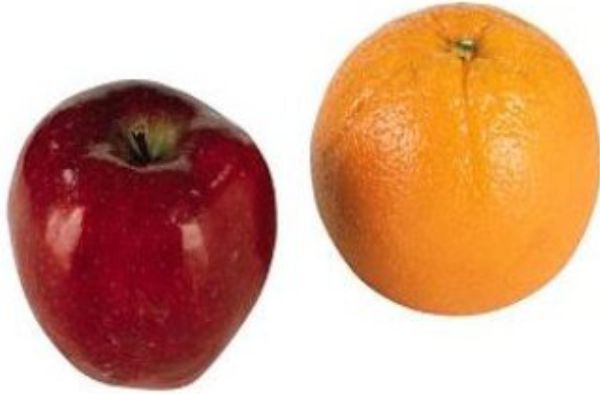
Apple orangeSo there’s a lot of not much between galaxies, but a whole lot more not much, relatively speaking, within them. I just measured an apple and an orange in my kitchen. They’re both about the same size, 3 inches in diameter, so I have no idea why she chose different fruits – perhaps she wanted to avoid comparing apples and oranges.

Anyway, if you felt like doing the galaxy visualization you could put two apple galaxies on the floor about 12 feet apart and then line up about 50 apples between them. A fair amount of space for more galaxies.

To see inside a galaxy you could put one orange star in Miami FL, and its on-the-average nearest orange neighbor in Seattle WA. Then you could set out a long skinny row of just about 63 million oranges in between. Oh, and on this scale the nearest galaxy would be about 2 billion miles (or 43 quadrillion oranges) away. Way more not much inside a galaxy than between two neighboring ones.

So if we squeeze all those apples and oranges together we’d get rid of all the empty space, right?

Not by a long shot. Nearly all those stars are balls of very hot gas, which means they’re made up of atoms crossing empty space inside the star to collide with other atoms. Relative to the size of the atoms, how much empty space is there inside the star?

Matryoshkii 1For example, every chemistry student learns that 6×10²³ molecules of any gas take up a volume of 22.4 liters at normal Earth temperature and pressure. For a single-atom gas like helium that works out to about 22 atom-widths between atoms.

Now think about emptiness inside the Sun. If it’s a typical star (which it is) and if all of its atoms are hydrogen (which they mostly are) and if the average density of the Sun (1408 kg/m3) applied all the way down to the center of the Sun (which it doesn’t), and if we believe NASA’s numbers for the Sun (hey, why not?), then the average density works out to about 0.7 atom-widths between neighbors.

So no empty space to squeeze out of the Sun, eh? Well, actually there is quite a lot, because those atoms are mostly empty space, too.

OK, I cheated up there about the Sun, because virtually all of the Sun’s atoms have been dissociated into separated electrons and nuclei. The nucleus is much smaller than than its atom – by a factor of 60,000 or so. Think of a grape seed in the middle of a football field.

To sum it upward, we’ve got a set of Russian matryoshka dolls, one inside the next. At the center is a collection of grape seeds, billions and billions of them, each in their own football field. The football fields are all balled into a stellar orange (or maybe an apple), but there are billions of those crammed into a galactic apple (or maybe an orange) that’s about ten feet away from the nearest other piece of fruit.

As Douglas Adams wrote in Hitchhiker’s Guide to The Galaxy,

“Space … is big. Really big. You just won’t believe how vastly, hugely, mindbogglingly big it is. I mean, you may think it’s a long way down the road to the chemist’s, but that’s just peanuts to space…”

The thing to realize is that the function of all that space is to keep everything from being in the same place. That’s important.

~~ Rich Olcott

Prime years and such

I’ve liked 4s and 6s ever since when, but lately 3s and 7s have been cropping up.  A lot.  And they have a really weird connection with 2016.

For me New Year has always been an opportunity to inspect the upcoming year’s number for interesting properties.

Maybe the easiest way for a number to be interesting is to be prime, that is, not divisible by anything other than itself and one.  My Uncle Harold once proved to me that all odd numbers are prime.

“One’s a prime, and so are three and five.  How about seven?  Seven’s prime.  Nine?  Not a prime but we can throw that one out as experimental error.  Eleven?  Prime.  Thirteen?  Prime.  Case closed.”

They use that logic a lot in politics nowadays.

There are a few prime-ity tests that just need a quick glance.  Take 2015 for example.  Ends with a “5” so it’s got to be divisible by five.  Not a prime.  A number ending with a “0” is like ending with twice five so it’s not prime either.

Take 2016.  Ends in an even digit so it’s divisible by two.  Not a prime.  Moreover, it fails the “nines test” — add up all the digits (2+0+1+6=9).  If the total is nine or divisible by nine then the number itself is divisible by nine (and by three) so it’s non-prime.  2016 is also divisible by seven but that’s not as easy to diagnose.

That’s about it for quickies.  Beyond those tests you have to slog through dividing the target by every prime number from three up to the target’s square root.  Why stop there?  Because any factor bigger than the square root will have a partner smaller than the square root.

Remember Party Like It’s 1999 (prime)?  Very popular when the Artist Then Known As Prince produced it in 1982 (not a prime).  Unfortunately, we who were working on Y2K projects were too busy to party that year so we couldn’t celebrate 1999 being prime until it was all over.

Y2K itself, 2000, definitely wasn’t prime.  If you know that 1999 is prime you know 2000 can’t be because after you get past 1-2-3, no two adjacent numbers can be prime — one of them would have to be even.  Next-but-one can work, though: both 1997 and 1999 are prime.  Primes separated by two like that are twin primes.

If 2016 won’t be a prime year, is there another way it can be special?  Hmmm…  2016 isn’t a perfect square, nor is it the sum of two squares.  Neither its square nor its cube are particularly noteworthy, but the square PLUS the cube is kinda cute: their sum is 8,197,604,352 which contains every digit just once.

According to The On-Line Encyclopedia of Integer Sequences, 2016 is a hexagonal number.  Start with a dot.  Make that dot one corner of a hexagon of dots.  Then add a hexagon around that, one more dot per side,  keeping the original dot as a corner (like the plan for a starter motte-and-bailey castle)…Hexagonal numbers Keep going until the outermost hexagon has 32 dots along each edge.  All the hexagons together will have exactly 2016 dots.

The OEIS says that 2016 is a participant in at least 925 more special sequences, so I guess it’s a pretty cool number after all.

Those 3s and 7s?  Here they come….

My nominee for Puzzle King of The World is my good friend Jimmy.  I challenged him once to find the connection between

  • the British Army’s WWII section number (2701) for Alan Turing’s super-secret cryptography unit at Bletchley Park, and
  • Jean Valjean’s prisoner number (24601) in Les Misérables 

Turns out it’s all about the primes.  2701 is the product of two primes: 73×37.  24601 is also the product of two primes 73×337.   Better yet, both of the product expressions are palindromes in their digits (7337, 73337). To put whipped cream on top, I first noticed the connection during my 73rd year.

So then of course I went looking for other 3…7 and 7…3 primes. There aren’t a lot of them. Going all the way out to 1037 I found:

37 73
337 733
 (3,337 is 47×71, not a prime) 7,333
333,337 733,333

Pretty good symmetry there.

OK, back to number 2016. I asked Mathematica®, “How many different pairs of primes, like 1999 and 17, sum to 2016?”

What do you suppose the answer was?  Yup, “73.”

Oh, and the next prime year is 2017.  It’ll be great.

~~ Rich Olcott

Circular Logic

We often read “singularity” and “black hole” in the same pop-science article.  But singularities are a lot more common and closer to us than you might think. That shiny ball hanging on the Christmas tree over there, for instance.  I wondered what it might look like from the inside.  I got a surprise when I built a mathematical model of it.

To get something I could model, I chose a simple case.  (Physicists love to do that.  Einstein said, “You should make things as simple as possible, but no simpler.”)

I imagined that somehow I was inside the ball and that I had suspended a tiny LED somewhere along the axis opposite me.  Here’s a sketch of a vertical slice through the ball, and let’s begin on the left half of the diagram…Mirror ball sketch

I’m up there near the top, taking a picture with my phone.

To start with, we’ll put the LED (that yellow disk) at position A on the line running from top to bottom through the ball.  The blue lines trace the light path from the LED to me within this slice.

The inside of the ball is a mirror.  Whether flat or curved, the rule for every mirror is “The angle of reflection equals the angle of incidence.”  That’s how fun-house mirrors work.  You can see that the two solid blue lines form equal angles with the line tangent to the ball.  There’s no other point on this half-circle where the A-to-me route meets that equal-angle condition.  That’s why the blue line is the only path the light can take.  I’d see only one point of yellow light in that slice.

But the ball has a circular cross-section, like the Earth.  There’s a slice and a blue path for every longitude, all 360o of them and lots more in between.  Every slice shows me one point of yellow light, all at the same height.  The points all join together as a complete ring of light partway down the ball.  I’ve labeled it the “A-ring.”

Now imagine the ball moving upward to position B.  The equal-angles rule still holds, which puts the image of B in the mirror further down in the ball.  That’s shown by the red-lined light path and the labeled B-ring.

So far, so good — as the LED moves upward, I see a ring of decreasing size.  The surprise comes when the LED reaches C, the center of the ball.  On the basis of past behavior, I’d expect just a point of light at the very bottom of the ball (where it’d be on the other side of the LED and therefore hidden from me).

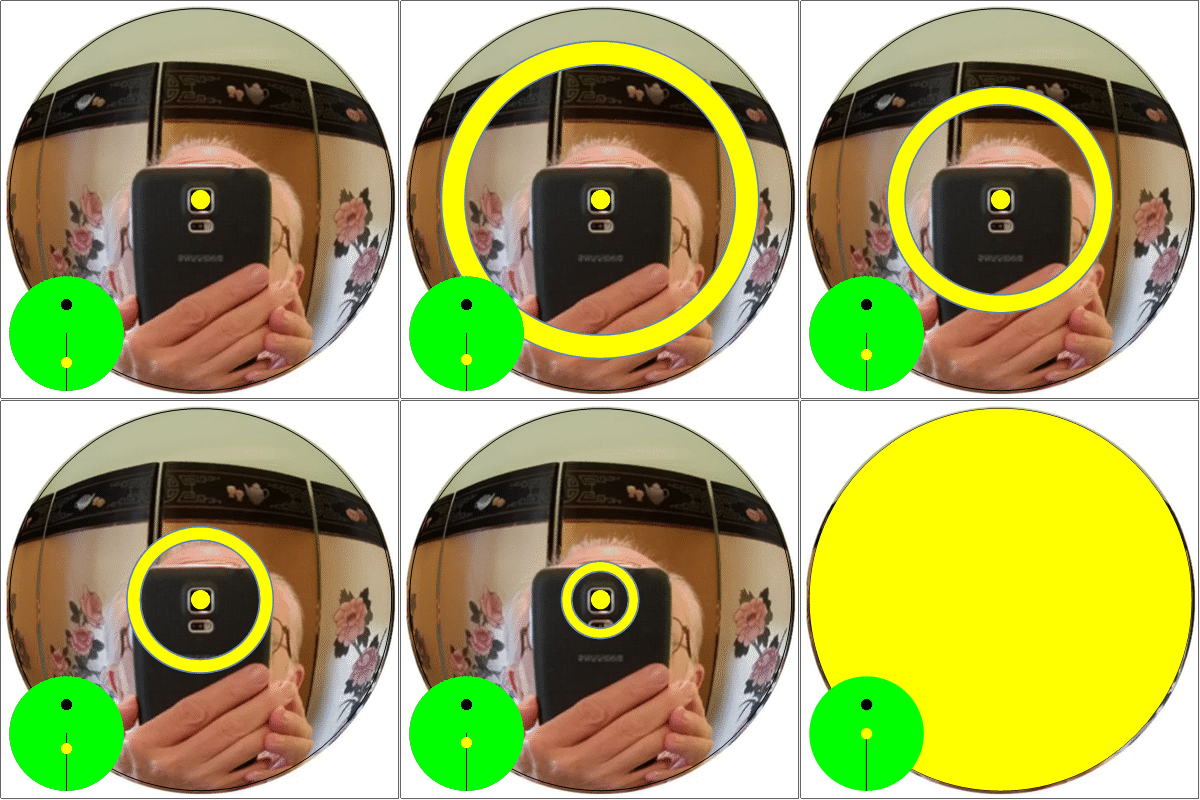
Nup, doesn’t happen.  Here’s the simulation.  The small yellow disk is the LED, the ring is the LED’s reflected image, the inset green circle shows the position of the LED (yellow) and the camera (black), and that’s me in the background, taking the picture…g6z

The entire surface suddenly fills with light — BLOOIE! — when the LED is exactly at the ball’s center.  Why does that happen?  Scroll back up and look at the right-hand half of the diagram.  When the ball is exactly at C, every outgoing ray of light in any direction bounces directly back where it came from.  And keeps on going, and going and going.  That weird display can only happen exactly at the center, the ball’s optical singularity, that special point where behavior is drastically different from what you’d expect as you approach it.

So that’s using geometry to identify a singularity.  When I built the model* that generated the video I had to do some fun algebra and trig.  In the process I encountered a deeper and more general way to identify singularities.

<Hint> Which direction did Newton avoid facing?

* – By the way, here’s a shout-out to Mathematica®, the Wolfram Research company’s software package that I used to build the model and create the video.  The product is huge and loaded with mysterious special-purpose tools, pretty much like one of those monster pocket knives you can’t really fit into a pocket.  But like that contraption, this software lets you do amazing things once you figure out how.

~~ Rich Olcott

Buttered Cats — The QM perspective

You may have heard recently about the “buttered cat paradox,” a proposition that starts from two time-honored claims:

  • Cats always land on their feet.
  • Buttered toast always lands buttered side down.

“The paradox arises when one considers what would happen if one attached a piece of buttered toast (butter side up) to the back of a cat, then dropped the cat from a large height. …
“[There are those who suggest] that the experiment will produce an anti-gravity effect. They propose that as the cat falls towards the ground, it will slow down and start to rotate, eventually reaching a steady state of hovering a short distance from the ground while rotating at high speed as both the buttered side of the toast and the cat’s feet attempt to land on the ground.”

~~ en.wikipedia.org/wiki/Buttered_cat_paradox

After extensive research (I poked around with Google a little), I’ve concluded that no-one has addressed the situation properly from the quantum mechanical perspective. The cat+toast system in flight clearly meets the Schrödinger conditions — we cannot make an a priori prediction one way or the other so we must consider the system to be in a 50:50 mix of both positions (cat-up and cat-down).

In a physical experiment with a live cat it’s probable that cat+toast actually would be rotating. As is the case with unpolarized light, we must consider the system’s state to be a 50:50 mixture of clockwise and counter-clockwise rotation about its roll axis (defined as one running from the cat’s nose to the base of its tail). Poor kitty would be spinning in two opposing directions at the same time.

Online discussions of the problem have alluded to some of the above considerations. Some writers have even suggested that the combined action of the two opposing adages could generate infinite rotational acceleration and even anti-gravity effects. Those are clearly incorrect conclusions – the concurrent counter-rotations would automatically cancel out any externally observable effects. As to the anti-gravity proposal, not even Bustopher Jones is heavy enough to bend space like a black hole. Anyway, he has white spats.

However, the community appears to have completely missed the Heisenbergian implications of the configuration.

The Heisenberg Uncertainty Principle declares that it’s impossible to obtain simultaneous accurate values for two paired variables such as a particle’s position and momentum. The better the measurement of one variable, the less certain you can be of the other, and vice-versa. There’s an old joke about a cop who pulled a physicist to the side of the road and angrily asked her, “Do you have any idea how fast you were going?”  “I’m afraid not, officer, but I know exactly where I am.”

It’s less commonly known that energy and time are another such pair of variables – the stronger the explosion, the harder it is to determine precisely when it started.

Suppose now that our cat+toast system is falling slowly, perhaps in a low-gravity environment. The landing, when it finally occurs, will be gentle and extend over an arbitrarily long period of time. Accordingly, the cat will remain calm and may not even awake from its usual slumberous state.

Tom and toastBy contrast, suppose that cat+toast falls rapidly. The resulting impact will occur over a very small duration. As we would expect from Heisenberg’s formulation, the cat will become really really angry and with strong probability will attack the researcher in a highly energetic manner.

From a theoretical standpoint therefore, we caution experimentalists to take proper precautions in preparing a laboratory system to test the paradox.

Next week – Getting more certain about Heisenberg

~~ Rich Olcott

Dimensional venturing, Part 2 – Twirling in 4-space

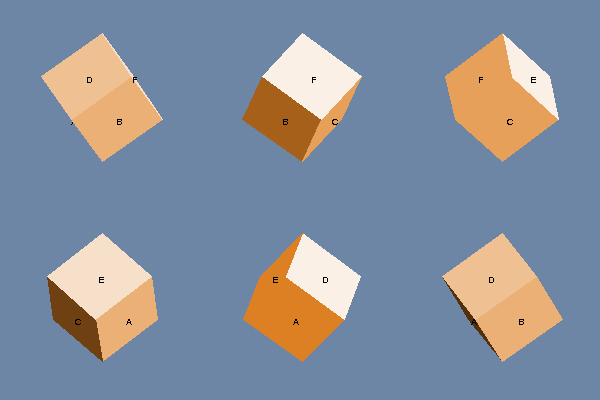
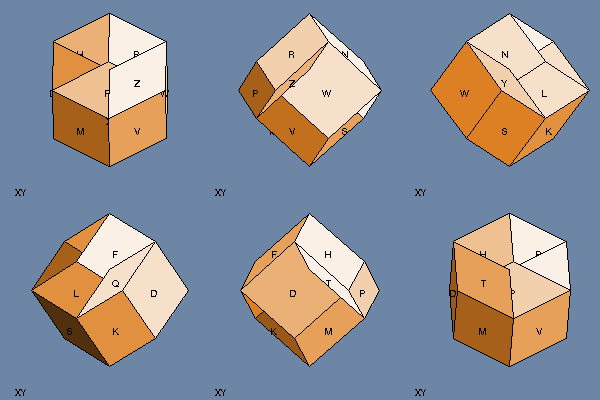
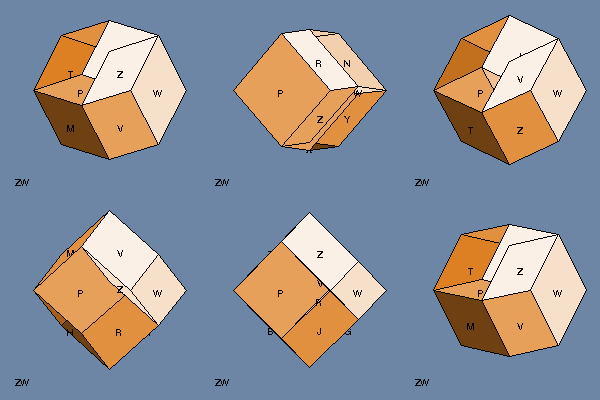
Last week we introduced the tesseract, which is to a cube what a cube is to a square — an extension into one more dimension.  That’s why it’s also called a hypercube.  The first tesseract diagrams I ever saw were so confusing — they looked like lots of overlapped squares tied together with lines that didn’t make much sense.  I wondered, “Wouldn’t it be easier to understand a tesseract if I could see it rotating?”

Years later computers and I had both moved ahead to where I could generate the pictures you see in this post.  What I learned while doing that was that 4-D figures have two equators.  In four dimensions, it’s possible for something to rotate in two perpendicular directions at the same time.  Read on and please don’t mind my doggerel — it doesn’t bite.

line2c The LINE is just a single stroke,
a path from here to there.
Stretch it out beside itself
and you will have a SQUARE.
Where’s its face when it turns around?
Gone, ’cause its back’s not there.
square2c
cube2c The CUBE’s a square
made thick, you see.
Length, breadth and depth
comprise a full 3-D.
Add yet a thickness more,
crosswise all to X, Y, Z.
A TESSERACT on a corner spins
but an XY-slice is all we see.
tess2cxy
tess2czw But the axis, too, can rotate through
a path that’s drawn invisibly.
Four faces grow and shrink in place —
it’s hard to do that physically.
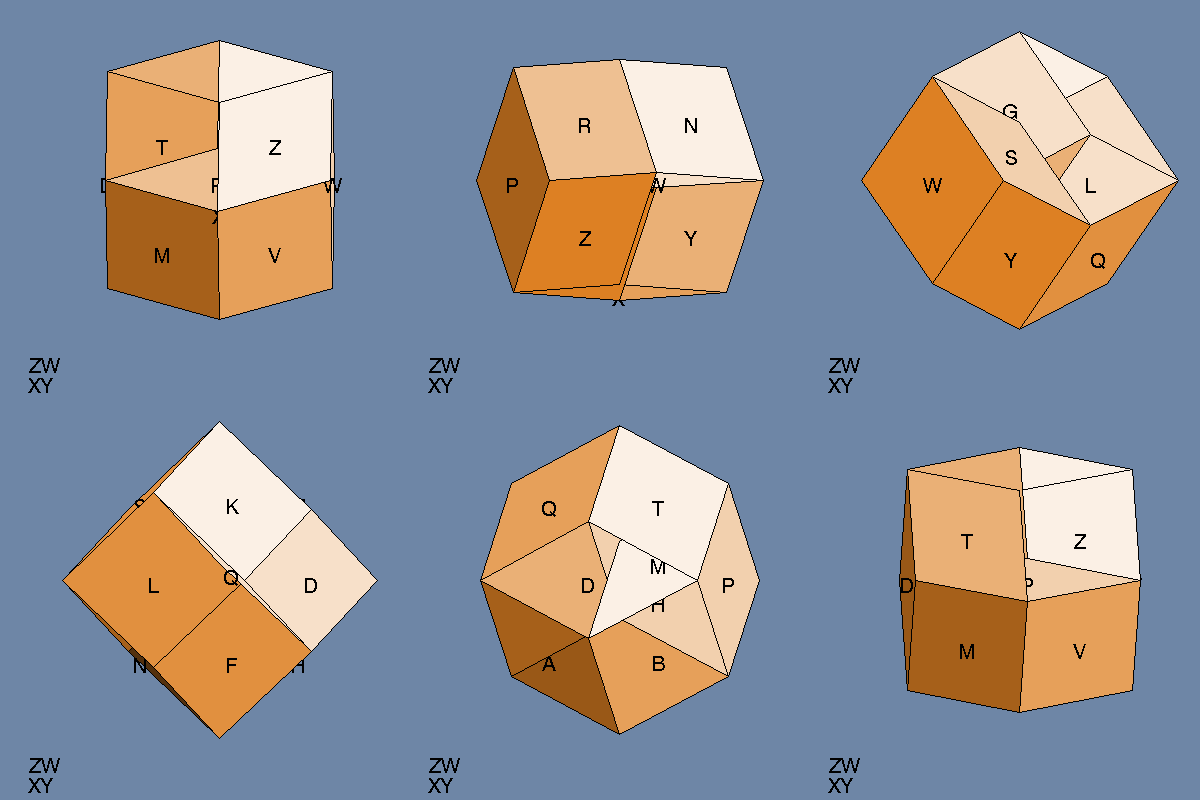
This tesseract is tumbling ’bout
two equators perpendicular.
Were I in such a state, I vow,
I’d be giddy, even sickular.
tess4cxyzw

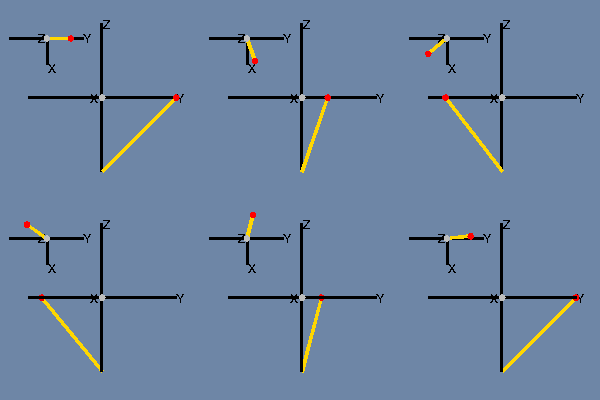
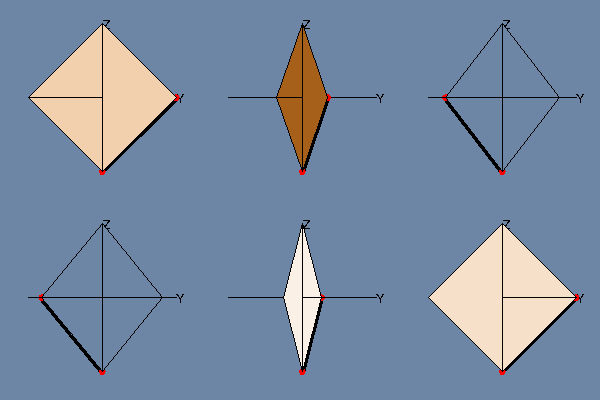
In the 4-D views, when one of the tesseract’s cubical faces appears to disappear into an adjacent face, what’s actually happening is that the face is sliding past the other face along that fourth dimension (which I called W because why not?)

You’re looking at a two-dimensional picture of the three-dimensional projection of a four-dimensional object as it moves in 5-space (X, Y, Z, W, and time — if it didn’t move in time then it couldn’t be spinning).

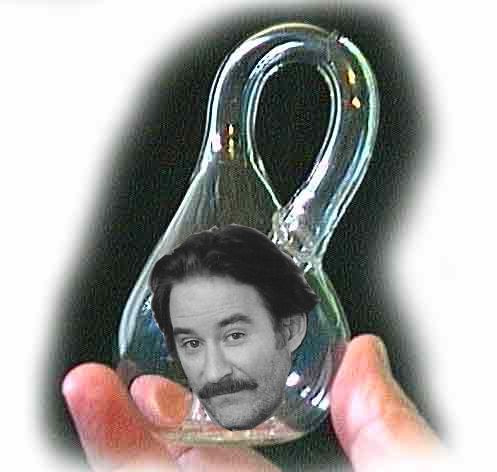
Next week — Herr Klein’s bottle, or rather flask, or rather surface.

~~ Rich Olcott

The Four-force Model, generalized

The particle physicist’s Standard Model recognizes four fundamental forces

  • the Strong nuclear force, which holds atomic nuclei together
  • the Weak nuclear force, which mediates some kinds of radioactivity
  • Electromagnetism, which holds molecules together
  • Gravity, which holds together planets and stars and galaxies and such

On Terry Pratchett’s Diskworld*, the Druids also recognize four fundamental forces but at a much higher level of emergent structure

  • Charm
  • Persuasiveness
  • Chaos/Uncertainty
  • Bloody-mindedness

I suggest that the seasons presents us with an excellent example of this Druidic principle

  • Springtime is clearly all Charm
  • Summertime uses Persuasion to bring forth crops and lull us to sleep
  • Fall is Chaos, with school terms starting and fallen leaves fluttering everywhere, especially into the gutters
  • Winter — ah, bloody-mindedness in action, both in its effects and in what it takes to get through them.

~~ Rich Olcott

* – The Light Fantastic, halfway down the right-hand page