What’s In Project 2025?

  • Breaking through the fourth wall, but I’m an American citizen who is horrified at what the current Administration is doing to the country I love. In the spirit of ‘know your opponent‘ I’ve briefly departed from our normal time with Sy and the gang to shine light on a document that was carefully not publicized prior to the 2024 election. Back to our normal programming next week.
  • The material below is based on the Project 2025 document. It’s my understanding that much of the Project’s philosophy underlies and is embedded in the ‘One Big Beautiful Bill’ Act (OBBBA) currently working its way through Congress, but I’ve not read through all of that legislation’s ~900 pages (way too many ‘notwithstandings’). From what I’ve seen, the House‑passed version is every bit as contrary to our founding principles. ~ RJO

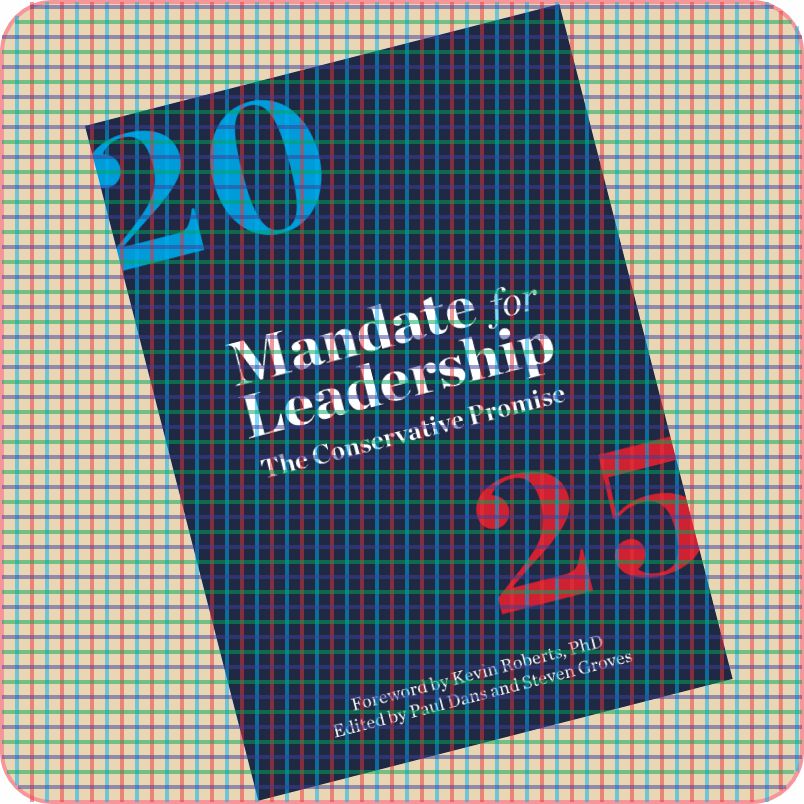
I expect only a few people have read through 2025 Mandate for Leadership, the Heritage Foundation’s manifesto that lays out much of the tactical structure for what the current Administration is trying to accomplish. It’s a hefty tome, nearly 900 pages including a seven‑page list of Contributors. You don’t approach it like a novel; you settle down with a notepad and a supply of coffee, then scan through looking for mentions of your favorite parts of the Federal government.

Someone asked me which were my Top Three things to dislike about the Project 2025 prospectus. It was like asking which three threads in a plaid should be discarded but making no distinction between warp and woof. Plaid’s not that bad a metaphor, because the document has a warp (the underlying notions) and a woof (specific recommendations laid out for every entity in the government).

Some of the warp threads are explicit, proudly highlighted in the 33‑page Forward (quotes are direct from the text)

  1. “Restore the family as the centerpiece of American life and protect our children.” (page 4) — Family is implicitly defined in the follow-on text as male breadwinner, female homemaker, some number of kids, all happily occupied with “the building blocks of any healthy society. Marriage. Family. Work. Church. School. Volunteering.” (page 4) Note that political activity is not in the list. Parents must have veto authority over the entire content of their offspring’s schooling, except that screen time for kids is terrible and must be forbidden.
  2. “Dismantle the administrative state and return self-governance to the American people.” (page 6) — “So today in Washington, most policy is no longer set by Congress at all, but by the Administrative State. Given the choice between being powerful but vulnerable or irrelevant but famous, most Members of Congress have chosen the latter. Congress passes intentionally vague laws that delegate decision‑making over a given issue to a federal agency. That agency’s bureaucrats–not just unelected but seemingly un‑fireable–then leap at the chance to fill the vacuum created by Congress’s preening cowardice.” (page 7) On the one hand the Project authors want to return all decision‑making power to Congress, but on the other hand they point to congressional incapacity for the job. Clearly, the authors have an alternative governing structure in mind (see item 5).
  3. “Defend our nation’s sovereignty, borders, and bounty against global threats.” (page 9) — The “sovereignty, borders and bounty” notions are stretched to cover diatribes against the “managerial elite” (page 10), “globalization” (page 11), “environmental extremism” (page 11) and of course “wokeism” (page 14) in general.
  4. “Secure our God-given individual rights to live freely — what our Constitution calls ‘the Blessings of Liberty.’ ” (page 13) Consider the moral arrogance and intellectual acrobatics required to transform ‘the pursuit of Happiness’ to “Our Constitution grants each of us the liberty to do not what we want, but what we ought.” (page 13) Such a bleak prospect.

There are also implicit tenets and directives throughout the following 875 pages, there if one looks for them:

  1. Abrogation of the Founders’ concept of checks and balances. Federal government power is to be lodged in the Unitary Executive branch, not in Congress (see item 2), not in the Judiciary. Orders come top‑down, which looks like an administrative state under another guise but that would be even further from democratic rule.
    • Notably, OBBBA provision 70302 would largely immunize the Executive branch against being held in contempt if it ignores or violates a Judicial ruling.
  2. An imperative to privatize any governmental service that someone might or might not make a profit from.
  3. Mean-spirited Social Darwinism, as exemplified by Musk’s remark that “the fundamental weakness of Western civilization is empathy.”
  4. The notion that unregulated is always better than regulated, no matter the social cost.
  5. Primacy of corporate/employer rights over worker rights (“union” is mentioned 102 times, “contract” 40 times).
  6. Indictment of a supposed “climate crisis industry” (“climate” is mentioned 155 times) along with a spirited defense of the fossil‑fuel industries (“fossil” gets 31 mentions).
  7. Religiosity, specifically Christian‑flavored. One telling example — “Congress should encourage communal rest by amending the Fair Labor Standards Act (FLSA) to require that workers be paid time and a half for hours worked on the Sabbath.” (page 589)
  8. Deprecation of support for basic science and Public Health as governmental responsibilities. Despite more than 1000 uses of the word “science,” NASA is mentioned only once, in a footnote.
  9. and a few others I lost track of.

That’s the warp of the plaid, but the woof uses the warp’s tool kit to prescribe actions to be taken in or against (nearly) every Federal Department and Agency, from the office of the White House Chief of Staff through the Cabinet positions out to the independent regulatory agencies ending with the Federal Elections Commission and the Federal Trade Commission. Notably not included are the United States Postal Service, the Smithsonian Institution and the Kennedy Center.

My Top Three objectionable items? The document presents hundreds and hundreds of woof‑level recommendations, some of which seem reasonable to me but most of which don’t. In picking anti‑favorites I’ll stick with the warp level. Chief among them are jettisoning checks‑and‑balances, disparagement of science in general and climate change in particular, and the authors’ demonstrated propensity to cling to ideological positions in the face of contrary evidence.  Coming from a union family, I’m not too happy about item 9, either.

Think I’ve mischaracterized what’s in there? Download the document yourself and look through it to check me. Compare the listings to what has transpired so far since January 21. If you care about a particular governmental function (the Veterans Administration, the National Park Service, the Census Bureau, whatever), look up its prognosis. Think about that and decide what you want to do about it. Then do that.

~ Rich Olcott

The Importance of Saving Data

  • A repost from 8 years ago, but it’s become timely again. Eight years ago my concern was data related to Public Health and animal welfare. Subsequent event proved that concern was well‑founded. This time around the climate and Public Health issues are still with us but the likelihood of ideological meddling spreads much more broadly, to research related to psychoactives, guns, citizenship status and more. Forewarned is forearmed.

Sorry, but I’ve got to break into my normal Monday-morning stream to spread this around.  It’s a ProPublica document (click on the link to pull down a copy) detailing safe ways to leak information.

When I first heard about the data-stashing “parties” I thought it was something of an over-reaction.  Climate scientists and students organizing a massive effort to copy important data out of government files in case the new Administration decided to cover it all up somehow.

I’ve changed my mind.

What changed it was USDA’s suddenly blocking access to their animal welfare database, the one that keeps inspection records on research labs, companies, zoos, circuses, and animal transporters and how well they adhere to the Animal Welfare Act.

The agency said in a statement that it revoked public access to the reports “based on our commitment to being transparent …”  Being transparent by blocking information — there’s a certain Orwellian flavor to that, but it gets better.

I followed this article‘s link to see the original statement.  Well, I tried to follow it.  FireFox flat-out refused to show me the page because “Your connection is not secure. The owner of acis.aphis.educ.usda.gov has configured their website improperly.”  The error code was “SEC_ERROR_UNKNOWN_ISSUER.” Funny that an official .gov site mucked up its security certificate.

Then I tried Microsoft’s  edge browser, which has less alert security than my beefed-up FireFox.  edge showed me an imposing and somewhat threatening USDA e-Login page including the statements that “Unauthorized or improper use of this system may result in disciplinary action, as well as civil and criminal penalties…. You have no reasonable expectation of privacy regarding any communications or data transiting or stored on this information system…. Your consent is final and irrevocable…

disappearing-lorem-ipsum

All this before Mr Sonny Perdue III is confirmed as the new Secretary of Agriculture. That name rings a bell, right?  Yeah, Perdue Farms, the country’s poultry farmer. It’s hard not to connect dots to the Department suddenly wanting to hide farm inspection records.

So, it’s now pretty clear that we can expect other government-funded databases to disappear without warning, especially databases even remotely related to climate change, drug safety, water supply degradation, … you know, the things that there are regulations about that get in the way when your object is to maximize profits.

So — if you’re in science and you have possession of or access to data (databases, files, whatever) that might be in jeopardy

  1. Get it to an offsite and secure backup ASAP
  2. When/if it becomes clear that your or the public’s access to that data is about to be restricted, take one or more of the actions laid out in the ProPublica document.

Sometimes it’s rational to be paranoid.

~~ Rich Olcott

A.I. and The Ouroboros Effect

The Acme Building Science and Pizza Society is meeting again around the big table near the kitchen in Eddie’s Pizza Place. It’s my deal so I set the next topic. “Artificial Intelligence.” There’s some muttering but play starts.

Cal has first honors. “Not my favorite thing. I hadda change my name ’cause of A.I., f’crying out loud.”

Eddie antes up a chip. “But Cal, your astronomy magazines are loaded with new discoveries that some A.I. made rummaging through godzillabytes of big telescope data. Train an A.I. on a few thousand normal galaxies and then let it chase through the godzillabytes. It says ‘Here’s a weird one‘ and the human team gets to publish papers about a square galaxy or something.”

Susan chips in. “What about all the people who’ve been saved from cancer because an A.I. found bad cells while screening histology images?”

Kareem folds. “Not much A.I. in Geology yet. Our biggest Big Data project these days is whole‑Earth tomography. That uses pretty much all the computer time we can get funds for. A.I.’s Large Language Models soak up all the research money.”

Vinnie raises by a chip. “I use autopilot a lot when I’m flying, but that’s up in the air, Great Circle point‑to‑point and no worries about pedestrian traffic. Autopilot in a car? Not for me, thanks — too many variables and I’ve seen too many crazy situations you couldn’t predict. Black ice in the winter, roadwork and bicyclists the rest of the year — I want to be able to steer and brake when I need to.”

Susan grins. “Are you a stick‑shift purist, Vinnie?”

“Naw, automatic transmissions are okay these days and besides my car uses electric motors and doesn’t even have a transmission. Lots of torque at low revs and that’s the way I like it. What about you, Cathleen? Got any A.I. war stories?”

Cathleen calls Vinnie’s raise. “A few. One thing I’ve learned — chatbots have a limited working memory. I once asked a bot to list Jupiter’s 35 biggest moons in decreasing order of size. It got the first 24 in the right order, then some more moons out of order and two of them were moons of Saturn. So ‘trust but verify‘ like the man said. Sy, you do a lot of writing. What’s your experience?”

I call Cathleen’s raise. “Mixed. I’m a generalist so I have to read a lot of papers or at least be aware of them. Summarizer bots do a decent job on some reports but miss badly when it comes to tying together material that’s not already well organized. Probably comes from that working memory limitation you noticed, Cathleen. The other problem I’ve seen doesn’t apply so much to technical work but it’s a killer for essays and fiction that have anything to do with interactions between people.”

“I’ve seen that, too. No soul.”

“Soul’s the word I’ve been looking for, Kareem. The bots are good at picking up styles and ‘who said what‘ surface material, but they fail completely at emotional subtext, the ‘why‘ that’s the actual thread of a conversation. Subtext is why we read good novels. From what I’ve been seeing recently, it’s not going to get any better.”

“Nothing does, I’m starting to think.”

“C’mon, Cal, your coffee’s improved since the city put in better water pipes. On the other hand, you owe the pot a bet.”

“Sorry. I’m still in, okay?” <sound of chips clinking> “So why’s A.I. not gonna get better? I keep reading how different ones passed tougher tests.”

“Well, that’s the thing. If you’re reading about it online, the bots are, too. What they read goes into their training database. Those impressive test scores may just be the result of inadvertent cheating — but the software’s so opaque that its developers simply don’t know whether or not that’s true. Just another case of the Ouroboros Effect.”

Eddie and Susan meet Cal’s bet, then Vinnie goes all‑in and shows his three queens. “Ouroboros, Sy?”

“The Norse World Snake that eats its tail. Bogus A.I.‑generated output used as A.I. input yields worse output. That’s a loss, not a gain. Unlike here where my four kings take the pot.”

“Geez, Sy, again?”

~~ Rich Olcott

Three Feet High And Rising

“Bless you, Al, for your air conditioning and your iced coffee.”

“Hiya, Susan. Yeah, you guys do look a little warm. What’ll you have, Sy and Mr Feder?”

“Just my usual mug of mud, Al, and a strawberry scone. Put Susan’s and my orders on Mr Feder’s tab, he’s been asking us questions.”

“Oh? Well, I suppose, but in that case I get another question. Cold brew for me, Al, with ice and put a shot of vanilla in there.”

“So what’s your question?”

“Is sea level rising or not? I got this cousin he keeps sending me proofs it ain’t but I’m reading how NYC’s talking big bucks to build sea walls around Manhattan and everything. Sounds like a big boondoggle.” <pulling a crumpled piece of paper from his pocket and smoothing it out a little> “Here’s something he’s sent me a couple times.”

“That’s bogus, Mr Feder. They don’t tell us moon phase or time of day for either photo. We can’t evaluate the claim without that information. The 28‑day lunar tidal cycle and the 24‑hour solar cycle can reinforce or cancel each other. Either picture could be a spring tide or a neap tide or anything in‑between. That’s a difference of two meters or more.”

“Sy. the meme’s own pictures belie its claim. Look close at the base of the tower. The water in the new picture covers that sloping part of the base that was completely above the surface in the old photo. A zero centimeter rise, my left foot.”

“Good point, Susan. Mind if I join the conversation from a geologist’s perspective? And yes, we have lots of independent data sources that show sea levels are rising in general.”

“Dive right in, Kareem, but I thought you were an old‑rocks guy.”

“I am, but I study old rocks to learn about the rise and fall of land masses. Sea level variation is an important part of that story. It’s way more complicated than what that photo pretends to deny.”

“Okay, I get that tides go up and down so you average ’em out over a day, right? What’s so hard?”

“Your average will be invalid two weeks later, Mr Feder, like Sy said. To suppress the the Sun’s and Moon’s cyclic variations you’d have to take data for a full year, at least, although a decade would be better.”

“I thought they went like clockwork.”

“They do, mostly, but the Earth doesn’t. There’s several kinds of wobbles, a few of which may recently have changed because Eurasia weighs less.”

“Huh?”
 ”Huh?”
  ”Huh?”

“Mm-hm, its continental interior is drying out, water fleeing the soil and going everywhere else. That’s 10% of the planet’s surface area, all in the Northern hemisphere. Redistributing so much water to the Southern hemisphere’s oceans changes the balance. The world will spin different. Besides, the sea’s not all that level.”

“Sea level’s not level?”

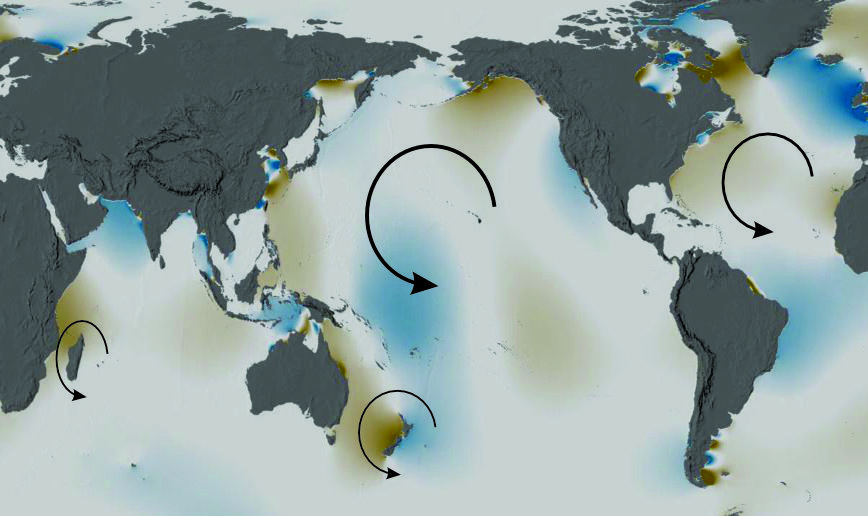
“Nope. Surely you’ve sloshed water in a sink or bathtub. The sea sloshes, too, counterclockwise. Galileo thought sloshing completely accounted for tides, but that was before Newton showed that the Moon’s gravity drives them. NASA used satellite data to build a fascinating video of sea height all over the world. The sea on one side of New Zealand is always about 2 meters higher than on the opposite side but the peak tide rotates. Then there’s storm surges, tsunamis, seiche resonances from coastal and seafloor terrain, gravitational irregularities, lots of local effects.”

Adapted from a video by NASA’s Scientific Visualization Studio

Susan, a chemist trained to consider conservation of mass, perks up. “Wait. Greenland and Antarctica are both melting, too. That water plus Eurasia’s has to raise sea level.”

“Not so much. Yes, the melting frees up water mass that had been locked up as land-bound ice. But on the other hand, it also counteracts sea rise’s major driver.”

“Which is?”

“Expansion of hot water. I did a quick calculation. The Mediterranean Sea averages 1500 meters deep and about 15°C in the wintertime. Suppose it all warms up to 35°C. Its sea level would rise by about 3.3 meters, that’s 10 feet! Unfortunately, not much of Greenland’s chilly outflow will get past the Straits of Gibraltar.”

~~ Rich Olcott

Y2K plus 25 plus 2½

Mike reminded me of the task we took on mid‑year in 1997, 27½ years ago. If I recall correctly, that’s when the IT department we worked for got serious about New Year’s Day 2000.

This was an outgrowth of our disaster preparedness project. Some context: large corporation, HQ and most of the manufacturing in New Jersey, the rest in Memphis. The good news: the IT center was in Memphis where I lived. The bad news: Memphis is on the eastern edge of Tornado Alley’s range from Oklahoma across central Arkansas. Most of the twisters seem to dodge north or south around the city, but you never know.

True story — The Memphis plant had an Uninterruptible Power Supply (UPS) facility housed in a separate structure behind the computer room. The UPS held a ton of lead‑acid batteries and power conditioning equipment, plus an automated diesel generator outside. One thunderstormy afternoon a lightning bolt took out the power line to the building. Everything went dark. The UPS kicked in within milliseconds and our IT equipment kept running just fine — until a second lightning bolt took out the generator. The utility’s linemen, bless ’em, had us powered back up a few hours later and just minutes before Management’s deadline for declaring a disaster.

“Declare a disaster” means you kick over to your spare copy “in The Cloud,” right? Not in those days. The Cloud (which really is market‑ese for “somebody else’s computer”) isn’t a viable operation without telecomm speeds a hundred times faster than the comm lines we had in the 1990s. Back then Disaster Recovery (DR) was a multi-step process:

  • Backup your essential programs and data onto tape
  • Truck the tapes to a secure distant storage vault
  • When/if a disaster is declared, move operations to an offsite DR center that offers comparable IT facilities (computers, data storage, network connections, etc.)
    • Truck the tapes to the DR center. People, too, if necessary.
    • Read the tapes onto DR center storage.
    • Pray that your backups in fact had all the stuff you need and that the data’s sufficiently up‑to‑date for business requirements.

Clunky, huh? But the process gave us practice in cloning our systems and thinking about risks. That’s where our Y2K prep started.

The real “Y2K problem” wasn’t the 2‑digit‑year design flaw, it was the impossibility of doing reliable date logic or calculations when the dates in question might be in either century. Did “X” happen before or after a deadline? No way to know when “12” is all you’ve got to work with. Fixing the problem was a multi‑prong challenge:

  • Revise the data structure to hold a four‑digit year.
  • Revise the stored data with the right four‑digit year numbers.
  • Revise the programs that handle the data but…
  • Don’t break the programs that you revise.

Most of the program updates weren’t particularly challenging, it’s just that there were so many of them. Some enterprises knew their own software well enough that they did that work in‑house. Others shipped the work overseas, a tremendous boon to India’s fledgling software industry. Still others said, “Our competitive advantage is our product line and marketing team, not our home‑grown programs. We’ll convert to an industry‑standard replacement even though we’ll have to change how we’ve been doing business.”

Whichever strategy was chosen, the devil was in the testing. No way could new code or data structures be checked out with live data on our production system.

We needed a testbed, a sandbox, “System 2K,” whatever you want to call it, that was isolated from the live systems we made our money from. It had to have no‑leaks portals for programmer access, code revisions and artificial test‑case data. Most importantly, its system clock had to be adjustable to any future date.

That’s where my team came in. Using what we’d learned from our DR practice runs, we cloned our running system and bolted on some tricksy infrastructure. Don’t ask about technical details, that’s a quarter‑century ago and I don’t remember them.

But I’m proud to say that New Year’s Day 2000 was boring.

~ Rich Olcott

  • Thanks to Mike Newsom, whose comment inspired this post, and to Bob, Susie, Ralph, Tom, Doug, Mick, Don, Roy and the rest of the project team.

Wait For It

“So, Jeremy, have I convinced you that there’s poetry in Physics?”

“Not quite, Mr Moire. Symbols can carry implications and equation syntax is like a rhyme scheme, okay, but what about the larger elements we’ve studied like forms and metaphors?”

“Forms? Hoo boy, do we have forms! Books, theses, peer-reviewed papers, conference presentations, poster sessions, seminars, the list goes on and that’s just to show results. Research has forms — theoretical, experimental, and computer simulation which is sort of halfway between. Even within the theory division we have separate forms for solving equations to get mathematically exact solutions, versus perturbation techniques that get there by successive approximations. On the experimental side—”

“I get the picture, Mr Moire. Metaphorically there’s lots of poetry in Physics.”

“Sorry, you’re only partway there. My real point is that Physics is metaphor, a whole cascade of metaphors.”

“Ha, that’s a metaphor!”

“Caught me. But seriously, Science in general and Physics in particular underwent a paradigm shift in Galileo’s era. Before his century, a thousand years of European thought was rooted in Aristotle’s paradigm that centered on analysis and deduction. Thinkers didn’t much care about experiment or observing the physical world. No‑one messed with quantitative observations except for the engineers who had to build things that wouldn’t fall down. Things changed when Tycho Brahe and Galileo launched the use of numbers as metaphors for phenomena.”

“Oh, yeah, Galileo and the Leaning Tower experiment.”

“Which may or may not have happened. Reports differ. Either way, his ‘all things fall at the same speed‘ conclusion was based on many experimental trials where he rolled balls of different material, sizes and weights down a smooth trough and timed each roll.”

“That’d have to be a long trough. I read how he used to count his pulse beats to measure time. One or two seconds would be only one or two beats, not much precision.”

“True, except that he used water as a metaphor for time. His experiments started with a full jug of water piped to flow into an empty basin which he’d weighed beforehand. His laboratory arrangement opened a valve in the water pipe when he released the ball. It shut the valve when the ball crossed a finish line. After calibration, the weight of released water represented the elapsed time, down to a small fraction of a second. Distance divided by time gave him speed and he had his experimental data.”

“Pretty smart.”

“His genius was in devising quantitative challenges to metaphor‑based suppositions. His paradigm of observation, calculation and experimental testing far outlasted the traditionalist factions who tried to suppress his works. Of course that was after a century when Renaissance navigators and cartographers produced maps as metaphors for oceans and continents.”

“Wait, Mr Moire. In English class we learned that a metaphor says something is something else but an analogy is when you treat something like something else. Water standing for time, measurements on a map standing for distances — aren’t those analogies rather than metaphors?”

“Good point. But the distinction gets hazy when things get abstract. Take energy, for example. It’s not an object or even a specific kind of motion like a missile trajectory or an ocean wave. Energy’s a quantity that we measure somewhere somehow and then claim that the same quantity is conserved when it’s converted or transferred somewhere else. That’s not an analogy, it’s a metaphor for a whole parade of ways that energy can be stored or manifested. Thermodynamics and quantum mechanics depend on that metaphor. You can’t do much anywhere in Physics without paying some attention to it. People worry about that, though.”

“Why’s that?”

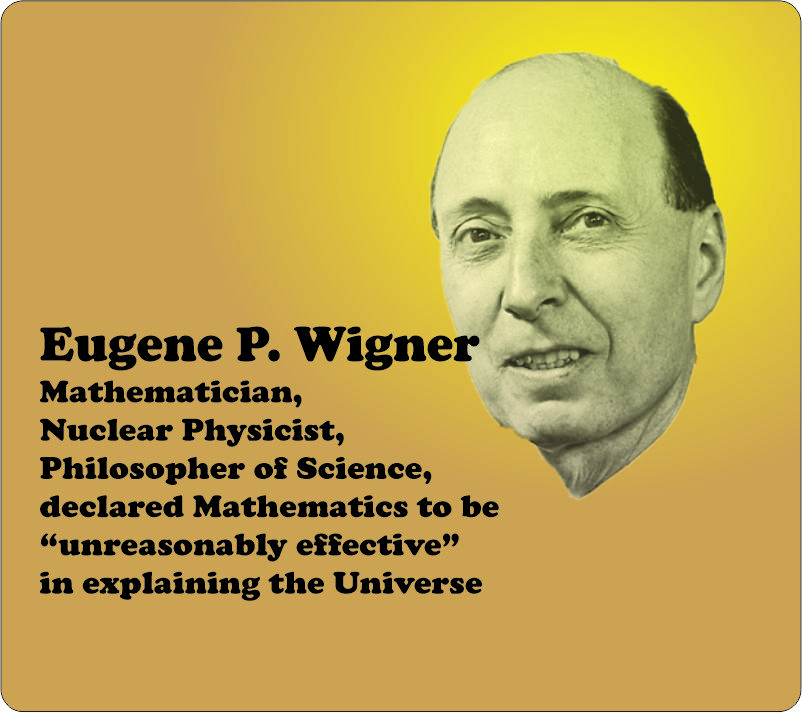
“We don’t really understand why energy and our other fundamental metaphors work as well as they do. No metaphor is perfect, there are always discrepancies, but Physics turns out to be amazingly exact. Chemistry equations balance to within the accuracy of their measuring equipment. Biology’s too complex to mathematize but they’re making progress. Nobel Prize winner Eugene Wigner once wrote a paper entitled, ‘The Unreasonable Effectiveness of Mathematics in The Natural Sciences.’ It’s a concern.”

“Well, after all that, there’s only one thing to say. If you’re in Physics, metaphors be with you.”

~~ Rich Olcott

4 Tips 4 A Young Scientist

From: Robin Feder <rjfeder@fortleenj.com>
To: Sy Moire <sy@moirestudies.com>
Subj: Questions

Dear Mr. Moire, I am a High School student who has a crazy theory about dark matter. I get bored often and do not learn as much as I think most believe I should in science class. I was thinking about dark matter and how it reacts oppositely of how we expect it to. We expect it to probably not follow “normal” physics. This got me thinking about other impossible things the human mind has thought of. One of them caught my mind–absolute zero. The logic connected itself in my mind and later that day I typed up a doc just to keep my ideas. I played with it and the more I thought about it the evidence started to overlap. I have finally found an end to the theory. I am now ready to send this theory with some scientists who actually have the expertise to critique me. Please give me your thoughts as I of course am not fully confident in it. I have a lot of information that I can’t fit in one email so this is all for now. Hope to improve it. Sincerely, Robin Feder


From: Sy Moire <sy@moirestudies.com>
To: Robin Feder <rjfeder@fortleenj.com>

Subj: Re: Questions

My best to your Dad, Robin, you take after him and I’m glad you’re thinking about science. I hear you about the boring classes often feel that way if the other kids don’t pick things up as quickly as you do. Maybe your teachers can point you to supplementary materials that’ll perk up your interest.

Before we get into your topics I’ll give you some tips that may help your future. The first is, keep an idea notebook. It could be a physical book you keep in your pocket or it could be a directory of files on your phone or computer, doesn’t matter. What does matter is that you record all your ideas as they occur to you so you don’t forget one that might become important later on. In science and other fields, ideas are your stock in trade so you want to preserve your inventory. That absolute‑zero doc is a good start.

Second tip is, after you’ve written down an idea, take a long look at it and ask yourself, “How could I disprove this?” and write that down, too. The essence of science is that it relies more on disproving things than proving them. Get into the habit of thinking about disproof — it’s a powerful way of filtering out incorrect thinking. Works better in some areas than others but in general there’s forward progress.

The reason I highlighted “after” up there is that the first thought, even if it’s wrong, often leads to second and third thoughts that are better. If you discard ideas too quickly you limit yourself. Think of it as an ongoing one‑person brainstorming session. So write first, maybe cross off later, OK?

Third tip is, read up on what your idea is about. A lot. Every field of study has its own “language,” a set of words and concepts that people in the field generally understand. You need to have some command of those if you’re going to ask them clear questions about your idea.

That’s for two reasons. The most important is that using the correct terminology speeds up communication — neither you nor they will have to stop and explain a term or concept. But in addition, if you use the words and concepts properly that tells your conversation partner that you respect their time enough to have done your initial reading.

Fourth tip is where to look for that initial reading. Most textbooks, even shiny freshly-printed ones, are decades behind the current research frontiers. You need to go deeper. You’ll Google your topic, of course, to find popular science articles. Here’s another path to more recent work. Start at a good Wikipedia article. Follow the links to its key recent footnotes and Google the names of the paper’s authors. Many of them will have blogs that they write for a student audience. Follow those blogs.

Looking forward to reading those two files.

Regards,
Sy Moire.

~~ Rich Olcott

Unless We’re All In This, Together

I wrote the italicized text for another forum, but I’m reposting it here because my head and heart and the times demand it…


We’ll soon be in the month of our national Independence Day so it’s appropriate to point out that we’re living in an Age of Heroes.  We’ve had heroes all along, of course — the Founding Fathers and Mothers, the military who defend the country we’ve built, the first responders who run toward danger to protect the rest of us. 

Less lauded but still crucial is another group of heroes – parents, teachers, caregivers and others who take on responsibility for nurturing and supporting people who for whatever reason can’t handle the challenge themselves.  These heroes may not risk bodily damage but the emotional toll can be devastating.  It says something positive for our society that we have so many in this group.

But in the past few months we’ve come to recognize yet another category of heroism.  From maintenance and transportation staff to the entire farm‑to‑table supply chain workforce, these people have quietly continued their tasks in the face of COVID‑19, with or without protective measures in place.  Without their brave efforts our cities and economy would have been weakened far more than they have been. 

Those three categories together comprise a significant fraction of our population.  In my opinion, there’s a lesson there that our country has been too slow to learn.  Humans got where we are because we’re a societal species.  The Western Frontier closed a century ago.  Even the legendarily reclusive “mountain men” had to come into town occasionally for medical care or supplies they just couldn’t produce on their own.  In the past few months, our distress with social distancing and our burgeoning activity on social media highlight just how much we want/need to interact with other people.

Like it or not, we are all part of society.  Moreover, the smooth functioning of our society depends on our collaboration.  I’m not arguing an absolutist position here – cooperation leaves plenty of room for competition and individual liberty (how best to organize the economy is a separate discussion).  But I do think we need official and explicit recognition of the fact that what I do affects you and what you do affects me.

Here’s my modest proposal – let’s rename the Fourth of July as National Interdependence Day.


Part of being societal, of course, is the impulse to protect those about us. That’s why many of those on the Thin Blue Line got into the force and I’m grateful and more than a little awed. But as we’ve seen, some of them don’t live up to what’s expected of them.

“There’s some bad apples in every barrel,” has been said too often. The question is, why are they still there? The line officers know better than anyone else the characters of their peers. Can’t they get rid of the bad apples themselves?

The most common defense I’ve heard from my LEO friends has been along the lines of, “Out there we can only survive if we know we have each other’s backs. If I write up a complaint and if the higher-ups don’t desk or boot the guy, he’ll look the other way the next time something goes down when we’re on the street together.” That culture must change, for the sake of the good cops and the rest of us.

There are some indications that the no-snitch attitude may be changing as the unions and PD administrators and prosecutors realize that bad cops directly contribute to the deadly conditions the rest have to work under. I sure hope so.

In closing, I highly recommend this thought piece from Trevor Noah, who is far more than a comedian. Please do listen through to the end. Then think about it. Then do something.

~~ Rich Olcott

RIP, Dr Hawking

Today I depart from my normal schedule and the current story line and science line.  A giant has left us and I want to pay proper tribute.

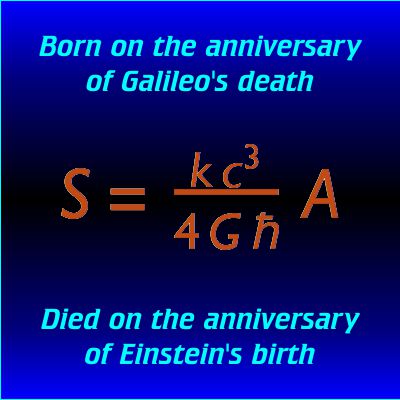
Dr Stephen Hawking enjoyed telling people of his fortunate birth date, exactly 300 years after Galileo Galilei passed away.  He liked a good joke, and I think he’d be tickled with this additional connection to the man whose work made Hawking’s work possible:
RIP Hawking

The equation in the center of this cut is Hawking’s favorite result, which he wanted to be carved on his gravestone.  It links a black hole’s entropy (S) to its surface area (A).  The other letters denote a collection of constants that have been central to the development of theoretical Physics over the past century and a half:

  • k is Boltzmann’s constant, which links temperature with kinetic energy
  • c is the speed of light, the invariance of which led Einstein to Relativity
  • G is Newton’s universal gravitational constant
  • h is Planck’s constant, the “quantum of action”

Hawking spent much of his career thinking deeply about the implications of Einstein’s concepts.  Newton’s equations support excellent descriptions of everyday physical motions, from the fall of raindrops to the orbits of solar systems.  Einstein’s equations led to insights about conditions at the most extreme — velocities near lightspeed, masses millions of times the Sun’s but packed into a volume only a few dozen miles wide.

But Hawking also pondered extremes of the ultimately large and the ultimately small — the edge of the Universe and distances far smaller than atomic nuclei.  Because his physical condition prohibited speech or quick jottings, he was forced to develop extraordinary powers of concentration and visualization that enabled him to encapsulate in a few phrases insights that would take others books to develop and communicate.

Hawking wrote books, too, of course, of a quality and clarity that turned his name and Science into watchwords for the general public as well as the physics community.  By his life and how he lived it he was an inspiration to many, abled and otherwise.  Science needs its popularizers, though some in the field deprecate them as hangers-on.  Hawking managed to bridge that gap with ease and grace, a giant with standing on either side.

Requiescat in pace, Dr Hawking.  Thank you.

~~ Rich Olcott

Wikipedia Skillz

A young man’s knock, eager yet a bit hesitant.

“C’mon in, the door’s open.”

Tall kid, glasses, hoodie thrown back.

“Hi, Mr Moire, can I ask you some questions?  I’m doing a term paper on black holes and I’ve read up on in Wikipedia but there’s things I don’t understand and besides Ms Plenum said not to trust Wikipedia.”

“Hold on, son, let’s get acquainted first.  You are…?”

“My name’s Jeremy Yazzie, sir, and I’m like Richard Feynman’s archetypical intelligent high school student he wanted to explain things to except he gave up on particle spin.”

“Well, you have done your homework, though you’ve muddled a couple of his quotes.  But about Wikipedia — Ms Plenum’s mostly right but in my experience the technical articles are pretty dependable.  Those writers are usually more interested in explaining than convincing.  Have you checked Wikipedia’s Talk pages?”

“There’s, like, comments?”

“Sort of, except Talk pages lie behind articles and target what’s right or wrong and what should be changed to make the article better.  I often learn as much from the technical discussion as I do from the article itself.”

wikieyes
A riff on Wikipedia’s logo, original in Wikimedia Commons

“I’ve never seen those pages.  How do I get to them?”

“You need a desktop view.  That’s the standard view when you use a desktop or laptop computer, but you can only maybe get to it on a handheld device.  Depends on the device, the browser, and even their maintenance levels.  Do you have a handheld in that backpack?”

“Yeah, an iPad.”

“Safari, Firefox and Chrome can all show that other view.”

“I’ve got all three.”

“Great, pull up Chrome, get to Wikipedia and look up ‘Black hole.'”

… “Got it.  Uhh… don’t see anything about a Talk page.”

“You’re looking at ‘mobile mode.’  See that three-dots icon at the top right?  Tap on it and check the pop-up menu.”

“Hah, here’s one that says, Request Desktop Site.  I’ll tap on that.  Hey, now I’ve got tabs above the text, one says Article and another that says Talk.  Whoa, here’s one that says View Source.  Whups, now there’s a box that says I can start editing.  Better not, huh?  How do I get out of that?”

“Tap your browser’s backup button.  By the way, even though in principle anyone can edit any article, the Wikipedia moderators have locked down some of the most popular or controversial just to prevent update wars.  This article’s one of those.”

“Yeah, I just backed up then tried View Source again and it says I’m not an established registered user.  No duh, right?  OK, lessee what’s in the Talk page.  Umm, how-to stuff and then organization stuff and then, huh! ‘this article has been rated GA-class on the quality scale.’ People come around and, like, check your work?”

“Absolutely, which is why I think Ms Plenum’s advice is a little too pessimistic.  Trust but verify — if you see something you’d like to quote but you don’t want to look foolish, double-check with another source.  But on the whole I’ve found the science, math and other technical articles to be trustworthy.”

“Aha, the first set of comments is about my questions, Hawking radiation and how black holes evaporate and what are virtual particles and like that.”

“So many questions, so little time.  Let’s finish off with the browser issue before we dive into physics.  Bring up your Firefox browser on that iPad.”

“All right.  Mmm, I’m going to Wikipedia, and I’m searching for ‘Black hole’ … got it, but the display doesn’t have tabs or a three-dot icon.”

“Firefox has two ways to get to desktop mode.  One way is to tap the three-bar icon at the top right…”

“YESS! the pop-up menu has half-a-dozen options and there’s Request Desktop Site.  Hey, it toggles, I can flip modes back and forth.  Sweet!  What’s the other way?”

“Press-and-hold the reload circle-arrow in the address bar.”

“A-hah, that opens a Request Desktop Site button right under the arrow.  Cool, that’s a toggle, too.  How does Safari handle this stuff?”

“They use the reload circle-arrow ploy, same as Firefox, dunno who did it first.”

“Oops, late for class.  Seeya.”

“Don’t mention it.”

~~ Rich Olcott