Elevator, Locked And Loaded

Vinnie’s on his phone again.  “Michael!  Where are you, man?  We’re still trapped in this elevator!  Ah, geez.”  <to me>  “Guy can’t find the special lever.”  <to phone>  “Well, use a regular prybar, f’petesake.”  <to me>  “Says he doesn’t want to damage the new door.”  <to phone>  “Find something else, then.  It’s way past dinner-time, I’m hungry, and Sy’s starting to look good, ya hear what I’m sayin’?  OK, OK, the sooner the better.”  <to me>  “Michael’s says he’s doin’ the best he can.”
“I certainly hope so.  Try chewing on one of your moccasins there.  It’d complain less than I would and probably taste better.”

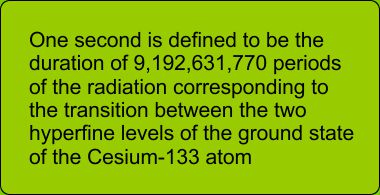
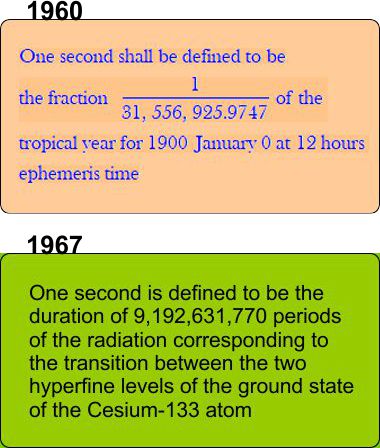
“Don’t worry about it.  Yet.”  <looks at Old Reliable’s display, takes his notebook from a pocket, scribbles in it>  “That 1960 definition has more digits than the 1967 one.  Why’d they settle for less precision in the new definition?  Lemme guess — 1960s tech wasn’t up to counting frequencies any higher so they couldn’t get any better numbers?”

“Nailed it, Vinnie.  The International Bureau of Weights and Measures blessed the cesium-microwave definition just as laser technology began a whole cascade of advancements.  It started with mode-locking, which led to everything from laser cooling to optical clockwork.”

“We got nothing better to do until Michael. Go ahead, ‘splain those things.”

“Might as well, ’cause this’ll take a while. What do you know about how a laser works?”

“Just what I see in my magazines. You get some stuff that can absorb and emit light in the frequency range you like. You put that stuff in a tube with mirrors at each end but one of them’s leaky. You pump light in from the side. The stuff absorbs the light and sends it out again in all different directions. Light that got sent towards a mirror starts bouncing back and forth, getting stronger and stronger. Eventually the absorber gets saturated and squirts a whoosh of photons all in sync and they leave through the leaky mirror. That’s the laser beam. How’d I do?”

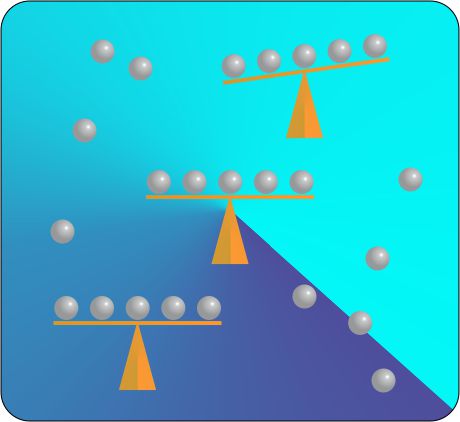
“Pretty good, you got most of the essentials except for the ‘saturated-squirting’ part. Not a good metaphor. Think about putting marbles on a balance board. As long as the board stays flat you can keep putting marbles on there. But if the board tilts, just a little bit, suddenly all the marbles fall off. It’s not a matter of how many marbles, it’s the balance. But what’s really important is that there’s lots of boards, one after the other, all down the length of the laser cavity, and they interact.”
“How’s that important?”

“Because then waves can happen. Marbles coming off of board 27 disturb boards 26 and 28. Their marbles unbalance boards 25 and 29 and so on. Waves of instability spread out and bounce off those mirrors you mentioned. New marbles coming in from the marble pump repopulate the boards so the process keeps going. Here’s the fun part — if a disturbance wave has just the right wavelength, it can bounce off of one mirror, travel down the line, bounce back off the other mirror, and just keep going. It’s called a standing wave.”

“I heard this story before, but it was about sound and musical instruments. Standing waves gotta exactly match the tube length or they die away.”

“Mm-hm, wave theory shows up all over Physics. Laser resonators are just another case.”

“You got a laser equivalent to overtones, like octaves and fourths?”
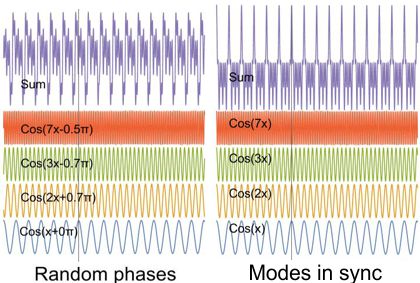
“Sure, except that laser designers call them modes. If one wave exactly fits between the mirrors, so does a wave with half the wavelength, or 1/3 or 1/4 and so on. Like an organ pipe, a laser can have multiple active modes. But it makes a difference where each mode is in its cycle. Here, let me show you on Old Reliable … Both graphs have time along the horizontal. Reading up from the bottom I’ve got four modes active and the purple line on top is what comes out of the resonator. If all modes peak at different times you just get a hash, but if you synchronize their peaks you get a series of big peaks. The modes are locked in. Like us in this elevator.”

“Michael! Get us outta here!”

~~ Rich Olcott
Time in A Bottle, Sort Of

We’re in the Acme Building’s elevator, headed down to Eddie’s for pizza, when there’s a sudden THUNK.  Vinnie’s got his cellphone out and speed-dialed before I’ve registered that we’ve stopped.  “Michael, it’s me, Vinnie.  Hi.  Me and Sy are in elevator three and it just stopped between floors.  Yeah, between six and five.  Of course I know that’s where, I always count floors.  Look, you get us outta here quick and I won’t have to call the rescue squad and you don’t have paperwork, OK?  Warms my heart to hear you say that.  Right.  And there’s pizza in it for you when we’re out.  Thanks, Michael.”  <to me>  “Says it’ll be a few minutes.  You good for climbing out when he levers the doors?”

“Sure, no problem.  Might as well keep on about why the kilogram definition changed.  Oddly enough, the story starts with one of the weirdest standards in Science.  Here, I’ll pull it up on Old Reliable…”

“OK, that’s a weird number in the fraction, but what’s weird about the whole definition?”

“Think about it — when they defined this standard in 1960, it essentially said, ‘Go back sixty years, see how long it took for the Sun to return to exactly where it was in the sky a year earlier, capture exactly that weird fraction of the one-year interval in a bottle and bring it back to the present for comparison with an interval you want to report a time for.  Sound doable to you?”

“Mmm, no.  But these guy’s weren’t stupid.  There had to be a way.”

“The key is in those words, ephemeris time.”

“Something like Greenwich Time?  How would that help?” 

“Greenwich Mean Time would be better — ‘mean’ as in ‘average.’  You know the Earth doesn’t spin perfectly, right?”

“Yeah, it wobbles.  The Pole Star won’t be at the pole in a few thousand years.”

“That’s the idea but things are messier than that.  For instance, when a large mass moves around, like a big volcano eruption or a major ice-sheet breakup or monsoon rains using Indian Ocean water to drench Southwest Asia, that causes a twitch in the rotation.”

“Hard to see how those twitches would be measurable.”

“They are when you’re working at 9-digit precision, which atomic clocks exceeded long ago.  Does your GPS unit have that spiffy dual-frequency function for receiving satellite time signals?”

“Sure does  — good to within a foot.”

“That’d be about 30 centimeters.  Speed of light’s 3×10⁸ meters per second so you’re depending on satellite radio time-checks good to about, um, 100 nanoseconds, in a data field holding week number and seconds down to nanoseconds.  So you’d expect measurement jitter within … about 2 parts in 1015.  Pretty good, and on that scale those twitches count.”

“What do they do about them?”

“Well, you can’t fix Earth, but you can measure the twitches very carefully and then average over them.  Basically, you list all the Sun-position measurements made over many years, along with the corresponding time as reported by then-current science’s best clocks.  Use those observations to build a mathematical model of where an averaged fake Sun would appear to be at any given moment if it were absolutely regular, no twitches.  When the fake Sun would be at its highest during a given day, that’s noon GMT.”

“Fine, but what’s that got to do with your weird definition?”

“You can run your mathematical model backward in time to see how many times your best-we’ve-got-now clock would tick between fake noon and fake 12:00:01 on that date.  That calibrates your clock.”

“Seems a little circular to me — Sun to clock to model to fake-Sun to clock.”

“Which is why, now that we’ve got really good clocks, they’ve changed the operational definition by dropping the middleman.  The most precise measurements for anything depend on counting.  We now have technology that can count individual peaks in a lightwave signal.  These days the second is defined this way.  If a counter misses one peak, that’s one part in 10 million, three counts per year.  That’s so much better than Solar time they sometimes have to throw in a ‘leap-second’ so the years can keep up with the clocks.”

“Michael’s way overdue.  I’m callin’ him again.”

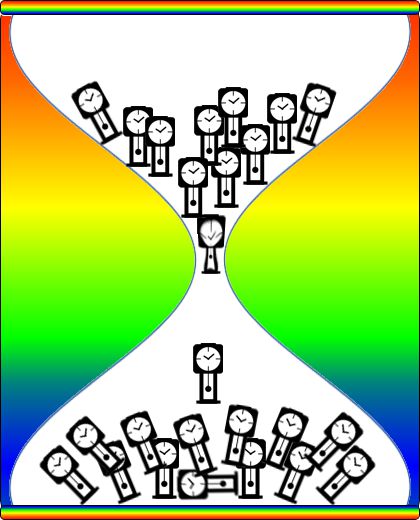
Clock image from vecteezy.com

~~ Rich Olcott


An Official Mass Movement

A December nip’s in the air.  I’m in my office trying to persuade the heating system to be more generous, when Vinnie wanders in carrying a magazine.  “I been reading about how a pound won’t be a pound any more.”

This takes me a moment to work out.  “Ah, you’re talking kilograms, not pounds, right?”

“Pound, kilogram, same difference, they’re both weights.”

“No, they’re not.  A kilogram at the bottom of the sea would still be a kilogram at the top of a mountain, but a pound high up weighs less than a pound lower down.”

“In what alternate universe does that make sense?”

“In any universe where Galileo’s observations and Newton’s equations are valid.  Thanks to them we know the difference between weight and mass.”

“Which is…?”

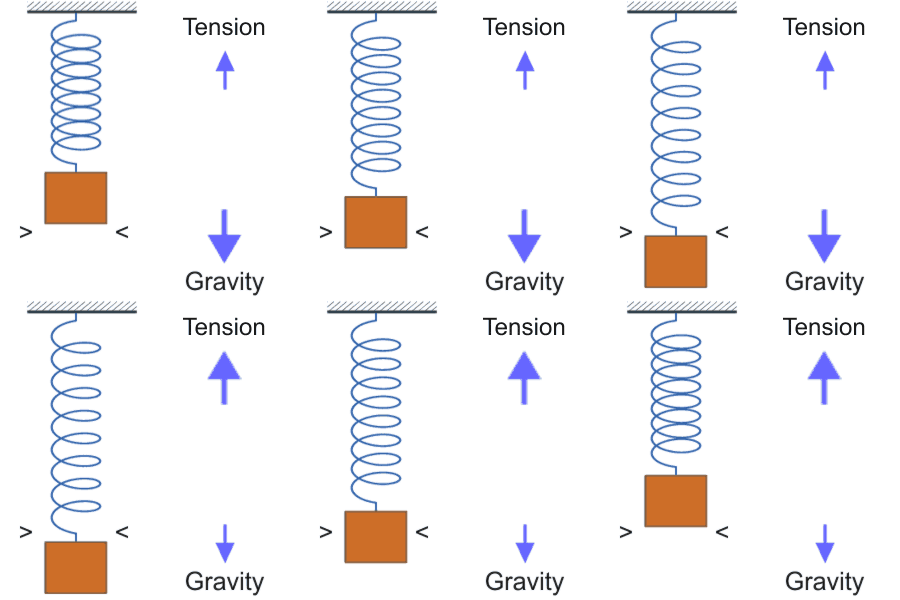
“That’s where things get subtle and it took Newton to tease them apart.  It’s the difference between quantifying something with a spring scale and quantifying it with a balance.  Say you put a heavy object on a scale.  It pulls down on the spring and the spring pulls up on the object.  When everything stops moving, the upward and downward forces are equal.  Given the spring’s stretch-per-pound relationship, you can measure the stretch and figure out how many pounds of force the object exerts.”

“Yeah, so…?”

“So now you put the same object on one pan of a balance.  You put kilogram blocks on the other pan until the balance beam levels out.  The beam goes level because the two sides of the balance carry the same mass.  Count the blocks and you know your object’s mass in kilograms.”

“Like I said, same difference.”

“Nope, because you’ve done two different operations.  On a balance your object will match up with the same number of blocks wherever you go with them.  Balance measurements are all about mass.  With the spring scale you compared gravity’s force against some other kind of force.  If you go somewhere else where gravity’s weaker, say to the top of Mt Everest, the scale will show a different weight even though the mass hasn’t changed.”

“How much different?”

“Not much for most purposes — about two pounds per ton between sea-level and Mt Everest’s peak.  But that’s a huge variation for physicists who look for clues to the Universe in the 5th or 6th decimal place.  High tech science and engineering need measurements, like mass, that are precise, stable and reproducible in many labs.  You noticed that both of my example measurements are too approximate for the techs.”

“Sure, the scale thing can be off because the spring can get wonky with use.  Um, and you can only measure the stretch within a percent or so probably.  But you can count the kilogram blocks — that ought to be a pretty good number.”

“Count-based metrics are indeed the most precise, but they’re problematic in their own way.  For one thing, maybe the object isn’t an exact number of kilograms.  Best you can do is say it’s between and n+1 kilograms.  But it’s worse than that.  The kilogram blocks can get wonky, too — finger-marks, corrosion, all of that.”

“But you can counter that by comparing the daily-use blocks with a standard you don’t use much.”

“Which sooner or later gets wonky with use so you have re-calibrate it to a whole chain of calibration blocks going back to a lovingly preserved great-grandmaster standard block, but what do we do when we get to Mars where it’d be difficult to get the local standard back to Earth for a re-calibration?”

“I see the problem.  Is that why a kilogram won’t be a kilogram any more?”

“Well, that’s why The Kilogram won’t be Le grand K, the great-grandmaster standard — a carefully monitored hunk of platinum-iridium that’s actually kept in a guarded, climate-controlled vault in a Paris basement.  It’s taken out only once every few years to compare with its kin.  Even so it appears to have lost 50 micrograms since 1889.  We think.  So they’re demoting it.” 

“What’re they replacing it with?  Not another lump of metal, then?”

“Oh, no, they need something that’s precisely reproducible anywhere, preferably something that’s count-based.  The new standard will be official soon.  It’s a great physics story.”

~~ Rich Olcott

LIGO: Gravity Waves Ain’t Gravitational Waves

Sometimes the media get sloppy.  OK, a lot of times, especially when the reporters don’t know what they’re writing about.  Despite many headlines that “LIGO detected gravity waves,” that’s just not so.  In fact, the LIGO team went to a great deal of trouble to ensure that gravity waves didn’t muck up their search for gravitational waves.

Spring2A wave happens in a system when a driving force and a restoring force take turns overshooting an equilibrium point AND the away-from-equilibrium-ness gets communicated around the system.  The system could be a bunch of springs tied together in a squeaky old bedframe, or labor and capital in an economic system, or the network of water molecules forming the ocean surface, or the fibers in the fabric of space (whatever those turn out to be).
If you  were to build a mathematical model of some wavery system you’d have to include those two forces plus quantitative descriptions of the thingies that do the moving and communicating.  If you don’t add anything else, the model will predict motion that cycles forever.  In reality, of course, there’s always something else that lets the system relax into equilibrium.

The something else could be a third force, maybe someone sitting on the bed, or government regulation in an economy, or reactant depletion for a chemical process.  But usually it’s friction of one sort or another — friction drains away energy of motion and converts it to heat.  Inside a spring, for instance, adjacent crystallites of metal rub against each other.  There appears to be very little friction in space — we can see starlight waves that have traveled for billions of years.

Physicists pay attention to waves because there are some general properties that apply to all of them.  For instance, in 1743 Jean-Baptiste le Rond d’Alembert proved there’s a strict relationship between a wave’s peakiness and its time behavior.  Furthermore, Jean-Baptiste Joseph Fourier (pre-Revolutionary France must have been hip-deep in physicist-mathematicians) showed that a wide variety of more-or-less periodic phenomena could be modeled as the sum of waves of differing frequency and amplitude.

Monsieur Fourier’s insight has had an immeasurable impact on our daily lives.  You can thank him any time you hear the word “frequency.”  From broadcast radio and digitally recorded music to time-series-based business forecasting to the mode-locked lasers in a LIGO device — none would exist without Fourier’s reasoning.

Gravity waves happen when a fluid is disturbed and the restoring force is gravity.  We’re talking physicist fluid here, which could be sea water or the atmosphere or solar plasma, anything where the constituent particles aren’t locked in place. Winds or mountain slopes or nuclear explosions push the fluid upwards, gravity pulls it back, and things wobble until friction dissipates that energy.

Gravitational waves are wobbles in gravity itself, or rather, wobbles in the shape of space.  According to General Relativity, mass exerts a tension-like force that squeezes together the spacetime immediately around it.  The more mass, the greater the tension.

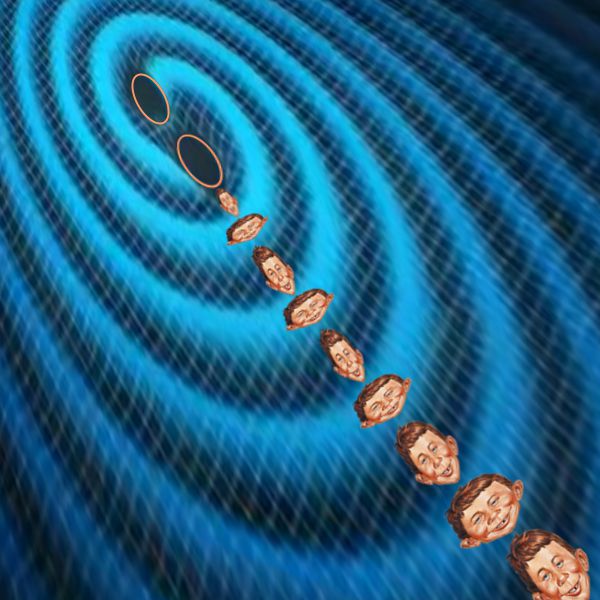
Binary BH with AENAn isolated black hole is surrounded by an intense gravitational field and a corresponding compression of spacetime.  A pair of black holes orbiting each other sends out an alternating series of tensions, first high, then extremely high, then high…

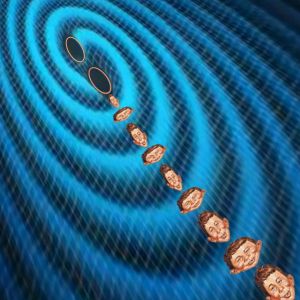
Along any given direction from the pair you’d feel a pulsing gravitational field that varied above and below the average force attracting you to the pair.  From a distance and looking down at the orbital plane, if you could see the shape of space you’d see it was distorted by four interlocking spirals of high and low compression, all steadily expanding at the speed of light.

The LIGO team was very aware that the signal of a gravitational wave could be covered up by interfering signals from gravity waves — ocean tides, Earth tides, atmospheric disturbances, janitorial footsteps, you name it.  The design team arrayed each LIGO site with hundreds of “seismometers, accelerometers, microphones, magnetometers, radio receivers, power monitors and a cosmic ray detector.”  As the team processed the LIGO trace they accounted for artifacts that could have come from those sources.

So no, the LIGO team didn’t discover gravity waves, we’ve known about them for a century.  But they did detect the really interesting other kind.

~~ Rich Olcott