Not Even A Sneeze in A Hurricane

Quite a commotion at the lakeshore this morning. I walk over to see what’s going on. Not surprised at who’s involved. “Come away from there, Mr Feder, you’re too close to their goslings.” Doesn’t work, of course, so I resort to stronger measures. “Hey, Mr Feder, any questions for me?”

That did the trick. “Hey, yeah, Moire, I got one. There’s this big problem with atomic power ’cause there’s leftovers when the fuel’s all used up and nobody wants it buried their back yard and I unnerstand that. How about we just load all that stuff into one of Musk’s Starships and send it off to burn up in the Sun? Or would that make the Sun blow up?”

“Second part first. Do you sneeze?”

“What kinda question is that? Of course I sneeze. Everyone sneezes.”

“Ever been in a hurricane?”

“Oohyeah. Sandy, back in 2012. Did a number on my place in Fort Lee. Took out my back fence, part of the roof, branches down all over the place—”

“Did you sneeze during the storm?”

“Who remembers that sort of thing?”

“If you had, would it have made any difference to how the winds blew?”

“Nah, penny‑ante compared to what else was going on. Besides, the storm eye went a couple hundred miles west of us.”

“Well, there you go. The Sun’s surface is covered by about a million granules, each about the size of Texas, and each releasing about 400 exawatts—”.

“Exawha?”

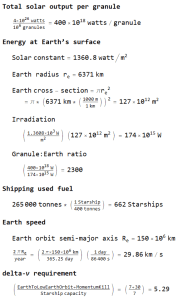
“Exawatt. One watt is one joule of energy per second. Exa– means 1018. So just one of those granules releases 400×1018 joules of energy per second. By my numbers that’s about 2300 times the total energy that Earth gets from the Sun. There’s a million more granules like that. Still think one of our rockets would make much difference with all that going on?”

“No difference anybody’d notice. But that just proves it’d be safe to send our nuclear trash straight to the Sun.”

“Safe, yes, but not practical.”

“When someone says ‘practical’ they’re about to do numbers, right?”

“Indeed. How much nuclear waste do you propose to ship to the Sun?”

“I dunno. How much we got?”

“I saw a 2022 estimate from the International Atomic Energy Agency that our world‑wide accumulation so far is over 265 000 tonnes, mostly spent fuel. Our heaviest heavy‑lift vehicle is the SpaceX Starship. Maximum announced payload to low‑Earth orbit is 400 tonnes for a one‑way trip. You ready to finance 662 launches?”

“Not right now, I’m a little short ’til next payday. How about we just launch the really dangerous stuff, like plutonium?”

“Much easier rocket‑wise, much harder economics‑wise.”

“Why do you say that?”

“Because most of the world’s nuclear power plants depend on MOX fuel, a mixture of plutonium and uranium oxides. Take away all the plutonium, you mess up a significant chunk of our carbon‑free‑mostly electricity production. But I haven’t gotten to the really bad news yet.”

“I’m always good for bad news. Give.”

“Even with the best of intentions, it’s an expensive challenge to shoot a rocket straight from Earth into the Sun.”

“Huh? It’d go down the gravity well just like dropping a ball.”

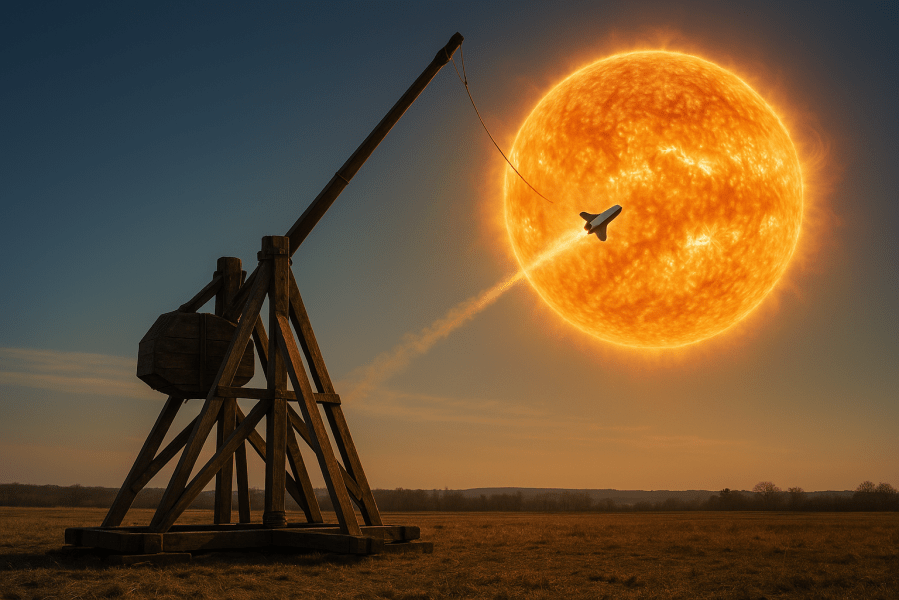
“Nope, not like dropping a ball. More like flinging it off to the side with a badly‑aimed trebuchet. Guess how fast the Earth moves around the Sun.”

“Dunno. I heard it’s a thousand miles an hour at the Equator.”

“That’s the planet’s rotation on its own axis. My question was how fast we go taking a year to do an orbit around the Sun. I’ll spare you the arithmetic — the planet speeds eastward at 30 kilometers per second. Any rocket taking off from Earth starts with that vector, and it’s at right angles to the Earth‑Sun line. You can’t hit the Sun without shedding all that lateral momentum. If you keep it, the rules of orbital mechanics force the ship to go faster and faster sideways as it drops down the well — you flat‑out miss the Sun. By the way, LEO delta‑v for SpaceX’s most advanced Starship is about 7 km/s, less than a fifth of the minimum necessary for an Earth‑to‑Sun lift.”

~ Rich Olcott

The Phase Rue

Stepping past the fourth wall again. You may have noticed that some of my recent posts have included A.I.‑generated illustrations. The creation process has been fun and often frustrating. Sometimes I’ve gone through half‑a‑dozen or more iterations, refining and re‑refining a prompt until I got the effect I wanted. Or not.

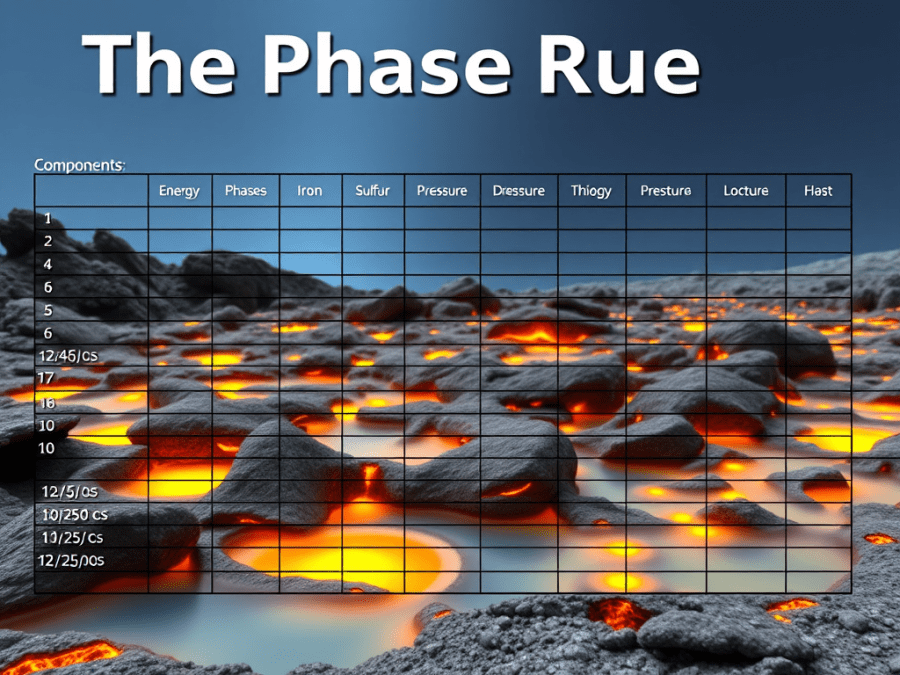
A couple of times I just gave the beast the text of the post and was delighted with the results (see in particular this one and this one). I used prompts for most of the space scenery in the “Sulfur on Io” series; on the whole they came out well. For some posts (for instance this one) I had to haul out my toolkit and tinker with the generated image. Other times I simply gave up and went back to my trusty digital artsy processes. I had to do that when I turned the A.I. loose on one of the “Phase Rule” posts:

The title (which I hadn’t asked for) was almost too good, but the column headings (“Thiogy”? “Presture”?) definitely went off the deep end.

Then there’s the following image, the final unfortunate result of an extended series of prompts I went through trying to illustrate a post about the three-body problem. So many issues:

  • The mise-en-scène just isn’t my visualization of Pizza Eddie’s place and I couldn’t get the A.I. to adjust it properly.
  • That “clock” has only ten, or maybe 9½, numbers. Besides, it’s in a stupid place, at the ceiling above the crown molding.
  • Vinnie’s holding a pizza fragment but neither pizza in front of him has been touched.
  • Eddie has no flour dust on his apron.
  • Sy’s right shoulder is too hyper‑developed for an office worker who doesn’t bowl or do archery. He’s the kind of guy who would wear a sport jacket any time he’s out of the house. Finally, in all of my prompts I had him facing the other two. Sy may be a shy person, but he’s not one to avoid the camera.

And then I watched John Oliver’s harangue about “A.I. slop.” As usual, he’s on‑target. The tech is fundamentally unfair because it has been built using work from real live working artists with whom it now competes. Moreover, A.I. is gleefully being abused by rapacious click‑harvesters who flood the internet with rubber‑stamp crap*, generally either political or cringey. Like the guy said, “It ain’t right.”

So in the future I’m going to avoid using A.I.‑generated images in favor of hand-made ones. Mostly.

* See Theodore Sturgeon’s First Law — “95% of everything is crap.” On recent evidence, that number’s probably too low these days.

[/rant]

~ Rich Olcott

Two’s Company, Three Is Perturbing

Vinnie does this thing when he’s near the end of his meal. He mashes his pizza crumbs and mozzarella dribbles into marbles he rolls around on his plate. Mostly on his plate. Eddie hates it when one escapes onto his floor. “Vinnie, you lose one more of those, you’ll be paying extra.”

“Aw, c’mon, Eddie, I’m your best customer.”

“Maybe, but there’ll be a surcharge for havin’ to mop extra around your table.”

Always the compromiser, I break in. “How about you put on less sauce, Eddie?”

Both give me looks you wouldn’t want.
  ”Lower the quality of my product??!?”
    ”Adjust perfection??!?”

“Looks like we’ve got a three‑body problem here.” Blank looks all around. “You two were just about to go at it until I put in my piece and suddenly you’re on the same side. Two‑way interaction predictable results, three‑way interaction hard to figure. Like when Newton calculated celestial orbits to confirm his Laws of Gravity and Motion. They worked fine for the Earth going around the Sun, not so good for the Moon going around the Earth. The Sun pulls on the Moon just enough to play hob with his two‑body Earth‑Moon predictions.”

“Newton again. So how did he solve it?”

“He didn’t, not exactly anyway.”

“Not smart enough?”

“No, Eddie, plenty smart. Later mathematicians have proven that the three‑body problem simply doesn’t have a general exact solution.”

“Ah-hah, Sy, I heard weaseling — general?”

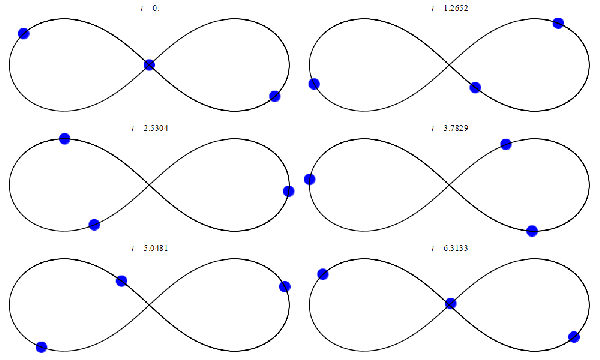
“Alright, Vinnie, there are some stable special cases. Three bodies at relative rest in an equilateral triangle; certain straight‑line configurations; two biggies circling each other and a third, smaller one in a distant orbit around the other two’s center of gravity. There are other specials but none stable in the sense that they wouldn’t be disrupted by a wobbly gravity field from a nearby star or the host galaxy.”

“So if NASA’s mission planners are looking at a four‑body Sun‑Jupiter‑Europa‑Juno situation, what’re they gonna do? ‘Give up’ ain’t an option.”

“Sure not. There’s a grand strategy with variations. The oldest variation goes back to before the Egyptian builders and everybody still uses it. Vinnie, when you fly a client to Tokyo, do you target a specific landing runway?”

“Naw, I aim for Japan, contact ATC Narita when I get close and they vector me in to wherever they want me to land.”

“How about you, Eddie? How do you get that exquisite balance in your flavoring?”

“Ain’t easy, Sy. Every batch of each herb is different — when it was picked, how it was stored, even the weather while it was growing. I start with an average mix which is usually close, then add a pinch of this and a little of that until it’s right.”

“For both of you, the critical word there was ‘close’. Call it in‑flight course adjustments, call it pinch‑and‑taste, everybody uses the ‘tweaking’ strategy. It’s a matter of skill and intuition, usually hard to generalize and even harder to teach in a systematic fashion. Engineers do it a lot, theoretical physicists work hard to avoid it.”

“What’ve they got that’s better?”

” ‘Better’ depends on your criteria. The method’s called ‘perturbation theory’ and strictly speaking, you can only use it for certain kinds of problems. Newton’s, for instance.”

“Good ol’ Newton.”

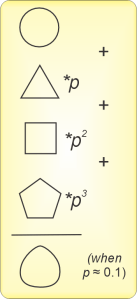
“Of course. Newton’s calculations almost matched Kepler’s planetary observations, but finagling the ‘not quite’ gave Newton headaches. More than 150 years passed before Laplace and others figured out how to treat a distant object as a perturbation of an ideal two‑body situation. It starts with calculating the system’s total energy, which wasn’t properly defined in Newton’s day. A perturbation factor p controls the third body’s contribution. The energy expression lets you calculate the orbits, but they’re the sum of terms containing powers of p. If p=0.1, p2=0.01, p3=0.001 and so on. If p isn’t zero but is still small enough, the p3 term and maybe even the p2 term are too small to bother with.”

“I’ll stick with pinch‑and‑taste.”

“Me and NASA’ll keep course‑correcting.”

~ Rich Olcott

Sharpening The Image

“One coffee, one latte and two scones, Cal. Next time is Cathleen’s turn. Hey, you’ve got a new poster behind the cash register. What are we looking at?”

“You like it, Sy? Built the file myself from pics in my astronomy magazines, used the Library’s large‑format printer for the frameable copy. Came out pretty well, didn’t it, Cathleen?”

“Mm‑hm. Sy, you should recognize the pebbly-looking one. It’s granules at the bottom of the Sun’s atmosphere. The image came from the Inouye Solar Telescope at Haleakala Observatory on Maui, probably Earth’s best ground‑based facility for studying the Sun. I showed the image to your niece in that phone call. For scale, those granules of super‑heated rising gas are each about the size of Texas.”

“My magazine article didn’t mention Texas but it said there’s about ten million granules. What it was mostly about was the IST and its resolution. Those edges in the picture are as narrow as 18 miles across. It’s that good ’cause the beast has a 4‑meter mirror, which used to be amazing, but they made it even better with active and adaptive optics.”

“Hmm. It’s obvious that the bigger the mirror, the better it is for catching photons. If someone’s going to build a big mirror they’re going to put it behind a big aperture, which is important for resolving points that are close together. But what are ‘active and adaptive optics’ and why did you say that like they’re two different things?”

” ‘Cause they are two different things, Sy. Different jobs, different time‑scales. Gravity here on Earth can make a big mirror sag, and the sag changes depending on where the machine is pointed and maybe part of it gets the wrong temperature. Active optics is about keeping the whole mirror in the right shape to focus the photons where they’re supposed to go. There’s a bunch of actuators rigged up to give adjustable support at different points behind the mirror. The astronomer tells the system to watch a certain guide point and there’s a computer that directs each actuator’s pushing to sharpen the point’s image.”

“And adaptive optics?”

“That’s about solving a different problem. Stars twinkle, right, and the reason they twinkle is because of the atmosphere. One part refracts light one way, another part maybe warmer or with different humidity sends the light another way. Everything moves second to second. By the time a light‑wave gets down to us it’s been jiggled a lot. Adaptive optics is a small mirror, also with a lot of actuators, placed up in the light path after the primary mirror. Again with a guide point and a computer, the little mirror’s job is to cancel the jiggles so the scope’s sensors see a smooth wave. Adaptive works a lot faster than active, which sounds backwards, but I guess active came first.”

“The granules must be in the Sun’s disk somewhere. The other two images look like they’re on the edge.”

“That’s right, Sy. The bottom one is from the Solar Dynamic Observatory satellite a few years ago. That’s not visible light, it’s EUV—”

“EUV?”

“Extreme UltraViolet, light‑waves too short even for hydrogen so it’s mostly from iron atoms heated to millions of degrees. SDO had to be a satellite to catch that part of the spectrum because the atmosphere absorbs it. Of course, up there there’s no need for active or adaptive optics but imaging EUV has its own problems.”

“How tall is that photogenic tree?”

“It’s a prominence. The article said it’s about twenty times Earth’s diameter.”

“What about the pink one?”

“That’s new, Cathleen, from another Maui telescope. Adaptive optics were in play but there’s a problem. If you’re probing inside the corona there’s no fixed guide point. The team focused their adjustment system on corona features where they were a few seconds ago. The article said the process was ‘tricky,’ but look at the results. The loop is about the size of Earth, and those fine lines are about the width of Vancouver Island. They discovered details no‑one’s ever seen before.”

Top left: Schmidt et al./NJIT/NSO/AURA/NSF;
Top right: NSO/AURA/NSF under CC A4.0 Intl license;
Bottom: NASA/SDO

~ Rich Olcott

Snap The Whip

“You say Alfven invented a whole science, Sy, but his double‑layer structures in plasma don’t look like much compared with the real ground‑breakers like Herschel or Hubble.”

“Your Astronomy bias is showing, Cathleen. The double‑layer thing was only a fraction what he gave to magnetohydrodynamics. To begin with, he dreamed up a new kind of wave.”

“There’s more than light waves, sound waves and ocean waves?”

“Certainly. There’s dozens of different kinds — look up waves in Wikipedia some day. Some move, some make other things move; sometimes things move in the direction the wave does, sometimes crosswise to it. From a Physics perspective waves are about repetition. Something that happens just once, where do you go from there?”

“That used to be Astronomy’s problem — only one solar system with fewer than a dozen planets, only two galaxies we could inspect closely. Now our space telescopes and monster‑mirror ground‑based observatories have given us thousands of planets and billions of stars and galaxies. If we get our classifications right we can follow an object type through every stage of development. It’s almost like watching Chemistry happen.”

“I doubt Susan Kim would agree but I get your point. Anyhow, most waves have a common underlying process. Many systems have an equilibrium condition. Doing something energetic like plucking on a guitar string moves the system away from equilibrium. That provokes some force to restore equilibrium. For the guitar, tension in the wire pulls it straight. Usually the restoration overshoots so the restoring force turns around to act in the opposite direction. That’s when the repetition starts, right?”

“Mm-hm, that’s sound waves in a nutshell. Ocean waves, too, because gravity’s the restoring force fighting with the wind to pull things flat.”

“Same idea. Well, Alfven’s first trick was to demonstrate that in a plasma or any conducting medium, a magnetic field acts like that guitar string. The field’s equilibrium configuration is straight and smooth. If you perturb the medium somehow to put a bend or kink in the field, magnetic tension kicks in to restore equilibrium. Waves restored by magnetic fields are important enough that they’re now called Alfven waves in his honor.”

“First trick, mmm? There’s more?”

“Yup, an old one he borrowed from Maxwell — the flux tube. Maxwell worked before atoms were a conceptual thing. He thought about magnetism in terms of immaterial ‘lines of force’ that followed the rules laid out in his equations. Think of grabbing a handful of barely cooked spaghetti, still mostly stiff.”

“Yuck.”

“You’re wearing gloves, okay? The point is, you’ve got a more‑or‑less cylindrical bundle of parallel strands. Pretend each strand is a line of magnetic force. Maxwell’s rules say the number of lines of force, the total magnetic flux, coming out one end of the bundle exactly equals the flux that went in the other end. There’s no sourcing or destroying magnetic flux in between.”

“What if I squeeze real hard?”

“Nope. The flux per unit area intensifies — that’s called ‘the pinch effect’ and particle beam folks love it — but the total flux stays the same. Here’s where it gets interesting. Alfven showed that if the flux tube passes through a plasma or other conducting medium, the medium’s charged particles get frozen into the field. Waggle the field, you waggle the particles. Now put that together with his waves.”

“Oh, that’s what those guys have been talking about! There’s a slew of recent papers built on observations from the Parker Solar Probe mission. One of the biggest outstanding problems in solar physics is, how can the corona, the outermost layer of the Sun’s atmosphere, be millions of degrees hotter than the 6000‑degree photosphere beneath it? Well, PSP and other satellite missions have recorded many observations where the ambient magnetic field suddenly flipped from one direction to its near‑opposite. It’s like the probe had flown through a flux tube zig‑zag in space.”

“Those sharp angles indicate a lot of pent‑up magnetic tension.”

“Absolutely! Now imagine those zig‑zags in the crowded chaos inside the Sun’s atmosphere, colliding, criss‑crossing, disconnecting, reconnecting, releasing their magnetic flux energy into frozen‑in particles that aren’t frozen any more. What do you get, Sy?”

“Immense amounts of kinetic energy. Hot times, indeed”

~ Rich Olcott

What’s In Project 2025?

  • Breaking through the fourth wall, but I’m an American citizen who is horrified at what the current Administration is doing to the country I love. In the spirit of ‘know your opponent‘ I’ve briefly departed from our normal time with Sy and the gang to shine light on a document that was carefully not publicized prior to the 2024 election. Back to our normal programming next week.
  • The material below is based on the Project 2025 document. It’s my understanding that much of the Project’s philosophy underlies and is embedded in the ‘One Big Beautiful Bill’ Act (OBBBA) currently working its way through Congress, but I’ve not read through all of that legislation’s ~900 pages (way too many ‘notwithstandings’). From what I’ve seen, the House‑passed version is every bit as contrary to our founding principles. ~ RJO

I expect only a few people have read through 2025 Mandate for Leadership, the Heritage Foundation’s manifesto that lays out much of the tactical structure for what the current Administration is trying to accomplish. It’s a hefty tome, nearly 900 pages including a seven‑page list of Contributors. You don’t approach it like a novel; you settle down with a notepad and a supply of coffee, then scan through looking for mentions of your favorite parts of the Federal government.

Someone asked me which were my Top Three things to dislike about the Project 2025 prospectus. It was like asking which three threads in a plaid should be discarded but making no distinction between warp and woof. Plaid’s not that bad a metaphor, because the document has a warp (the underlying notions) and a woof (specific recommendations laid out for every entity in the government).

Some of the warp threads are explicit, proudly highlighted in the 33‑page Forward (quotes are direct from the text)

  1. “Restore the family as the centerpiece of American life and protect our children.” (page 4) — Family is implicitly defined in the follow-on text as male breadwinner, female homemaker, some number of kids, all happily occupied with “the building blocks of any healthy society. Marriage. Family. Work. Church. School. Volunteering.” (page 4) Note that political activity is not in the list. Parents must have veto authority over the entire content of their offspring’s schooling, except that screen time for kids is terrible and must be forbidden.
  2. “Dismantle the administrative state and return self-governance to the American people.” (page 6) — “So today in Washington, most policy is no longer set by Congress at all, but by the Administrative State. Given the choice between being powerful but vulnerable or irrelevant but famous, most Members of Congress have chosen the latter. Congress passes intentionally vague laws that delegate decision‑making over a given issue to a federal agency. That agency’s bureaucrats–not just unelected but seemingly un‑fireable–then leap at the chance to fill the vacuum created by Congress’s preening cowardice.” (page 7) On the one hand the Project authors want to return all decision‑making power to Congress, but on the other hand they point to congressional incapacity for the job. Clearly, the authors have an alternative governing structure in mind (see item 5).
  3. “Defend our nation’s sovereignty, borders, and bounty against global threats.” (page 9) — The “sovereignty, borders and bounty” notions are stretched to cover diatribes against the “managerial elite” (page 10), “globalization” (page 11), “environmental extremism” (page 11) and of course “wokeism” (page 14) in general.
  4. “Secure our God-given individual rights to live freely — what our Constitution calls ‘the Blessings of Liberty.’ ” (page 13) Consider the moral arrogance and intellectual acrobatics required to transform ‘the pursuit of Happiness’ to “Our Constitution grants each of us the liberty to do not what we want, but what we ought.” (page 13) Such a bleak prospect.

There are also implicit tenets and directives throughout the following 875 pages, there if one looks for them:

  1. Abrogation of the Founders’ concept of checks and balances. Federal government power is to be lodged in the Unitary Executive branch, not in Congress (see item 2), not in the Judiciary. Orders come top‑down, which looks like an administrative state under another guise but that would be even further from democratic rule.
    • Notably, OBBBA provision 70302 would largely immunize the Executive branch against being held in contempt if it ignores or violates a Judicial ruling.
  2. An imperative to privatize any governmental service that someone might or might not make a profit from.
  3. Mean-spirited Social Darwinism, as exemplified by Musk’s remark that “the fundamental weakness of Western civilization is empathy.”
  4. The notion that unregulated is always better than regulated, no matter the social cost.
  5. Primacy of corporate/employer rights over worker rights (“union” is mentioned 102 times, “contract” 40 times).
  6. Indictment of a supposed “climate crisis industry” (“climate” is mentioned 155 times) along with a spirited defense of the fossil‑fuel industries (“fossil” gets 31 mentions).
  7. Religiosity, specifically Christian‑flavored. One telling example — “Congress should encourage communal rest by amending the Fair Labor Standards Act (FLSA) to require that workers be paid time and a half for hours worked on the Sabbath.” (page 589)
  8. Deprecation of support for basic science and Public Health as governmental responsibilities. Despite more than 1000 uses of the word “science,” NASA is mentioned only once, in a footnote.
  9. and a few others I lost track of.

That’s the warp of the plaid, but the woof uses the warp’s tool kit to prescribe actions to be taken in or against (nearly) every Federal Department and Agency, from the office of the White House Chief of Staff through the Cabinet positions out to the independent regulatory agencies ending with the Federal Elections Commission and the Federal Trade Commission. Notably not included are the United States Postal Service, the Smithsonian Institution and the Kennedy Center.

My Top Three objectionable items? The document presents hundreds and hundreds of woof‑level recommendations, some of which seem reasonable to me but most of which don’t. In picking anti‑favorites I’ll stick with the warp level. Chief among them are jettisoning checks‑and‑balances, disparagement of science in general and climate change in particular, and the authors’ demonstrated propensity to cling to ideological positions in the face of contrary evidence.  Coming from a union family, I’m not too happy about item 9, either.

Think I’ve mischaracterized what’s in there? Download the document yourself and look through it to check me. Compare the listings to what has transpired so far since January 21. If you care about a particular governmental function (the Veterans Administration, the National Park Service, the Census Bureau, whatever), look up its prognosis. Think about that and decide what you want to do about it. Then do that.

~ Rich Olcott

Why Those Curtains Ripple

I’m in the scone line at Cal’s Coffee when suddenly there’s a too‑familiar poke at my back, a bit right of the spine and just below the shoulder blade. I don’t look around. “Morning, Cathleen.”

“Morning, Sy. Your niece Teena certainly likes auroras, doesn’t she?”

“She likes everything. She’s the embodiment of ‘unquenchable enthusiasm.’ At that age she’s allowed.”

“It’s a gift at any age. Some of the kids in my classes, they just can’t see the wonders no matter how I try. I show them aurora photos and they say, ‘Oh yes, red and green in the sky‘ and go back to their phone screens. Of course there’s no way to get them outside late at night at a location with minimal light pollution.”

“I feel your pain.”

“Thanks. By the way, your aurora write-ups have been all about Earth’s end of the magnetic show. When you you going to do the rest of the story?”

“How do you mean?”

“Magnetism on the Sun, how a CME works, that sort of thing.”

“As a physicist I know a lot about magnetism, but you’re going to have to educate me on the astronomy.”

Plane‑polarized Lorentz (electromagnetic) wave
 Electric (E) component is red
 Magnetic (B) component is blue
(Image by Loo Kang Wee and Fu-Kwun Hwang from Wikimedia Commons)
Licensed under CC ASA3.0 Unported

“Deal. You go first.”

<displaying an animation on Old Reliable> “We’ll have to flip between microscopic and macroscopic a couple times. Here’s the ultimate micro — a single charged particle bouncing up and down somewhere far away has generated this Lorentz‑force wave traveling all alone in the Universe. The force has two components, electric and magnetic, that travel together. Neither component does a thing until the wave encounters another charged particle.”

“An electron, right?”

“Could be but doesn’t have to be. All the electric component cares about is how much charge the particle’s carrying. The magnetic component cares about that and also about its speed and direction. Say the Lorentz wave is traveling east. The magnetic component reaches out perpendicular, to the north and south. If the particle’s headed in exactly the same direction, there’s no interaction. Any other direction, though, the particle’s forced to swerve perpendicular to both the field and the original travel. Its path twists up- or downward.”

“But if the particle swerves, won’t it keep swerving?”

“Absolutely. The particle follows a helical path until the wave gives out or a stronger field comes along.”

“Wait. If a Lorentz wave redirects charge motion and moving charges generate Lorentz waves, then a swerved particle ought to mess up the original wave.”

“True. It’s complicated. You can simplify the problem by stepping back far enough that you don’t see individual particles any more and the whole assembly looks like a simple fluid. We’ve known for centuries how to do Physics with water and such. Newton invented hydrodynamics while battling the ghost of Descartes to prove that the Solar System’s motion was governed by gravity, not vortices in an interplanetary fluid. People had tried using Newton‑style hydrodynamics math to understand plasma phenomena but it didn’t work.”

<grinning> “I don’t imagine it would — all that twistiness would have thrown things for a loop.”

“Haha. Well, in the early 1940s Swedish physicist Hannes Alfven started developing ideas and techniques, extending hydrodynamics to cover systems containing charged particles. Their micro‑level electromagnetic interactions have macro‑level effects.”

“Like what?”

“Those aurora curtains up there. Alfven showed that in a magnetic field plasmas can self‑organize into what he called ‘double layers’, pairs of wide, thin sheets with positive particles on one side against negative particles in the other. Neither sheet is stable on its own but the paired‑up structure can persist. Better yet, plasma magnetic fields can support coherent waves like the ones making that curtain ripple.”

“Any plasma?”

“Sure.”

“Most of the astronomical objects I show my students are associated with plasmas — the stars themselves, of course, but also the planetary nebulae that survive nova explosions, the interstellar medium in galactic star‑forming regions, the Solar wind, CMEs…”

“Alfven said we can’t understand the Universe unless we understand magnetic fields and electric currents.”

~ Rich Olcott

Colors Made of Air

Teena’s whirling around in the night with her head thrown back. “I LUVV AURORAS!! They’re SO beautiful beautiful beautiful!”

“Yes, they are, Teena. They’re beautiful and magical, and for me it’s even better because they’re Physics at work right in front of us. Well, above us.”

“Oh, Sy, give it a rest.”

“No, really, Sis. I look at a rainbow and I’m dazzled by its glory against the rainclouds but I’m also aware that each particular glimpse of pure color comes to me by refraction through one individual droplet. Better yet, I appreciate the geometry that presents the entire spectrum in perfectly circular arcs. Marvels supported by underlying marvels. These curtains are another example of beauty emerging from hidden sources.”

“What do you mean?”

“Remember Teena’s teacher’s magnetic force lines that were organized and revealed by iron filings? Auroras are a bit like that, except one level deeper. Again we don’t see magnetic fields directly. What we do see is light coming to us from oxygen and nitrogen atoms that are bombarded by rampaging charged particles.”

“Wait, Uncle Sy, we learned that charges make magnetic fields when they move.”

“That, too. It works both ways, which is why they call it electromagnetism. A magnetic field steers protons and electrons which make their own field to push back on the first one. But my point is, the colors in each curtain and the curtains themselves tell us about the current state of the atmosphere and Earth’s magnetic field.”

“Okay, I can see how magnetic fields up there could steer charged particles to certain parts of the sky, but how does that tell us about the atmosphere? What do the colors have to do with it? Is this more rainbows and geometry?”

“Definitely not. Sis. Rainbows are sunlight refracted through water droplets. Aurora light’s emitted by atoms in our own atmosphere. Each color is like a fingerprint of a specific atom in specific circumstances. The uppermost reds, for instance come from oxygen atoms that rarely touch another atom of any kind. They’re at 150 or more kilometers altitude, way above the stratosphere. There aren’t many of them that far up which is why the curtain tops sort of fade away into infinity.”

“Oooo, now it’s going green and yellow!”

“Mm-hm, the bombardment’s reaching further now. Excited oxygen atoms emit green lower down in the atmosphere where collisions happen more often and don’t give the red‑emitters a chance to do their thing. The in‑between yellow isn’t really there — it’s what your eye tells you when it sees pure red and pure green overlapping.”

“Why do the curtains have that sharp lower edge, Sy? Surely we don’t run out of oxygen there.”

“Quite the reverse. That level’s about 100 kilometers up. It’s where the atmosphere gets so thick that collisions drain away an excited atom’s energy before it gets a chance to shine.”

“But why are there curtains at all? Why not simply fill the sky with a smooth color wash?”

“Mars gets auroras like that, or at least Perseverance just spotted one. We don’t, thanks to our well‑ordered magnetic field. Mars’ field is lumpy and too weak to funnel incoming charged particles to special spots like our poles. Actually, those curtains are just segments of rings that go all around Earth’s magnetic axis. The rings usually lurk about 2/3 of the way to our poles but a really strong solar event like this one can push them closer to the Equator.”

“Mars gets auroras? Uncle Sy, how about other planets?”

“Them, too, but theirs mostly don’t look like ours. You’d have to be able to see X‑rays on Mercury, for instance. Venus gets a general green glow for the same reason that Mars does. Jupiter is Texas for the Solar System — everything’s bigger there, including auroras in every color from X‑ray to infrared. Strong ordered field, so I’m sure there’s curtains up there.”

Sis yanks out her writer’s‑companion notebook and scribbles without looking down…
  ”Curtains made of colors
   Colors made of air.

Aurora, photo by Bellezzasolo
licensed under CC BY-SA 4.0

~ Rich Olcott

Sky Lights

“Mom! Uncle Sy! Come outside NOW before it goes away!”

“Whah— oooh!”
 ”An aurora! Thanks for calling us.”

“Glowing curtains rippling across the sky! Spotlights shining down through them! Where do those come from?”

“From the Sun, Teena.”

“C’mon, Sy. The Sun’s 93 million miles away. Even if that bright streak up there is as much as 10 miles across, which I doubt, the beam from the Sun would be only a teeny‑tiny fraction of a degree wide. Not even magnetars send out anything that narrow.”

“Didn’t say it’s a beam, Sis. The whole display comes from the Sun as single package. Sort of. Sometimes.”

“Even for you, little brother, that’s a new level of weasel‑wording.”

“Well, it’s complicated.”

“So unravel it. Start from the beginning.”

“Okay. The Sun’s covered in plasma—”

“Eww!”

“Not that kind of plasma, Teena. This is mostly hydrogen atoms except they’re so hot that the electrons and protons break away from each other and travel separately. What have they told you in school about magnets?”

“Not much. Umm … electric currents push on magnets and that’s how motors work, and magnets push on electrons and that’s how a generator works. Oh, and Mr Cox laid a sheet of paper on top of a magnet and sprinkled iron filings on it so we could see the lines of force, but when I asked him what made the magnetism ’cause I didn’t see any wires he started talking about electrons in iron atoms and then the bell rang and I had to go to Spanish class.”

The shape of the bar magnet’s field, disclosed by iron filings chaining together.

<sigh> “The clock rules, doesn’t it? Anyway, he was on the right track, but I want to get back to those lines of force. Were they there before he sprinkled on those filings?”

“Mmm … Mom would say, ‘That’s a good question,’ but how could you know? I’m gonna say they were.”

“Your Mom would be right, but sorry, you’re wrong. With no iron filings in the picture, the magnetic field is nice and smooth, everywhere just the same or maybe only a little bit stronger or weaker than neighboring points. No lines. Conditions change when you put the first bit of iron anywhere in the field. As Mr Cox was probably saying when the bell interrupted, the electrons in the grain’s iron atoms align orbitals with the magnetic field. The alignment affects the surrounding field and that pulls in other iron bits that change the field even more.”

“But wouldn’t that make just a solid iron blob?”

“No, because a magnetic field has both strength and direction. Once the first particle points along the field, the iron bits it recruits rotate to point mostly in the same direction. You wind up with a chain of specks tracing out where they’ve acted together to alter the field. The chain’s surrounded by spaces where the field’s been stressed.”

“And then lotsa chains make lotsa lines, yeah!”

“I see where you’re headed, Sy. You’re going to claim that the vertical lines we see in the curtains trace out the Sun’s magnetic field.”

“Not quite, Sis. There’s only one magnetic field, a combination of Earth’s field, the Sun’s field, and the magnetic fields contained in whatever the Sun throws our way. Way out here Earth’s field is about ten thousand times stronger than the Sun’s is, but the fields inside a CME can range up to 10% or 20% of Earth’s. The moving curtains up there are the result of a magnetic tussle between us and a CME or maybe a flare’s outflow.”

“But there aren’t any iron filings up there, Uncle Sy!”

“True, but there are free charged particles in the ionosphere thanks to UV radiation from the Sun. A free electron caught in a magnetic field whips into a tight spiral. Its field gets neighbor particles spiraling. Pretty soon you wind up with a chain of them spiraling together, lining up like the filings do.”

“The spotlights?”

“Probably ion blobs embedded in the CME, but that’s a guess.”

Aurora, photo by W.carter
licensed under CC BY-SA 4.0

~ Rich Olcott

A Play Beyond The Play

Vinnie takes a long thoughtful look at the image that had dashed his beautiful six‑universe idea. “Wait, Sy. I don’t like this picture”

“Because it messes up your invention?”

“No, because how can they know what that halo looks like? I mean, the whole thing with dark matter is that we can’t see it.”

“You’re right about that. Dark matter’s so transparent that even with five times more mass than normal matter, it doesn’t block CMB photons coming from 13.8 billion lightyears away. That still boggles my brain every once in a while. But dark matter’s gravitational effects — those we can see.”

“Yeah, I remember a long time ago we talked about Fritz Zwicky and Vera Rubin and how they told people about galaxies held together by too much gravity but nobody believed them.”

“Well, they did, after a while—”

“A long while, like a long while since those talks. Remind me what ‘too much gravity’ was about.”

“It was about conflicts between their observations and the prevailing theoretical models. Everyone thought that galaxies and galaxy clusters should operate pretty much like planetary orbits — your speed increases the closer you are to the center, up to Einstein’s speed limit. Newton’s Laws of Motion predict how fast you should move if you’re at a certain distance from a body with a certain mass. If you’re moving faster than that, you fly away.”

“Yeah, escape velocity. So the galaxies in Zwicky’s cluster didn’t follow Newton’s Laws?”

“They didn’t seem to. Galaxies that should have escaped were still in there. The only way he could explain the stability was to suppose the galaxies are only a small fraction of the cluster’s mass. Extra gravity from the extra mass must bind things together. Forty years later Rubin’s improved technology revealed that stars within galaxies had the same anomalous motion.”

“I’m guessing the ‘faster near the center’ rule didn’t hold, or else you wouldn’t be telling this story. Spun like a wheel, I bet.”

“When a wheel spins, every part of it rotates at the same angular speed, the same number of degrees per second, right?”

“Ahh, the bigger my circle the higher my airspeed so the rule would be ‘faster farther out’.”

“That’s the wheel rule, right, but Rubin’s data showed that stars within galaxies don’t obey that one either. She measured lots of stars in Andromeda and other galaxies. Their linear speeds, kilometers per second, are nearly identical from near the center all the way out. Even dust and gas clouds beyond the galactic starry edges also fit the ‘same linear speed everywhere’ rule. You’d lose the bet.”

“That just doesn’t feel right. How can just gravity make that happen?”

“It can if the right amount of dark matter’s distributed in the right‑shaped smeared‑out hollowed‑out spherical halo. The halo’s radial density profile looks about like this. Of course, profiles for different galaxies differ in spread‑outness and other details, but the models are pretty consistent.”

“Wait, if dark matter only does gravity like you said, why’s that hole in the middle? Why doesn’t everything just fall inward?”

“Dark matter has mass so it also has inertia, momentum and angular momentum, just as normal matter does. Suppose some of the dark matter has collected gravitationally into a blob and the blob is moving slower than escape velocity. If it’s flying straight at the center of gravity it’ll get there and stay there, more or less. But if the blob’s aimed in any other direction, it has angular momentum relative to the center. Momentum’s conserved for dark matter, too. The blob eventually goes into orbit and winds up as part of the shell.”

“Does Zwicky’s galaxy cluster have a halo, too?”

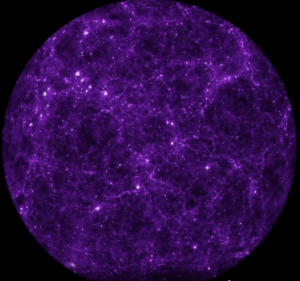
“Not in the same way. Each galaxy probably has its own halo but the galaxies are far apart relative to their size. The theoreticians have burned huge amounts of computer time simulating the chaos inside large ensembles of gravity‑driven blobs. I just read one paper about a 4‑billion‑particle calculation and mind you, a ‘particle’ in this study carried more than a million solar masses. Big halos host subhalos, with filaments of minihalos tying them together. What we can’t see is complicated, too.”

~ Rich Olcott