

250 years ago, when people were getting used to the idea that the planets circle the Sun and not the other way around, they wondered how that worked. Isaac Newton said, “I can explain it with my Laws of Motion and my Law of Gravity.”
The first Law of Motion is that an object will move in a straight line unless acted upon by a force. If you’re holding a ball by a string and swing the ball in a circle, the reason the ball doesn’t fly away is that the string is exerting a force on the ball. Using Newton’s Laws, if you know the mass of the ball and the length of the string, you can calculate how fast the ball moves along that circle.
Newton said that the Solar System works the same way. Between the Sun and each planet there’s an attractive force which he called gravity. If you can determine three points in a planet’s orbit, you can use the Laws of Motion and the Law of Gravity to calculate the planet’s speed at any time, how close it gets to the Sun, even how much the planet weighs.
Astronomers said, “This is wonderful! We can calculate the whole Solar System this way, but… we don’t see any strings. How does gravity work?”
Newton was an honest man. His response was, “I don’t know how gravity works. But I can calculate it and that should be good enough.”
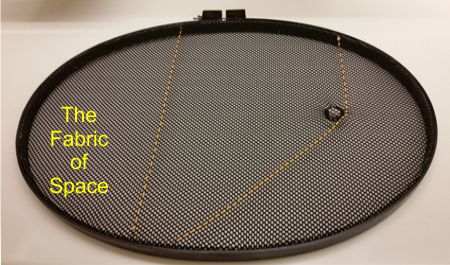
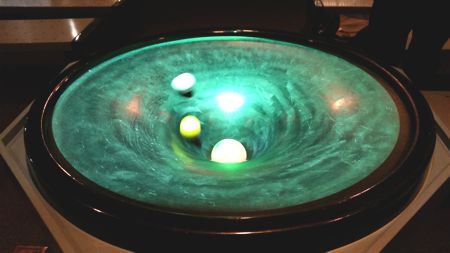
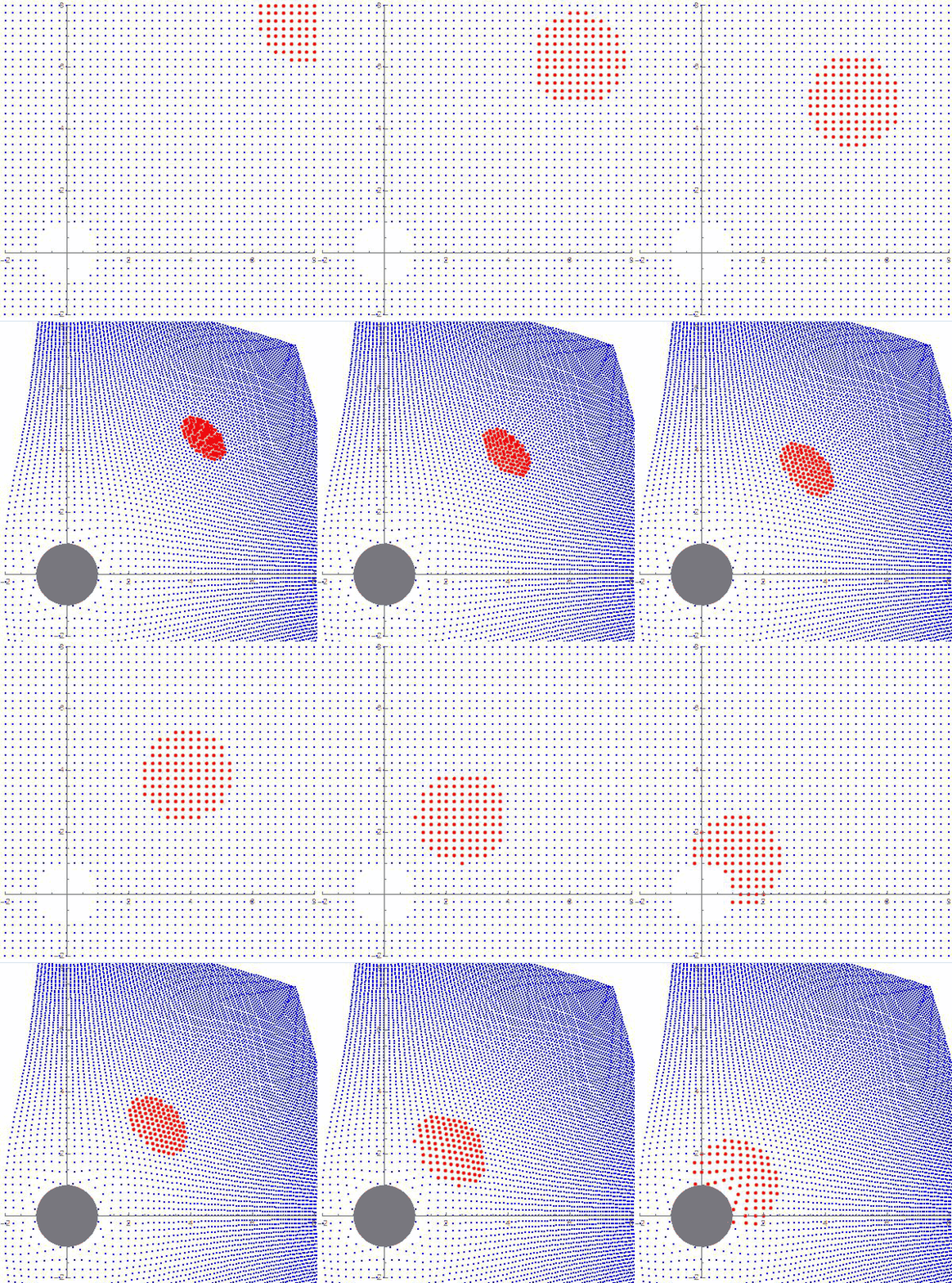
And that was good enough for 250 years until Albert Einstein produced his Theories of Relativity. This graphic shows one model of Einstein’s model of “the fabric of space.” According to the theory, light (the yellow threads) travels at 186,000 miles per second everywhere in the Universe.

As we’ve seen, the theory also says that space is curved and compressed near a massive object. Accordingly, the model’s threads are drawn together near the dark circle, which could represent a planet or a star or a black hole. If you were standing next to a black hole (but not too close). you’d feel fine because all your atoms and the air you breathe would shrink to the same scale. You’d just notice through your telescope that planetary orbits and other things in the Universe appear larger than you expect.
This video shows how a massive object’s space compression affects a passing light wave. The brown dot and the blue dot both travel at 186,000 miles per second, but “miles are shorter near a black hole.” The wave’s forward motion is deflected around the object because the blue dot’s miles are longer than the miles traveled by the brown dot.
When Einstein presented his General Theory of Relativity in 1916, his calculations led him to predict that this effect would cause a star’s apparent position to be altered by the Sun’s gravitational field. 
An observer at the bottom of this diagram can pinpoint the position of star #1 by following its light ray back to the star’s location. Star #2, however, is so situated that its light ray is bent by our massive object. To the observer, star #2’s apparent position is shifted away from its true position.
In 1919, English physicist-astronomer Arthur Eddington led an expedition to the South Atlantic to test Einstein’s prediction. Why the South Atlantic? To observe the total eclipse of the sun that would occur there. With the Sun’s light blocked by the Moon, Eddington would be able to photograph the constellation Taurus behind the Sun.
Sure enough, in Eddington’s photographs the stars closest to the Sun were shifted in their apparent position relative to those further way. Furthermore, the sizes of the shifts were almost embarrassingly close to Einstein’s predicted values.
Eddington presented his photographs to a scientific conference in Cambridge and thus produced the first public confirmation of Einstein’s theory of gravity.
Wait, how does an object bending a light ray connect with that object’s pull on another mass? Another piece of Einstein’s theory says that if a light ray and a freely falling mass both start from the same point in spacetime, both will follow the same path through space. American physicist John Archibald Wheeler said, “Mass bends space, and bent space tells mass how to move.”
~~ Rich Olcott

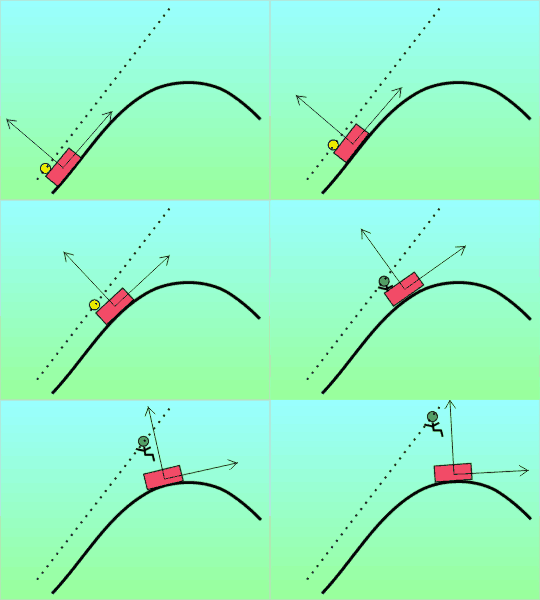 But there are other accelerations that aren’t so easily accounted for. Ever ride in a car going around a curve and find yourself almost flung out of your seat? This little guy wasn’t wearing his seat belt and look what happened. The car accelerated because changing direction is an acceleration due to a lateral force. But the guy followed Newton’s First Law and just kept going in a straight line. Did he accelerate?
 Suppose you’re investigating an object’s motion that appears to arise from a new force you’d like to dub “heterofugal.” If you can find a different frame of reference (one not attached to the object) or otherwise explain the motion without invoking the “new force,” then heterofugalism is a fictitious force.


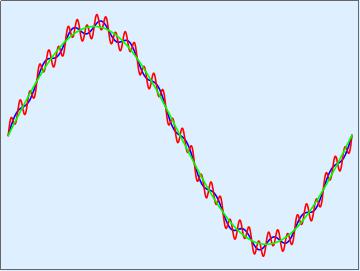
 Sure enough, that’s a straight line (see the chart). Reminds me of how Newton’s Law of Gravity is valid



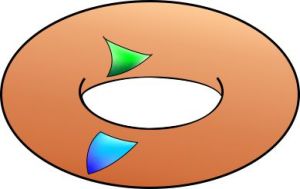
 In several of his Discworld books, author Terry Pratchett featured something called Library-space, L-space for short. It’s defined as “a dimension that connects every library and book depository in the universe. L-Space is portrayed as a natural outgrowth of the fact that knowledge = power = energy = matter = mass and mass warps space, and therefore, libraries in the Discworld universe are a very dangerous place indeed for the unprepared”.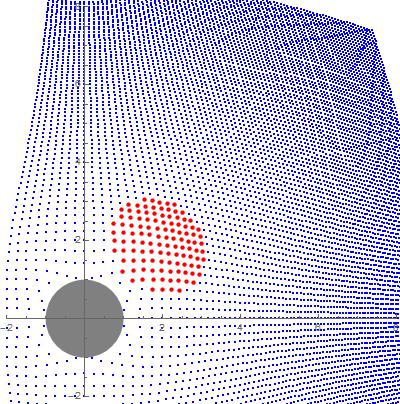


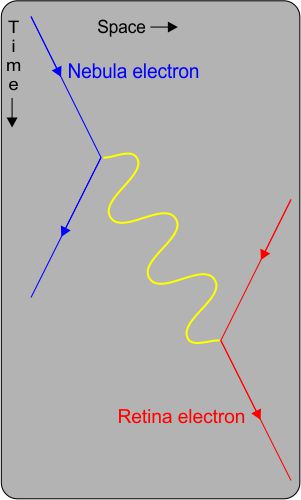 Here we have a Feynman diagram, named for the Nobel-winning (1965) physicist who invented it and much else. The diagram plots out the transaction we just discussed. Not a conventional x-y plot, it shows Space, Time and particles. To the left, that far-away electron emits a photon signified by the yellow wiggly line. The photon has momentum so the electron must recoil away from it.
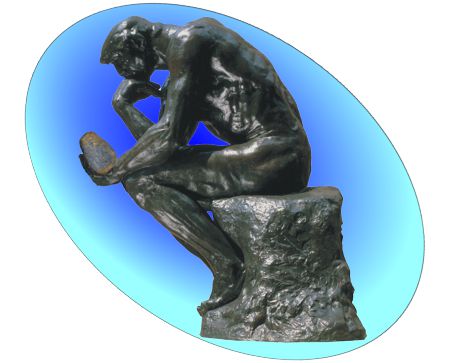 Gargh, proto-humanity’s foremost physicist 2.5 million years ago, opened a practical investigation into how motion works. “I throw rock, hit food beast, beast fall down yes. Beast stay down no. Need better rock.” For the next couple million years, we put quite a lot of effort into making better rocks and better ways to throw them. Less effort went into understanding throwing.
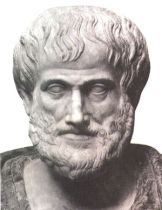 Aristotle wasn’t satisfied with anything so unsystematic. He was just full of theories, many of which got in each other’s way. One theory was that things want to go where they’re comfortable because of what they’re made of — stones, for instance, are made of earth so naturally they try to get back home and that’s why we see them fall downwards (no concrete linkage, so it’s still AAAD).


 It would have been awesome to watch Dragon Princes in battle (from a safe hiding place), but I’d almost rather have witnessed “The Tussles in Brussels,” the two most prominent confrontations between Albert Einstein and Niels Bohr.
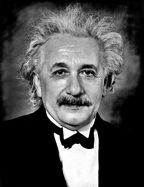 Like Newton, Einstein was a particle guy. He based his famous thought experiments on what his intuition told him about how particles would behave in a given situation. That intuition and that orientation led him to paradoxes such as entanglement, the
  Bohr was six years younger than Einstein. Both Bohr and Einstein had attained Directorship of an Institute at age 35, but Bohr’s has his name on it. He started out as a particle guy — his first splash was a trio of papers that treated the hydrogen atom like a one-planet solar system. But that model ran into serious difficulties for many-electron atoms so Bohr switched his allegiance from particles to Schrödinger’s wave theory. Solve a Schrödinger equation and you can calculate statistics like
  Here’s where Ludwig Wittgenstein may have come into the picture. Wittgenstein is famous for his telegraphically opaque writing style and for the fact that he spent much of his later life disagreeing with his earlier writings. His 1921 book, Tractatus Logico-Philosophicus (in German despite the Latin title) was a primary impetus to the Logical Positivist school of philosophy. I’m stripping out much detail here, but the book’s long-lasting impact on QM may have come from its Proposition 7: “Whereof one cannot speak, thereof one must be silent.“


 Hard Science Ain't Hard