

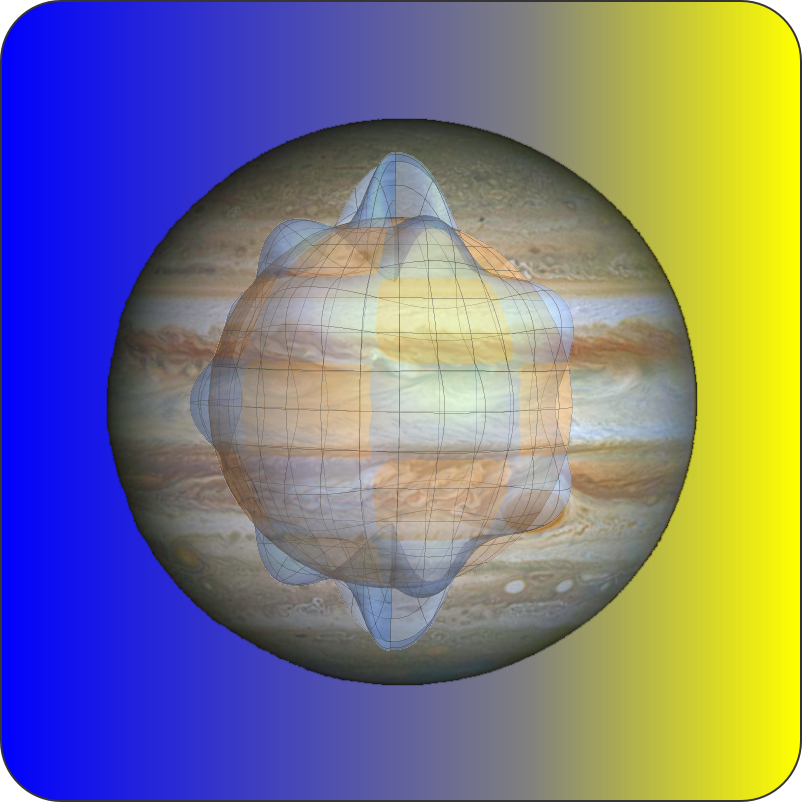
Walt’s mustache bristles as he gives me the eye. ”You claim three harmonics control how the Sun’s gravity could affect spacecraft orbits around a target planet like Jupiter. You said we don’t have to care about Jupiter’s gravitational zones and isolating the sectors probably isn’t doable. What’s the third?”
Time to twist the screws. ”Three harmonic systems, Walt, all working together and you’ve got their names wrong. They control nothing, they’re a framework for analysis. And Jupiter’s special. Solar gravity doesn’t affect its zonal harmonic arcs but that’s only because Jupiter’s polar axis is nearly perpendicular to its orbital plane. Zonal‑effect N‑S twisting at Jupiter is pennies on a C‑note. Any mission we send to Mars, Saturn or Uranus we’ll care a lot about their zonal harmonics because their axes have more tilt. An 82° tilt for Uranus, can’t get much more tilted than that. Sectorial harmonics may still help us navigate there because Uranus probably has a lot less magnetism than Jupiter.”
That rocks him but he comes back strong. ”The third kind of harmonic?!! C’mon, give!”
“Radial, the center‑out dimension. The gravitational force between bodies depends on center‑to‑center distances so yeah, your people would be interested.”
“I presume radial harmonics have numbers like Jn and Cm do?”
“They do. Sorry, this’ll get technical again but I’ll go as light as I can. Each radial harmonic is the product of two factors. You know about factors, right?”
“Sure, force multipliers.”
“You would know that kind. More generally, factors are things that get multiplied together. I’ll call the general radial harmonic Rn. It’s the product of two factors. The first is a sum of terms that begin with rn, where r is the distance. For instance, R3‘s first factor would look like a*r³+b*r²+c*r+d, where the a,b,c,d are just some numbers. Different radial harmonics have different exponents in their lead terms. You still with me?”
“Polynomials from high school algebra. Tell me something new.”
“The second factor decreases exponentially with n*r. No matter how large rn gets, when you multiply an rn polynomial by something that decreases exponentially, the (polynomial)×(exponential) product eventually gets really small.”
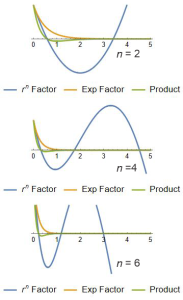
“Give me a second. … So what you’re saying is, at a big enough distance these radial harmonics just die away.”
“That’s where I was going.”
“How far is ‘enough’?”
“Depends on n. Higher values of n shut down faster.”
“So these Cms and Jns and Rns just add together?” <pauses, squints at me suspiciously> “Is there some reason you used n for both Jn and Rn?”

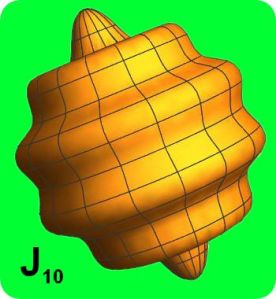
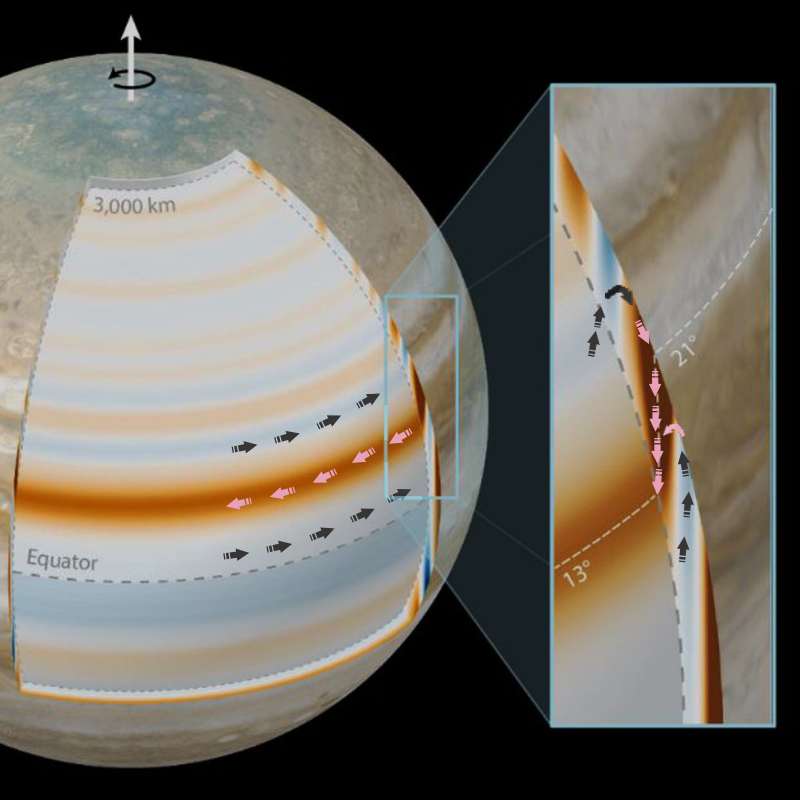
“No but yes, and yes. You combine a C, a J and an R using multiplication to get a full harmonic F, except there are rules. The J and R must belong to the same n. The m can’t be larger than n. From far away we’d model Jupiter’s gravity as F000=R0×J0×C0, which is an infinite sphere — R0 never dies away and J0×C0 says ‘no angular dependence.’ The Sun’s gravity acts along R0 and that’s what keeps Jupiter in orbit. If the problem demands combining full harmonics, you use addition.” <rousing a display on Old Reliable> “Here’s how a particular pair of harmonics combine to increase or decrease spherical gravity in specific directions.”
“But Juno doesn’t see those gravity lumps until it gets close‑in. How close?”
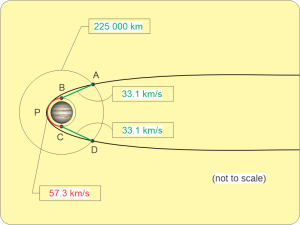
“R2‘s down to less than a part per thousand at three planetary radii, call it 225 000 kilometers away from the planet’s center.”
“How much time is it closer than that distance?”
“Complicated question. A precise answer requires some calculus — is your smart phone set up for elliptic integrals?”
“Of course not. A good estimate will do.”
“Okay, here’s the plan. What we’d like is total time spent while Juno travels along the ellipsoidal arc between points A and D where the orbit crosses the 225 000‑km circle. Unfortunately, Juno speeds up approaching point P, slows down going away — calculating the A‑D time is tricky. I’ll assume Juno travels straight lines AB and CD at the A-speed. I’ll also approximate the orbit’s close pass as a semicircle at P‑speed.” <tapping> “I get a 3.6-hour duration, less than 0.3% of the full 53-day orbit. Will that satisfy your people?”
“You’ll know if it doesn’t.”
~~ Rich Olcott













 Hard Science Ain't Hard