What’s In Project 2025?

  • Breaking through the fourth wall, but I’m an American citizen who is horrified at what the current Administration is doing to the country I love. In the spirit of ‘know your opponent‘ I’ve briefly departed from our normal time with Sy and the gang to shine light on a document that was carefully not publicized prior to the 2024 election. Back to our normal programming next week.
  • The material below is based on the Project 2025 document. It’s my understanding that much of the Project’s philosophy underlies and is embedded in the ‘One Big Beautiful Bill’ Act (OBBBA) currently working its way through Congress, but I’ve not read through all of that legislation’s ~900 pages (way too many ‘notwithstandings’). From what I’ve seen, the House‑passed version is every bit as contrary to our founding principles. ~ RJO

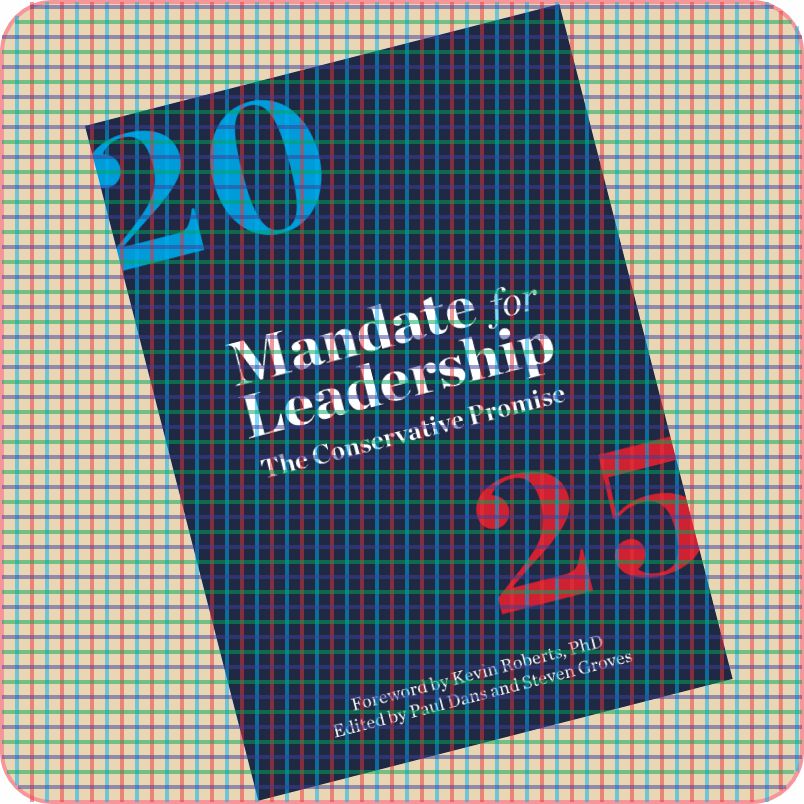
I expect only a few people have read through 2025 Mandate for Leadership, the Heritage Foundation’s manifesto that lays out much of the tactical structure for what the current Administration is trying to accomplish. It’s a hefty tome, nearly 900 pages including a seven‑page list of Contributors. You don’t approach it like a novel; you settle down with a notepad and a supply of coffee, then scan through looking for mentions of your favorite parts of the Federal government.

Someone asked me which were my Top Three things to dislike about the Project 2025 prospectus. It was like asking which three threads in a plaid should be discarded but making no distinction between warp and woof. Plaid’s not that bad a metaphor, because the document has a warp (the underlying notions) and a woof (specific recommendations laid out for every entity in the government).

Some of the warp threads are explicit, proudly highlighted in the 33‑page Forward (quotes are direct from the text)

  1. “Restore the family as the centerpiece of American life and protect our children.” (page 4) — Family is implicitly defined in the follow-on text as male breadwinner, female homemaker, some number of kids, all happily occupied with “the building blocks of any healthy society. Marriage. Family. Work. Church. School. Volunteering.” (page 4) Note that political activity is not in the list. Parents must have veto authority over the entire content of their offspring’s schooling, except that screen time for kids is terrible and must be forbidden.
  2. “Dismantle the administrative state and return self-governance to the American people.” (page 6) — “So today in Washington, most policy is no longer set by Congress at all, but by the Administrative State. Given the choice between being powerful but vulnerable or irrelevant but famous, most Members of Congress have chosen the latter. Congress passes intentionally vague laws that delegate decision‑making over a given issue to a federal agency. That agency’s bureaucrats–not just unelected but seemingly un‑fireable–then leap at the chance to fill the vacuum created by Congress’s preening cowardice.” (page 7) On the one hand the Project authors want to return all decision‑making power to Congress, but on the other hand they point to congressional incapacity for the job. Clearly, the authors have an alternative governing structure in mind (see item 5).
  3. “Defend our nation’s sovereignty, borders, and bounty against global threats.” (page 9) — The “sovereignty, borders and bounty” notions are stretched to cover diatribes against the “managerial elite” (page 10), “globalization” (page 11), “environmental extremism” (page 11) and of course “wokeism” (page 14) in general.
  4. “Secure our God-given individual rights to live freely — what our Constitution calls ‘the Blessings of Liberty.’ ” (page 13) Consider the moral arrogance and intellectual acrobatics required to transform ‘the pursuit of Happiness’ to “Our Constitution grants each of us the liberty to do not what we want, but what we ought.” (page 13) Such a bleak prospect.

There are also implicit tenets and directives throughout the following 875 pages, there if one looks for them:

  1. Abrogation of the Founders’ concept of checks and balances. Federal government power is to be lodged in the Unitary Executive branch, not in Congress (see item 2), not in the Judiciary. Orders come top‑down, which looks like an administrative state under another guise but that would be even further from democratic rule.
    • Notably, OBBBA provision 70302 would largely immunize the Executive branch against being held in contempt if it ignores or violates a Judicial ruling.
  2. An imperative to privatize any governmental service that someone might or might not make a profit from.
  3. Mean-spirited Social Darwinism, as exemplified by Musk’s remark that “the fundamental weakness of Western civilization is empathy.”
  4. The notion that unregulated is always better than regulated, no matter the social cost.
  5. Primacy of corporate/employer rights over worker rights (“union” is mentioned 102 times, “contract” 40 times).
  6. Indictment of a supposed “climate crisis industry” (“climate” is mentioned 155 times) along with a spirited defense of the fossil‑fuel industries (“fossil” gets 31 mentions).
  7. Religiosity, specifically Christian‑flavored. One telling example — “Congress should encourage communal rest by amending the Fair Labor Standards Act (FLSA) to require that workers be paid time and a half for hours worked on the Sabbath.” (page 589)
  8. Deprecation of support for basic science and Public Health as governmental responsibilities. Despite more than 1000 uses of the word “science,” NASA is mentioned only once, in a footnote.
  9. and a few others I lost track of.

That’s the warp of the plaid, but the woof uses the warp’s tool kit to prescribe actions to be taken in or against (nearly) every Federal Department and Agency, from the office of the White House Chief of Staff through the Cabinet positions out to the independent regulatory agencies ending with the Federal Elections Commission and the Federal Trade Commission. Notably not included are the United States Postal Service, the Smithsonian Institution and the Kennedy Center.

My Top Three objectionable items? The document presents hundreds and hundreds of woof‑level recommendations, some of which seem reasonable to me but most of which don’t. In picking anti‑favorites I’ll stick with the warp level. Chief among them are jettisoning checks‑and‑balances, disparagement of science in general and climate change in particular, and the authors’ demonstrated propensity to cling to ideological positions in the face of contrary evidence.  Coming from a union family, I’m not too happy about item 9, either.

Think I’ve mischaracterized what’s in there? Download the document yourself and look through it to check me. Compare the listings to what has transpired so far since January 21. If you care about a particular governmental function (the Veterans Administration, the National Park Service, the Census Bureau, whatever), look up its prognosis. Think about that and decide what you want to do about it. Then do that.

~ Rich Olcott

Why Those Curtains Ripple

I’m in the scone line at Cal’s Coffee when suddenly there’s a too‑familiar poke at my back, a bit right of the spine and just below the shoulder blade. I don’t look around. “Morning, Cathleen.”

“Morning, Sy. Your niece Teena certainly likes auroras, doesn’t she?”

“She likes everything. She’s the embodiment of ‘unquenchable enthusiasm.’ At that age she’s allowed.”

“It’s a gift at any age. Some of the kids in my classes, they just can’t see the wonders no matter how I try. I show them aurora photos and they say, ‘Oh yes, red and green in the sky‘ and go back to their phone screens. Of course there’s no way to get them outside late at night at a location with minimal light pollution.”

“I feel your pain.”

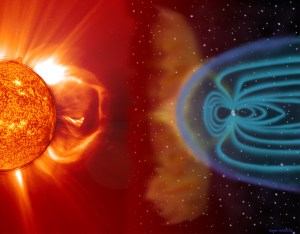
“Thanks. By the way, your aurora write-ups have been all about Earth’s end of the magnetic show. When you you going to do the rest of the story?”

“How do you mean?”

“Magnetism on the Sun, how a CME works, that sort of thing.”

“As a physicist I know a lot about magnetism, but you’re going to have to educate me on the astronomy.”

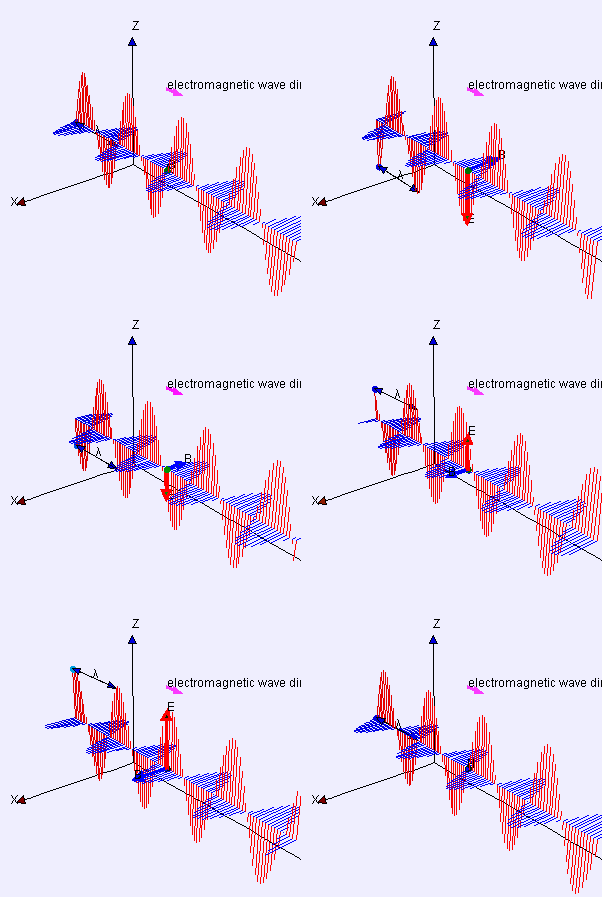
Plane‑polarized Lorentz (electromagnetic) wave
 Electric (E) component is red
 Magnetic (B) component is blue
(Image by Loo Kang Wee and Fu-Kwun Hwang from Wikimedia Commons)
Licensed under CC ASA3.0 Unported

“Deal. You go first.”

<displaying an animation on Old Reliable> “We’ll have to flip between microscopic and macroscopic a couple times. Here’s the ultimate micro — a single charged particle bouncing up and down somewhere far away has generated this Lorentz‑force wave traveling all alone in the Universe. The force has two components, electric and magnetic, that travel together. Neither component does a thing until the wave encounters another charged particle.”

“An electron, right?”

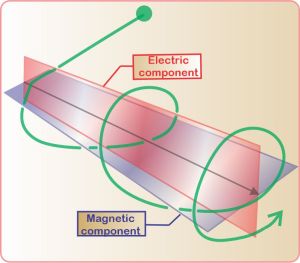
“Could be but doesn’t have to be. All the electric component cares about is how much charge the particle’s carrying. The magnetic component cares about that and also about its speed and direction. Say the Lorentz wave is traveling east. The magnetic component reaches out perpendicular, to the north and south. If the particle’s headed in exactly the same direction, there’s no interaction. Any other direction, though, the particle’s forced to swerve perpendicular to both the field and the original travel. Its path twists up- or downward.”

“But if the particle swerves, won’t it keep swerving?”

“Absolutely. The particle follows a helical path until the wave gives out or a stronger field comes along.”

“Wait. If a Lorentz wave redirects charge motion and moving charges generate Lorentz waves, then a swerved particle ought to mess up the original wave.”

“True. It’s complicated. You can simplify the problem by stepping back far enough that you don’t see individual particles any more and the whole assembly looks like a simple fluid. We’ve known for centuries how to do Physics with water and such. Newton invented hydrodynamics while battling the ghost of Descartes to prove that the Solar System’s motion was governed by gravity, not vortices in an interplanetary fluid. People had tried using Newton‑style hydrodynamics math to understand plasma phenomena but it didn’t work.”

<grinning> “I don’t imagine it would — all that twistiness would have thrown things for a loop.”

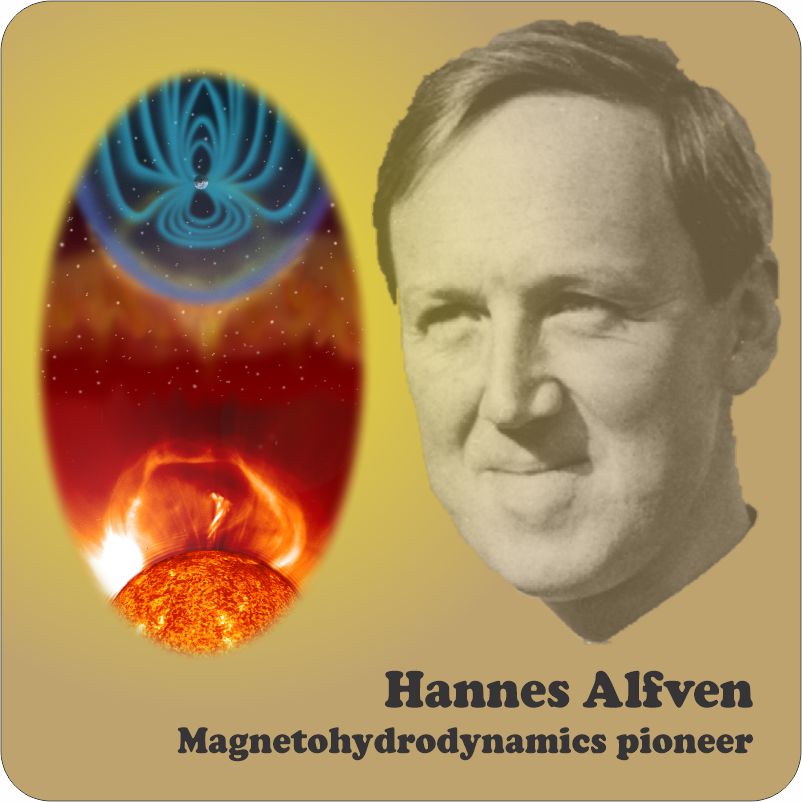
“Haha. Well, in the early 1940s Swedish physicist Hannes Alfven started developing ideas and techniques, extending hydrodynamics to cover systems containing charged particles. Their micro‑level electromagnetic interactions have macro‑level effects.”

“Like what?”

“Those aurora curtains up there. Alfven showed that in a magnetic field plasmas can self‑organize into what he called ‘double layers’, pairs of wide, thin sheets with positive particles on one side against negative particles in the other. Neither sheet is stable on its own but the paired‑up structure can persist. Better yet, plasma magnetic fields can support coherent waves like the ones making that curtain ripple.”

“Any plasma?”

“Sure.”

“Most of the astronomical objects I show my students are associated with plasmas — the stars themselves, of course, but also the planetary nebulae that survive nova explosions, the interstellar medium in galactic star‑forming regions, the Solar wind, CMEs…”

“Alfven said we can’t understand the Universe unless we understand magnetic fields and electric currents.”

~ Rich Olcott

Colors Made of Air

Teena’s whirling around in the night with her head thrown back. “I LUVV AURORAS!! They’re SO beautiful beautiful beautiful!”

“Yes, they are, Teena. They’re beautiful and magical, and for me it’s even better because they’re Physics at work right in front of us. Well, above us.”

“Oh, Sy, give it a rest.”

“No, really, Sis. I look at a rainbow and I’m dazzled by its glory against the rainclouds but I’m also aware that each particular glimpse of pure color comes to me by refraction through one individual droplet. Better yet, I appreciate the geometry that presents the entire spectrum in perfectly circular arcs. Marvels supported by underlying marvels. These curtains are another example of beauty emerging from hidden sources.”

“What do you mean?”

“Remember Teena’s teacher’s magnetic force lines that were organized and revealed by iron filings? Auroras are a bit like that, except one level deeper. Again we don’t see magnetic fields directly. What we do see is light coming to us from oxygen and nitrogen atoms that are bombarded by rampaging charged particles.”

“Wait, Uncle Sy, we learned that charges make magnetic fields when they move.”

“That, too. It works both ways, which is why they call it electromagnetism. A magnetic field steers protons and electrons which make their own field to push back on the first one. But my point is, the colors in each curtain and the curtains themselves tell us about the current state of the atmosphere and Earth’s magnetic field.”

“Okay, I can see how magnetic fields up there could steer charged particles to certain parts of the sky, but how does that tell us about the atmosphere? What do the colors have to do with it? Is this more rainbows and geometry?”

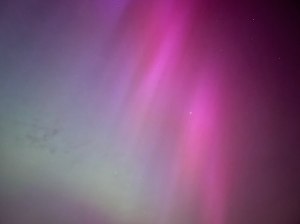
“Definitely not. Sis. Rainbows are sunlight refracted through water droplets. Aurora light’s emitted by atoms in our own atmosphere. Each color is like a fingerprint of a specific atom in specific circumstances. The uppermost reds, for instance come from oxygen atoms that rarely touch another atom of any kind. They’re at 150 or more kilometers altitude, way above the stratosphere. There aren’t many of them that far up which is why the curtain tops sort of fade away into infinity.”

“Oooo, now it’s going green and yellow!”

“Mm-hm, the bombardment’s reaching further now. Excited oxygen atoms emit green lower down in the atmosphere where collisions happen more often and don’t give the red‑emitters a chance to do their thing. The in‑between yellow isn’t really there — it’s what your eye tells you when it sees pure red and pure green overlapping.”

“Why do the curtains have that sharp lower edge, Sy? Surely we don’t run out of oxygen there.”

“Quite the reverse. That level’s about 100 kilometers up. It’s where the atmosphere gets so thick that collisions drain away an excited atom’s energy before it gets a chance to shine.”

“But why are there curtains at all? Why not simply fill the sky with a smooth color wash?”

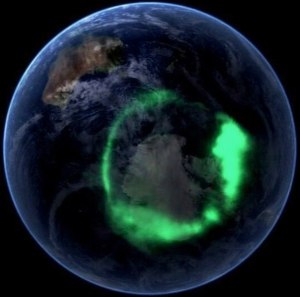
“Mars gets auroras like that, or at least Perseverance just spotted one. We don’t, thanks to our well‑ordered magnetic field. Mars’ field is lumpy and too weak to funnel incoming charged particles to special spots like our poles. Actually, those curtains are just segments of rings that go all around Earth’s magnetic axis. The rings usually lurk about 2/3 of the way to our poles but a really strong solar event like this one can push them closer to the Equator.”

“Mars gets auroras? Uncle Sy, how about other planets?”

“Them, too, but theirs mostly don’t look like ours. You’d have to be able to see X‑rays on Mercury, for instance. Venus gets a general green glow for the same reason that Mars does. Jupiter is Texas for the Solar System — everything’s bigger there, including auroras in every color from X‑ray to infrared. Strong ordered field, so I’m sure there’s curtains up there.”

Sis yanks out her writer’s‑companion notebook and scribbles without looking down…
  ”Curtains made of colors
   Colors made of air.

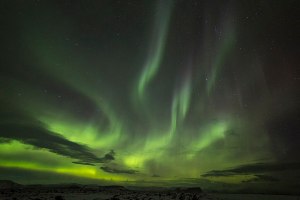
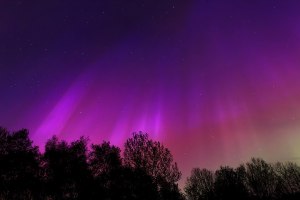
Aurora, photo by Bellezzasolo
licensed under CC BY-SA 4.0

~ Rich Olcott

Sky Lights

“Mom! Uncle Sy! Come outside NOW before it goes away!”

“Whah— oooh!”
 ”An aurora! Thanks for calling us.”

“Glowing curtains rippling across the sky! Spotlights shining down through them! Where do those come from?”

“From the Sun, Teena.”

“C’mon, Sy. The Sun’s 93 million miles away. Even if that bright streak up there is as much as 10 miles across, which I doubt, the beam from the Sun would be only a teeny‑tiny fraction of a degree wide. Not even magnetars send out anything that narrow.”

“Didn’t say it’s a beam, Sis. The whole display comes from the Sun as single package. Sort of. Sometimes.”

“Even for you, little brother, that’s a new level of weasel‑wording.”

“Well, it’s complicated.”

“So unravel it. Start from the beginning.”

“Okay. The Sun’s covered in plasma—”

“Eww!”

“Not that kind of plasma, Teena. This is mostly hydrogen atoms except they’re so hot that the electrons and protons break away from each other and travel separately. What have they told you in school about magnets?”

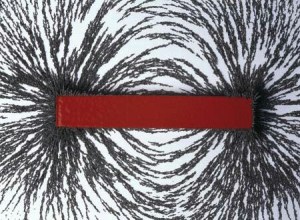
“Not much. Umm … electric currents push on magnets and that’s how motors work, and magnets push on electrons and that’s how a generator works. Oh, and Mr Cox laid a sheet of paper on top of a magnet and sprinkled iron filings on it so we could see the lines of force, but when I asked him what made the magnetism ’cause I didn’t see any wires he started talking about electrons in iron atoms and then the bell rang and I had to go to Spanish class.”

The shape of the bar magnet’s field, disclosed by iron filings chaining together.

<sigh> “The clock rules, doesn’t it? Anyway, he was on the right track, but I want to get back to those lines of force. Were they there before he sprinkled on those filings?”

“Mmm … Mom would say, ‘That’s a good question,’ but how could you know? I’m gonna say they were.”

“Your Mom would be right, but sorry, you’re wrong. With no iron filings in the picture, the magnetic field is nice and smooth, everywhere just the same or maybe only a little bit stronger or weaker than neighboring points. No lines. Conditions change when you put the first bit of iron anywhere in the field. As Mr Cox was probably saying when the bell interrupted, the electrons in the grain’s iron atoms align orbitals with the magnetic field. The alignment affects the surrounding field and that pulls in other iron bits that change the field even more.”

“But wouldn’t that make just a solid iron blob?”

“No, because a magnetic field has both strength and direction. Once the first particle points along the field, the iron bits it recruits rotate to point mostly in the same direction. You wind up with a chain of specks tracing out where they’ve acted together to alter the field. The chain’s surrounded by spaces where the field’s been stressed.”

“And then lotsa chains make lotsa lines, yeah!”

“I see where you’re headed, Sy. You’re going to claim that the vertical lines we see in the curtains trace out the Sun’s magnetic field.”

“Not quite, Sis. There’s only one magnetic field, a combination of Earth’s field, the Sun’s field, and the magnetic fields contained in whatever the Sun throws our way. Way out here Earth’s field is about ten thousand times stronger than the Sun’s is, but the fields inside a CME can range up to 10% or 20% of Earth’s. The moving curtains up there are the result of a magnetic tussle between us and a CME or maybe a flare’s outflow.”

“But there aren’t any iron filings up there, Uncle Sy!”

“True, but there are free charged particles in the ionosphere thanks to UV radiation from the Sun. A free electron caught in a magnetic field whips into a tight spiral. Its field gets neighbor particles spiraling. Pretty soon you wind up with a chain of them spiraling together, lining up like the filings do.”

“The spotlights?”

“Probably ion blobs embedded in the CME, but that’s a guess.”

Aurora, photo by W.carter
licensed under CC BY-SA 4.0

~ Rich Olcott

A Play Beyond The Play

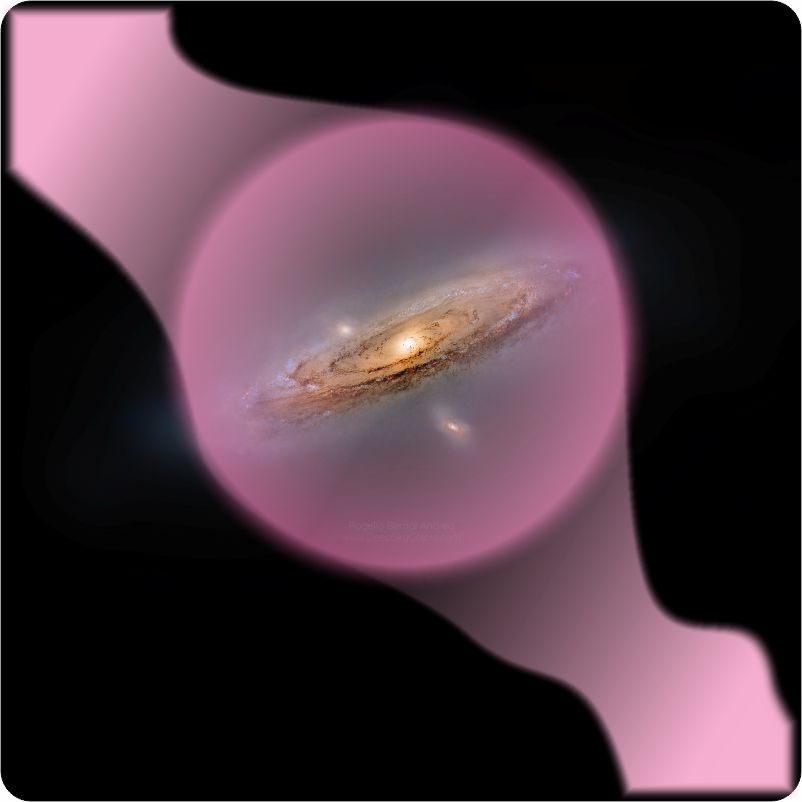
Vinnie takes a long thoughtful look at the image that had dashed his beautiful six‑universe idea. “Wait, Sy. I don’t like this picture”

“Because it messes up your invention?”

“No, because how can they know what that halo looks like? I mean, the whole thing with dark matter is that we can’t see it.”

“You’re right about that. Dark matter’s so transparent that even with five times more mass than normal matter, it doesn’t block CMB photons coming from 13.8 billion lightyears away. That still boggles my brain every once in a while. But dark matter’s gravitational effects — those we can see.”

“Yeah, I remember a long time ago we talked about Fritz Zwicky and Vera Rubin and how they told people about galaxies held together by too much gravity but nobody believed them.”

“Well, they did, after a while—”

“A long while, like a long while since those talks. Remind me what ‘too much gravity’ was about.”

“It was about conflicts between their observations and the prevailing theoretical models. Everyone thought that galaxies and galaxy clusters should operate pretty much like planetary orbits — your speed increases the closer you are to the center, up to Einstein’s speed limit. Newton’s Laws of Motion predict how fast you should move if you’re at a certain distance from a body with a certain mass. If you’re moving faster than that, you fly away.”

“Yeah, escape velocity. So the galaxies in Zwicky’s cluster didn’t follow Newton’s Laws?”

“They didn’t seem to. Galaxies that should have escaped were still in there. The only way he could explain the stability was to suppose the galaxies are only a small fraction of the cluster’s mass. Extra gravity from the extra mass must bind things together. Forty years later Rubin’s improved technology revealed that stars within galaxies had the same anomalous motion.”

“I’m guessing the ‘faster near the center’ rule didn’t hold, or else you wouldn’t be telling this story. Spun like a wheel, I bet.”

“When a wheel spins, every part of it rotates at the same angular speed, the same number of degrees per second, right?”

“Ahh, the bigger my circle the higher my airspeed so the rule would be ‘faster farther out’.”

“That’s the wheel rule, right, but Rubin’s data showed that stars within galaxies don’t obey that one either. She measured lots of stars in Andromeda and other galaxies. Their linear speeds, kilometers per second, are nearly identical from near the center all the way out. Even dust and gas clouds beyond the galactic starry edges also fit the ‘same linear speed everywhere’ rule. You’d lose the bet.”

“That just doesn’t feel right. How can just gravity make that happen?”

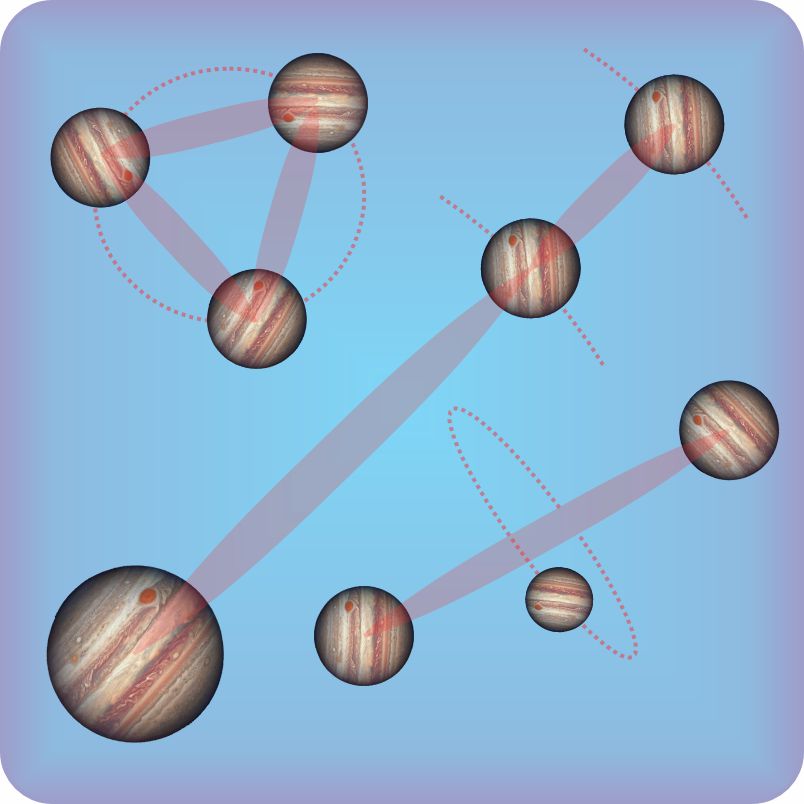
“It can if the right amount of dark matter’s distributed in the right‑shaped smeared‑out hollowed‑out spherical halo. The halo’s radial density profile looks about like this. Of course, profiles for different galaxies differ in spread‑outness and other details, but the models are pretty consistent.”

“Wait, if dark matter only does gravity like you said, why’s that hole in the middle? Why doesn’t everything just fall inward?”

“Dark matter has mass so it also has inertia, momentum and angular momentum, just as normal matter does. Suppose some of the dark matter has collected gravitationally into a blob and the blob is moving slower than escape velocity. If it’s flying straight at the center of gravity it’ll get there and stay there, more or less. But if the blob’s aimed in any other direction, it has angular momentum relative to the center. Momentum’s conserved for dark matter, too. The blob eventually goes into orbit and winds up as part of the shell.”

“Does Zwicky’s galaxy cluster have a halo, too?”

“Not in the same way. Each galaxy probably has its own halo but the galaxies are far apart relative to their size. The theoreticians have burned huge amounts of computer time simulating the chaos inside large ensembles of gravity‑driven blobs. I just read one paper about a 4‑billion‑particle calculation and mind you, a ‘particle’ in this study carried more than a million solar masses. Big halos host subhalos, with filaments of minihalos tying them together. What we can’t see is complicated, too.”

~ Rich Olcott

Five More Alternate Universes?

I unlock my office door and there’s Vinnie inside, looking out the window. “Your 12th‑floor view’s pretty nice, Sy. From above the tree tops you can see leaf buds just starting to show their early green colors.”

“What are you doing here, Vinnie? I thought you were charter‑flying to Vancouver.”

“The guy canceled. Said with all the on‑again, off‑again tariffs there’s no sense traveling to make a deal when he doesn’t know what he’s dealing with. So I got some time to think.”

“And you came here so it’s something physics‑technical.”

“Yeah, some. I notice colors a lot when I’m flying. Some of those trees down there this time of year are exactly the same bright yellow‑green as some of the rice paddies I’ve flown over. But all the trees get the same hard dark green by August before they go every different color when the chlorophyll fades away.”

I’ve noticed that. So you came here to talk about spectra?”

“Some other time. This time I want to talk about dark matter.”

“But we call it dark matter precisely because it doesn’t do light. All our normal matter is made of atoms and the atoms are made of electrons and nuclei and each nucleus is made of protons and neutrons and protons and neutrons are made of quarks. Electrons and quarks carry electrical charge. Anything with electrical charge is subject to electromagnetism, one way or another. Dark matter doesn’t notice electromagnetism. If dark matter had even the slightest interaction with light’s electromagnetic field, we wouldn’t be able to see galaxies billions of lightyears away.”

“Calm down, Sy, breath a couple times. Stay with me here. From your stuff and what else I’ve read, all we know about dark matter is a lot of things it isn’t or doesn’t do. The only force we know it respects is gravity so it attracts itself and also normal matter and they all clump up to make galaxies and such, right?”

<a bit reluctantly and on a rising note> “Mm‑hnn…?”

“I read your three‑part series about the Bullet Cluster, where we think two galaxy clusters went though each other and their gas clouds gave off a lot of X‑rays that didn’t match where the stars were or where the gravity was so the astronomers blame dark matter for the gravity, right?”

“That’s pretty much it. So?”

“So the other thing I got from that series was maybe there’s friction between dark matter and other dark matter, like it doesn’t just slide past itself. If dark matter is particles, maybe they’re sorta sticky and don’t bounce off each other like billiard balls. That doesn’t make sense if all they do is gravity.”

“I see where you’re going. You’re thinking that maybe dark matter feels some kind of force that’s not gravity or electromagnetism.”

“That’s it! We’ve got light photons carrying electromagnetic forces to hold our molecules and rocks together. Could there be dark photons carrying some dark‑sticky force to connect up dark molecules and dark rocks and stuff?”

“That’s an interesting—”

“I ain’t done yet, Sy. It gets better. I’ve read a bunch of articles saying there’s about five times as much dark matter in the Universe as normal matter. You physicists love symmetry, suppose it’s exactly five times as much. There’d be six kinds of force, one called electromagnetism and a different snooty force each for five kinds of dark matter and that’ll add up to the 25% we can’t see. Like, a purple dark force for purple dark rocks, naturally they’re not really purple, and a yellow dark force and so on.”

“You’re proposing that each kind of dark matter responds only to its own special force, so no cross‑communication?”

“Yup, gravity’s the only thing they’d all agree on. That bein’ the case, the galaxies would hold six times as many stars as we think, except 5/6 of them are invisible to our 1/6. Five alternate universes sharing space with ours. Cozy, huh?”

“Clever, Vinnie, except for the evidence that most galaxies are embedded in huge nearly‑spherical halos of dark matter. The halos would have collapsed long ago if only gravity and stickiness were in play.”

“Dang.”

~ Rich Olcott
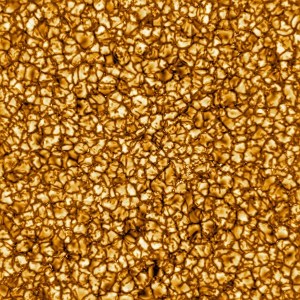
Old Sol And The Pasta Pot

<chirp, chirp> “Excuse me, folks, it’s my niece. Hello, Teena.”

“Hi, Uncle Sy. What’s a kme?”

“Sorry, I don’t know that word. Spell it.”

“I’ve never seen it written down. Brian says the Sun’s specially active and gonna spit out a kme that’ll bang into Earth and knock us out of our orbit.”

“Ah, that’s a C‑M‑E, three separate letters. It stands for Coronal Mass Ejection. As usual, Brian’s got some of it right and much of it wrong. The right part is that the Sun’s at the peak of its 11‑year activity cycle so there’s lots of sunspots and flares—”

“He said flares, too. They’re super bright and could cook an Astronaut and it’d happen so fast we won’t have any warning.”

“Once again, partially right but mostly wrong. Here, let me give you to Cathleen who can set you straight. Cathleen, did you catch the conversation’s drift?”

<phone‑pass pause> “Hello, Teena. I gather you’re upset about solar activity?”

“Hi, Dr O’Meara. Yes, my sorta‑friend Brian likes to scare me with what he brings back from going down YouTube rabbit holes. I don’t really believe him but. You know?”

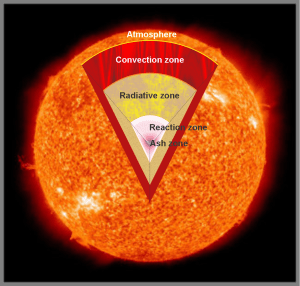
“I understand. Rabbit holes do tend to collect rubbish. Here, let me send you a diagram I use in my classes.” <another pause> “Did you get that?”

“Mm‑hm. Brian showed me a picture like that without the cut‑out part because he was all about the bright flashes.”

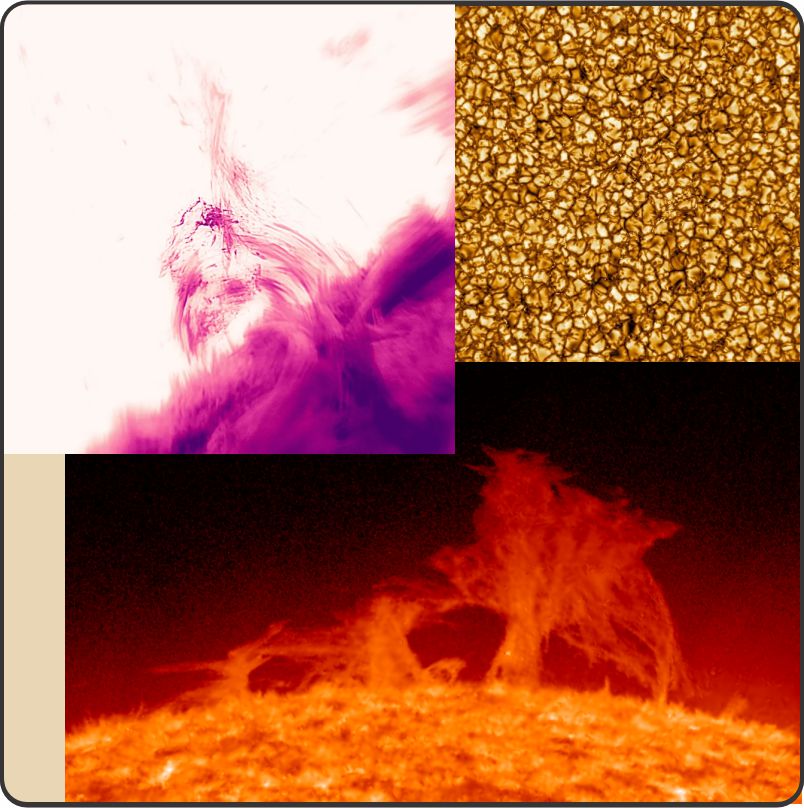
“Of course he was. I’ll skip the details, but the idea is that the Sun generates its heat and light energy deep in the reaction zone. Various processes carry that energy up through other zones until it hits the Sun’s atmosphere. You’ve watched water boil on the stove, surely.”

“Oh, yes. Mom put me in charge of doing the pasta last year. I don’t care what they say, a watched pot does eventually boil if there’s enough heat underneath it. I experimented.”

“Wonderful. That process, heat rising into a fluid layer, works the same way on the Sun as it does in your pasta pot. Heat ascends through the fluid but it doesn’t do that uniformly. No, the continuous fluid separates into distinct cells, they’re called Bénard cells, where hot fluid comes up the center, spreads out and cools across the top and then flows down the cell’s outer boundary.”

“That’s what I see happen in the pot with low water and low heat just before the bubbling starts.”

“Right, bubbling will disturb what had been a stable pattern. The cells in the Sun’s surface, they’re called granules, continually rise up to the surface and crowd out neighbors that have cooled off enough to sink or disappear.”

“Funny to say something on the Sun is cool.”

“Relatively cool, only 4000K compared to 6000K. But the Sun has bubbles, too. The granules run about 1500 kilometers wide and last only a quarter‑hour. There’s evidence they’re in top of a supporting layer of supergranules 20 times wider. Or maybe the plasma’s magnetic field is patchy. Anyhow, the surface motion is chaotic. Occasionally, especially concentrated heat or magnetic structure punches out between the granules. There’s a sudden huge release of superhot plasma, a blast of electromagnetic energy radiating out at all frequencies — that’s one of Brian’s flares. Lasts about as long as the granules.”

“That’s what could cook an astronaut?”

“Not really, The radiation’s pretty spread out by the time it’s travelled 150 million kilometers to us. The real danger is from high‑energy particle storms that travel along the Sun’s magnetic field lines. Space crews need to take shelter from them but particle masses travel slower than light so there’s several hours notice.”

“So what about the CMEs?”

“They’re big bubbles of plasma mass that the Sun throws off a few times a year on average. Maybe they come from ultra‑flares but we just don’t know. Their charged particles and magnetic fields can mess up our electronic stuff, but don’t worry about their mass. If a CME’s entire mass hit us straight on, it’d be only a millionth of a millionth of Earth’s mass. We’d roll on just fine.”

~ Rich Olcott

Rows, Columns And Freedom

“Geez, Sy. You know I hate equations. I was fine with the Phase Rule as an arithmetic thing but you’ve thrown so much algebra at me I’m flummoxed. How about something I can visualize?”

“Sorry, Vinnie, the algebra was just to show where the Rule came from. Application’s not in my bailiwick. Susan, it’s your turn.”

“Sure, Sy, this is Chemistry. Okay, Vinnie, what’s the Rule about?”

“Degrees of freedom, but I’m still not sure what that means. ‘Independent intensive variables’ doesn’t say much to me.”

“Understandable, seeing as you don’t like equations. Visualize a spreadsheet. There’s an ‘Energy’ header over columns A and B. The second row reads ‘Name’ and ‘Value’ in those two columns. Then one row each for Temperature and Pressure.”

“This is more like it. Any numbers in the value column?”

“Not yet. They’ll be degrees of freedom, maybe. Next, ‘Components in cell C1, ‘Name’ in C2 and then C rows, one for each component.”

“Do we care how much of each component?”

“Not yet.* Next visualize a multi‑column ‘Phases header over one column for each phase. The second row names the phase. Below that there’s a row for each component. The whole array is for figuring how each component spreads across the phases assuming there’s enough of everything to reach equilibrium. With me?”

“A little ahead, I think. Take one of Kareem’s lava pools on Io, for instance. It’s got two components, iron and sulfur, and two molten phases, iron‑light 5:95 floating on top of iron‑heavy 60:40. Phase Rule says the freedom degrees is C–P+2=2–2+2, comes to 2 but that disagrees with the 6 open boxes I see.”

“But the boxes aren’t independent. Think of the interface between the two phases. One by one, atoms in each phase wander across to the other side. At equilibrium the wandering happens about as often in both directions.”

“That’s your reversibility equilibrium.”

“Right, thermodynamics’ classic competition between energy and entropy — electronic energy holding things together against entropy flinging atoms everywhere. Pure iron’s a metallic electron soup that can accept a lot of sulfur without much disturbance to its energy configuration. That means sulfur’s enthalpy doesn’t differ much between the two environments and that allows easy sulfur traffic between the two phases. On the other hand, pure sulfur will accept only a little iron because iron disrupts sulfur‑sulfur moleular bonding. Steep energy barrier against iron atoms drifting into the 95:5 phase; low barrier to spitting them out. Kareem’s phase diagram for atmospheric pressure shows how things settle out for each temperature. There’s a neat equation for calculating the concentration ratios from the enthalpy differences, but you don’t like equations.”

“You’re right about that, Susan, but I smell weaseling in your temperature‑pressure dodge.”

“Not really. You’ve read Sy’s posts about enthalpy’s internal energy, thermal and PV‑work components. Heat boosts entropy’s dominance and tinkers with the enthalpies.”

Meanwhile, I’ve been tapping Old Reliable’s screen. “I’m playing water games over here. Maybe this will help clarify the freedom. Water can be ice, liquid or vapor. At high temperature and pressure, the liquid and gas phases become a single phase we call supercritical. Here’s a sketch of water’s phase diagram. Only one component so C=1 … and a spreadsheet summarizing seven conditions.

“The first four are all at atmospheric pressure, starting at position 1 — just water vapor in a single phase so P=1, DF=2. We can change temperature and pressure independently within the phase boundaries. If we chill to point 2 liquid water condenses. If we stop there, on the boundary, we’re at equilibrium. We could change temperature and still be at equilibrium, but only if we change pressure just right so we stay on that dotted line. The temperature‑pressure linkage constraint leaves us only one degree of freedom — along the line.”

“Ah, 3 and 5 work the same way as 1 but for liquid and solid, and 4‘s like 2. The Fixed ones—?”

“One unique temperature‑pressure combination for each equilibrium. No freedoms left.”

  • * Given specific quantities of iron and sulfur, chemists can calculate equilibrium quantities for each phase. Susan assigned that as a homework problem once.

~ Rich Olcott

The Quest for Independents

The thing about Vinnie is, he’s always looking for the edges and loopholes. He’d make a good scientist or lawyer but he’s happy flying airplanes. “Guys, I heard a lot of dodging when you started talking about that Gibbs Rule. You said it only works when things are in equilibrium. That’s what Susan was talking about when she said Loki Lake on Io ain’t an equilibrium ’cause there’s stuff getting pumped in and going away so the equations don’t balance. I got that. But then you threw in some other excepts, like no biology or other kinds of work. What’s all that got to do with the phases and chemistry?”

“They’re different processes that drive a system away from equilibrium. Biology, for example. Every kind of life taps energy sources to maintain unstable structures. Proteins, for instance — chemically they’re totally unstable. Oxidation, random acid‑base reactions, lots of ways to degrade a protein molecule’s structure until its atoms wind up in carbon dioxide and nitrogen gas. Your cells, though, they continually burn your food for energy to protect old protein molecules or build new ones and DNA and bones and everything. I visualize someone riding a bicycle up a hillside of falling bowling balls, desperately fighting entropy just to keep upright.”

“Fearsome image, Susan, but it fits. From a Physics perspective, dumping in or extracting any kind of work disrupts any system that’s at equilibrium. The Phase Rule accounts for pressure-volume energy because that’s already part of enthalpy—”

“Wait, Sy, I don’t see pressure‑volume or even ‘PV‘ in
  ’degrees of freedom=components–phases+2‘.”

“That’s what the ‘2′ is about, Vinnie. If it weren’t for pressure‑volume energy, that two would be a one.”

“C’mon.”

“No, really. ‘Degrees of freedom’ counts the number of intensive properties that are independent of each other. Neither temperature nor pressure care about how much of something you’ve got, so they’re both intensive properties. Temperature’s always there so that’s one degree of freedom. If PV energy’s part of whatever process you’re looking at, then pressure comes into the Rule by way of the enthalpies we use to calculate equilibrium situations. I guess you could write the Rule as
  DF=C–P+1T+1PV.

“That’s not the way we learned that in school, Sy. It was
  DF=C–P+1+N,
with ‘N’ counting the number of work modes — PV, gravitational, electrical, whatever fits the problem.”

“How would you do gravitational work on an ice cube, Kareem?”

“Wouldn’t be a cube, Vinnie, it’d be a parcel of Jupiter’s atmosphere caught in a kilometers‑high vertical windstream. Water ice, ammonia ice, ammonium polysulfide solids, all in a hydrogen‑helium medium. A complicated problem; whoever picks it up will have to account for gravity and pressure effects.”

“Come to think of it, the electric option is getting popular and Kareem’s iron‑sulfur system may be a big player. My Chemistry journals have carried a sudden flurry of papers about iron‑sulfur batteries as cheap, safe alternatives to lithium‑based designs for industry‑sized storage where low weight isn’t a consideration. Battery voltage is intensive, doesn’t care about size. Volt’s extensive ‘how much’ buddy is amps. Electrical work is volts times amps so it fits right in with the Rule if I write
  DF=C–P+1T+1PV+1VA
A voltage box with sulfur electrodes on one side and iron electrodes on the other would be way out of equilibrium.”

“But why components minus phases? Why not times? What if it comes out negative? What’d that even mean?”

Water’s phase diagram

“Fair questions, Vinnie. Degrees of freedom counts independent properties, right? You’d think the phases‑components contribution to DF would be P*C but no. The component percentages in C must total 100%. If you know all but one percentage, the last percentage isn’t independent. Same logic applies to the P phases. That leaves (C–1) and (P–1) independent variables. For the P phases P*C drops to P*(C–1) variables. But you also know that each component is in equilibrium across all phases. Each equilibrium reduces the count by one, for C*(P–1) reductions. Do the subtraction
  P*(C–1)–C*(P–1)=C–P
You’re left with only C–P quantities that can change without affecting other things. If the result’s negative it’ll constrain exactly that many other intensive variables, like with water’s triple point.”

~ Rich Olcott

Water Rites

Vinnie pulls a chair over to our table, grabs some paper napkins for scribbling. “You guys know I hate equations, but this Phase Rule one is simple enough even I can play. It says ‘degrees of freedom’ equals ‘components’ minus ‘phases’ plus 2, right? Kareem’s phase diagram has a blue piece with a slush of iron crystals floating in an iron‑sulfur melt. There’s two components, iron and sulfur, two phases, crystals and melt, so the degrees come to 2–2+2=2 and that means we get to choose any two, you said intensive properties, to change. Do I got all that straight, tell me more about degrees and what’s intensive?”

“Good job, Vinnie, and good questions. Extensive properties are about how much. In Kareem’s experiment, he’s free to add iron or sulfur in whatever quantities he wants. By contrast, intensive properties don’t care about how much is there. The equilibrium melt’s iron:sulfur ratio stays between zero and one whatever the size of Kareem’s experiment. The ratio’s an intensive property. So are temperature and pressure. If he kept his experimental pressure constant but raised the temperature, I expect some of the crystals would dissolve. That’d lift the iron:sulfur ratio.”

“How about raising the pressure, Kareem?”

“I suspect that’d squeeze iron back into the crystalline mass, but I’ve not tried that so I don’t know. Different materials behave different ways. Raising the pressure on normal water ice melts it, which is why ice skates work.”

Susan suddenly pulls her tablet from her purse and starts fiddling with it.

“Fair enough. Okay, in your diagram’s top yellow piece where it’s all molten, there’s still 2 components but one phase so the Rule goes 2–1+2=3. You’re saying 3 degrees means you can choose whatever temperature, pressure and mix ratio you want and it’d still be molten.”

“You’ve got the idea, Vinnie. What I’m really interested in, though, is what happens when I add more components. To model Io’s lava pools I need to roll in oxygen and silicon from the surrounding rocks. I’m looking at a 4‑component situation which could have multiple phases and things are complicated”

Vinnie’s got that ‘gotcha’ glint in his eye. “Understood. But how about going in the other direction? If you’ve got only one component then you could have either 1–2+2=1 or 1–3+2=0. How do either of those make sense?”

Susan shows a display on her tablet. “As soon as Kareem mentioned ice I figured this phase diagram would come in handy. It’s for water — single component so there’s no variation along a component axis, just pressure and temperature.”

“Kareem had to read his chart to us. Now it’s your turn.”

“Of course. By convention, pressure’s on the y‑axis, temperature’s along the x‑axis. The pressure range is so wide that this chart uses a logarithmic scale which is why the distances look weird. Over there on the cold side, there’s two kinds of ice. Ice Ic has a cubic crystal structure. Warm it up past 240K and it converts to a hexagonal form, Ice Ih. That’s the usual variety that makes snowflakes.”

“TP!” <snirk, snirk>

“Cal, please. That’s water’s Triple Point, Vinnie’s 1–3+2=0 situation where all three phases are in equilibrium with each other so there’s no degrees of freedom. The solid‑liquid and liquid‑vapor boundaries are examples of Vinnie’s 1–2+2=1 condition — only one degree of freedom, which means that equilibrium temperature and pressure are tightly linked together. Squeeze on ice, its melting point drops, so we ice skate on a thin film of liquid water. Normal Boiling Point holds at standard atmospheric pressure but if you heat water while up on a balloon ride it may not get hot enough to hard‑boil those eggs you brought for the picnic.”

“What’s going on in the gray northeast corner?”

CP‘s the Critical Point at the end of the 1–2+2=1 line. The liquid-vapor surface disappears. No gas or liquid in the container, just opalescent supercritical fog. There’s only one phase; temperature and pressure are independent. Beyond CP you’re in 1–1+2=2 territory.”

~ Rich Olcott