EROs Atop A Ladder

“‘That’s where the argument started? That’s right up there with ‘Then the murders began.’ Cathleen Cliff‑hanger strikes again.”

<giggling> “Gotcha, Sy, just like always. Sorry, Kareem, we’ve had this thing since we were kids.”

“Don’t mind me, but do tell him what’s awry with the top of your galactic distance ladder.”
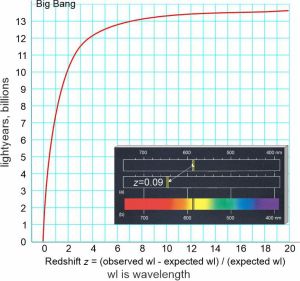
“I need to fill you in first about the ladder’s framework. We know the distances to special ‘standard candles’ scattered across the Universe, but there’s oodles of other objects that aren’t special that way. We can’t know their distances unless we can tie them to the candles somehow. Distance was Edwin Hubble’s big thing. Twenty years after Henrietta Swan Leavitt identified one kind of candle, Hubble studied the light from them. The farthest spectra were stretched more than the closest ones. Better yet, there was a strict relationship between the amount of stretch, we call it the z factor, and the candle’s distance. Turns out that everything at the intergalactic scale is getting farther from everything else. He didn’t call that expansion the Hubble Flow but we do. It comes to about 7% per billion lightyears distance. z connects candle spectrum, object spectrum and object distance. That lets us calibrate successive overlapping steps on the distance ladder, one candle type to the next one.”

“A constant growth rate — that’s exponential, by definition. Like compound interest. The higher it gets, it gets even higher faster.”

“Right, Kareem, except that in the past quarter-century we’ve realized that Hubble was an optimist. The latest data suggests the expansion he discovered is accelerating. We don’t know why but dark energy might have something to do with it. But that’s another story.”

“Cathleen, you said the distance ladder’s top rung had something to do with surface brightness. Surface of what?”

“Galaxies. Stars come at all levels of brightness. You can confirm that visually, at least if you’re in a good dark‑sky area. But a galaxy has billions of stars. When we assess brightness for a galaxy as a whole, the brightest stars make up for the dimmest ones. On the average it’ll look like a bunch of average stars. The idea is that the apparent brightness of some galaxy tells you roughly how many average stars it holds. In turn, that gives you a rough estimate of the galaxy’s mass — our final step up the mass ladder. Well, except for gravitational lensing, but that’s another story.”

“So what’s wrong with that candle?”

“We didn’t think anything was wrong until recently. Do you remember that spate of popular science news stories a year ago about giant galaxies near the beginning of time when they had no business to exist yet?”

“Yeah, there was a lot of noise about we’ll have to revise our theories about how the Universe evolved from the Big Bang, but the articles I saw didn’t have much detail. From what you’ve said so far, let me guess. These were new galaxy sightings, so probably from James Webb Space Telescope data. JWST is good at infra‑red so they must have been looking at severely stretched starlight—”

z-factor near 8″

“— so near 13 billion lightyears old, but the ‘surface brightness’ standard candle led the researchers to claim their galaxies held some ridiculous number of stars for that era, at least according to current theory. How’d I do?”

“Good guess, Sy. That’s where things stood for almost a year until scientists did what scientists do. A different research group looking at even more data as part of a larger project came up with a simpler explanation. Using additional data from JWST and several other sources, the group concentrated on the most massive galaxies, starting with low‑z recent ones and working back to z=9. Along the way they found some EROs — Extremely Red Objects where a blast of infra‑red boosts their normal starlight brightness. The researchers attribute the blast to hot dust associated with a super‑massive black hole at each ERO’s center. The blast makes an ERO appear more massive than it really is. Guess what? The first report’s ‘ridiculously massive’ early galaxies were EROs. Can’t have them in that top rung.”

“Kareem, how about the rungs on your ladder?”

~~ Rich Olcott

One Step After Another

Mid-afternoon, time for a coffee break. As I enter Cal’s shop, I see Cathleen and Kareem chuckling together behind a jumble of Cal’s distinctive graph‑lined paper napkins. “What’s the topic of conversation, guys?”

“Hi, Sy. Kareem and I are comparing ladders.”

I look around, don’t see anything that looks like construction equipment.

“Not that kind, Sy. What’s your definition of a ladder?”

“Getting down to definitions, eh, Kareem? Okay, it’s a framework with steps you can climb up towards something you can’t reach.”

“Well, there you go.”

“Not much help, Cathleen. What are you really bantering about?”

“Each of our fields of study has a framework with steps that let us measure something that’d be way out of reach without it.”

“You’ll appreciate this, Sy — our ladders even use different math. The steps on Cathleen’s ladder are mostly linear, mine are mostly exponential.”

“And they’re both finicky — you have to be really careful when using them.”

“And they’ve both recently had adjustments at the top end.”

“I can see the fun, I think. How about some specifics?”

They exchange a look, Kareem gestures ‘after you‘ and Cathleen opens. “Mine’s in astrometry, Sy, the precise recording of relative positions. Tycho Brahe’s numbers were good to a few dozen arcseconds—”

“Arcsecond?”

1/60 of an arcminute which is 1/60 of a degree which is 1/360 of a full circle around the sky. Good enough in Newton’s day for him to explain planetary orbits, but we’ve come <ahem> a long way since then. The Gaia telescope mission can resolve certain objects down to a few microarcseconds but that’s only half the problem.”

“Let me guess — you have angles but you don’t have distances.”

“Bingo. Distance is astrometry’s biggest challenge.”

“Wait, Newton’s Law of Gravity includes r as the distance between objects. For that matter, Kepler’s Laws use and . Couldn’t you juggle them around to evaluate r?”

“Nope. Kepler did ratios, not absolute values. Newton’s Law has but you can rewrite it as F ² = GMm/r² = G(M/r)(m/r), G times the product of two mass‑to‑distance ratios. Newton’s G is our least‑accurate physical constant and we don’t have good handles on either of those numerators. Before space flight we just had mass ratios like M/m. We only discovered the Moon’s absolute mass when we orbited it with spacecraft of known mass. That’s the lowest rung on our mass ladder. Inside the Solar System we go step by step with orbit ratios. Outside the system everything’s measured relative to Solar mass.”

“I’m getting the ladder idea. So how do you distances?”

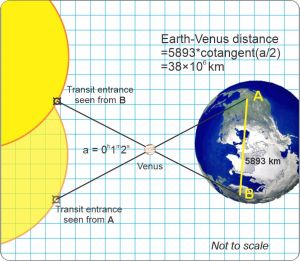
“Lowest rung is parallax, like binocular vision. You look at something from two different points a known distance apart. Measure the angle between the sight‑lines. Figure the triangles to get the something’s distance. The earliest example I know of was in the mid‑1700s when astrometers thousands of miles apart on Earth watched Venus cross the Sun’s disk. Each recorded the precise time they saw Venus touch the Sun’s disk. Given the time shift and the on‑Earth distance, some trigonometry gave them the Earth‑Venus distance. That put a scale to Newtonian orbital diagrams. Parallax across the width of Earth’s orbit yielded stellar distances out to thousands of lightyears with Hubble. We expect ten times better from Gaia.”

“That gets you maybe across the Milky Way. What about farther out?”

“Several ingenious variations on the parallax idea, but mostly standard candles.”

“Candles?”

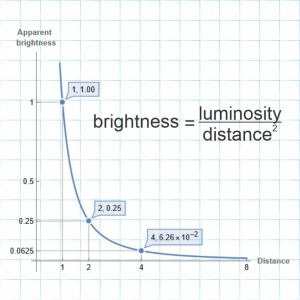
“Suppose you measure the brightness of a candle that’s a known distance away and there’s an equally luminous candle some unknown distance away. Measured brightness falls as the square of the distance, so if the second candle appears half as bright it’s four times the distance and so on. Climbing the cosmic distance ladder is going from one kind of uniformly‑luminous candle to another kind farther away.”

“Such as?”

“We know how brightness relates to bright‑dim‑bright cycle time for several types of variable stars. That gets us out to 30 million lightyears or so. Type I‑a supernovas act as useful candles out to a billion lightyears. Beyond that we can use galaxy surface brightness. That’s where the recent argument started.”

~ Rich Olcott

  • Thanks to Ken Burke for mentioning tellurium‑128’s septillion‑year half‑life.

Visionaries Old And New

Cathleen’s back at the mic. “Let’s have a round of applause for Maria, Jeremy, Madison and C‑J. Thank you all. We have a few minutes left for questions… Paul, you’re first.”

“Thanks, Cathleen. A comment, not a question. As you know, archeoastronomy is my specialty so I applaud Jeremy’s advocacy for the field. I agree with his notion that the Colorado Plateau’s dry, thin air generally lets us see more stars than sea‑level Greeks do. When I go to a good dark sky site, it can be difficult to see the main stars that define a constellation because of all the background dimmer stars. However, I don’t think that additional stars would change the pictures we project into the sky. Most constellations are outlined from only the brightest stars up there. Dimmer stars may confuse the issue, but I very much doubt they would have altered the makeup of the constellations a culture defines. Each culture uses their own myths and history when finding figures among the stars.”

“Thanks for the confirmation from personal experience, Paul. Yes, Sy?”

“Another comment not a question. I’m struck by how Maria’s Doppler technique and Jeremy’s Astrometry complement each other Think of a distant stellar system like a spinning plate balanced on a stick. Doppler can tell you how long the stick is. Astrometry can tell you how wide the plate is. Both can tell you how fast it’s spinning. The strongest Doppler signal comes from systems that are edge‑on to us. The strongest Astrometry signal comes from systems we see face‑on. Those are the extreme cases, of course. Most systems are be at some in‑between angle and give us intermediate signals.”

“That’s a useful classification, Sy. Madison’s and C‑J’s transit technique also fits the edge‑on category. Jim, I can see you’re about to bust. What do you have to tell us about?”

“How about a technique that lets you characterize exoplanets inside a galaxy we see as only a blurry blob? This paper I just read blew me away.”

“Go ahead, you have the floor.”

“Great. Does everyone know about Earendel?” <blank looks from half the audience, mutters about ‘Lord Of The Rings?’ from several> “OK, quick refresher. Earendel is the name astronomers gave to the farthest individual star we’ve ever discovered. It’s either 13 or 28 billion lightyears away, depending on how you define distance. We only spotted it because of an incredible coincidence — the star happens to be passing through an extremely small region of space where light in our general direction is concentrated thousands‑fold into a beam towards us. Earendel may be embedded in a galaxy, but the amplification region is so narrow we can’t see stars that might be right next to it.”

<Feder’s voice> “Ya gonna tell us what makes the region?”

“Only very generally, because it’s complicated. You know what a magnifying lens does in sunlight.”

“Sure. I’ve burnt ants that way.”

“… Right. So what you did was take all the light energy hitting the entire surface of your lens and concentrate it on a miniscule spot. The concentration factor was controlled by the Sun‑to‑lens‑to‑spot distances and the surface area of the lens. Now bring that picture up to cosmological distances. The lens is the combined gravitational field of an entire galaxy cluster, billions of lightyears away from us, focusing light from Earendel’s galaxy billions of lightyears farther away. Really small spots at both ends of the light path and that’s what isolated that star.”

“That’s what got you excited?”

“That’s the start of it. This new paper goes in the other direction. The scientists used brilliant X‑ray light from an extremely distant quasar to probe for exoplanets inside a galaxy’s gravitational lens. Like one of your ants analyzing sunlight’s glare to assess dust flecks on your lens. Or at least their averaged properties. A lens integrates all the light hitting it so your ant can’t see individual grains. What it can do, though, is estimate numbers and size ranges. This paper suggests the lensing galaxy is cluttered with 2000 free‑floating planets per main‑sequence star — stars too far for us to see.”

~~ Rich Olcott

  • Thanks to Dave Martinez and Dr Ka Chun Yu for their informative comments.

Astrometers Are Wobble-Watchers

letter A Hi, Sy, what’s going on in Cathleen’s seminar?

You were right, Al.
It’s about exoplanets and how to find them.
Jeremy’s pitching astrometry.
That’s about measuring star locations in the sky.
I’ll fill you in later.

“So that’s my cultural colonialism rant, thanks for listening. On to the real presentation. Maria showed us how to look for exoplanets when they wobble along our line of sight. But what if they wobble perpendicular to that? Careful measurement should show that, right? The ancients thought that holy forces had permanently set the positions of all the stars except for the planets so they didn’t measure that close. Tycho Brahe took meticulous measurements with room‑sized instruments—”

<voice from the back> “Room‑sized? What difference does that make?”

“What if I told you that two stars are 3 millimeters apart in the sky?”

<another voice> “How far out’s your ruler? Sky stuff, you need to talk angles because that’s all you got.”

“Well there you go. That’s why Tycho went for maximum angle‑measuring accuracy. He built a sextant with a 5‑foot radius. He used an entire north‑south wall as a quadrant. His primary instrument was an armillary sphere three yards across.”

<first voice again> “Wait, a sphere, like a big bubble? Why north‑south? What’s a quadrant?”

  • I give him a nudge. “He’s just a kid, Mr Feder. Be nice. One question at a time.”
  • “But I got so many!”

“Think about Tycho’s goal. Like astrometers before him, he wanted to build an accurate map of the heavens. Native Americans a thousand years or more ago carved free‑hand star maps on cave ceilings and turtle shells. Tycho followed the Arabic and Chinese quantitative mapping traditions. There’s two ways to do that. One is to measure and map the visual angles between many pairs of stars. That strategy fails quickly because errors accumulate. Four or five steps along the way you’re plotting the same star in two different locations.”

<Feder’s voice again> “There’s a better way?”

“Yessir. Measure and map each star relative to a standard coordinate system. If your system’s a good one, errors tend to average out. The latitude‑longitude system works well for locating places on Earth. Two thousand years ago the Babylonians used something similar for places in the crystal sphere they thought supported the stars above us. Where the equinoctial Sun rose on the horizon was a special direction. Their buildings celebrated it. Starting from that direction the horizontal angle to a star was its longitude. The star’s latitude was its angle up from the horizon towards the zenith straight above. But those map coordinates don’t work for another part of the world. Astrometers needed something better.”

<Feder again> “So what did they do already?”

“They may or may not have believed the Earth itself is round, but they recognized the Pole Star’s steady position that the rest of the sky revolved around. They also noticed that as each month went by the constellations played ring‑a‑rosie in a plane perpendicular to the north‑south axis. Call that the Plane of The Ecliptic. Pick a star, measure its angle away from the Ecliptic and you’ve got an ecliptic latitude. Measure its angle around the Ecliptic away from a reference star and you’ve got a ecliptic longitude. Tycho’s instruments were designed to measure star coordinates. His quadrant was a 90° bronze arc he embedded in that north‑south wall, let him measure a star’s latitude as it crossed his meridian. His ‘Sphere’ was simply a pair of calibrated metal rings on a gimbal mounting so he could point to target and reference stars and measure the angle between them. If his calibration used degree markings they’d be about 25 millimeters apart. His work was the best of his time but the limit of his accuracy was a few dozen arcseconds.”

“Is that bad?”

“It is if you’re looking for exoplanets by watching for stellar wobble. Maria’s Jupiter example showed the Sun wobbling by 1½ million kilometers. I worked this example with a bigger wobble and a star that would be mid‑range for most of our constellations. Best case, we’d see its image jiggling by about 90 microarcseconds. Tycho’s instruments weren’t good enough for wobbles.”

~~ Rich Olcott

The Stars from A Different Viewpoint

“Thank you, Maria, nice job showing us why the Doppler method had such a hard time finding exoplanets. Next up, Jeremy. You’re not going to talk about black holes, are you?”

“No, ma’am, my subject today is astrometry, but that’s useful for both exoplanets and black holes. I have to be careful when I say the word because it sounds so much like astronomy but they’re different things. It helped when I looked the words up. Turns out that ‘astronomy‘ means ‘naming stars‘ but ‘astrometry‘ means ‘measuring‘ them. Not weighing one or any of that, just measuring accurately where that star is in the sky at a certain moment. Everyone on Earth has the sky above. In the days before city life and city lights brought their eyes down, cultures all over the world were doing astronomy and astrometry. Professional astronomers generally use Greek and Arabic names, but that’s Eurocentrism and it got silly.”

<voice from the back> “Like how?”

“The Greeks couldn’t name constellations in the southern hemisphere’s skies because they never saw those stars. Polynesian navigators and Indigenous Australians saw them. Those cultures had their own perfectly good constellations. Did official Astronomy ask any of those people? Of course not, so we’ve got contrived designations like The Microscope and The Air Pump. Some of you know that I’m doing a research project with Professor Begaye to correlate constellations from different cultures. I’ve found some surprises.”

<voice from the back> “Like what?”

“Practically everyone in the northern hemisphere has a special image for the Pole Star and the stars close to it. Europeans picked out Ursa Minor, the Little Bear. For us Navajos the same stars make up The Northern Fire in the sky’s dome like the fire in our traditional domed hogan homes. Staying close to the Northern Fire we see two human figures, a woman and a man. One surprise for me was that the woman’s most prominent stars are the same ones the Greeks chose for Cassiopeia, also a female. The man’s image includes many of the same stars that Europeans call Ursa Major, the Big Bear. Did you know that the word ‘Artic‘ comes from the Greek word ‘arktos‘ which means ‘bear‘? Anyway, further out there’s a winter constellation containing three bright stars in a straight line plus a few more that could be shoulders and knees.”

<voice from the back> “Orion!”

“Mm-hm. We have almost exactly the same constellation. It’s also a hunter, except that the Greeks picture the three stars as his belt and we say it’s the quiver for his arrows. Right in front of the hunter are—”

<voice from the back> “The Pleaides!”

“But for us they’re Dilyehe, the Planting Stars. When they go below the horizon it’s time to plant corn. Which gets me to astrometry. The stars and constellations have always been clocks and calendars for the world’s cultures. Typically they compare the position of the Sun or certain stars with special structures.”

<voice from the back> “Like Stonehenge and the Pyramids!”

“There’s claims and doubts about both of those. People have searched out apparent special locations, like ‘This doorway and that window were placed to show a certain star rising on Midsummers Eve,’ but without explicit markings there’s no way to be sure it wasn’t just accidental. Besides, both structures were built with huge stone blocks, a real challenge to place accurately enough to pick out just one star on one day. We Navajos don’t build structures to track special times. We use mountains.”

<voice from the back> “What, you move mountains around?”

“No, we honor and respect the natural landscape for its beauty. What we do is find the special places that help the mountains and other landmarks tell us what time of year it is. My favorite example is the Double Sunset.”

<voice from the back> “Can’t have two!”

“Yes, you can, if the mountains are sharp and stand close to one another. On the right day of the year, the Sun sets behind one mountain, then peeks for just a minute through the cleft between the two. You just have to know where to stand to see that.”

~ Rich Olcott

Naming the place and placing the name

“By the way, Cathleen, is there any rhyme or reason to that three-object object‘s funky name?  I’ve still got it on Old Reliable here.”

PSR J0337+1715

“It’s nothing like funky, Sy, it’s perfectly reasonable and in fact it’s far more informative than a name like ‘Barnard’s Star.’  The ‘PSR‘ part says that the active object, the reason anyone even looked in that system’s direction, is a pulsar.”

“And the numbers?”

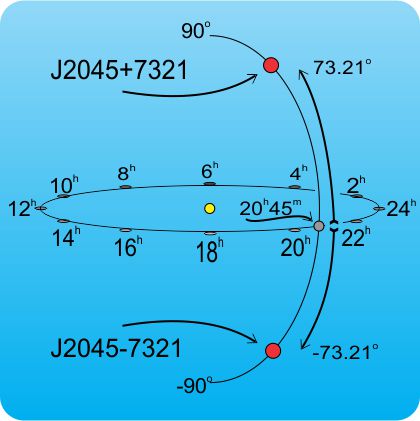
“Its location in two parts.  Imagine a 24-hour clockface in the Solar Plane.  The zero hour points to where the Sun is at the Spring equinox.  One o’clock is fifteen degrees east of that, two o’clock is another fifteen degrees eastward and so on until 24 o’clock is back pointing at the Springtime Sun.  Got that?”

“Mm, … yeah.  It’d be like longitudes around the Earth, except the Earth goes around in a day and this clock looks like it measures a year.”

“Careful there, it has nothing to do with time.  It’s just a measure of angle around the celestial equator.  It’s called right ascension.

“How about intermediate angles, like between two and three o’clock?”

“Sixty arc-minutes between hours, sixty arc-seconds between arc-minutes, just like with time.  If you need to you can even go to tenths or hundredths of an arc-second, which divide the circle into … 8,640,000 segments.”

“OK, so if that’s like longitudes, I suppose there’s something like latitudes to go with it?”

“Mm-hm, it’s called declination.  It runs perpendicular to ascension, from plus-90° up top down to 0° at the clockface to minus-90° at the bottom.  Vivian, show Sy Figure 3 from your paper.”Right ascension and declination“Wait, right ascension in hours-minute-seconds but declination in degrees?”

“Mm-hm.  Blame history.  People have been studying the stars and writing down their locations for a long time.  Some conventions were convenient back in the day and we’re not going to give them up.  So anyway, an object’s J designation with 4-digit numbers tells you which of 13 million directions to look to find it.  Roughly.”

“Roughly?”

“That’s what the ‘J‘ is about.  If the Earth’s rotation were absolutely steady and if the Sun weren’t careening about a moving galaxy, future astronomers could just look at an object’s angular designation and know exactly where to look to find it again.  But it’s not and it does and they won’t.  The Earth’s axis of rotation wobbles in at least three different ways, the Sun’s orbit around the galaxy is anything but regular and so on.  Specialists in astrometry, who measure things to fractions of an arc-second, keep track of time in more ways than you can imagine so we can calculate future positions.  The J-names at least refer back to a specific point in time.  Mostly.  You want your mind bent, look up epoch some day.”

“Plane and ship navigators care, too, right?”

“Not so much.  Earth’s major wobble, for instance, shifts our polar positions only about 40 parts per million per year.  A course you plotted last week from here to Easter Island will get you there next month no problem.”

Old Reliable judders in my hand.  Old Reliable isn’t supposed to have a vibration function, either.  Ask her about interstellar navigation.  “Um, how about interstellar navigation?”Skewed Big Dipper

“Oh, that’d be a challenge.  Once you get away from the Solar System you can’t use the Big Dipper to find the North Star, any of that stuff, because the constellations look different from a different angle.  Get a couple dozen lightyears out, you’ve got a whole different sky.”

“So what do you use instead?”

“I suppose you could use pulsars.  Each one pings at a unique repetition interval and duty cycle so you could recognize it from any angle.  The set of known pulsars would be like landmarks in the galaxy.  If you sent out survey ships, like the old-time navigators who mapped the New World, they could add new pulsars to the database.  When you go someplace, you just triangulate against the pulsars you see and you know where you are.”

If they happen to point towards you! You only ever see 20% of them.  Starquakes and glitches and relativistic distortions mess up the timings.  Poor Xian-sheng goes nuts each time we drop out of warp.

~~ Rich Olcott