Galaxies Fluffy And Faint

Cathleen’s at the coffee shop’s baked goods counter. “A lemon scone, please, Al.”

I’m next in line. “Lemon sounds good to me, too. It’s a warm day.”

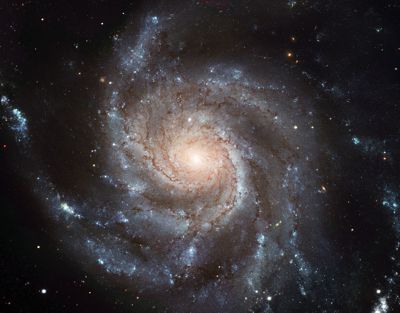
The Pinwheel Galaxy, NGC 5457
Credit: ESA/Hubble

“Sure thing, Sy. Hey, got a question for you, Cathleen, you bein’ an Astronomer and all. I just saw an Astronomy news item about a fluffy galaxy and they mentioned a faint galaxy. Are they the same and why the excitement?”

“Not the same, Al. It’ll be easier to show you in pictures. Sy, may I borrow Old Reliable?”

“Sure, here.”

“Thanks. OK, Al, here’s a classic ‘grand design‘ spiral galaxy, NGC 5457, also known as The Pinwheel. Gorgeous, isn’t it?”

“Sure is. Hey, I’ve wondered — what does ‘NGC‘ stand for, National Galaxy Collection or something?”

“Nope. The ‘G‘ doesn’t even stand for ‘Galaxy‘. It’s ‘New General Catalog‘. Anyway, here’s NGC 2775, one of our prettiest fluffies. Doesn’t look much like the Pinwheel or Andromeda, does it?”

NGC 2775
Credit: NASA / ESA / Hubble / J. Lee / PHANGS-HST Team / Judy Schmidt

“Nah, those guys got nice spiral arms that sort of grow out of the center. This one looks like there’s an inside edge to all the complicated stuff. And it’s got what, a hundred baby arms.”

“The blue dots in those ‘baby arms’ are young blue stars. They’re separated by dark lanes of dust just like the dark lanes in classic spirals. The difference is that these lanes are much closer together. The grand design spirals are popular photography subjects in your astronomy magazines, Al, but they’re only about 10% of all spirals. I’ll bet your news item was about 2775 because we’re just coming to see how mysterious this one is.”

“What’s mysterious about it?”

“That central region. It’s huge and smooth, barely any visible dust lanes and no blue dots. It’s bright in the infra‑red, which is what you’d expect from a population of old red stars. In the ultra‑violet, though, it’s practically empty — just a small dot at the center. UV is high‑energy light. It generally comes from a young star or a recent nova or a black hole’s accretion disk. The dot is probably a super-massive back hole. but its image is just a tiny fraction of the smooth region’s width. With a billion red stars in the way it’s hard to see how the black hole’s gravity field could have cleaned up all the dust that should be in there. Li’l Fluffy here is just begging for some Astrophysics PhD candidates to burn computer time trying to explain it.”

NGC 1052-DF2
Credit: NASA, ESA, and P. van Dokkum (Yale University)

“What about Li’l Faint?”

“That’s probably this one, NGC 1052-DF2. Looks a bit different, doesn’t it?

“I’ll say. It’s practically transparent. Is it a thing at all or just a smudge on the lens?”

“Not a smudge. We’ve got multiple images in different wavelength ranges from multiple observatories, and there’s another similar object, NGC 1052-DF4, in the same galaxy group. We even have measurements from individual stars and clusters in there. The discovery paper claimed that DF2 is so spread out because it lacks the dark matter whose gravity compacts most galaxies. That led to controversy, of course.”

“Is there anything in Science that doesn’t? What’s this argument?”

“It hinges on distance, Sy. The object is about as wide as the Milky Way but we see only 1% as many stars. Does their mass exert enough gravitational force to hold the structure together? There’s a fairly good relationship between a galaxy’s mass and its intrinsic brightness — more stars means more emitting surface and more mass. We know how quickly apparent brightness drops with distance. From other data the authors estimated DF2 is 65 lightyears away and from its apparent brightness they back‑calculated its mass to be just about what you’d expect from its stars alone. No dark matter required to prevent fly‑aways. Another group using a different technique estimated 42 lightyears. That suggested a correspondingly smaller luminous mass and therefore a significant amount of dark matter in the picture. Sort of. They’re still arguing.”

“But why does it exist at all?”

“That’s another question.”

~~ Rich Olcott

  • Thanks to Oriole for suggesting this topic.

Two Against One, And It’s Not Even Close


On a brisk walk across campus when I hear Vinnie yell from Al’s coffee shop. “Hey! Sy! Me and Al got this argument going you gotta settle.”

“Happy to be a peacemaker, but it’ll cost you a mug of Al’s coffee and a strawberry scone.”

“Coffee’s no charge, Sy, but the scone goes on Vinnie’s tab. What’s your pleasure?”

“It’s morning, Al, time for black mud. What’s the argument, Vinnie?”

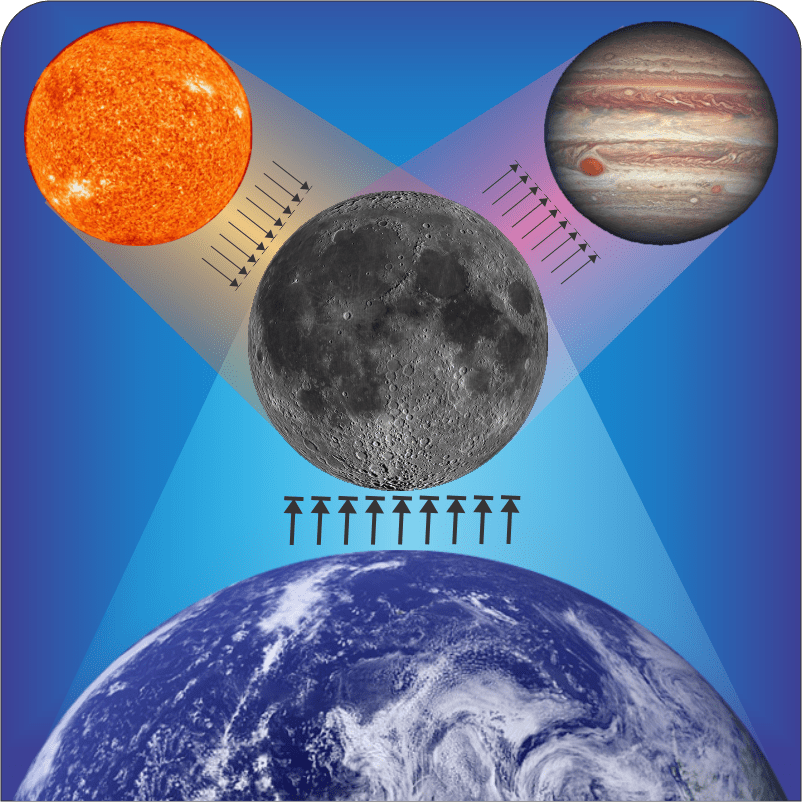
“Al read in one of his astronomy magazines that the Moon’s drifting away from us. Is that true, and if it is, how’s it happen? Al thinks Jupiter’s gravity’s lifting it but I think it’s because of Solar winds pushing it. So which is it?”

“Here you go, Sy, straight from the bottom of the pot.”

“Perfect, Al, thanks. Yes, it’s true. The drift rate is about 1¼ nanometers per second, 1½ inches per year. As to your argument, you’re both wrong.”

“Huh?”
 ”Aw, c’mon!”

“Al, let’s put some numbers to your hypothesis. <pulling out Old Reliable and screen‑tapping> I’m going to compare Jupiter’s pull on the Moon to Earth’s when the two planets are closest together. OK?”

“I suppose.”

“Alright. Newton’s Law tells us the pull is proportional to the mass. Jupiter’s mass is about 320 times Earth, which is pretty impressive, right? But the attraction drops with the square of the distance. The Moon is 1¼ lightseconds from Earth. At closest approach, Jupiter is almost 2100 lightseconds away, 1680 times further than the Moon. We need to divide the 320 mass factor by a 1680‑squared distance factor and that makes <key taps> Jupiter’s pull on the Moon is only 0.011 percent of Earth’s. It’ll be <taps> half that when Jupiter’s on the other side of the Sun. Not much competition, eh?”

“Yeah, but a little bit at a time, it adds up.”

“We’re not done yet. The Moon feels the big guy’s pull on both sides of its orbit around Earth. On the side where the Moon’s moving away from Jupiter, you’re right, Jupiter’s gravity slows the Moon down, a little. But on the moving-toward-Jupiter side, the motion’s sped up. Put it all together, Jupiter’s teeny pull cancels itself out over every month’s orbiting.”

“Gotcha, Al. So what about my theory, Sy?”

“Basically the same logic, Vinnie. The Solar wind varies, thanks to the Sun’s variable activity, but satellite measurements put its pressure somewhere around a nanopascal, a nanonewton per square meter. Multiply that by the Moon’s cross‑sectional area and we get <tap, tap> a bit less than ten thousand newtons of force on the Moon. Meanwhile, Newton’s Law says the Earth’s pull on the Moon comes to <tapping>
  G×(Earth’s mass)×(Moon’s mass)/(Earth-Moon distance)²
and that comes to 2×10¹¹ newtons. Earth wins by a 107‑fold landslide. Anyway, the pressure slows the Moon for only half of each month and speeds it up the other half so we’ve got another cancellation going on.”

“So what is it then?”
 ”So what is it then?”

“Tides. Not just ocean tides, rock tides in Earth’s fluid outer mantle. Earth bulges, just a bit, toward the Moon. But Earth also rotates, so the bulge circles the planet every day.”

“Reminds me of the wave in the Interstellar movie, but why don’t we see it?”

“The movie’s wave was hundreds of times higher than ours, Al. It was water, not rock, and the wave‑raiser was a huge black hole close by the planet. The Moon’s tidal pull on Earth produces only a one‑meter variation on a 6,400,000‑meter radius. Not a big deal to us. Of course, it makes a lot of difference to the material that’s being kneaded up and down. There’s a lot of friction in those layers.”

“Friction makes heat, Sy. Rock tides oughta heat up the planet, right?”

“Sure, Vinnie, the process does generate heat. Force times distance equals energy. Raising the Moon by 1¼ nanometers per second against a force of 2×10²¹ newtons gives us <taping furiously> an energy transfer rate of 4×10‑23 joules per second per kilogram of Earth’s 6×1024‑kilogram mass. It takes about a thousand joules to heat a kilogram of rock by one kelvin so we’re looking at a temperature rise near 10‑27 kelvins per second. Not significant.”

“No blaming climate change on the Moon, huh?”

~~ Rich Olcott

The Latte Connection

An early taste of Spring’s in the air so Al’s set out tables in front of his coffee shop. I’m enjoying my usual black mud when the Chemistry Department’s Susan Kim passes by carrying her usual mocha latte. “Hi, Sy, mind if I take the socially distant chair at your table?”

“Be my guest, Susan. What’s going on in your world?”

“I’ve been enjoying your hysteresis series. It took me back to Physical Chemistry class. I’m intrigued by how you connected it to entropy.”

“How so?”

“I think of hysteresis as a process, but entropy is a fixed property of matter. If I’m holding twelve grams of carbon at room temperature, I know what its entropy is.”

“Mmm, sorta. Doesn’t it make a difference whether the carbon’s a 60‑carat diamond or just a pile of soot?”

“OK, I’ll give you that, the soot’s a lot more random than the diamond so its entropy is higher. The point remains, I could in principle measure a soot sample’s heat capacity at some convenient temperature and divide that by the temperature. I could repeat that at lower and lower temperatures down to near absolute zero. When I sum all those measurements I’ll have the entropy content of the sample at my starting temperature.”

“A classical definition, just what I’d expect from a chemist. But suppose your soot spills out of its test tube and the breeze spreads it all over the neighborhood. More randomness, higher entropy than what you measured, right?”

“Well, yes. I wouldn’t have a clue how to calculate it, but that goes way beyond Carnot’s and Clausius’ original concept.”

“So entropy has at least a thin linkage with history and hysteresis. To you chemists, though, an element or compound is timeless — lead or water have always been lead or water, and their physical constants are, well, constant.”

“Not quite true, Sy. Not with really big molecules like proteins and DNA and rubber and some plastics. Squirt a huge protein like catalase through a small orifice and its properties change drastically. It might not promote any reaction, much less the one Nature designed it for. Which makes me think — Chemistry is all about reactions and they take time and studying what makes reactions run fast or slow is a big part of the field. So we do pay attention to time.”

“Nice play, Susan! You’re saying small molecules aren’t complex enough to retain memories but big ones are. I’ll bet big molecules probably exhibit hysteresis.”

“Sure they do. Rubber molecules are long-chain polymers. Quickly stretch a rubber band to its limit, hold it there a few seconds then let go. Some of the molecular strands lock into the stretched configuration so the band won’t immediately shrink all the way down to its original size. There’s your molecular memory.”

“And a good example it is — classic linear Physics. How much force you exert, times the distance you applied it through, equals the energy you expended. Energy’s stored in the rubber’s elasticity when you stretch it, and the energy comes back out on release.”

“Mostly right, Sy. You actually have to put in more energy than you get out — Second Law of Thermodynamics, of course — and the relationship’s not linear. <rummaging into purse> Thought I had a good fat rubber band somewhere … ah‑hah! Here, stretch this out while you hold it against your forehead. Feel it heat up briefly? Now keep checking for heat while you relax the band.”

“Hey, it got cold for a second!”

“Yep. The stretched-out configuration is less random so its entropy and heat capacity are lower than the relaxed configuration’s. The stretched band had the same amount of heat energy but with less heat required per degree of temperature, that amount of energy made the band hotter. Relaxing the band let its molecules get less orderly. Heat capacity went back up. temperature went back down.”

“Mmm-HM. My hysteresis diagram’s upward branch is stretch energy input and the downward branch is elastic energy output. The energy difference is the area inside the hysteresis curve, which is what’s lost to entropy in each cycle and there we have your intriguing entropy‑hysteresis connection. Still intrigued?”

“Enough for another latte.”

~~ Rich Olcott

Diamonds in The Tough

“Excuse me, they said there’s a coffee shop over here somewhere. Could you please point me to it?”

“Sure. Al’s place is right around the next corner, behind the Physics building. I’ll walk you over there.”

“Oh, I don’t want to bother you.”

“No bother, it’s my coffee time anyway. Hi, Al, new customer for you.”

“Hi, Sy. What’ll it be, Ms … ?”

“I’m Susan, Susan Kim. A mocha latte, please, Al. And you’re Sy …?”

“Moire. Sy Moire, Consulting Physicist. Who’s the ‘they’ that told you about Al’s?”

“An office staffer in the Chemistry Department. I just joined the research faculty over there.”

Al’s ears perk up. “A chemist, at last! For some reason they don’t show up over here very much.”

“Hah, I bet it’s because they’re used to drinking lab coffee from beakers.”

“As a matter of fact, Sy, I do have a coffee beaker. A glass‑worker friend added a very nice handle to a 500‑milliliter beaker for me. It’s not unpacked yet which is why I was looking for a coffee shop. This latte is very good, Al, better than lab coffee any day.”

“Thanks. So what’s the news in Science, guys?”

“Mmm… On Mars, the Insight mission‘s ‘mole’ thermal probe has finally buried itself completely, on its way down we hope to its targeted 5‑meter depth. And the OSIRIS‑REx mission to Asteroid Bennu successfully collected maybe a little too much asteroid sample. One rock fragment blocked the sampler’s lid like a bit of souvenir sticking out of a tourist’s carry‑on bag. Fortunately the engineers figured out how to stow the stuff more neatly for the two‑year trip back home. How about in the Chemistry world, Susan?”

“Hmm… Ranga Dias and his team at the University of Rochester used a diamond anvil cell to—”

“Wait — a diamond anvil? Like the Village Blacksmith but made of diamond?”

“No, Al, nothing like that. Diamond is the hardest substance we know of, right? A DAC uses a pair of quarter‑carat gem‑quality diamonds pushing against each other to create a small volume of crazy high pressure in the space between them, up into the million‑atmosphere range. Here, I’ve got a gorgeous photo of one on my phone…

Diamond anvil cell, photo by J. Adam Fenster / University of Rochester

“To give you an idea of the scale, that square black gasket between the two diamonds is a piece of rhenium metal foil that’s a quarter of a millimeter thick. The reaction vessel itself is a hole they spark-drilled through the gasket. This is teeny, nanoliter chemistry.”

“OK, they’re small diamonds, but .. DIAMONDS! I bet they crack some of them. That’s got to be ex‑PENsive, our tax dollars going CRUNCH!.”

“Not really. You’re right, some do crack, up around the seven million atmosphere mark. But here’s the fun part — the researchers don’t pay market price for those diamonds. They come from the government’s stock of smuggled goods that Customs agents have confiscated at the border.”

“Why go to all that trouble? What’s wrong with test tubes and beakers?”

“Because not all chemistry takes place at atmospheric pressure, Sy. High pressure crams molecules closer together. They get in each other’s way, maybe deform each other enough to react in ways that they wouldn’t under conditions we’d call ‘normal.’ Even water has something like 17 different forms of ice under different pressure‑temperature conditions. The whole discipline of high‑pressure chemistry got started because the seismologists needed to know how minerals transform, melt, flow and react under stress. The thing about diamond is that it doesn’t transform, melt, flow or react.”

“Oo, oo, you can see through a diamond, sorta. I’ll betcha people pipe laser beams down them, right?”

“Absolutely, Al. Before lasers came along researchers were using regular light and optics to track events in a pressurized DAC. Lasers and fiber optics completely changed the game. Not just for observation — you can use intense light to heat things up, get them even closer to deep‑Earth conditions.”

“I suppose chemists are like physicists — once a new tool becomes available everybody dives in to play.”

“You know it. There’s thousands of papers out there detailing work that used a DAC.”

“So what did Dias report on?”

~~ Rich Olcott

A Star’s Tale

It’s getting nippy outside so Al’s moved his out‑front coffee cart into his shop. Jeremy’s manning the curbside take‑out window but I’m walking so I step inside. Limited seating, of course. “Morning, Al. Here’s my hiking mug, fill ‘er up with high‑test and I’ll take a couple of those scones — one orange, one blueberry. Good news that the Governor let you open up.”

“You know it, Sy. Me and my suppliers have been on the phone every day. Good thing we’ve got long‑term relationships and they’ve been willing to carry me but it gets on my conscience ’cause they’re in a crack, too, ya know?”

“Low velocity of money hurts everybody, Al. Those DC doofuses and their political kabuki … but don’t get me started. Hey, you’ve got a new poster over the cash register.”

“You noticed. Yeah, it’s a beaut. Some artist’s idea of what it’d look like when a star gets spaghettified and eaten by a black hole. See, it’s got jets and a dust dusk and everything.”

“Very nice, except for a few small problems. That’s not spaghettification, the scale is all wrong and that tail-looking thing … no.”

Artist’s impression of AT2019qiz. Credit: ESO/M. Kornmesser
Under Creative Commons Attribution 4.0 International License

“Not spaghettification? That’s what was in the headline.”

“Sloppy word choice. True spaghettification acts on solid objects. Gravity’s force increases rapidly as you approach the gravitational center. Suppose you’re in a kilometer-long star cruiser that’s pointing toward a black hole from three kilometers away. The cruiser’s tail is four kilometers out. Newton’s Law of Gravity says the black hole pulls almost twice as hard on the nose as on the tail. If the overall field is strong enough it’d stretch the cruiser like taffy. Larry Niven wrote about the effect in his short story, Neutron Star.”

“The black hole’s stretching the star, right?”

“Nup, because a star isn’t solid. It’s fluid, basically a gas held together by its own gravity. You can’t pull on a piece of gas to stretch the whole mass. Your news story should have said ‘tidal disruption event‘ but I guess that wouldn’t have fit the headline space. Anyhow, an atom in the star’s atmosphere is subject to three forces — thermal expansion away from any gravitational center, gravitational attraction toward its home star and gravitational attraction toward the black hole. The star breaks up atom by atom when the two bodies get close enough that the black hole’s attraction matches the star’s surface gravity. That’s where the scale problem comes in.”

Al looks around — no waiting customers so he strings me along. “How?”

“The supermassive black hole in the picture, AT2019qiz, masses about a million Suns‑worth. The Sun‑size star can barely hold onto a gas atom at one star‑radius from the star’s center. The black hole can grab that atom from a thousand star‑radii away, about where Saturn is in our Solar System. The artist apparently imagined himself to be past the star and about where Earth is to the Sun, 100 star‑radii further out. Perspective will make the black hole pretty small.”

“But that’s a HUGE black hole!”

“True, mass‑wise, not so much diameter‑wise. Our Sun’s about 864,000 miles wide. If it were to just collapse to a black hole, which it couldn’t, its Event Horizon would be about 4 miles wide. The Event Horizon of a black hole a million times as massive as the Sun would be less than 5 times as wide as the Sun. Throw in the perspective factor and that black circle should be less than half as wide as the star’s circle.”

“What about the comet‑tail?”

“The picture makes you think of a comet escaping outward but really the star’s material is headed inward and it wouldn’t be that pretty. The disruption process is chaotic and exponential. The star’s gravity weakens as it loses mass but the loss is lop‑sided. Down at the star’s core where the nuclear reactions happen the steady burn becomes an irregular pulse. The tail should flare out near the star. The rest should be jagged and lumpy.”

“And when enough gets ripped away…”

“BLOOEY!”

~~ Rich Olcott

  • Thanks to T K Anderson for suggesting this topic.
  • Link to Technical PS — Where Do Those Numbers Come From?.

A Turn to The Urn

Working under social distancing rules, Al’s selling coffee from a drive-up cart in front of his shop — urns, paper cups, everything at arms length. No cash register, credit or debit transactions only. “Give me my usual, Al. I miss the mugs; your brews just don’t taste the same in paper.”

“I know, Sy, but what can you do? Say, I’ve been reading your stuff with the sort‑of overlaps between Physics and Economics. Beyond your usual orbital? <heh, heh>”

“Very funny, Al. Yeah, a little, but it’s giving me some new perspectives on old ground.”

“Oh, yeah? What’s next?”

“Fluid mechanics, for instance. Ever notice how many money terms relate to water? ‘Cash flow,’ of course, but there’s also ‘liquidity,’ ‘frozen assets,’ ‘drowning in debt,’ a long list, so I decided to chase that metaphor, see how well it holds up. There’s a lot of Physics on your coffee cart, for instance.”

“Well, it’s heavy, I’ll tell you that.”

“Sure, but how about that glass tube that tells you how full the urn is? The Egyptians were using the principle thousands of years ago but Pascal put it on a firm theoretical basis before Newton got a chance to.”

“There’s theory in that thing?”

“Sure. There’s a pipe from the urn to the little tube, right, so all the liquid is connected. Pascal proved that the pressure on every little packet of fluid anywhere in a connected system has to be the same, otherwise fluid would flow to wherever the pressure is least and even things out. Pressure at the bottom of any skinny vertical column comes from atmospheric pressure plus the pull of gravity on the liquid in that column. It takes 33 feet of water to balance normal atmospheric pressure. For columns the size of your urn gravity’s contribution is less than 3% of atmospheric so the atmosphere rules. Pressure on the tube is the same as pressure on the urn so the two have to be at the same height. When the urn’s low, the tube’s low because Physics.”

“Cool, though when you look at it that way it seems obvious.”

“The good explanations often are. It takes a Pascal or a Newton to make it obvious.”

“So what’s this got to do with Economics?”

“Pascal’s principle supplied a fundamental assumption about how market‑based systems are supposed to work. Not with water, but with money — and instead of pressure there’s profit potential. The idea is that just like water will flow everywhere in a connected system until the pressure is equalized, money will flow everywhere in an economy until no‑one thinks they can make more profit in one place than in another. It’s more complicated than your coffee urn, though.”

“I expect so — lots more opportunities.”

“Well, yes, but the force‑equivalent is more complicated, too. Gravity and atmospheric pressure both exert force in the same direction. When you’re considering an investment, what do you think about?”

“The net profit, of course — how much I could make against what it’ll cost me to get in.”

“How about risk?”

“Three guesses why I’m doing this no-cash. I know what you mean though — like what if this electric cord overheats and burns the place down. Not likely, I checked the wire gauge and the circuit box.”

“Good strategy — look at all the things that can go wrong and address what you can control. But there’s uncontrolables, right? From an Economics perspective, you need to put each risk in money terms. Take the likelihood that something bad will happen, multiply by the monetary loss if it does happen and you get monetary risk you’ve got to figure against that expected net profit. My point is that the Economics version of Pascal’s principle has to take account of forces that pull money towards an investment option AND forces that push money away.”

“Two-way stretch, huh?”

“Absolutely. Take a look at a stock or bond prospectus some day. You’ll see risk categories you’ve never even heard of. Bond analysts have a field day with that kind of stuff. Their job is to calculate likely growth and cash yield against likely risk and come up with a price.”

“Risky business.”

“Always the joker, Al.”

~~ Rich Olcott

The Buck Rolls On, We Hope

<knock, knock> “Door’s open. Come in but maintain social distance.”

“Hiya, Sy. Here’s your pizza, still hot and everything but no pineapple.”

“Thanks, Eddie. Just put it on the credenza. There’s a twenty there waiting for you. Put the balance on my tab.”

“Whoa, I recognize this bill. It’s the one that Vinnie won off me at the after‑hours dice game last month before all this started. See, I initialed it down here on the corner ’cause Vinnie usually don’t do that well. How’d you get it from him?”

“I didn’t get it from Vinnie, I got it from Al when I sold him a batch of old astronomy magazines. Vinnie must have finally paid off his tab at Al’s coffee shop.”

“Funny how that one bill just went in a circle. Financed some risky business, paid off a loan, bought stuff, and here I get it again so I can buy stuff to make more pizza. That’s a lotta work for one piece of paper.”

“Mm-hm. Everyone’s $20 better off now, all because the bill kept moving. Chalk it off to ‘the velocity of money.‘ If Vinnie didn’t spend that money the velocity’d be zero and none of the rest would have happened.”

“That sounds suspiciously like Physics, Sy.”

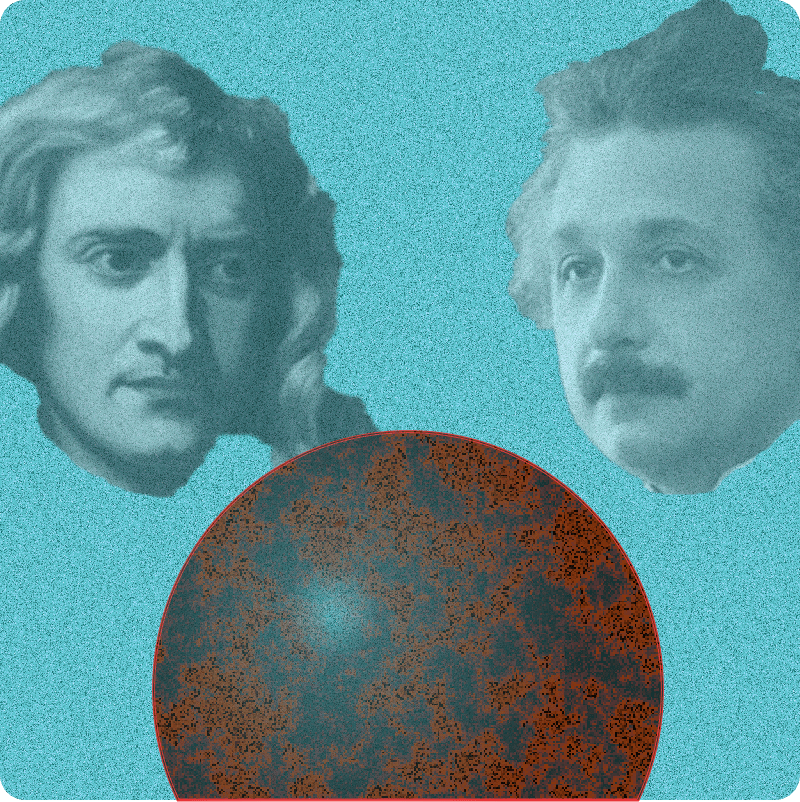
“Guilty as charged, Eddie. Just following along with what Isaac Newton started back when he was staying at his mother’s place, hiding out from the bubonic plague.”

Newton, after a day at the beach
while wearing an anti-viral mask

“What’s that got to do with money? Was Newton a banker?”

“Not quite, although the last 30 years of his life he headed up England’s Royal Mint. The core of his work during his Science years was all about change and rate of change. His Laws of Motion quantified what it takes to cause change. He developed his version of calculus to bridge between how fast change happens and how much change has happened.”

“Hey, that’s those graphs you showed me, with the wave on the top line and the slope underneath.”

“Bingo. Pandemics are a long way from the simple systems that Newton studied, but the important point is that to study his planets and pendulums he developed general strategies for tackling complex situations. He started with just a few basic concepts, like position and speed, and expanded on them.”

“Speed’s speed, what’s to expand?”

“Newton expanded the notion of speed to velocity, which also includes direction. From Newton’s point of view, the velocity of a planet in orbit is continuously changing even if its miles per hour is as steady as … a planet.”

“Who cares?”

“Newton did, because he wanted to know what makes the change happen. His starting point was if there’s any motion, it’s got to be at constant speed and in a straight line unless some force causes a velocity change. That’s where his notion of gravity came from — he invented the idea of ‘the force of gravity‘ to account for us not flying off the rotating Earth and the Earth not zooming away from the Sun. His methods set the model that physicists have followed ever since — if we see motion, we measure how fast it’s happening and then we look for the force or forces that can explain that.”

“Now I see where you’re going. That ‘velocity of money‘ thing is about how fast the paper changes hands, isn’t it? Wait, if Vinnie had put that twenty up on his wall as a trophy, then the chain would’ve been broken.”

“Right, or if Al had diverted it to buy, say, coffee beans. That’s why we say velocity of money and not speed, because the direction of flow counts.”

“Smelling more and more like Physics, Sy. Like, there’s astrophysics and biophysics and you’re coming up with econophysics.”

“Well, yeah, but I didn’t invent the term. It’s already out there, with textbooks and academic study groups and everything. It’s just interesting to use economics as a metaphor for physics and vice-versa. The fun is in seeing where the metaphors break down.”

“I see one already, Sy. Those forces — we all had different reasons to kick the bill along.”

“Good point. Now we figure out those forces.”

~~ Rich Olcott

Myopic Astronomy

Cathleen goes into full-on professor mode. “OK folks, settle down for the final portion of “IR, Spitzer and The Universe,” our memorial symposium for the Spitzer Space Telescope which NASA retired on January 30. Jim’s brought us up to speed about what infra-red is and how we work with it. Newt’s given us background on the Spitzer and its fellow Great Observatories. Now it’s my turn to show some of what Astronomy has learned from Spitzer. Thousands of papers have been published from Spitzer data so I’ll just skim a few highlights, from the Solar System, the Milky Way, and the cosmological distance.”

“Ah, Chinese landscape perspective,” murmurs the maybe-an-Art-major.

“Care to expand on that?” Cathleen’s a seasoned teacher, knows how to maintain audience engagement by accepting interruptions and then using them to further her her own presentation.

“You show detail views of the foreground, the middle distance and the far distance, maybe with clouds or something separating them to emphasize the in‑between gaps.”

“Yes, that’s my plan. Astronomically, the foreground would be the asteroids that come closer to the Earth than the Moon does. Typically they reflect about as much light as charcoal so our visible-light telescopes mostly can’t find them. But even though asteroids are as cold as interplanetary space that’s still above absolute zero. The objects glow with infra-red light that Spitzer was designed to see. It found hundreds of Near-Earth Objects as small as 6 meters across. That data helped spark disaster movies and even official conversations about defending us from asteroid collisions.”

<A clique in the back of the room> “Hoo-ahh, Space Force!

Some interruptions she doesn’t accept. “Pipe down back there! Right, so further out in the Solar System, Spitzer‘s ability to detect glowing dust was key to discovering a weird new ring around Saturn. Thanks to centuries of visible‑range telescope work, everyone knows the picture of Saturn and its ring system. The rings together form an annulus, an extremely thin circular disk with a big round hole in the middle. The annulus is bright because it’s mostly made of ice particles. The annulus rotates to match Saturn’s spin. The planet’s rotational axis and the annulus are both tilted by about 27° relative to Saturn’s orbit. None of that applies to what Spitzer found.”

Vinnie’s voice rings out. “It’s made of dust instead of ice, right ?”

Cathleen recognizes that voice. “Good shot, Vinnie, but the differences don’t stop there. The dust ring is less a disk than a doughnut, about 200 thousand times thicker than the icy rings and about 125 times wider than the outermost ice ring. But the weirdest part is that the doughnut rotates opposite to the planet and it’s in Saturn’s orbital plane, not tilted to it. It’s like the formation’s only accidentally related to Saturn. In fact, we believe that the doughnut and its companion moon Phoebe came late to Saturn from somewhere else.”

She takes a moment for a sip of coffee. “Now for the middle distance, which for our purpose is the stars of the Milky Way. Spitzer snared a few headliners out there, like TRAPPIST-1, that star with seven planets going around it. Visible-range brightness monitoring suggested there was a solar system there but Spitzer actually detected light from individual planets. Then there’s Tabby’s Star with its weird dimming patterns. Spitzer tracked the star’s infra‑red radiance while NASA’s Swift Observatory tracked the star’s emissions in the ultra‑violet range. The dimming percentages didn’t match, which ruled out darkening due to something opaque like an alien construction project. Thanks to Spitzer we’re pretty sure the variation’s just patchy dust clouds.”

Spitzer view of the Trifid Nebula
Credit: NASA/JPL-Caltech/J. Rho (SSC/Caltech)

<from the crowd in general> “Awww.”

“I know, right? Anyway, Spitzer‘s real specialty is inspecting warm dust, so no surprise, it found lots of baby stars embedded in their dusty matrix. Here’s an example. This image contains 30 massive stars and about 120 smaller ones. Each one has grown by eating the dust in its immediate vicinity and having lit up it’s now blowing a bubble in the adjacent dust.” <suddenly her cellphone rings> “Oh, sorry, this is a call I’ve got to take. Talk among yourselves, I’ll be right back.”

~~ Rich Olcott

The Fourth Brother’s Quest

Newt Barnes is an informed and enthusiastic speaker in Cathleen’s “IR, Spitzer and the Universe” memorial symposium. Unfortunately Al interrupts him by bustling in to refresh the coffee urn.

After the noise subsides, Newt picks up his story. “As I was saying, it’s time for the Spitzer‘s inspirational life story. Mind you, Spitzer was designed to inspect very faint infra-red sources, which means that it looks at heat, which means that its telescope and all of its instruments have to be kept cold. Very cold. At lift-off time, Spitzer was loaded with 360 liters of liquid helium coolant, enough to keep it below five Kelvins for 2½ years.”

“Kelvins?”

“Absolute temperature. That’d be -268°C or -450°F. Very cold. The good news was that clever NASA engineers managed to stretch that coolant supply an extra 2½ years so Spitzer gave us more than five years of full-spectrum IR data.”

<mild applause>

“Running out of coolant would have been the end for Spitzer, except it really marked a mid-life transition. Even without the liquid helium, Spitzer is far enough from Earth’s heat that the engineers could use the craft’s solar arrays as a built-in sunshield. That kept everything down to about 30 Kelvins. Too warm for Spitzer‘s long-wavelength instruments but not too warm for its two cameras that handle near infra-red. They chugged along just fine for another eleven years and a fraction. During its 17-year life Spitzer produced pictures like this shot of a star-forming region in the constellation Aquila…”

NASA/JPL-Caltech/Milky Way Project.

The maybe-an-Art-major goes nuts, you can’t even make out the words, but Newt barrels on. “Here’s where I let you in on a secret. The image covers an area about twice as wide as the Moon so you shouldn’t need a telescope to spot it in our Summertime sky. However, even on a good night you won’t see anything like this and there are several reasons why. First, the light’s very faint. Each of those color-dense regions represents a collection of hundreds or thousands of young stars. They give off tons of visible light but nearly all of that is blocked by their dusty environment. Our nervous system’s timescale just isn’t designed for capturing really faint images. Your eye acts on photons it collects during the past tenth of a second or so. An astronomical sensor can focus on a target for minutes or hours while it accumulates enough photons for an image of this quality.”

“But you told us that Spitzer can see through dust.”

“That it can, but not in visible colors. Spitzer‘s cameras ignored the visible range. Instead, they gathered the incoming infrared light and separated it into three wavelength bands. Let’s call them long, medium and short. In effect, Spitzer gave us three separate black-and-white photos, one for each band. Back here on Earth, the post-processing team colorcoded each of those photos — red for long, green for medium and blue for short. Then they laid the three on top of each other to produce the final image. It’s what’s called ‘a falsecolor image’ and it can be very informative if you know what to look for. Most published astronomical images are in fact enhanced or colorcoded like this in some way to highlight structure or indicate chemical composition or temperature.”

“What happened after the extra extra years?”

“Problems had just built up. Spitzer doesn’t orbit the Earth, it orbits the Sun a little bit slower than Earth does. It gets further away from us every minute. It used to be able to send us its data almost real-time, but now it’s so far away a 2hour squirt-cast drains its batteries. Recharging the batteries using Spitzer‘s solar arrays tilts the craft’s antenna away from Earth — not good. Spitzer‘s about 120° behind Earth now and there’ll come a time when it’ll be behind the Sun from us, completely out of communication. Meanwhile back on Earth, the people and resources devoted to Spitzer will be needed to run the James Webb Space Telescope. NASA decided that January 30 was time to pull the plug.”

Cathleen takes the mic. “Euge, serve bone et fidélis. Well done, thou good and faithful servant.”

~~ Rich Olcott

A Tale of Four Brothers

Jim hands the mic to Cathleen, who announces, “Bio-break time. Please be back here in 15 minutes for the next speaker. Al will have fresh coffee and scones for us.” <a quarter-hour later> “Welcome back, everyone, to the next session of our ‘IR, Spitzer and the Universe‘ memorial symposium. Our next speaker will turn our focus to the Spitzer Space Telescope itself. Newt?”

“Thanks, Cathleen. Let’s start with a portrait of Spitzer. I’m putting this up because Spitzer‘s general configuration would fit all four of NASA’s Great Observatories…

A NASA artist’s impression of Spitzer against an IR view of the Milky Way’s dust

“Each of them was designed to be carried into space by one of NASA’s space shuttles so they had to fit into a shuttle’s cargo bay — a cylinder sixty feet long and fifteen feet in diameter. Knock off a foot or so each way to allow for packing materials and loading leeway.”

<voice from the crowd> “How come they had to be in space? It’d be a lot cheaper on the ground.”

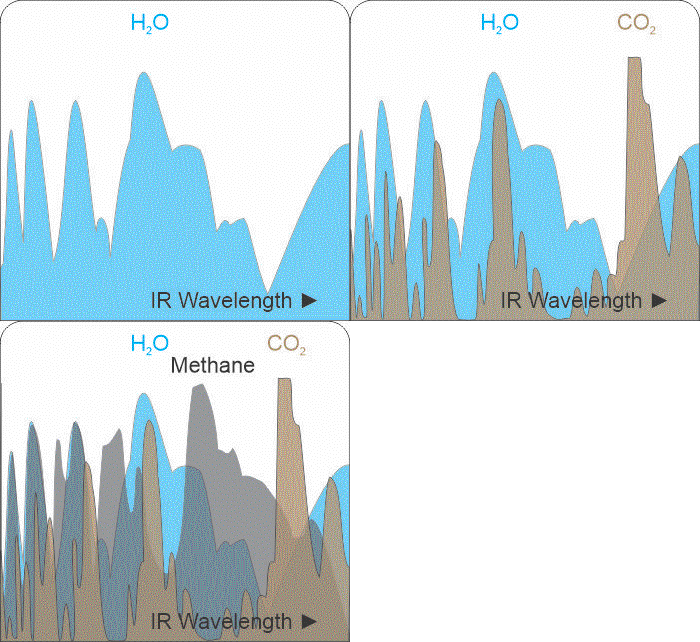
“If you’re cynical you might say that NASA had built these shuttles and they needed to have some work for them to do. But the real reasons go back to Lyman Spitzer (name sound familiar?). Right after World War II he wrote a paper listing the benefits of doing Astronomy outside of our atmosphere. We think Earth’s atmosphere is transparent, but that’s only mostly true and only at certain wavelengths. Water vapor and other gases block out great swathes of the infrared range. Hydrogen and other atoms absorb in the ultraviolet and beyond. Even in the visible range we’ve got dust and clouds. And of course there’s atmospheric turbulence that makes stars twinkle and astronomers curse.”

“So he wanted to put telescopes above all that.”

“Absolutely. He leveraged his multiple high-visibility posts at Princeton, constantly promoting government support of high-altitude Astronomy. He was one of the Big Names behind getting NASA approved in the first place. He lived to see the Hubble Space Telescope go into service, but unfortunately he died just a couple of years before its IR companion was put into orbit.”

“So they named it after him?”

“They did, indeed. The Spitzer was the fourth and final product of NASA’s ‘Great Observatories’ program designed to investigate the Universe from beyond Earth’s atmosphere. The Hubble Space Telescope was first. It was built to observe visible light but it also gave NASA experience doing unexpected inflight satellite repairs. <scattered chuckles in the audience. The maybe-an-Art-major nudges a neighbor for a whispered explanation.> The Atlantis shuttle put Hubble into orbit in 1990. Thirty years later it’s still producing great science for us.”

<The maybe-an-Art-major yells out> “And beautiful pictures!”

“Yes, indeed. OK, a year later Atlantis put Compton Gamma Ray Observatory into orbit. Its sensors covered a huge range of the spectrum, about twenty octaves as Jim would put it, from hard X-rays on upward. In its nine years of life it found nearly 300 sources for those high-energy photons that we still don’t understand. It also detected some 2700 gamma ray bursts and that’s something else we don’t understand other than that they’re way outside our intergalactic neighborhood.”

“Only nine years?”

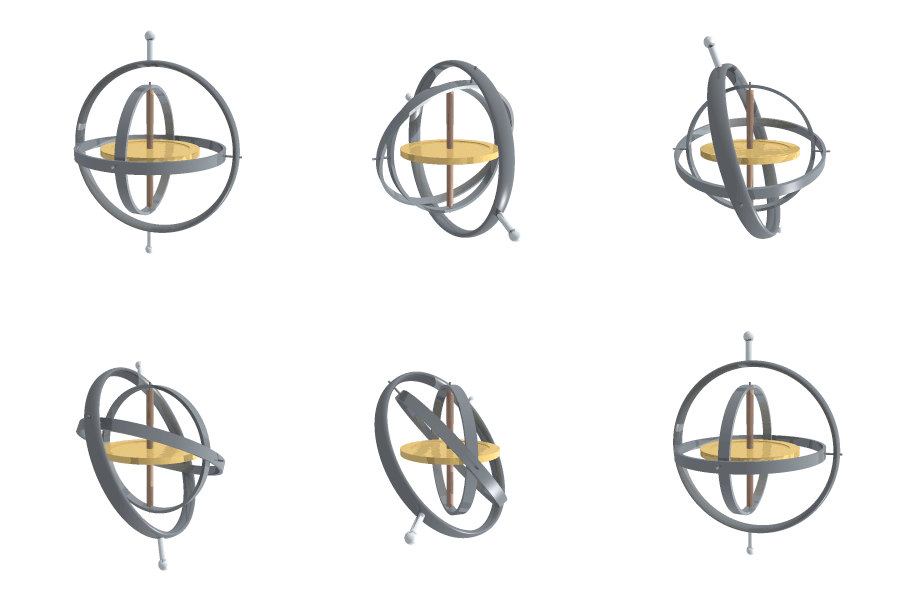
“Sad, right? Yeah, one of its gyroscopes gave out and NASA had to bring it down. Some people fussed, ‘It’ll come down on our heads and we’re all gonna die!‘ but the descent stayed under control. Most of the satellite burned up on re-entry and the rest splashed harmlessly into the Indian Ocean.”

<quiet snuffle>

“Cheer up, it gets better. A month and a half after Compton‘s end, the Columbia shuttle put Chandra X-Ray Observatory into orbit. Like Hubble, Chandra‘s still going strong and uncovering secrets for us. Chandra was first to record X-rays coming from the huge black hole at the Milky Way’s core. Chandra data from the Bullet Cluster helped confirm the existence of dark matter. Thanks to Chandra we understand Jupiter’s X-ray emissions well enough to steer the Juno spacecraft away from them. The good stuff just keeps coming.”

“Thanks, that helps me feel better.”

“Good, because it’s time for the Spitzer‘s inspirational life story.”

~~ Rich Olcott