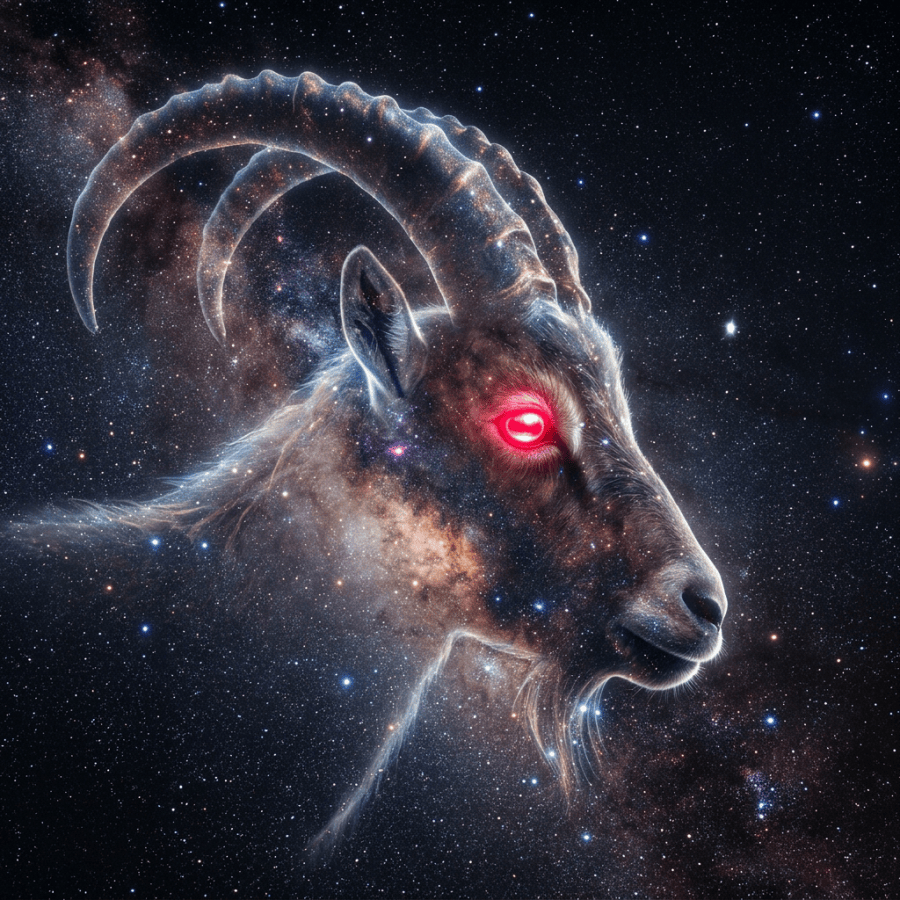
Luminous horned goat head surrounded by stars with one glowing red eye

A Mote in Capricorn’s Eye

<bzzt, bzzt> “You again, Moire. What is it this time?”

“Better get over to my office, Walt. I’ve got some charts you’ll want to see, but you probably don’t want them spread all over.”

“Fifteen minutes. No, make that twenty. Bye.” <click>


Twenty minutes later on the dot, his cane taps my office doorpost. “Let’s see those charts.”

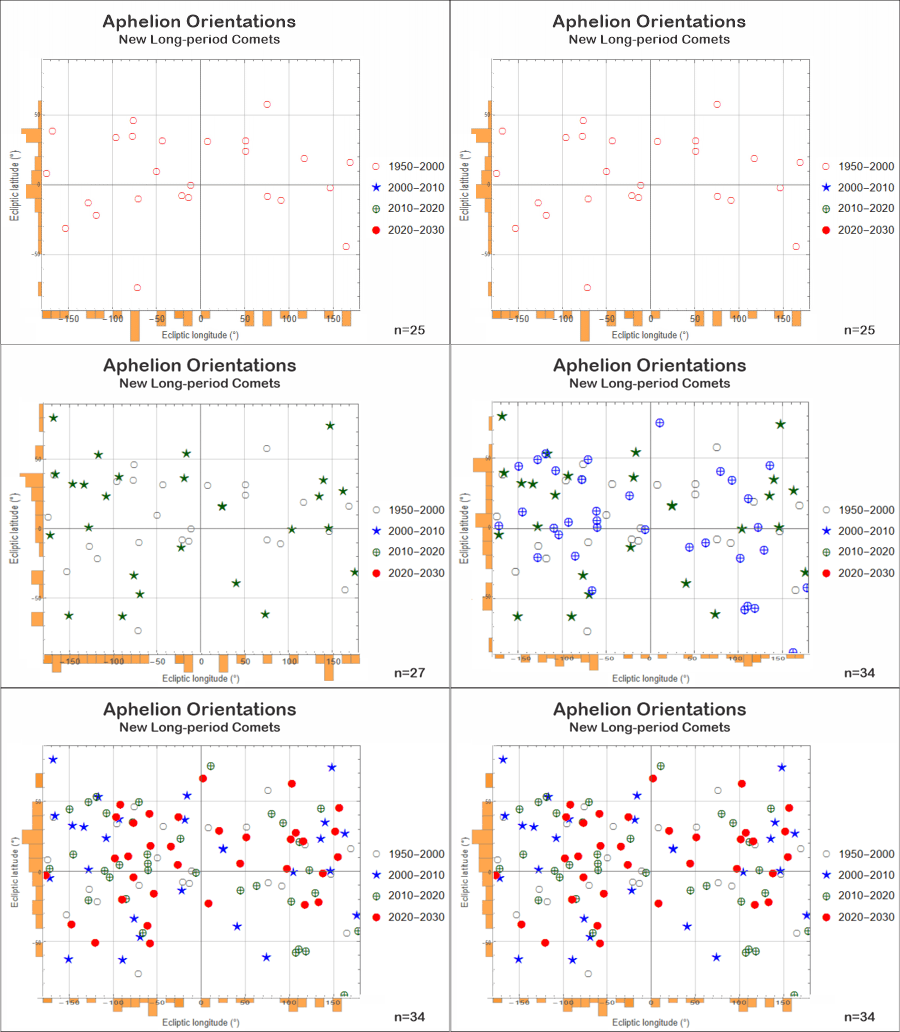
“Let me cast this video from Old Reliable to my wall screen. Watch it while I give you the background.”
“I’ll need background to even read this thing.”

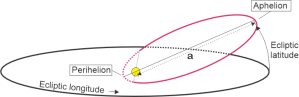
“I figured. Here’s a sketch for vocabulary. The big oval is a comet orbit, though they’re usually a lot skinnier than that, roughly ten times longer than wide. ‘Perihelion’ is Greek for ‘close to the Sun’. The word for its opposite point is ‘aphelion’. Your maybe‑incoming chunk of neutronium would be a quarter the Sun’s mass but far too small to see. Even so, I thought its gravity field could be enough to generate a signal made of long‑period comets kicked inward from the Oort cloud.”
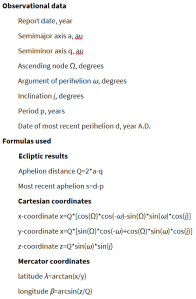
“Ah, that’s why your chart’s doing aphelions. A comet at aphelion far from the Sun would be out in the Oort cloud and vulnerable to being kicked. Side‑to‑side in the chart is east‑west; up top is the Pole Star then down to the southern sky. So what you’re showing me is where in the sky each long‑term comet would be when it’s farthest from the Sun. The markers are pretty much everywhere each decade. What’s with the orange fringes?”

“They’re bar charts to summarize relative comet count in each 10‑degree slice of latitude or longitude. The biggest bar in each longitude set represents 4 comets; the biggest latitude bars represent 6. If comets are coming in randomly around the Equator, the summaries along the bottom would be essentially flat, like it shows for the 50 years starting in 1950.”

“This is the kind of map that stretches Greenland relative to Africa, isn’t it?”

“Mm-hm. The latitude lines are drawn parallel to each other although they actually converge on an spherical surface.”

“So I can correct for that by mentally squeezing distances between latitudes … I’d expect relatively few markers close to the poles compared to what’s near the Equator. Right, that’s roughly the latitude summary pattern given the small sample sizes. But what’s going on after 2010?”
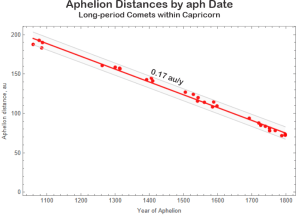
“You noticed that red-dot cluster centered above the Equator at about –75°. It’s in the constellation Capricorn. I asked Old Reliable to select the group between –100° and –50° and chart where and when each comet was at its most recent aphelion. Here’s the result. By the way, the slope estimate is at the 75% confidence level. You don’t often see data as tight as that.”

“Whoa! Around 1100 A.D. something from beyond 200 a.u. in the general direction of Capricorn started knocking long‑period comets down from the Oort cloud. Every century that thing’s gotten 17 a.u. closer which gives us … about 400 years before planetary chaos breaks out. What’s an ‘a.u.’?
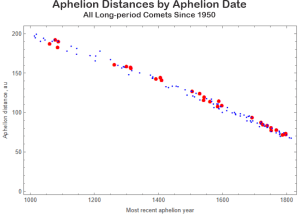
“Astronomical unit, essentially the radius of Earth’s orbit — 140 million kilometers. But here’s a plot of the same variables including all the long‑period comets reported since 1950. The red dots aren’t special; they behave like the general population. Feeling better?”

“Absolutely not. This looks like the entire Oort cloud is collapsing on us!”

“Relax. You’re looking at an observational artifact — a subtle one, the kind that scientists hate but they get their jollies from uncovering one. Especially if it’s someone else’s.”

“How is this an artifact? The dates and distances are right there.”

“The dates hide something deeper. We can’t see these guys at aphelion — they’re dark and far away. Our telescopes can only pick them up when they’re within 5 a.u. of the Sun, 10 a.u. at the most. Five a.u. is less than 3% of a 200‑a.u. orbit. Within a few percent, observation dates are perihelion dates in disguise. The chart’s horizontal axis is really perihelion‑to‑aphelion cycle time. We’ve known since Kepler’s time that more energetic comets fly farther and take longer to return.”

“Hmph. So your red dots are probably just a random eddy in the Oort cloud. Bye.”

~ Rich Olcott
Luminous horned goat head surrounded by stars with one glowing red eye

Neutronium Chill

<chirp, chirp> I recognize the caller’s number. “Afternoon, Walt. Weren’t you going to trash that phone?”

“Afternoon, Moire. I decided to keep it, just for you.”

“Aww.”

“Don’t get cute. My people have a follow-on question for you. The neutronium chunk that might or might not rearrange our Solar System — how much lead time do we have between when we detect it and when things go sour?”

“So many unknowns. The object’s size, its speed, what signal we’re monitoring, even what you mean by ‘go sour’.”

“Yes, yes, very uncertain. Make some assumptions.”

“Big assignment. I’ll start with size. The smallest neutron star we’ve ever seen is about 1.3 solar masses, but Oppenheimer’s calculations say smaller chunks could be stable. Suppose it’s near the theoretical minimum, say about a quarter of a solar mass, maybe 20‑25 kilometers in diameter.”

“A whole neutron star’s about that diameter. This chunk would be a small cast‑off.”

“No, the cast‑off could be wider than its parent. It’s only a fraction of the star’s mass, so there’d be less gravity squeezing its component particles together. Anyway, it’s a reasonable size for calculating the telescopic detection limit.”

“Walk me through that.”

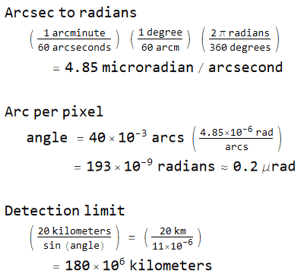
“Sure. Our sharpest telescopes, the Hubble and the Webb, both use detectors that span about about 40 milliarcseconds per pixel‑width.”

” ‘Milli-‘ I get; that’s one one‑thousandth. ‘Arcseconds’?”

“Works like a clock. Sixty arcseconds to an arcminute, sixty arcminutes to a degree. While I’m at it, 360 degrees is full circle is 2π radians. Put it all together, one of those pixels covers about 0.2 microradian across the sky. Now visualize a triangle. One side spans the chunk; the angle opposite it is at Hubble’s detector.”

“A long, pointy triangle.”

“Pointy enough that the angle in radians is essentially equal to its sine and we can do trigonometry. Your question boils down to, how close does the chunk have to be so its light spans a Hubble pixel?” <keyboard clatter> “You’re not going to like this. A 20‑kilometer object casting a one‑pixel figure can’t be more than 180 million kilometers away. That’s already well inside the Solar System, closer to us than the Asteroid Belt. Just a one‑pixel ‘image,’ not a portrait, from our best telescope for visible light.”

“How about another part of the spectrum?”

“I wouldn’t bet on it. The chunk probably radiated X‑rays early on, but it’s had millions of years in interstellar space to cool off.”

“How is it millions? The Crab Nebula hosts a neutron star and its supernova looks pretty random to me. The Nebula could have flung a chunk at us and it’s only 6500 lightyears away.”

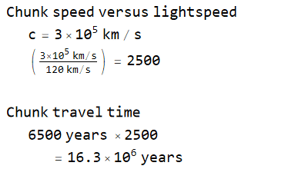
“The fastest interstellar traveler we’ve seen so far is 3I/Atlas, got here from who knows where with a base velocity of 58 kilometers per second. I’ll give you a factor of two — say the Crab flung your chunk at 120 km/sec. That’s still 2500 times slower than lightspeed. At that rate it’d take 16 million years to arrive here. The Crab supernova’s light got here only 970‑some years ago so no chance for an IR‑bright Crab chunk any time soon.”

“Neutrinos?”

“The IceCube Neutrino Observatory detects a million cosmic‑ray muons for every neutrino it sees. Tough odds.”

“Telescopic surveillance isn’t an option. Observing neutrinos is a crapshoot. How about gravitational messing with planet orbits?”

“Something subtler would appear first. Imagine a spherical shell where the inward pull of the Sun’s gravity just equals the outward pull of everything outside.”

“That’d be the outer edge of the Oort Cloud.”

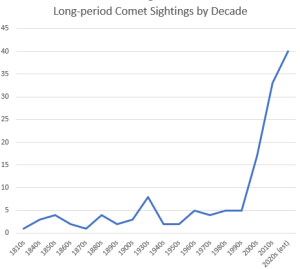
“Pretty much. The chunk will carry its own gravity sphere. Where the two spheres intersect, the opposing gravity fields fight. Some Oort objects fly outward, many drop inward to become long‑period comets. The chunk‑detection signal would be a drastic rise in long‑period comet sightings. Typical long‑period comets take hundreds of years to get down to where we can see them. Nonetheless, we’ve had an upward spike recently.”

“Because of improved technology?”

“Or improved financing. Congress is interested in finding Earth‑threatening asteroids. Look for asteroids, maybe find comets.”

“Lead time in centuries, opening bell may have rung. Bye”

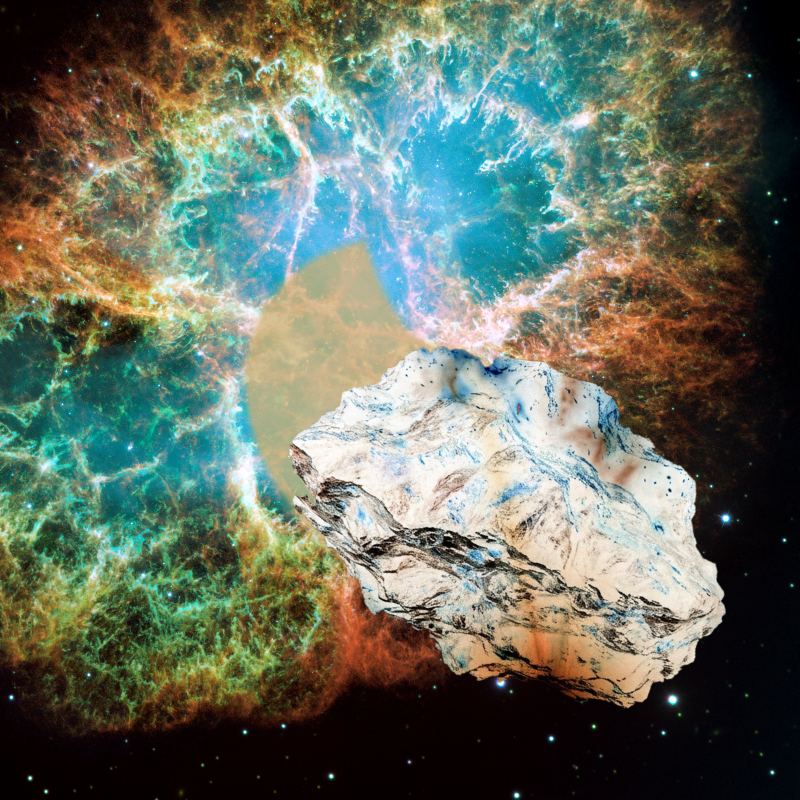
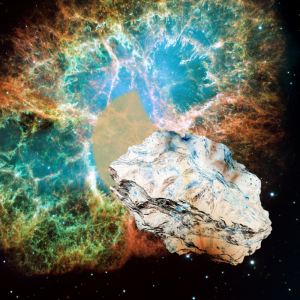
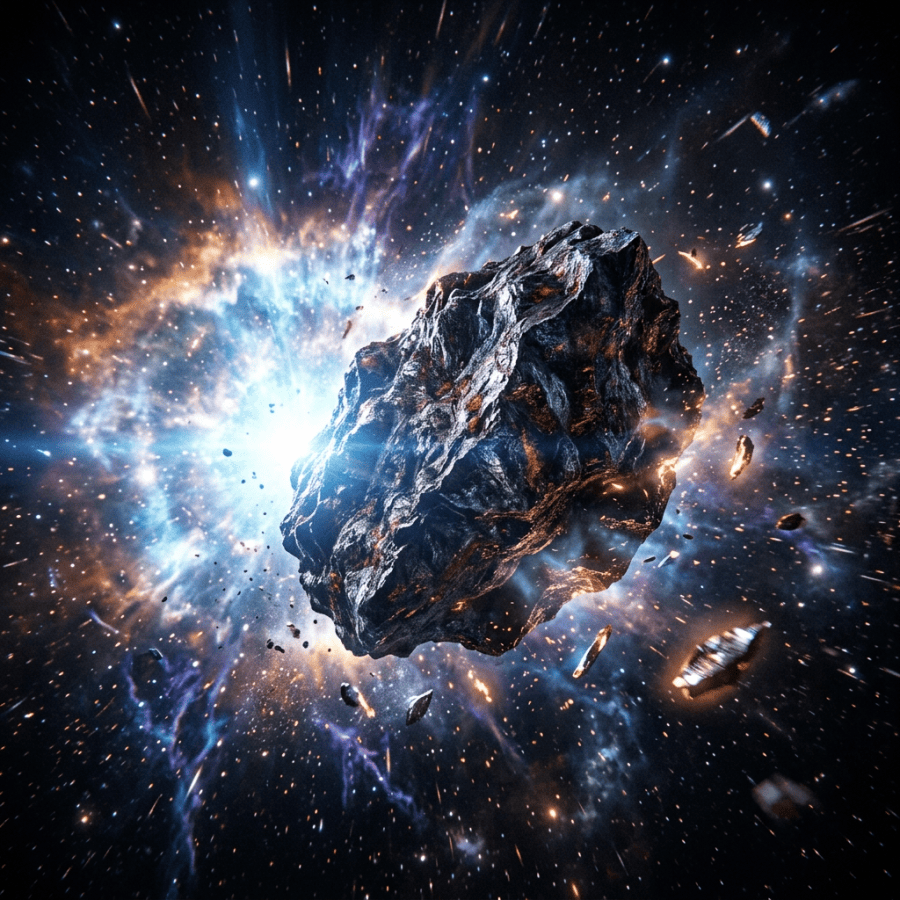
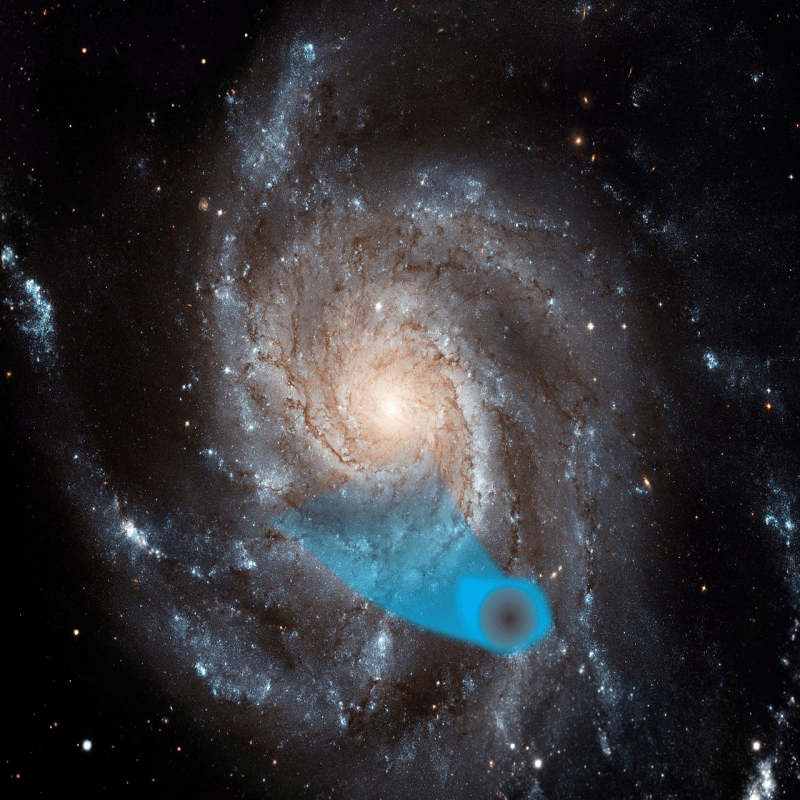
Author’s conception of a neutronium fragment
being expelled from the Crab Nebula.

~ Rich Olcott

A Three Burdens Story

<bzzzt, bzzzt> “Who is this and how did you get this number?”

“Morning, Walt. It’s Sy Moire. Does hitting ‘Reply’ to your entry on my phone log count as spycraft?”

“Drat, another burner phone to trash. Oh well. Why the call?”

“Some history for your neutronium question, may make a difference.”

“Good difference or bad difference?”

“Depends on how you slant it, I suppose. The good news is that detecting that Earth‑threatening lump of neutronium would be easier than I thought. The bad news is that detecting it would be easier than I thought.”

“Forward and backward in the same statement. Unravel that.”

“It all goes back to Oppenheimer—”

“J Robert, the guy who ran the Manhattan Project?”

“The same, except before that he did theoretical Physics, not project management. Probably the most prominent physicist of the 1930s. He was active and influential in everything from molecular quantum mechanics and quantum field theory to astrophysics. He knew pretty much everyone who counted; everyone else knew of him. That made him a natural choice as a recruiter for the Project. I think many people were surprised when he turned out to be a good administrator.”

“Good for him and us. Why drag him into this?”

“He showed how neutron stars and black holes could happen. We’d known since 1915 that black holes were implicit in Einstein’s equations. Einstein himself didn’t think the Universe would allow matter to be that dense. In 1939 Oppenheimer showed how a star’s collapse could compress matter enough for the job. Actually, black holes were the easy part.”

“How could that be easy?”

“A star’s outer layers are supported by thermal pressure from the gas inside, right? When there’s not enough fuel to supply the heat, those outer layers come smashing inward like a roof when you knock out a load‑bearing wall. A big‑enough star would have plenty of gravitational potential energy to crush its core into black‑hole mode. Oppenheimer’s real challenge was explaining why the fall stopped partway for a smaller star. He used a tip from Fermi.”

“Enrico Fermi, the guy who built the nuclear reactor under the football field?”

“The same, except it wasn’t under the field, it was under the bleacher seats, but that’s another story. Anyway, Fermi had applied Pauli’s exclusion principle—”

“Out from the weeds, please.”

“Sorry. A couple of years prior, Fermi had worked out how a gas of quantum particles would behave under compression.”

“We’re talking electron or neutron gases?”

“Those among others. Squeeze a sparse quantum gas and measure the pressure it exerts at each decrease in volume. Pressure times volume is energy. For normal gases, pressure change times volume change at constant temperature is essentially constant. With quantum gases there’s a quantum‑limit pressure where the ΔP×ΔV energy goes nuts regardless of temperature. You need to input drastic amounts of energy to achieve even a small volume decrease. Technically, the limit’s called degeneracy pressure but I’d avoid that term in your report.”

“Because negative electron repels negative electron, naturally.”

“Nope, this is completely quantum, nothing to do with charge. It applies to neutrons just like it does to electrons although the limits are different. Try to cram too many quantum particles into a given volume and something has to give.”

“I see where you’re going. Does that energy limit depend on particle mass?”

“Indeed. Heavier particles have a higher limit.”

“Let me guess. White dwarf stars collapse to the electron limit, neutron stars to the neutron limit, pressure crushing beyond that makes a black hole. That’s what Oppenheimer calculated?”

“Mm‑hm. Better yet, he calculated minimum mass for each object type. That’s where the good‑news/bad‑news comes in. You need a lot of gravitational pressure to maintain a stable neutronium object. Below about a tenth of a solar mass, BLOOEY! If your nasty nova were to fling a too‑small chunk of neutronium at us, the chunk would disintegrate long before it could get this far.”

“So the good‑bad news is, a mass of neutronium could only get near us if it was more than a tenth of the Sun’s mass. Anything that heavy would make noticeable changes to planetary orbits long before we could see it. Bye.” <click>

~ Rich Olcott

Abstract cosmic composition with colorful swirling ribbons, organic forms, and stars

A Cosmic Trattoria

Walt is not amused. ” ‘Not likely but probably’ — what kind of answer is that, Moire? You going for Pratchett’s ‘million-to-one chances crop up nine times out of ten’?”

“You asked me two questions, I gave you two answers. I won’t even bill you for one of them.”

“You know my opinion about lagniappes. We’ll pay for both, but only if we get value.”

“Your first question was, could a nova have flung a chunk of neutronium that’ll hit our Solar System?” <starts tapping on Old Reliable’s screen> “I assume your people are worried about protecting Earth.”

“I neither confirm nor deny that assumption.”

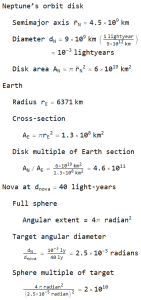
“Either way, by geometry alone the likelihood’s negligible. All our System’s planets and most of the satellites and asteroids and comets are within a few degrees of the Plane of the Ecliptic. Think of everything from Neptune’s orbit inward as a thin flat disk. From above, Earth’s cross‑section area is almost a trillionth of the disk’s area. Suppose your nova is 10 times as far away as our nearest star. Worst case is the nova hanging directly above the Ecliptic. Our disk would be a circular patch in the nova’s sky. If the nova throws a neutronium chunk, it can choose randomly from 20 billion patches the same size as ours; Earth is only a trillionth of one of them. Best case is the nova’s located edge-on to our disk; the odds of a hit would be far smaller. A neutronium chunk striking Earth is a framazillion times less likely than a hit from one of our own near‑Earth asteroids.”

“‘Framazillion.’ I’m going to quote you on that.”

“No extra charge. Now for your second question, whether we could detect a neutronium interloper. Yes, if we’re looking in the right direction with the right detectors.”

“Needs a full-sky survey, obviously, because we have no clue where it’s coming from. What kind of detectors? It’s got to be warmer than empty space. Infrared?”

“Mm-hm. The chunk’s free electrons would shine with black‑body radiation.at all wavelengths but IR’s your best choice.”

“Free electrons? I thought the thing was made of neutrons.”

“Sorry, that’s pop‑sci simplification. The neutrons in a neutronium object are stabilized by gravitational compression, but the gravity field tapers off near the surface. Deep inside you’ve got neutron soup, possibly superfluid, but the particles further up aren’t crowded quite as tightly and have ways of freezing up. There’s a slushy lower crust of nuclear pasta, then an atomic upper crust of iron and its transition‑metal relatives plus some hydrogen and helium. Finally there’s a free‑electron ‘atmosphere’.”

“Wait — nuclear pasta?”

“Technical term, believe it or not. Liquid water and ice make a slush, right, one ingredient occurring in two phases. Water has about 20 different phases—”

“Ice-nine, in Vonnegut’s book.”

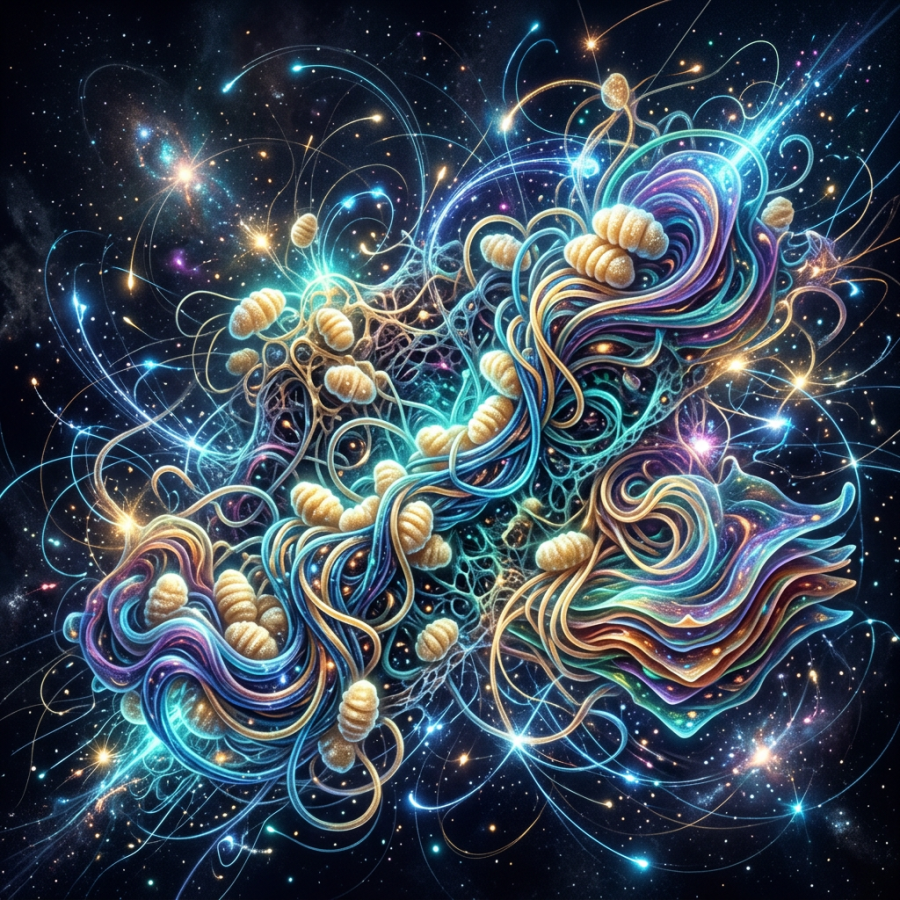
“That’s a plot device, I’m talking real ice here. You get different ices at different temperatures and pressures because the microscopic‑level components re‑arrange. We think neutronium does the same. Near the top of a neutron star’s lower crust, the pressure’s low enough that neutrons and protons can clump together as monster nuclei with a high neutron/proton ratio. Theorists depict them as ‘gnocci‘ (or ‘meatballs’) floating in the uncrystallized neutron phase. Down below where the pressure’s higher, the gnocci phase breaks up to form long thin strands of ‘spaghetti.’ Even further down you get sheets of ‘lasagna’ and so on. Physicists can have fun, too. Anyway, IR detectors would be best because the star’s gravity field redshifts UV and visible black‑body emissions to longer wavelengths. But your problem is, that’s not neutronium‑specific.”

“Right, any warm rock would emit IR. Is there something else?”

“Yes, there is, and we already have the right observatories in place and operating.”

“What do they detect?”

“Neutrinos, the lightest particles we know of, about a millionth the mass of an electron. Every time a proton absorbs an electron and converts to a neutron, neutrinos are emitted. That happens a lot in neutronium; a chunk of it ought to be a bright neutrino source. We’ve got a dozen neutrino telescopes in operation all over the world. If they spot something, you’ll hear about it.”

“Bye.”

“Don’t mention it.”

~ Rich Olcott

Rugged asteroid surrounded by glowing debris in a colorful nebula

Neutral Under Pressure

The Acme Building’s elevator takes me to the 12th floor with no hiccups, for a change. I unlock my office door and there’s “Walt,” standing in the middle of the room brandishing his cane with what looks like a fat cell phone plugged into it somehow. “The place is clean, Mr Moire. No listeners in the elevator shaft, corridor or office space, and I put temporary foam over your windows to block laser‑bounce sound pickup.”

“That’s good to know, Walt. Should I give you credit for fixing the elevator?”

“Not publicly. Found a dark web relay routine freeloading elevator’s controller computer. Disabled it so the machine can do its real job.”

“Nice work. But why so surreptitious? You know I don’t do military consults. And why come up to my office instead of meeting at Eddie‘s or the park as usual?”

“Tradecraft, Mr Moire — never use the same location too often. Espionage is a thing, military or not, and it doesn’t recognize national boundaries. My people have their secrets, too.”

“Naturally. What are your people curious about this time?”

“Neutronium.”

“Neutronium?”

“Yes, what can you tell me about it?”

“It’s really dense. You’ve heard the line that atoms are mostly empty space. An atomic nucleus is maybe a few femtometers across, but it floats in a ball of space that’s a thousand to ten thousand times wider. The space isn’t empty, of course — it’s occupied by spread‑out electronic charge. Neutronium doesn’t have that not‑quite‑empty space. A neutronium ball with the Sun’s mass would be a dozen kilometers across.”

“Mashed‑together charge like a metal. Would neutronium be shiny?”

“Possibly. I’ve never seen any.”

“Are there neutronium ores you could mine for?”

“Not on Earth, guaranteed. Except for the noble metals like gold, ore atoms are isolated from each other, dispersed in minerals like oxides or sulfides. Neutronium by its nature would have to be in a massive isolated deposit.”

“By its nature?”

“An isolated neutron lives about 15 minutes before it spits out an electron and becomes a proton. A neutron near enough to another nuclear particle is stabilized by the weak nuclear force, but that’s ineffective beyond a few femtometers. Either a neutron’s in an atomic nucleus or it’s mashed up against other neutrons in neutronium or it’s dead.”

“How about a chunk of neutronium buried in one of these ultra‑dense asteroids I’ve read about, like 33 Polyhymnia, or 16 Psyche that we’ve sent a space mission to look at?”

“You have read up, haven’t you? Not even those two asteroids are dense enough to host more than a speck of neutronium. Asteroid mass and volume are separate measurements; you need both to figure mass‑per‑volume density. Each component is a challenging exercise in accurate observation. The first guesstimate for Polyhymnia was that it was more than 10 times denser than iron. That’s why you’ve heard of it. With better data now we think both Polyhymnia and Psyche are at about the density of iron. Higher than most but too low for neutronium by a factor of quintillions.”

“Where else could we go for neutronium?”

“This’ll take some background. The more massive the star, the bigger its diameter and the longer it lives, right?”

Walt gives me a suspicious eye. “You’re fudging, Mr Moire.”

“Nothing gets past you, Walt. More massive stars burn hotter. The heat bulges them out, as you’d expect. The fudge is they exhaust their fuel faster so they die sooner. When the fuel gives out and they go nova, big guys collapse harder than smaller ones can. Their collapse squeezes their residual core tighter. Collapsing a really big star crams its remains into a volume smaller than its Schwartzschild radius. That makes a black hole. Smaller stars can’t go that far. The crush might stop when the residue’s electrons are squeezed into its atomic nuclei. Protons there could capture them and become neutrons. If so, you’ve got neutronium and a neutron star.”

“A nova’s pretty violent, shoots material out randomly?”

“One of the sloppiest, most violent events in the Universe.”

“Could a nova have flung a neutronium fragment through our Solar System like something flung ‘Oumuamua? Could we detect that?”

“Not likely but probably.”

~ Rich Olcott

A No-Charge Transaction

“I ain’t done yet, Sy. I got another reason for Dark Matter being made of faster‑then‑light tachyons.”

“I’m still listening, Vinnie.”

“Dark Matter gotta be electrically neutral, right, otherwise it’d do stuff with light and that doesn’t happen. I say tachyons gotta be neutral.”

“Why so?”

“Stands to reason. Suppose tachyons started off as charged particles. The electric force pushes and pulls on charges hugely stronger than gravity pulls—”

“1036 times stronger at any given distance.”

“Yeah, so right off the bat charged tachyons either pair up real quick or they fly away from the slower‑than‑light bradyon neighborhood leaving only neutral tachyons behind for us bradyon slowpokes to look at.”

“But we’ve got un‑neutral bradyon matter all around us — electrons trapped in Earth’s Van Allen Belt and Jupiter’s radiation belts, for example, and positive and negative plasma ions in the solar wind. Couldn’t your neutral tachyons get ionized?”

“Probably not much. Remember, tachyon particles whiz past each other too fast to collect into a star and do fusion stuff so there’s nobody to generate tachyonic super‑high‑energy radiation that makes tachyon ions. No ionized winds either. If a neutral tachyon collides with even a high-energy bradyon, the tachyon carries so much kinetic energy that the bradyon takes the damage rather than ionize the tachyon. Dark Matter and neutral tachyons both don’t do electromagnetic stuff so Dark Matter’s made of tachyons.”

“Ingenious, but you missed something way back in your initial assumptions.”

“Which assumption? Show me.”

“You assumed that tachyon mass works the same way that bradyon mass does. The math says it doesn’t.” <grabbing scratch paper for scribbling> “Whoa, don’t panic, just two simple equations. The first relates an object’s total energy E to its rest mass m and its momentum p and lightspeed c.”

E² = (mc²)² + (pc)²

“I recognize the mc² part, that’s from Einstein’s Equation, but what’s the second piece and why square everything again?”

“The keyword is rest mass.”

“Geez, it’s frames again?”

“Mm‑hm. The (mc²)² term is about mass‑energy strictly within the object’s own inertial frame where its momentum is zero. Einstein’s famous E=mc² covers that special case. The (pc)² term is about the object’s kinetic energy relative to some other‑frame observer with relative momentum p. When kinetic energy is comparable to rest‑mass energy you’re in relativity territory and can’t just add the two together. The sum‑of‑squares form makes the arithmetic work when two observers compare notes. Can I go on?”

“I’m still waitin’ to hear about tachyons.”

“Almost there. If we start with that equation, expand momentum as mass times velocity and re‑arrange a little, you get this formula

E = mc² / √(1 – v²/c²)

The numerator is rest‑mass energy. The v²/c² measures relative kinetic energy. The Lorentz factor down in the denominator accounts for that. See, when velocity is zero the factor is 1.0 and you’ve got Einstein’s special case.”

“Give me a minute. … Okay. But when the velocity gets up to lightspeed the E number gets weird.”

“Which is why c is the upper threshold for bradyons. As the velocity relative to an observer approaches c, the Lorentz factor approaches zero, the fraction goes to infinity and so does the object’s energy that the observer measures.”

“Okay, here’s where the tachyons come in ’cause their v is bigger than c. … Wait, now the equation’s got the square root of a negative number. You can’t do that! What does that even mean?”

“It’s legal, when you’re careful, but interpretation gets tricky. A tachyon’s Lorentz factor contains √(–1) which makes it an imaginary number. However, we know that the calculated energy has to be a real number. That can only be true if the tachyon’s mass is also an imaginary number, because i/i=1.”

“What makes imaginary energy worse than imaginary mass?”

“Because energy’s always conserved. Real energy stays that way. Imaginary mass makes no sense in Newton’s physics but in quantum theory imaginary mass is simply unstable like a pencil balanced on its point. The least little jiggle and the tachyon shatters into real particles with real kinetic energy to burn. Tachyons disintegrating may have powered the Universe’s cosmic inflation right after the Big Bang — but they’re all gone now.”

“Another lovely theory shot down.”

~ Rich Olcott

Got To Be Good-lookin’ ‘Cause He’s So Hard To See

I’ll be sorry when Acme Building’s management swaps out our old‑style door locks for electronic ones. Vinnie has such fun lock‑picking his way past my office door in the morning. “Morning, Vinnie.”

“Morning, Sy. Hey, I got a new Crazy Theory for you. Nobody knows what Dark Matter is, right?”

“Right. All we know is that it has about five times as much mass as normal matter so it participates in gravitational interactions. Some of it seems to gather in spherical halos around galaxies and some of it seems to collect in spikes near their centers. Cosmologists are arguing about whether or not Dark Matter is particles, much less how they’d be quantized. And we call it Dark because it absolutely doesn’t care about electromagnetism.”

“That’s what I thought. I remember you said if Dark Matter did play with light waves at all it’d block our view of the CMB. So yeah, absolute. Good.”

“I gather your theory is about Dark Matter.”

“Mm-hm. I thought of a way that all that mass could be hiding in plain sight except we can’t see it.”

“Alright, I’m listening.”

“Tachyons.”

“Come again?”

“Tachyons — particles that fly around faster than light. I read an article about ’em. Some people say they can’t exist but hear me out, okay? The reason they’re not supposed to exist is ’cause it would take an infinite amount of energy to boost something up past lightspeed. I got that, but suppose they were born above lightspeed, back when the Big Bang singularity had energy packed so tight the Physics laws we know don’t apply. A lot of particles got flung out below lightspeed, but maybe even more got flung out above it.”

“What does this have to do with dark matter?”

“I’m gettin’ there. The thing with tachyons is, the article said it’d take infinite energy to slow one down to lightspeed. A tachyon rock hits a slow rock, it don’t stop ’cause the slow rock don’t have the juice for that. The collision may take a little energy from the tachyon rock but that just changes its trajectory.”

“Mmm, those tachyon rocks can’t be a thing. The — what can I call it? slow matter?”

“The article called ’em bradyons.”

“Thanks. We know that 92% of all … bradyonic atoms in the Universe are hydrogens. Rocks are made of silicon, oxygen and other atoms that are even heavier. Everything heavier than hydrogen and maybe some helium was created by nuclear reactions inside a star. Tachyonic atoms zooming beyond lightspeed couldn’t gather together to form a star or even join one. No significant tachyonic fusion, no tachyonic rocks.”

“Okay, they all stay tachy‑hydrogen, still not a problem. The point is, there could be a lot of them and they could add up to a lot of mass. So the next thing I asked is, where would tachyons hang out? Gotta be around galaxies, but being tachyons going super‑lightspeed they can’t just hang, they orbit around the centers. They’d spend the most time where they go slowest which is where they’re farthest away ’cause that’s how orbits work. But they’d be thickest close in ’cause of gravity but that’s where they go fastest.”

“Cute, so you’re predicting galaxies with halos of tachyons, plus spikes of them at each center. That just happens to be the dark matter distribution the astronomers find.”

“It gets better, Sy. I’m not so sure of this because math, but it feels right. I don’t think tachyons can do electromagnetism things.”

“Why not?”

“No blue glow — you know, that blue glow in nuclear reactors when electrons go through the cooling water faster than light?”

“Cherenkov radiation, happens when fast electrons polarize the water. The polarizing slows light in water relative to a vacuum.”

“Right, but tachyons in space travel through vacuum. They ought to polarize the vacuum like what fast electrons do to water. Electromagnetic tachyons orbiting galaxies ought to make a blue glow but there isn’t one, so tachyons don’t do electromagnetism things and that makes them Dark Matter.”

“You’re going to have to do better than that, Vinnie. Absence of evidence just might be evidence of absence. Maybe they’re not there to begin with.”

~ Rich Olcott

The Time Is Out of Joint

Vinnie galumphs over to our table. “Hi, guys. Hey, Sy, I just read your Confluence post. I thought that we gave up on things happening simultaneous because of Einstein and relativity but I guess that wasn’t the reason.”

“Oh, things do happen simultaneously, no‑one claims they don’t, it’s just that it’s impossible for two widely‑separated observers to have evidence that two widely‑separated events happened simultaneously. That’s a very different proposition.”

“Ah, that makes me feel better. The ‘nothing is simultaneous‘ idea was making me itchy ’cause I know for sure that a good juggler lets go with one hand just as they’re catching with the other. How’s Einstein involved then?”

“Lightspeed’s a known constant. Knowing distance and lightspeed lets you calculate between‑event time, right? The key to simultaneity was understanding why lightspeed is a constant. We’d known lightspeed wasn’t infinite within the Solar System since Rømer’s time, but people doubted his number applied everywhere. Maxwell’s theory of electromagnetism derived lightspeed from the properties of space itself so it’s universal. Only in Newton’s Universe was it possible for two distant observers to agree that two also‑distant events were simultaneous.”

“Why was Newton’s Universe special?

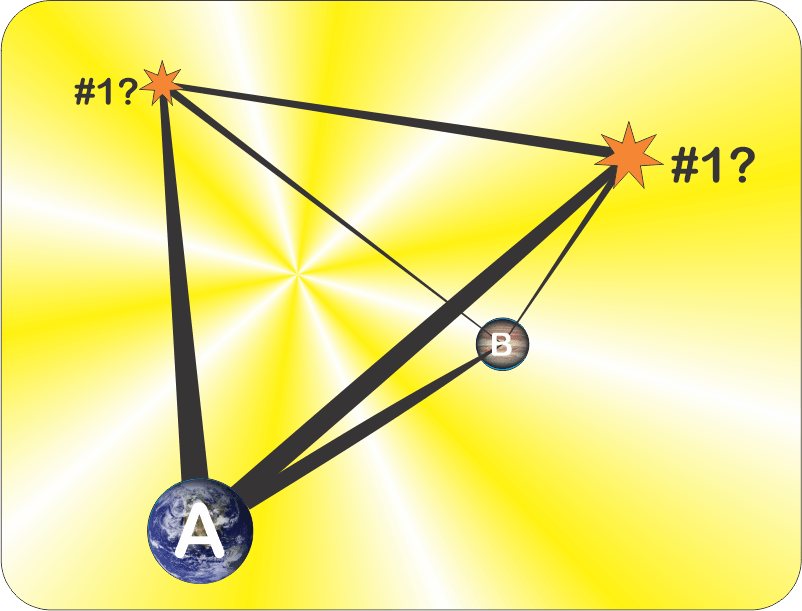
“Space held still and didn’t bend. Astronomers A and B had a stable baseline between them. After measuring the baseline with light they could measure the angles each observed between the events. Some trigonometry let them send each other congratulatory messages on seeing a simultaneous pair of incidents. After Einstein’s work, they knew better.”

“It’s frames again, ain’t it?”

“Of course, Vinnie. A‘s frame is almost certainly moving relative to B‘s frame. Motion puts the Lorentz relativity factor into the game, making each astronomer’s clock run faster than the other’s. Worse, each astronomer sees that the other’s yardsticks are too short.”

Jeremy gives me a confused look.

“Space compression goes along with time dilation, Jeremy. Professor Hanneken will explain it all when your class gets to that unit. Bottom line, things can happen simultaneously in Einstein’s Universe, but no‑one can agree on which things.”

“Wait, if every frame has its own time‑rate, how can two spaceships rendezvous for an operation?”

“Good question, Jeremy. Einstein had an answer but complications hide under the covers. He suggested that A start a timer when sending a light pulse to a mirror at B. A waits for the reflection. B starts a timer when they see A‘s pulse. A measures the pulse’s round‑trip time. Each creates a clock that advances one tick for half of the round-trip time. B sets their clock back by one tick. That done, they agree to meet some number of ticks later.”

“Hmm… That should work, but you said there are complications.”

“There are always complications. For instance, suppose B is slingshotting around a black hole so that pulse and reflection travel different pathlengths. Or suppose one frame is rotating edge‑on to the other. In practice the ships would re‑sync repeatedly while approaching the rendezvous point.”

Vinnie erupts. “HAW! Successive approximation again!”

“Indeed. If we could extend the method to more than two participants we’d have a true Universal Coordinated Time.”

“Don’t we have that, Mr Moire? The Big Bang happened 14 billion years ago. Couldn’t we measure time from that?”

“Sort of. Last I looked the number was 13.787 plus‑or‑minus 20 million years. Too much slop for an instantaneous fleet‑level rendezvous like the final battle scene in StarTrek:Picard. But you’ve brought up an interesting question for a Crazy Theories seminar. One of Cosmology’s deepest unsolved questions is, ‘How does inertia work?’ Do you remember Newton’s First Law?”

<closes eyes> “In an inertial reference frame, an object either remains at rest or continues to move at a constant velocity, unless acted upon by a net force.“

“Right. In other words, every object resists change to its current steady motion along a geodesic. Why is that? There’s no coherent, well‑founded, well‑tested theory. Einstein liked Mach’s Principle, which says inertia exists because every object is attracted through space to all the mass in the Universe. Suppose there’s a Mach’s Principle for Time, saying that objects squirt up the Time axis because they’re repelled by all the mass in the Universe.”

Vinnie hoots, “Bo-o-o-ohh-GUS!”

~ Rich Olcott

Black, White And Wormy

“Whaddaya mean, Sy, if white holes exist? You just told me how they’re in the equations just like black holes.”

“Math gives us only models of reality, Vinnie. Remarkably good models, some of them, but they’re only abstractions. Necessarily they leave out things that might skew math results away from physical results or the other way around. Einstein believed his math properly reflected how the Universe works, but even so, he doubted that black holes could exist. He didn’t think it’d be possible to collect that much mass into such a small space. Two decades after he said that, Oppenheimer figured out how that could happen.”

“Oppenheimer like the A‑bomb movie guy?”

“Same Oppenheimer. He was a major physicist even before they put him in charge of the Manhattan Project. He did a paper in 1939 showing how a star‑collapse could create the most common type of black hole we know of. Twenty‑five years after that the astronomers found proof that black holes exist.”

“Well, if Einstein was wrong about black holes, why wasn’t he wrong about white holes?”

“We need another Oppenheimer to solve that. So far, no‑one has come up with a mechanism that would create a stand‑alone white hole. That level of stress on spacetime requires an enormous amount of mass‑energy in a tiny volume. Whatever does that must somehow do it with a time‑twist opposite to how a black hole is formed. Worse yet, by definition the white hole’s Event Horizon leaks matter and energy. The thing ought to evaporate almost as soon as it’s formed.”

“I heard weaseling. You said, ‘a stand‑alone white hole,’ like there’s maybe another kind. How about that?”

“Could be, maybe not, depending on who’s talking and whether or not they’re accounting for magnetic fields, neutrinos or quantum effects. The discussion generally involves wormholes.”

“Wormholes.”

“Mm-hm. Some cosmologists think that wormholes might bridge between highly stressed points in spacetime. Black hole or white, the stress is what matters. The idea’s been around nearly as long as our modern idea of black holes. No surprise, ‘wormhole’ was coined by John Archibald Wheeler, the same guy who came up with the phrases ‘black hole’ and ‘quantum foam’.”

“Quantum—. Nope, not gonna bite. Get back to white holes.”

“I’m getting there. Anyway, the relativity theory community embraced black holes, white holes and wormholes as primary tools for studying how spacetime works.”

“How’re they gonna do that? That squib Cal showed me said we’ve never seen a white hole.”

“Fair question. Last I heard, the string theory community confidently predicted 10500 different Universes with little hope of narrowing the field. In contrast, relativity theory is firmly constrained by well‑founded math, a century of confirmation from experimental tests and a growing amount of good black hole data. Perfectly good math says that wormholes and white holes could form but only under certain unlikely conditions. Those conditions constrain white holes like Oppenheimer’s conditions constrained forming a stellar‑size black hole.”

“So how do we make one?”

“We don’t. If the Universe can make the right conditions happen somewhere in spacetime, it could contain white holes and maybe a network of wormholes; otherwise, not. Maybe we don’t see them because they’ve all evaporated.”

“I remember reading one time that with quantum, anything not forbidden must happen.”

“Pretty much true, but we’re not talking quantum here. Macro‑scale, some things don’t happen even though they’re not forbidden.”

“Name one.”

“Anti‑matter. The laws of physics work equally well for atoms with positive or negative nuclear charge. We’ve yet to come up with an explanation for why all the nuclear matter we see in the Universe has the positive‑nucleus structure. The mystery’s got me considering a guess for Cathleen’s next Crazy Theories seminar.”

“Oh, yeah? Let’s have it.”

“Strictly confidential, okay?”

“Sure, sure.”

“Suppose the Big Bang’s chaos set up just the right conditions to make a pair of CPT‑twin black holes, expanding in opposite directions along spacetime’s time dimension. Suppose we’re inside one twin. Our time flows normally. If we could see into the other twin, we’d see inside‑out atoms and clocks running backwards. From our perspective the twin would be a white hole.”

“Stay outta that wormhole bridge.”

~ Rich Olcott

Five More Alternate Universes?

I unlock my office door and there’s Vinnie inside, looking out the window. “Your 12th‑floor view’s pretty nice, Sy. From above the tree tops you can see leaf buds just starting to show their early green colors.”

“What are you doing here, Vinnie? I thought you were charter‑flying to Vancouver.”

“The guy canceled. Said with all the on‑again, off‑again tariffs there’s no sense traveling to make a deal when he doesn’t know what he’s dealing with. So I got some time to think.”

“And you came here so it’s something physics‑technical.”

“Yeah, some. I notice colors a lot when I’m flying. Some of those trees down there this time of year are exactly the same bright yellow‑green as some of the rice paddies I’ve flown over. But all the trees get the same hard dark green by August before they go every different color when the chlorophyll fades away.”

“I’ve noticed that. So you came here to talk about spectra?”

“Some other time. This time I want to talk about dark matter.”

“But we call it dark matter precisely because it doesn’t do light. All our normal matter is made of atoms and the atoms are made of electrons and nuclei and each nucleus is made of protons and neutrons and protons and neutrons are made of quarks. Electrons and quarks carry electrical charge. Anything with electrical charge is subject to electromagnetism, one way or another. Dark matter doesn’t notice electromagnetism. If dark matter had even the slightest interaction with light’s electromagnetic field, we wouldn’t be able to see galaxies billions of lightyears away.”

“Calm down, Sy, breath a couple times. Stay with me here. From your stuff and what else I’ve read, all we know about dark matter is a lot of things it isn’t or doesn’t do. The only force we know it respects is gravity so it attracts itself and also normal matter and they all clump up to make galaxies and such, right?”

<a bit reluctantly and on a rising note> “Mm‑hnn…?”

“I read your three‑part series about the Bullet Cluster, where we think two galaxy clusters went though each other and their gas clouds gave off a lot of X‑rays that didn’t match where the stars were or where the gravity was so the astronomers blame dark matter for the gravity, right?”

“That’s pretty much it. So?”

“So the other thing I got from that series was maybe there’s friction between dark matter and other dark matter, like it doesn’t just slide past itself. If dark matter is particles, maybe they’re sorta sticky and don’t bounce off each other like billiard balls. That doesn’t make sense if all they do is gravity.”

“I see where you’re going. You’re thinking that maybe dark matter feels some kind of force that’s not gravity or electromagnetism.”

“That’s it! We’ve got light photons carrying electromagnetic forces to hold our molecules and rocks together. Could there be dark photons carrying some dark‑sticky force to connect up dark molecules and dark rocks and stuff?”

“That’s an interesting—”

“I ain’t done yet, Sy. It gets better. I’ve read a bunch of articles saying there’s about five times as much dark matter in the Universe as normal matter. You physicists love symmetry, suppose it’s exactly five times as much. There’d be six kinds of force, one called electromagnetism and a different snooty force each for five kinds of dark matter and that’ll add up to the 25% we can’t see. Like, a purple dark force for purple dark rocks, naturally they’re not really purple, and a yellow dark force and so on.”

“You’re proposing that each kind of dark matter responds only to its own special force, so no cross‑communication?”

“Yup, gravity’s the only thing they’d all agree on. That bein’ the case, the galaxies would hold six times as many stars as we think, except 5/6 of them are invisible to our 1/6. Five alternate universes sharing space with ours. Cozy, huh?”

“Clever, Vinnie, except for the evidence that most galaxies are embedded in huge nearly‑spherical halos of dark matter. The halos would have collapsed long ago if only gravity and stickiness were in play.”

“Dang.”

~ Rich Olcott