A No-Charge Transaction

I ain’t done yet, Sy. I got another reason for Dark Matter being made of faster‑then‑light tachyons.”

“I’m still listening, Vinnie.”

“Dark Matter gotta be electrically neutral, right, otherwise it’d do stuff with light and that doesn’t happen. I say tachyons gotta be neutral.”

“Why so?”

“Stands to reason. Suppose tachyons started off as charged particles. The electric force pushes and pulls on charges hugely stronger than gravity pulls—”

“1036 times stronger at any given distance.”

“Yeah, so right off the bat charged tachyons either pair up real quick or they fly away from the slower‑than‑light bradyon neighborhood leaving only neutral tachyons behind for us bradyon slowpokes to look at.”

“But we’ve got un‑neutral bradyon matter all around us — electrons trapped in Earth’s Van Allen Belt and Jupiter’s radiation belts, for example, and positive and negative plasma ions in the solar wind. Couldn’t your neutral tachyons get ionized?”

“Probably not much. Remember, tachyon particles whiz past each other too fast to collect into a star and do fusion stuff so there’s nobody to generate tachyonic super‑high‑energy radiation that makes tachyon ions. No ionized winds either. If a neutral tachyon collides with even a high-energy bradyon, the tachyon carries so much kinetic energy that the bradyon takes the damage rather than ionize the tachyon. Dark Matter and neutral tachyons both don’t do electromagnetic stuff so Dark Matter’s made of tachyons.”

“Ingenious, but you missed something way back in your initial assumptions.”

“Which assumption? Show me.”

“You assumed that tachyon mass works the same way that bradyon mass does. The math says it doesn’t.” <grabbing scratch paper for scribbling> “Whoa, don’t panic, just two simple equations. The first relates an object’s total energy E to its rest mass m and its momentum p and lightspeed c.”

E² = (mc²)² + (pc)²

“I recognize the mc² part, that’s from Einstein’s Equation, but what’s the second piece and why square everything again?”

“The keyword is rest mass.”

“Geez, it’s frames again?”

“Mm‑hm. The (mc²)² term is about mass‑energy strictly within the object’s own inertial frame where its momentum is zero. Einstein’s famous E=mc² covers that special case. The (pc)² term is about the object’s kinetic energy relative to some other‑frame observer with relative momentum p. When kinetic energy is comparable to rest‑mass energy you’re in relativity territory and can’t just add the two together. The sum‑of‑squares form makes the arithmetic work when two observers compare notes. Can I go on?”

“I’m still waitin’ to hear about tachyons.”

“Almost there. If we start with that equation, expand momentum as mass times velocity and re‑arrange a little, you get this formula

E = mc² / √(1 – v²/c²)

The numerator is rest‑mass energy. The v²/c² measures relative kinetic energy. The Lorentz factor down in the denominator accounts for that. See, when velocity is zero the factor is 1.0 and you’ve got Einstein’s special case.”

“Give me a minute. … Okay. But when the velocity gets up to lightspeed the E number gets weird.”

“Which is why c is the upper threshold for bradyons. As the velocity relative to an observer approaches c, the Lorentz factor approaches zero, the fraction goes to infinity and so does the object’s energy that the observer measures.”

“Okay, here’s where the tachyons come in ’cause their v is bigger than c. … Wait, now the equation’s got the square root of a negative number. You can’t do that! What does that even mean?”

“It’s legal, when you’re careful, but interpretation gets tricky. A tachyon’s Lorentz factor contains √(–1) which makes it an imaginary number. However, we know that the calculated energy has to be a real number. That can only be true if the tachyon’s mass is also an imaginary number, because i/i=1.”

“What makes imaginary energy worse than imaginary mass?”

“Because energy’s always conserved. Real energy stays that way. Imaginary mass makes no sense in Newton’s physics but in quantum theory imaginary mass is simply unstable like a pencil balanced on its point. The least little jiggle and the tachyon shatters into real particles with real kinetic energy to burn. Tachyons disintegrating may have powered the Universe’s cosmic inflation right after the Big Bang — but they’re all gone now.”

“Another lovely theory shot down.”

~ Rich Olcott
Got To Be Good-lookin’ ‘Cause He’s So Hard To See

I’ll be sorry when Acme Building’s management swaps out our old‑style door locks for electronic ones. Vinnie has such fun lock‑picking his way past my office door in the morning. “Morning, Vinnie.”

“Morning, Sy. Hey, I got a new Crazy Theory for you. Nobody knows what Dark Matter is, right?”

“Right. All we know is that it has about five times as much mass as normal matter so it participates in gravitational interactions. Some of it seems to gather in spherical halos around galaxies and some of it seems to collect in spikes near their centers. Cosmologists are arguing about whether or not Dark Matter is particles, much less how they’d be quantized. And we call it Dark because it absolutely doesn’t care about electromagnetism.”

“That’s what I thought. I remember you said if Dark Matter did play with light waves at all it’d block our view of the CMB. So yeah, absolute. Good.”

“I gather your theory is about Dark Matter.”

“Mm-hm. I thought of a way that all that mass could be hiding in plain sight except we can’t see it.”

“Alright, I’m listening.”

“Tachyons.”

“Come again?”

“Tachyons — particles that fly around faster than light. I read an article about ’em. Some people say they can’t exist but hear me out, okay? The reason they’re not supposed to exist is ’cause it would take an infinite amount of energy to boost something up past lightspeed. I got that, but suppose they were born above lightspeed, back when the Big Bang singularity had energy packed so tight the Physics laws we know don’t apply. A lot of particles got flung out below lightspeed, but maybe even more got flung out above it.”

“What does this have to do with dark matter?”

“I’m gettin’ there. The thing with tachyons is, the article said it’d take infinite energy to slow one down to lightspeed. A tachyon rock hits a slow rock, it don’t stop ’cause the slow rock don’t have the juice for that. The collision may take a little energy from the tachyon rock but that just changes its trajectory.”

“Mmm, those tachyon rocks can’t be a thing. The — what can I call it? slow matter?”

“The article called ’em bradyons.”

“Thanks. We know that 92% of all … bradyonic atoms in the Universe are hydrogens. Rocks are made of silicon, oxygen and other atoms that are even heavier. Everything heavier than hydrogen and maybe some helium was created by nuclear reactions inside a star. Tachyonic atoms zooming beyond lightspeed couldn’t gather together to form a star or even join one. No significant tachyonic fusion, no tachyonic rocks.”

“Okay, they all stay tachy‑hydrogen, still not a problem. The point is, there could be a lot of them and they could add up to a lot of mass. So the next thing I asked is, where would tachyons hang out? Gotta be around galaxies, but being tachyons going super‑lightspeed they can’t just hang, they orbit around the centers. They’d spend the most time where they go slowest which is where they’re farthest away ’cause that’s how orbits work. But they’d be thickest close in ’cause of gravity but that’s where they go fastest.”

“Cute, so you’re predicting galaxies with halos of tachyons, plus spikes of them at each center. That just happens to be the dark matter distribution the astronomers find.”

“It gets better, Sy. I’m not so sure of this because math, but it feels right. I don’t think tachyons can do electromagnetism things.”

“Why not?”

“No blue glow — you know, that blue glow in nuclear reactors when electrons go through the cooling water faster than light?”

“Cherenkov radiation, happens when fast electrons polarize the water. The polarizing slows light in water relative to a vacuum.”

“Right, but tachyons in space travel through vacuum. They ought to polarize the vacuum like what fast electrons do to water. Electromagnetic tachyons orbiting galaxies ought to make a blue glow but there isn’t one, so tachyons don’t do electromagnetism things and that makes them Dark Matter.”

“You’re going to have to do better than that, Vinnie. Absence of evidence just might be evidence of absence. Maybe they’re not there to begin with.”

~ Rich Olcott

A Play Beyond The Play

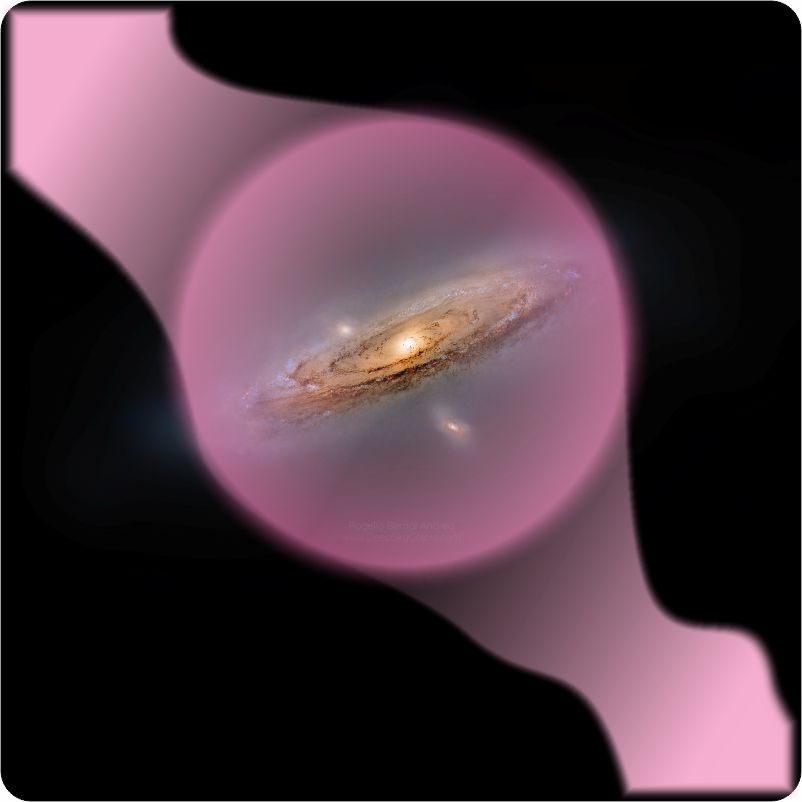
Vinnie takes a long thoughtful look at the image that had dashed his beautiful six‑universe idea. “Wait, Sy. I don’t like this picture”

“Because it messes up your invention?”

“No, because how can they know what that halo looks like? I mean, the whole thing with dark matter is that we can’t see it.”

“You’re right about that. Dark matter’s so transparent that even with five times more mass than normal matter, it doesn’t block CMB photons coming from 13.8 billion lightyears away. That still boggles my brain every once in a while. But dark matter’s gravitational effects — those we can see.”

“Yeah, I remember a long time ago we talked about Fritz Zwicky and Vera Rubin and how they told people about galaxies held together by too much gravity but nobody believed them.”

“Well, they did, after a while—”

“A long while, like a long while since those talks. Remind me what ‘too much gravity’ was about.”

“It was about conflicts between their observations and the prevailing theoretical models. Everyone thought that galaxies and galaxy clusters should operate pretty much like planetary orbits — your speed increases the closer you are to the center, up to Einstein’s speed limit. Newton’s Laws of Motion predict how fast you should move if you’re at a certain distance from a body with a certain mass. If you’re moving faster than that, you fly away.”

“Yeah, escape velocity. So the galaxies in Zwicky’s cluster didn’t follow Newton’s Laws?”

“They didn’t seem to. Galaxies that should have escaped were still in there. The only way he could explain the stability was to suppose the galaxies are only a small fraction of the cluster’s mass. Extra gravity from the extra mass must bind things together. Forty years later Rubin’s improved technology revealed that stars within galaxies had the same anomalous motion.”

“I’m guessing the ‘faster near the center’ rule didn’t hold, or else you wouldn’t be telling this story. Spun like a wheel, I bet.”

“When a wheel spins, every part of it rotates at the same angular speed, the same number of degrees per second, right?”

“Ahh, the bigger my circle the higher my airspeed so the rule would be ‘faster farther out’.”

“That’s the wheel rule, right, but Rubin’s data showed that stars within galaxies don’t obey that one either. She measured lots of stars in Andromeda and other galaxies. Their linear speeds, kilometers per second, are nearly identical from near the center all the way out. Even dust and gas clouds beyond the galactic starry edges also fit the ‘same linear speed everywhere’ rule. You’d lose the bet.”

“That just doesn’t feel right. How can just gravity make that happen?”

“It can if the right amount of dark matter’s distributed in the right‑shaped smeared‑out hollowed‑out spherical halo. The halo’s radial density profile looks about like this. Of course, profiles for different galaxies differ in spread‑outness and other details, but the models are pretty consistent.”

“Wait, if dark matter only does gravity like you said, why’s that hole in the middle? Why doesn’t everything just fall inward?”

“Dark matter has mass so it also has inertia, momentum and angular momentum, just as normal matter does. Suppose some of the dark matter has collected gravitationally into a blob and the blob is moving slower than escape velocity. If it’s flying straight at the center of gravity it’ll get there and stay there, more or less. But if the blob’s aimed in any other direction, it has angular momentum relative to the center. Momentum’s conserved for dark matter, too. The blob eventually goes into orbit and winds up as part of the shell.”

“Does Zwicky’s galaxy cluster have a halo, too?”

“Not in the same way. Each galaxy probably has its own halo but the galaxies are far apart relative to their size. The theoreticians have burned huge amounts of computer time simulating the chaos inside large ensembles of gravity‑driven blobs. I just read one paper about a 4‑billion‑particle calculation and mind you, a ‘particle’ in this study carried more than a million solar masses. Big halos host subhalos, with filaments of minihalos tying them together. What we can’t see is complicated, too.”

~ Rich Olcott

Five More Alternate Universes?

I unlock my office door and there’s Vinnie inside, looking out the window. “Your 12th‑floor view’s pretty nice, Sy. From above the tree tops you can see leaf buds just starting to show their early green colors.”

“What are you doing here, Vinnie? I thought you were charter‑flying to Vancouver.”

“The guy canceled. Said with all the on‑again, off‑again tariffs there’s no sense traveling to make a deal when he doesn’t know what he’s dealing with. So I got some time to think.”

“And you came here so it’s something physics‑technical.”

“Yeah, some. I notice colors a lot when I’m flying. Some of those trees down there this time of year are exactly the same bright yellow‑green as some of the rice paddies I’ve flown over. But all the trees get the same hard dark green by August before they go every different color when the chlorophyll fades away.”

I’ve noticed that. So you came here to talk about spectra?”

“Some other time. This time I want to talk about dark matter.”

“But we call it dark matter precisely because it doesn’t do light. All our normal matter is made of atoms and the atoms are made of electrons and nuclei and each nucleus is made of protons and neutrons and protons and neutrons are made of quarks. Electrons and quarks carry electrical charge. Anything with electrical charge is subject to electromagnetism, one way or another. Dark matter doesn’t notice electromagnetism. If dark matter had even the slightest interaction with light’s electromagnetic field, we wouldn’t be able to see galaxies billions of lightyears away.”

“Calm down, Sy, breath a couple times. Stay with me here. From your stuff and what else I’ve read, all we know about dark matter is a lot of things it isn’t or doesn’t do. The only force we know it respects is gravity so it attracts itself and also normal matter and they all clump up to make galaxies and such, right?”

<a bit reluctantly and on a rising note> “Mm‑hnn…?”

“I read your three‑part series about the Bullet Cluster, where we think two galaxy clusters went though each other and their gas clouds gave off a lot of X‑rays that didn’t match where the stars were or where the gravity was so the astronomers blame dark matter for the gravity, right?”

“That’s pretty much it. So?”

“So the other thing I got from that series was maybe there’s friction between dark matter and other dark matter, like it doesn’t just slide past itself. If dark matter is particles, maybe they’re sorta sticky and don’t bounce off each other like billiard balls. That doesn’t make sense if all they do is gravity.”

“I see where you’re going. You’re thinking that maybe dark matter feels some kind of force that’s not gravity or electromagnetism.”

“That’s it! We’ve got light photons carrying electromagnetic forces to hold our molecules and rocks together. Could there be dark photons carrying some dark‑sticky force to connect up dark molecules and dark rocks and stuff?”

“That’s an interesting—”

“I ain’t done yet, Sy. It gets better. I’ve read a bunch of articles saying there’s about five times as much dark matter in the Universe as normal matter. You physicists love symmetry, suppose it’s exactly five times as much. There’d be six kinds of force, one called electromagnetism and a different snooty force each for five kinds of dark matter and that’ll add up to the 25% we can’t see. Like, a purple dark force for purple dark rocks, naturally they’re not really purple, and a yellow dark force and so on.”

“You’re proposing that each kind of dark matter responds only to its own special force, so no cross‑communication?”

“Yup, gravity’s the only thing they’d all agree on. That bein’ the case, the galaxies would hold six times as many stars as we think, except 5/6 of them are invisible to our 1/6. Five alternate universes sharing space with ours. Cozy, huh?”

“Clever, Vinnie, except for the evidence that most galaxies are embedded in huge nearly‑spherical halos of dark matter. The halos would have collapsed long ago if only gravity and stickiness were in play.”

“Dang.”

~ Rich Olcott

Things That Won’t Work

Vinnie gets a far-away look in his eye. I wait. “Ya know, Sy, there oughtta be a way.”

“A way to what?”

“I ain’t giving up on this faster-than-light communication stuff. I know Einstein said it couldn’t happen because it’d flip cause and effect and he didn’t like that, but that feels too much like philosophy books I’ve read that boil down to, ‘This thing can’t be true because I don’t want it to be.’ Maybe there’s something we ain’t thought of yet.”

“Lots of people have played with that challenge for decades. Do you have any fresh ideas?”

“A couple possibles. Lessee if I’ve got this straight. We’ve got two separate message channels going — one that works instant-like for information between entangled quantum thingies, and one for everything else that’s stuck at lightspeed or less. Suppose I’ve got two entangled pizzas— nah, we’re really talking quantum stuff like electrons and photons so I’ll just say particles. Suppose I’ve got two entangled particles that are some ugly mix of red and green but we know when they’re de-linked they’ll be opposite. I send one to you the regular way but they’re still linked. I look at the one I still got and it’s red, say. The same moment, yours instantly went green but you don’t know that yet until you look or you get status information from me through the not‑instant channel. So the problem is getting information to leak between the two channels, right?”

“That’s about the size of it.”

“OK, try this one. How about I use a magnetic field or something to force mine to red? And maybe a set time later I make it green to confirm I’m in control and it’s a real signal.”

“Sorry, as soon as you manipulate properties in part of an entangled system you break the entanglement and the other part is free to do whatever it wants to. Next?”

“Uhh … time synchronization. How about you and me set a certain time for me to look at mine? You can watch yours and when it flips or not you’ll know.”

“All that does is move the manipulation to the other end of the setup. Me looking at my particle resets yours to whatever color mine isn’t and that breaks the entanglement. Next?”

“Maybe something with a bunch of particles all entangled together? How about—”

“Nup, can’t base a strategy on that. Like everything else quantum, entanglement is statistical. There’s no guarantee that even in our two‑particle system I’ll see green if you see red — the odds are high but not 100%. There’s a proven theorem that says if two particles are ‘maximally entangled,’ adding a third to the system reduces the odds that any two will coordinate their behaviors. A bunch of particles would be even less stable. It’s called the monogamy theorem, care to guess why?”

“Physics fun with metaphors again, cute, but I can see this is a good one. You got anything?”

“Not having to do with entanglement, but I have been playing with a different idea, sort of a blank‑sky approach.”

“You mean blue‑sky.”

“Uh-uh, blank. Think about a sky made of dark matter. Dark matter’s subject to gravity but so far as we know it has absolutely no interaction with electromagnetism of any kind — doesn’t play with electrons, light waves, nothing. Einstein based part of his relativity work on Maxwell’s electromagnetism equations. In fact, that’s where the idea came from that ‘c‘ was the speed limit for the Universe. It was a good idea and there’s a huge amount of evidence that he was right. Everything in our Standard Model except the photon is subject to the Lorentz factor. Both light and gravity acting on normal matter travel at c‑speed. Well, maybe the value of c has something to do with how quarks work. Dark matter doesn’t have quarks. What if dark matter has a different speed limit, maybe a lot higher than c or even no limit at all? Maybe we could exploit that property somehow. How about a dark‑matter telegraph?”

“I’m thinking of my Grampa’s recipe for rabbit stew. ‘First you gotta catch your rabbit,’ he used to say,”

~~ Rich Olcott

A Neutral Party

“Hi, folks, sorry I’m late to the party. What are we arguing about and which side am I on?”

“Hi, Vinnie. We started out talking about neutrality and Jim proved that we’re electrically neutral otherwise we’d spray ourselves apart because of like‑charge repulsons.”

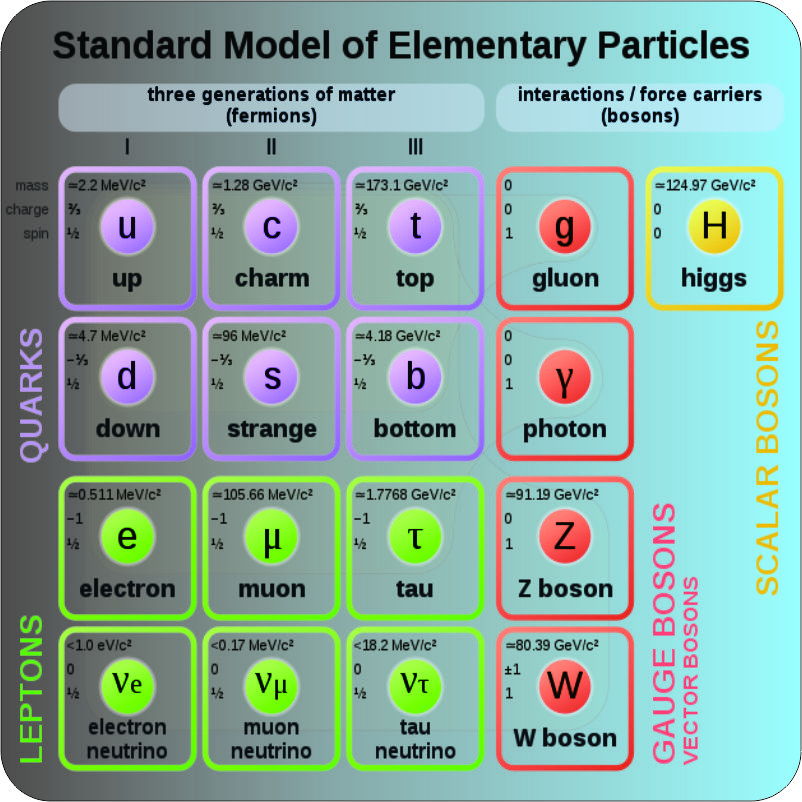
“Yeah, an’ then we got into the Standard Module picture here and how it’s weird that the electron charge exactly cancels out the quark mixture in a proton even though electrons don’t have quarks and quarks don’t have exact charges.”

Jim’s on it. “Almost, Eddie. Quarks have exact charges, but they’re exact fractions. They just add up when you mix three of them to make a particle. Two of them, sometimes. Up‑quark, up‑quark and down‑quark is two‑thirds plus two‑thirds minus one‑third equals one. That’s one proton, exactly opposing one electron’s charge.”

Vinnie’s good at mental math. “What happens when you mix one‑third plus one‑third minus two‑thirds which is zero?”

“Two downs and an up. That’s a neutron.”

“Ups, downs, electrons, protons, neutrons — except for the neutrino the first column’s pretty much atoms, right? What’s with those other boxes?”

“We only see evidence for the other purple‑box quarks in collider records or nuclear reactions. Same for the muon and tau. They’re all way too unstable to contribute much to anything that hangs around. The guys in the red and gold boxes aren’t building blocks, they’re more like glue that holds everything else together. The green‑box neutrinos at the bottom are just weird and we’ll probably be a long time figuring them out.”

“Says here that neutrinos have zero charge, and so do most of the force thingies. Is that really zero or is it just too small to measure?”

“A true Chemistry‑style question, Susan. Charges we can count but you’re right, energy exchanges in a process have to be measured. The zero charges are really zero. For example, Pauli dreamed up the neutrino as an energy‑accounting trick for a nuclear process where all the charges went to known products but there was energy left over. If they existed at all, neutrinos could carry away that energy but they had to have zero charge. A quarter‑century later we detected some and they fit all the requirements.”

Vinnie perks up. “Zero charge so they doesn’t interact with light, teeny mass per each but there’s a hyper‑gazillion of them out there which oughtta add up to a lot of mass. Could neutrinos be what dark matter is?”

“Some researchers thought that for a while but the idea hasn’t held up to inspection. The neutrinos we know about come to about 1% of dark matter’s mass. Some people think there may be a really heavy fourth kind of neutrino that would make up the difference, but it’s a long shot and there’s no firm evidence for it so far. Dark matter doesn’t interact with photons, photons interact with electric charge, quarks have electric charge. If you’ve got quarks you’re not dark matter.”

“How about neutrons floating around?”
 ”Those molecular clouds I’ve read about Aren’t they neutral? Are there neutral stars?”
  ”How about neutron stars and black holes?”
   ”What’s a neutron star?”

“All good questions. Free neutrons are a bad bet, Vinnie — unless they’re bound with protons they usually emit an electron and become a proton within an hour. Susan, electrostatic forces would overwhelm gravity so we believe stars and molecular clouds must be electrically neutral or close to it. Anyway, stars and clouds can’t be dark matter because they’ve got quarks. Eddie, what do you suppose happens when a star uses up the fuel that keeps it big?”

“Since you ask it that way, I suppose it caves in.”

“Got it in one. If the star’s too big to collapse to be a white dwarf but too small to collapse to be a black hole, it collapses to be a neutron star. Really weird objects — a star‑and‑a‑half of of mass packed into a 10‑kilometer sphere, probably spinning super‑fast and possessing a huge magnetic field. From a ‘what is dark matter?‘ perspective, though, collapsed stars of any sort are still made of quarks and can’t qualify.”

“So what is dark matter then?”

“Good question.”

~~ Rich Olcott

  • Thanks to Alex, who asked a question.

Seesaw to The Stars

I look around the playground. “Where’s the seesaw, Teena?”

“They took it away. That’s good ’cause I hated that thing!”

“Why’s that, Sweetie?”

“I never could play right on it. Almost never. Sometimes there’d be a kid my size on the other end and that worked OK, but a lot of times a big kid got on the other end and bounced me up in the air. The first time I even fell off and they laughed.”

“Well, I can understand that. I’m sure you’ve been nicer than that to the littler kids.”

“Uh-huh, except for Bratty Brian, but he liked it when I bounced him. He called it ‘going to the Moon’.”

“I can understand that, too. If things go just right you come off your seat and float like an astronaut for a moment. I bet he held onto the handles tight.”

“Yeah, I just wasn’t ready for it the first time.”

“Y’know, there’s another way that Brian’s bounces were like a rocket trip to somewhere. They went through the same phases of acceleration and deceleration.”

“Uncle Sy, you know you’re not allowed to use words like that around me without ‘splaining them.”

“Mmm, they both have to do with changing speed. Suppose you’re standing still. Your speed is zero, right? When you start moving your speed isn’t zero any more and we say you’ve accelerated. When you slow down again we say you’re decelerating. Make sense?”

“So when Bratty Brian gets on the low end of the seesaw he’s zero. When I squinch down at my end he accelerates –“

“Right, that’s like the boost phase of a rocket trip.”

“… And when he’s floating at the very top –“

“Like astronauts when they’re coasting, sort of but not really.”

“… And then they decelerate when they land. Bratty Brian did, too. I guess deceleration is like acceleration backwards. But why such fancy words?”

“No-one paid much attention to acceleration until Mr Newton did. He changed Physics forever when he said that all accelerations involve a force of some kind. That thought led him to the whole idea of gravity as a force. Ever since then, when physicists see something being accelerated they look for the force that caused it and then they look for what generated the force. That’s how we learned about electromagnetism and the forces that hold atoms together and even dark matter which is ultra-mysterious.”

“Ooo, I love mysteries! What did Mr Newton tell us about this one?”

“Nothing, directly, but his laws gave us a clue about what to look for. Tell me what forces were in play during Brian’s ‘moon flight’.”

“Let’s see. He accelerated up and then he accelerated down. I guess while he was on the seesaw seat at the beginning the up-acceleration came from an up-force from his end of the board. And the down-acceleration came from gravity’s force. But the gravity force is there all along, isn’t it?”

“Good point. What made the difference is that your initial force was greater than gravity’s so Brian went up. When your force stopped, gravity’s force was all that mattered so Brian came back down again.”

“So it’s like a tug-of-war, first I won then gravity won.”

“Exactly. Now how about the forces when you were on the merry-go-round?”

“OK. Gravity’s always there so it was pulling down on me. The merry-go-round was pushing up?”

“Absolutely. A lot of people think that’s weird, but whatever we stand on pushes up exactly as hard as gravity pulls us down. Otherwise we’d sink into the ground or fly off into space. What about other forces?”

“Oh, yeah, Mr Newton’s outward force pushed me off until … holding the handles made the inward force to keep me on!”

“Nice job! Now think about a galaxy, millions of stars orbiting around like on a merry-go-round. They feel an outward force like you did, and they feel an inward force from gravity so they all stay together instead of flying apart. But…”

“But?”

“Mr Newton’s rules tell us how much gravity the stars need to stay together. The astronomers tell us that there aren’t enough stars to make that much gravity. Dark matter supplies the extra.”

~~ Rich Olcott

Three Shades of Dark

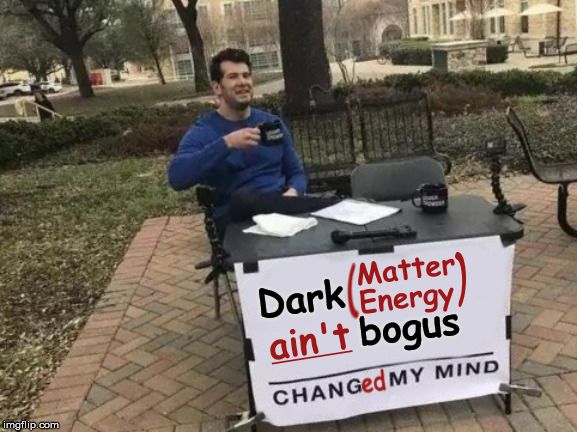
The guy’s got class, I’ll give him that. Astronomer-in-training Jim and Physicist-in-training Newt met his challenges so Change-me Charlie amiably updates his sign.

But he’s not done. “If dark matter’s a thing, how’s it different from dark energy? Mass and energy are the same thing, right, so dark energy’s gotta be just another kind of dark matter. Maybe dark energy’s what happens when real matter that fell into a black hole gets squeezed so hard its energy turns inside out.”

Jim and Newt just look at each other. Even Cap’n Mike’s boggled. Someone has to start somewhere so I speak up. “You’re comparing apples, cabbages and fruitcake. Yeah, all three are food except maybe for fruitcake, but they’re grossly different. Same thing for black holes, dark matter and dark energy — we can’t see any of them directly but they’re grossly different.”

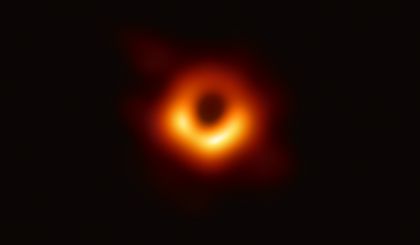
EHT's image of the black hole at the center of the Messier 87 galaxy
Black hole and accretion disk, image by the Event Horizon Telescope Collaboration

Vinnie’s been listening off to one side but black holes are one of his hobbies. “A black hole’s dark ’cause its singularity’s buried inside its event horizon. Whatever’s outside and somehow gets past the horizon is doomed to fall towards the singularity inside. The singularity itself might be burn-your-eyes bright but who knows, ’cause the photons’re trapped. The accretion disk is really the only lit-up thing showing in that new EHT picture. The black in the middle is the shadow of the horizon, not the hole.”

Jim picks up the tale. “Dark matter’s dark because it doesn’t care about electromagnetism and vice-versa. Light’s an electromagnetic wave — it starts when a charged particle wobbles and it finishes by wobbling another charged particle. Normal matter’s all charged particles — negative electrons and positive nuclei — so normal matter and light have a lot to say to each other. Dark matter, whatever it is, doesn’t have electrical charges so it doesn’t do light at all.”

“Couldn’t a black hole have dark matter in it?”

“From what little we know about dark matter or the inside of a black hole, I see no reason it couldn’t.”

“How about normal matter falls in and the squeezing cooks it, mashes the pluses and minuses together and that’s what makes dark matter?”

“Great idea with a few things wrong with it. The dark matter we’ve found mostly exists in enormous spherical shells surrounding normal-matter galaxies. Your compressed dark matter is in the wrong place. It can’t escape from the black hole’s gravity field, much less get all the way out to those shells. Even if it did escape, decompression would let it revert to normal matter. Besides, we know from element abundance data that there can’t ever have been enough normal matter in the Universe to account for all the dark matter.”

Newt’s been waiting for a chance to cut in. “Dark energy’s dark, too, but it works in the opposite direction from the other two. Gravity from normal matter, black holes or otherwise, pulls things together. So does gravity from dark matter which is how we even learned that it exists. Dark energy’s negative pressure pulls things apart.”

“Could dark energy pull apart a black hole or dark matter?”

Big Cap’n Mike barges in. “Depends on if dark matter’s particles. Particles are localized and if they’re small enough they do quantum stuff. If that’s what dark matter is, dark energy can move the particles apart. My theory is dark matter’s just ripples across large volumes of space so dark energy can change how dark matter’s spread around but it can’t break it into pieces.”

Vinnie stands up for his hobby. “Dark energy can move black holes around, heck it moves galaxies, but like Sy showed us with Old Reliable it’s way too weak to break up black holes. They’re here for the duration.”

Newt pops him one. “The duration of what?”

“Like, forever.”

“Sorry, Hawking showed that black holes evaporate. Really slowly and the big ones slower than the little ones and the temperature of the Universe has to cool down a bit more before that starts to get significant, but not even the black holes are forever.”

“How long we got?”

“Something like 10106 years.”

“That won’t be dark energy’s fault, though.”

~~ Rich Olcott

Dark Horizon

Charlie's table sign says "Dark Energy is bogus"

Change-me Charlie attacks his sign with a rag and a marker, rubbing out “Matter” and writing in “Energy.” Turns out his sign is a roll-up dry-erase display and he can update it on site. Cool. I guess with his rotating-topic strategy he needs that. “OK, maybe dark matter’s a thing, but dark energy ain’t. No evidence, someone just made that one up to get famous!”

And of course Physicist-in-training Newt comes back at him. “Lots of evidence. You know about the Universe expanding?”

“Prove it.” At least he’s consistent.

<sigh> “You know how no two snowflakes are exactly alike but they can come close? It applies to stars, too. Stars are fairly simple in a complicated way. If you tell me a star’s mass, age and how much iron it has, I can do a pretty good job of computing how bright it is, how hot it is, its past and future life history, all sort of things. As many stars as there are, we’re pretty much guaranteed that there’s a bunch of them with very similar fundamentals.”

“So?”

“So when a star undergoes a major change like becoming a white dwarf or a neutron star or switching from hydrogen fusion to burning something else, any other star that has the same fundamentals will behave pretty much the same way. They’d all flare with about the same luminosity, pulsate with about the same frequency —”

“Wait. Pulsate?”

“Yeah. You’ve seen campfires where one bit of flame coming out of a hotspot flares up and dies back and flares up and dies back and you get this pulsation —”

“Yeah. I figured that happens with a sappy log where the heat gasifies a little sap then the spot cools off when outside air gets pulled in then the cycle goes again.”

“That could be how it works, depending. Anyhow, a star in the verge of mode change can go through the same kind of process — burn one kind of atom in the core until heat expansion pushes fuel up out of the fusion zone; that cools things down until fuel floods back in and off we go again. The point is, that kind of behavior isn’t unique to a single star. We’ve known about variable stars for two centuries, but it wasn’t until 1908 that Henrietta Swan Leavitt told us how to determine a particular kind of variable star’s luminosity from its pulsation frequency.”

“Who cares?”

“Edwin Hubble cared. Brightness dies off with the distance squared. If you compare the star’s intrinsic luminosity with how bright the star appears here on Earth, it’s simple to calculate how far away the star is. Hubble did that for a couple dozen galaxies and showed they had to be far outside the Milky Way. He plotted red-shift velocity data against those distances and found that the farther away a galaxy is from us, the faster it’s flying away even further.”

“A couple dozen galaxies ain’t much.”

“That was for starters. Since the 1930s we’ve built a whole series of ‘standard candles,’ different kinds of objects whose luminosities we can convert to distances out to 400 million lightyears. They all agree that the Universe is expanding.”

“Well, you gotta expect that, everything going ballistic from the Big Bang.”

“They don’t go the steady speed you’re thinking. As we got better at making really long-distance measurements, we learned that the expansion is accelerating.”

“Wait. I remember my high-school physics. If there’s an acceleration, there’s gotta be a force pushing it. Especially if it’s fighting the force of gravity.”

“Well there you go. Energy is force times distance and you’ve just identified dark energy. But standard candles aren’t the only kind of evidence.”

“There’s more?”

“Sure — ‘standard sirens‘ and ‘standard rulers.’ The sirens are events that generate gravitational waves we pick up with LIGO facilities. The shape and amplitude of the LIGO signals tell us how far away the source was — and that information is completely immune to electromagnetic distortions.”

“And the rulers?”

“They’re objects, like spiral galaxies and intergalactic voids, that we have independent methods for connecting apparent size to distance.”

“And the candles and rulers and sirens all agree that acceleration and dark energy are real?”

“Yessir.”

~~ Rich Olcott

Dancing in The Dark

Change-me Charlie at his argument table

The impromptu seminar at Change-me Charlie’s “Change My Mind” table is still going strong, but it looks like Physicist-in-training Newt and Astronomer-in-training Jim have met his challenge. He’s switched from arguing that dark matter doesn’t exist to asking how it worked in the Bullet Cluster’s massive collision between two collections of galaxies with their clouds of plasma and dark matter. “OK, the individual galaxies are so spread out they slide past each other without slowing down but the plasma clouds obstruct each other by friction. Wouldn’t friction in the dark matter hold things back, too?”

Jim’s still standing in front of the table. “Now that’s an interesting question, so interesting that research groups have burned a bazillion computer cycles trying to answer it.”

“Interesting, yes, but that interesting?”

“For sure. What we know about dark matter is mostly what it doesn’t do. It doesn’t give off light, it doesn’t absorb light, it doesn’t seem to participate in the strong or weak nuclear forces or interact with normal matter by any means other than gravity, and no identifiable dark matter particles have been detected by bleeding-edge experiments like IceCube and the Large Hadron Collider. So people wonder, does dark matter even interact with itself? If we could answer that question one way or the other, that ought to tell us something about what dark matter is.”

“How’re we gonna do that?”

Newt’s still perched on Charlie’s oppo chair. “By using computers and every theory tool on the shelf to run what-if? simulations. From what we can tell, nearly everywhere in the Universe normal matter is embedded in a shell of dark matter. The Bullet Cluster and a few other objects out there appear to break that rule and give us a wonderful check on the theory work.”

The Bullet Cluster, 1E 0657-56 (NASA image)

“Like for instance.”

“Simple case. What would the collision would looked like if dark matter wasn’t involved? Some researchers built a simulation program and loaded it with a million pretend plasma particles in two cluster-sized regions moving towards each other from 13 million pretend lightyears apart. They also loaded in position and momentum data for the other stars and galaxies shown in the NASA image. The simulation tracked them all as pretend-time marched along stepwise. At each time-step the program applied known or assumed laws of physics to compute every object’s new pretend position and momentum since the prior step. Whenever two pretend-particles entered the same small region of pretend-space, the program calculated a pretend probability for their collision. The program’s output video marked each successful collision with a pink pixel so pinkness means proton-electron plasma. Here’s the video for this simulation.”

“Doesn’t look much like the NASA picture. The gas just spreads out, no arc or cone to the sides.”

“Sure not, which rules out virtually all models that don’t include dark matter. So now the team went to a more complicated model. They added a million dark matter particles that they positioned to match the observed excess gravity distribution. Those’re marked with blue pixels in the videos. Dark matter particles in the model were allowed to scatter each other, too, under control of a self-interaction parameter. The researchers ran the simulations with a whole range of parameter values, from no-friction zero up to about twice what other studies have estimated. Here’s the too-much case.”

“Things hold together better with all that additional gravity, but it’s not a good match either.”

“Right, and here’s the other end of the range — no friction between dark matter particles. Robertson, the video’s author/director, paused the simulation in the middle to insert NASA’s original image so we could compare.”

“Now we’re getting somewhere.”

“It’s not a perfect match. Here’s an image I created by subtracting a just-after-impact simulation frame from the NASA image, then amplifying the red. There’s too much left-over plasma at the outskirts, suggesting that maybe no-friction overstates the case and maybe dark matter particles interact, very slightly, beyond what a pure-gravity theory predicts.”

“Wait, if the particles don’t use gravity, electromagnetism or the nuclear forces on each other, maybe there’s a fifth force!”

“New Physics!”

A roar from Cap’n Mike — “Or they’re not particles!”

~~ Rich Olcott