Does Tomorrow Exist?

Power’s back on. The elevator lets us out on the second floor where we proceed into Eddie’s Pizza Place. We order, find a table, and Cathleen cocks an eyebrow. “So, Anne, you’re a time‑traveler?”

“Lots of dimensions, actually. Time, space, probability… Once I accidentally jumped into a Universe where the speed of light was a lot slower. I was floating near a planet in a small system whose sun flared up but it took a long, long time for the flash to reflect off the planet behind me. Funny, I felt stiffer than usual. It was a lot harder to move my arms. I avoid cruising dimensions like that one.”

<The other eyebrow goes up> “Wait, what’s the speed of light got to do with dimensions? And why would it affect moving your arms?”

My cue. “Physics has a long‑standing problem with the speed of light and a dozen or so other fundamental numbers like Newton’s gravitational constant and Einstein’s cosmological constant. We can measure them but we can’t explain why they have the values they do. Okay, the speed of light depends on electric and magnetic force constants, but we can’t explain those, either — the rabbit hole just gets deeper. In practice, our Laws of Physics are a set of equations with blanks for plugging in the measured values. People have suggested that there’s a plethora of alternate universes with the same laws of physics we have but whose fundamental constants can vary from ours. Apparently Anne traveled along a dimension that connects universes with differing values of lightspeed.”

“I suppose. … But the arm‑moving part?”

“An effect of Special Relativity. Newton’s Second Law a=F/m says that an object’s acceleration equals the applied force per unit mass. That works fine in every‑day life but not when the object’s velocity gets close to lightspeed.” <jotting on a paper napkin> “I don’t see Vinnie nearby so here’s the relativistic equation: a=(F/m)×√[1–(v/c)²]. The v/c ratio compares object velocity to lightspeed. The Lorentz factor, that square root, is less than 1.0 for velocities less than lightspeed. This formula says a given amount of force per unit mass produces less acceleration than Newton would expect. How much less depends on how fast you’re already going. In fact, the acceleration boost approaches zero when v approaches c. With me?”

“If your factor’s exactly zero, then even an infinite force couldn’t accelerate you, right? But what’s all that got to do with my arm?”

“Zero acceleration, mm‑hm. Suppose your arm’s rest mass and muscle force per unit mass are the same in the slow‑light universe as they are in ours. The Lorentz factor’s different. Lightspeed in our Universe is 3×10⁸ m/s. Suppose you wave your arm at 10 m/s. Your Lorentz factor here is √[1–(10/3×108)²] which is so close to unity we couldn’t measure the difference. Now suppose ‘over there’ the lightspeed is 20 m/s and you try the same wave. The Lorentz formula works out to √[1–(10/20)²] or about 85%. That wave would cost you about 15% more effort.”

<Both eyebrows down> “Have you tried going forward in time?”

“Sure, but I can’t get very far. It’s like I’ve got an anchor ‘here.’ I can move back ‘here’ from the past, no problem, but when I try to move forward from ‘here’ even a day or so … It’s hard to describe but as I go everything feels fuzzier and then I get queasy and have to stop. Do you have an explanation for that, Sy?”

“Well, an explanation but I can’t tell you it’s correct. Einstein thought it conflicts with Relativity, other people disagree. According to the growing block theory of time, the past and present are set and unchanging but the future doesn’t exist until we get there. Your description sounds like a build on that theory, like maybe the big structures extend a bit beyond us but their quantum details are still chaotic until time catches up with them. There are a few reports of lab experiments that would be consistent with something like that but it’s early days in the research.”

“As the saying goes, ‘Time will tell,’ right, Sy?”

“Mm-hm, lo que será, será.

~ Rich Olcott

It’s All About The Coupling

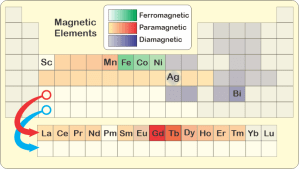
The game‘s over but there’s still pizza on the table so Eddie picks up the conversation. “So if gadolinoleum has even more unpaired electrons than iron, how come it’s not ferromagnetic like iron is?”

Vinnie’s tidying up the chips he just won. “I bet I know part of it, Eddie. Sy and me, we talked about magnetic domains some years ago. If I remember right, each iron atom in a chunk is a tiny little magnet, which I guess is the fault of its five unpaired electrons, but usually the atom magnets are pointing in all different directions so they all average out and the whole chunk doesn’t have a field. If you stroke the chunk with a magnet, that collects the little magnets into domains and the whole thing gets magnetic. How come gadomonium” <winks at Eddie, Eddie winks back> “doesn’t play the domain game, Susan?”

“It’s gadolinium, boys, please. As to the why, part’s at the atom level and part’s higher up. My lab neighbor Tammy schooled me on rare earth magnetism just last week. She does high‑temperature solid state chemistry with lanthanide‑containing materials. Anyway, she says it’s all about coupling.”

“I hope she told you more than that.”

“She did. Say you’ve got a single gadolinium atom floating in space. Its environment is spherically symmetrical, no special direction to organize the wave‑orbitals hosting unpaired charges. Now turn on a magnetic field to tell the atom which way is up, call that the z‑axis. The atom’s wave‑orbital with zero angular momentum orients along z. Six more wave‑orbitals with non‑zero angular momentum spin one way or the other at various angles to the z‑axis. Those charges in motion build the atom’s personal magnetic field.”

“But we’re on Earth, not in space.”

“Bear with me. First, as a chemist I must say that most of the transition and lanthanide elements happily lose two electrons so in general we’re dealing with ions. Before you ask, Vinnie, that goes even for metals where the ions float in an electron sea. When Tammy said ‘coupling’ she was talking about how strongly one ion feels the neighboring fields. Iron and other ferromagnetic materials have a strong coupling, much stronger than the paramagnetics do.”

“Why’s the ferro- coupling so much stronger?”

“Two effects. You can read both of them right off the Periodic Table. Physical size, for one. Each row down in the table represents one electronic shell which takes up space. The atom or ion in any row is bigger than the ones above it. Yes, the heavy elements have more nuclear charge to pull electronic charge close, but shielding from their completed lower shells lets the outer charge cloud expand. Tammy told me that gadolinium’s ions are about 20% wider than iron’s.”

“Makes sense — you make the ions get further apart, they won’t connect so good. What’s the other effect?”

“It’s about how each orbital distributes its charge. There are tradeoffs between shell number, angular momentum and distance from the nucleus. Unpaired charge concentration in gadolinium’s high‑momentum 4f‑orbitals on the average stays inside of all its 3‑shell waves. The outermost charge shelters the unpaired waves inside it. That weakens magnetic coupling with unpaired charge in neighboring ions. Bottom line — gadolinium and its cousins are paramagnetic because they’re bigger and less sensitive than ferromagnetic iron is.”

“Then how come rare earth supermagnets the Chinese make are better than the cheapie ironic kinds we can make here?”

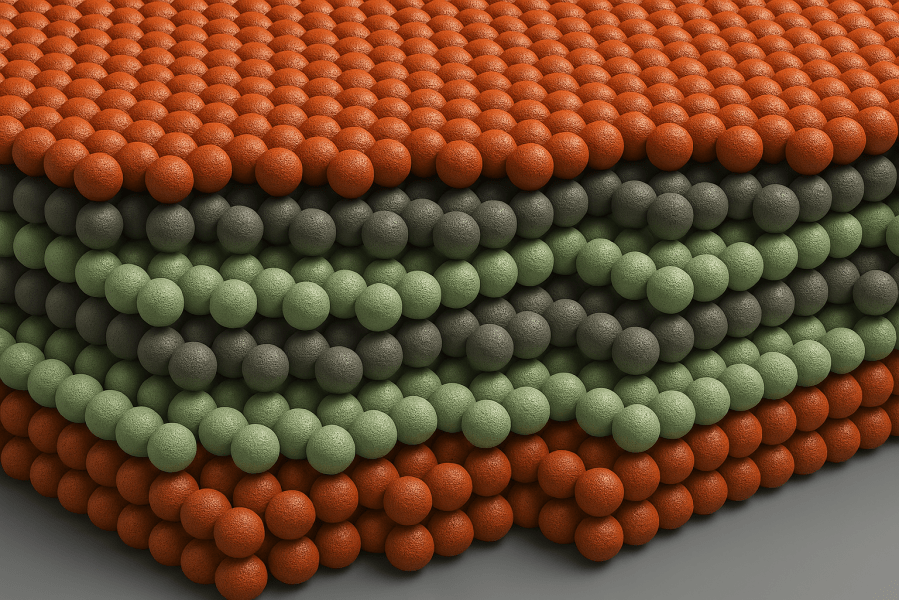
“The key is getting the right atoms into the right places in a crystalline solid. Neodymium magnets, for instance, have clusters of iron atoms around each lanthanide. The cluster arrangement aligns everyone’s z‑axes letting the unpaired charges gang up big‑time. You find materials like that mostly by luck and persistence. Tammy’s best samples are multi‑element oxides that arrange themselves in planar layers. Pick a component just 1% off the ideal size or cook your mixture with the wrong temperature sequence and the structure has completely different properties. Chinese scientists worked decades to perfect their recipes. USA chose to starve research in that area.”

~ Rich Olcott

That Lump in The Table

The Acme Building Science and Pizza Society is back in session. It’s Cal’s turn to deal the cards and the topic. “This TV guy was talking about rare earths that China’s got a lock on and it’s gonna mess up our economy, but he didn’t say what they are or why we should care about them. What’s goin’ on?”

Vinnie passes but Susan tosses a chip into the pot. “The rare earths are oxides of the lanthanide elements—”

“Wait, they’re from the planet that the Strange New Worlds engineering prof is from?”

“Put in a chip, Vinnie, you know the rules.” <He does.> “No, they have nothing to do with Pelia or her home planet. She’s a Lanthanite, these elements are lanthanides. Although these days we’re supposed to call them lanthanoids because ‑ides are ionic compounds like oxides.”

It’s not Kareem’s turn yet but he chuckles and flips in a chip. “Funny. The geology community settled on meteoroids as rocks floating in space, meteors when they flash through the sky, and meteorites when they hit the ground. I don’t think there’s such a thing as a meteoride. Sorry, Susan, go on.”

“As a matter of fact, Kareem, I once did a high‑rated downhill mountain bike path in Arizona called the Meteoride. Once. Didn’t wipe out but I admit I used my brakes a whole lot. Where was I? Oh, yes, the lanthanides. They’re a set of fourteen near‑identical twins, chemistry so similar that it took decades of heroic effort by 19th‑century Swedish chemists in the long, cold Swedish nights to separate and identify them.”

“Similar how?”

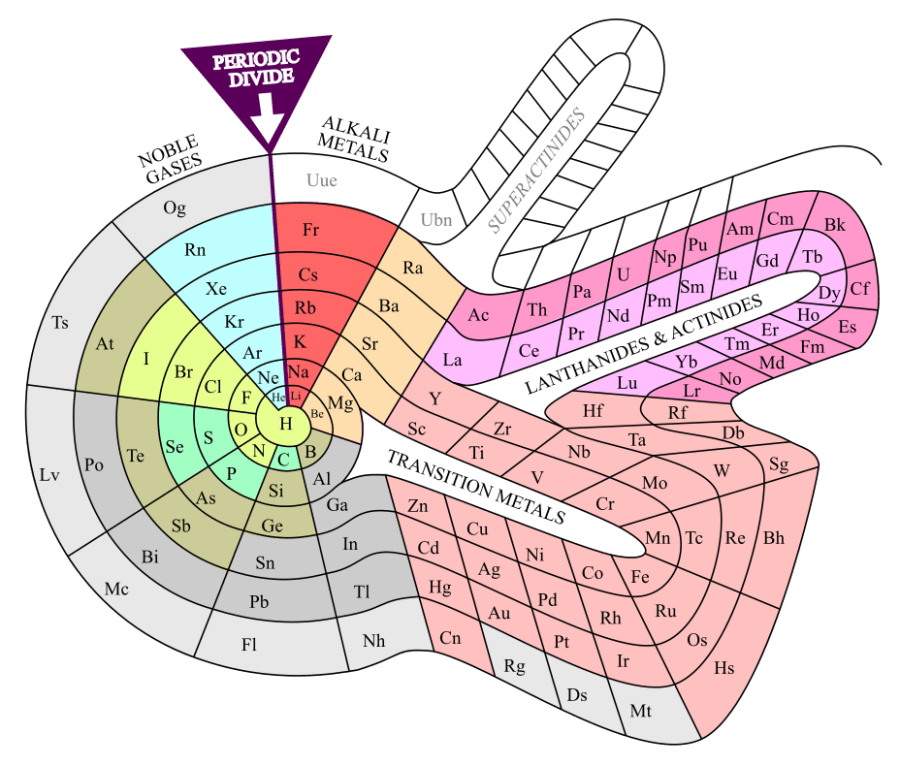
“They all act like aluminum.” <pulls laptop from her purse, points to two stickers on its lid> “You’ve all at least heard of the Periodic Table, right? Back in the mid-1800s, the chemists had isolated dozens of chemical elements, enough that they could start classifying them. They didn’t know what atoms were yet but they had developed ways to measure average atomic weights. Some theorists played with the idea of arranging elements with similar chemistries according to their atomic weights. Mendeleev did the best job, even predicting three elements to fill empty slots in his tabulation. These guys in the lime green row and the pale pink bulge were his biggest puzzlement.”

“Why’s that? They’re all spread out nice.”

“Because like I said, Vinnie, they all have pretty much the same chemistry. Aluminum’s a soft silvery metal, oxidizes readily to a 3+ ion and stays there. Same for almost all the lanthanides. Worse yet, all their atoms are nearly the same size, less than 8% difference from the largest to the smallest.”

“Why’s that make a difference?”

“Because they can all fit into the same crystalline structure. Nineteenth‑century chemistry’s primary technique for isolating a metallic element was to dissolve a likely‑looking ore, purify the solution, add an organic acid or something to make crystalline salts, burn away the organics, add more acid to dissolve the ash, purify the solution and re‑crystallize most it. Do that again and again until you have a provably pure product. All the lanthanide ions have the same charge and nearly the same size so the wrong ions could maliciously infiltrate your crystals. It took a lot of ingenious purification steps to isolate each element. There were many false claims.”

Kareem contributes another chip. “Mm‑hm, because geology doesn’t use chemically pure materials to create its ores. Four billion years ago when our planet was coated with molten magma, the asteroids striking Earth in the Late Heavy Bombardment brought megatons of stone‑making lithophile elements. The lanthanides are lithophiles so random mixtures of them tended to concentrate within lithic silicate and phosphate blobs that later cooled to form rocky ores. Industry‑scale operations can tease lanthanides out of ores but the processes use fierce chemicals and require close control of temperature and acidity. Tricky procedures that the Chinese spent billions and decades to get right. For the Chinese, those processes are precious national security assets.”

Cal’s getting impatient. “Hey, guys, are we playing cards or what?”

~ Rich Olcott

Confluence

“My usual cup of — Whoa! Jeremy, surprised to see you behind the counter here. Where’s Cal?”

“Hi, Mr Moire. Cal just got three new astronomy magazines in the same delivery so he’s over there bingeing. He said if I can handle the pizza place gelato stand he can trust me with his coffee and scones. I’m just happy to get another job ’cause things are extra tough back on the rez these days. Here’s your coffee, which flavor scone can I get for you?”

“Thanks, Jeremy. Smooth upsell. I’ll take a strawberry one. … Morning, Cal. Having fun?”

“Morning, Sy. Yeah, lotsa pretty pictures to look at. Funny coincidence, all three magazines have lists of coincidences. This one says February 23, 1987 we got a neutrino spike from supernova SN 1987A right after we saw its light. The coincidence told us that neutrinos fly almost fast as light so the neutrino’s mass gotta be pretty small. 1987’s also the year the Star Tours Disney park attractions opened for the Star Wars fans. The very same year Gene Roddenberry and the Paramount studio released the first episodes of Star Trek: The Next Generation. How about that?”

“Pretty good year.”

“Mm‑hm. Didja know here in 2025 we’ve got that Mercury‑Venus‑Jupiter-Saturn‑Uranus‑Neptune straight‑line arrangement up in the sky and sometimes the Moon lines up with it?”

“I’ve read about it.”

“Not only that, but right at the September equinox, Neptune’s gonna be in opposition. That means our rotation axis will be broadside to the Sun just as Neptune will be exactly behind us. It’ll be as close to us as it can get and it’s face‑on to the Sun so it’s gonna be at its brightest. Cool, huh?”

“Good time for Hubble Space Telescope to take another look at it.”

“Those oughta be awesome images. Here’s another coincidence — Virgo’s the September sign, mostly, and its brightest star is Spica. All the zodiac constellations are in the ecliptic plane where all the planet orbits are. Planets can get in the way between us and Spica. The last planet to do that was Venus in 1783. The next planet to do that will be Venus again, in 2197.”

“That’ll be a long wait. You’ve read off things we see from Earth. How about interesting coincidences out in the Universe?”

“Covered in this other magazine’s list. Hah, they mention 1987, too, no surprise. Ummm, in 2017 the Fermi satellite’s GRB instrument registered a gamma‑ray burst at the same time that LIGO caught a gravitational wave from the same direction. With both light and gravity in the picture they say it was two neutron stars colliding.”

“Another exercise in multi-messenger astronomy. Very cool.”

“Ummm … Galaxy NGC 3690 shot off two supernovas just a few months apart last year. Wait, that name’s familiar … Got it, it’s half of Arp 299. 299’s a pair of colliding galaxies so there’s a lot of gas and dust and stuff floating around to set off stars that are in the brink. If I remember right, we’ve seen about eight supers there since 2018.”

“Hmm, many events with a common cause. Makes sense.”

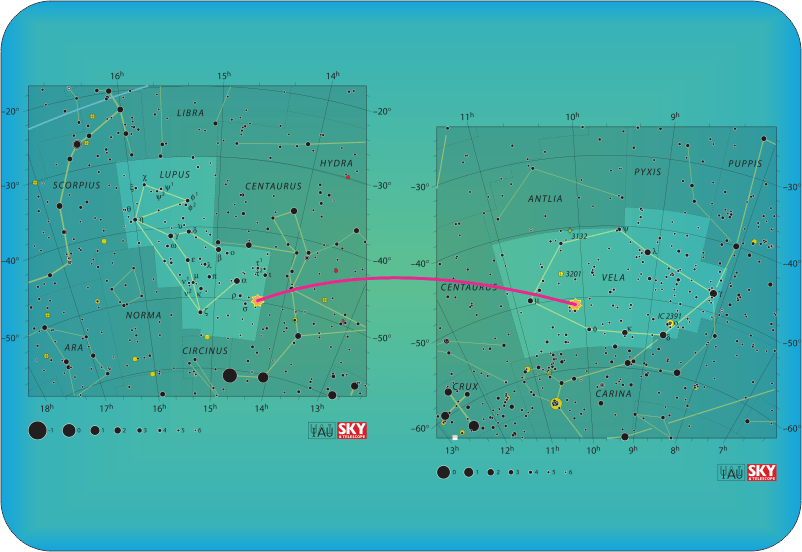
“Oh, it’s a nice idea, alright, but explain V462 Lupi and V572 Velorum. Just a couple months ago, two novas less than 2 weeks apart in two different constellations 20 degrees apart in the sky. Bright enough you could see ’em both with good eyes if you were below the Equator and knew where to look and looked in the first week of June. My skywatcher internet buddies down there went nuts.”

“How far are those events from us?”

“The magazine doesn’t say. Probably the astronomers are still working on it. Could be ten thousand lightyears, but I’d bet they’re a lot closer than that.”

“On average, visible stars are about 900 lightyears away. Twenty degrees would put them about 300 lightyears apart. They’re separated by a slew of stars that haven’t blown up. One or both could be farther away than that, naturally. Whatever, it’s hard to figure a coordinating cause for such a distant co‑occurrence. Sometimes a coincidence is just a coincidence.”

~ Rich Olcott

Sussing Out The Unseeable

<chirp, chirp> “Moire here.”

“Hello, Mr Moire.”

“Afternoon, Walt. Pizza time again?”

“No, too public. Poor craft to be seen too often in the same place. There’s a park bench by the lake.”

“I know the spot.”

“Fifteen minutes.”

“Twenty.”


“Afternoon, Walt. What are your people curious about this time?”

“Word is that astronomers uncovered a huge amount of matter they’d been searching for. We’re interested in concealment techniques, so we want to know how it was hidden and how was it found.”

“Forty percent of all baryonic matter—”

“Baryonic?”

“Made out of atoms. Baryons are multi-quark particles like protons and—”

“Leave the weeds and get back to the topic. Where was that 40% hiding?”

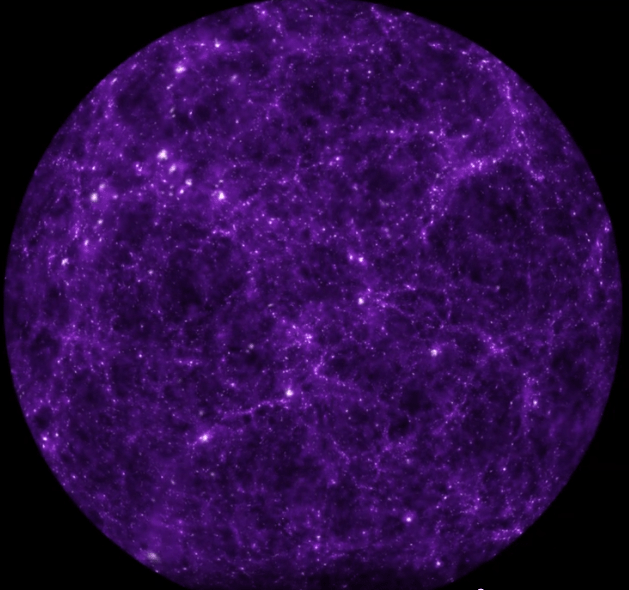
“In plain sight, all over the sky, in strands forming a network that connects galaxies and galaxy clusters. They’re calling it the Cosmic Web.”

“Something that big … how was hidden?”

“Some techniques I’m sure you’ll recognize. First, the material in the strands is diffuse — just an atom or two per cubic meter. An Earth laboratory would be proud to pump down a vacuum ten million times more dense.”

<taking notes> “Spread your forces so there’s no prime target for counter‑attack, mm‑hm. But if the material’s that thin, surely it doesn’t mass much.”

“Remember how big space is. These filaments span the widths of multiple galaxies. Do the math. A thread could be on the order of 100 million lightyears long by 1000 lightyears in diameter. A lightyear is 1016 meters. The thread has a volume of about 1062 cubic meters. At 10-26 kilogram per cubic meter that’s 1036 kilograms which is comparable to the mass of a small galaxy. That’s just one thread. Add them up and you get roughly half the baryons in the Universe, all hiding in the Web.”

“Concealment by dispersal, got it. What’s another technique?”

“Camouflage. No, not tiny uniforms in a woodland pattern. These atoms fade into the background because oncoming light waves pass right by them unless the wave has exactly the right wavelength for an absorption.”

“So how did astronomers detect these scattered and camouflaged atoms?”

“A couple of different ways. X‑rays, for one.”

“But these atoms are camouflaged against passing light. X‑rays are light waves.”

“X‑rays the atoms emit. Everybody thinks that space is cold, but those lonely atoms bounce around with a kinetic energy equivalent to million‑degree temperatures. When two of them collide some of that kinetic energy escapes as high‑frequency light, X‑ray range. Not a whole lot, because the atoms are sparse, but enough that European and Japanese space telescopes were able to tweeze it out of the background.”

“Use sensitive mics to pick up whispered convo in the opposing line.”

<pause> “Right, more or less. What do you know about refraction?”

“Mmm… Newton and his prism, splitting white light into different colors. I’ve no idea how that works.”

“The short answer is that the speed of light depends on its wavelength and the medium it’s traversing. In a perfect vacuum, light always goes at top speed just like Einstein said, but charged particles in its path slow it down.”

“Even those atoms in space that you said can’t absorb light?”

“Yup. It’s called virtual coupling; quantum’s involved. One inaccurate way to describe the interaction is that atoms occasionally absorb wrong‑wavelength photons but spit them right back out again after a brief delay. Short wavelengths see more of that effect than long wavelengths do. With me?”

<pause> “Go on.”

“Does the phrase ‘Fast Radio Burst’ sound familiar?”

“Of course, but probably not the way you mean.”

“Ah. Right. For this context, Fast Radio Bursts are isolated pulses of radio‑frequency light from incredibly bright extra-galactic sources we don’t understand. They’re all over the sky. A pulse lasts only a millisecond or so. What’s important here is that refraction skews each pulse’s wavelength profile as it travels through the intergalactic medium. Researchers analyze the distortions to detect and characterize Web filaments in the direction each pulse came from.”

“Intercept the oppo’s communications to the front.”

“That’s about the size of it.”

“Bye.”

“Don’t mention it.”

~ Rich Olcott

A Carefully Plotted Tale

<chirp, chirp> “Moire here.”

“Hello, Mr Moire. Remember me?”

“Yes, I do, Walt. I hope your people were satisfied with what you brought them from our last meeting.”

“They were, which is why I’m calling. Buy you pizza at Eddie’s, fifteen minutes?”

“Make it twenty.”


We’re at the rear‑corner table, Walt facing both doors, naturally. “So, what’s the mysterious question this time?”

“Word on the street is that the CPT Law’s being violated. We want to know who’s involved, and what’s their connection with ChatGPT.”

Good thing I’ve just bit into my pizza so I can muffle my chuckle in my chewing. “What do you know about anti‑matter?”

“Inside‑out atoms — protons outside whizzing around electrons in the nucleus.”

“Common misconception. One proton has the mass of 1800 electrons. An atom built as you described would be unstable — the thing would fly apart. You’ve got anti‑matter’s charges arranged right but not the particles. Anti‑matter has negative anti‑protons in the nucleus and positrons, positive electrons, on the outside.”

<writing rapidly in his notebook> “You can do that? Just flip the sign on a particle?”

“No, positrons and such are respectable particles in their own right, distinct from their anti‑partners. Electric charge comes built into the identity. What’s important is, an anti‑atom behaves exactly like a normal atom does. Maxwell’s Equations and everything derived from them, including quantum mechanics, work equally well for either charge structure.”

“There’s a bit of Zen there — change but no‑change.”

“Nice. Physicists call that sort of thing a symmetry. In this case it’s charge symmetry, often written as C.”

“The C in CPT?”

“Exactly.”

“What about the P and T?”

“When someone says something is symmetrical, what do you think of first?”

“Right side’s a reflection of left side. Symmetrical faces look better but they’re usually less memorable.”

“Interesting choice of example. Anyway, reflection symmetry is important in common physical systems.”

“Classical Greek and Cambodian architecture; the Baroque aesthetic without the decorative frills.”

“I suppose so. Anyway, we call reflection symmetry Parity, or P for short.”

“And T?”

“Time.”

“Time’s not symmetrical. It’s always past‑to‑future.”

“Maybe, maybe not. In all our physical laws that deal with a small number of particles, you can replace t for time with –t and get the same results except for maybe a flipped sign. Newton’s Laws would run the Solar System in reverse just as well as they do forward.”

“But … Ah, ‘small number of particles,’ that’s your out. If your system has a large number of particles, you’re in chaos territory where randomness and entropy have to increase. Entropy increase is the arrow for one‑way time.”

“Good quote.”

“I’ve been in some interesting conversations. You’re not my only Physics source. So CPT is about Charge AND Parity AND Time symmetries. But you can’t simply add them together.”

“You multiply them. Technically, each of them is represented by a mathematical operator—”

“Step away from the technically.”

“Understood. This’ll be simpler. If a system’s atoms have positive nuclei, set C=1, otherwise set C=1. If the system’s naturally‑driven motion is counterclockwise set P=1, otherwise P=1. If time is increasing, set T=1, otherwise set T=1. Okay?”

“Go on.”

“You can summarize any system’s CPT state by multiplying the prevailing symmetry values. The product will be either +1 or 1. The CPT Law says that in any universe where quantum mechanics and relativity work, one CPT state must hold universe‑wide.”

“Make it real for me.”

“You know the Right-hand Rule for electromagnetism?”

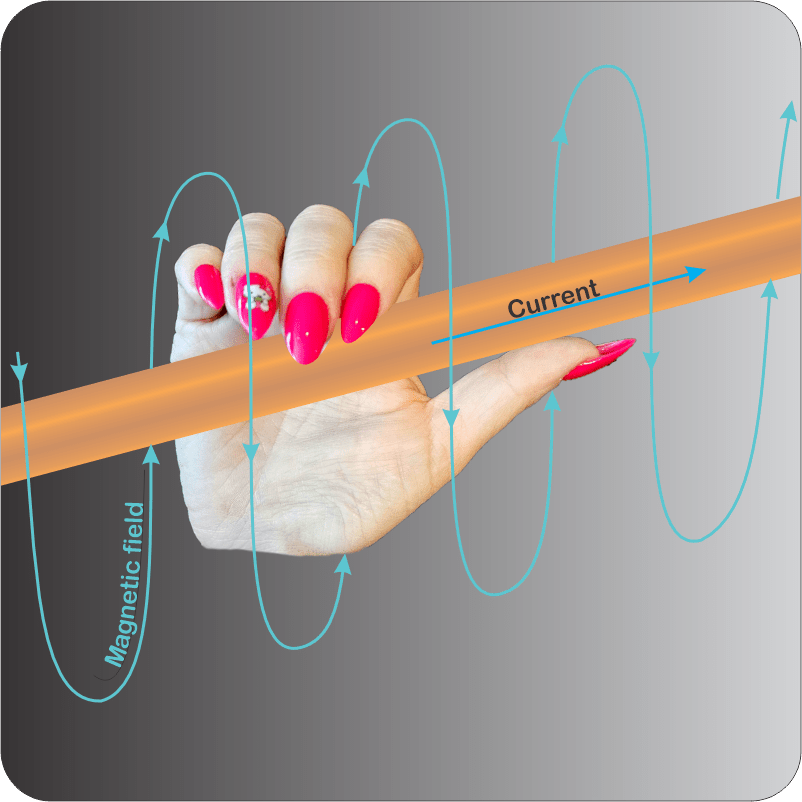
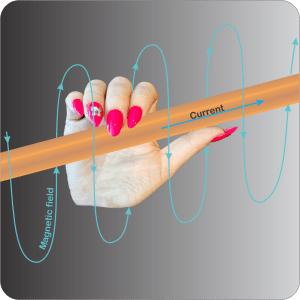
“Grab the wire with your right hand, thumb pointing along the current. Your fingers wrap in the direction of the spiraling magnetic field.”

“Perfect. Suppose C*P*T=+1 for this case. Now reverse the charge, making C=1. What happens?”

“Ssss… The magnetic spin flips orientation. That’s a reflection operation so P=1. The C*P*T calculation is (+1)*(1)*(1)=+1, no change.”

“The CPT Law in action. The CPT violation you’ve heard about is only observed in rare weak‑force‑mediated radioactive decays of a carefully prepared nucleus. That was a 1956 Nobel‑winning discovery, though the right person didn’t win it.”

“1956. Decades before A.I.”

“Yup, ChatGPT is off the hook. For that.”

“Bye.”

“Don’t mention it.”

~ Rich Olcott

  • Thanks to Caitlin, the hand model.

Two’s Company, Three Is Perturbing

Vinnie does this thing when he’s near the end of his meal. He mashes his pizza crumbs and mozzarella dribbles into marbles he rolls around on his plate. Mostly on his plate. Eddie hates it when one escapes onto his floor. “Vinnie, you lose one more of those, you’ll be paying extra.”

“Aw, c’mon, Eddie, I’m your best customer.”

“Maybe, but there’ll be a surcharge for havin’ to mop extra around your table.”

Always the compromiser, I break in. “How about you put on less sauce, Eddie?”

Both give me looks you wouldn’t want.
  ”Lower the quality of my product??!?”
    ”Adjust perfection??!?”

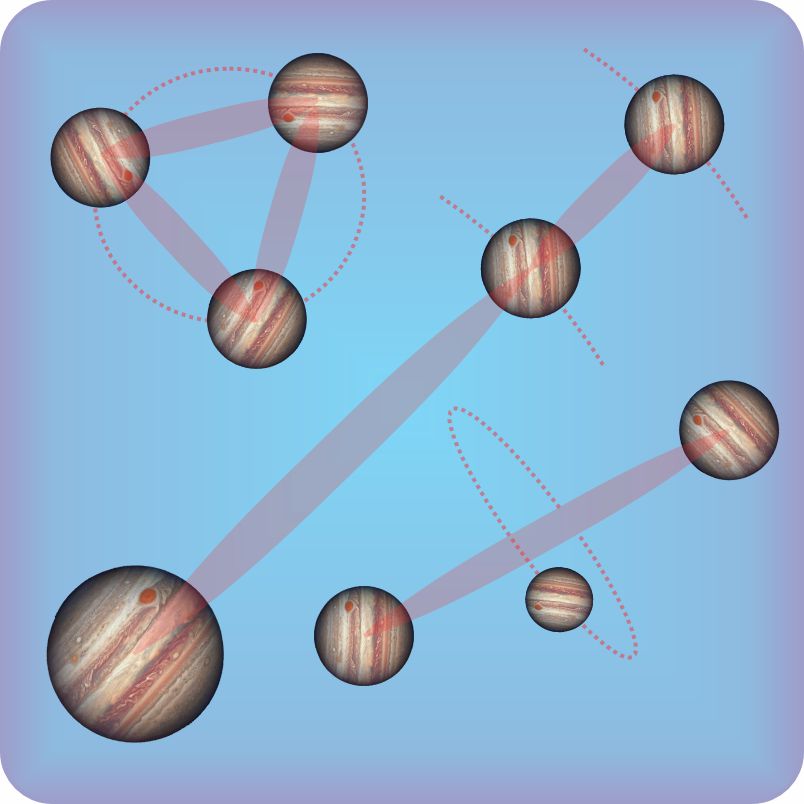
“Looks like we’ve got a three‑body problem here.” Blank looks all around. “You two were just about to go at it until I put in my piece and suddenly you’re on the same side. Two‑way interaction predictable results, three‑way interaction hard to figure. Like when Newton calculated celestial orbits to confirm his Laws of Gravity and Motion. They worked fine for the Earth going around the Sun, not so good for the Moon going around the Earth. The Sun pulls on the Moon just enough to play hob with his two‑body Earth‑Moon predictions.”

“Newton again. So how did he solve it?”

“He didn’t, not exactly anyway.”

“Not smart enough?”

“No, Eddie, plenty smart. Later mathematicians have proven that the three‑body problem simply doesn’t have a general exact solution.”

“Ah-hah, Sy, I heard weaseling — general?”

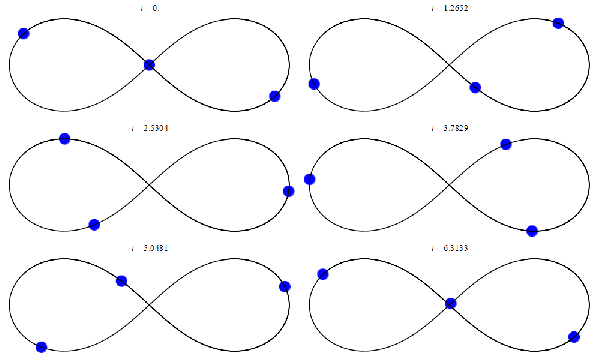
“Alright, Vinnie, there are some stable special cases. Three bodies at relative rest in an equilateral triangle; certain straight‑line configurations; two biggies circling each other and a third, smaller one in a distant orbit around the other two’s center of gravity. There are other specials but none stable in the sense that they wouldn’t be disrupted by a wobbly gravity field from a nearby star or the host galaxy.”

“So if NASA’s mission planners are looking at a four‑body Sun‑Jupiter‑Europa‑Juno situation, what’re they gonna do? ‘Give up’ ain’t an option.”

“Sure not. There’s a grand strategy with variations. The oldest variation goes back to before the Egyptian builders and everybody still uses it. Vinnie, when you fly a client to Tokyo, do you target a specific landing runway?”

“Naw, I aim for Japan, contact ATC Narita when I get close and they vector me in to wherever they want me to land.”

“How about you, Eddie? How do you get that exquisite balance in your flavoring?”

“Ain’t easy, Sy. Every batch of each herb is different — when it was picked, how it was stored, even the weather while it was growing. I start with an average mix which is usually close, then add a pinch of this and a little of that until it’s right.”

“For both of you, the critical word there was ‘close’. Call it in‑flight course adjustments, call it pinch‑and‑taste, everybody uses the ‘tweaking’ strategy. It’s a matter of skill and intuition, usually hard to generalize and even harder to teach in a systematic fashion. Engineers do it a lot, theoretical physicists work hard to avoid it.”

“What’ve they got that’s better?”

” ‘Better’ depends on your criteria. The method’s called ‘perturbation theory’ and strictly speaking, you can only use it for certain kinds of problems. Newton’s, for instance.”

“Good ol’ Newton.”

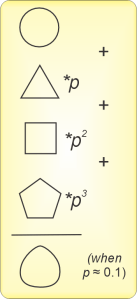
“Of course. Newton’s calculations almost matched Kepler’s planetary observations, but finagling the ‘not quite’ gave Newton headaches. More than 150 years passed before Laplace and others figured out how to treat a distant object as a perturbation of an ideal two‑body situation. It starts with calculating the system’s total energy, which wasn’t properly defined in Newton’s day. A perturbation factor p controls the third body’s contribution. The energy expression lets you calculate the orbits, but they’re the sum of terms containing powers of p. If p=0.1, p2=0.01, p3=0.001 and so on. If p isn’t zero but is still small enough, the p3 term and maybe even the p2 term are too small to bother with.”

“I’ll stick with pinch‑and‑taste.”

“Me and NASA’ll keep course‑correcting.”

~ Rich Olcott

Up, Down And Between

Vinnie finishes his double‑pepperoni pizza. “Sy, these enthalpies got a pressure‑volume part and a temperature‑heat capacity part, but seems to me the most important part is the chemical energy.”

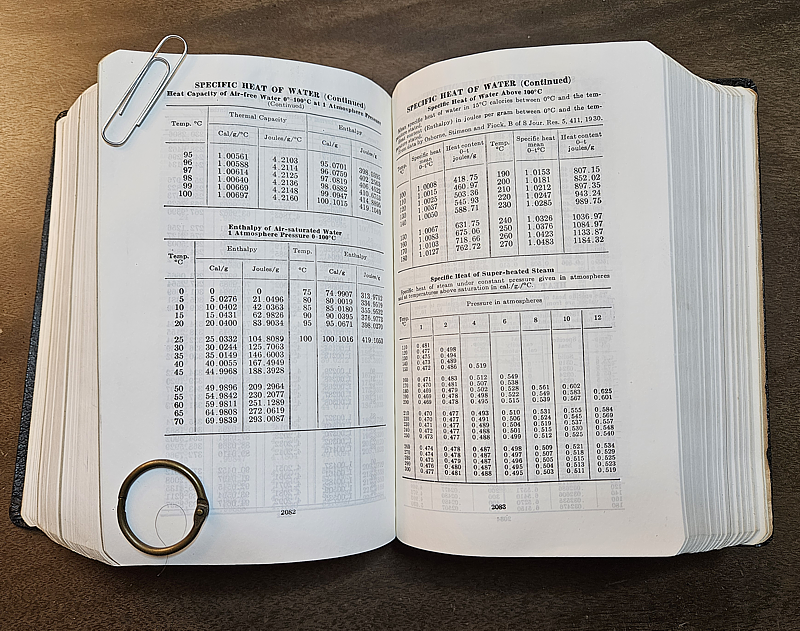
I’m still working on my slice (cheese and sausage). “That’s certainly true from a fuel engineering perspective, Vinnie. Here’s a clue. Check the values in this table for 0°C, also known as 273K.”

“Waitaminute! That line says the enthalpy’s exactly zero under the book‘s conditions. We talked about zeros a long time ago. All measurements have error. Nothing’s exactly zero unless it’s defined that way or it’s Absolute Zero temperature and we’ll never get there. Is this another definition thing?”

“More of a convenience thing. The altimeters in those planes you fly, do they display the distance to Earth’s center?”

“Nope, altitude above sea level, if they’re calibrated right.”

“But the other would work, too, say as a percentage of the average radius?”

“Not really. Earth’s fatter at the Equator than it is at the poles. You’d always have to correct for latitude. And the numbers would be clumsy, always some fraction of a percent of whatever the average is—”

“6371 kilometers.”

“Yeah, that. Try working with fractions of a part per thousand when you’re coming in through a thunderstorm. Give me kilometers or feet above sea level and I’m a lot happier.”

“But say you’re landing in Denver, 1.6 kilometers above sea level.”

“It’s a lot easier to subtract 1.6 from baseline altitude in kilometers than 0.00025 from 1.00something and getting the decimals right. Sea‑level calibrations are a lot easier to work with.”

“So now you know why the book shows zero enthalpy for water at 273K.”

“You’re saying there’s not really zero chemical energy in there, it’s just a convenient place to start counting?”

“That’s exactly what I’m saying. Chemical energy is just another form of potential energy. Zeroes on a potential scale are arbitrary. What’s important is the difference between initial and final states. Altitude’s about gravitational potential relative to the ground; chemists care about chemical potential relative to a specific reaction’s final products. Both concerns are about where you started and where you stop.”

“Gimme a chemical f’rinstance.”

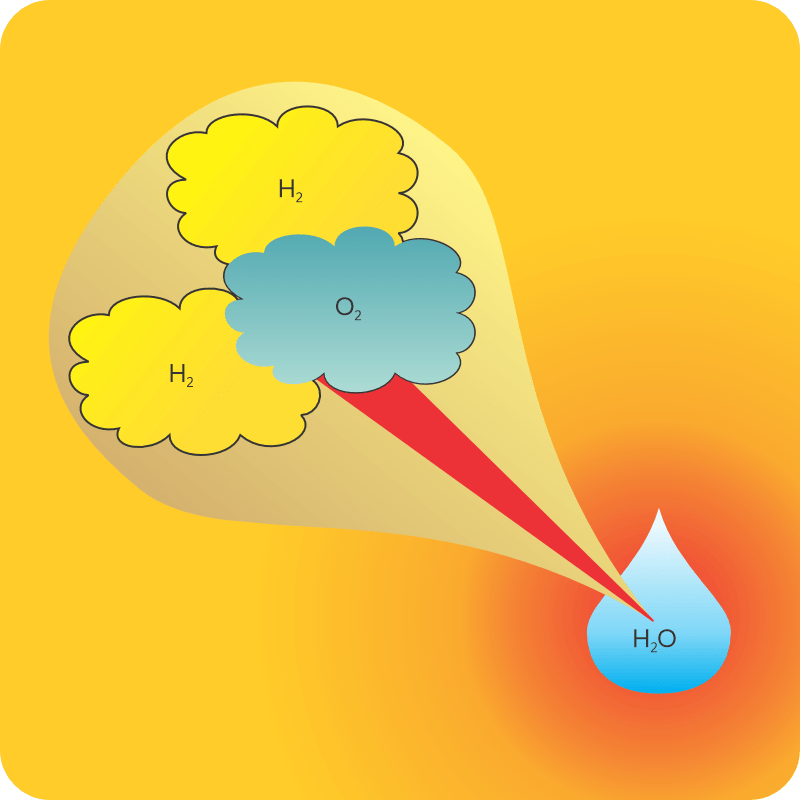
<reading off of Old Reliable> “Reacting 1 gram of oxygen gas and 0.14 gram of hydrogen gas slowly in a catalytic fuel cell at 298K and atmospheric pressure produces one gram of liquid water and releases 18.1 kilojoules of energy. Exploding the same gas mix at the same pressure in a piston also yields 18.1 kilojoules once you cool everything back down to 298K. Different routes, same results.”

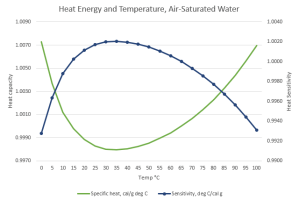
Meanwhile, Jeremy’s wandered over from his gelato stand. “Excuse me, Mr Moire. I read your Crazy Theory about how mammals like to keep their body temperature in the range near water’s minimum Specific Heat, um Heat Capacity, but now I’m confused.”

“What’s the confusion, Jeremy?”

“Well, what you told me before made sense, about increased temperature activates higher‑energy kinds of molecular waggling to absorb the heat. But that means that Heat Capacity always ought to increase with increasing temperature, right?”

“Good thinking. So your problem is…?

“Your graph shows that if water’s cold, warming it decreases its Heat Capacity. Do hotter water molecules waggle less?”

“No, it’s a context thing. Gas and liquid are different contexts. Each molecule in a gas is all by itself, most of the time, so its waggling is determined only by its internal bonding and mass configuration. Put that molecule into a liquid or solid, it’s subject to what its neighbors are doing. Water’s particularly good at intermolecular interactions. You know about the hexagonal structure locked into ice and snowflakes. When water ice melts but it’s still at low temperature, much of the hexagonal structure hangs around in a mushy state. A loose structure’s whole‑body quivering can absorb heat energy without exciting waggles in its constituent molecules. Raising the temperature disrupts that floppy structure. That’s most of the fall on the Heat Capacity curve.”

“Ah, then the Sensitivity decrease on the high‑temperature side has to do with blurry structure bits breaking down to tinier pieces that warm up more from less energy. Thanks, Mr Moire.”

“Don’t mention it.”

~~ Rich Olcott

Hiding Under Many Guises

Vinnie lifts his pizza slice and pauses. “I dunno, Sy, this Pressure‑Volume part of enthalpy, how is it energy so you can just add or subtract it from the thermal and chemical kinds?”

“Fair question, Vinnie. It stumped scientists through the end of Napoleon’s day until Sadi Carnot bridged the gap by inventing thermodynamics.”

“Sounds like a big deal from the way you said that.”

“Oh, it was. But first let’s clear the ‘is it energy?’ question. How would Newton have calculated the work you did lifting that slice?”

“How much force I used times the distance it moved.”

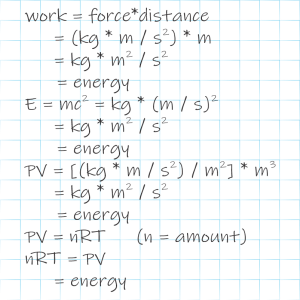
“Putting units to that, it’d be force in newtons times distance in meters. A newton is one kilogram accelerated by one meter per second each second so your force‑distance work there is measured in kilograms times meters‑squared divided by seconds‑squared. With me?”

“Hold on — ‘per second each second’ turned into ‘per second‑squared.” <pause> “Okay, go on.”

“What’s Einstein’s famous equation?”

“Easy, E=mc².”

“Mm-hm. Putting units to that, c is in meters per second, so energy is kilograms times meters‑squared divided by seconds‑squared. Sound familiar?”

“Any time I’ve got that combination I’ve got energy?”

“Mostly. Here’s another example — a piston under pressure. Pressure is force per unit area. The piston’s area is in square meters so the force it feels is newtons per meter‑squared, times square meters, or just newtons. The piston travels some distance so you’ve got newtons times meters.”

“That’s force‑distance work units so it’s energy, too.”

“Right. Now break it down another way. When the piston travels that distance, the piston’s area sweeps through a volume measured in meters‑cubed, right?”

“You’re gonna say pressure times volume gives me the same units as energy?”

“Work it out. Here’s a paper napkin.”

“Dang, I hate equations … Hey, sure enough, it boils down to kilograms times meters‑squared divided by seconds‑squared again!”

“There you go. One more. The Ideal Gas Law is real simple equation —”

“Gaah, equations!”

“Bear with me, it’s just PV=nRT.”

“Is that the same PV so it’s energy again?”

“Sure is. The n measures the amount of some gas, could be in grams or whatever. The R, called the Gas Constant, is there to make the units come out right. T‘s the absolute temperature. Point is, this equation gives us the basis for enthalpy’s chemical+PV+thermal arithmetic.”

“And that’s where this Carnot guy comes in.”

“Carnot and a host of other physicists. Boyle, Gay‑Lussac, Avagadro and others contributed to Clapeyron’s gas law. Carnot’s 1824 book tied the gas narrative to the energetics narrative that Descartes, Leibniz, Newton and such had been working on. Carnot did it with an Einstein‑style thought experiment — an imaginary perfect engine.”

“Anything perfect is imaginary, I know that much. How’s it supposed to work?”

<sketching on another paper napkin> “Here’s the general idea. There’s a sealed cylinder in the middle containing a piston that can move vertically. Above the piston there’s what Carnot called ‘a working body,’ which could be anything that expands and contracts with temperature.”

“Steam, huh?”

“Could be, or alcohol vapor or a big lump of iron, whatever. Carnot’s argument was so general that the composition doesn’t matter. Below the piston there’s a mechanism to transfer power from or to the piston. Then we’ve got a heat source and a heat sink, each of which can be connected to the cylinder or not.”

“Looks straight‑forward.”

“These days, sure. Not in 1824. Carnot’s gadget operates in four phases. In generator mode the working body starts in a contracted state connected to the hot Th source. The body expands, yielding PV energy. In phase 2, the body continues to expand while it while it stays at Th. Phase 3, switch to the cold Tc heat sink. That cools the body so it contracts and absorbs PV energy. Phase 4 compresses the body to heat it back to Th, completing the cycle.”

“How did he keep the phases separate?”

“Only conceptually. In real life Phases 1 and 2 would occur simultaneously. Carnot’s crucial contribution was to treat them separately and yet demonstrate how they’re related. Unfortunately, he died of scarlet fever before Clapeyron and Clausius publicized and completed his work.”

~ Rich Olcott

Energy Is A Shape-shifter

Another dinner, another pizza at Eddie’s place. Vinnie wanders over to my table. “Hi, Sy, got a minute?”

“Not doing anything other than eating, Vinnie. What’s on your mind other than the sound of my chewing?”

“At least you keep your mouth closed. No, it’s about this energy thing you’ve gotten back into. I read that enthalpy piece and it’s bothering me.”

“In what way?”

“Well, you said that something’s enthalpy is the energy total of ‘thermal plus Pressure‑Volume plus chemical energy,’ right? I’m trying to fit that together with the potential energy and kinetic energy we talked about a while ago. It’s not working.”

“Deep question for dinner time but worth the effort. Would it help if I told you that the ‘actual versus potential’ notion goes back to Aristotle, the ‘kinetic’ idea came from Newton’s enemy Leibniz, but ‘enthalpy’ wasn’t a word until the 20th century?”

“Not a bit.”

“Didn’t think it would. Here’s another way to look at it. The thinkers prior to the mid‑1700s all looked at lumpy matter — pendulums, rolling balls on a ramp, planets, missiles — either alone or floating in space or colliding with each other. You could in principle calculate kinetic and potential energy for each lump, but that wasn’t enough when the Industrial Revolution came along.”

“What more did they want?”

“Fuel was suddenly for more than cooking and heating the house. Before then, all you needed to know was whether the log pile was stocked better than it was last year. If not, you might have a few chilly early Spring days but you could get past that. Then the Revolution came along. Miners loved Watt’s coal‑fired water‑pump except if you bought one and ran out of coal then the mine flooded. The miners learned that some kinds of coal burned hotter than others. You didn’t need as much of the good kind for a day’s pumping. The demand for a coal‑rating system got the scientists interested, but those lumps of coal weren’t falling or colliding, they just sat there with their heat locked inside. The classical energy quantities didn’t seem to apply so it was time to invent a new kind of energy.”

“That’s how Conservation of Energy works? You just spread the definition out a little?”

“That’s the current status of dark energy, for instance. We know the galaxies are moving apart against gravity so dark energy’s in there to balance the books. We have no good idea why it exists or where it comes from, but we can calculate it. ‘Internal energy’ put the Victorian‑era physicists in the same pickle — ‘atom’ and ‘molecule’ were notions from Greek and Roman times but none of the Victorians seriously believed in them. The notion of chemical bond energy didn’t crop up until the twentieth century. Lacking a good theory, all the Victorians could do was measure and tabulate heat output from different chemical reactions, the data that went into handbooks like the CRC. Naturally they had to invent thermodynamics for doing the energy accountancy.”

“But if it’s just book-balancing, how do you know the energy is real?”

“Because all the different forms of energy convert to each other. Think of a rocket going up to meet the ISS. Some of the rocket fuel’s chemical energy goes into giving the craft gravitational potential energy just getting it up there. At the same time, most of the chemical energy becomes kinetic energy as the craft reaches the 27600 km/h speed it needs to orbit at that altitude.”

<grin> “All?”

“Okay, we haven’t figured out how to harness dark energy. Yet.”

“HAW! Wait, how does enthalpy’s ‘chemical+PV+thermal’ work when the pressure’s zero, like out in space?”

“Then no work was done against an atmosphere up there to make way for the volume. Suppose you suddenly transported a jug of fuel from Earth up to just outside of the ISS. Same amount of fuel, so same amount of chemical energy, right? Same temperature so same thermal component?”

“I suppose.”

“The volume that the jug had occupied on Earth, what happened to it?”

“Suddenly closed in, probably with a little thud.”

“The thud sound’s where the Earth‑side PV energy went. It all balances out.”

~ Rich Olcott