A Clock You Can Count On And Vice-versa

We’re both leery of the Acme Building’s elevators after escaping from one, so Vinnie and I take the stairs down to Pizza Eddie’s. “Faster, Sy, that order we called in will be cold when we get there.”

“Maybe not, Vinnie. Depends on his backlog.”

“Hey, before all this started, we were talking about the improved time standard and you said something about optical clockwork. I gather it’s got something to do with lasers and such.”

“It sure does. Boils down to Science preferring count-based units over ratios because they’re more precise. If you count something twice you should get exactly the same answer each time; if you’re measuring a ratio against a ruler or something, duplicate measurements might not agree. For instance, you can probably tell me how many steps there are between floors — “

“Fourteen”

“— more precisely than you can tell me the floor-to-floor height in feet or meters. And more accurately, too.”

“How can it be more accurate? I’ve got a range-finder gadget that reads out to a tenth of an inch. Or a millimeter if you set the switch for that.”

“Because that reading is subject to all sorts of potential errors — maybe you’re pointing it at an angle, or its temperature calibration is off, or you’re moving and there’s a Doppler effect. It may give you exactly the same reading twice in a row —”

“I always measure twice before I cut once.”

“Of course you do. My point is, that device might give you very precise but inaccurate answers that are way off. You’d have to calibrate its readings against a trustworthy standard to be sure.”

“Suppose my range-finder’s as precise as my step-counting. How can step-counting be better?”

“Because the step is defined as the measurement unit. There’s no calibration issues or instrumental drift or ‘it depends on how good the carpenter was,’ a step is a step. Step counting is accurate by definition. Nearly all our conventional units of measurement have some built-in ‘‘it depends’ factors that drive the measurement folks crazy. Like the foot, for instance — every time a new king came to power, his foot became the new standard and every wood and cloth merchant in the kingdom had to revise their inventory listings.”

“OK, so that’s basically why the time-measurement people wanted to get away from that ‘a second is a fraction of a day back when‘ definition — too many ‘it depends’ factors and they wanted something they could count. Got it. So back in what, 1967? they switched to a time standard where they could count waves and they went to the ‘a second is so many waves‘ thing. I also got that their first shot was to use microwaves ’cause that’s what they could count. But that was half-a-century ago. Haven’t they moved up the spectrum since then, say to visible light?”

“Not quite. They had to get tricky. Think about it. Yellow-orange light’s wavelength is about 600 nanometers or 600×10-9 meters. Divide that by the speed of light, 3×10⁸ meters/second, and you get that each wave whizzes by in only 2×10-15 seconds. Our electronics still can’t count that fast, but we can cheat. Uhhh … which would be easier to answer — how many floors in this building or how many steps?”
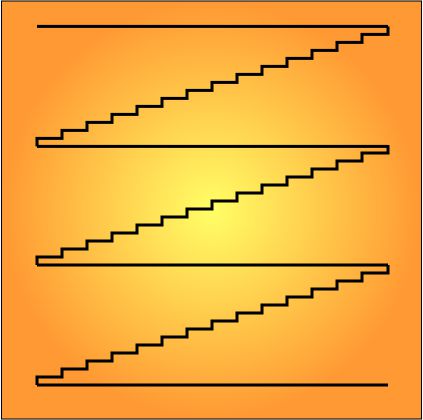
“Floors, of course, there’s a lot fewer of them.”

“But the step count would track the floor count, regular as clockwork, because an exact number of steps separates each pair of floors. If you know one count, arithmetic tells you the other. The same logic can work with lightwaves. Soon after the engineers developed mode-locking theory and a few tricks like frequency combs, they figured out ways to stabilize a maser by mode-locking it to a laser. It’s like gearing down a once-a-second pendulum to regulate the hour-hand of a clock, so of course they called it optical clockwork even though there’s no gears.”

“Maser?”

“A maser does microwaves the way a laser does lightwaves. Every tick from a cesium-based maser is about 47,000 ticks from a strontium-based laser. Mode-lock them together and your clock’s good within a few seconds over the age of the Universe.”

“Hiya, Eddie.”

“Hiya, Vinnie. Perfect timing. Those pizzas you called for, they’re just comin’ outta the oven.”

~~ Rich Olcott
Moby Divergence

Stepping into Pizza Eddie’s I see Jeremy at his post behind the gelato stand, an impressively thick book in front of him.  “Hi, Jeremy, one chocolate-hazelnut combo, please.  What’re you reading there?”

“Hi, Mr Moire.  It’s Moby Dick, for English class.”

“Ah, one of my favorites.  Melville was a 19th-century techie, did for whaling what Tom Clancy did for submarines.”

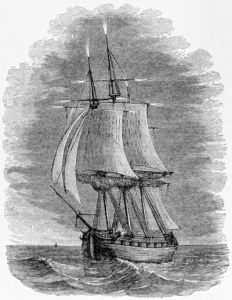
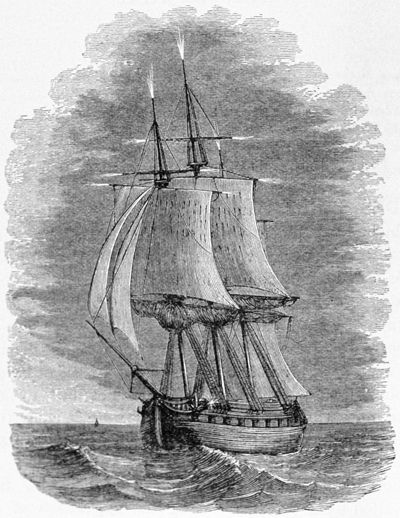
“You’re here at just the right time, Mr Moire.  I’m reading the part where something called ‘the corpusants’ are making lights glow around the Pequod.  Sometimes he calls them lightning, but they don’t seem to come down from the sky like real lightning.  Umm, here it is, he says. ‘All the yard-arms were tipped with pallid fire, and touched at each tri-pointed lightning-rod-end with three tapering white flames, each of the three tall masts was silently burning in that sulphurous air, like three gigantic wax tapers before an altar.’  What’s that about?”St Elmos fire

“That glow is also called ‘St Elmo’s Fire‘ among other things.  It’s often associated with a lightning storm but it’s a completely different phenomenon.  Strictly speaking it’s a concentrated coronal discharge.”

“That doesn’t explain much, sir.”

“Take it one word at a time.  If you pump a lot of electrons into a confined space, they repel each other and sooner or later they’ll find ways to leak away.  That’s literally dis-charging.”

“How do you ‘pump electrons’?”

“Oh, lots of ways.  The ancient Greeks did it by rubbing amber with fur, Volta did it chemically with metals and acid,  Van de Graaff did it with a conveyor belt, Earth does it with winds that transport air between atmospheric layers.  You do it every time you shuffle across a carpet and get shocked when you put your finger near a water pipe or a light switch.”

“That only happens in the wintertime.”

“Actually, carpet-shuffle electron-pumping happens all the time.  In the summer you discharge as quickly as you gain charge because the air’s humidity gives the electrons an easy pathway away from you.  In the winter you’re better insulated and retain the charge until it’s too late.”

“Hm.  Next word.”

Corona, like ‘halo.’  A coronal discharge is the glow you see around an object that gets charged-up past a certain threshold.  In air the glow can be blue or purple, but you can get different colors from other gases.  Basically, the electric field is so intense that it overwhelms the electronic structure of the surrounding atoms and molecules.  The glow is electrons radiating as they return to their normal confined chaos after having been pulled into some stretched-out configuration.”

“But this picture of the corpusants has them just at the mast-heads and yard-arms, not all over the boat.”

“That’s where the ‘concentrated’ word come in.  I puzzled over that, too, when I first looked into the phenomenon.  Made no sense.”

“Yeah.  If the electrons are repelling each other they ought to spread out as much as possible.  So why do they seem pour out of the pointy parts?”

“That was a mystery until the 1880s when Heaviside cleaned up Maxwell’s original set of equations.  The clarified math showed that the key is the electric field’s spread-out-ness, technically known as divergence.”

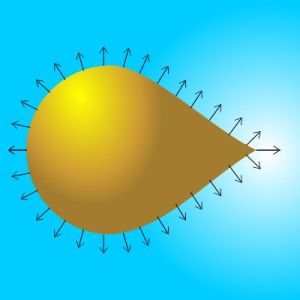
DivergenceWith my finger I draw in the frost on his gelato cabinet.  “Imagine this is a brass ball, except I’ve pulled one side of it out to a cone.  Someone’s loaded it up with extra electrons so it’s carrying a high negative charge.”
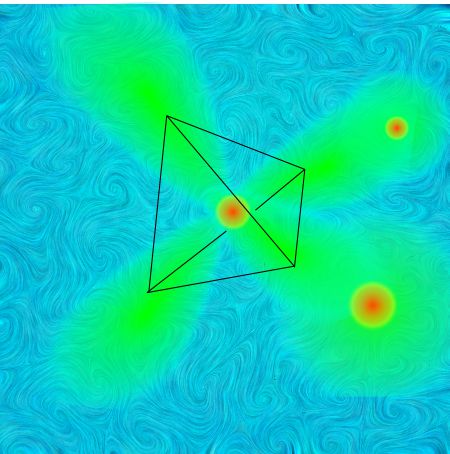
“The electrons have spread themselves evenly over the metal surface, right, including at the pointy part?”

“Yup, that’s why I’m doing my best to make all these electric field arrows the same distance apart at their base.  They’re also supposed to be perpendicular to the surface.  What part of that field will put the most rip-apart stress on the local air molecules?”

“Oh, at the tip, where the field spreads out most abruptly.”

“Bingo.  What makes the glow isn’t the average field strength, it’s how drastically the field varies from one side of a molecule to the other.  That’s what rips them apart.  And you get the greatest divergence at the pointy parts like at the Pequod’s mast-head.”

“And Ahab’s harpoon.”

~~ Rich Olcott

The Shape of Water

Amazing what you can do with mozzarella drips and crumbled pizza edges.  Vinnie’s rolling his crumbs into decent-sized marbles.  (Pizza-maker Eddie’s giving him a look.)  He adds a fourth ball to his triangle to make a square.  “So anyway, what you’re telling us is that Bohr’s 8-electron shell isn’t that far off.”

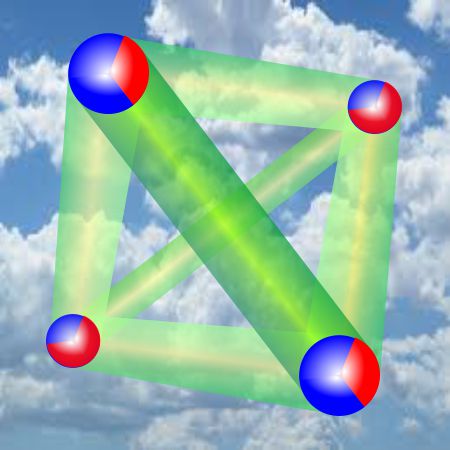
“Oh, it is far off.  Bohr put his electrons in a plane like your square there.  Try putting that fourth ball on top of the others to make a triangular pyramid.  See that?  Counting the bottom it’s a four-sided figure called a tetrahedron.  It’s the fundamental structural building block for most of the Universe’s molecules.”Water molecule“Hey, that’s the alpha-particle shape that the protons and neutrons get themselves into.”

“Good point, Vinnie.  Mind you, though, an alpha particle doesn’t have a central attractor, and it’s a quarter-million times smaller than an atom’s electron cloud.  Got that pyramid shape in mind?”

“Sure.”

“OK, put those balls back in your square. … Put a finger on the north ball and another on the south one.  Now roll them both up into contact on top of the line between the east and west ones.”

“Hey, it’s that tetra-thing again.”

“Right, Eddie.  Any time you have four objects each the same distance from all the others, you’ve got a tetrahedron.  If the ‘objects’ are clouds of electron charge all attracted to the nucleus and all repelled by the other clouds, that’s the shape they’ll take.  It’s no accident that an equal mix of an atom’s spherical and three dumbbell orbitals in a shell makes four equivalent orbitals pointing to the corners of a tetrahedron.”

“Cute, but what’s it get us?”

“It gets us to the chemists’ trick for thinking about molecular structures without doing all the quantum mechanics.  The key is that 8-electron shell.  Forget electrons racing in a ring or electron pairs in a square.  When you see a chemical diagram with four lines coming out of a central atom, think of them in a tetrahedron.  Here’s an example.  Guess what’s the commonest atom in the Universe.”

“Helium.”

“Hydrogen.”

“Eddie’s win with hydrogen — 923,000 atoms out of a million.  Carbon’s the fourth most common, 480 atoms per million.  Think of a carbon atom, floating around in space with four of its six units of electronic charge in its 2-shell.  And it’s surrounded by hydrogen atoms with electrons just begging to pair up with something.  No surprise, there’s suddenly a lot of electron pairing and you’ve got a molecule of methane, CH4.  What’s its shape?  Any hydrogen-hydrogen chains in there?”

“With this build-up, I gotta guess they’re all on the carbon and that they’re splayed out tetrahedron-like, hydrogen centers trying to get away from the other ones and shared charge clouds trying to get away from each other, too.”

“Couldn’t put it better myself, Vinnie.”

“Hey, water’s H2O, right?  You can’t make a tetrahedron from only three atoms.”

“True, Eddie, but an oxygen atom comes with two more electrons than carbon has.  We’ve still got a tetrahedron, but only two of its corners carry a hydrogen.  The other two orbitals stick out their own directions, each loaded with negative charge.  The chemists call that unshared kind of orbital a lone pair.  They often show it as a double-dot on the structure diagram. That’s basically just a bookkeeping device to keep track of electron counts.  All the charge is really spread around throughout all the molecular orbitals just like with atomic orbitals, only it’s not spread evenly.”

“Why do they bother to keep track like that?”

“Lone pairs affect the molecule’s structure.  If it weren’t for them, the water molecule would be a straight line.  In fact, a lone pair orbital crowds the space a bit more than a bonding pair — the H–O–H angle is about 5º smaller than a perfect tetrahedron.”

“Makes sense when you think about it, like you can wave a stick all over the place unless someone grabs the other end.”

“Mm-hm.  The big reason chemists care, though, is that lone pairs can be active centers during a chemical reaction.  All that negative charge just waiting for something positive-ish to come along.”

“Like a really good tip,” grumbles Eddie.

~~ Rich Olcott


To Bond Or Not To Bond, That Is The Question

Vinnie’s pushing pizza crumbs around his plate, watching them clump together.  “These molecular orbitals gotta be pretty complicated.  How do you even write them down?”

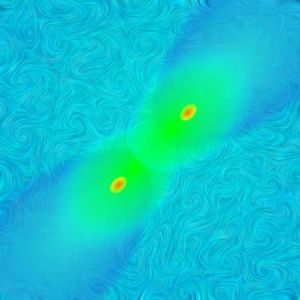
“Combinations.  There’s a bunch of different strategies, but they all go back to Laplace’s spherical harmonics.  Remember, he showed that every possible distribution around a central attractor could be described as a combination of his patterns.  Turn on a field, like from another atom, and you just change what combination is active.  Here’s a sketch of the simplest case, two hydrogen atoms — see how the charge on each one bulges toward the other?  The bulge is a combination of a spherical orbital and a dumbbell one.  The molecular orbitals are combinations of orbitals from both atoms, describing how the charges overlap, or not.”Hydrogen molecule

“What’s that blue in the other direction?”

“Another possible combination.  You can combine atomic orbitals with pluses or minuses.  The difference is that the minus combination will always have an additional node in between.  Extra nodes mean higher energy, harder to activate. When the molecule’s in the lowest energy state, charge will be between the atoms where that extra node isn’t.”

“So the overlapped charge here is negative, right, and it pulls the two positive nucleusses —”

“Nuclei”

“Whatever, it pulls ’em together.  Why don’t they just merge?”

“Positive-positive repulsion counts, too.  At the equilibrium bond distance, the nuclei repel each other exactly as much as the shared charge pulls them together.”

Eddie’s still hovering by our table.  “You said that there’s this huge number of possible atomic orbitals.  Wouldn’t there be an even huger number of molecular orbitals?”

“Sure.  The trick is in figuring out which of them are lowest-energy and activated and how that relates to the molecule’s configuration.  Keep track of your model’s total energy as you move the atoms about, for instance, and you can predict the equilibrium distance where the energy is a minimum.  In principle you can calculate configuration changes as two molecules approach each other and react.”

“Looks like a lot of work.”

“For sure, Eddie.  Even a handful of atoms has lots of atomic orbitals to keep track of.  That can burn up acres of compute time.”

Vinnie pushes three crumbs into a triangle.  “You got three distances, you can figure their angles.  So you got the whole shape of the thing.”

“Right, but like Eddie said, that’s a lot of computer work.  Chemists had to come up with shortcuts.  As a matter of fact, they had the shortcuts way before the computers came along.”

“They used, like, abacuses?”

“Funny, Vinnie.  No, no math at all.  And it’s why they still show school-kids those Bohr diagrams.”

“Crazy Eights.”

“Eddie, you got games on the brain.  But yeah, eights.  Or better, quartets of pairs.  One thing I’ve not mentioned yet is that even though they’ve got the same charge, electrons are willing to pair up.”

“How come?”

“That’s the thing of it, Vinnie.  There’s a story about Richard Feynman, probably the foremost physicist of the mid-20th Century.  Someone asked him to explain the pairing-up without using math.  Feynman went into his office for a week, came back out and said he couldn’t do it.  The math demands pairing-up, but outside of the math all we can say is experiments show that’s how it works.”

“HAH, that’s the reason for the ‘two charge units per orbital’ rule!”

“Exactly, Eddie.  It’s how charge can collect in that bonding molecular orbital in the first place.  It’s also the reason that helium doesn’t form molecules at all.  Imagine two helium atoms, each with two units of charge.  Suppose they come close to each other like those hydrogens did.  Where would the charge go?”

“OK, you got two units going into that in-between space, ahh, and the other two activating that blue orbital and pulling the two atoms apart.  So that adds up to zero?”

“Uh-huh.  They just bounce off and away.”

“Cool.”

“Hey, I got a question.  Your sketch has a ball orbital combining with a dumbbell.  But they’ve got different node counts, one and two.  Can you mix things from different shells?”

“Sure, Vinnie, if there’s enough energy.  The electron pair-up can release that much.”

“Cool.”

~~ Rich Olcott

  • A friend pointed out that I’m doing my best to avoid saying the word “electron.” He’s absolutely right.  At least in this series I’m taking Bohr’s side in his debate with Einstein — electrons in atoms don’t act like little billiard balls, they act like statistical averages, smeared-out ones at that.  It’s closer to reality to talk about where the charge is so that’s how I’m writing it.

The Shell You Say

Everyone figures Eddie started his pizza place because he likes to eavesdrop.  No surprise, he wanders over to our table.  “I heard you guys talking about atoms and stuff and how Sy here don’t like Bohr’s model of electrons in atoms even though Bohr’s model and the shell model both account for hydrogen’s spectrum.  Why’s the shell model better?”

Vinnie comes back quick.  “Because it’s not physically impossible, for one thing.”

I’m on it.  “Because the shell model extends smoothly to atoms and ions in an electric or magnetic field.  Better yet, shell methods can be applied to molecules.”

“What do fields have to do with it?”

“It’ll help to know that some of those electron patterns come in sets.  The 2-node shell has three dumbbell shapes, for instance — one each along the x, y and z axes. Think about an atom all alone in space with no fields around.  How does it know which way z goes?””

“It don’t.  Everything’s gotta be in all directions, like spherical.”

Vinnie’s back in.  “I’m seeing an atom in an electric field, say up-to-down, it’s going to pull charge in one direction, say down.  So now the atom don’t look like no ball no more, right?”

orbital in a field
Vertical field on the right

“Right.  Once the atom’s got a special direction, those three dumbbells stop being equivalent.  We say that the field mixes together the spherical pattern (in atoms we’d call it an s-orbital) with that direction’s dumbbell (we’d call it a p-orbital) to make two combination orbitals.  One combination has a lump of charge stretched downwards and the other combination has a bowl of diminished charge stretched upwards.  The stronger the field, the wider the energy split between those two.”

“What about the other two dumbbells?”

“They’re still equivalent, Eddie.  If there’s charge in them it’s spread evenly around the equator like a doughnut.  Energy-wise they’re in between the two s±p combinations.”

IF there’s charge, like maybe there ain’t?”

“Ever suspicious, eh, Vinnie?  You’re right, and that’s a good point.  Orbitals are only a way to describe the chaos inside the atom, like notes are a way to describe music.  There are 3-node orbitals and 47-node orbitals, all the way up, but most of the time they’re not charge-activated just like a piano’s top note hardly ever gets played.”

“How do we know whether an orbital’s activated?”

“We’ve got rules for that, Eddie.  Maximum of two units of charge per orbital, lowest energy first.  Unless some light wave has deactivated a deeper orbital and activated a higher one.”

“You’re being careful again, not saying an electron’s here or an electron’s there.”

“Darn right, Vinnie.  It’s that chaos thing — charge is smeared all over the atom like air molecules jiggle all over the place to carry a sound wave.  Chemists and physicists may talk about ‘the electron in the 2s-orbital’ but that’s shorthand.  They know it’s really not like that.”

“I’m doing arithmetic over here.  So there’s two electrons, OK, call it two units of charge for that 1-node ball orbital, plus two units for the 2-node ball, plus two units each for the three dumbbells, uses up five orbitals.  That’s the same 2+8 stable mix that Bohr came up with.”

“Yeah, Eddie, but that field Sy talked about could be any strength.  Run the energy  equations backwards and the astronomers get a way to check a star’s fields.”

“Exactly, Vinnie.  Transitions involving combination orbitals have slightly different energy jumps than the ones we see in isolated atoms.  Electric and magnetic fields split each line in an element’s spectrum into multiplets.  Measure their splittings and you can work back to the field strengths that caused them.  The shell theory offers more predictions and more scientific insights than Bohr’s model ever dreamed of.”

“You said shell theory can handle molecules, too.  How’s that work?”

“Same as that electric field, but a lot messier.  Every nucleus exerts a field, mostly electric, on the rest of the molecule.  So does all the electron charge, but it’s more diffuse and includes more magnetism.  Molecular orbitals span the whole thing.  Works like atoms but much harder to calculate.”

“Figuring tips is easier,” hints Eddie.

~~ Rich Olcott

The Music of The Spherical Harmonics

Eddie’s diner serves tasty pizza, but his music playlist’s tasty, too — heavy with small-group vocals.  We’re talking atomic structure but suddenly Vinnie surprises me.  “Whoa, she’s got a hot voice!”

“Who?”

“That girl who’s singing.”

“Which one?  That’s a quartet.”

“The alto.”

“How can you pick one voice out of that close-harmony performance?”

“By listening!  She’s the only one singing those notes.”

“You’re hearing a chaotic sound wave yet you can pick out just one sound.”

“Yeah, just her special notes.”

“Interesting thing is, atoms do that, too.  Think about, say, a uranium atom, 92 electrons attracted by the nucleus, repelled by every other electron, all dashing about in the nuclear field and getting in each other’s way.  Think that’d be a nice, orderly picture?”

“Sure not.  It’d be, like you say, chaotic.”

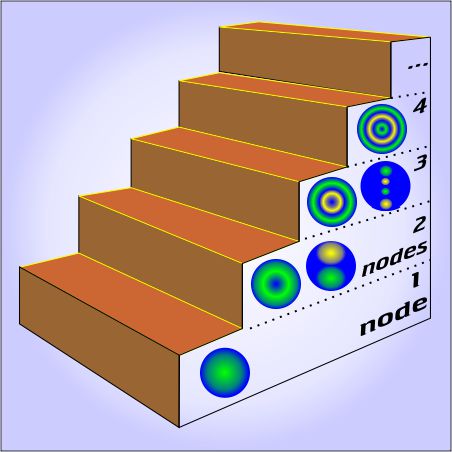
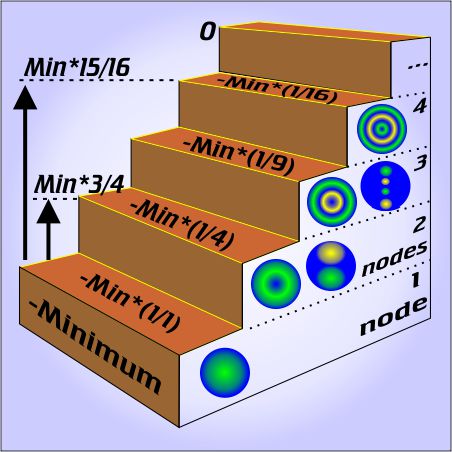
“But just like we can describe a messy sound wave as a combination of frequencies, we can describe that atom’s electron structure as a combination of basic patterns.”  I pull Old Reliable from its holster and bring up an image.  “Here’s something I built for a presentation.  It’s a little busy so I’ll walk you through it.”Shell levels

“Busy, uh-huh.”

“Start with those blue circles.  They look familiar?”

“Right, they’re Laplace’s spherical patterns.  You got them sorted by how many blue spaces they got.”

“Yup.  Blue represents a node, a 2-D region where the value touches or crosses zero.  There are patterns with three or more nodes, but I ran out of space and patience to draw them.  Laplace showed there’s an infinite number of candidate patterns as you add more and more nodes.  You can describe any physically reasonable distribution around the central point as some combination of his patterns.”

“Why’d you draw them on stair-steps?”

“Because each step (we call it a shell) is at a different potential energy level.  Suppose, for instance, that there’s charge in that one-node pattern.  Moving it away from the nucleus puts a node there.  That’ll cost some energy and shift charge to the two-node shell.  To exclude it from there and also from another node, say a larger spherical surface, would take even more energy, and so on.”

“How is that potential energy?”

“We’re comparing shell energy to the energy of an electron that’s far away.  It’s like gravitational potential energy, maybe the energy a space rock converts to kinetic energy as it falls to Earth.  Call the far-away energy zero.  The numbers get more and more negative as the rock or the charge get closer to the center of attraction.”

“Ah, so that’s why you’ve got minus signs in the picture.”

“Exactly.  See zero at the top of the stairs?  With a hydrogen atom, for instance, an electron would give up 13.6 electron-volts of energy to get close to the nucleus in that 1-node pattern.  Conversely, it’d take 13.6 eV to rip that charge completely away.”

“If the 13.6 is what you’re calling ‘Minimum’, why not just write ‘–13.6’ in there?”

“It’s a different number for different atoms and even ions.  Astronomers see all kinds of ions with every amount of charge so they have to keep things general in their calculations.”

“What are those fractions about?  Wait, don’t tell me, I can figure this.  Each divisor is the square of its node count.  Are those the 1/n² numbers from whosit’s formula?”

Rydberg’s.  You’re on the right track, keep going.”

“If the minimum is 13.6 eV, the diagram says that the two-node shell is … 3.4 eV down from the top and … 10.2 eV up from the bottom.  And from what we said about the hydrogen spectrum, I’ll bet that 10.2 eV jump is the first line in that, was it the Ly series, the one in the ultra-violet?”

“Bravo, Vinnie!  The Lyman series it is.  Excellent memory for detail there.”

“I noticed something else.  You carefully didn’t say we moved an electron between shells.”

“That’s an important point.  At the atomic size scale we can’t treat the electron as a particle moving around.  Lightwaves act to turn off one shell and excite another one, like your singer exciting a different note.”

“Yes, she does.”

~~ Rich Olcott

  • Thanks to the Molnars for a delightful meal, and to their dinner party guests the Jumps for instigating this post.

Gravity from Another Perspective

“OK, we’re looking at that robot next to the black hole and he looks smaller to us because of space compression down there.  I get that.  But when the robot looks back at us do we look bigger?”

We’re walking off a couple of Eddie’s large pizzas.  “Sorry, Mr Feder, it’s not that simple.  Multiple effects are in play but only two are magnifiers.”

“What isn’t?”

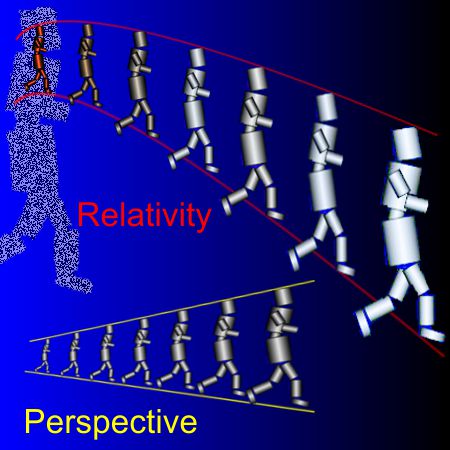
“Perspective for one.  That works the same in both directions — the image of an object shrinks in direct proportion to how far away it is.  Relativity has nothing to do with that principle.”

“That makes sense, but we’re talking black holes.  What does relativity do?”

“Several things, but it’s complicated.”

“Of course it is.”

“OK, you know the difference between General and Special Relativity?”

“Yeah, right, we learned that in kindergarten.  C’mon.”

“Well, the short story is that General Relativity effects depend on where you are and Special Relativity effects depend on how fast you’re going.  GR says that the scale of space is compressed near a massive object.  That’s the effect that makes our survey robot appear to shrink as it approaches a black hole.  GR leaves the scale of our space larger than the robot’s.  Robot looks back at us, factors out the effect of perspective, and reports that we appear to have grown.  But there’s the color thing, too.”

“Color thing?”

“Think about two photons, say 700-nanometer red light, emitted by some star on the other side of our black hole.  One photon slides past it.  We detect that one as red light.  The other photon hits our robot’s photosensor down in the gravity well.  What color does the robot see?”

“It’s not red, ’cause otherwise you wouldn’t’ve asked me the question.”

“Check.”

“Robot’s down there where space is compressed…  Does the lightwave get compressed, too?”

“Yup.  It’s called gravitational blue shift.  Like anything else, a photon heading towards a massive object loses gravitational potential energy.  Rocks and such make up for that loss by speeding up and gaining kinetic energy.  Light’s already at the speed limit so to keep the accounts balanced the photon’s own energy increases — its wavelength gets shorter and the color shifts blue-ward.  Depending on where the robot is, that once-red photon could look green or blue or even X-ray-colored.”

“So the robot sees us bigger and blue-ish like.”Robots and perspective and relativity 2“But GR’s not the only player.  Special Relativity’s in there, too.”
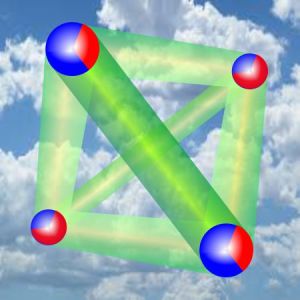
“Maybe our robot’s standing still.”

“Can’t, once it gets close enough.  Inside about 1½ diameters there’s no stable orbit around the black hole, and of course inside the event horizon anything not disintegrated will be irresistibly drawn inward at ever-increasing velocity.  Sooner or later, our poor robot is going to be moving at near lightspeed.”

“Which is when Special Relativity gets into the game?”

“Mm-hm.  Suppose we’ve sent in a whole parade of robots and somehow they maintain position in an arc so that they’re all in view of the lead robot.  The leader, we’ll call it RP-73, is deepest in the gravity well and falling just shy of lightspeed.  Gravity’s weaker further out — trailing followers fall slower.  When RP-73 looks back, what will it see?”

“Leaving aside the perspective and GR effects?  I dunno, you tell me.”

“Well, we’ve got another flavor of red-shift/blue-shift.  Speedy RP-73 records a stretched-out version of lightwaves coming from its slower-falling followers, so so it sees their colors shifted towards the red, just the opposite of the GR effect.  Then there’s dimming — the robots in the back are sending out n photons per second but because of the speed difference, their arrival rate at RP-73 is lower.  But the most interesting effect is relativistic aberration.”

“OK, I’ll bite.”

“Start off by having RP-73 look forward.  Going super-fast, it intercepts more oncoming photons than it would standing still.”

“Bet they look blue to it, and really bright.”

“Right on.  In fact, its whole field of view contracts towards its line of flight.  The angular distortion continues all the way around.  Rearward objects appear to swell.”

“So yeah, we’d look bigger.”

“And redder.  If RP-73 is falling fast enough.”

~~ Rich Olcott

  • Thanks to Timothy Heyer for the question that inspired this post.

Water, Water Everywhere — How Come?

Lunch time, so I elbow my way past Feder and head for the elevator.  He keeps peppering me with questions.

“Was Einstein ever wrong?”

“Sure. His equations pointed the way to black holes but he thought the Universe couldn’t pack that much mass into that small a space.  It could.  There are other cases.”

We’re on the elevator and I punch 2.  “Where you going?  I ain’t done yet.”

“Down to Eddie’s Pizza.  You’re buying.”

“Awright, long as I get my answers.  Next one — if the force pulling an electron toward a nucleus goes as 1/r², when it gets to where r=0 won’t it get stuck there by the infinite force?”

“No, because at very short distances you can’t use that simple force law.  The electron’s quantum wave properties dominate and the charge is a spread-out blur.”

The elevator stops at 7.  Cathleen and a couple of her Astronomy students get on, but Feder just peppers on.  “So I read that everywhere we look in the Solar System there’s water.  How come?”

I look over at Cathleen.  “This is Mr Richard Feder of Fort Lee, NJ.  He’s got questions.  Care to take this one?  He’s buying the pizza.”

“Well, in that case.  It all starts with alpha particles, Mr Feder.”

The elevator door opens on 2, we march into Eddie’s, order and find a table.  “What’s an alpha particle and what’s that got to do with water?”

Alpha particle
Two protons and two neutrons, assembled as an alpha particle

“An alpha particle’s a fragment of nuclear material that contains two protons and two neutrons.  99.999% of all helium atoms have an alpha particle for a nucleus, but alphas are so stable relative to other possible combinations that when heavy atoms get indigestion they usually burp alpha particles.”

“And the water part?”

“That goes back to where our atoms come from — all our atoms, but in particular our hydrogen and oxygen.  Hydrogen’s the simplest atom, just a proton in its nucleus.  That was virtually the only kind of nucleus right after the Big Bang, and it’s still the most common kind.  The first generation of stars got their energy by fusing hydrogen nuclei to make helium.  Even now, that’s true for stars about the size of the Sun or smaller.  More massive stars support hotter processes that can make heavier elements.  Umm, Maria, do you have your class notes from last Tuesday?”

“Yes, Professor.”

“Please show Mr Feder that chart of the most abundant elements in the Universe.  Do you see any patterns in the second and fourth columns, Mr Feder?”

Element Atomic number Mass % *103 Atomic weight Atom % *103
Hydrogen 1 73,900 1 92,351
Helium 2 24,000 4 7,500
Oxygen 8 1,040 16 81
Carbon 6 460 12 48
Neon 10 134 20 8
Iron 26 109 56 2
Nitrogen 7 96 14 <1
Silicon 14 65 32 <1

“Hmm…  I’m gonna skip hydrogen, OK?  All the rest except nitrogen have an even atomic number, and all of ’em except nitrogen the atomic weight is a multiple of four.”

“Bravo, Mr Feder.  You’ve distinguished between two of the primary reaction paths that larger stars use to generate energy.  The alpha ladder starts with carbon-12 and adds one alpha particle after another to go from oxygen-16 on up to iron-56.  The CNO cycle starts with carbon-12 and builds alphas from hydrogens but a slow step in the cycle creates nitrogen-14.”

“Where’s the carbon-12 come from?”

“That’s the third process, triple alpha.  If three alphas with enough kinetic energy meet up within a ridiculously short time interval, you get a carbon-12.  That mostly happens only while a star’s going nova, simultaneously collapsing its interior and spraying most of its hydrogen, helium, carbon and whatever out into space where it can be picked up by neighboring stars.”

“Where’s the water?”

“Part of the whatever is oxygen-16 atoms.  What would a lonely oxygen atom do, floating around out there?  Look at Maria’s table.  Odds are the first couple of atoms it runs across will be hydrogens to link up with.  Presto!  H2O, water in astronomical quantities.  The carbon atoms can make methane, CH4; the nitrogens can make ammonia, NH3; and then photons from Momma star or somewhere can help drive chemical reactions  between those molecules.”

“You’re saying that the water astronomers find on the planets and moons and comets comes from alpha particles inside stars?”

“We’re star dust, Mr Feder.”

~~ Rich Olcott

Enter the Elephant, stage right

Anne?”

“Mm?”

“Remember when you said that other reality, the one without the letter ‘C,’  felt more probable than this one?”

“Mm-mm.”

“What tipped you off?”

Now you’re asking?”

“I’m a physicist, physicists think about stuff.  Besides, we’ve finished the pizza.”

<sigh> “This conversation has gotten pretty improbable, if you ask me.  Oh, well.  Umm, I guess it’s two things.  The more-probable realities feel denser somehow, and more jangly. What got you on this track?”

“Conservation of energy.  Einstein’s E=mc² says your mass embodies a considerable amount of energy, but when you jump out of this reality there’s no flash of light or heat, just that fizzing sound.  When you come back, no sudden chill or things falling down on us, just the same fizzing.  Your mass-energy that has to go to or come from somewhere.  I can’t think where or how.”

“I certainly don’t know, I just do it.  Do you have any physicist guesses?”

“Questions first.”

“If you must.”

“It’s what I do.  What do you perceive during a jump?  Maybe something like falling, or heat or cold?”

“There’s not much ‘during.’  It’s not like I go through a tunnel, it’s more like just turning around.  What I see goes out of focus briefly.  Mostly it’s the fizzy sound and I itch.”

“Itch.  Hmm…  The same itch every jump?”

“That’s interesting.  No, it’s not.  I itch more if I jump to a more-probable reality.”

Very interesting.  I’ll bet you don’t get that itch if you’re doing a pure time-hop.”

“You’re right!  OK, you’re onto something, give.”

“You’ve met one of my pet elephants.”

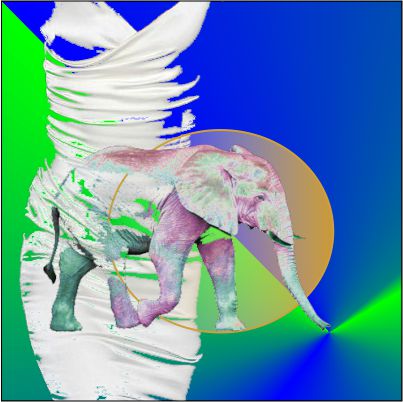
“Wha….??”White satin and elephant

“A deep question that physics has been nibbling around for almost two centuries.  Like the seven blind men and the elephant.  Except the physicists aren’t blind and the elephant’s pretty abstract.  Ready for a story?”

“Pour me another and I will be.”

“Here you go.  OK, it goes back to steam engines.  People were interested in getting as much work as possible out of each lump of coal they burned.  It took a couple of decades to develop good quantitative concepts of energy and work so they could grade coal in terms of energy per unit weight, but they got there.  Once they could quantify energy, they discovered that each material they measured — wood, metals, water, gases — had a consistent heat capacity.  It always took the same amount of energy to raise its temperature across a given range.  For a kilogram of water at 25°C, for instance, it takes one kilocalorie to raise its temperature to 26°C.  Lead and air take less.”

“So where’s the elephant come in?”

“I’m getting there.  We started out talking about steam engines, remember?  They work by letting steam under pressure push a piston through a cylinder.  While that’s happening, the steam cools down before it’s puffed out as that classic old-time Puffing Billy ‘CHUFF.’  Early engine designers thought the energy pushing the piston just came from trading off pressure for volume.  But a guy named Carnot essentially invented thermodynamics when he pointed out that the cooling-down was also important.  The temperature drop meant that heat energy stored in the steam must be contributing to the piston’s motion because there was no place else for it to go.”

“I want to hear about the elephant.”

“Almost there.  The question was, how to calculate the heat energy.”

“Why not just multiply the temperature change by the heat capacity?”

“That’d work if the heat capacity were temperature-independent, which it isn’t.  What we do is sum up the capacity at each intervening temperature.  Call the sum ‘elephant’ though it’s better known as Entropy.  Pressure, Volume, Temperature and Entropy define the state of a gas.  Using those state functions all you need to know is the working fluid’s initial and final state and you can calculate your engine.  Engineers and chemists do process design and experimental analysis using tables of reported state function values for different substances at different temperatures.”

“Do they know why heat capacity changes?”

“That took a long time to work out, which is part of why entropy’s an elephant.  And you’ve just encountered the elephant’s trunk.”

“There’s more elephant?”

“And more of this.  Want a refill?”

~~ Rich Olcott

Gozer, The Stay Puft Black Hole

We’re downstairs at Eddie’s Pizza.  Vinnie orders his usual pepperoni.  In memory of Sam Panapoulos, I order a Hawaiian.  Then we’re back to talking black holes.

“I been thinking, Sy.  These regular-size black holes, the ones close to the Sun’s mass, we got a lot of ’em?”

“I’ve seen an estimate of 50,000 in the Milky Way Galaxy so you could say they’re common.  That’s one way to look at it.  The other way is to compare 50,000 with the 250 billion stars in the galaxy.  One out of 5,000,000 is a black hole, so they’re rare.  Your choice, Vinnie.”

“But all three confirmed LIGO signals were the next bigger size range, maybe 10 to 30 solar masses; two of ’em hittin’ each other and they’ve all been more than a billion lightyears away.  How come LIGO doesn’t see the little guys that are close to us?”

“Darn good question.  Lessee… OK, I’ve got several possibilities.  Maybe the close-in little guys do collide, but the signal’s too weak for us to detect.  But we can put numbers to that.  In each LIGO event we’ve seen, the collision released about 10% of their 40-to-60-Sun total mass-energy in the form of gravitational waves.  LIGO’s just barely able to detect that, right?”

“They were excited they could, yeah.”

“So if a pair of little-guy black holes collided they’d release about 10% of two makes 0.2 solar masses worth of energy.  That’d be way below our detection threshold if the collision is a billion light-years away.  But we’re asking about collisions inside the Milky Way.  Suppose the collision happened near the center, about 26,000 lightyears from us.  Signal strength grows as the square of how close the source is, so multiply that ‘too weak to detect’ wave by (1 billion/26000)² =15×1012, fifteen quadrillion.  LIGO’d be deafened by a signal that strong.”

“But LIGO’s OK, so we can rule that out.  Next guess.”

“Maybe the signal’s coming in at the wrong frequency.  The equations say that just before a big-guy collision the two objects circle each other hundreds of times a second.  That frequency is in the lower portion of the 20-20,000 cycles-per-second human audio range.  LIGO’s instrumentation was tuned to pick up gravitational waves between 30 and 7,000.  Sure enough, LIGO recorded chirps that were heard around the world.”

“So what frequency should LIGO be tuned to to pick up little-guy collisions?”

“We can put numbers to that, too.  Physics says that at a given orbit radius, revolution frequency varies inversely with the square root of the mass.   The big-guy collisions generated chirps between 100 and 400 cps.  Little guy frequencies would be f2/f50=√(50/2)=5 times higher, between 500 and 2000 cps.  Well within LIGO’s range.”

“We don’t hear those tweets so that idea’s out, too.  What’s your third try?”

“Actually I like this one best.  Maybe the little guys just don’t collide.”

“Why would you like that one?”

“Because maybe it’s telling us something.  It could be that they don’t collide simply because they’re surrounded by so many other stars that they never meet up.  But it also could be that binary black holes, the ones that are fated to collide with each other, are the only ones that can grow beyond 10 solar masses.  And I’ve got a guess about how that could happen.”

“Alright, give.”

“Let’s start with how to grow a big guy.  Upstairs we talked about making little guys.  When a star’s core uses up one fuel, like hydrogen, there’s an explosive collapse that sets off a hotter fuel, like helium, until you get to iron which doesn’t play.  At each step, unburnt fuel outside the core gets blown away.  If the final core’s mass is greater than about three times the Sun’s you wind up with a black hole.  But how about if you don’t run out of fuel?”

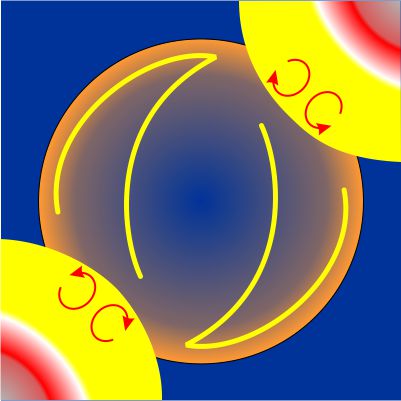
“How can that happen?  The star’s got what it’s got.”Binary protoBHs

“Not if it’s got close neighbors that also expel unburnt fuel in their own burn-collapse cycles.  Grab their cast-off fuel and your core can get heavier before you do your next collapse.  Not impossible in a binary or cluster where all the stars are roughly the same age.  Visualize kids tossing marshmallows into each other’s mouths.”

“Or paying for each other’s pizzas.  And it’s your turn.”

~~ Rich Olcott