A Matter of Perspective

As I stepped off the escalator by the luggage carousel a hand came down heavy on my shoulder.

“Keep movin’, I gotchur bag.”

That’s Vinnie, always the surprises.  I didn’t bother to ask how he knew which flight I came in on.  What came next was also no surprise.

“You owe me for the pizza.  Now about that kinetic energy –”

“Hold that thought ’til we get to my office where I can draw diagrams.”

We got my car out of the lot, drove to the Acme Building and took the elevator to 12.

As my computer booted up I asked, “When we talked about potential energy, did we ever mention inertial frames?”

“Come to think of it, no, we didn’t.  How come?”

“Because they’ve got nothing to do with potential energy.  Gravitational and electrical potentials are all about intensity at one location in space relative to other locations in space.  The potentials are static so long as the configuration is static.  If something in the region changes, like maybe a mass moves or the charge on one object increases, then the potential field adjusts to suit.”

“Right, kinetic energy’s got to do with things that move, like its name says.  I get that.  But how does it play into LIGO?”

“Let’s stick with our spacecraft example for a bit.  I’ve been out of town for a while, so a quick review’s in order.  Objects that travel in straight lines and constant speed with respect to each other share the same inertial frame.  Masses wrinkle the shape of space.  The paths light rays take are always the shortest possible paths, so we say a light ray shows us what a straight line is.

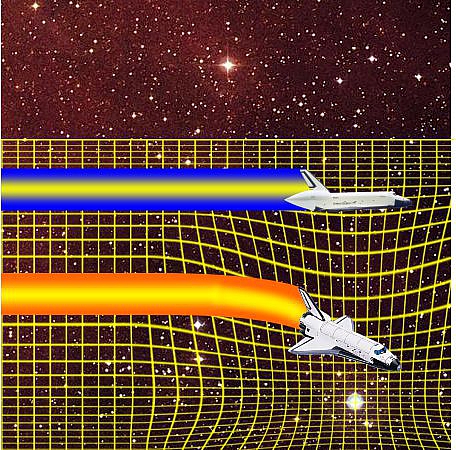
“In our story, we’re flying a pair of space shuttles using identical speed settings along different light-ray navigation beams.  Suddenly you encounter a region of space that’s compressed, maybe by a nearby mass or maybe by a passing gravitational wave.

“That compressed space separates our inertial frames.  In your inertial frame there’s no effect — you’re still following your nav beam and the miles per second you measure hasn’t changed.  However, from my inertial frame you’ve slowed down because the space you’re traveling through is compressed relative to mine.  Does all that ring a bell?”

“Pretty much the way I remember it. Now what?”shuttle-escape-framed

“Do you remember the formula for kinetic energy?”

“Give me a sec… mass times the square of the velocity.”

“Uh-huh.  Mind you, ‘velocity’ is the combination of speed and direction but velocity-squared is just a number.  So, your kinetic energy depends in a nice, simple way on speed.  What happened to your kinetic energy when you encountered that gravity well?”

“Ah, now I see where you’re going.  In my frame my speed doesn’t change so I don’t gain or lose kinetic energy.  In your frame you see me slow down so you figure me as losing kinetic energy.”

“But the Conservation of Energy rule holds across the Universe.  Where’d your kinetic energy go?”

“Does your frame see me gaining potential energy somehow that I don’t see in mine?”

“Nice try, but that’s not it.  We’ve already seen that potential energy doesn’t depend on frames.  What made our frames diverge in the first place?”

“That gravity field curving the space I’d flown into.  Hey, action-reaction!  If the curved space slowed me down, did I speed it up?”

“Now we’re getting there.  No, you didn’t speed up space, ’cause space doesn’t work that way — the miles don’t go anywhere.  But your kinetic energy (that I can see and you can’t) did act to change the spatial curvature (that I can see and you can’t).  I suspect the curvature flattened out, but the math to check that is beyond me.”

“Lemme think…  Right, so back to my original question — what I wasn’t getting was how I could lose both kinetic energy AND potential energy flying into that compressed space.  Lessee if I got this right.  We both see I lost potential energy ’cause I’ve got less than back in flat space.  But only you see that my kinetic energy changed the curvature that only you see.  Good?”

“Good.”

(sound of footsteps)

(sound of door)

“Don’t mention it.”

~~ Rich Olcott
Three ways to look at things

A familiar shadow loomed in from the hallway.

“C’mon in, Vinnie, the door’s open.”

“I brought some sandwiches, Sy.”

“Oh, thanks, Vinnie.”

“Don’t mention it.    An’ I got another LIGO issue.”

“Yeah?”

“Ohh, yeah.  Now we got that frame thing settled, how does it apply to what you wrote back when?  I got a copy here…”

The local speed of light (miles per second) in a vacuum is constant.  Where space is compressed, the miles per second don’t change but the miles get smaller.  The light wave slows down relative to the uncompressed laboratory reference frame.

“Ah, I admit I was a bit sloppy there.  Tell you what, let’s pretend we’re piloting a pair of space shuttles following separate navigation beams that are straight because that’s what light rays do.  So long as we each fly a straight line at constant speed we’re both using the same inertial frame, right?”

“Sure.”

“And if a gravity field suddenly bent your beam to one side, you’d think you’re still flying straight but I’d think you’re headed on a new course, right?”

“Yeah, because now we’d have different inertial frames.  I’d think your heading has changed, too.”two-shuttles

“So what does the guy running the beams see?”

“Oh, ground-pounders got their own inertial frame, don’t they?  Uhh… He sees me veer off and you stay steady ’cause the gravity field bent only my beam.”

“Right — my shuttle and the earth-bound observer share the same inertial frame, for a while.”

“A while?”

“Forever if the Earth were flat because I’d be flying straight and level, no threat to the shared frame.  But the Earth’s not flat.  If I want to stay at constant altitude then I’ve got to follow the curve of the surface rather than follow the light beam straight out into space.  As soon as I vector downwards I have a different frame than the guy on the ground because he sees I’m not in straight-line motion.”

“It’s starting to get complicated.”

“No worries, this is as bad as it gets.  Now, let’s get back to square one and we’re flying along and this time the gravity field compresses your space instead of bending it.  What happens?  What do you experience?”

“Uhh… I don’t think I’d feel any difference.  I’m compressed, the air molecules I breath are compressed, everything gets smaller to scale.”

“Yup.  Now what do I see?  Do we still have the same inertial frame?”

“Wow.  Lessee… I’m still on the beam so no change in direction.  Ah!  But if my space is compressed, from your frame my miles look shorter.  If I keep going the same miles per second by my measure, then you’ll see my speed drop off.”

“Good thinking but there’s even more to it.  Einstein showed that space compression and time dilation are two sides of the same phenomenon.  When I look at you from my inertial frame, your miles appear to get shorter AND your seconds appear to get longer.”

“My miles per second slow way down from the double whammy, then?”

“Yup, but only in my frame and that other guy’s down on the ground, not in yours.”

“Wait!  If my space is compressed, what happens to the space around what got compressed?  Doesn’t the compression immediately suck in the rest of the Universe?”

“Einstein’s got that covered, too.  He showed that gravity doesn’t act instantaneously.  Whenever your space gets compressed, the nearby space stretches to compensate (as seen from an independent frame, of course).  The edge of the stretching spreads out at the speed of light.  But the stretch deformation gets less intense as it spreads out because it’s only offsetting a limited local compression.”

“OK, let’s get back to LIGO.  We got a laser beam going back and forth along each of two perpendicular arms, and that famous gravitational wave hits one arm broadside and the other arm cross-wise.  You gonna tell me that’s the same set-up as me and you in the two shuttles?”

“That’s what I’m going to tell you.”

“And the guy on the ground is…”

“The laboratory inertial reference.”

“Eat your sandwich, I gotta think about this.”

(sounds of departing footsteps and closing door)

“Don’t mention it.”

~~ Rich Olcott
A Defective Story

It was an interesting knock at my office door — aggressive but feminine, with a hint of desperation.

“C’mon in, the door’s open.”

She wore a business suit that must have cost a month’s rent.  It fit her like it had been sewn on, and she had all the right sizes.  There was a button missing from the left sleeve.  On the other hand her left lapel bore a Star Trek badge, Security Section.

“What can I do for you, Miss…?”

“My name’s Victoria Baird, Mr Moire.  I’m CEO of ADastra, ‘media relations for the stars.’  I’ve been reading your posts, put two and two together, and thought I’d better drop in.”

“Well, it’s nice to know I’ve got readers.  Which posts caught your attention?”

“Several of them, but mostly this one,” pointing to a Web page on her smartphone.  It was my Breathing Space video.  “You show how gravitational waves fluctuate as they polarize local space.  They induce varying curvatures in different directions.  Curved space is mass, Mr Moire, but this curvature moves at lightspeed.  Hadn’t you noticed that?”

“It crossed my mind, yes, but when I thought about surfing a gravitational wave like ocean surfers do, I realized you’d have to get up to the wave’s speed to ride it.”

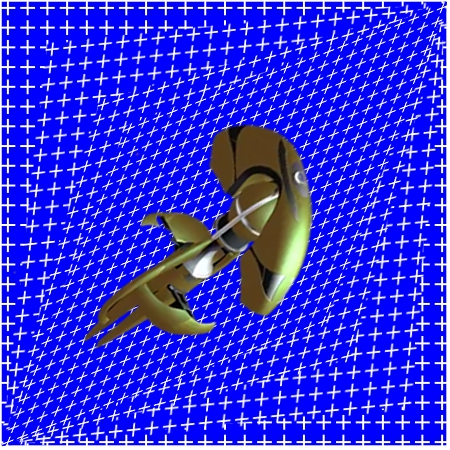
jellyfish-starcraft
Spock’s Jellyfish starcraft,
as seen in the 2009 Star Trek film
(image from the video by Rob Morey)

“There’s more.  Are you familiar with that one-man starcraft that Ambassador Spock used in the 2009 Star Trek film?  The ship with the rotating after-section?”

“I did see ‘Baby Star Trek,’ yes.”

“Did you know that the starcraft’s official design designation is Jellyfish?”

“No, I hadn’t heard that.”

“Well, it is.  And you’ve written about Earth jellyfish, haven’t you, Mr Moire, and how their propulsion system is so efficient?”

I was getting a little tired of her aggressive questions, so I challenged her with one of my own.  “And you see a connection?”

“I do, and that’s why you have to help me, Mr Moire.  Can I trust you?”

“Secrets are my business, Miss Baird.  Uncovering them or covering them up, it’s all the same to me.”

“Maybe I need to let my hair down.”  She removed her cloche cap and her pointed ears sprang free.  “I need you to get me back to my crew.”

“Can’t you just call them on that communicator badge?”

“This is costume jewelry.  The spectrum here on Earth is so crowded that my real badge is useless at long range.  I’ve been looking for subtle signals in the media.  I thought your posts were just such a signal … but I can see you’re a local.”

“Guilty as charged.  I take it the connection you saw resembled the signal you sought?”

“Yes.  You’ve published two of the essential principles of the LaForge Drive.  The first was your displays of spatial curvature in motion.  The second was your description of how jellyfish move by stepping along a ladder of seawater vortices.

jellyfish-2“That’s what the LaForge Drive does, Mr Moire.  The counter-rotating blades are an osmium-hassium alloy, the densest substance known, and under tremendous compression.  Together their mass creates a complex pilot wave in the gravity field.  The spacecraft surfs on that waveform the way a jellyfish surfs on the eddies it creates.

“The wave’s phase velocity exceeds lightspeed by some enormous factor we’ve never been able to measure.  In fact, I’m here on Earth because I was on a research cruise to find if there’s a limit.  We … ran into a problem and I’m part of an away team sent to procure … something we need.”

“That trope’s been done to death, Miss Baird.  And besides, that design wouldn’t be practical.  What’s your real story?”

“What do you mean it’s not practical?”

“You can’t steer.  Pilot waves follow the most intense local spatial curvature, which means the craft will always home like a torpedo on the nearest large mass.”

Suddenly that badge chirped.  “We’ve recovered the detonator, Lieutenant.  Have you kept him from looking out the window?”

“Yes, his eyes have been on me the whole time.  Ready for beam-up.  Goodbye, Mr Moire, that was fun.”

Her form began to shimmer, twinkle … and disappeared.

“Don’t mention it.”

~~ Rich Olcott

Breathing Space

It was December, it was cold, no surprise.  I unlocked my office door, stepped in and there was Vinnie, standing at the window.  He turned to me, shrugged a little and said, “Morning, Sy.”  That’s Vinnie for you.

“Morning, Vinnie.  What got you onto the streets this early?”

“I ain’t on the streets, I’m up here where it’s warm and you can answer my LIGO question.”

“And what’s that?”

“I read your post about gravitational waves, how they stretch and compress space.  What the heck does that even mean?”

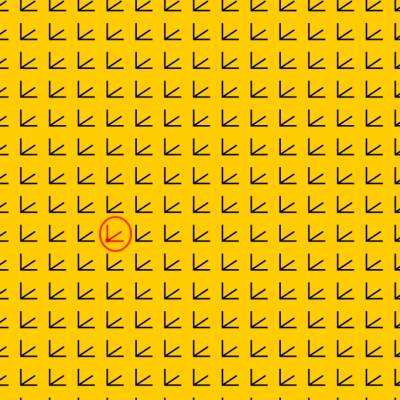
gravwave
An array of coordinate systems
floating in a zero-gravity environment,
each depicting a local x, y, and z axis

“Funny thing, I just saw a paper by Professor Saulson at Syracuse that does a nice job on that.  Imagine a boxful of something real light but sparkly, like shiny dust grains.  If there’s no gravitational field nearby you can arrange rows of those grains in a nice, neat cubical array out there in empty space.  Put ’em, oh, exactly a mile apart in the x, y, and z directions.  They’re going to serve as markers for the coordinate system, OK?”

“I suppose.”

“Now it’s important that these grains are in free-fall, not connected to each other and too light to attract each other but all in the same inertial frame.  The whole array may be standing still in the Universe, whatever that means, or it could be heading somewhere at a steady speed, but it’s not accelerating in whole or in part.  If you shine a ray of light along any row, you’ll see every grain in that row and they’ll all look like they’re standing still, right?”

“I suppose.”

“OK, now a gravitational wave passes by.  You remember how they operate?”

“Yeah, but remind me.”

(sigh)  “Gravity can act in two ways.  The gravitational attraction that Newton identified acts along the line connecting the two objects acting on each other.  That longitudinal force doesn’t vary with time unless the object masses change or their distance changes.  We good so far?”
long-and-transverse-grav
“Sure.”

“Gravity can also act transverse to that line under certain circumstances.  Suppose we here on Earth observe two black holes orbiting each other.  The line I’m talking about is the one that runs from us to the center of their orbit.  As each black hole circles that center, its gravitational field moves along with it.  The net effect is that the combined gravitational field varies perpendicular to our line of sight.  Make sense?”

“Gimme a sec…  OK, I can see that.  So now what?”

“So now that variation also gets transmitted to us in the gravitational wave.  We can ignore longitudinal compression and stretching along our sight line.  The black holes are so far away from us that if we plug the distance variation into Newton’s F=m1m2/r² equation the force variation is way too small to measure with current technology.

“The good news is that we can measure the off-axis variation because of the shape of the wave’s off-axis component.  It doesn’t move space up-and-down.  Instead, it compresses in one direction while it stretches perpendicular to that, and then the actions reverse.  For instance, if the wave is traveling along the z-axis, we’d see stretching follow compression along the x-axis at the same time as we’d see compression following stretching along the y-axis.”

gravwave-2“Squeeze in two sides, pop out the other two, eh?”

“Exactly.  You can see how that affects our grain array in this video I just happen to have cued up.  See how the up-down and left-right coordinates close in and spread out separately as the wave passes by?”

“Does this have anything to do with that ‘expansion of the Universe’ thing?”

“Well, the gravitational waves don’t, so far as we know, but the notion of expanding the distance between coordinate markers is exactly what we think is going on with that phenomenon.  It’s not like putting more frosting on the outside of a cake, it’s squirting more filling between the layers.  That cosmological pressure we discussed puts more distance between the markers we call galaxies.”

“Um-hmm.  Stay warm.”

(sound of departing footsteps and door closing)

“Don’t mention it.”

~~ Rich Olcott

Gentle pressure in the dark

“C’mon in, the door’s open.”

Vinnie clomps in and he opens the conversation with, “I don’t believe that stuff you wrote about LIGO.  It can’t possibly work the way they say.”

“Well, sir, would you mind telling me why you have a problem with those posts?”  I’m being real polite, because Vinnie’s a smart guy and reads books.  Besides, he’s Vinnie.

“I’m good with your story about how Michelson’s interferometer worked and why there’s no æther.  Makes sense, how the waves mess up when they’re outta step.  Like my platoon had to walk funny when we crossed a bridge.  But the gravity wave thing makes no sense.  When a wave goes by maybe it fiddles space but it can’t change where the LIGO mirrors are.”

“Gravitational wave,” I murmur, but speak up with, “What makes you think that space can move but not the mirrors?”

“I seen how dark energy spreads galaxies apart but they don’t get any bigger.  Same thing must happen in the LIGO machine.”

“Not the same, Vinnie.  I’ll show you the numbers.”

“Ah, geez, don’t do calculus at me.”de-vs-gravity

“No, just arithmetic we can do on a spreadsheet.” I fire up the laptop and start poking in  astronomical (both senses) numbers.  “Suppose we compare what happens when two galaxies face each other in intergalactic space, with what happens when two stars face each other inside a galaxy.  The Milky Way’s my favorite galaxy and the Sun’s my favorite star.  Can we work with those?”

“Yeah, why not?”

“OK, we’ll need a couple of mass numbers.  The Sun’s mass is… (sound of keys clicking as I query Wikipedia) … 2×1030 kilograms, and the Milky Way has (more key clicks) about 1012 stars.  Let’s pretend they’re all the Sun’s size so the galaxy’s mass is (2×1030)×1012 = 2×1042 kg. Cute how that works, multiplying numbers by adding exponents, eh?”

“Cute, yeah, cute.”  He’s getting a little impatient.

“Next step is the sizes.  The Milky Way’s radius is 10×104 lightyears, give or take..  At 1016 meters per lightyear, we can say it’s got a radius of 5×10²⁰ meters.  You remember the formula for the area of a circle?”

“Sure, it’s πr2.” I told you Vinnie’s smart.

“Right, so the Milky Way’s area is 25π×1040 m2.  Meanwhile, the Sun’s radius is 1.4×10⁹ m and its cross-sectional area must be 2π×1018 m2.  Are you with me?”

“Yeah, but what’re we doing playing with areas?  Newton’s gravity equations just talk about distances between centers.”  I told you Vinnie’s smart.

“OK, we’ll do gravity first.  Suppose we’ve got our Milky Way facing another Milky Way an average inter-galactic distance away.  That’s about 60 galaxy radii,  about 300×1020 meters.  The average distance between stars in the Milky Way is about 4 lightyears or 4×10¹⁶ meters.  (I can see he’s hooked so I take a risk)  You’re so smart, what’s that Newton equation?”

Force or potential energy?”

“Alright, I’m impressed.  Let’s go for force.”

“Force equals Newton’s G times the product of the masses divided by the square of the distance.”

“Full credit, Vinnie.  G is about 7×10-11 newton-meter²/kilogram², so we’ve got a gravity force of (typing rapidly) (7×10-11)×(2×1042)×(2×1042)/(300×1020)² = 3.1×1029 N for the galaxies, and (7×10-11)×(2×1030)×(2×1030)/(4×1016)² = 1.75×10¹⁷ N for the stars.  Capeesh?”

“Yeah, yeah.  Get on with it.”

“Now for dark energy.  We don’t know what it is, but theory says it somehow exerts a steady pressure that pushes everything away from everything.  That outward pressure’s exerted here in the office, out in space, everywhere.  Pressure is force per unit area, which is why we calculated areas.

“But the pressure’s really, really weak.  Last I saw, the estimate’s on the order of 10-9 N/m².  So our Milky Way is pushed away from that other one by a force of (10-9)×(25π×1040) ≈ 1031 N, and our Sun is pushed away from that other star by a force of (10-9)×(2π×1018) ≈ 1010 N with rounding.  Here, look at the spreadsheet summary…”

 Force, newtons Between Galaxies Between stars
Gravity 3.1×1029 1.75×10¹⁷
Dark energy 1031 1010
Ratio 3.1×10⁻² 17.5×10⁶

“So gravity’s force pulling stars together is 18 million times stronger than dark energy’s pressure pushing them apart.  That’s why the galaxies aren’t expanding.”

“Gotta go.”

(sound of door-slam )

“Don’t mention it.”

~~ Rich Olcott

Michelson, Morley and LIGO

Two teams of scientists, 128 years apart.  The first team, two men, got a negative result that shattered a long-standing theory.  The second team, a thousand strong, got a positive result that provided final confirmation of another long-standing theory.  Both teams used instruments based on the same physical phenomenon.  Each team’s innovations created whole new fields of science and technology.

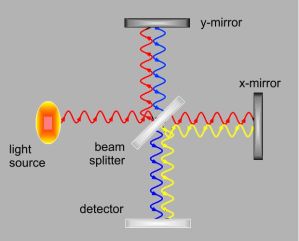
Interferometer 1Their common experimental strategy sounds simple enough — compare two beams of light that had traveled along different paths

Light (preferably nice pure laser light, but Albert Michelson didn’t have a laser when he invented interferometry in 1887) comes in from the source at left and strikes the “beam splitter” — typically, a partially-silvered mirror that reflects half the light and lets the rest through.  One beam goes up the y-arm to a mirror that reflects it back down through the half-silvered mirror to the detector.  The other beam goes on its own round-trip journey in the x-direction.  The detector (Michelson’s eye or a photocell or a fancy-dancy research-quality CCD) registers activity if the waves in the two beams are in step when they hit it.  On the other hand, if the waves cancel then there’s only darkness.

Getting the two waves in step requires careful adjustment of the x- and y-mirrors, because the waves are small.  The yellow sodium light Michelson used has a peak-to-peak wavelength of 589 nanometers.  If he twitched one mirror 0.0003 millimeter away from optimal position the valleys of one wave would cancel the peaks of the other.

So much for principles.  The specifics of each team’s device relate to the theory being tested.  Michelson was confronting the æther theory, the proposition that if light is a wave then there must be some substance, the æther, that vibrates to carry the wave.  We see sunlight and starlight, so  the æther must pervade the transparent Universe.  The Earth must be plowing through the æther as it circles the Sun.  Furthermore, we must move either with or across or against the æther as we and the Earth rotate about its axis.  If we’re moving against the æther then lightwave peaks must appear closer together (shorter wavelengths) than if we’re moving with it.Michelson-Moreley device

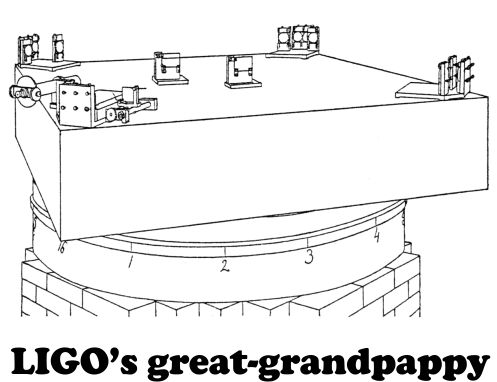
Michelson designed his device to test that chain of logic. His optical apparatus was all firmly bolted to a 4′-square block of stone resting on a wooden ring floating on a pool of mercury.  The whole thing could be put into slow rotation to enable comparison of the x– and y-arms at each point of the compass.

Interferometer 3
Suppose the æther theory is correct. Michelson should see lightwaves cancel at some orientations.

According to the æther theory, Michelson and his co-worker Edward Morley should have seen alternating light and dark as he rotated his device.  But that’s not what happened.  Instead, he saw no significant variation in the optical behavior around the full 360o rotation, whether at noon or at 6:00 PM.

Cross off the æther theory.

Michelson’s strategy depended on light waves getting out of step if something happened to the beams as they traveled through the apparatus.  Alternatively, the beams could charge along just fine but something could happen to the apparatus itself.  That’s how the LIGO team rolled.

Interferometer 2
Suppose Einstein’s GR theory is correct. Gravitational wave stretching and compression should change the relative lengths of the two arms.

Einstein’s theory of General Relativity predicts that space itself is squeezed and stretched by mass.  Miles get shorter near a black hole.  Furthermore, if the mass configuration changes, waves of compressive and expansive forces will travel outward at the speed of light.  If such a wave were to encounter a suitable interferometer in the right orientation (near-parallel to one arm, near-perpendicular to the other), that would alter the phase relationship between the two beams.

The trick was in the word “suitable.”  The expected percentage-wise length change was so small that eLIGO needed 4-kilometer arms to see movement a tiny fraction of a proton’s width.  Furthermore, the LIGO designers flipped the classical detection logic.  Instead of looking for a darkened beam, they set the beams to cancel at the detector and looked for even a trace of light.

eLIGO saw the light, and confirmed Einstein’s theory.

~~ Rich Olcott

Gravitational Waves Are Something Else

gravitational-gif.0

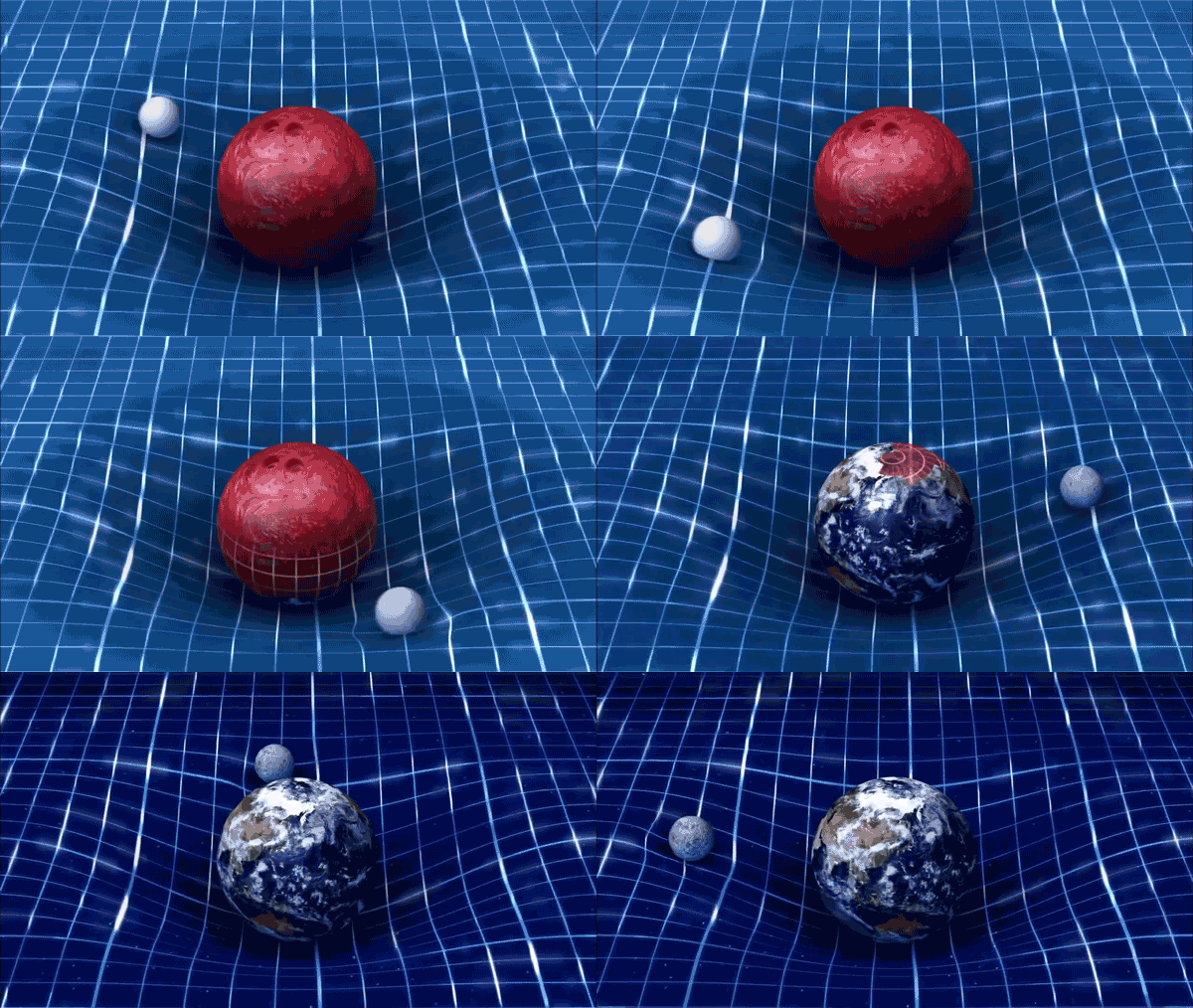
If you’re reading this post, you’ve undoubtedly seen at least one diagram like the above — a black hole or a planet or a bowling ball makes a dent in a rubber sheet and that’s supposed to explain Gravity.  But it doesn’t, and neither does this spirally screen-grab from Brian Greene’s presentation on Stephen Colbert’s Late Show:rubber-sheet waves_post

<Blush> I have to admit that the graphic I used a couple of weeks ago is just as bad.

Gravitational waves don’t make things go up and down like ocean waves, and they’re definitely not like that planet on a trampoline — after all, there’s nothing “below” to pull things downward so there can’t be a dent.  And gravitational waves don’t do spirals, much.

soundwaveOf all the wave varieties we’re familiar with, gravitational waves are most similar to (NOT identical with!!) sound waves.  A sound wave consists of cycles of compression and expansion like you see in this graphic.  Those dots could be particles in a gas (classic “sound waves”) or in a liquid (sonar) or neighboring atoms in a solid (a xylophone or marimba).

Contrary to rumor, there can be sound in space, sort of.  Any sizable volume of “empty” space contains at least a few atoms and dust particles.  A nova or similar sudden event can sweep particles together and give rise to successive waves that spread as those local collections bang into particles further away.  That kind of activity is invoked in some theories of spiral galaxy structure and the fine details of Saturn’s rings.

In a gravitational wave, space itself is compressed and stretched.  A particle caught in a gravitational wave doesn’t get pushed back and forth.  Instead, it shrinks and expands in place.  If you encounter a gravitational wave, you and all your calibrated measurement gear (yardsticks, digital rangers, that slide rule you’re so proud of) shrink and expand together.  You’d only notice the experience if you happened to be comparing two extremely precise laser rangers set perpendicular to each other (LIGO!).  One would briefly register a slight change compared to the other one.

Light always travels at 186,000 miles per second but in a compressed region of space those miles are shorter.  bent lightEinstein noticed that implication of his Theory of General Relativity and in 1916 predicted that the path of starlight would be bent when it passed close to a heavy object like the Sun.  The graphic shows a wave front passing through a static gravitational structure.  Two points on the front each progress at one graph-paper increment per step.  But the increments don’t match so the front as a whole changes direction.  Sure enough, three years after Einstein’s prediction, Eddington observed just that effect while watching a total solar eclipse in the South Atlantic.

Unlike the Sun’s steady field, a gravitational wave is dynamic. Gravitational waves are generated by changes in a mass configuration.  The wave’s compression and stretching forces spread out through space.

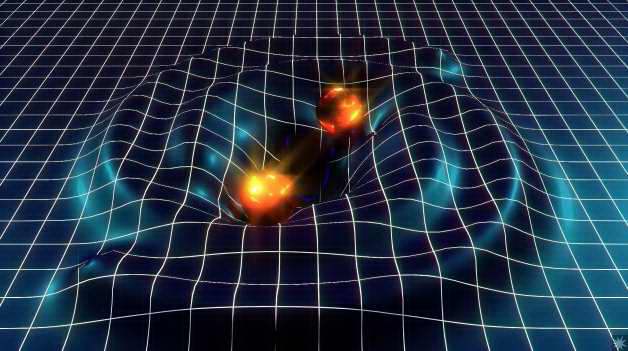
Here’s a simulation of the gravitational forces generated by two black holes orbiting into a collision.  The contours show the net force felt at each point in the region around the pair.
2 black holesWe’re being dynamic here, so the simulation has to include the fact that changes in the mass configuration aren’t felt everywhere instantaneously.  Einstein showed that space transmits gravitational waves at the speed of light, so I used a scaled “speed of light” in the calculation.  You can see how each of the new features expands outward at a steady rate.

Even near the violent end, the massive objects move much more slowly than light speed.  The variation in their nearby field quickly smooths out to an oval and then a circle about the central point, which is why the calculated gravity field generates no spiral like the ones in the pretty pictures.

Oh, and those “gravity well” pictures?  They’re not showing gravitational fields, they’re really gravitational potential energy diagrams, showing how hard it’d be to get away from somewhere.  In the top video, for example, the satellite orbits the planet because it doesn’t have enough kinetic energy to get out of the well.  The more massive the attractor, the tighter it curves space around itself and the deeper the well.

~~ Rich Olcott

aLIGO and eLISA: Tuning The Instrument

Oh, it’s good to see Big News in hard science get big attention in Big Media.  The LIGO story and Columbia’s Dr Brian Greene even made it to the Stephen Colbert Late Show.  Everyone chuckled at the final “boowee-POP” audio recording (simulation at 7:30 into this clip; get for-real traces and audio from this one).

There’s some serious science in those chirps, not to mention serious trouble for any alien civilization that happened to be too close to the astronomical event giving rise to them.

LIGO trace 3
Adapted from the announcement paper by Abbot et al

The peaks and valleys in the top LIGO traces represent successive spatial compression cycles generated by two massive bodies orbiting each other.  There’s one trace for each of the two LIGO installations.  The spectrograms beneath show relative intensity at each frequency.  Peaks arrived more rapidly in the last 100 milliseconds and the simulated sound rose in pitch because the orbits grew smaller and faster.  The audio’s final POP is what you get from a brief but big disturbance, like the one you hear when you plug a speaker into a live sound system.  This POP announced two black holes merging into one, converting the mass-energy of three suns into a gravitational jolt to the Universe.

Scientists have mentioned in interviews that LIGO has given us “an ear to the Universe.”  That’s true in several different <ahem> senses.  First, we’ve seen in earlier posts that gravitational physics is completely different from the electromagnetism that illuminates every kind of telescope that astronomers have ever used.  Second, black hole collisions generate signals in frequencies that are within our auditory range.  Finally, LIGO was purposely constructed to have peak sensitivity in just that frequency range.

Virtually every kind of phenomenon that physicists study has a characteristic size range and a characteristic frequency/duration range.  Sound waves, for instance, are in the audiophile’s beloved “20 to 20,000” cycles per second (Hz).  Put another way, one cycle of a sound wave will last something between 1/20 and 1/20,000 second (0.05-0.000 05 second).  The speed of sound is roughly 340 meters per second which puts sound’s characteristic wavelength range between 17 meters and 17 millimeters.

No physicist would be surprised to learn that humans evolved to be sensitive to sound-making things in that size range.  We can locate an oncoming predator by its roar or by the snapping twig it stepped on but we have to look around to spot a pesky but tiny mosquito.

So the greenish box in the chart below is all about sound waves.  The yellowish box gathers together the classes of phenomena scientists study using the electromagnetic spectrum.  For instance, we use infra-red light (characteristic time range 10-15-10-12 second) to look at (or cause) molecular vibrations.

RegimesWe can investigate things that take longer than an instrument’s characteristic time by making repeated measurements, but we can’t use the instrument to resolve successive events that happen more quickly than that.  We also can’t resolve events that take place much closer together than the instrument’s characteristic length.
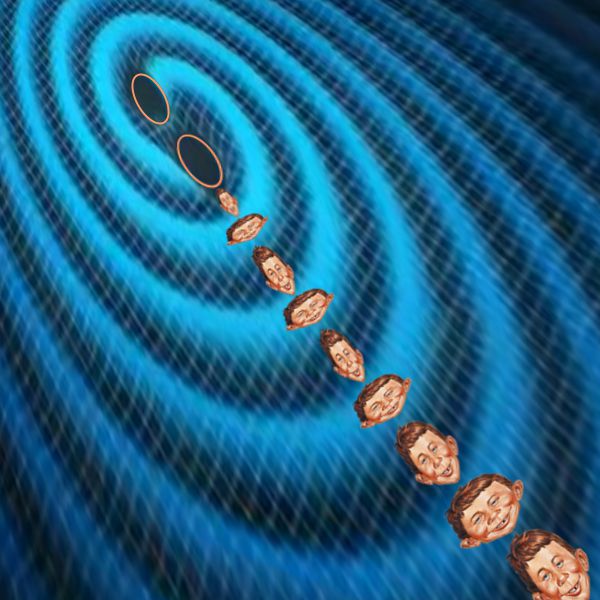
The electromagnetic spectrum serves us well, but it has its limitations.  The most important is that there are classes of objects out there that neither emit nor absorb light in any of its forms.  Black holes, for one.  They’re potentially crucial to the birth and development of galaxies.  However, we have little hard data on them against which to test the plethora of ideas the theoreticians have come up with.

Dark matter is another.  We know it’s subject to gravity, but to our knowledge the only way it interacts with light is by gravitational lensing.  Most scientists working on dark matter wield Occam’s Razor to conclude it’s pretty simple stuff.  Harvard cosmologist Dr Lisa Randall has suggested that there may be two kinds, one of which collects in disks that clothe themselves in galaxies.

That’s where LIGO and its successors in the gray box will help.  Their sensitivity to gravitational effects will be crucial to our understanding of dark objects.  Characteristic times in tens and thousands of seconds are no problem nor are event sizes measured in kilometers, because astronomical bodies are big.

GrWave Detectors
Gravitational instrumentation, from Christopher Berry’s blog and Web page

This is only the beginning, folks, we ain’t seen nothin’ yet.

~~ Rich Olcott

LIGO: Gravity Waves Ain’t Gravitational Waves

Sometimes the media get sloppy.  OK, a lot of times, especially when the reporters don’t know what they’re writing about.  Despite many headlines that “LIGO detected gravity waves,” that’s just not so.  In fact, the LIGO team went to a great deal of trouble to ensure that gravity waves didn’t muck up their search for gravitational waves.

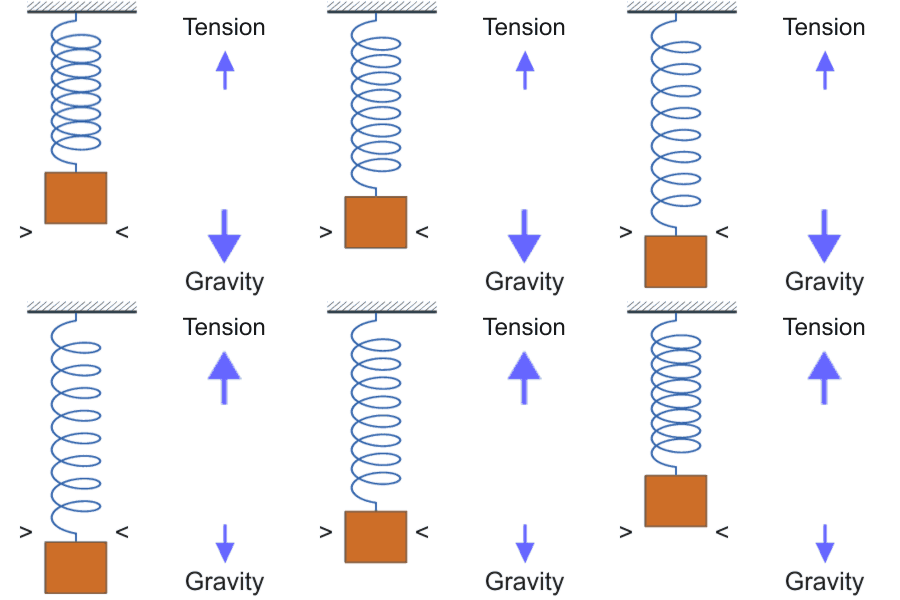
Spring2A wave happens in a system when a driving force and a restoring force take turns overshooting an equilibrium point AND the away-from-equilibrium-ness gets communicated around the system.  The system could be a bunch of springs tied together in a squeaky old bedframe, or labor and capital in an economic system, or the network of water molecules forming the ocean surface, or the fibers in the fabric of space (whatever those turn out to be).

If you  were to build a mathematical model of some wavery system you’d have to include those two forces plus quantitative descriptions of the thingies that do the moving and communicating.  If you don’t add anything else, the model will predict motion that cycles forever.  In reality, of course, there’s always something else that lets the system relax into equilibrium.

The something else could be a third force, maybe someone sitting on the bed, or government regulation in an economy, or reactant depletion for a chemical process.  But usually it’s friction of one sort or another — friction drains away energy of motion and converts it to heat.  Inside a spring, for instance, adjacent crystallites of metal rub against each other.  There appears to be very little friction in space — we can see starlight waves that have traveled for billions of years.

Physicists pay attention to waves because there are some general properties that apply to all of them.  For instance, in 1743 Jean-Baptiste le Rond d’Alembert proved there’s a strict relationship between a wave’s peakiness and its time behavior.  Furthermore, Jean-Baptiste Joseph Fourier (pre-Revolutionary France must have been hip-deep in physicist-mathematicians) showed that a wide variety of more-or-less periodic phenomena could be modeled as the sum of waves of differing frequency and amplitude.

Monsieur Fourier’s insight has had an immeasurable impact on our daily lives.  You can thank him any time you hear the word “frequency.”  From broadcast radio and digitally recorded music to time-series-based business forecasting to the mode-locked lasers in a LIGO device — none would exist without Fourier’s reasoning.

Gravity waves happen when a fluid is disturbed and the restoring force is gravity.  We’re talking physicist fluid here, which could be sea water or the atmosphere or solar plasma, anything where the constituent particles aren’t locked in place. Winds or mountain slopes or nuclear explosions push the fluid upwards, gravity pulls it back, and things wobble until friction dissipates that energy.

Gravitational waves are wobbles in gravity itself, or rather, wobbles in the shape of space.  According to General Relativity, mass exerts a tension-like force that squeezes together the spacetime immediately around it.  The more mass, the greater the tension.

Binary BH with AENAn isolated black hole is surrounded by an intense gravitational field and a corresponding compression of spacetime.  A pair of black holes orbiting each other sends out an alternating series of tensions, first high, then extremely high, then high…

Along any given direction from the pair you’d feel a pulsing gravitational field that varied above and below the average force attracting you to the pair.  From a distance and looking down at the orbital plane, if you could see the shape of space you’d see it was distorted by four interlocking spirals of high and low compression, all steadily expanding at the speed of light.

The LIGO team was very aware that the signal of a gravitational wave could be covered up by interfering signals from gravity waves — ocean tides, Earth tides, atmospheric disturbances, janitorial footsteps, you name it.  The design team arrayed each LIGO site with hundreds of “seismometers, accelerometers, microphones, magnetometers, radio receivers, power monitors and a cosmic ray detector.”  As the team processed the LIGO trace they accounted for artifacts that could have come from those sources.

So no, the LIGO team didn’t discover gravity waves, we’ve known about them for a century.  But they did detect the really interesting other kind.

~~ Rich Olcott

Would the CIA want a LIGO?

So I was telling a friend about the LIGO announcement, going on about how this new “device” will lead to a whole new kind of astronomy.  He suddenly got a far-away look in his eyes and said, “I wonder how many of these the CIA has.”

The CIA has a forest of antennas, but none of them can do what LIGO does.  That’s because of the physics of how it works, and what it can and cannot detect.  (If you’re new to this topic, please read last week’s post so you’ll be up to speed on what follows.  Oh, and then come back here.)

There are remarkable parallels between electromagnetism and gravity.  The ancients knew about electrostatics — amber rubbed by a piece of cat fur will attract shreds of dry grass.  They certainly knew about gravity, too.  But it wasn’t until 100 years after Newton wrote his Principia that Priestly and then Coulomb found that the electrostatic force law, F = ke·q1·q2 / r2, has the same form as Newton’s Law of Gravity, F = G·m1·m2 / r2. (F is the force between two bodies whose centers are distance r apart, the q‘s are their charges and the m‘s are their masses.)

Jim and AlAlmost a century later, James Clerk Maxwell (the bearded fellow at left) wrote down his electromagnetism equations that explain how light works.  Half a century later, Einstein did the same for gravity.
But interesting as the parallels may be, there are some fundamental differences between the two forces — fundamental enough that not even Einstein was able to tie the two together.

One difference is in their magnitudes.  Consider, for instance, two protons.  Running the numbers, I found that the gravitational force pulling them together is a factor of 1036 smaller than the electrostatic force pushing them apart.  If a physicist wanted to add up all the forces affecting a particular proton, he’d have to get everything else (nuclear strong force, nuclear weak force, electromagnetic, etc.) nailed down to better than one part in 1036 before he could even detect gravity.

But it’s worse — electromagnetism and gravity don’t even have the same shape.

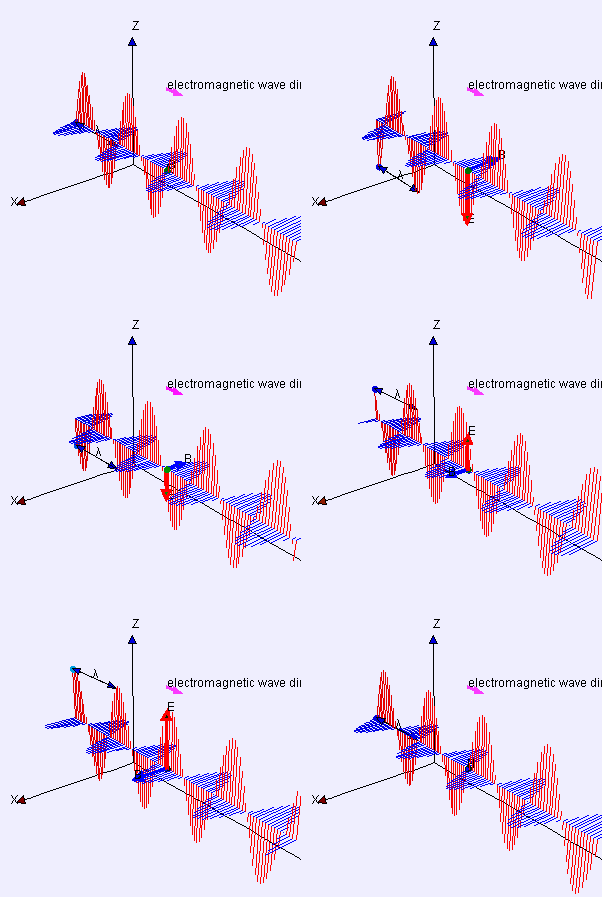
Electromagneticwave3D
Electric (red) and magnetic (blue) fields in a linearly polarized light wave
(graphic from WikiMedia Commons, posted by Lookang and Fu-Kwun Hwang)

A word first about words.  Electrostatics is about pure straight-line-between-centers (longitudinal) attraction and repulsion — that’s Coulomb’s Law.  Electrodynamics is about the cross-wise (transverse) forces exerted by one moving charged particle on the motion of another one.  Those forces are summarized by combining Maxwell’s Equations with the Lorenz Force Law.  A moving charge gives rise to two distinct forces, electric and magnetic, that operate at right angles to each other.  The combined effect is called electromagnetism.

The effect of the electric force is to vibrate a charge along one direction transverse to the wave.  The magnetic force only affects moving charges; it acts to twist their transverse motion to be perpendicular to the wave.  An EM antenna system works by sensing charge flow as electrons move back and forth under the influence of the electric field.

Gravitostatics uses Newton’s Law to calculate longitudinal gravitational interaction between masses.  That works despite gravity’s relative weakness because all the astronomical bodies we know of appear to be electrically neutral — no electrostatic forces get in the way.  A gravimeter senses the strength of the local gravitostatic field.

Maxwell and EinsteinGravitodynamics is completely unlike electrodynamics.  Gravity’s transverse “force” doesn’t act to move a whole mass up and down like Maxwell’s picture at left.  Instead, as shown by Einstein’s picture, gravitational waves stretch and compress while leaving the center of mass in place. I put “force” in quotes because what’s being stretched and compressed is space itself.  See this video for a helpful visualization of a gravitational wave.

LIGO is neither a telescope nor an electromagnetic antenna.  It operates by detecting sudden drastic changes in the disposition of matter within a “small” region.  In LIGO’s Sept 14 observation, 1031 kilograms of black hole suddenly ceased to exist, converted to gravitational waves that spread throughout the Universe.  By comparison, the Hiroshima explosion released the energy of 10-6 kilograms.

Seismometers do a fine job of detecting nuclear explosions.  Hey, CIA, they’re a lot cheaper than LIGO.

~~ Rich Olcott