

Dusk at the end of January, not my favorite time of day or year. I was just closing up the office when I heard a familiar footstep behind me. “Hi, Vinnie. What’s up?”
“Energy, Sy.”
“Energy?”
“Energy and LIGO. Back in flight school we learned all about trading off kinetic energy and potential energy. When I climb I use up the fuel’s chemical energy to gain gravitational potential energy. When I dive I convert gravitational potential energy into kinetic energy ’cause I speed up. Simple.”
“So how do you think that ties in with LIGO?”
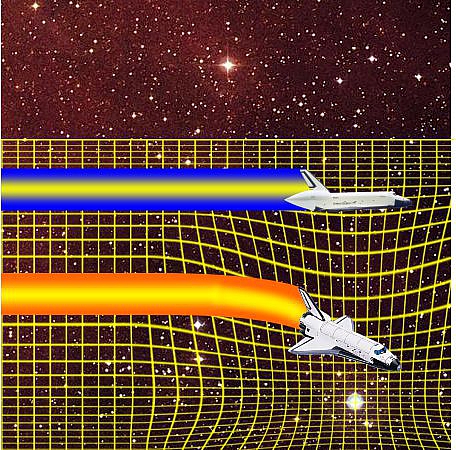
“OK, back when we pretended we was in those two space shuttles (which you sneaky-like used to represent photons in a LIGO) and I got caught in that high-gravity area where space is compressed, we said that in my inertial frame I’m still flying at the same speed but in your inertial frame I’ve slowed down.”
“Yeah, that’s what we worked out.”
“Well, if I’m flying into higher gravity, that’s like diving, right, ’cause I’m going where gravity is stronger like closer to the Earth, so I’m losing gravitational potential energy. But if I’m slowing down I’ve gotta be losing kinetic energy, too, right? So how can they both happen? And how’s it work with photons?”
“Interesting questions, Vinnie, but I’m hungry. How about some dinner?”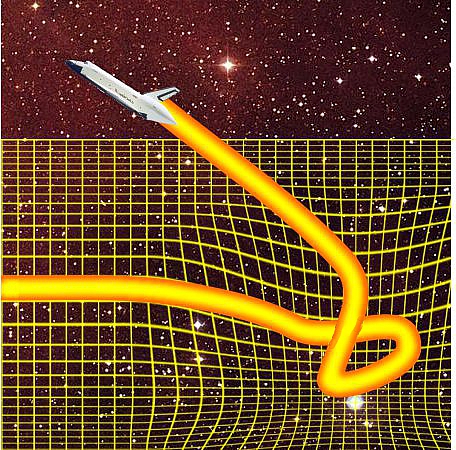
We took the elevator down to Eddie’s pizza joint on the second floor. I felt heavier already. We ordered, ate and got down to business.
“OK, Vinnie. Energy with photons is different than with objects that have mass, so let’s start with the flying-objects case. How do you calculate gravitational potential energy?”
“Like they taught us in high school, Sy, ‘little g’ times mass times the height, and ‘little g’ is some number I forget.”
“Not a problem, we’ll just suppose that ‘little g’ times your plane’s mass is some convenient number, like 1,000. So your gravitational potential energy is 1000×height, where the height’s in feet and the unit of energy is … call it a fidget. OK?”
“Saves having to look up that number.”

“Fine. Let’s suppose you’re flying over San Francisco Bay and your radar altimeter reads 20,000 feet. What’s your gravitational potential energy?”
“Uhh… twenty million fidgets.”
“Great. You maintain level flight to Denver. As you pass over the Rockies you notice your altimeter now reads 6,000 feet because of that 14,000-foot mountain you’re flying over. What’s your gravitational potential energy?”
“Six million fidgets. Or is it still twenty?”
“Well, if God forbid you were to drop out of the sky, would you hit the ground harder in California or Colorado?”
“California, of course. I’d fall more than three times as far.”
“So what you really care about isn’t some absolute amount of potential energy, it’s the relative amount of smash you experience if you fall down this far or that far. ‘Height’ in the formula isn’t some absolute height, it’s height above wherever your floor is. Make sense?”
“Mm-hm.”
“That’s an essential characteristic of potential energy — electric, gravitational, chemical, you name it. It’s only potential. You can’t assign a value without stating the specific transition you’re interested in. You don’t know voltages in a circuit until you put a resistance between two specific points and meter the current through it. You don’t know gravitational potential energy until you decide what location you want to compare it with.”
“And I suppose a uranium atom’s nuclear energy is only potential until a nuke or something sets it off.”
“You got the idea. So, when you flew into that high-gravity compressed-space sector, what happened to your gravitational potential energy?”
“Like I said, it’s like I’m in a dive so I got less, right?”
“Depends on what you’re going to fall onto, doesn’t it?”
“No, wait, it’s definitely less ’cause I gotta use energy to fly back out to flat space.”
“OK, you’re comparing here to far away. That’s legit. But where’s that energy go?”
“Ahh, you’re finally getting to the kinetic energy side of my question –”
“Whoa, look at the time! Got a plane to catch. We’ll pick this up next week. Bye.”
“Hey, Sy, your tab! … Phooey, stuck for it again.”
~~ Rich Olcott

 “Does the Moon go around the Earth or does the Earth go around the Moon?”

 “Squeeze in two sides, pop out the other two, eh?”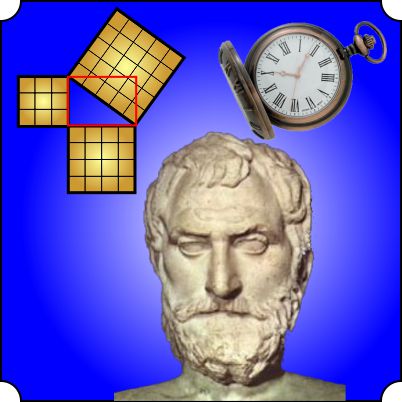
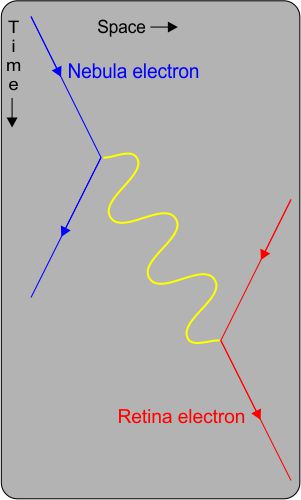 One more step and we can answer Ken’s question. A moving object’s proper time is defined to be the time measured by a clock affixed to that object. The proper time interval between two events encountered by an object is exactly Minkowski’s spacetime interval. Lucy’s clock never moves from zero.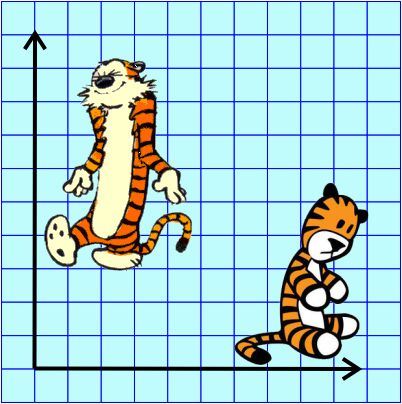
 I so miss Calvin and Hobbes, the wondrous, joyful comic strip that cartoonist Bill Watterson gave us between 1985 and 1995. Hobbes was a stuffed toy tiger — except that 6-year-old Calvin saw him as a walking, talking man-sized tiger with a sarcastic sense of humor.
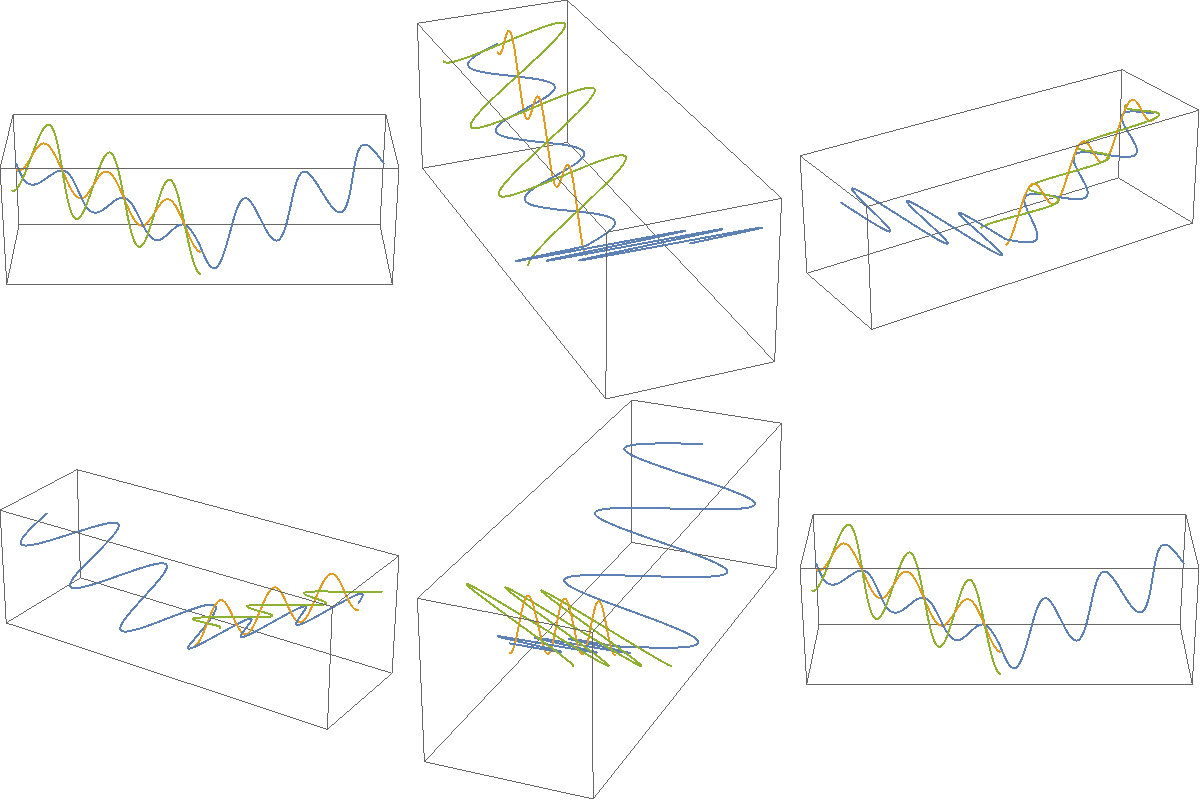 In this video, orange, green and blue electromagnetic fields shine in from one side of the box onto its floor. Each color’s field is polar because it “lives” in only one plane. However, the beam as a whole is unpolarized because different components of the total field direct recipient electrons into different planes giving zero net polarization. The Sun and most other familiar light sources emit unpolarized light.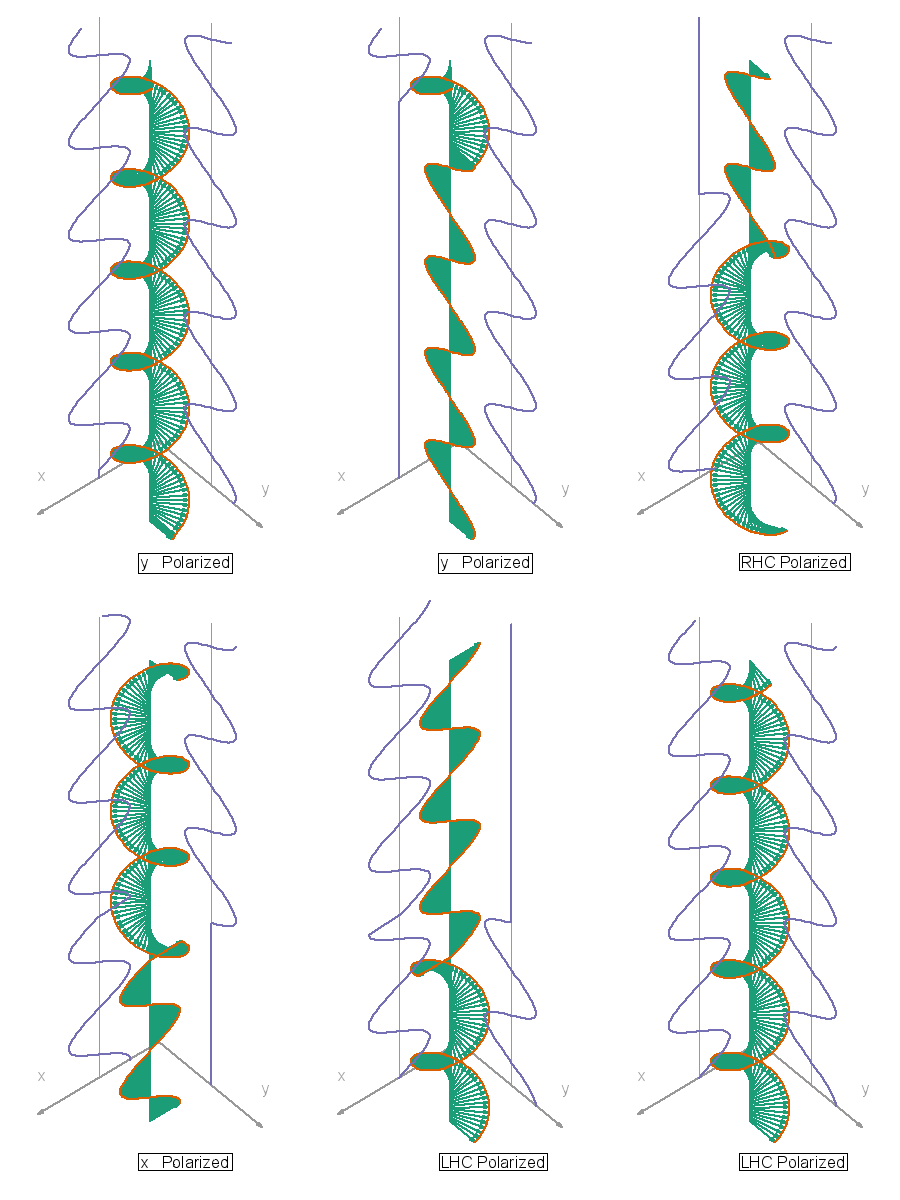

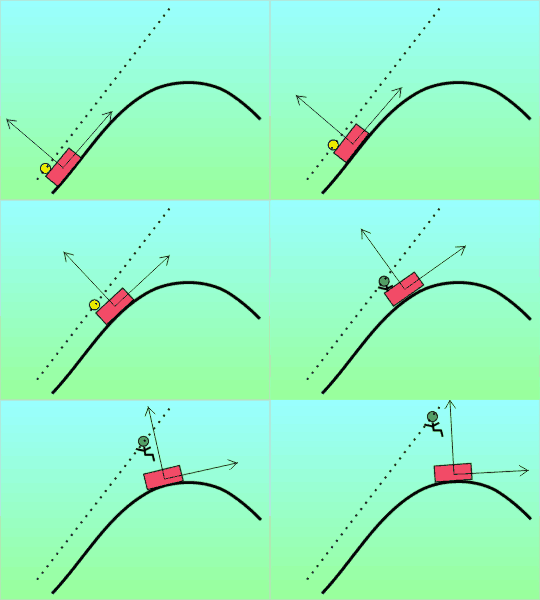 But there are other accelerations that aren’t so easily accounted for. Ever ride in a car going around a curve and find yourself almost flung out of your seat? This little guy wasn’t wearing his seat belt and look what happened. The car accelerated because changing direction is an acceleration due to a lateral force. But the guy followed Newton’s First Law and just kept going in a straight line. Did he accelerate?
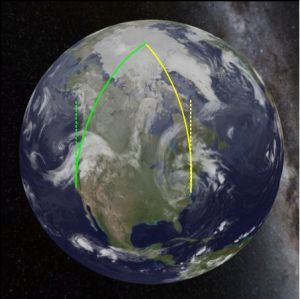 Suppose you’re investigating an object’s motion that appears to arise from a new force you’d like to dub “heterofugal.” If you can find a different frame of reference (one not attached to the object) or otherwise explain the motion without invoking the “new force,” then heterofugalism is a fictitious force.

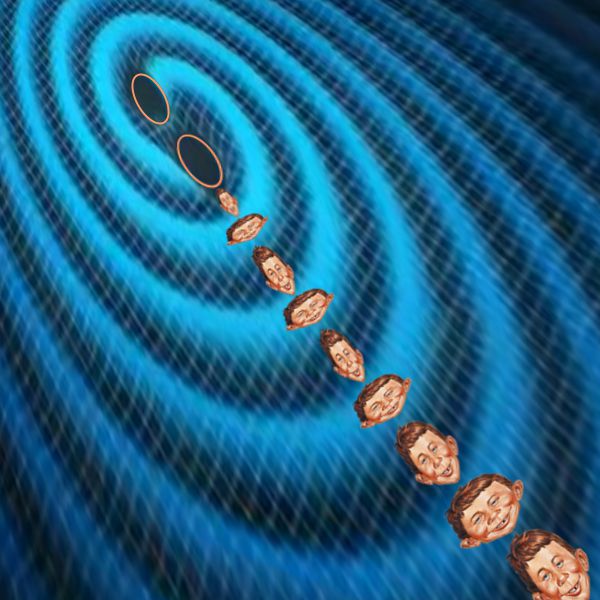
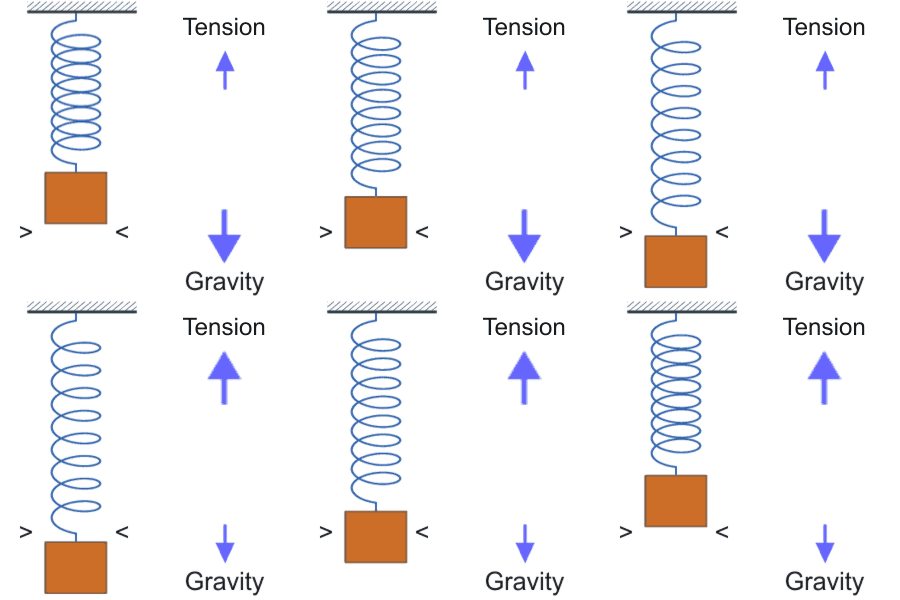 A wave happens in a system when a driving force and a restoring force take turns overshooting an equilibrium point AND the away-from-equilibrium-ness gets communicated around the system. The system could be a bunch of springs tied together in a squeaky old bedframe, or labor and capital in an economic system, or the network of water molecules forming the ocean surface, or the fibers in the fabric of space (whatever those turn out to be).
 An isolated black hole is surrounded by an intense gravitational field and a corresponding compression of spacetime. A pair of black holes orbiting each other sends out an alternating series of tensions, first high, then extremely high, then high…
 The experiment consists of shooting laser beams out along both arms, then comparing the returned beams.

