Pinks In Space

Mr Feder, of Fort Lee NJ, is outraged. “A pretty pink parasol? NASA spent taxpayer dollars to decorate the James Webb Space Telescope with froufrou like that?”

Astronomer Cathleen stays cool. “Certainly not, Mr Feder. This is no effete Victorian‑era parasol. It’s a big, muscular ‘defender against the Sun,’ which is what the word means when you break it down — para‑sol. Long and wide as a tennis court. Its job is to fight off the Sun’s radiation and keep JWST‘s cold side hundreds of degrees colder than the Sunfacing side. Five layers of highstrength Kapton film, the same kind that helped protect New Horizons against freezing and micrometeorites on its way to Pluto and beyond. Each layer carries a thin coat of aluminum, looks like a space blanket or those Mylar mirror balloons but this is a different kind of plastic.”

“Sounds like a lot of trouble for insulation. Why not just go with firebrick backed up with cinder blocks? That’s what my cousin used for her pottery kiln.”

I cut in, because Physics. “Two reasons, Mr Feder. First one is mass. Did you help your cousin build her kiln?”

“Nah, bad back, can’t do heavy lifting.”

“There you go. On a space mission, every gram and cubic centimeter costs big bucks. On a benefit/cost scale of 1 to 10, cinder blocks rate at, oh, about ½. But the more important reason is that cinder blocks don’t really address the problem.”

“They keep the heat in that kiln real good.”

“Sure they do, but on JWST‘s hot side the problem is getting rid of heat, not holding onto it. That’s the second reason your blocks fail the suitability test. Sunlight at JWST ‘s orbit will be powerful enough to heat the satellite by hundreds of degrees, your choice of Fahrenheit or centigrade. That’s a lot of heat energy to expel. Convection is a good way to shed heat but there’s no air in space so that’s not an option. Conduction isn’t either, because the only place to conduct the heat to is exactly where we don’t want it — the scope’s dish and instrument packages. Cinder blocks don’t conduct heat as well as metals do, but they do it a lot better than vacuum does.”

“So that leaves what, radiating it away?”

“Exactly.”

“Aluminum on the plastic makes it a good radiator, huh?”

“Sort of. The combo’s a good reflector, which is one kind of radiating.”

“So what’s the problem?”

“It’s not a perfect reflector. The challenge is 250 kilowatts of sunlight. Each layer blocks 99.9% but that still lets 0.1% through to heat up what’s behind it. The parasol has radiate away virtually all the incoming energy. That’s why there’s five layers and they’re not touching so they can’t conduct heat to each other.”

“Wait, they can still radiate to each other. Heat bounces back and forth like between two mirrors, builds up until the whole thing bursts into flames. Dumb design.”
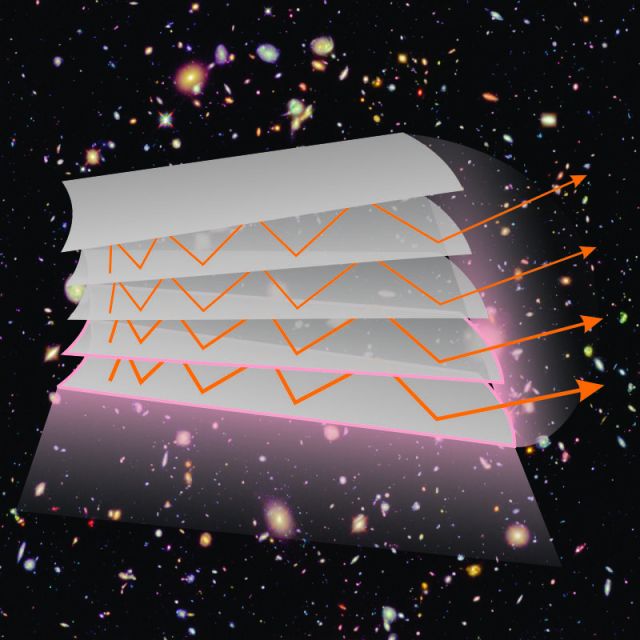
“No flames, despite what the Space Wars movies show, because there’s no oxygen in space to support combustion. Besides, the designers were a lot smarter than that. The mirrors are at an angle to each other, just inches apart near the center, feet apart at the edges. Heat in the form of infrared light does indeed bounce between each pair of layers but it always bounces at an angle aimed outwards. The parasol’s edges will probably shine pretty brightly in the IR, but only from the sides and out of the telescope’s field of view.”

“OK, I can understand the aluminum shiny, but why make it pink?”

“That’s a thin extra coat of a doped silicon preparation, just on the outermost two layers. It’s not so good at reflection but when it heats up it’s good at emitting infrared. Just another way to radiate.”

“But it’s pink?”

“The molecules happen to be that color.”

“Why’s it dopey?”

“Doped, not dopey. Pure silicon is an electrical insulator. Mixing in the right amount of the right other atoms makes the coating a conductor so it can bleed off charge coming in on the solar wind.”

“Geez, they musta thought of everything.”

“They tried hard to.”

~~ Rich Olcott

Yardsticks

“Hi, Cathleen, meet Mr Richard Feder, of Fort Lee NJ. He’s got a question that’s more in your Astronomy bailiwick than mine. Have a strawberry scone.”

“Mmm, still warm from Al’s oven. Thanks, Sy. Hello and what’s your question, Mr Feder?”

“Hiya. So if the James Webb Space Telescope is gonna be a million miles behind the Moon, won’t the Moon block its signals to us?”

“Oh dear, he said ‘miles.’ Sy, you’d better get out Old Reliable to look up numbers and do unit conversions. Mr Feder, I don’t think in miles.”

“Huh? What do you use instead, like paces or something?”

“Depends on what objects I’m considering and why I’m thinking about them. There are so many useful ratios out there it’s often easier to use ratios than huge numbers one can’t wrap one’s head around. Jupiter’s radius, for instance, is eleven times Earth’s, and the Sun is ten times wider still. Diameter and circumference follow the same ratios, of course. Square those ratios for relative surface area, cube them for relative volume. Who needs miles or kilometers?”

“Those numbers right, Moire?”

“Mmm … 6371 kilometers or 3959 miles for Earth, 71492 kilometers or 42441 miles for Jupiter, 695700 kilometers or 432300 miles for the Sun. The Jupiter/Earth ratio’s 11.2, the Sun/Jupiter ratio’s 9.73. The lady knows what she’s talking about.”

“Here’s a few fun factoids. The Moon’s distance is 10 times Earth’s Equator which is 100 times the International Space Station’s altitude. For that matter, if you wrapped a string around Earth’s Equator, it’d be just long enough to reach up to a GPS satellite and back. But all those are near‑Earth measurements where it makes sense to think in miles or kilometers. That’s too cumbersome for the bigger picture.”

“What else you got?”

“Within the Solar System I generally use one or the other of two convenient yardsticks. They measure the same distances, of course, but they have different applications. One is the nominal radius of Earth’s orbit, about 150 million kilometers.’

“That’s 93 million miles, Mr Feder.”

“I knew that one, Moire.”

“Anyway, we call that distance an Astronomical Unit. It’s handy for locating bodies relative to the Sun. Parker Solar Probe has gotten within a tenth of an AU of the Sun, for instance, and Neptune’s about 30 AU out. The Oort Cloud begins near 2000 AU and may extend a hundred times as far.”

“I ain’t even gonna ask what the Oort‐thing is, but I’m glad it’s a long way away.”

“We think it’s where long‑period comets come from.”

“Far away is good then. So what’s your other yardstick?”

“Lightspeed.”

“186 thousand miles per second, Mr Feder.”

“Yeah, yeah.”

“It’s also 300 thousand kilometers per second, and one light‑second per second, and one light‑year per year. Within the Solar System my benchmarks are that Earth is 500 light-seconds from the Sun, and Pluto was 4½ light-hours away from us when New Horizons sent back those marvelous images. The Sun’s nearest star system, Alpha Centauri, is 4⅓ light‑years away, and when you compare hours to years that gives you an idea of how small we are on the interstellar scale.”

“Cathleen, when you mentioned New Horizons that reminded me of the JWST. We’ve gotten off the track from Mr Feder’s question. Why isn’t the Moon going to block those signals?”

“Because it’ll never be in the way.” <sketching on a paper napkin> “There’s a bunch of moving parts here so hold on. The Earth orbits the Sun and the Moon orbits the Earth once a month, right? The L2 point doesn’t orbit the Earth. It orbits the Sun, staying exactly behind Earth so yeah, once a month the Moon could maybe get between Earth and L2. But JWST won’t be at L2, it’ll be in a wide orbit around that point and mostly perpendicular to the orbits of the Earth and Moon.”

“How wide?”

“It’ll vary depending on what they need, but it’s big enough to keep the spacecraft’s solar panels in the sunlight.”

“Solar panels? I thought the IR sensors needed cold cold cold.”

“They do. JWST protects its cold side with a hot side featuring a pretty pink Kapton parasol.”

~~ Rich Olcott

The Venetian Blind Problem

Susan Kim gives me the side‑eye. “Sy, I get real suspicious when someone shows me a graph with no axis markings. I’ve seen that ploy used too often by people pushing a bias — you don’t know what happens offstage either side and you don’t know whether an effect was large or small. Your animated chart was very impressive, how that big methane infrared absorption peak just happens to fill in the space between CO2 and H2O peaks. But how wide is the chart compared to the whole spectrum? Did you cherry‑pick a region that just happens to make your point?”

“Susan, how could you accuse me of such underhanded tactics? But I confess — you’re right, sort of. <more tapping on Old Reliable’s keyboard> The animation only covered the near‑IR wavelengths from 1.0 to 5.0 micrometers. Here’s the whole strip from 0.2 micrometers in the near UV, out to 70 micrometers in the far IR. Among other things, it explains the James Webb Space Telescope, right, Al?”

Spectrum of Earth’s atmosphere. Adapted
under the Creative Commons 3.0 license
from Robert Wohde’s work
with the HITRAN2004 spectroscopic database,

“I know the Webb’s set up for IR astronomy from space, Sy. Wait, does this graph say there’s too much water vapor blocking the galaxy’s IR and that’s why they’re putting the scope like millions of miles away out there?”

“Not quite. The mission designers’ problem was the Sun’s heat, not Earth’s water vapor. The solution was to use Earth itself to shield the device from the Sun’s IR emissions. The plan is to orbit the Webb around the Earth‑Sun L2 point, about a million miles further out along the Sun‑Earth line. Earth’s atmosphere being only 60 miles thick, most of it, the Webb will be quite safe from our water molecules. No, our steamy atmosphere’s only a problem for Earth‑based observatories that have to peer through a Venetian blind with a few missing slats at very specific wavelengths.”

“Don’t forget, guys, the water spectrum is a barrier in both directions. Wavelengths the astronomers want to look at can’t get in, but also Earth’s heat radiation at those wavelengths can’t get out. Our heat balance depends on the right amount of IR energy making it out through where those missing slats are. That’s where Sy’s chart comes in — it identifies the wavelengths under threat by trace gases that aren’t so trace any more.”

“And we’re back to your point, Susan. We have to look at the whole spectrum. I heard one pitch by a fossil fuel defender who based his whole argument on the 2.8‑micrometer CO2 peak. ‘It’s totally buried by water’s absorption,‘ he claimed. ‘Can’t possibly do us any further damage.’ True, so far as it goes, but he carefully ignored CO2‘s other absorption wavelengths. Pseudoscience charlatan, ought to be ashamed of himself. Methane’s not as strong an absorber as CO2, but its peaks are mostly in the right places to do us wrong. Worse, both gas concentrations are going up — CO2 is 1½ times what it was in Newton’s day, and methane is 2½ times higher.”

“Funny how they both go up together. I thought the CO2 thing was about humanity burning fossil fuels but you said methane operations came late to that game.”

“Right on both counts, Al. Researchers are still debating why methane’s risen so bad but I think they’re zeroing in on cow gas — belches and farts. By and large, industry has made the world’s population richer over the past two centuries. People who used to subsist on a grain diet can now afford to buy meat so we’ve expanded our herds. Better off is good, but there’s an environmental cost.”

Al gets a far-away look. “Both those gases have carbon in them, right? How about we burn methane without the carbon in, just straight hydrogen?”

Susan gets excited. “Several groups in our lab are working on exactly that possibility, Al. The 2H2+O2→2H2O reaction yields 30% more energy per oxygen atom than burning methane. We just need to figure out how to use hydrogen economically.”

~~ Rich Olcott

Presbyopic Astronomy

Her phone call done, Cathleen returns to the Spitzer Memorial Symposium microphone with her face all happiness. “Good news! Jim, the grant came through. Your computer time and telescope access are funded. Woo-hoo!!”

<applause across the audience and Jim grins and blushes>

Cathleen still owns the mic. “So I need to finish up this overview of Spitzer highlights. Where was I?”

Maybe-an-Art-major tries to help. “The middle ground of our Universe.”

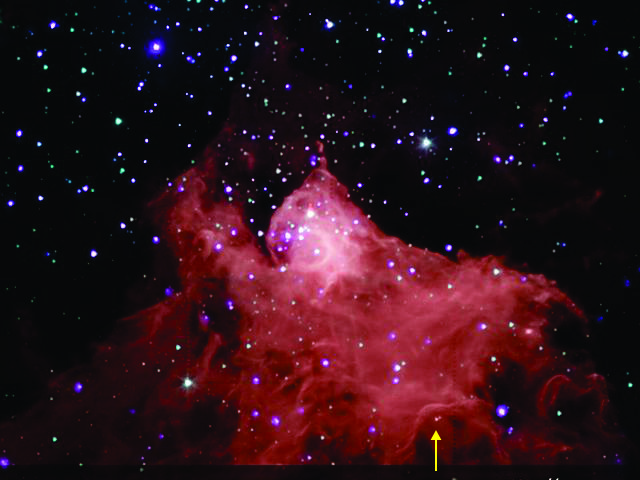
“Ah yes, thanks. So we’ve looked at close-by stars but Spitzer showed us a few more surprises lurking in the Milky Way. This, for instance — most of the image is colorized from the infra‑red, but if you look close you can see Chandra‘s X‑ray view, colorized purple to highlight young stars.”

The Cepheus-B molecular cloud
X-ray: NASA/CXC/PSU/K. Getman et al.; IRL NASA/JPL-Caltech/CfA/J. Wang et al

<hushed general “oooo” from the audience>

“Giant molecular clouds like this are scattered throughout the Milky Way, mostly in the galaxy’s spiral arms. As you see, this cloud’s not uniform, it has clumps and voids. By Earth standards the cloud is still a pretty good vacuum. The clumps are about 10-15 of our atmosphere’s density, but that’s still a million times more dense than our Solar System’s interplanetary space. The clumps appear to be where new stars are born. The photons and other particles from a newly-lit star drive the surrounding dust away. My arrow points to one star with a particularly nice example of that — see the C-shape around the star?”

The maybe-an-Art-major pipes up. “How about that one just a little below center?”

“Uh-huh. There’s so much activity in that dense region that the separate shockwaves collide to create hot spots that’ll generate even more stars in the future. The clouds are mostly held together by their own gravity. They last for tens of millions of years, so we think of them as huge roiling stellar nurseries.”

“Like my kid’s day care center but bigger.”

“Mm-mm, but let’s turn to the Milky Way’s center, home of that famous black hole with the mass of four million Suns and this remarkable structure, a double-helix of warm dust.”

False-color infra-red image of the Double-Helix Nebula
The double helix nebula.
Credit: NASA/JPL-Caltech/M. Morris (UCLA)

Vinnie blurts out, “That’s a jet from a black hole! One of Newt’s babies.”

Newt can’t resist breaking into Cathleen’s pitch. “Maybe it’s a jet, Vinnie. Yes, it’s above the central galactic plane and perpendicular to it, but the helix doesn’t quite point to the central black hole.”

“So take another picture that follows it down.”

“We’d love to, but we can’t. Yet. That image came from a long-wavelength instrument that only operated during Spitzer‘s initial 5-year cold period. Believe me, there are bunches of astronomers who can’t wait for the James Webb Space Telescope‘s far-IR instruments to get into position and start doing science. Meanwhile, we’ve got just the one image and a few earlier ones from an even less-capable spacecraft. This thing may be a lit-up part of a longer structure that twists down to the black hole or at least its accretion disk. We just don’t know.”

Cathleen takes control again. “The next image comes from outside our galaxy — far outside.”

Spitzer visualization of Galaxy MACS 1149-JD1
Credit: NASA/ESA/STScI/W. Zheng (JHU), and the CLASH team

The maybe-an-Art-major snorts, “Pointillism derivative!”

“No, it’s pixels from a starfield image with a very low signal-to-noise ratio. That red blotch in the center is one of the most distant objects ever observed, gracefully named MACS 1149-JD1. It’s a galaxy 13.2 billion lightyears away. That’s so far away that the expansion of the Universe has stretched the galaxy’s emitted photons by a factor of 10.2. Spectrum-wise, 1149-JD1’s ultra-violet light skipped right past the visible range and down into the near infra-red. Intensity-wise, that galaxy’s about 5200 times further away than the Andromeda galaxy. Assuming the two are about the same overall brightness, 1149-JD1 would be about 27 million times fainter than Andromeda.”

“How can we even see anything that dim?”

“We couldn’t, except for a fortunate coincidence. Right in line between us and 1149-JD1 there’s a massive galaxy cluster whose gravity acts like a lens to focus 1149-JD1’s light.”

The seminar’s final words, from maybe-an-Art-major — “A distant light, indeed.”

~~ Rich Olcott