Significant Twinkles

Cathleen’s got a bit of fire in her eye. “Good exposition, Jeremy, but only just barely on‑assignment. You squeezed in your exoplanet search material at the very end. <sigh> Okay, for our next presentation we have two of our freshmen, Madison and C‑J.”

“Hello, everybody, I’m Madison. I fell in love with Science while watching Nova and Star Trek with my family. Doctor O’Meara’s Astronomy class is my first step into the real thing. C‑J?”

“Hi, I’m C‑J, like she said. What started me on Astronomy was just looking at the night sky. My family’s ranch is officially in dark sky country, but really it’s so not dark. Jeremy’s also from the High Plateau and we got to talking. We see a gazillion stars up there, probably more stars than the Greeks did because they were looking up through humid sea-level air. On a still night our dry air’s so clear you can read by the light of those stars. I want to know what’s up there.”

“Me, too, but I’m even more interested in who‘s up there living on some exoplanet somewhere. How do we find them? We’ve just heard about spectroscopy and astrometry. C‑J and I will be talking about photometry, measuring the total light from something. You can use it even with light sources that are too dim to pick out a spectrum. Photometry is especially useful for finding transits.”

“A transit is basically an eclipse, an exoplanet getting between us and its star—”

“Like the one we had in 2017. It was so awesome when that happened. All the bird and bug noises hushed and the corona showed all around where the Sun was hiding. I was only 12 then but it changed my Universe when they showed us on TV how the Moon is exactly the right size and distance to cover the Sun.”

“Incredible coincidence, right? Almost exactly 100% occultation. If the Moon were much bigger or closer to us we’d never see the corona’s complicated structure. We wouldn’t have that evidence and we’d know so much less about how the Sun works. But even with JWST technology we can’t get near that much detail from other stars.”

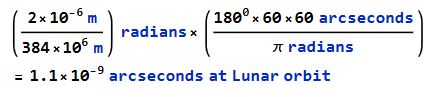
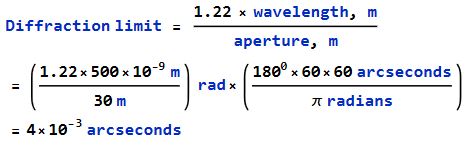
“Think of trying to read a blog post on your computer, but your only tool is a light meter that gives you one number for the whole screen. Our nearest star, Alpha Centauri, is 20% larger than our Sun but it’s 4.3 lightyears away. I worked out that at that distance its image would be about 8½ milliarcseconds across. C‑J found that JWST’s cameras can’t resolve details any finer than 8 times that. All we can see of that star or any star is the light the whole system gives off.”

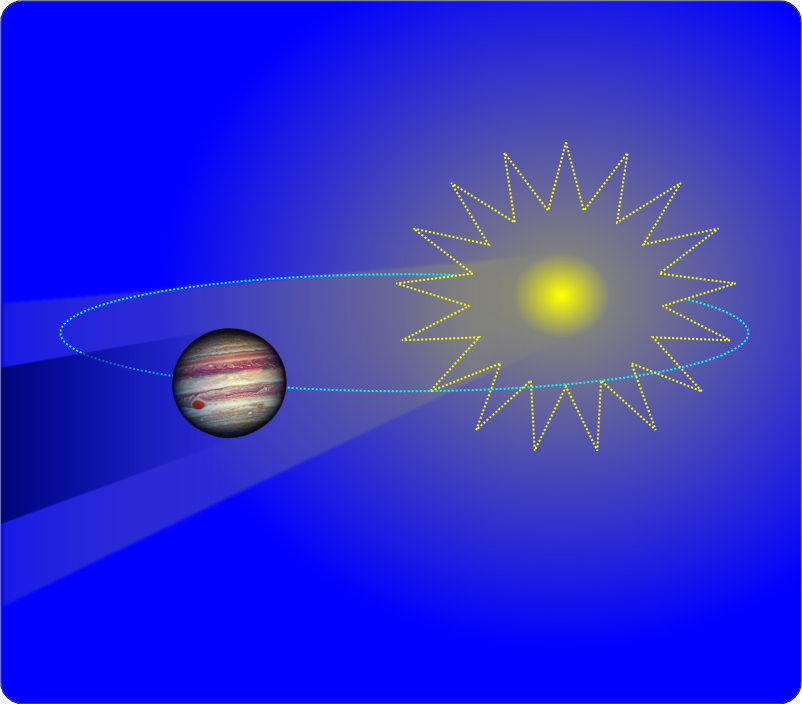
“So here’s where we’re going. We can’t see exoplanets because they’re way too small and too far away, but if an exoplanet transits a star we’re studying, it’ll block some of the light. The question is, how much, and the answer is, not very. Exoplanets block starlight according to their silhouette area. Jupiter’s diameter is about a tenth the Sun’s so it’s area is 1% of the Sun’s. When Jupiter transits the Sun‑‑‑”

“From the viewpoint of some other solar system, of course—”

“Doesn’t matter. Jupiter could get in between the Sun and Saturn; the arithmetic works out the same. The maximum fraction of light Jupiter could block would be its area against the Sun’s area and that’s still 1%.”

“Well, it does matter, because of perspective. If size was the only variable, the Moon is so much smaller than the Sun we’d never see a total eclipse. The star‑planet distance has to be much smaller than the star‑us distance, okay?”

“Alright, but that’s always the way with exoplanets. Even with a big planet and a small star, we don’t expect to measure more than a few percent change. You need really good photometry to even detect that.”

“And really good conditions. Everyone knows how atmospheric turbulence makes star images twinkle—”

“Can’t get 1% accuracy on an image that’s flickering by 50%—”

“And that’s why we had to get stable observatories outside the atmosphere before we could find exoplanets photometrically.”

~~ Rich Olcott
Astrometers Are Wobble-Watchers

letter A Hi, Sy, what’s going on in Cathleen’s seminar?

You were right, Al.
It’s about exoplanets and how to find them.
Jeremy’s pitching astrometry.
That’s about measuring star locations in the sky.
I’ll fill you in later.

“So that’s my cultural colonialism rant, thanks for listening. On to the real presentation. Maria showed us how to look for exoplanets when they wobble along our line of sight. But what if they wobble perpendicular to that? Careful measurement should show that, right? The ancients thought that holy forces had permanently set the positions of all the stars except for the planets so they didn’t measure that close. Tycho Brahe took meticulous measurements with room‑sized instruments—”

<voice from the back> “Room‑sized? What difference does that make?”

“What if I told you that two stars are 3 millimeters apart in the sky?”

<another voice> “How far out’s your ruler? Sky stuff, you need to talk angles because that’s all you got.”

“Well there you go. That’s why Tycho went for maximum angle‑measuring accuracy. He built a sextant with a 5‑foot radius. He used an entire north‑south wall as a quadrant. His primary instrument was an armillary sphere three yards across.”

<first voice again> “Wait, a sphere, like a big bubble? Why north‑south? What’s a quadrant?”

  • I give him a nudge. “He’s just a kid, Mr Feder. Be nice. One question at a time.”
  • “But I got so many!”

“Think about Tycho’s goal. Like astrometers before him, he wanted to build an accurate map of the heavens. Native Americans a thousand years or more ago carved free‑hand star maps on cave ceilings and turtle shells. Tycho followed the Arabic and Chinese quantitative mapping traditions. There’s two ways to do that. One is to measure and map the visual angles between many pairs of stars. That strategy fails quickly because errors accumulate. Four or five steps along the way you’re plotting the same star in two different locations.”

<Feder’s voice again> “There’s a better way?”

“Yessir. Measure and map each star relative to a standard coordinate system. If your system’s a good one, errors tend to average out. The latitude‑longitude system works well for locating places on Earth. Two thousand years ago the Babylonians used something similar for places in the crystal sphere they thought supported the stars above us. Where the equinoctial Sun rose on the horizon was a special direction. Their buildings celebrated it. Starting from that direction the horizontal angle to a star was its longitude. The star’s latitude was its angle up from the horizon towards the zenith straight above. But those map coordinates don’t work for another part of the world. Astrometers needed something better.”

<Feder again> “So what did they do already?”

“They may or may not have believed the Earth itself is round, but they recognized the Pole Star’s steady position that the rest of the sky revolved around. They also noticed that as each month went by the constellations played ring‑a‑rosie in a plane perpendicular to the north‑south axis. Call that the Plane of The Ecliptic. Pick a star, measure its angle away from the Ecliptic and you’ve got an ecliptic latitude. Measure its angle around the Ecliptic away from a reference star and you’ve got a ecliptic longitude. Tycho’s instruments were designed to measure star coordinates. His quadrant was a 90° bronze arc he embedded in that north‑south wall, let him measure a star’s latitude as it crossed his meridian. His ‘Sphere’ was simply a pair of calibrated metal rings on a gimbal mounting so he could point to target and reference stars and measure the angle between them. If his calibration used degree markings they’d be about 25 millimeters apart. His work was the best of his time but the limit of his accuracy was a few dozen arcseconds.”

“Is that bad?”

“It is if you’re looking for exoplanets by watching for stellar wobble. Maria’s Jupiter example showed the Sun wobbling by 1½ million kilometers. I worked this example with a bigger wobble and a star that would be mid‑range for most of our constellations. Best case, we’d see its image jiggling by about 90 microarcseconds. Tycho’s instruments weren’t good enough for wobbles.”

~~ Rich Olcott

The Stars from A Different Viewpoint

“Thank you, Maria, nice job showing us why the Doppler method had such a hard time finding exoplanets. Next up, Jeremy. You’re not going to talk about black holes, are you?”

“No, ma’am, my subject today is astrometry, but that’s useful for both exoplanets and black holes. I have to be careful when I say the word because it sounds so much like astronomy but they’re different things. It helped when I looked the words up. Turns out that ‘astronomy‘ means ‘naming stars‘ but ‘astrometry‘ means ‘measuring‘ them. Not weighing one or any of that, just measuring accurately where that star is in the sky at a certain moment. Everyone on Earth has the sky above. In the days before city life and city lights brought their eyes down, cultures all over the world were doing astronomy and astrometry. Professional astronomers generally use Greek and Arabic names, but that’s Eurocentrism and it got silly.”

<voice from the back> “Like how?”

“The Greeks couldn’t name constellations in the southern hemisphere’s skies because they never saw those stars. Polynesian navigators and Indigenous Australians saw them. Those cultures had their own perfectly good constellations. Did official Astronomy ask any of those people? Of course not, so we’ve got contrived designations like The Microscope and The Air Pump. Some of you know that I’m doing a research project with Professor Begaye to correlate constellations from different cultures. I’ve found some surprises.”

<voice from the back> “Like what?”

“Practically everyone in the northern hemisphere has a special image for the Pole Star and the stars close to it. Europeans picked out Ursa Minor, the Little Bear. For us Navajos the same stars make up The Northern Fire in the sky’s dome like the fire in our traditional domed hogan homes. Staying close to the Northern Fire we see two human figures, a woman and a man. One surprise for me was that the woman’s most prominent stars are the same ones the Greeks chose for Cassiopeia, also a female. The man’s image includes many of the same stars that Europeans call Ursa Major, the Big Bear. Did you know that the word ‘Artic‘ comes from the Greek word ‘arktos‘ which means ‘bear‘? Anyway, further out there’s a winter constellation containing three bright stars in a straight line plus a few more that could be shoulders and knees.”

<voice from the back> “Orion!”

“Mm-hm. We have almost exactly the same constellation. It’s also a hunter, except that the Greeks picture the three stars as his belt and we say it’s the quiver for his arrows. Right in front of the hunter are—”

<voice from the back> “The Pleaides!”

“But for us they’re Dilyehe, the Planting Stars. When they go below the horizon it’s time to plant corn. Which gets me to astrometry. The stars and constellations have always been clocks and calendars for the world’s cultures. Typically they compare the position of the Sun or certain stars with special structures.”

<voice from the back> “Like Stonehenge and the Pyramids!”

“There’s claims and doubts about both of those. People have searched out apparent special locations, like ‘This doorway and that window were placed to show a certain star rising on Midsummers Eve,’ but without explicit markings there’s no way to be sure it wasn’t just accidental. Besides, both structures were built with huge stone blocks, a real challenge to place accurately enough to pick out just one star on one day. We Navajos don’t build structures to track special times. We use mountains.”

<voice from the back> “What, you move mountains around?”

“No, we honor and respect the natural landscape for its beauty. What we do is find the special places that help the mountains and other landmarks tell us what time of year it is. My favorite example is the Double Sunset.”

<voice from the back> “Can’t have two!”

“Yes, you can, if the mountains are sharp and stand close to one another. On the right day of the year, the Sun sets behind one mountain, then peeks for just a minute through the cleft between the two. You just have to know where to stand to see that.”

~ Rich Olcott

Science or Not-science?

Vinnie trundles up to Jeremy’s gelato stand. “I’ll take a Neapolitan, one each chocolate, vanilla and strawberry.”

“Umm… Eddie forgot to order more three-dip cones and I’m all out. I can give you three separate cones or a dish.”

“The dish’ll be fine, way less messy. Hey, Sy, I got a new theory.”

“Mm… Unless you’ve got a lot of firm evidence it can’t be a theory. Could be a conjecture or if it’s really good maybe a hypothesis. What’s your idea?”

“Thing is, Sy, there can’t be any evidence. Ever. That’s the fun of it.”

“Conjecture, then. C’mon, out with it.”

“Well, you remember all that stuff about how time bends toward a black hole’s mass and that’s how gravity works?”

“Sure, except it’s not just black holes. Time bends the same way toward every mass, it’s just more intense with black holes.”

“Understood. Anyway, we talked once about how stars collapse to form black holes but that’s only up to a certain size, I forget what—”

“Ten to fifteen solar masses. Beyond that the collapse goes supernova and doesn’t leave much behind but dust.”

“Right. So you said we don’t know how to make size‑30 black holes like the first pair that LIGO found.”

“We’ve got a slew of hypotheses but the jury’s still out.”

“That’s what I hear. Well, if we don’t even know that much then we for‑sure don’t know how to make the supermassive black hole the science magazines say we’ve got in the middle of the Milky Way.”

“We’ve found that nearly every galaxy has one, some a lot bigger than ours. Why that’s true is one of the biggest mysteries in astrophysics.”

“And I know the answer! What if those supermassive guys started out as just big lumps of dark matter and then they wrapped themselves in more dark matter and everything else?”

“Cute idea, but the astronomy data says we can account for galaxy shapes and behavior if they’re embedded at the center of a spherical halo of dark matter.”

“Not a problem, Sy. Look at the numbers. Our superguy is a size‑4‑million, right? The whole Milky Way’s a billion times heavier than that. Tuck an extra billionth into the middle of the swirl and the stars wouldn’t see the difference.”

“Okay, but there’s more data that says dark matter spreads itself pretty evenly, doesn’t seem to clump up like you need it to.”

“Yeah, but maybe there’s two kinds, one kind clumpy and the other kind not. Only way to find out is to look inside a superguy but time blocks information flow out of there. So no‑one can say I’m wrong!”

“But sir, that’s not science!”

“Why not, kid?”

“The unit my philosophy class did on Popper.”

“The stuff you sniff or the penguins guy?”

“Neither, Karl Popper the philosopher. Dr Crom really likes Popper’s work so we spent a lot of time reading him. Popper was one of the Austrian intellectuals the Nazis chased out when they took power in the 1930s. Popper traveled around, wound up in New Zealand where he wrote his Open Society book that shredded Hegel and Marx. Those sections were fun reading even if they were wordy. Anyway, one of Popper’s big things was the demarcation problem, how to tell the difference between what’s a scientific assertion and what’s not. He decided the best criterion was if there’s a way to prove the assertion false. Not whether it was false but whether it could at least be tested. I was surprised by how many goofy things the Greeks said that would qualify as Popper‑scientific even though they were just made up and have been proven wrong.”

“Well there you go, Vinnie. Physics and the Universe don’t let us see into a supermassive black hole, therefore your idea isn’t testable even in principle. Jeremy’s right, it’s not scientific even though it’s all dressed up in a Science suit.”

“I can still call it a conjecture, though, right, Sy?”

“Conjecture it is. Might even be true, but we’ll never know unless we somehow find out something about dark matter that surprises us. We’ve been surprised a lot, though, so don’t give up hope.”

~~ Rich Olcott

Chocolate, Mint And Notation

“But calculus, Mr Moire. Why do they insist we learn calculus? You said that Newton and Leibniz started it but why did they do it?”

“Scoop me a double-dip chocolate-mint gelato, Jeremy, and I’ll tell you about an infamous quarrel. You named Newton first. I expect most Europeans would name Leibniz first.”

“Here’s your gelato. What does geography have to do with it?”

“Thanks. Mmm, love this combination. Part of the geography thing is international history, part of it is personality and part of it is convenience. England and continental Europe have a history of rivalry in everything from the arts to trade to outright warfare. Each naturally tends to favor its own residents and institutions. Some people say that the British Royal Society was founded to compete with the French philosophical clubs. Maybe England’s king appointed Newton as the society’s President to upgrade the rivalry. Dicey choice. From what I’ve read, Newton’s didn’t hate everybody, he just didn’t like anybody. But somehow he ran that group effectively despite his tendency to go full‑tilt against anyone who disagreed with his views.”

“Leibniz did the same thing on the European side?”

“No, quite the opposite. There was no pre‑existing group for him to head up and he didn’t start one. Instead, he served as a sort of Information Central while working as diplomat and counselor for a series of rulers of various countries. He carried on a lively correspondence with pretty much everyone doing science or philosophy. He kept the world up to date and in the process inserted his own ideas and proposals into the conversation. Unlike Newton, Leibniz was a friendly soul, constantly looking for compromise. Their separate calculus notations are a great example.”

“Huh? Didn’t everyone use the same letters and stuff?”

“The letters, yeah mostly, but the stuff part was a long time coming. What’s calculus about?”

“All I’ve seen so far is proofs and recipes for integrating different function types. Nothing about what it’s about.”

Newton approximates arc ABCDEF.

<sigh> “That’s because you’re being taught by a mathematician. Calculus is about change and how to handle it mathematically. That was a hot topic back in the 1600s and it’s still central to Physics. Newton’s momentum‑acceleration‑force perspective led him to visualize things flowing with time. His Laws of Motion made it easy to calculate straight‑line flows but what to do about curves? His solution was to break the curve into tiny segments he called fluxions. He considered each fluxion to be a microscopic straight line that existed for an infinitesimal time interval. A fluxion’s length was its time interval multiplied by the velocity along it. His algebraic shorthand for ‘per time‘ was to put a dot over whatever letter he was using for distance. Velocity along x was . Acceleration is velocity change per time so he wrote that with a double dot like . His version of calculus amounted to summing fluxion lengths across the total travel time.”

“But that only does time stuff. What about how, say, potential energy adds up across a distance?”

“Excellent question. Newton’s notation wasn’t up to that challenge, but Leibniz developed something better.”

“He copied what Newton was doing and generalized it somehow.”

“Uh, no. Newton claimed Leibniz had done that but Leibniz swore he’d been working entirely independently. Two lines of evidence. First, Newton was notoriously secretive about his work. He held onto his planetary orbit calculations for years before Halley convinced him to publish. Second, Leibniz and other European thinkers came to the problem with a different strategy. Descartes invented Cartesian coordinates a half‑century before. That invention naturally led the Europeans to plot anything against anything. Newton’s fluxions combined tiny amounts of distance and time; Leibniz and company split the two dimensions, one increment along each component. Leibniz tried out a dozen different notations for the increment. After much discussion he finally settled on a simple d. The increment along x is dx, but x could be anything quantitative. dy/dx quantifies y‘s change with x.”

“Ah, the increments are the differentials we see in class. But those all come from limit processes.”

“Leibniz’ d symbol and its powerful multi‑dimensional extensions carry that implication. More poetry.”

~~ Rich Olcott

Wait For It

“So, Jeremy, have I convinced you that there’s poetry in Physics?”

“Not quite, Mr Moire. Symbols can carry implications and equation syntax is like a rhyme scheme, okay, but what about the larger elements we’ve studied like forms and metaphors?”

“Forms? Hoo boy, do we have forms! Books, theses, peer-reviewed papers, conference presentations, poster sessions, seminars, the list goes on and that’s just to show results. Research has forms — theoretical, experimental, and computer simulation which is sort of halfway between. Even within the theory division we have separate forms for solving equations to get mathematically exact solutions, versus perturbation techniques that get there by successive approximations. On the experimental side—”

“I get the picture, Mr Moire. Metaphorically there’s lots of poetry in Physics.”

“Sorry, you’re only partway there. My real point is that Physics is metaphor, a whole cascade of metaphors.”

“Ha, that’s a metaphor!”

“Caught me. But seriously, Science in general and Physics in particular underwent a paradigm shift in Galileo’s era. Before his century, a thousand years of European thought was rooted in Aristotle’s paradigm that centered on analysis and deduction. Thinkers didn’t much care about experiment or observing the physical world. No‑one messed with quantitative observations except for the engineers who had to build things that wouldn’t fall down. Things changed when Tycho Brahe and Galileo launched the use of numbers as metaphors for phenomena.”

“Oh, yeah, Galileo and the Leaning Tower experiment.”

“Which may or may not have happened. Reports differ. Either way, his ‘all things fall at the same speed‘ conclusion was based on many experimental trials where he rolled balls of different material, sizes and weights down a smooth trough and timed each roll.”

“That’d have to be a long trough. I read how he used to count his pulse beats to measure time. One or two seconds would be only one or two beats, not much precision.”

“True, except that he used water as a metaphor for time. His experiments started with a full jug of water piped to flow into an empty basin which he’d weighed beforehand. His laboratory arrangement opened a valve in the water pipe when he released the ball. It shut the valve when the ball crossed a finish line. After calibration, the weight of released water represented the elapsed time, down to a small fraction of a second. Distance divided by time gave him speed and he had his experimental data.”

“Pretty smart.”

“His genius was in devising quantitative challenges to metaphor‑based suppositions. His paradigm of observation, calculation and experimental testing far outlasted the traditionalist factions who tried to suppress his works. Of course that was after a century when Renaissance navigators and cartographers produced maps as metaphors for oceans and continents.”

“Wait, Mr Moire. In English class we learned that a metaphor says something is something else but an analogy is when you treat something like something else. Water standing for time, measurements on a map standing for distances — aren’t those analogies rather than metaphors?”

“Good point. But the distinction gets hazy when things get abstract. Take energy, for example. It’s not an object or even a specific kind of motion like a missile trajectory or an ocean wave. Energy’s a quantity that we measure somewhere somehow and then claim that the same quantity is conserved when it’s converted or transferred somewhere else. That’s not an analogy, it’s a metaphor for a whole parade of ways that energy can be stored or manifested. Thermodynamics and quantum mechanics depend on that metaphor. You can’t do much anywhere in Physics without paying some attention to it. People worry about that, though.”

“Why’s that?”

“We don’t really understand why energy and our other fundamental metaphors work as well as they do. No metaphor is perfect, there are always discrepancies, but Physics turns out to be amazingly exact. Chemistry equations balance to within the accuracy of their measuring equipment. Biology’s too complex to mathematize but they’re making progress. Nobel Prize winner Eugene Wigner once wrote a paper entitled, ‘The Unreasonable Effectiveness of Mathematics in The Natural Sciences.’ It’s a concern.”

“Well, after all that, there’s only one thing to say. If you’re in Physics, metaphors be with you.”

~~ Rich Olcott

Making Things Simpler

“How about a pumpkin spice gelato, Mr Moire?”

“I don’t think so, Jeremy. I’m a traditionalist. A double‑dip of pistachio, please.”

“Coming right up, sir. By the way, I’ve been thinking about the Math poetry you find in the circular and hyperbolic functions. How about what you’d call Physics poetry?”

“Sure. Starting small, Physics has symmetries for rhymes. If you can pivot an experiment or system through some angle and get the same result, that’s rotational symmetry. If you can flip it right‑to‑left that’s parity symmetry. I think of a symmetry as like putting the same sound at the end of each line in rhymed verse. Physicists have identified dozens of symmetries, some extremely abstract and some fundamental to how we understand the Universe. Our quantum theory for electrons in atoms is based on the symmetries of a sphere. Without those symmetries we wouldn’t be able to use Schrodinger’s equation to understand how atoms work.”

“Symmetries as rhymes … okaaayy. What else?”

“You mentioned the importance of word choice in poetry. For the Physics equivalent I’d point to notation. You’ve heard about the battle between Newton and Leibniz about who invented calculus. In the long run the algebraic techniques that Leibniz developed prevailed over Newton’s geometric ones because Leibniz’ way of writing math was far simpler to read, write and manipulate — better word choice. Trying to read Newton’s Principia is painful, in large part because Euler hadn’t yet invented the streamlined algebraic syntax we use today. Newton’s work could have gone faster and deeper if he’d been able to communicate with Euler‑style equations instead of full sentences.”

“Oiler‑style?”

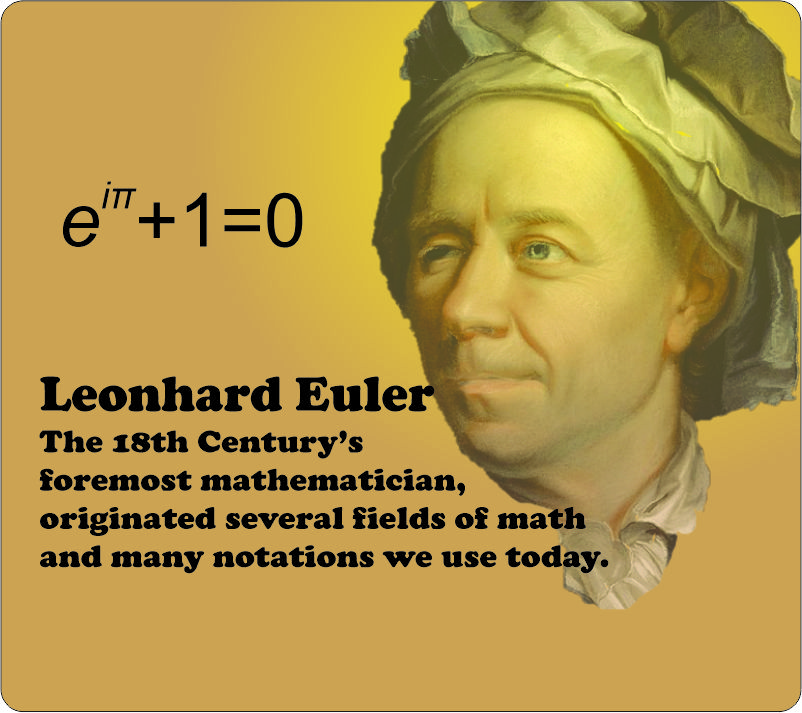
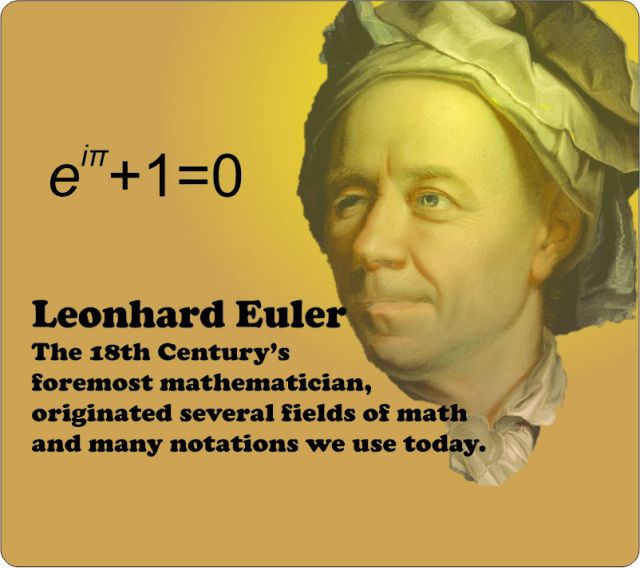
“Leonhard Euler, though it’s pronounced like ‘oiler‘. Europe’s foremost mathematician of the 18th Century. Much better at math than he was at engineering or court politics — both the Russian and Austrian royal courts supported him but they decided the best place for him was the classroom and his study. But while he was in there he worked like a fiend. There was a period when he produced more mathematics literature than all the rest of Europe. Descartes outright rejected numbers involving ‑1, labeled them ‘imaginary.’ Euler considered ‑1 a constant like any other, gave it the letter i and proceeded to build entire branches of math based upon it. Poor guy’s vision started failing in his early 30s — I’ve often wondered whether he developed efficient notational conventions as a defense so he could see more meaning at a glance.”

“He invented all those weird squiggles in Math and Physics books that aren’t even Roman or Greek letters?”

“Nowhere near all of them, but some important ones he did and he pointed the way for other innovators to follow. A good symbol has a well‑defined meaning, but it carries a load of associations just like words do. They lurk in the back of your mind when you see it. π makes you think of circles and repetitive function like sine waves, right? There’s a fancy capital‑R for ‘the set of all real numbers‘ and a fancy capital‑Z for ‘the set of all integers.’ The first set is infinitely larger than the second one. Each symbol carries implications abut what kind of logic is valid nearby and what to be suspicious of. Depends on context, of course. Little‑c could be either speed‑of‑light or a triangle’s hypotenuse so defining and using notation properly is important. Once you know a symbol’s precise meaning, reading an equation is much like reading a poem whose author used exactly the right words.”

“Those implications help squeeze a lot of meaning into not much space. That’s the compactness I like in a good poem.”

“It’s been said that a good notation can drive as much progress in Physics as a good experiment. I’m not sure that’s true but it certainly helps. Much of my Physics thinking is symbol manipulation. Give me precise and powerful symbols and I can reach precise and powerful conclusions. Einstein turned Physics upside down when he wrote the thirteen symbols his General Relativity Field Equation use. In his incredibly compact notation that string of symbols summarizes sixteen interconnected equations relating mass‑energy’s distribution to distorted spacetime and vice‑versa. Beautiful.”

“Beautiful, maybe, but cryptic.”

~~ Rich Olcott

Math Poetry

Eddie serves a good pizza. I amble over to the gelato stand for a chaser. “Evening, Jeremy. You’re looking a little distraught.”

“I am, Mr Moire. Just don’t ask me to quantify it! Math is getting me down. Why do they shove so much of it at us? You don’t put much math into your posts and they make sense mostly.”

“Thanks for the mostly. … Do you enjoy poetry?”

“Once I read some poems I liked. Except in English class. They spend too much time classifying genre and rhyme scheme instead of just looking at what the poet wrote. All that gets in the way.”

“Interesting. What is it that you like about poetry?”

“Mmm, part of it is how it can imply things without really saying them, part of it is how compact a really good one is. I like when they cram the maximum impact into the fewest possible words — take out one word and the whole thing falls apart. That’s awesome when it works.”

“Well, how does it work?”

“Oh, there’s lots of techniques. Metaphor’s a biggie — making one thing stand for something else. Word choice, too — an unexpected word or one with several meanings. Sometimes it’s a challenge finding the word that has just the right rhythm and message.”

“Ah, you write, too. When you compose something, do you use English or Navajo?”

“Whichever fits my thought better. Each language is better at some things, worse at others. A couple of times I’ve used both together even though only rez kids would understand the mix.”

“Makes sense. You realize, of course, that we’ve got a metaphor going here.”

“We do? What standing for what?”

“Science and Poetry. I’ve often said that Physics is poetry with numbers. Math is as much a language as English and Navajo. It has its own written and spoken forms just like they do and people do poetry with it. Like them, it’s precise in some domains and completely unable to handle others. Leaning math is like learning a very old language that’s had time to acquire new words and concepts. No wonder learning it is a struggle.”

“Poetry in math? That’s a stretch, Mr Moire.”

“Prettiest example I can think of quickly is rhyming between the circular and hyperbolic trigonometric systems. The circular system’s based on the sine and cosine. The tangent and such are all built from them.”

“We had those in class — I’ll remember ‘opposite over hypotenuse‘ forever and I got confused by all the formulas — but why do you call them circular and what’s ‘hyperbolic‘ about?”

“Here, let me use Ole Reliable to show you some pictures. I’m sure you recognize the wavy sine and cosine graphs in the circular system. The hyperbolic system is also based on two functions, ‘hyperbolic sine‘ and ‘hyperbolic cosine,’ known in the trade as ‘sinh‘ and ‘cosh.’ They don’t look very similar to the other set, do they?”

“Sure don’t.”

“But for every circular function and formula there’s a hyperbolic partner. Now watch what happens when we combine a sine and cosine. I’ll do it two ways, a simple sum and the Pythagorean sum.”

“Pythagorean?”

“Remember his a2+b2=c2? The orange curve comes from that, see in the legend underneath?”

“Oh, like a right triangle’s hypotenuse. But the orange curve is just a flat straight line.”

“True, as we’ve known since Euler’s day. Are you familiar with polar coordinates?”

“A little. There’s a center, one coordinate is distance from the center, and the other coordinate is the angle you’ve rotated something, right?”

“Good enough. Here’s what the same two combinations look like in polar coordinates..”

“Wow. Two circles. I never would have guessed that.”

“Mm-hm. Check the orange circle, the one that was just a level straight line on the simple graph. It’s centered on the origin. That tells us the sum of the squares is invariant, doesn’t change with the angle.”

“Do the hyperbolic thingies make hyperbolas when you add them that way?”

“Not really, just up-curving lines. The plots for their differences are interesting though. For these guys the Pythagorean difference is invariant. Einstein’s relativity is based on that property.”

“Pretty, like you say.”

~~ Rich Olcott

In vacuo veritas?

“Let’s see if my notes are complete, Mr Moire. We’re crossed off two possible Universe finales — falling into a Big Crunch or expanding forever while making new matter between the galaxies to keep itself in a steady state. Or the Universe might expand to some critical density and then stay there but we mostly ruled that out because a twitch would push it to either crunching or expanding forever. Einstein’s Cosmological Constant might or might not be dark energy but either way, Friedmann’s equation predicts that the Universe will expand exponentially. Is that all the ways we could end?”

“Of course not, Jeremy. The far distant future’s like anything we humans don’t know much about, we make lots of guesses. Vacuum energy, for instance.”

“Anything to do with getting my roommate off the couch when it’s their turn to do the floors?”

“Very funny, but no. The notion of ‘vacuum‘ has a history. Aristotle said it’s empty space and that’s nothing and you can’t talk about nothing, but of course that’s exactly what he was doing. It wasn’t until Newton’s day that we developed dependable technologies for producing and investigating ‘nothing.’ Turns out that a good vacuum’s hard to find and even outer space is a lot busier than you might think.”

“Yeah, Jim in the Physics lab says he’s working with Ultra‑High Vacuum, a millionth of a millionth of an atmosphere, and the molecules left in the apparatus still cause problems.”

“Wonder how many molecules that is. Time for Old Reliable. <muttering> Avagadro’s Number, 22.4 liters, 10-12 atmospheres … Wow, there’s nearly 30 billion molecules per liter in his rig, a couple hundred times more if he chills it. <scrolling> This Wikipedia article says the solar wind runs only ten thousand protons per liter; interstellar medium’s about a tenth of that. But all those are physical vacuums. Theoretical vacuums are completely empty except they’re sort‑of not.”

“How could they be empty but not? Is that a Schrödinger joke?”

“No, but it does point up how the word has acquired multiple technical meanings. Newton’s concept of a vacuum was basically equivalent to Aristotle’s — simply a space with no matter in it. Two centuries later, Maxwell pointed the way to electric and magnetic fields which meant we needed to define a new vacuum with no such fields. Einstein added his proviso about the speed of light in a vacuum but that was okay. Then along came quantum and strings and several new kinds of vacuum.”

“Why would we need new definitions? Nothing’s nothing, isn’t it?”

“Not necessarily in theory, and that’s the point. For instance, you might use a Maxwell‑inspired theory to think about how a certain charged object behaves in a certain electromagnetic field. You can’t isolate the field’s effects unless you can add it to a theoretical space containing no objects or electromagnetic fields. Make sense?”

“And that’s a Maxwell vacuum? Seems reasonable. Then what?”

“Quantum theories go in the other direction. They start by assuming that Maxwellian vacuums can’t exist, that space itself continually produces virtual particles from their associated fields.”

“Um, conservation of mass?”

“Valid question. This may feel like dodging, but there’s math and experiment to back it up. What’s really conserved, we think, is mass‑energy. Particles, anti‑particles and energy fluctuations averaging to zero over finite time intervals. A dab of energy concentrated to create a particle’s mass? No problem, because that particle will be annihilated and release its energy equivalent almost immediately. To replace the Maxwellian vacuum, quantum theorists co‑opted the word to refer to a system’s lowest possible quantum state or maybe the lowest possible set of states, depending on which kind of calculation is underway. The cosmology people picked up that notion and that’s when the doom‑saying started.”

“Awright, now we’re getting somewhere. What’s their vacuum like?”

“From what I’ve seen, a tall stack of ‘if‘s and hand‑waving. The idea is that our Universe may not be in the lowest possible quantum state and if so, sometime in the next 188 billion years we could suddenly drop from false to true vacuum, in which case everything goes haywire. I’m not convinced that the Universe even has a quantum state. Don’t panic.”

~~ Rich Olcott

Generation(s) of Stars

“How’re we gonna tell, Mr Moire?”

“Tell what, Jeremy?”

“Those two expanding Universe scenarios. How do we find out whether it’s gonna be the Big Rip or the Big Chill?”

“The Solar System will be recycled long before we’d have firm evidence either way. The weak dark energy we have now is most effective at separating things that are already at a distance. In the Big Rip’s script a brawnier dark energy would show itself first by loosening the gravitational bonds at the largest scale. Galaxies would begin scattering into the voids between the multi‑galactic sheets and filaments we’ve been mapping. Only later would the galaxies themselves release their stars to wander off and dissolve when dark energy gets strong enough to overcome electromagnetism.”

“How soon will we see those things happen?”

“If they happen. Plan on 188 billion years or so, depending on how fast dark energy strengthens. The Rip itself would take about 2 billion years, start to finish. Remember, our Sun will go nova in only five billion years so even the Rip scenario is far, far future. I prefer the slower Chill story where the Cosmological Constant stays constant or at least the w parameter stays on the positive side of minus‑one. Weak dark energy doesn’t mess with large gravitationally‑bound structures. It simply pushes them apart. One by one galaxies and galaxy clusters will disappear beyond the Hubble horizon until our galaxy is the only one in sight. I take comfort in the fact that our observations so far put w so close to minus‑one that we can’t tell if it’s above or below.”

“Why’s that?”

“The closer (w+1) approaches zero, the longer the timeline before we’re alone. We’ll have more time for our stars to complete their life cycles and give rise to new generations of stars.”

“New generations of stars? Wow. Oh, that’s what you meant when you said our Solar System would be recycled.”

“Mm-hm. Think about it. Back when atoms first coalesced after the Big Bang, they were all either hydrogen or helium with just a smidgeon of lithium for flavor. Where did all the other elements come from? Friedmann’s student George Gamow figured that out, along with lots of other stuff. Fascinating guy, interested in just about everything and good at much of it. Born in Odessa USSR, he and his wife tried twice to defect to the West by kayak. They finally made it in 1933 by leveraging his invitation to Brussels and the Solvay Conference on Physics where Einstein and Bohr had their second big debate. By that time Gamow had produced his ‘liquid drop‘ theory of how heavy atomic nuclei decay by spitting out alpha particles and electrons. He built on that theory to explain how stars serve as breeder reactors.”

“I thought breeder reactors are for turning uranium into plutonium for bombs. Did he have anything to do with that?”

“By the start of the war he was a US citizen as well as a top-flight nuclear theorist but they kept him away from the Manhattan Project. That undoubtedly was because of his Soviet background. During the war years he taught university physics, consulted for the Navy, and thought about how stars work. His atom decay work showed that alpha particles could escape from a nucleus by a process a little like water molecules in a droplet bypassing the droplet’s surface tension. For atoms deep inside the Sun, he suggested that his droplet process could work in reverse. He calculated the temperatures and pressures it would take for gravity to force alpha particles or electrons into different kinds of nuclei. The amazing thing was, his calculations worked.”

“Wait — alpha particles? Where’d they come from if the early stars were just hydrogen and helium?”

“An alpha particle is just a helium atom with the electrons stripped off. Anyway, with Gamow leading the way astrophysicists figured out how much of which elements a given star would create by the time it went nova. Those elements became part of the gas‑dust mix that coalesces to become the next generation of stars. We may have gone through 100 such cycles so far.”

“A hundred generations of stars. Wow.”

~~ Rich Olcott