The Bad, Sad, Rad Red Dot

“Was it just my imagination, Kareem, or was there some side action going on in that Africa‑Eurasia nutcracker video?”

“Always the trained observer, eh, Sy? You’re right, India had an interesting life in the same era. Here, let me bring up another Gplates video on Old Reliable. I need to show both sides of the world so I’ll switch from orthographic to Mollweide projection. Aannd I don’t need to go quite as far back, only to about 120 million years. Mmm, yeah, I’ll squeeze in some special markings, give me a sec… There. This slick enough for you?”

India’s 120-million-year journey
rendered using the GPlates system
and configuration data from Müller, et al., 2019, doi.org/10.1029/2018TC005462

“Busy, indeed. Care to read out what‑all is happening?”

“Sure. The big thing, of course, is the new ocean opening up around the Mid-Atlantic Rift. Further south, by 120 million years ago Gondwanaland had already calved off South America and Africa so all it had left was Madagascar, India, Australia and the Antarctic.”

“Somehow I’d always thought that Madagascar was tied to southern Africa, but I guess not.”

“Hasn’t been for 175 million years, and back then it was up level with where Kenya and Somalia are now. OK, what caught your eye east of Africa was India zoomin’ on up there three times faster than South America was drifting away from Africa. What I’ve done here, I locked the display onto Antarctica so everything’s moving relative to that even though Antarctica wandered around a bit, too. Then I marked a spot in central India, dialed back to 120 million years ago and started scanning forward by three‑million-year increments. At each step I put an orange dot over my marked spot. The dot sequence shows the subcontinent’s motion up to today. You can see it’s not a straight line and the points aren’t evenly spaced.”

“The uneven spacing and wiggly line say that India didn’t move at constant velocity.”

“Spoken like a true physicist.”

“And like any physicist who sees a velocity change I wonder about the forces that make that happen. That red dot, for instance, why did it break the pattern?”

“The red dot is special because it marks 66 million years ago. Does that date ring a bell with you?”

“Umm … Ah-hah! That was the meteor that killed off the dinosaurs, right?”

“The Chicxulub impactor had a lot to do with it, but that wasn’t the whole story. The dot is already far ahead of where it should have been considering India’s previous vector. Something happened that sped that plate along a good three million years before the meteor hit. We’re pretty sure the something was related to massive continental volcanic activity on India just south of where my dots are. The lava covered half the continent, six hundred thousand square miles. All that molten discharge undoubtedly came along with toxic gases that would have fouled the planet’s atmosphere and troubled the dinosaurs and everything else trying to breathe,”

“And what caused the volcanoes?”

“Really bad luck. There’s an active hotspot, we call it Réunion after the French island that’s on top of it at the moment. India just happened to pass right over the hotspot between 69 and 63 million years ago. The spot’s rising magma punched through the subcontinent’s bedrock, ran all over the place and maybe lubricated the passage. Then along comes the meteor when India’s only halfway across the hotspot. The asteroid doesn’t hit India but where it hits is almost as bad — just off the Mexican coast, almost exactly on the other side of the planet from where India is at the time. Imagine a massive ring of violent earthquakes sweeping around the Earth’s surface and coming to a focus smack in the middle of the volcanoes. That’s my shooting red line, except the shakers really come at India from every direction. The magma outflow rate doubles. Altogether, the discharge finally lays over 1015 metric tons of lava on top of poor India and whatever’s living there at the time.”

“Wow. Talk about your perfect storm.”

“The only good thing to come out of it is all the minerals in the magma left India with incredibly fertile soil.”

“That’s something.”

~~ Rich Olcott
Ka-RUNCH!

“Kareem, will you ever actually tell me what’s going on with the volcanoes in Italy and Greece and Turkey? And do it quick, I gotta start getting ready for the lunch trade.”

“Eddie, you’re the one who keeps asking the side questions. Sy, I see you’re carrying Old Reliable.”

“I always travel ready for action, Kareem.”

“You got the GPlates system loaded in there? It’s a go‑to tool in our Geophysics lab.”

“Matter of fact, I do, but I’ve not had time to start playing with it. Here, show us what it can do.”

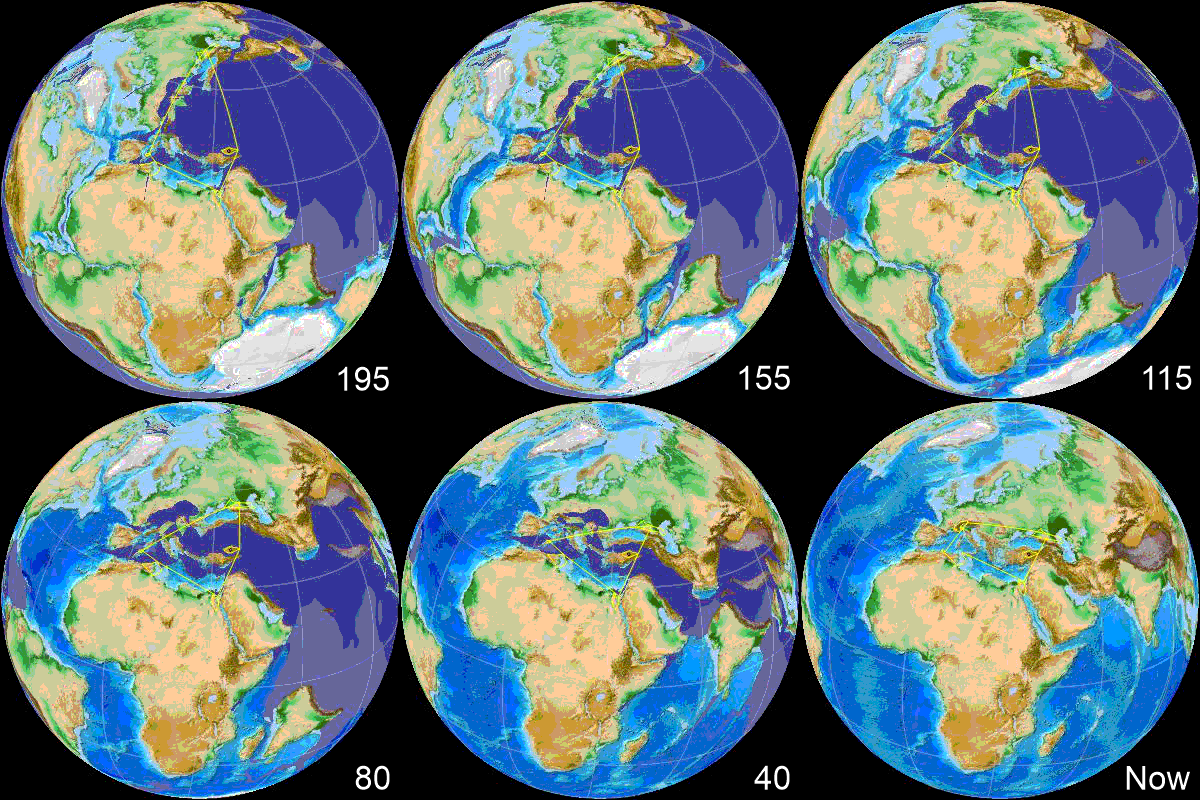
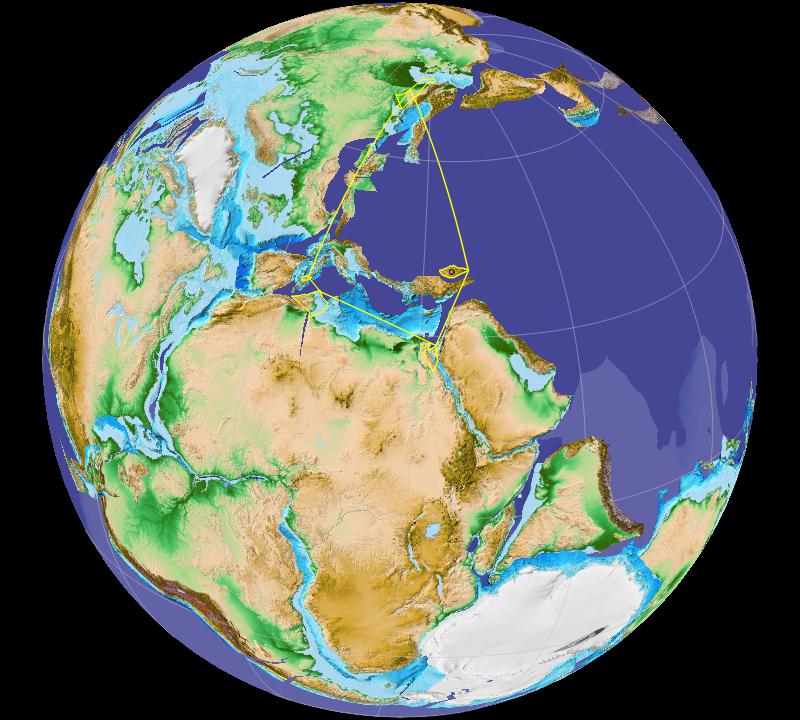
“I’ve got a particular display in mind, give me a minute. <busy‑fingers pause> There. What you’re looking at is Planet Earth as we think it was 195 million years ago.”

“Is that Pangaea?”
 ”Is that Pangaea?”

“Sure is. Most of Earth’s high‑silica slag had sutured together in one big supercontinent that stretched from pole to pole.”

“What’s on Earth’s other side?”

“Mostly a huge ocean, which is why I colored it flat blue. There were probably seamounts and rifts and stuff scattered around the seabottom but all that high‑density low‑silica structure is long gone, shoved below by the continents that rode over it. This is a snapshot at the time when Pangaea was just beginning to come apart — you can see where South America is ripping away from Africa at their southern juncture, and North America’s just started to move off to the west.”

“What’s the difference between the light blue and the darker blue?”

“Good eyes, Eddie, and it’s important. The light blue is the continental shelf.”

“It’s not part of the continent?”

“Oh, it is. The shelf’s the flooded margin, partly ancient consolidated rock and partly sediments that have washed down over the ages. There’s usually a steepish drop‑off from the shelf down to the abyssal bottoms. My hero Wegener is the guy who realized that when you’re putting the jigsaw puzzle together, the shelf is the border you need to pay attention to.”

“What’s the yellow-line kite shape?”

“It ties together some points that’ll help answer Eddie’s Italy‑Greece‑Turkey question. Let me put the video in motion…”

Earth from 195 million years ago to the present
rendered using the GPlates system
and configuration data from Müller, et al., 2019, doi.org/10.1029/2018TC005462

“I see you’ve got Africa in the center instead of the usual New World axis.”

“Why not? Anyway it’s convenient for Eddie’s volcanoes. See that fragment at the kite’s eastern corner? I marked it with dark circle. Watch what happened to it about 55 million years ago, and where it went after that.”

“It banged into what’s gonna be Turkey!”

“Mm-hm, and the land crinkled up and that’s the origin of Turkey’s volcano belt that I’ve marked purple. GPlates calls that chunk the Kirsehir plate. No connection with the vulcanism further west.”

“Wait. That little thing is a plate?”

“The definition depends on who you’re talking to and what about. Officially we’ve got cratons, major plates, minor plates, microplates and terranes, but there’s fuzzy lines between them. GPlates ‘plate’ list contains about a thousand chunks that have moved around independently and are big enough to pay attention to.”

“I can see why you called it the Africa‑Eurasia nutcracker, Kareem. It crunches right down on that continental shelf north of Africa.”

“That’s the planet’s oldest bit of seafloor, Sy, maybe 300 million years old, half again older than anywhere else. Maybe the rock got brittle with age, but the collision region’s faults and folds are incredibly complex.”

“It’s a hot mess, HAW!”

“Can’t say you’re wrong, Eddie. Anyway, south and west of Turkey there’s a whole series of trenches where north‑bound seafloor crust dives under south‑bound structures. The sunken material melts, puffs up and pushes up against what’s above it. All of that leaves beaucoodles of weak spots for magma to leak upwards and you get volcanoes throughout the red‑marked area.”

“One thing I get from this, Eddie, is that it’s not one long arc from Italy through Turkey. Kareem’s pointed out two different formation periods, 50 million years apart.”

“I get that, too, Sy. It’s amazing what you can see when you look close.”

“And when hundreds of researchers gather data over two centuries.”

“Thanks, Kareem. Gotta go.”

~~ Rich Olcott

The Tale of The Stripes

“Wait, Kareem, Eurasia and Africa acting like a nutcracker? I thought Africa is moving straight east, away from the Mid‑Atlantic Ridge.”

“Uh-uh, Sy, everything seems to be swinging around eastern Turkey, Africa going northeast—”

“Africa’s moving? How does anybody know that? How does this ‘continental drift‘ even work?”

“Eddie, those are the questions that messed up Alfred Wegener’s reputation.”

<Eddie settles back in his seat> “I can see this is gonna go on for a while.”

“A little bit. Don’t go throwing shade at my man Wegener, Sy. He wrote the standard textbook in meteorology. He was honored as a pioneer in polar weather studies. He even died saving other people during a polar expedition. His book Origins of The Continents And The Oceans went through four editions so it’s not like his proposals were ignored. The old-line geologists weren’t happy because he used evidence from outside their field and besides, they didn’t believe there was a power source big enough to move continents.”

“Evidence from outside the field?!! The nerve!”

“Nuts, huh? Like, <putting up fingers> Meteorology — glacier tracks from what are now tropical areas. Paleontology — fossils of animal and plant species found on multiple continents that are far apart today. Cartography — everyone who’s seen a world map has picked up on how South America almost fits into Africa’s west coast. Wegener showed that the fit’s much better when you work with the continental shelves. Better yet, he showed how all the major land masses could fit together that way into one big supercontinent.”

“Pangaea!”
 ”Pangaea!”

“Right, except being German he called it der Urkontinent, meaning the original continent. In his day there were well‑documented geological surveys that matched layers and faults between the North American Appalachians and the Caledonian formations in Scotland and Norway. Not even those forced the geologists to buy in until oceanographers in the 1950s came up with new kinds of evidence that sealed the case. Poor Wegener was 25 years dead by then.”

<Eddie sits up in his seat> “OK, everything moves, but how do you know what direction?”

“Magnetic measurements are a prime data source. When magma exits a volcano, its magnetic atoms like iron tend to align with Earth’s magnetic field and get locked that way when the magma freezes to become lava. Measure the magnetism of a good lava field, you know which way was north at the time of eruption. If it’s a continental lava field you can even grab rocks and assay their radioisotopes to date the field. Do that with two related fields and you can work out where the mass was going at the time and how fast it was getting there.”

<Eddie sits forward in his seat> “So what’s the answer to the geologists’ biggest gripe?”

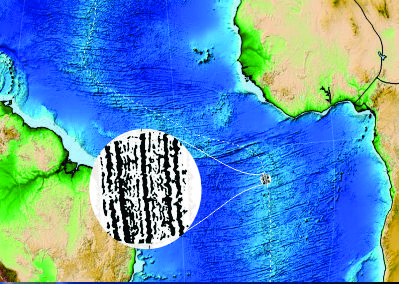
“The power source? We didn’t have a clue until those 1950s oceanographics guys started mapping magnetic fields and comparing them with improved sonar maps of the ocean bottom. We’d long known about seamounts in the middle of the Atlantic, but sonar scans revealed they’re links in a continuous 10000‑mile chain centered on a broad ridge. It’s almost a single 10000‑mile‑long volcano. Meanwhile, magnetometer scans showed a strong signal right over the chain, just as you’d expect for a lava field. What researchers didn’t expect was two parallel sets of magnetic stripes on either side of the ridge. The stripes march all the way to the coasts on either side. That explained everything, almost.”

“Not to me, it doesn’t”

“Oh, I forgot to mention that we already had evidence from continental lava fields that Earth’s magnetic field flips every half‑million years about, and no, we don’t know why that happens, that’s the ‘almost.’ Anyway, each stripe echoes the field direction at the time it froze to make fresh seafloor. Each flip starts a new pair of stripes sliding away. It all fits a model assuming that below the seafloor there’s a 10000‑mile‑long roll of rising magma in the upper mantle. The rolling pushes up to create the ridge, which cracks open at the center to create the volcanoes. Meanwhile the magma diverges to either side and pushes the Americas apart from Africa and Europe.”

“But what about Italy and Greece?”

~~ Rich Olcott

Just Floating Along

Eddie gets impatient. “OK, I get why volcanoes don’t spit metal, but why do they line up like we got across Italy, Greece and Turkey?”

Kareem gets repetitive. “Like I said, tectonics.”

“Sounds like a brand name for fancy fizzy water. What’s that really?”

“Directly it’s a reference to mountain‑building. Really it’s about everything that happens when the continents move around. That starts with light things floating on top of dense things, like a planet’s rocky material floating on the core.”

“Wait, rocks are heavy. Why should they float on anything?”

“Depends on the rock. Pumice floats on water, but it cheats because it’s loaded with bubbles. Most rocks don’t have bubbles, though. I think of them as compact silicon dioxide structures with an optional sprinkling of metal ions. A silicon atom weighs twice as much as an oxygen, but single iron and nickel atoms weigh nearly as much as an entire SiO2 unit. When everything’s all molten, like back when the proto‑planet was being pelted with millions of asteroids and stuff, atoms can move around and dense ones tend to move downward. Light atoms in the way get shoved towards the surface. Geologists call the process differentiation. Anyway, what you wind up with is a hot core of iron, nickel and other heavy atoms. The core’s surrounded by coats of lighter atoms, mostly silicon and oxygen because those were the most common atoms in the gas cloud we started with.”

“Not hydrogen?”

“Hydrogen was there originally, Sy, but many geologists think that the metal‑silicate mishmash was so hot that most hydrogen atoms shot from the mix beyond escape velocity and just sped off. Solar radiation drove them out to where the gas‑giant planets could capture them. The same geologists think the hydrogen we have now came later, as H2O from incoming comets. There’s a lot of argument on the whole issue.”

“That’s all good, Kareem, but when does the tectonics happen?”

“About 4 billion years ago, Eddie, when the asteroid bombardment tapered off. That shut down a major heat energy source so things started to cool off. Each layer cooled off at a different rate. The silica‑rich slag that rose to the surface radiated heat directly to the Universe and formed a solid crust. Meanwhile the metal‑rich layers inside stayed fluid but contracted.”

“Wait, if the inside shrinks but the outside’s a solid it’d crinkle up like a grape going raisin.”

“Absolutely, and some of us think that’s what happened with Mars and maybe Pluto. That crinkle‑up kind of mountain building is called ‘thrust tectonics.’ There’s evidence that Mars now has a ‘tight cap’ structure with a continuous crust that completely envelops the planet. Along with volcanoes and meteor craters, thrust tectonism seems to have been a major landscape driver there.”

“If there’s a tight cap, there ought to be a loose cap.”

“There is, Sy, and we’re standing on it. About 30% of Earth’s surface is continental crust, high in silica and light metals like aluminum. The other 70% is oceanic crust, which is much thinner. It’s also denser because it’s richer in heavier metals like iron. Some people like the theory that Earth once had a tight‑cap crust of continental material, but a catastrophic collision tore off most of it and gave us the Moon. Anyhow, what continental crust we have is in pieces that are loose enough to wander across the surface.”

“This is starting to sound familiar. I bet they bump into each other, right?”

“On-target, Eddie. The big pieces are called plates. The study of ‘plate tectonics‘ is about the ways they collide.”

“Wait, they got different ways to collide?”

“Oh, yes. The simple case is an equal‑density collision, like north-bound India crashing into Asia. The edges of the plates crinkle up to make mountain chains like the Himalayas. More interesting things happen in a different‑density collision. The low‑density continental crust rides up over the high‑density oceanic crust, drives it down into the hot interior where it melts and rises up, burrowing through anything above it to make—”

“Volcanoes! And my Italy‑Greece‑Turkey line—”

“Is probably the leading edge of what may be the planet’s oldest ocean crust, squeezed in by the Eurasia‑Africa nutcracker.”

~~ Rich Olcott

An Italianate Mantle Piece

Eddie has set out some tables in the Acme Building’s atrium in front of his pizza place. Mid‑morning as I walk by he’s sitting at one of them, reading a newspaper. “Morning, Eddie. Ready for walk‑in customers now that things are opening up?”

“I sure hope so, Sy. The building’s still half‑empty ’cause of the work‑from‑homers but I got hopes thanks to folks like you comin’ in.”

“I’ll drop down for lunch later. Don’t see many actual print newspapers these days. What’s in there?”

“Oh, this is the weekly from my cousin in Catania. Etna’s acting up again, as usual.”

“Catania?”

“City on the southeast coast of Sicily, about 20 miles away from the volcano. Even with the earthquakes and eruptions Catania’s almost 3000 years old. Funny, in Italy we got Etna and Vesuvius and Stromboli, Greece has Santorini and Methana, there’s a whole bunch strung out through Turkey — wonder why they all line up like that.”

A new voice behind me, but somehow familiar. “Tectonics.”

I turn. It’s the fellow with the dinosaur theory. “Hello, there. I thought you were a paleontologist.”

“Nah, I prefer really old rocks. The Paleontology course was part of my Geology program. You’re Cathleen’s friend Sy, aren’t you?”

“Guilty as charged. If I recall correctly, you’re Kareem who won the Ceremonial Broom?”

“Guilty as charged.”

“Will you guys quit playing games and just answer the question? What’s with those volcanoes?”

“Sorry, Eddie. You know about continental drift, right, that the continents are big slabs that float on top of the Earth’s molten‑metal insides?”

“Sort of, Kareem. Which brings up another question. If the layer underneath is molten metal, how come the volcanoes spit rock instead of metal? Anyway, how do we know it’s not rock all the way down?”

“Go easy on the guy, Eddie, you’re up to three questions already. Let him catch a breath.”

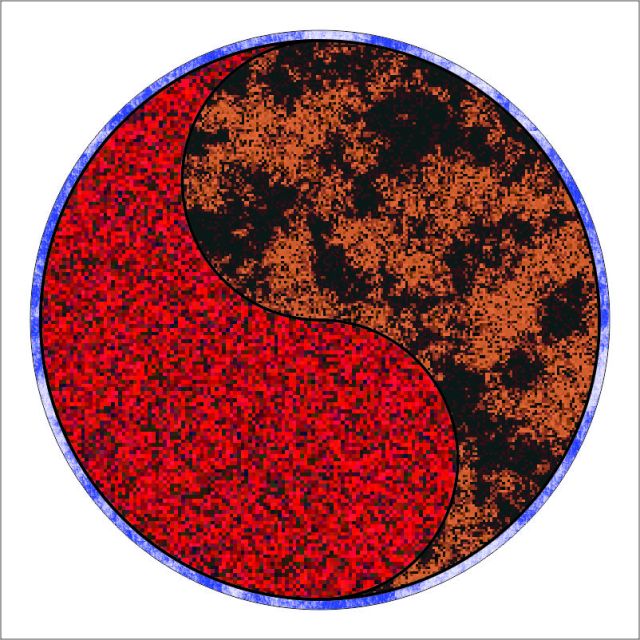
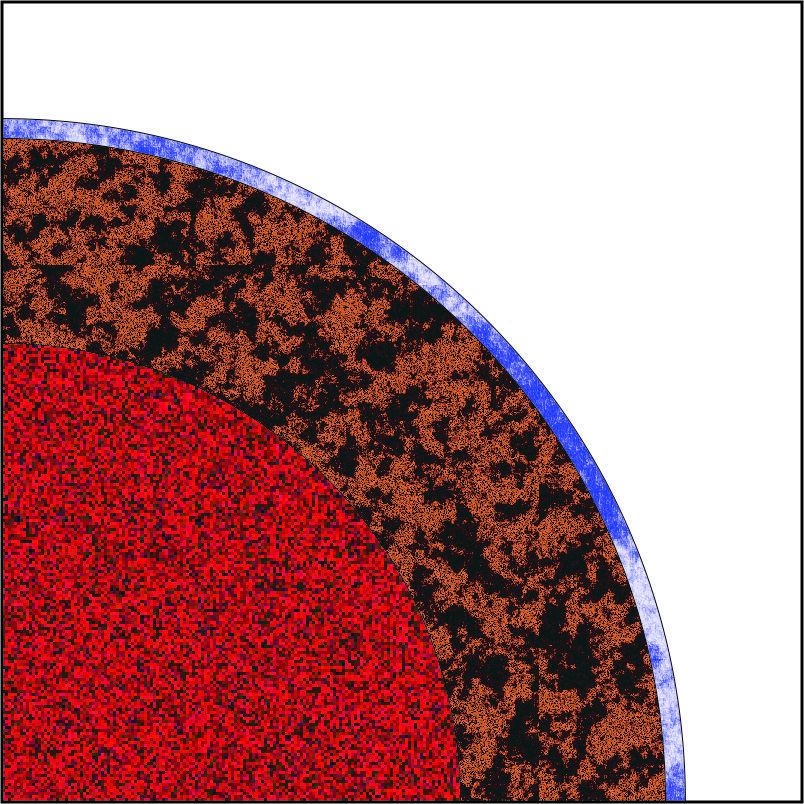
“Thanks, Sy. Last one first — we get a planet’s density from its size and orbit. For Earth it’s about 5.5 megagrams per cubic meter. For comparison, silicate rocks at the surface cluster around 2.7 and iron runs 7.9. Earth is just too heavy to be rock all the way down.”

“Those numbers put Earth almost exactly half-way between rock and iron. That tells me that half the planet’s mass is rocky. Surely the crust isn’t really that thick.”

“You might be surprised, Sy. Remember, volume goes up as the cube of the radius so it doesn’t take much crust thickness to make a large volume. Mind if I use a paper napkin, Eddie?”

“Nah, go ahead.”

“OK, here’s a really simplistic model. Suppose there’s just two layers, core and silicates, and density within each is uniform which means that mass is strictly proportional to volume times density. Let’s guess that core density is twice silicate density. If the core mass is half the planet’s mass, the core radius comes to … 69% of the total and the silicate layer is 1900 kilometers thick. That’s 2/3 of the way down to the bottom of the mantle, Earth’s real middle layer between crust and core. Almost embarrassingly good agreement, considering. Anyway, Eddie, it can’t be rock all the way down and the metallic component is pretty well trapped below megameters of rock. What escapes is the heat that melts the rocks for volcanoes to spit.”

“You started out with metal in the middle of the Earth and then you switched to iron. Which is it and how do you know?”

“It is metallic, mostly iron and nickel. We’ve got four lines of evidence for that. Meteorites are the oldest. Lots of them are stony, but about 6% are a combination of two nickel‑iron alloys. We think those came to us from planetoids that weren’t harvested when the planets were under construction. Second is Earth’s magnetic field, which we think is generated by currents of molten metal deep within the planet. Third is seismic data combined with lab data on how waves travel through different materials at high temperature and pressure. The observed combination’s consistent with a nickel‑iron core. Fourth comes from nuclear theory and astrophysical observation — iron’s by far the most common metallic element in the Universe. Build with what you got.”

“But what about the volcanoes?”

~~ Rich Olcott

Question Time

Cathleen unmutes her mic. “Before we wrap up this online Crazy Theories contest with voting for the virtual Ceremonial Broom, I’ve got a few questions here in the chat box. The first question is for Kareem. ‘How about negative evidence for a pre-mammal civilization? Played-out mines, things like that.‘ Kareem, over to you.”

“Thanks. Good question but you’re thinking way too short a time period. Sixty‑six million years is plenty of time to erode the mountain a mine was burrowing into and take the mining apparatus with it.

“Here’s a different kind of negative evidence I did consider. We’re extracting coal now that had been laid down in the Carboniferous Era 300 million years ago. At first, I thought I’d proved no dinosaurs were smart enough to dig up coal because it’s still around where we can mine it. But on second thought I realized that sixty-six million years is enough time for geological upthrust and folding to expose coal seams that would have been too deeply buried for mining dinosaurs to get at. So like the Silurian Hypothesis authors said, no conclusions can be drawn.”

“Nice response, Kareem. Jim, this one’s for you. ‘You said our observable universe is 93 billion lightyears across, but I’ve heard over and over that the Universe is 14 billion years old. Did our observable universe expand faster than the speed of light?‘”

“That’s a deep space question, pun intended. The answer goes to what we mean when we say that the Hubble Flow expands the Universe. Like good Newtonian physicists, we’re used to thinking of space as an enormous sheet of graph paper. We visualize statements like, ‘distant galaxies are fleeing away from us‘ as us sitting at one spot on the graph paper and those other galaxies moving like fireworks across an unchanging grid.

“But that’s not the proper post-Einstein way to look at the situation. What’s going on is that we’re at our spot on the graph paper and each distant galaxy is at its spot, but the Hubble Flow stretches the graph paper. Suppose some star at the edge of our observable universe sent out a photon 13.7 billion years ago. That photon has been headed towards us at a steady 300000 kilometers per second ever since and it finally reached an Earth telescope last night. But in the meantime, the graph paper stretched underneath the photon until space between us and its home galaxy widened by a factor of 3.4.

“By the way, it’s a factor of 3.4 instead of 6.8 because the 93 billion lightyear distance is the diameter of our observable universe sphere, and the photon’s 13.7 billion lightyear trip is that sphere’s radius.

“Mmm, one more point — The Hubble Flow rate depends on distance and it’s really slow on the human‑life timescale. The current value of the Hubble Constant says that a point that’s 3×10¹⁹ kilometers away from us is receding at about 70 kilometers per second. To put that in perspective, Hubble Flow is stretching the Moon away from us by 3000 atom‑widths per year, or about 1/1300 the rate at which the Moon is receding because of tidal friction.”

“Nice calculation, Jim. Our final question is for Amanda. ‘Could I get to one of the other quantum tracks if I dove into a black hole and went through the singularity?‘”

“I wouldn’t want to try that but let’s think about it. Near the structure’s center gravitational intensity compresses mass-energy beyond the point that the words ‘particle’ and ‘quantum’ have meaning. All you’ve got is fields fluctuating wildly in every direction of spacetime. No sign posts, no way to navigate, you wouldn’t be able to choose an exit quantum track. But you wouldn’t be able to exit anyway because in that region the arrow of time points inward. Not a sci‑fi story with a happy ending.”

“<whew> Alright, folks, time to vote. Who presented the craziest theory? All those in favor of Kareem, click on your ‘hand’ icon. … OK. Now those voting for Jim? … OK. Now those voting for Amanda? … How ’bout that, it’s a tie. I guess for each of you there’s a parallel universe where you won the virtual Ceremonial Broom. Congratulations to all and thanks for such an interesting evening. Good night, everyone.”

~~ Rich Olcott

Worlds Enough And Time Reversed

Cathleen unmutes her mic. “Thanks, Kareem. Our next Crazy Theory presentation is from one of my Cosmology students, Jim.”

“Thanks, Cathleen. Y’all have probably heard about how Relativity Theory and Quantum Mechanics don’t play well together. Unfortunately, people have mixed the two of them together with Cosmology to spawn lots of Crazy Theories about parallel universes. I’m going to give you a quick look at a couple of them. Fasten your seat belt, you’ll need it.

“The first theory depends on the idea that the Universe is infinitely large and we can only see part of it. Everything we can see — stars, galaxies, the Cosmic Microwave Background — they all live in this sphere that’s 93 billion lightyears across. We call it our Observable Universe. Are there stars and galaxies beyond the sphere? Almost certainly, but their light hasn’t been in flight long enough to reach us. By the same token, light from the Milky Way hasn’t traveled far enough to reach anyone outside our sphere.

“Now suppose there’s an alien astronomer circling a star that’s 93 billion lightyears away from us. It’s in the middle of its observable universe just like we’re in the middle of ours. And maybe there’s another observable universe 93 billion lightyears beyond that, and so on to infinity. Oh, by the way, it’s the same in every direction so there could be an infinite number of locally-observable universes. They’re all in the same space, the same laws of physics rule everywhere, it’s just that they’re too far apart to see each other.

“The next step is a leap. With an infinite number of observable universes all following the same physical laws, probability says that each observable universe has to have twins virtually identical to it except for location. There could be many other people exactly like you, out there billions of lightyears away in various directions, sitting in front of their screens or jogging or whatever. Anything you might do, somewhere out there there’s at least one of you doing that. Or maybe a mirror image of you. Lots of yous in lots of parallel observable universes.”

“I don’t like that theory, on two grounds. First, there’s no way to test it so it’s not science. Second, I think it plays fast and loose with the notion of infinity. There’s a big difference between ‘the Universe is large beyond anything we can measure‘ and ‘the Universe is infinite‘. If you’ve been reading Sy Moire’s stuff you’ve probably seen his axiom that if your theory contains an infinity, you’ve left out physics that would stop that. Right, Cathleen?”

Cathleen unmutes her mic. “That quote’s good, Jim.”

“Thanks, so’s the axiom. So that’s one parallel universe theory. OK, here’s another one and it doesn’t depend on infinities. The pop‑science press blared excitement about time‑reversal evidence from the ANITA experiment in Antarctica. Unfortunately, the evidence isn’t anywhere as exciting as the reporting has been.

“The story starts with neutrinos, those nearly massless particles that are emitted during many sub‑atomic reactions. ANITA is one kind of neutrino detector. It’s an array of radio receivers dangling from a helium‑filled balloon 23 miles up. The receivers are designed to pick up the radio waves created when a high‑energy neutrino interacts with glacier ice, which doesn’t happen often. Most of the neutrinos come in from outer space and tell us about solar and stellar activity. However, ANITA detected two events, so‑called ‘anomalies,’ that the scientists can’t yet explain and that’s where things went nuts.

“Almost as soon as the ANITA team sent out word of the anomalies, over three dozen papers were published with hypotheses to account for them. One paper said maybe the anomalies could be interpreted as a clue to one of Cosmology’s long‑standing questions — why aren’t there as many antiprotons as protons? A whole gang of hypotheses suggest ways that maybe something in the Big Bang directed protons into our Universe and antiprotons into a mirror universe just like ours except charges and spacetime are inverted with time running backwards. There’s a tall stack of maybes in there but the New York Post and its pop‑sci allies went straight for the Bizarro parallel universe conclusion. Me, I’m waiting for more data.”

~~ Rich Olcott

Smart Dinosaurs?

<chirp, chirp> “Moire here, what can I do for you while staying six feet away?”

“Hi, Sy, this is Cathleen. you’re invited to to an experiment.”

“What sort of experiment?”

“You’ve been to a few of our ‘Crazy Theory’ events. We can’t do those now, of course, but we’re trying it online. Interested?”

“Sounds like fun. Email me the details and I’ll dial in.”


“Hi, everyone, welcome to our first-ever online ‘Crazy Theories’ seminar. I’m afraid it’ll be a bit different from our traditional affairs. Everyone but the presenter’s on mute so don’t bother shouting encouragement or booing. Any spitballs or wadded-up paper napkins you throw you get to clean up. As always at the end we’ll take a vote to award the Ceremonial Broom for the craziest theory. Type your questions and comments in the chat box; we’ll get to them after the presenter finishes. Everybody got all that? OK, our first presenter is from my Planetology class. Go ahead, Kareem.”

“Hey, everybody. I’m Kareem and my Crazy Theory isn’t mine, personally, but it’s the one that got me into Planetology class. Its was in this science fiction novel I read a couple of years ago. The story’s complicated and has a lot of science that I didn’t understand, but the part that caught my imagination was his idea that what killed off the dinosaurs was smart dinosaurs.”

<consults notes>

“A little history first. In the late 1970s two scientists named Alvarez discovered that all around the Earth there’s a thin layer of soil with more than ten times the normal amount of an element called iridium. They found that the layer was 66 million years old, which just matched the end of the Cretaceous Era when the last of the dinosaurs died off. They knew that some meteorites have a lot of iridium so in 1980 they suggested that a meteor strike must have done the deed.

“That idea was so controversial that John McLoughlin came up with his own explanation and based his book on it. He supposed that about 66 million years ago evolution produced intelligent dinosaurs that took over the planet the way that we humans have in our time. They weren’t huge like T‑rex but they were big enough to use Triceratops as draft and meat animals and smart enough to develop lots of iridium‑based technology like we use copper. Anyway, they got into a world war and that was what wiped everything out and left behind the traces of iridium.”

<gulps down soda>

“McLaughlin’s book came out in 1988. Since than we’ve learned that the Alvarez guys were basically right although there was some other stuff going on, too. But the book got me thinking that maybe there could have been a world‑wide civilization and the only things left after 66 million years were bones and this trace of a metal they used. Humans have only been around for like a hundred thousand years and we’ve only been doing metals big‑time for a few hundred which is teeny compared to a million years. A paleontologist wouldn’t even be able to detect a time period that small. So my Crazy Theory is, maybe there were smart dinosaurs or something and we just haven’t found evidence for them.”

<burp>

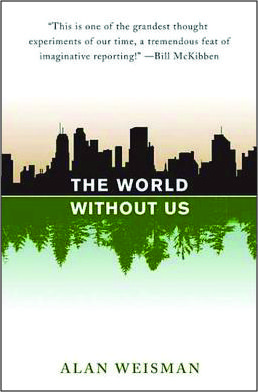
“Ever since then I’ve kept an eye out for publications about what a vanished civilization might leave behind for us to discover. In this book Weisman lays out survival times for our civilization’s stuff — plastic, houses, roads and so on. Pretty much everything but Mount Rushmore and the Chunnel will have dissolved or eroded away much sooner than a million years. Really readable if you want more details.”

<more soda>

“I also found a paper, ‘The Silurian Hypothesis,’ that took a more technical approach. Their big library research project pulled results from scores of geologic isotope analysis and fossil survey reports looking for ancient times that resemble Earth’s sudden change since the start of the Industrial Age — climate, species declines, whatever. They found about a dozen, but as they said, ‘the known unique markers might not be indicative, while the (perhaps) more expected markers are not sufficient.’ In other words, my Crazy Theory might be crazy. Or maybe not.”

~~ Rich Olcott