A No-Charge Transaction

I ain’t done yet, Sy. I got another reason for Dark Matter being made of faster‑then‑light tachyons.”

“I’m still listening, Vinnie.”

“Dark Matter gotta be electrically neutral, right, otherwise it’d do stuff with light and that doesn’t happen. I say tachyons gotta be neutral.”

“Why so?”

“Stands to reason. Suppose tachyons started off as charged particles. The electric force pushes and pulls on charges hugely stronger than gravity pulls—”

“1036 times stronger at any given distance.”

“Yeah, so right off the bat charged tachyons either pair up real quick or they fly away from the slower‑than‑light bradyon neighborhood leaving only neutral tachyons behind for us bradyon slowpokes to look at.”

“But we’ve got un‑neutral bradyon matter all around us — electrons trapped in Earth’s Van Allen Belt and Jupiter’s radiation belts, for example, and positive and negative plasma ions in the solar wind. Couldn’t your neutral tachyons get ionized?”

“Probably not much. Remember, tachyon particles whiz past each other too fast to collect into a star and do fusion stuff so there’s nobody to generate tachyonic super‑high‑energy radiation that makes tachyon ions. No ionized winds either. If a neutral tachyon collides with even a high-energy bradyon, the tachyon carries so much kinetic energy that the bradyon takes the damage rather than ionize the tachyon. Dark Matter and neutral tachyons both don’t do electromagnetic stuff so Dark Matter’s made of tachyons.”

“Ingenious, but you missed something way back in your initial assumptions.”

“Which assumption? Show me.”

“You assumed that tachyon mass works the same way that bradyon mass does. The math says it doesn’t.” <grabbing scratch paper for scribbling> “Whoa, don’t panic, just two simple equations. The first relates an object’s total energy E to its rest mass m and its momentum p and lightspeed c.”

E² = (mc²)² + (pc)²

“I recognize the mc² part, that’s from Einstein’s Equation, but what’s the second piece and why square everything again?”

“The keyword is rest mass.”

“Geez, it’s frames again?”

“Mm‑hm. The (mc²)² term is about mass‑energy strictly within the object’s own inertial frame where its momentum is zero. Einstein’s famous E=mc² covers that special case. The (pc)² term is about the object’s kinetic energy relative to some other‑frame observer with relative momentum p. When kinetic energy is comparable to rest‑mass energy you’re in relativity territory and can’t just add the two together. The sum‑of‑squares form makes the arithmetic work when two observers compare notes. Can I go on?”

“I’m still waitin’ to hear about tachyons.”

“Almost there. If we start with that equation, expand momentum as mass times velocity and re‑arrange a little, you get this formula

E = mc² / √(1 – v²/c²)

The numerator is rest‑mass energy. The v²/c² measures relative kinetic energy. The Lorentz factor down in the denominator accounts for that. See, when velocity is zero the factor is 1.0 and you’ve got Einstein’s special case.”

“Give me a minute. … Okay. But when the velocity gets up to lightspeed the E number gets weird.”

“Which is why c is the upper threshold for bradyons. As the velocity relative to an observer approaches c, the Lorentz factor approaches zero, the fraction goes to infinity and so does the object’s energy that the observer measures.”

“Okay, here’s where the tachyons come in ’cause their v is bigger than c. … Wait, now the equation’s got the square root of a negative number. You can’t do that! What does that even mean?”

“It’s legal, when you’re careful, but interpretation gets tricky. A tachyon’s Lorentz factor contains √(–1) which makes it an imaginary number. However, we know that the calculated energy has to be a real number. That can only be true if the tachyon’s mass is also an imaginary number, because i/i=1.”

“What makes imaginary energy worse than imaginary mass?”

“Because energy’s always conserved. Real energy stays that way. Imaginary mass makes no sense in Newton’s physics but in quantum theory imaginary mass is simply unstable like a pencil balanced on its point. The least little jiggle and the tachyon shatters into real particles with real kinetic energy to burn. Tachyons disintegrating may have powered the Universe’s cosmic inflation right after the Big Bang — but they’re all gone now.”

“Another lovely theory shot down.”

~ Rich Olcott

Deep Dive

“Sy, I’m trying to get my head wrapped around how the potential‑kinetic energy thing connects with your enthalpy thing.”

“Alright, Vinnie, what’s your cut so far?”

“It has to do with scale. Big things, like us and planets, we can see things moving and so we know they got kinetic energy. If they’re not moving steady in a straight line we know they’re swapping kinetic energy, give and take, with some kind of potential energy, probably gravity or electromagnetic. Gravity pulls things into a circle unless angular momentum gets in the way. How’m I doing so far?”

“I’d tweak that a little, but nothing to argue with. Keep at it.”

“Yeah, I know the moving is relative to whether we’re in the same reference frame and all that. Beside the point, gimme a break. So anyway, down to the quantum level. Here you say heat makes the molecules waggle so that’s kinetic energy. What’s potential energy like down there?”

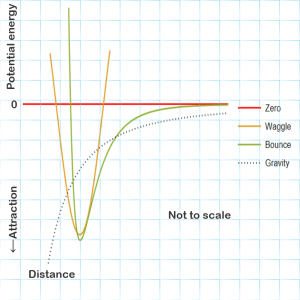
<grabs another paper napkin> “Here’s a quick sketch of the major patterns.”

“Hmm. You give up potential energy when you fall and gravity’s graph goes down from zero to more negative forever, I guess, so gravity’s always attracting.”

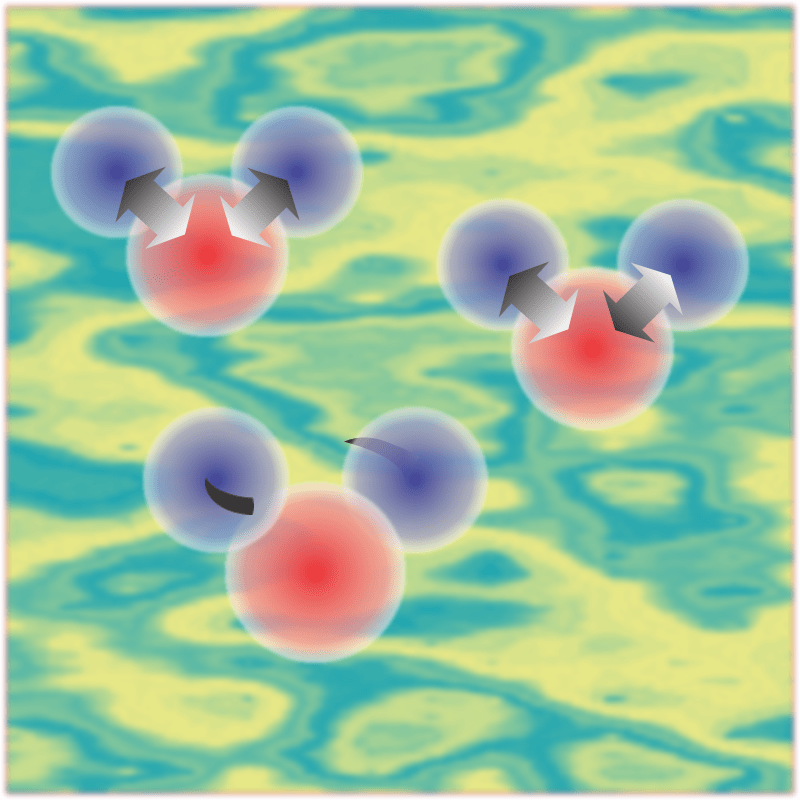
“Pretty much, but at this level we don’t have to bother with gravity at all. It’s about a factor of 1038 weaker than electric interactions. Molecular motions are dominated by electromagnetic fields. Some are from a molecule’s other internal components, some from whatever’s around that brandishes a charge. We’ve got two basic patterns. One of them, I’m labeling it ‘Waggle,’ works like a pendulum, sweeping up and down that U‑shape around some minimum position, high kinetic energy where the potential energy’s lowest and vice‑versa. You know how water’s H‑O‑H molecules have that the V‑shape?”

“Yeah, me you and Eddie talked about that once.”

“Mm‑hm. Well, the V‑shape gives that molecule three different ways to waggle. One’s like breathing, both sides out then both sides in. If the hydrogens move too far from the oxygen, that stretches their chemical bonds and increases their potential energy so they turn around and go back. If they get too close, same thing. Bond strength is about the depth of the U. The poor hydrogens just stretch in and out eternally, swinging up and down that symmetric curve.”

“Awww.”

“That’s a chemist’s picture. The physics picture is cloudier. In the quantum version, over here’s a trio of fuzzy quarks whirling around each other to make a proton. Over there’s a slightly different fuzzy trio pirouetting as a neutron. Sixteen of those roiling about make up the oxygen nucleus plus two more for the hydrogens plus all their electrons — imagine a swarm of gnats. On the average the oxygen cloud and the two hydrogen clouds configure near the minimum of that U‑shaped potential curve but there’s a lot of drifting that looks like symmetrical breathing.”

“What about the other two waggles?”

“I knew you’d ask. One’s like the two sides of a teeterboard, oscillating in and out asymmetrically. The other’s a twist, one side coming toward you and then the other side. Each waggle has its own distinct set of resistance forces that define its own version of waggle curve. Each kind interacts with different wavelengths of infrared light which is how we even know about them. Waggle’s official name is ‘harmonic oscillator.’ More complicated molecules have lots of them.”

“What’s that ‘bounce’ curve about?”

“Officially that’s a Lennard-Jones potential, the simplest version of a whole family of curves for modeling how molecules bounce off each other. Little or no interaction at large distances, serious repulson if two clouds get too close, and a little stickiness at some sweet-spot distance. If it weren’t for the stickiness, the Ideal Gas Law would work even better than it does. So has your head wrapped better?”

“Sorta. From what I’ve seen, enthalpy’s PV part doesn’t apply in quantum. The heat capacity part comes from your waggles which is kinetic energy even if it’s clouds moving. Coming the other way, quantum potential energy becomes enthalpy’s chemical part with breaking and making chemical bonds. Did I bridge the gap?”

“Mostly, if you insist on avoiding equations.”

~ Rich Olcott

Energy Is A Shape-shifter

Another dinner, another pizza at Eddie’s place. Vinnie wanders over to my table. “Hi, Sy, got a minute?”

“Not doing anything other than eating, Vinnie. What’s on your mind other than the sound of my chewing?”

“At least you keep your mouth closed. No, it’s about this energy thing you’ve gotten back into. I read that enthalpy piece and it’s bothering me.”

“In what way?”

“Well, you said that something’s enthalpy is the energy total of ‘thermal plus Pressure‑Volume plus chemical energy,’ right? I’m trying to fit that together with the potential energy and kinetic energy we talked about a while ago. It’s not working.”

“Deep question for dinner time but worth the effort. Would it help if I told you that the ‘actual versus potential’ notion goes back to Aristotle, the ‘kinetic’ idea came from Newton’s enemy Leibniz, but ‘enthalpy’ wasn’t a word until the 20th century?”

“Not a bit.”

“Didn’t think it would. Here’s another way to look at it. The thinkers prior to the mid‑1700s all looked at lumpy matter — pendulums, rolling balls on a ramp, planets, missiles — either alone or floating in space or colliding with each other. You could in principle calculate kinetic and potential energy for each lump, but that wasn’t enough when the Industrial Revolution came along.”

“What more did they want?”

“Fuel was suddenly for more than cooking and heating the house. Before then, all you needed to know was whether the log pile was stocked better than it was last year. If not, you might have a few chilly early Spring days but you could get past that. Then the Revolution came along. Miners loved Watt’s coal‑fired water‑pump except if you bought one and ran out of coal then the mine flooded. The miners learned that some kinds of coal burned hotter than others. You didn’t need as much of the good kind for a day’s pumping. The demand for a coal‑rating system got the scientists interested, but those lumps of coal weren’t falling or colliding, they just sat there with their heat locked inside. The classical energy quantities didn’t seem to apply so it was time to invent a new kind of energy.”

“That’s how Conservation of Energy works? You just spread the definition out a little?”

“That’s the current status of dark energy, for instance. We know the galaxies are moving apart against gravity so dark energy’s in there to balance the books. We have no good idea why it exists or where it comes from, but we can calculate it. ‘Internal energy’ put the Victorian‑era physicists in the same pickle — ‘atom’ and ‘molecule’ were notions from Greek and Roman times but none of the Victorians seriously believed in them. The notion of chemical bond energy didn’t crop up until the twentieth century. Lacking a good theory, all the Victorians could do was measure and tabulate heat output from different chemical reactions, the data that went into handbooks like the CRC. Naturally they had to invent thermodynamics for doing the energy accountancy.”

“But if it’s just book-balancing, how do you know the energy is real?”

“Because all the different forms of energy convert to each other. Think of a rocket going up to meet the ISS. Some of the rocket fuel’s chemical energy goes into giving the craft gravitational potential energy just getting it up there. At the same time, most of the chemical energy becomes kinetic energy as the craft reaches the 27600 km/h speed it needs to orbit at that altitude.”

<grin> “All?”

“Okay, we haven’t figured out how to harness dark energy. Yet.”

“HAW! Wait, how does enthalpy’s ‘chemical+PV+thermal’ work when the pressure’s zero, like out in space?”

“Then no work was done against an atmosphere up there to make way for the volume. Suppose you suddenly transported a jug of fuel from Earth up to just outside of the ISS. Same amount of fuel, so same amount of chemical energy, right? Same temperature so same thermal component?”

“I suppose.”

“The volume that the jug had occupied on Earth, what happened to it?”

“Suddenly closed in, probably with a little thud.”

“The thud sound’s where the Earth‑side PV energy went. It all balances out.”

~ Rich Olcott

Virial Yang And Yin

“But Mr Moire, how does the Virial Equation even work?”

“Sometimes it doesn’t, Jeremy. There’s an ‘if’ buried deep in the derivation. It only works for a system in equilibrium. Sometimes people use the equation as a test for equilibrium.”

“Sorry, what does that mean?”

“Let’s take your problem galaxy cluster as an example. Suppose the galaxies are all alone in the Universe and far apart even by astronomical standards. Gravity’s going to pull them together. Galaxy i and galaxy j are separated by distance Rij. The potential energy in that interaction is Vij = G·mi·mj / Rij. The R‘s are very large numbers in this picture so the V attractions are very small. The Virial is the average of all the V’s so our starting Virial is nearly zero.”

“Nearly but not quite zero, I get that. Wait, if the potential energy starts near zero when things are far apart, and a falling‑in object gives up potential energy, then whatever potential energy it still has must go negative.”

“It does. The total energy doesn’t change when potential energy converts to kinetic energy so yes, we say potential energy decreases even though the negative number’s magnitude gets larger. It’d be less confusing if we measured potential energy going positive from an everything-all-together situation. However, it makes other things in Physics much simpler if we simply write (change in potential energy)+(change in kinetic energy)=0 so that’s the convention.”

“The distances do eventually get smaller, though.”

“Sure, and as the objects move closer they gain momentum and kinetic energy. Gaining momentum is gaining kinetic energy. You’re used to writing kinetic energy as T=m·v²/2, but momentum is p=m·v so it’s just as correct to write T=p²/2m. The two are different ways of expressing the same quantity. When a system is in equilibrium, individual objects may be gaining or losing potential energy, but the total potential energy across the system has reached its minimum. For a system held together by gravity or electrostatic forces, that’s when the Virial is twice the average kinetic energy. As an equation, V+2T=0.”

“So what you’re saying is, one galaxy might fall so far into the gravity well that its potential energy goes more negative than –2T. But if the cluster’s in equilibrium, galaxy‑galaxy interactions during the fall‑in process speed up other galaxies just enough to make up the difference. On the flip side, if a galaxy’s already in deep, other galaxies will give up a little T to pull it outward to a less negative V.”

“Well stated.”

“But why 2? Why not or some other number?”

“The 2 comes from the kinetic energy expression’s ½. The multiplier could change depending on how the potential energy varies with distance. For both gravity and electrostatic interactions the potential energy varies the same way and 2 is fine the way it is. In a system with a different rule, say Hooke’s Law for springs and rubber bands, the 2 gets multiplied by something other than unity.”

“All that’s nice and I see how the Virial Equation lets astronomers calculate cluster‑average masses or distances from velocity measurements. I suppose if you also have the masses and distances you can test whether or not a collection of galaxies is in equilibrium. What else can we do with it?”

“People analyze collections of stars the same way, but Professor Hanneken’s a physicist, not an astronomer. He wouldn’t have used class time on the Virial if it weren’t good for a broad list of phenomena in and outside of astronomy. Quantum mechanics, for instance. I’ll give you an important example — the Sun.”

“One star, all by itself? Pretty trivial to take its average.”

“Not averaging the Sun as an object, averaging its plasma contents — hydrogen nuclei and their electrons, buffeted by intense heat all the way down to the nuclear reactions that run near the Sun’s core. It’s gravitational potential energy versus kinetic energy all over again, but at the atomic level this time. The Virial Theorem still holds, even though turbulence and electromagnetic effects generate a complicated situation.”

“I’m glad he didn’t assign that as a homework problem.”

“The semester’s not over yet.”

~~ Rich Olcott

Viral, Virial, What’s The Difference?

A young man’s knock at my office door, eager yet a bit hesitant. “C’mon in, Jeremy, the door’s open.”

“Hi, Mr Moire. Got a minute?”

“It’s slow season, Jeremy. What can I do for you?”

“It’s my physics homework, sir. Professor Hanneken asked a question that I don’t understand.”

“John’s a bit of a joker but asking unsolvable questions isn’t usually one of his things. Well, except for that one about how long it would take to play Mahler’s Piano Quartet if you had only two musicians because of budget restrictions. What’s the question?”

“He wants us to use something called ‘the viral theorem‘ to deduce things about a certain galaxy cluster. I know what viral memes are but I don’t think I’ve ever heard of a theorem that spreads like a virus. I’ve done searches on my class notes and online textbook — nothing. So what is it and how am I supposed to use it?”

“Do you have the question with you?”

“Yessir, it’s #4 on this sheet.”

“Ah, just as I thought. Read it again. The word is ‘virial,’ not ‘viral.’ Big difference.”

“I suppose, but what’s a virial then?”

“We need some context. Imagine a cluster of free‑floating objects bound together by mutual forces of attraction. No central attractor, just lots of pairwise pulling, okay?”

“What kind of forces?”

“That’s the thing, it doesn’t matter. Gravitational, electrostatic, rubber bands even. The only restriction is that the force between each pair of objects follows the same force‑distance rule. For rubber bands it’s mostly just 1/distance until you get near the elastic limit. For gravity and electrostatics the rule is that force runs as 1/distance2. Got that picture?”

<grin> “It’d be tricky rigging up those rubber bands to not get tangled. Anyhow, instead of planets around the Sun you want me to think of stars held in a cluster by each other’s gravity. Do they all have to be the same size or the same distance apart?”

“No, because of what happens next. You’re thinking right — a heavier star pulls harder than a lighter one, and two stars close together feel more mutual force than stars far apart. We account for that variation by taking an average. Multiply force times distance for every possible pairing, then divide the total by the number of objects. The averaged number is the Virial, symbol V.”

“Wait, force times distance. That’s the Physics definition of work, like pulling something up against gravity.”

“Exactly. Work is directed energy. What we’re talking about here is the amount of energy required to pull all those objects away from the center of mass or charge or whatever, out to their current positions. The Virial is the average energy per object. It’s average potential energy because it depends on position, not motion.”

“They’d release all that energy if they just fell together so why don’t … wait, they’re going all different directions so momentum won’t let them, right?”

“You’re on your way. Motion’s involved.”

“Umm … Kepler’s Law — the closer any two of them get, the faster they orbit each other … OH! Kinetic energy! When things fall, potential energy’s converted to kinetic energy. Is there an average kinetic energy that goes up to compensate for the Virial getting smaller?”

“Bingo. When you say ‘average kinetic energy‘ what quantity springs to mind?”

“Temperature. But that’s only for molecules.”

“No reason we can’t define a galactic analog. In fact, Eddington did that back in 1916 when he brought the notion from gas theory over to astrophysics. He even used ‘T‘ for the kinetic average, but remember, this T refers to kinetic energy of stars moving relative to each other, not the temperatures of the stars themselves. Anyhow, the Virial Theorem says that a system of objects is in gravitational or electrostatic equilibrium when the Virial is T/2. Clausius’ ground‑breaking 1870 proof for gases was so general that the theorem’s been used to study everything from sub‑atomic particles to galaxies and dark matter.”

<bigger grin> “With coverage like that, the Virial’s viral after all. Thanks, Mr Moire.”

~~ Rich Olcott

  • Thanks to Dr KaChun Yu for helpful pointers to the literature. Naturally, any errors in this post are my own.

Climbing Out Of A Well

Al can’t contain himself. “Wait, it’s gravity!”

Vinnie and I are puzzled. “Come again?”

“Sy, you were going on about how much speed a rocket has to shed on the way to some special orbit around Mars, like that’s a big challenge. But it’s not. The rocket’s fighting the Sun’s gravity all the way. That’s where the speed goes. The Earth’s gravity, too, a little bit early on, but mostly the Sun’s, right?”

“Good point, Al. Sun gravity’s what bends the rocket onto a curve instead of a straight line. Okay, Sy, you got a magic equation that accounts for the shed speed? Something’s gotta, ’cause we got satellites going around Mars.”

“Good point, Vinnie, and you’re right, there is an equation. It’s not magic, you’ve already seen it and it ties kinetic energy to gravitational potential energy.”

“Wait, if I remember right, kinetic energy goes like mass times velocity squared. How can you calculate that without knowing how big the rocket is?”

“Good question. We get around that by thinking things through for a unit mass, one kilogram in SI units. We can multiply by the rocket’s mass when we’re done, if we need to. The kinetic energy per unit mass, we call that specific kinetic energy, is just ½v². Look familiar?”

“That’s one side of your v²=2GM/R equation except you’ve got the 2 on the other side.”

“Good eye, Al. The right-hand side, except for the 2, is specific gravitational potential energy, again for unit mass. But we can’t use the equation unless we know the kinetic energy and gravitational potential are indeed equal. That’s true if you’re in orbit but we’re talking about traveling between orbits where you’re trading kinetic for potential or vice versa. One gains what the other loses so Al’s right on the money. Traveling out of a gravity well is all about losing speed.”

Al’s catching up. “So how fast you’re going determines how high you are, and how high you are says how fast you have to be going.”

Vinnie frowns a little. “I’m thinking back to in‑flight refueling ops where I’m coming up to the tanker from below and behind while the boom operator directs me in. That doesn’t sound like it’d work for joining up to a satellite.”

“Absolutely. If you’re above and behind you could speed up to meet the beast falling, or from below and ahead you could slow down to rise. Away from that diagonal you’d be out of luck. Weird, huh?”

“Yeah. Which reminds me, now we’re talking about this ‘deeper means faster‘ stuff. How does the deep‑dive maneuver work? You know, where they dive a spacecraft close to a planet or something and it shoots off with more speed than it started with. Seems to me whatever speed it gains it oughta give up on the way out of the well.”

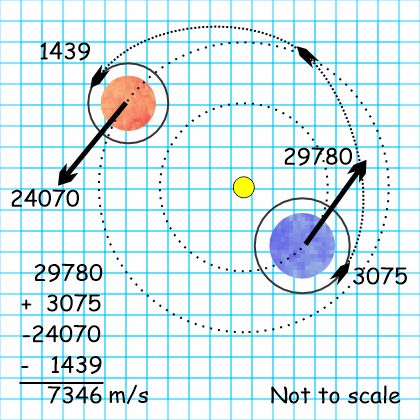
“It’s a surprise play, alright, but it’s actually two different tricks. The slingshot trick is to dive close enough to capture a bit of the planet’s orbital momentum before you fly back out of the well. If you’re going in the planet’s direction you come out going faster than you went in.”

“Or you could dive in the other direction to slow yourself down, right?”

“Of course, Al. NASA used both options for the Voyager and Messenger missions. Vinnie, I know what you’re thinking and yes, theoretically stealing a planet’s orbital momentum could affect its motion but really, planets are huge and spacecraft are teeny. DART hit the Dimorphos moonlet head-on and slowed it down by 5%, but you’d need 66 trillion copies of Dimorphos to equal the mass of dinky little Mercury.”

“What’s the other trick?”

“Dive in like with the slingshot, but fire your rocket engine when you’re going fastest, just as the craft approaches its closest point to the planet. Another German rocketeer, Hermann Oberth, was the first to apply serious math to space navigation. This trick’s sometimes called the Oberth effect, though he didn’t call it that. He showed that rocket exhaust gets more effective the faster you’re going. The planet’s gravity helps you along on that, for free.”

“Free help is good.”

~~ Rich Olcott

Maybe It’s Just A Coincidence

Raucous laughter from the back room at Al’s coffee shop, which, remember, is situated on campus between the Physics and Astronomy buildings. It’s Open Mic night and the usual crowd is there. I take a vacant chair which just happens to be next to the one Susan Kim is in. “Oh, hi, Sy. You just missed a good pitch. Amanda told a long, hilarious story about— Oh, here comes Cap’n Mike.”

Mike’s always good for an offbeat theory. “Hey, folks, I got a zinger for you. It’s the weirdest coincidence in Physics. Are you ready?” <cheers from the physicists in the crowd> “Suppose all alone in the Universe there’s a rock and a planet and the rock is falling straight in towards the planet.” <turns to Al’s conveniently‑placed whiteboard> “We got two kinds of energy, right?”

Potential Energy    Kinetic Energy

Nods across the room except for Maybe-an-Art-major and a couple of Jeremy’s groupies. “Right. Potential energy is what you get from just being where you are with things pulling on you like the planet’s gravity pulls on the rock. Kinetic energy is what potential turns into when the pulls start you moving. For you Physics smarties, I’m gonna ignore temperature and magnetism and maybe the rock’s radioactive and like that, awright? So anyway, we know how to calculate each one of these here.”

PE = GMm/R    KE = ½mv²

“Big‑G is Newton’s gravitational constant, big‑M is the planet’s mass, little‑m is the rock’s mass, big‑R is how far apart the things are, and little‑v is how fast the rock’s going. They’re all just numbers and we’re not doing any complicated calculus or relativity stuff, OK? OK, to start with the rock is way far away so big‑R is huge. Big number on the bottom makes PE’s fraction tiny and we can call it zero. At the same time, the rock’s barely moving so little‑v and KE are both zero, close enough. Everybody with me?”

More nods, though a few of the physics students are looking impatient.

“Right, so time passes and the rock dives faster toward the planet Little‑v and kinetic energy get bigger. Where’s the energy coming from? Gotta be potential energy. But big‑R on the bottom gets smaller so the potential energy number gets, wait, bigger. That’s OK because that’s how much potential energy has been converted. What I’m gonna do is write the conversion as an equation.

GMm/R=½mv²

“So if I tell you how far the rock is from the planet, you can work the equation to tell me how fast it’s going and vice-versa. Lemme show those straight out…”

v=(2GM/R)    R=2GM/v²

Some physicist hollers out. “The first one’s escape velocity.”

“Good eye. The energetics are the same going up or coming down, just in the opposite direction. One thing, there’s no little‑m in there, right? The rock could be Jupiter or a photon, same equations apply. Suppose you’re standing on the planet and fire the rock upward. If you give it enough little‑v speed energy to get past potential energy equals zero, then the rock escapes the planet and big‑R can be whatever it feels like. Big‑R and little‑v trade off. Is there a limit?”

A couple of physicists and an astronomy student see where this is going and start to grin.

“Newton physics doesn’t have a speed limit, right? They knew about the speed of light back then but it was just a number, you could go as fast as you wanted to. How about we ask how far the rock is from the planet when it’s going at the speed of light?”

R=2GM/

Suddenly Jeremy pipes up. “Hey that’s the Event Horizon radius. I had that in my black hole term paper.” His groupies go “Oooo.”

“There you go, Jeremy. The same equation for two different objects, from two different theories of gravity, by two different derivations.”

“But it’s not valid for lightspeed.”

“How so?”

“You divided both sides of your conversion equation by little‑m. Photons have zero mass. You can’t divide by zero.”

Everyone in the room goes “Oooo.”

~~ Rich Olcott

Chutes And Landers

From: Robin Feder <rjfeder@fortleenj.com>
To: Sy Moire <sy@moirestudies.com>
Subj: Questions

Hello again, Mr Moire. Kalif and I have a question. We were talking about falling out of stuff and we wondered how high you have to fall out of to break every bone in your body. We asked our science teacher Mr Higgs and he said it was something that you or Randall Munroe could answer and besides he (Mr Higgs) had to get ready for his next online. Can you tell us? Sincerely, Robin Feder


From: Sy Moire <sy@moirestudies.com>
To: Robin Feder <rjfeder@fortleenj.com>
Subj: Re: Questions

Hello again, Robin. You do take after your Dad, don’t you? Please give my best to him and to Mr Higgs, who has a massive job. Mr Munroe may already have answered your question somewhere, but I’ll give it a shot.

You’ve assumed that the higher the fall, the harder the hit and the more bones broken. It’s not that simple. Suppose, for instance, that your fall is onto the Moon, whose gravity is 1/6 that of Earth. For any amount of impact, however high the fall would have been on Earth, it’d be six times higher on the Moon. So the answer depends where you’re falling.

But the Moon doesn’t have an atmosphere worth paying attention to. That’s important because atmospheres impose a speed limit, technically known as terminal velocity, that depends on a whole collection of things

  • the Mass of the falling object
  • the local strength of Gravity
  • the Density of the atmosphere
  • the object’s cross‑sectional Area in the direction of fall

The first two produce the downward pull of gravity, the others produce the upward push of air resistance. Fun fact — in Galileo’s “All things fall alike” experiments, he always used spheres in order to cancel the effects of air resistance in his comparisons.

Let’s put some numbers to it. Suppose someone’s at Earth’s “edge of space” 100 kilometers up. From the PE=m·g·h formula for gravitational potential energy and dividing out their mass which I don’t know, they have 9.8×10⁵ joules/kilogram of potential energy relative to Earth’s surface. Now suppose they convert that potential to kinetic energy by falling to the surface with no air resistance. Using KE=m·v² I calculate they’d hit at about 1000 meters/second. But in real life, the terminal velocity of a falling human body is about 55 meters/second.

That Area item is why parachutes work. Make a falling object’s area larger and it’ll have to push aside more air molecules on its way down. Anyone wanting to survive a fall wants as much area as they can get. A parachute’s fabric canopy gives them a huge area and a big help. Parachute drops normally hit at about 5 meters/second. Trained people walk away from that all the time. Mostly.

Which gets to the matter of how you land. Parachute training schools and martial arts dojos give you the same advice — don’t try to stop your fall, just tuck in your chin and twist to convert vertical kinetic energy to rolling motion. Rigid limbs lead to bones breaking, ligaments tearing and joints going out of joint.

So let’s talk bones. Adults have about 210 of them, about 90 fewer than when they were a kid. Bones start out as separate bony patches embedded in cartilage. The patches eventually join together as boney tissue and the cartilage proportion decreases with age. Bottom line — kid bones are bendy, old bones snap more easily. For your question, breaking “every bone in your body” is a bigger challenge if you’re young.

But all bones aren’t equal — some are more vulnerable than others. Sesamoid bones, like the ones at the base of your thumb, are millimeter‑sized and embedded in soft tissue that protects them. The tiny “hammer, anvil and stirrup” ear bones are buried deep in hard bony tissue that protects them, too. Thanks to bones and soft tissues that would absorb nearly all the energy of impact, these small bones are almost invulnerable.

To summarize, no matter how high up from Earth you fall from, you can’t fall fast enough to hit hard enough to break every bone in your body. Be careful anyhow.

Regards,
Sy Moire.

~~ Rich Olcott

  • Thanks to Xander and Lucas for their input.

The Big Chill

Jeremy gets as far as my office door, then turns back. “Wait, Mr Moire, that was only half my question. OK, I get that when you squeeze on a gas, the outermost molecules pick up kinetic energy from the wall moving in and that heats up the gas because temperature measures average kinetic energy. But what about expansion cooling? Those mist sprayers they set up at the park, they don’t have a moving outer wall but the air around them sure is nice and cool on a hot day.”

“Another classic Jeremy question, so many things packed together — Gas Law, molecular energetics, phase change. One at a time. Gas Law’s not much help, is it?”

“Mmm, guess not. Temperature measures average kinetic energy and the Gas Law equation P·V = n·R·T gives the total kinetic energy for the n amount of gas. Cooling the gas decreases T which should reduce P·V. You can lower the pressure but if the volume expands to compensate you don’t get anywhere. You’ve got to suck energy out of there somehow.”

Illustrations adapted from drawings by Trianna

“The Laws of Thermodynamics say you can’t ‘suck’ heat energy out of anything unless you’ve got a good place to put the heat. The rule is, heat energy travels voluntarily only from warm to cold.”

“But, but, refrigerators and air conditioners do their job! Are they cheating?”

“No, they’re the products of phase change and ingenuity. We need to get down to the molecular level for that. Think back to our helium-filled Mylar balloon, but this time we lower the outside pressure and the plastic moves outward at speed w. Helium atoms hit the membrane at speed v but they’re traveling at only (v-w) when they bounce back into the bulk gas. Each collision reduces the atom’s kinetic energy from ½m·v² down to ½m·(v-w)². Temperature goes down, right?”

“That’s just the backwards of compression heating. The compression energy came from outside, so I suppose the expansion energy goes to the outside?”

“Well done. So there has to be something outside that can accept that heat energy. By the rules of Thermodynamics, that something has to be colder than the balloon.”

“Seriously? Then how do they get those microdegree above absolute zero temperatures in the labs? Do they already have an absolute-zero thingy they can dump the heat to?”

“Nope, they get tricky. Suppose a gas in a researcher’s container has a certain temperature. You can work that back to average molecular speed. Would you expect all the molecules to travel at exactly that speed?”

“No, some of them will go faster and some will go slower.”

“Sure. Now suppose the researcher uses laser technology to remove all the fast-moving molecules but leave the slower ones behind. What happens to the average?”

“Goes down, of course. Oh, I see what they did there. Instead of the membrane transmitting the heat away, ejected molecules carry it away.”

“Yup, and that’s the key to many cooling techniques. Those cooling sprays, for instance, but a question first — which has more kinetic energy, a water droplet or the droplet’s molecules when they’re floating around separately as water vapor?”

“Lessee… the droplet has more mass, wait, the molecules total up to the same mass so that’s not the difference, so it’s droplet velocity squared versus lots of little velocity-squareds … I’ll bet on the droplet.”

“Sorry, trick question. I left out something important — the heat of vaporization. Water molecules hold pretty tight to each other, more tightly in fact than most other molecular substances. You have to give each molecule a kick to get it away from its buddies. That kick comes from other molecules’ kinetic energy, right? Oh, and one more thing — the smaller the droplet, the easier for a molecule to escape.”

“Ah, I see where this is going. The mist sprayer’s teeny droplets evaporate easy. The droplets are at air temperature, so when a molecule breaks free some neighbor’s kinetic energy becomes what you’d expect from air temperature, minus break-free energy. That lowers the average for the nearby air molecules. They slow their neighbors. Everything cools down. So that’s how sprays and refrigerators and such work?”

“That’s the basic principle.”

“Cool.”

~ Rich Olcott

Thanks to Mitch Slevc for the question that led to this post.

The Hot Squeeze

A young man’s knock, eager yet a bit hesitant.

“C’mon in, Jeremy, the door’s open.”

“Hi, Mr Moire. How’s your Summer so far? I got an ‘A’ on that black hole paper, thanks to your help. Do you have time to answer a question now that Spring term’s over?”

“Hi, Jeremy. Pretty good, congratulations, and a little. What’s your question?”

“I don’t understand about the gas laws. You squeeze a gas, you raise its temperature, but temperature’s the average kinetic energy of the molecules which is mass times velocity squared but mass doesn’t change so how does the velocity know how big the volume is? And if you let a gas expand it cools and how does that happen?”

“A classic Jeremy question. Let’s take it a step at a time, big-picture view first. The Gas Law says pressure times volume is proportional to the amount of gas times the temperature, or P·V = n·R·T where n measures the amount of gas and R takes care of proportionality and unit conversions. Suppose a kid gets on an airplane with a balloon. The plane starts at sea level pressure but at cruising altitude they maintain cabins at 3/4 of that. Everything stays at room temperature, so the balloon expands by a third –“

Kid drawing of an airplane with a red balloon
Adapted from a drawing by Xander

“Wait … oh, pressure down by 3/4, volume up by 4/3 because temperature and n and R don’t change. OK, I’m with you. Now what?”

“Now the plane lands at some warm beach resort. We’re back at sea level but the temp has gone from 68°F back home to a basky 95°F. How big is the balloon? I’ll make it easy for you — 68°F is 20°C is 293K and 95°F is 35°C is 308K.”

“Volume goes up by 308/293. That’s a change of 15 in about 300, 5% bigger than back home.”

“Nice estimating. One more stop on the way to the molecular level. Were you in the crowd at Change-me Charlie’s dark matter debate?”

“Yeah, but I didn’t get close to the table.”

“Always a good tactic. So you heard the part about pressure being a measure of energy per unit of enclosed volume. What does that make each side of the Gas Law equation?”

“Umm, P·V is energy per volume, times volume, so it’s the energy inside the balloon. Oh! That’s equal to n·R·T but R‘s a constant and n measures the number of molecules so T = P·V/n·R makes T proportional to average kinetic energy. But I still don’t see why the molecules speed up when you squeeze on them. That just packs the same molecules into a smaller volume.”

“You’re muddling cause and effect. Let’s try to tease them apart. What forces determine the size of the balloon?”

“I guess the balance between the outside pressure pushing in, versus the inside molecules pushing out by banging against the skin. Increasing their temperature means they have more energy so they must bang harder.”

“And that increases the outward pressure and the balloon expands until things get back into balance. Fine, but think about individual molecules, and let’s pretend that we’ve got a perfect gas and a perfect balloon membrane — no leaks and no sticky collisions. A helium-filled Mylar balloon is pretty close to that. When things are in balance, molecules headed outward approach the membrane with some velocity v and bounce back inward with the same velocity v though in a different direction. Their kinetic energy before hitting the membrane is ½m·v²; after the collision the energy’s also ½m·v² so the temperature is stable.”

“But that’s at equilibrium.”

“Right, so let’s increase the outside pressure to squeeze the balloon. The membrane closes in at some speed w. Out-bound molecules approach the membrane with velocity v just as before but the membrane’s speed boosts the bounce. The ‘before’ kinetic energy is still ½m·v² but the ‘after’ value is bigger: ½m·(v+w)². The total and average kinetic energy go up with each collision. The temperature boost comes from the energy we put into the squeezing.”

“So the heating actually happens out at the edges.”

“Yup, the molecules in the middle don’t know about it until hotter molecules collide with them.”

“The last to learn, eh?.”

“Always the case.”

~~ Rich Olcott

Thanks to Mitch Slevc for the question that led to this post.